

Emotion regulation in patients with somatic symptom and related disorders: A systematic review
Open accessThe DOI matches its Crossref record; 158 of the 160 references it cites were found in a registry or an index, and 2 are not checked yet.
Abstract
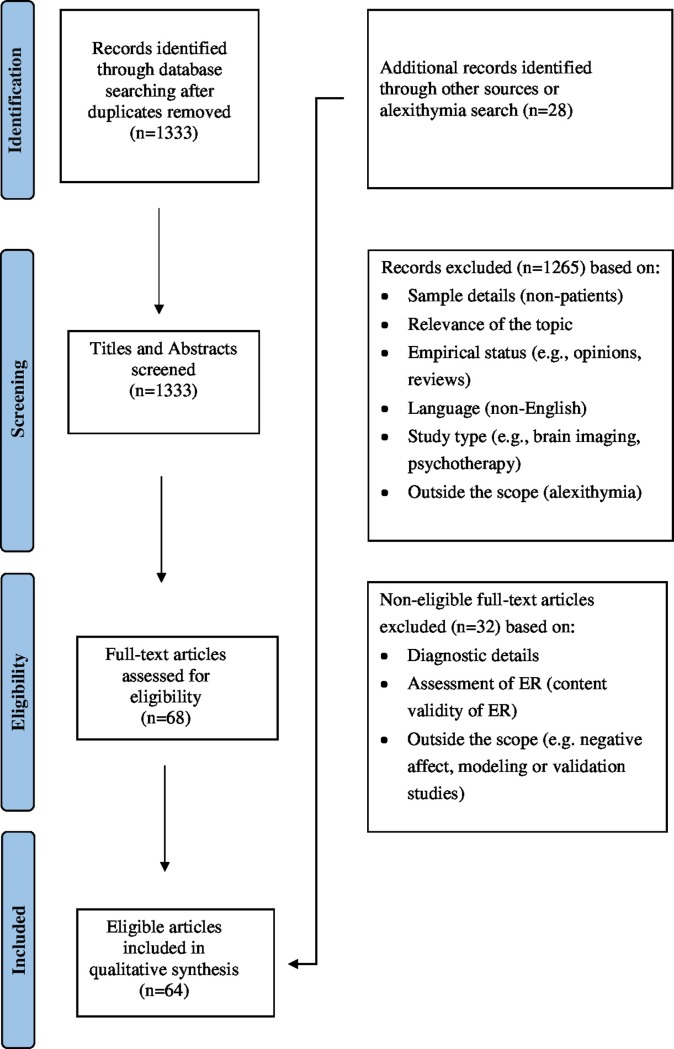
BACKGROUND: Somatic symptoms and related disorders (SSD) are prevalent phenomena in the health-care system. Disturbances in emotion regulation (ER) are commonly observed in patients suffering from SSD. OBJECTIVES: This review aimed to examine ER processes that characterize SSD by a systematic analysis of the available empirical studies. DATA SOURCES: PsycINFO and PubMed databases for the articles published between January 1985 and June 2018. SEARCH TERMS: "emotion/al regulation" or "affect regulation" and various forms of SSD. STUDY ELIGIBILITY CRITERIA: Empirical studies that a) assigned adolescent or adult patients suffering from SSD based on a clinical diagnosis, and b) examined the relationship between ER and SSD, were included. STUDY SYNTHESIS METHODS: A tabular summary of the articles was generated according to study characteristics, study quality, variables, and findings. The findings were organized based on ER variables used in the articles and diagnoses of SSD, which were then re-organized under the main constituents of ER (attention, body, and knowledge). RESULTS: The findings of the 64 articles largely supported the association between SSD and disturbances in ER, which are usually shared by different diagnoses of SSD. The results indicate that patients show a reduced engagement with cognitive content of emotions. On the other hand, bodily constituents of ER seem to depict an over-reactive pattern. Similarly, the patients tend to encounter difficulties in flexibly disengaging their (spontaneous) attention from emotional material. LIMITATIONS: There is a scarcity of longitudinal designs, randomized controlled trials, experiments, and diary studies suited to investigate the short- and long-term causal relationship between ER and SSD. Symptoms of SSD and measures to assess emotion regulation are heterogeneous. CONCLUSIONS AND IMPLICATIONS: Assessment of ER processes is potentially useful to understand SSD and for treatment planning. Furthermore, a concurrent investigation of the dynamic interaction of the ER modalities promises insights for better understanding of the role of ER in development, course, and maintenance of SSD.
Overview
The claims and statistics of this paper haven’t been checked yet.
Free: it reads the open-access text and checks the first 5 claims that cite a source we can check. Create a free account to check every claim.
Integrity signals
Registry
Cites
Statistics
Figures
Verification
Claims the paper makes
The claims and statistics of this paper haven’t been checked yet.
Free: it reads the open-access text and checks the first 5 claims that cite a source we can check. Create a free account to check every claim.
Claims other papers make about this one
Each is checked against this paper’s own text: does it say what the citing paper says it does?
The source backs part of the claim, not all of it — or backs it for a different population, condition or comparison.
In the citing paper
“However, a concurrent somatoform disorder is accompanied by more severely altered body and brain structures related to increased hypervigilance and catastrophizing (62, 63).”
From The integration of yoga breathing techniques in cognitive behavioral therapy for post-traumatic stress disorder: A pragmatic randomized controlled trial (2023) · cites this paper as [63]
Experimental — accuracy not yet measuredThe source backs part of the claim, not all of it — or backs it for a different population, condition or comparison.
In the citing paper
“This increase in emotion regulation is crucial in patients with somatic complaints as a lack of emotional awareness and an overuse of maladaptive emotion regulation strategies are considered basic psychological liabilities of Somatic Symptom Disorder (Waller and Scheidt, 2004; Garnefski et al., 2017; Okur Güney et al., 2019).”
From Does the practice of mindfulness reduce somatic symptoms and COVID-19-related anxiety? A community-based survey (2022) · cites this paper as Okur Güney et al., 2019
Experimental — accuracy not yet measured
Self-check
Percentages, sums and reported differences re-computed from the paper’s own numbers.
The self-check needs the paper’s full text.
Citations
Cites
Diagnostic and Statistical Manual of Mental Disorders
Williams, J. B. W., & First, M. (2013) · Encyclopedia of Social Work · doi:10.1093/acrefore/9780199975839.013.104 · Cited by 109,519
Statistical Power Analysis for the Behavioral Sciences
Muller, K. (1989) · Technometrics · doi:10.1080/00401706.1989.10488618 · Cited by 99,167
Preferred Reporting Items for Systematic Reviews and Meta-Analyses: the PRISMA statement
Moher, D., Liberati, A., Tetzlaff, J., Altman, D. G., & for the PRISMA Group (2009) · BMJ · doi:10.1136/bmj.b2535 · Cited by 83,823
Statistical power analysis for the behavioral sciences
(1990) · Computers, Environment and Urban Systems · doi:10.1016/0198-9715(90)90050-4 · Cited by 65,269
Preferred Reporting Items for Systematic Reviews and Meta-Analyses: The PRISMA Statement
Moher, D., Liberati, A., Tetzlaff, J., Altman, D. G., & The PRISMA Group (2009) · PLoS Medicine · doi:10.1371/journal.pmed.1000097 · Cited by 64,042
Preferred reporting items for systematic reviews and meta-analyses: the PRISMA Statement.
(2009) · PubMed Central · Cited by 44,859
Wang, G., Ma, R., Qiao, G., Wada, K., Aizawa, Y., & Satoh, T. (2015) · Integrative Medicine International · doi:10.1159/000368408 · Cited by 18,657
The emerging field of emotion regulation: an integrative review
Gross, J. J. (1998) · Review of General Psychology · doi:10.1037/1089-2680.2.3.271 · Cited by 9,916
Gratz, K. L., & Roemer, L. (2004) · Journal of Psychopathology and Behavioral Assessment · doi:10.1023/b:joba.0000007455.08539.94 · Cited by 8,942
Diagnostic and Statistical Manual of Mental Disorders
Siegel, L. J., & Fletcher‐Janzem, E. (2008) · Encyclopedia of Special Education · doi:10.1002/9780470373699.speced0655 · Cited by 8,477
Research works printed but not linked: 3
- Witthöft M, Loch N, Jasper F. Somatoforme beschwerden und stile der emotionsregulation. = Somatoform symptoms and strategies of emotion regulation. Verhaltenstherapie & Verhaltensmedizin. 2013; 34: 444– 464.
- Henningsen Peter. Somatic Symptom Disorder and Illness Anxiety Disorder. The American Psychiatric Association Publishing (2019). pp. 305– 321.
- Freud S. Repression In Strachy J. (Ed. & Trans.), The standard edition of the complete works of Sigmund Freud (Vol. 14, pp. 143_160). London: Hogarth Press (Originally published 1915).; 1961.
Cited by
Items 101–130 of 130
Etemadi, S., Poursharifi, H., Tajeri, B., Kalantari, M., & Somar, N. H. (2020) · Journal of Research in Behavioural Sciences · doi:10.52547/rbs.18.1.11
Risk of Somatic Symptom Disorder in Social Media Users Exposed to Information COVID-19
Anindya, I., & Tomhinsa, A. R. (2021) · Jurnal Ilmiah Ilmu Keperawatan Indonesia · doi:10.33221/jiiki.v11i02.1215
Somatoforme Störungen, somatische Belastungsstörungen, chronische Schmerzsyndrome
Martin, A., & Henningsen, P. (2021) · Elsevier eBooks · doi:10.1016/b978-3-437-22601-4.00014-0
The Process Behind the Origin of Symptoms That are Medically Unexplained
Gupta, S., & Sathish, S. (2022) · Indian Journal of Health Studies · doi:10.56490/ijhs.2022.4104
PENGARUH REGULASI EMOSI TERHADAP KECENDERUNGAN GANGGUAN SIMTOM SOMATIS PADA MAHASISWA TINGKAT AKHIR
Tajuddin, I., Jannah, M., & Grestin Sandy, R. (2023) · Media Keperawatan Politeknik Kesehatan Makassar · doi:10.32382/jmk.v14i1.3371 · Cited by 1
Gohari, M. E., Seirafi, M., Vaezi, A. A., Ranjbaripoor, T., & Mashayekh, M. (2022) · Alborz University Medical Journal · doi:10.61186/aums.12.1.49
Irani, Z., Khakpour, R., & Behboodi, M. (2023) · Qur̓ān/pizhūhī-i khāvar/shināsān · doi:10.61186/iau.33.4.393 · Cited by 1
Karabey, T. (2024) · Turkiye Klinikleri Journal of Nursing Sciences · doi:10.5336/nurses.2023-98884
Vesterling, C., Goagoses, N., & von Düring, U. (2024) · Kindheit und Entwicklung · doi:10.1026/0942-5403/a000436 · Cited by 2
Mohammadabad, S. H., Afshinpour, S., Zahedian, S., & Rezaei, H. (2024) · Armaghane Danesh · doi:10.61186/armaghanj.29.1.94 · Cited by 1
Somatization disorders in incarcerated populations
Vajawat, B., Venkataramu, N. V., Varshney, P., & Math, S. B. (2025) · Oxford University Press eBooks · doi:10.1093/med/9780192858290.003.0009 · Cited by 1
(2025) · Elsevier eBooks · doi:10.1016/b978-3-437-21835-4.00116-5
Emotionen und ihre Bedeutung für psychische Erkrankung und Psychotherapie
Benecke, C. (2025) · Elsevier eBooks · doi:10.1016/b978-3-437-21835-4.00011-1
Using photovoice to facilitate the report of emotions in an interview setting: An experimental study
Studer, S., Kleinstäuber, M., & Weise, C. (2025) · PLoS ONE · doi:10.1371/journal.pone.0322055 · Cited by 2
“Especially in disorders where access to emotions is more difficult (e.g., in somatoform disorders [58]), PV could serve as a bridge to communicate the inner experience more easily.”
Interpersonal Emotion Regulation within the Context of Transdiagnostic Model
Muslu, Ö. N. (2025) · Psikiyatride Guncel Yaklasimlar - Current Approaches in Psychiatry · doi:10.18863/pgy.1542165 · Cited by 1
Typische Probleme in der Behandlung und Empfehlungen zum Umgang
Janus-Göhringer, R., & Lehnen, N. (2025) · Psychotherapie: Praxis · doi:10.1007/978-3-662-70336-6_5
Prototypischer therapeutischer Prozess
Janus-Göhringer, R., & Lehnen, N. (2025) · Psychotherapie: Praxis · doi:10.1007/978-3-662-70336-6_4
Fine, K. S., O’Shea, A. W., Gupta, S., George, R. E., & Afifi, A. M. (2025) · Plastic & Reconstructive Surgery · doi:10.1097/prs.0000000000012527
Okati, N., Rangamiztoosi, L., Gholipour, M., & Zarani, F. (2025) · PLOS mental health. · doi:10.1371/journal.pmen.0000434 · Cited by 1
Aghili, M., & Nia, M. S. (2025) · The Neuroscience Journal of Shefaye Khatam · doi:10.61882/shefa.13.4.50 · Cited by 2
The Impact of Alexithymia on Emotional Self‐Efficacy Among High School Students in Konya Province
Yazar, M., & Bayır, B. (2025) · Journal of Child and Adolescent Psychiatric Nursing · doi:10.1111/jcap.70042
Myles, A. B., Jones, M. P., Beath, A., Loxton, D. J., & Ejova, A. (2025) · Psychology and Health · doi:10.1080/08870446.2025.2590067
Abrar, K., Goldstein, B. M., Frank, J. B., & Zakzanis, K. K. (2025) · Archives of Clinical Neuropsychology · doi:10.1093/arclin/acaf108
“We hypothesize that individuals with somatic symptom and related disorders will report greater emotional and somatic symptoms, given the disorder’s emphasis on worry about illness and associated distress (American Psychiatric Association, 2022; Okur Güney et al., 2019). c.”
Schmitz, M., Back, S. N., Seitz, K. I., Harbrecht, N. K., Streckert, L., Schulz, A., Herpertz, S. C., & Bertsch, K. (2024) · Figshare · doi:10.6084/m9.figshare.26568196
Health Anxiety in Somatic Symptom Disorder: The Impact of Emotion Regulation Deficits
Gitzen, H., & Martin, A. (2026) · Cognitive Therapy and Research · doi:10.1007/s10608-026-10718-1
Kernhof, K., & Merkle, W. (2026) · Die Psychotherapie · doi:10.1007/s00278-026-00839-z
Myles, A. B., Ejova, A., de Zoete, R. M. J., Mahdavi, E. G., & Roberts, R. M. (2026) · Clinical Journal of Pain · doi:10.1097/ajp.0000000000001396
Ferenz, E., Koehler, N., Floeth, M., Loske, F., Swierkosz, L., Pini, K., Lommetz, A., de Zwaan, M., Muehlberg, F., & Senf, P. (2026) · Journal of Psychosomatic Research · doi:10.1016/j.jpsychores.2026.112941
PSYCHOSOMATIC SYMPTOMS IN ADULTS: PSYCHOLOGICAL AND SOCIAL DETERMINANTS
Grodzka, Z., Latos, J. T., Kowalska, K. A., Brzezińska, K., Bełc, E., Meszka, M., Aleksandrowicz, K., Mamach, A., Król, M., Mokrzecki, S., et al. (2026) · International Journal of Innovative Technologies in Social Science · doi:10.31435/ijitss.2(50).2026.6117
Somatische Belastungsstörungen, somatoforme Störungen, chronische Schmerzsyndrome
Martin, A., & Henningsen, P. (2026) · Elsevier eBooks · doi:10.1016/b978-3-437-21352-6.00019-5
Metadata
- Authors
- Okur Güney, Z. E., Sattel, H., Witthöft, M., & Henningsen, P.
- Affiliations
- TUM Klinikum (DE)
- Johannes Gutenberg University Mainz (DE)
- Venue
- PLoS ONE
- Publisher
- Public Library of Science (PLoS)
- Published
- 2019-06-07
- Volume
- 14
- Issue
- 6
- Pages
- e0217277
- ISSN
- 1932-6203 (ISSN-L)
- PMC
- PMC6555516
- OpenAlex
- W2972364724
- Cited by
- 133
- References
- 160
- Citations by year
- 2026: 10 · 2025: 35 · 2024: 19 · 2023: 19 · 2022: 20 · 2021: 18 · 2020: 10 · 2019: 2
- FWCI
- 2.11
- Type
- journal article
- Language
- en
- Open access
- gold
- doi.org
- Licence
- Locations
- PLoS ONE (publishedVersion, cc-by)
- PubMed Central (publishedVersion, cc-by)
- PubMed (publishedVersion)
- DOAJ (DOAJ: Directory of Open Access Journals) (submittedVersion, cc-by-sa)
- Figshare (submittedVersion, cc-by)
- mediaTUM – the media and publications repository of the Technical University Munich (Technical University Munich) (submittedVersion, other-oa)
- mediaTUM – the media and publications repository of the Technical University Munich (Technical University Munich) (submittedVersion)
- Funders
- Marie Curie Initial Training Network, “TESIS: Towards an Embodied Science of Intersubjectivity” (FP7-PEOPLE-2010-ITN, 264828)
- Topics
- Health Sciences › Medicine › Psychiatry and Mental health › Psychosomatic Disorders and Their Treatments
- Social Sciences › Psychology › Experimental and Cognitive Psychology › Anxiety, Depression, Psychometrics, Treatment, Cognitive Processes
- Social Sciences › Psychology › Clinical Psychology › Personality Disorders and Psychopathology
- Keywords
- emotion regulation, somatic symptom and related disorders, attentional bias, cognitive reappraisal, body awareness, somatic symptoms, treatment planning
- MeSH terms
- Medically Unexplained Symptoms, Delivery of Health Care, Emotions, Humans
About these checks
Registry, retraction, Cites and statistics results are computed, not judged, with one exception: a printed reference that no index lists is read once by a model before it counts as a citation error. Claims are extracted by a model and kept only when their quote appears verbatim in the text; each cited source is then checked, with a model’s help, for whether it says what the claim relies on. Those verdicts can be wrong — read the claim’s quote and the cited source before relying on one.
Statistics and arithmetic are recomputed, not judged.
Confidence bands are shown only for fields calibrated on our annotated test set. None is calibrated yet, so no band is shown.
What counts as a claim ›How we measure confidence ›How we check this ›
Are you an author, or do you see a problem with this page? Request a review
Data sources
Bibliographic data: Semantic Scholar, OpenAlex, Crossref.
Contains information from the Semantic Scholar Academic Graph Datasets, made available under the ODC Attribution License (ODC-BY 1.0).
Semantic Scholar’s data is described in: Kinney, R., et al. (2023). The Semantic Scholar Open Data Platform. arXiv:2301.10140.
