

Emotion regulation in patients with somatic symptom and related disorders: A systematic review
Open accessThe DOI matches its Crossref record; 158 of the 160 references it cites were found in a registry or an index, and 2 are not checked yet.
Abstract
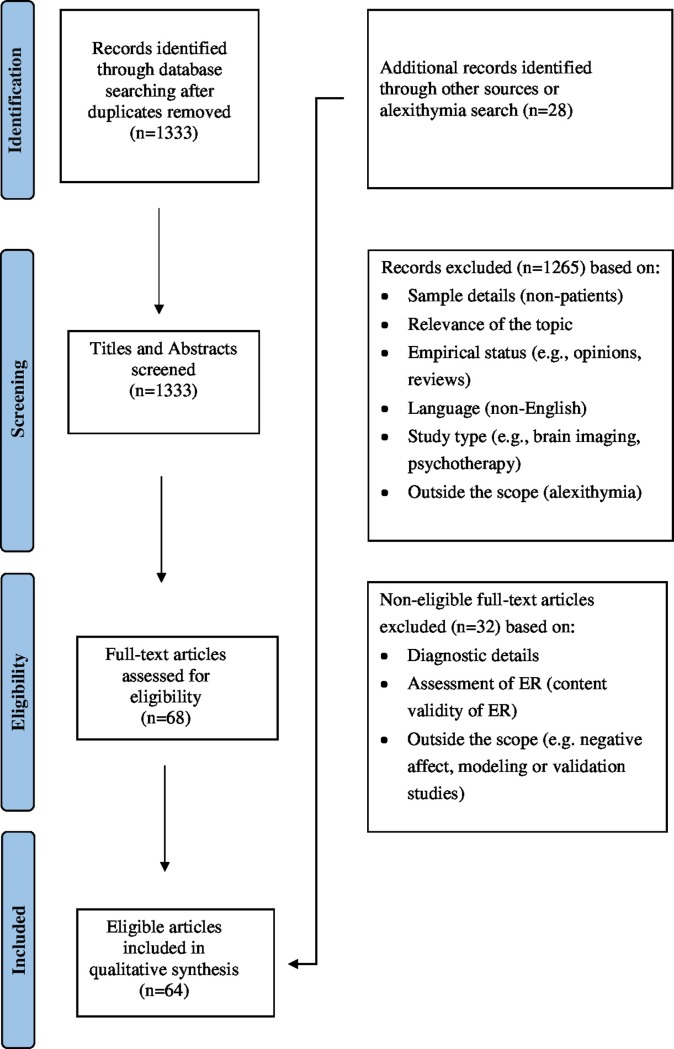
BACKGROUND: Somatic symptoms and related disorders (SSD) are prevalent phenomena in the health-care system. Disturbances in emotion regulation (ER) are commonly observed in patients suffering from SSD. OBJECTIVES: This review aimed to examine ER processes that characterize SSD by a systematic analysis of the available empirical studies. DATA SOURCES: PsycINFO and PubMed databases for the articles published between January 1985 and June 2018. SEARCH TERMS: "emotion/al regulation" or "affect regulation" and various forms of SSD. STUDY ELIGIBILITY CRITERIA: Empirical studies that a) assigned adolescent or adult patients suffering from SSD based on a clinical diagnosis, and b) examined the relationship between ER and SSD, were included. STUDY SYNTHESIS METHODS: A tabular summary of the articles was generated according to study characteristics, study quality, variables, and findings. The findings were organized based on ER variables used in the articles and diagnoses of SSD, which were then re-organized under the main constituents of ER (attention, body, and knowledge). RESULTS: The findings of the 64 articles largely supported the association between SSD and disturbances in ER, which are usually shared by different diagnoses of SSD. The results indicate that patients show a reduced engagement with cognitive content of emotions. On the other hand, bodily constituents of ER seem to depict an over-reactive pattern. Similarly, the patients tend to encounter difficulties in flexibly disengaging their (spontaneous) attention from emotional material. LIMITATIONS: There is a scarcity of longitudinal designs, randomized controlled trials, experiments, and diary studies suited to investigate the short- and long-term causal relationship between ER and SSD. Symptoms of SSD and measures to assess emotion regulation are heterogeneous. CONCLUSIONS AND IMPLICATIONS: Assessment of ER processes is potentially useful to understand SSD and for treatment planning. Furthermore, a concurrent investigation of the dynamic interaction of the ER modalities promises insights for better understanding of the role of ER in development, course, and maintenance of SSD.
Overview
The claims and statistics of this paper haven’t been checked yet.
Free: it reads the open-access text and checks the first 5 claims that cite a source we can check. Create a free account to check every claim.
Integrity signals
Registry
Cites
Statistics
Figures
Verification
Claims the paper makes
The claims and statistics of this paper haven’t been checked yet.
Free: it reads the open-access text and checks the first 5 claims that cite a source we can check. Create a free account to check every claim.
Claims other papers make about this one
Each is checked against this paper’s own text: does it say what the citing paper says it does?
The source backs part of the claim, not all of it — or backs it for a different population, condition or comparison.
In the citing paper
“However, a concurrent somatoform disorder is accompanied by more severely altered body and brain structures related to increased hypervigilance and catastrophizing (62, 63).”
From The integration of yoga breathing techniques in cognitive behavioral therapy for post-traumatic stress disorder: A pragmatic randomized controlled trial (2023) · cites this paper as [63]
Experimental — accuracy not yet measuredThe source backs part of the claim, not all of it — or backs it for a different population, condition or comparison.
In the citing paper
“This increase in emotion regulation is crucial in patients with somatic complaints as a lack of emotional awareness and an overuse of maladaptive emotion regulation strategies are considered basic psychological liabilities of Somatic Symptom Disorder (Waller and Scheidt, 2004; Garnefski et al., 2017; Okur Güney et al., 2019).”
From Does the practice of mindfulness reduce somatic symptoms and COVID-19-related anxiety? A community-based survey (2022) · cites this paper as Okur Güney et al., 2019
Experimental — accuracy not yet measured
Self-check
Percentages, sums and reported differences re-computed from the paper’s own numbers.
The self-check needs the paper’s full text.
Citations
Cites
Diagnostic and Statistical Manual of Mental Disorders
Williams, J. B. W., & First, M. (2013) · Encyclopedia of Social Work · doi:10.1093/acrefore/9780199975839.013.104 · Cited by 109,519
Statistical Power Analysis for the Behavioral Sciences
Muller, K. (1989) · Technometrics · doi:10.1080/00401706.1989.10488618 · Cited by 99,167
Preferred Reporting Items for Systematic Reviews and Meta-Analyses: the PRISMA statement
Moher, D., Liberati, A., Tetzlaff, J., Altman, D. G., & for the PRISMA Group (2009) · BMJ · doi:10.1136/bmj.b2535 · Cited by 83,823
Statistical power analysis for the behavioral sciences
(1990) · Computers, Environment and Urban Systems · doi:10.1016/0198-9715(90)90050-4 · Cited by 65,269
Preferred Reporting Items for Systematic Reviews and Meta-Analyses: The PRISMA Statement
Moher, D., Liberati, A., Tetzlaff, J., Altman, D. G., & The PRISMA Group (2009) · PLoS Medicine · doi:10.1371/journal.pmed.1000097 · Cited by 64,042
Preferred reporting items for systematic reviews and meta-analyses: the PRISMA Statement.
(2009) · PubMed Central · Cited by 44,859
Wang, G., Ma, R., Qiao, G., Wada, K., Aizawa, Y., & Satoh, T. (2015) · Integrative Medicine International · doi:10.1159/000368408 · Cited by 18,657
The emerging field of emotion regulation: an integrative review
Gross, J. J. (1998) · Review of General Psychology · doi:10.1037/1089-2680.2.3.271 · Cited by 9,916
Gratz, K. L., & Roemer, L. (2004) · Journal of Psychopathology and Behavioral Assessment · doi:10.1023/b:joba.0000007455.08539.94 · Cited by 8,942
Diagnostic and Statistical Manual of Mental Disorders
Siegel, L. J., & Fletcher‐Janzem, E. (2008) · Encyclopedia of Special Education · doi:10.1002/9780470373699.speced0655 · Cited by 8,477
Emotion-regulation strategies across psychopathology: A meta-analytic review
Aldao, A., Nolen-Hoeksema, S., & Schweizer, S. (2010) · Clinical Psychology Review · doi:10.1016/j.cpr.2009.11.004 · Cited by 6,686
How do you feel — now? The anterior insula and human awareness
(Bud) Craig, A. D. (2009) · Nature Reviews Neuroscience · doi:10.1038/nrn2555 · Cited by 6,657
Emotion regulation: current status and future prospects
Gross, J. J. (2015) · Psychological Inquiry · doi:10.1080/1047840x.2014.940781 · Cited by 5,229
Handbook of Emotion Regulation
Lambert, K. G. (2007) · JAMA · doi:10.1001/jama.298.15.1808 · Cited by 4,902
Baron-Cohen, S., & Wheelwright, S. (2004) · Journal of Autism and Developmental Disorders · doi:10.1023/b:jadd.0000022607.19833.00 · Cited by 4,093
Progress on a cognitive-motivational-relational theory of emotion
Lazarus, R. S. (1991) · American Psychologist · doi:10.1037/0003-066x.46.8.819 · Cited by 3,272
(2007) · Cited by 3,233
A model of neurovisceral integration in emotion regulation and dysregulation
Thayer, J. F., & Lane, R. D. (2000) · Journal of Affective Disorders · doi:10.1016/s0165-0327(00)00338-4 · Cited by 3,092
The somatic marker hypothesis and the possible functions of the prefrontal cortex
Damasio, A. R. (1996) · Philosophical Transactions of the Royal Society of London. Series B: Biological Sciences · doi:10.1098/rstb.1996.0125 · Cited by 2,847
The Prevalence of ‘Alexithymic’ Characteristics in Psychosomatic Patients
Sifneos, P. E. (2010) · Psychotherapy and Psychosomatics · doi:10.1159/000286529 · Cited by 2,818
Psychosomatic medicine in Germany: more timely than ever
Zipfel, S., Herzog, W., Kruse, J., & Henningsen, P. (2016) · Psychotherapy and Psychosomatics · doi:10.1159/000447701 · Cited by 2,323
Thayer, J. F., & Lane, R. D. (2009) · Neuroscience & Biobehavioral Reviews · doi:10.1016/j.neubiorev.2008.08.004 · Cited by 2,040
Webb, T. L., Miles, E., & Sheeran, P. (2012) · Psychological Bulletin · doi:10.1037/a0027600 · Cited by 2,006
Cole, P. M., Martin, S. E., & Dennis, T. A. (2004) · Child Development · doi:10.1111/j.1467-8624.2004.00673.x · Cited by 2,000
Research on attention networks as a model for the integration of psychological science.
Posner, M. I., & Rothbart, M. K. (2007) · Annual Review of Psychology · doi:10.1146/annurev.psych.58.110405.085516 · Cited by 1,569
Frijda, N. H. (1988) · American Psychologist · doi:10.1037/0003-066x.43.5.349 · Cited by 1,528
Affective style and affective disorders: Perspectives from affective neuroscience
Davidson, R. J. (1998) · Cognition & Emotion · doi:10.1080/026999398379628 · Cited by 1,496
The psychology of emotion regulation: An integrative review
Koole, S. L. (2009) · Cognition & Emotion · doi:10.1080/02699930802619031 · Cited by 1,490 · cited 1×
“For example, Koole (2009) [52], classified ER processes in terms of targets/ constituents of ER (e.g. attention, body and knowledge), as well as its functions.”
BackgroundEmbodiment in attitudes, social perception, and emotion
Niedenthal, P. M., Barsalou, L. W., Winkielman, P., Krauth-Gruber, S., & Ric, F. (2005) · Personality and Social Psychology Review · doi:10.1207/s15327957pspr0903_1 · Cited by 1,484
The dynamic architecture of emotion: Evidence for the component process model
Scherer, K. R. (2009) · Cognition and Emotion · doi:10.1080/02699930902928969 · Cited by 1,385
Emotion Regulation and Psychopathology
Sheppes, G., Suri, G., & Gross, J. J. (2015) · Annual Review of Clinical Psychology · doi:10.1146/annurev-clinpsy-032814-112739 · Cited by 1,214
Functional somatic syndromes: one or many?
Wessely, S., Nimnuan, C., & Sharpe, M. (1999) · The Lancet · doi:10.1016/s0140-6736(98)08320-2 · Cited by 1,211
MACLEAN, P. D. (1949) · Psychosomatic Medicine · doi:10.1097/00006842-194911000-00003 · Cited by 1,203
Medically Unexplained Physical Symptoms, Anxiety, and Depression: A Meta-Analytic Review
Henningsen, P., Zimmermann, T., & Sattel, H. (2003) · Psychosomatic Medicine · doi:10.1097/01.psy.0000075977.90337.e7 · Cited by 829
Self-citationConceptual and methodological issues in research on mindfulness and meditation.
Davidson, R. J., & Kaszniak, A. W. (2015) · American Psychologist · doi:10.1037/a0039512 · Cited by 773
Statistik für Human- und Sozialwissenschaftler
Bortz, J., & Schuster, C. (2010) · Springer-Lehrbuch · doi:10.1007/978-3-642-12770-0 · Cited by 742
Management of functional somatic syndromes
Henningsen, P., Zipfel, S., & Herzog, W. (2007) · The Lancet · doi:10.1016/s0140-6736(07)60159-7 · Cited by 741
Self-citationBridging emotion theory and neurobiology through dynamic systems modeling
Lewis, M. D. (2005) · Behavioral and Brain Sciences · doi:10.1017/s0140525x0500004x · Cited by 618
Statistik für Human- und Sozialwissenschaftler
Bortz, J. (2006) · doi:10.17877/de290r-6043 · Cited by 586
Symptoms and the body: taking the inferential leap
Van den Bergh, O., Witthöft, M., Petersen, S., & Brown, R. J. (2017) · Neuroscience & Biobehavioral Reviews · doi:10.1016/j.neubiorev.2017.01.015 · Cited by 543
Self-citationIntegrating emotion regulation and emotional intelligence traditions: a meta-analysis
Peña-Sarrionandia, A., Mikolajczak, M., & Gross, J. J. (2015) · Frontiers in Psychology · doi:10.3389/fpsyg.2015.00160 · Cited by 517
Ehlert, U., Gaab, J., & Heinrichs, M. (2001) · Biological Psychology · doi:10.1016/s0301-0511(01)00092-8 · Cited by 510
Damasio, A. R. (1998) · Brain Research Reviews · doi:10.1016/s0165-0173(97)00064-7 · Cited by 487
Kroenke, K., & Swindle, R. (2000) · Psychotherapy and Psychosomatics · doi:10.1159/000012395 · Cited by 478
Explaining medically unexplained symptoms-models and mechanisms
Rief, W., & Broadbent, E. (2007) · Clinical Psychology Review · doi:10.1016/j.cpr.2007.07.005 · Cited by 410
Attention and information Processing in infants and Adults
(2014) · Psychology Press eBooks · doi:10.4324/9781315807355 · Cited by 374
The limbic lobe and its output channels: implications for emotional functions and adaptive behavior
Heimer, L., & Van Hoesen, G. W. (2006) · Neuroscience & Biobehavioral Reviews · doi:10.1016/j.neubiorev.2005.06.006 · Cited by 366
Fink, P., & Schröder, A. (2010) · Journal of Psychosomatic Research · doi:10.1016/j.jpsychores.2010.02.004 · Cited by 334
De Gucht, V., & Heiser, W. (2003) · Journal of Psychosomatic Research · doi:10.1016/s0022-3999(02)00467-1 · Cited by 311
Reassessing emotion regulation.
Thompson, R. A., Lewis, M. D., & Calkins, S. D. (2008) · Child Development Perspectives · doi:10.1111/j.1750-8606.2008.00054.x · Cited by 300
Brown, R. J., & Reuber, M. (2016) · Clinical Psychology Review · doi:10.1016/j.cpr.2016.01.003 · Cited by 276
The role of emotion regulation in chronic pain: A systematic literature review
Koechlin, H., Coakley, R., Schechter, N., Werner, C., & Kossowsky, J. (2018) · Journal of Psychosomatic Research · doi:10.1016/j.jpsychores.2018.02.002 · Cited by 260
“I feel better but I don’t know why”: the psychology of implicit emotion regulation.
Koole, S. L., & Rothermund, K. (2011) · Cognition and Emotion · doi:10.1080/02699931.2010.550505 · Cited by 258
Somatoform disorders as disorders of affect regulation: A development perspective
Waller, E., & Scheidt, C. E. (2006) · International Review of Psychiatry · doi:10.1080/09540260500466774 · Cited by 246
Lane, R. D. (2008) · Psychosomatic Medicine · doi:10.1097/psy.0b013e3181647e44 · Cited by 223
Garland, E. L., Gaylord, S. A., Palsson, O., Faurot, K., Douglas Mann, J., & Whitehead, W. E. (2012) · Journal of Behavioral Medicine · doi:10.1007/s10865-011-9391-z · Cited by 210
Is there a better term than “medically unexplained symptoms”?
Creed, F., Guthrie, E., Fink, P., Henningsen, P., Rief, W., Sharpe, M., & White, P. (2010) · Journal of Psychosomatic Research · doi:10.1016/j.jpsychores.2009.09.004 · Cited by 207
Self-citationA taxonomy of emotional disturbances.
Berenbaum, H., Raghavan, C., Le, H.-N., Vernon, L. L., & Gomez, J. J. (2003) · Clinical Psychology: Science and Practice · doi:10.1093/clipsy.bpg011 · Cited by 205
Lane, R. D., Weihs, K. L., Herring, A., Hishaw, A., & Smith, R. (2015) · Neuroscience & Biobehavioral Reviews · doi:10.1016/j.neubiorev.2015.06.007 · Cited by 204
Symptoms and symbols: A multiple code theory of Somatization
Bucci, W. (1997) · Psychoanalytic Inquiry · doi:10.1080/07351699709534117 · Cited by 203
Somatoform disorders as disorders of affect regulation
Waller, E., & Scheidt, C. E. (2004) · Journal of Psychosomatic Research · doi:10.1016/s0022-3999(03)00613-5 · Cited by 193
There is only one functional somatic syndrome
Wessely, S., & White, P. D. (2004) · British Journal of Psychiatry · doi:10.1192/bjp.185.2.95 · Cited by 193
Autonomic regulation and attention.
Porges, S. W. (1992) · Cited by 189
The Beliefs about Emotions Scale: Validity, reliability and sensitivity to change
Rimes, K. A., & Chalder, T. (2010) · Journal of Psychosomatic Research · doi:10.1016/j.jpsychores.2009.09.014 · Cited by 188
Elsenbruch, S., Rosenberger, C., Bingel, U., Forsting, M., Schedlowski, M., & Gizewski, E. R. (2010) · Gastroenterology · doi:10.1053/j.gastro.2010.06.054 · Cited by 181
Emotions and emotional approach and avoidance strategies in fibromyalgia
van Middendorp, H., Lumley, M. A., Jacobs, J. W. G., van Doornen, L. J. P., Bijlsma, J. W. J., & Geenen, R. (2008) · Journal of Psychosomatic Research · doi:10.1016/j.jpsychores.2007.08.009 · Cited by 175
White, S. J., Coniston, D., Rogers, R., & Frith, U. (2011) · Autism Research · doi:10.1002/aur.174 · Cited by 171
Psychological Approaches to Origins and Treatments of Somatoform Disorders
Witthöft, M., & Hiller, W. (2010) · Annual Review of Clinical Psychology · doi:10.1146/annurev.clinpsy.121208.131505 · Cited by 171
Theory of Mind and Emotional Awareness Deficits in Patients With Somatoform Disorders
Subic-Wrana, C., Beutel, M. E., Knebel, A., & Lane, R. D. (2010) · Psychosomatic Medicine · doi:10.1097/psy.0b013e3181d35e83 · Cited by 165
Emotion and regulation are one!
Kappas, A. (2011) · Emotion Review · doi:10.1177/1754073910380971 · Cited by 163
Alexithymia and anger in patients with fibromyalgia
Sayar, K., Gulec, H., & Topbas, M. (2004) · Clinical Rheumatology · doi:10.1007/s10067-004-0918-3 · Cited by 162
Sattel, H., Lahmann, C., Gündel, H., Guthrie, E., Kruse, J., Noll-Hussong, M., Ohmann, C., Ronel, J., Sack, M., Sauer, N., et al. (2012) · British Journal of Psychiatry · doi:10.1192/bjp.bp.111.093526 · Cited by 160
Veehof, M. M., ten Klooster, P. M., Taal, E., Westerhof, G. J., & Bohlmeijer, E. T. (2011) · Clinical Rheumatology · doi:10.1007/s10067-011-1690-9 · Cited by 158
Non-Specific, Functional, and Somatoform Bodily Complaints
Schaefert, R., Hausteiner-Wiehle, C., Häuser, W., Ronel, J., Herrmann, M., & Henningsen, P. (2012) · Deutsches Ärzteblatt international · doi:10.3238/arztebl.2012.0803 · Cited by 153
The somatic marker hypothesis and the possible functions of the prefrontal cortex
Damasio, A. R. (1998) · The Prefrontal CortexExecutive and Cognitive Functions · doi:10.1093/acprof:oso/9780198524410.003.0004 · Cited by 148
The role of alexithymia in the development of functional motor symptoms (conversion disorder)
Demartini, B., Petrochilos, P., Ricciardi, L., Price, G., Edwards, M. J., & Joyce, E. (2014) · Journal of Neurology, Neurosurgery & Psychiatry · doi:10.1136/jnnp-2013-307203 · Cited by 147
Alexithymia in Chronic Pain Disorders
Tella, M. D., & Castelli, L. (2016) · Current Rheumatology Reports · doi:10.1007/s11926-016-0592-x · Cited by 139
Models and methods of emotional concordance
Hollenstein, T., & Lanteigne, D. M. (2014) · Biological Psychology · doi:10.1016/j.biopsycho.2013.12.012 · Cited by 131
Brown, R. J. (2007) · Clinical Psychology Review · doi:10.1016/j.cpr.2007.07.003 · Cited by 129
Disambiguating the Components of Emotion Regulation
Goldsmith, H. H., & Davidson, R. J. (2004) · Child Development · doi:10.1111/j.1467-8624.2004.00678.x · Cited by 124
Lane, R. D., Waldstein, S. R., Chesney, M. A., Jennings, J. R., Lovallo, W. R., Kozel, P. J., Rose, R. M., Drossman, D. A., Schneiderman, N., Thayer, J. F., et al. (2009) · Psychosomatic Medicine · doi:10.1097/psy.0b013e31819783be · Cited by 119
Altered associative learning and emotional decision making in fibromyalgia
Walteros, C., Sánchez-Navarro, J. P., Muñoz, M. A., Martínez-Selva, J. M., Chialvo, D., & Montoya, P. (2011) · Journal of Psychosomatic Research · doi:10.1016/j.jpsychores.2010.07.013 · Cited by 111
Emotional dysregulation, alexithymia, and attachment in psychogenic nonepileptic seizures
Brown, R. J., Bouska, J. F., Frow, A., Kirkby, A., Baker, G. A., Kemp, S., Burness, C., & Reuber, M. (2013) · Epilepsy & Behavior · doi:10.1016/j.yebeh.2013.07.019 · Cited by 111
Yücel, B., Kora, K., Özyalçın, S., Alçalar, N., Özdemir, Ö., & Yücel, A. (2002) · Headache The Journal of Head and Face Pain · doi:10.1046/j.1526-4610.2002.02051.x · Cited by 110
Association of costs with somatic symptom severity in patients with medically unexplained symptoms
Konnopka, A., Kaufmann, C., König, H.-H., Heider, D., Wild, B., Szecsenyi, J., Herzog, W., Heinrich, S., & Schaefert, R. (2013) · Journal of Psychosomatic Research · doi:10.1016/j.jpsychores.2013.08.011 · Cited by 109
Social regulation of emotion: messy layers
Kappas, A. (2013) · Frontiers in Psychology · doi:10.3389/fpsyg.2013.00051 · Cited by 108
Hsu, M. C., Schubiner, H., Lumley, M. A., Stracks, J. S., Clauw, D. J., & Williams, D. A. (2010) · Journal of General Internal Medicine · doi:10.1007/s11606-010-1418-6 · Cited by 102
Burger, A. J., Lumley, M. A., Carty, J. N., Latsch, D. V., Thakur, E. R., Hyde-Nolan, M. E., Hijazi, A. M., & Schubiner, H. (2016) · Journal of Psychosomatic Research · doi:10.1016/j.jpsychores.2015.12.003 · Cited by 101
Facial emotion recognition and alexithymia in adults with somatoform disorders
Pedrosa Gil, F., Ridout, N., Kessler, H., Neuffer, M., Schoechlin, C., Traue, H. C., & Nickel, M. (2009) · Depression and Anxiety · doi:10.1002/da.20456 · Cited by 98
Emotion regulation profiles in psychogenic non-epileptic seizures
Uliaszek, A. A., Prensky, E. H., & Baslet, G. C. (2012) · Epilepsy & Behavior · doi:10.1016/j.yebeh.2012.01.009 · Cited by 96
Lane, R. D., Waldstein, S. R., Critchley, H. D., Derbyshire, S. W. G., Drossman, D. A., Wager, T. D., Schneiderman, N., Chesney, M. A., Jennings, J. R., Lovallo, W. R., et al. (2009) · Psychosomatic Medicine · doi:10.1097/psy.0b013e318198a11f · Cited by 90
Autonomic imbalance is associated with reduced facial recognition in somatoform disorders
Pollatos, O., Herbert, B. M., Wankner, S., Dietel, A., Wachsmuth, C., Henningsen, P., & Sack, M. (2011) · Journal of Psychosomatic Research · doi:10.1016/j.jpsychores.2011.03.012 · Cited by 89
Self-citationGeenen, R., der Linden, L. V. O.-V., Lumley, M. A., Bijlsma, J. W. J., & van Middendorp, H. (2011) · Journal of Psychosomatic Research · doi:10.1016/j.jpsychores.2011.09.004 · Cited by 89
Van Middendorp, H., Lumley, M. A., Moerbeek, M., Jacobs, J. W. G., Bijlsma, J. W. J., & Geenen, R. (2010) · European Journal of Pain · doi:10.1016/j.ejpain.2009.03.007 · Cited by 88
Childhood Anxiety Disorders from the Perspective of Emotion Regulation and Attachment
Thompson, R. A. (2001) · The Developmental Psychopathology of Anxiety · doi:10.1093/med:psych/9780195123630.003.0008 · Cited by 87
Somatization is associated with deficits in affective Theory of Mind
Stonnington, C. M., Locke, D. E. C., Hsu, C., Ritenbaugh, C., & Lane, R. D. (2013) · Journal of Psychosomatic Research · doi:10.1016/j.jpsychores.2013.04.004 · Cited by 86
Di Tella, M., Castelli, L., Colonna, F., Fusaro, E., Torta, R., Ardito, R. B., & Adenzato, M. (2015) · PLOS ONE · doi:10.1371/journal.pone.0116542 · Cited by 84
Emotion in psychogenic nonepileptic seizures: Responses to affective pictures
Roberts, N. A., Burleson, M. H., Weber, D. J., Larson, A., Sergeant, K., Devine, M. J., Vincelette, T. M., & Wang, N. C. (2012) · Epilepsy & Behavior · doi:10.1016/j.yebeh.2012.03.018 · Cited by 83
Vulnerability for functional somatic disorders: A contemporary psychodynamic approach.
Luyten, P., Van Houdenhove, B., Lemma, A., Target, M., & Fonagy, P. (2013) · Journal of Psychotherapy Integration · doi:10.1037/a0032360 · Cited by 80
Lane, R. D., Hsu, C.-H., Locke, D. E. C., Ritenbaugh, C., & Stonnington, C. M. (2015) · Consciousness and Cognition · doi:10.1016/j.concog.2015.02.004 · Cited by 79
Individual differences in emotion components and dynamics: Introduction to the Special Issue
Kuppens, P., Stouten, J., & Mesquita, B. (2009) · Cognition and Emotion · doi:10.1080/02699930902985605 · Cited by 79
Links among emotional awareness, somatic awareness and autonomic homeostatic processing
Kanbara, K., & Fukunaga, M. (2016) · BioPsychoSocial Medicine · doi:10.1186/s13030-016-0059-3 · Cited by 79
Bruehl, S., Liu, X., Burns, J. W., Chont, M., & Jamison, R. N. (2012) · Pain · doi:10.1016/j.pain.2012.08.001 · Cited by 76
“Functional somatic syndromes, one or many?”: An answer by cluster analysis
Lacourt, T. E., Houtveen, J. H., & van Doornen, L. J. P. (2012) · Journal of Psychosomatic Research · doi:10.1016/j.jpsychores.2012.09.013 · Cited by 73
Faramarzi, M., Azadfallah, P., Book, H. E., Tabatabaei, S. K. R., Taheri, H., & Shokri‐Shirvani, J. (2013) · Asian Journal of Psychiatry · doi:10.1016/j.ajp.2012.12.012 · Cited by 69
Regulation of emotions in psychogenic nonepileptic seizures
Urbanek, M., Harvey, M., McGowan, J. F., & Agrawal, N. (2014) · Epilepsy & Behavior · doi:10.1016/j.yebeh.2014.06.004 · Cited by 69
Alexithymia in adolescents with chronic fatigue syndrome
van de Putte, E. M., Engelbert, R., Kuis, W., Kimpen, J. L. L., & Uiterwaal, C. S. P. M. (2007) · Journal of Psychosomatic Research · doi:10.1016/j.jpsychores.2007.07.009 · Cited by 69
Witthöft, M., Gerlach, A. L., & Bailer, J. (2006) · Journal of Abnormal Psychology · doi:10.1037/0021-843x.115.3.397 · Cited by 68
Burns, J. W., Gerhart, J. I., Bruehl, S., Peterson, K. M., Smith, D. A., Porter, L. S., Schuster, E., Kinner, E., Buvanendran, A., Fras, A. M., et al. (2015) · Health Psychology · doi:10.1037/hea0000091 · Cited by 67
Leong, L. E. M., Caño, A., & Johansen, A. B. (2011) · Journal of Pain · doi:10.1016/j.jpain.2011.04.004 · Cited by 63
Witthöft, M., Fischer, S., Jasper, F., Rist, F., & Nater, U. M. (2016) · Psychological Assessment · doi:10.1037/pas0000150 · Cited by 62
Rasting, M., Brosig, B., & Beutel, M. E. (2005) · Psychopathology · doi:10.1159/000085772 · Cited by 61
Intentionality and “free-will” from a neurodevelopmental perspective
Leisman, G., Machado, C., Melillo, R. J., & Mualem, R. (2012) · Frontiers in Integrative Neuroscience · doi:10.3389/fnint.2012.00036 · Cited by 58
A Taxonomy of Emotional Disturbances
Berenbaum, H. (2003) · Clinical Psychology Science and Practice · doi:10.1093/clipsy/bpg011 · Cited by 57
Abnormal affective startle modulation in individuals with psychogenical movement disorder
Seignourel, P. J., Miller, K., Kellison, I., Rodriguez, R., Fernandez, H. H., Bauer, R. M., Bowers, D., & Okun, M. S. (2007) · Movement Disorders · doi:10.1002/mds.21451 · Cited by 56
Gul, A., & Ahmad, H. (2014) · Epilepsy & Behavior · doi:10.1016/j.yebeh.2014.01.015 · Cited by 55
Wingenfeld, K., Riedesel, K., Petrovic, Z., Philippsen, C., Meyer, B., Rose, M., Grabe, H. J., Barnow, S., Löwe, B., & Spitzer, C. (2010) · Journal of Psychosomatic Research · doi:10.1016/j.jpsychores.2010.06.003 · Cited by 54
Altered brain activity during emotional empathy in somatoform disorder
de Greck, M., Scheidt, L., Bölter, A. F., Frommer, J., Ulrich, C., Stockum, E., Enzi, B., Tempelmann, C., Hoffmann, T., Han, S., et al. (2012) · Human Brain Mapping · doi:10.1002/hbm.21392 · Cited by 54
The new field of Brain–Body Medicine: What have we learned and where are we headed?
Lane, R. D., & Wager, T. D. (2009) · NeuroImage · doi:10.1016/j.neuroimage.2009.06.013 · Cited by 52
Bruehl, S., Chung, O. Y., Burns, J. W., & Diedrich, L. (2007) · Pain · doi:10.1016/j.pain.2006.11.013 · Cited by 52
Alexithymia, anger and psychological distress in patients with myofascial pain: a case-control study
Castelli, L., Santis, F. D., Giorgi, I. D., Deregibus, A., Tesio, V., Leombruni, P., Granieri, A., Debernardi, C. L., & Torta, R. (2013) · Frontiers in Psychology · doi:10.3389/fpsyg.2013.00490 · Cited by 52
Impaired emotion processing and a reduction in trust in patients with somatic symptom disorder
Erkic, M., Bailer, J., Fenske, S. C., Schmidt, S. N. L., Trojan, J., Schröder, A., Kirsch, P., & Mier, D. U. (2017) · Clinical Psychology & Psychotherapy · doi:10.1002/cpp.2151 · Cited by 52
Agar‐Wilson, M., & Jackson, T. (2012) · European Journal of Pain · doi:10.1016/j.ejpain.2011.05.011 · Cited by 50
Twiss, C., Kilpatrick, L., Craske, M., Buffington, C. A. T., Ornitz, E., Rodríguez, L. V., Mayer, E. A., & Naliboff, B. D. (2009) · Journal of Urology · doi:10.1016/j.juro.2009.01.025 · Cited by 47
von Piekartz, H., Wallwork, S. B., Mohr, G., Butler, D. S., & Moseley, G. L. (2014) · Journal of Oral Rehabilitation · doi:10.1111/joor.12249 · Cited by 47
Kleinstäuber, M., Gottschalk, J.-M., Berking, M., Rau, J., & Rief, W. (2015) · Contemporary Clinical Trials · doi:10.1016/j.cct.2015.12.003 · Cited by 47
Mazaheri, M. (2015) · Iranian Journal of Psychiatry and Behavioral Sciences · doi:10.17795/ijpbs-954 · Cited by 46
Blunted autonomic reactivity and increased pain tolerance in somatoform patients
Pollatos, O., Dietel, A., Herbert, B. M., Wankner, S., Wachsmuth, C., Henningsen, P., & Sack, M. (2011) · Pain · doi:10.1016/j.pain.2011.05.024 · Cited by 44
Burns, J. W., Quartana, P. J., & Bruehl, S. P. (2011) · Annals of Behavioral Medicine · doi:10.1007/s12160-011-9270-4 · Cited by 44
Baslet, G. C., Tolchin, B. D., & Dworetzky, B. A. (2017) · Seizure · doi:10.1016/j.seizure.2017.10.011 · Cited by 42
Koenig, J., Kooning, M. D., Bernardi, A., Williams, D. P., Nijs, J., Thayer, J. F., & Daenen, L. (2015) · Pain Practice · doi:10.1111/papr.12399 · Cited by 41
Steffen, A., Fiess, J., Schmidt, R., & Rockstroh, B. (2015) · BMC Psychiatry · doi:10.1186/s12888-015-0514-x · Cited by 40
Emotional suppression in chronic fatigue syndrome: Experimental study.
Rimes, K. A., Ashcroft, J., Bryan, L., & Chalder, T. (2016) · Health Psychology · doi:10.1037/hea0000341 · Cited by 40
Chavooshi, B., Mohammadkhani, P., & Dolatshahee, B. (2017) · Journal of Telemedicine and Telecare · doi:10.1177/1357633x15627382 · Cited by 38
Conceptual Foundations of Human Factors Measurement
Annett, J. (2007) · Ergonomics · doi:10.1080/00140130600971135 · Cited by 38
Negative affect as mediator between emotion regulation and medically unexplained symptoms
Schwarz, J., Rief, W., Radkovsky, A., Berking, M., & Kleinstäuber, M. (2017) · Journal of Psychosomatic Research · doi:10.1016/j.jpsychores.2017.08.010 · Cited by 37
Burns, J. W., Holly, A., Quartana, P., Wolff, B., Gray, E., & Bruehl, S. (2008) · Psychosomatic Medicine · doi:10.1097/psy.0b013e3181835cb7 · Cited by 36
Schönenberg, M., Mares, L. S., Smolka, R., Jusyte, A., Zipfel, S., & Hautzinger, M. (2014) · European Journal of Pain · doi:10.1002/j.1532-2149.2013.00440.x · Cited by 36
Emotional overactivity in patients with irritable bowel syndrome
Fournier, A., Mondillon, L., Dantzer, C., Gauchez, A., Ducros, V., Mathieu, N., Faure, P., Canini, F., Bonaz, B. L., & Pellissier, S. (2018) · Neurogastroenterology & Motility · doi:10.1111/nmo.13387 · Cited by 34
Haas, J., Eichhammer, P., Traue, H. C., Hoffmann, H., Behr, M., Crönlein, T., Pieh, C., & Busch, V. (2012) · Journal of Oral Rehabilitation · doi:10.1111/joor.12013 · Cited by 33
Fibromyalgia and other unexplained clinical conditions
Aaron, L. A., & Buchwald, D. (2001) · Current Rheumatology Reports · doi:10.1007/s11926-001-0006-5 · Cited by 29
Wong, W.-S., & Fielding, R. (2013) · The Clinical Journal of Pain · doi:10.1097/ajp.0b013e31827da3b5 · Cited by 27
Anger and ego-defence mechanisms in non-psychiatric patients with irritable bowel syndrome
Zoccali, R. A., Muscatello, M. R. A., Bruno, A., Barillà, G. P., Campolo, D., Meduri, M., Familiari, L., Bonica, M., Consolo, P., & Scaffidi, M. (2006) · Digestive and Liver Disease · doi:10.1016/j.dld.2005.10.028 · Cited by 27
Chronic Fatigue Syndrome: Cognitive, Behavioural and Emotional Processing Vulnerability Factors
Brooks, S. K., Chalder, T., & Rimes, K. A. (2017) · Behavioural and Cognitive Psychotherapy · doi:10.1017/s1352465816000631 · Cited by 27
Merten, J., & Brunnhuber, S. (2004) · Psychopathology · doi:10.1159/000081982 · Cited by 23
Burns, J. W., Gerhart, J. I., Bruehl, S., Post, K. M., Smith, D. A., Porter, L. S., Schuster, E., Buvanendran, A., Fras, A. M., & Keefe, F. J. (2016) · Health Psychology · doi:10.1037/hea0000221 · Cited by 23
Witthöft, M., Rist, F., & Bailer, J. (2008) · Journal of Behavior Therapy and Experimental Psychiatry · doi:10.1016/j.jbtep.2008.04.002 · Cited by 22
Attachment in Romantic Relationships and Somatization
Neumann, E., Sattel, H. C., Gündel, H., Henningsen, P., & Kruse, J. (2015) · The Journal of Nervous and Mental Disease · doi:10.1097/nmd.0000000000000241 · Cited by 22
Facial emotion recognition and alexithymia in adults with somatoform disorders
Gil, F. P., Ridout, N., Kessler, H., Neuffer, M., Schoechlin, C., Traue, H. C., & Nickel, M. (2007) · Depression and Anxiety · doi:10.1002/da.20440 · Cited by 21
Sibelli, A., Chalder, T., Everitt, H., Workman, P., Bishop, F. L., & Moss-Morris, R. E. (2017) · British Journal of Health Psychology · doi:10.1111/bjhp.12264 · Cited by 20
Psychophysiological decoupling in alexithymic pain disorder patients
Kleiman, A., Kramer, K. A., Wegener, I., Koch, A. S., Geiser, F., Imbierowicz, K., Zur, B., & Conrad, R. (2016) · Psychiatry Research · doi:10.1016/j.psychres.2016.01.021 · Cited by 19
Emotion Regulation and Psychopathology
DeJonghe, E. S. (2020) · Wiley eBooks · doi:10.1002/9781118970843.ch286 · Cited by 18
The first step is the hardest-emotion recognition in patients with somatoform disorders
Beck, T., Breuss, M., Kumnig, M., & Schüßler, G. (2013) · Zeitschrift für psychosomatische Medizin und Psychotherapie · doi:10.13109/zptm.2013.59.4.385 · Cited by 16
Mazaheri, M., Afshar, H., Nikneshan, S., & Adibi, P. (2016) · Advanced Biomedical Research · doi:10.4103/2277-9175.190937 · Cited by 15
The role of emotion dysregulation in Conversion Disorder.
del Río-Casanova, L., González-Vázquez, A. I., Justo-Alonso, A., Andrade, V., Páramo, M., Brenlla, J., & Blanco, A. (2018) · Actas Españolas de Psiquiatría · Cited by 15
Öztürk, A., Kılıç, A., Deveci, E., & Kırpınar, İ. (2016) · Neuropsychiatric Disease and Treatment · doi:10.2147/ndt.s106989 · Cited by 14
Variation of Functional Neurological Symptoms and Emotion Regulation with Time
Kienle, J., Rockstroh, B. S., Fiess, J., Schmidt, R., Popov, T. G., & Steffen, A. (2018) · Frontiers in Psychiatry · doi:10.3389/fpsyt.2018.00035 · Cited by 12
Tanum, L. (1998) · Cambridge University Press eBooks · doi:10.1017/cbo9780511549700 · Cited by 9
Definition and Etiological Theories
Manu, P. (1998) · Cambridge University Press eBooks · doi:10.1017/cbo9780511549700.002 · Cited by 7
Chapter 11. Somatic Symptom Disorder and Illness Anxiety Disorder
Henningsen, P. (2018) · American Psychiatric Association Publishing eBooks · doi:10.1176/appi.books.9781615371990.jl11 · Cited by 6
Research works printed but not linked: 3
- Witthöft M, Loch N, Jasper F. Somatoforme beschwerden und stile der emotionsregulation. = Somatoform symptoms and strategies of emotion regulation. Verhaltenstherapie & Verhaltensmedizin. 2013; 34: 444– 464.
- Henningsen Peter. Somatic Symptom Disorder and Illness Anxiety Disorder. The American Psychiatric Association Publishing (2019). pp. 305– 321.
- Freud S. Repression In Strachy J. (Ed. & Trans.), The standard edition of the complete works of Sigmund Freud (Vol. 14, pp. 143_160). London: Hogarth Press (Originally published 1915).; 1961.
Cited by
Interoceptive pathways to understand and treat mental health conditions
Nord, C. L., & Garfinkel, S. N. (2022) · Trends in Cognitive Sciences · doi:10.1016/j.tics.2022.03.004 · Cited by 199
“show reduced emotional awareness [115], suggesting a potential disposition for physical interpretations.”
Abbass, A., Town, J., Holmes, H., Luyten, P., Cooper, A., Russell, L., Lumley, M. A., Schubiner, H., Allinson, J., Bernier, D., et al. (2020) · Psychotherapy and Psychosomatics · doi:10.1159/000507738 · Cited by 75
“…helping the patient to somatically experience and process unconscious feelings to correct emotion dysregulation underlying somatic symptoms in FSD [12] while other methods such as Time Limited Dynamic Psychotherapy [13], Luborsky’s Supportive Expressive Therapy [14] and Malan’s Short-term Dynamic…”
Self-protection as an adaptive female strategy
Benenson, J. F., Webb, C. E., & Wrangham, R. W. (2021) · Behavioral and Brain Sciences · doi:10.1017/s0140525x21002417 · Cited by 76
Schnabel, K., Petzke, T. M., & Witthöft, M. (2022) · Clinical Psychology Review · doi:10.1016/j.cpr.2022.102196 · Cited by 61
Self-citationThe impact of traumatic childhood experiences on interoception: disregarding one’s own body
Schmitz, M., Back, S. N., Seitz, K. I., Harbrecht, N. K., Streckert, L., Schulz, A., Herpertz, S. C., & Bertsch, K. (2023) · Borderline Personality Disorder and Emotion Dysregulation · doi:10.1186/s40479-023-00212-5 · Cited by 65
Metadata
- Authors
- Okur Güney, Z. E., Sattel, H., Witthöft, M., & Henningsen, P.
- Affiliations
- TUM Klinikum (DE)
- Johannes Gutenberg University Mainz (DE)
- Venue
- PLoS ONE
- Publisher
- Public Library of Science (PLoS)
- Published
- 2019-06-07
- Volume
- 14
- Issue
- 6
- Pages
- e0217277
- ISSN
- 1932-6203 (ISSN-L)
- PMC
- PMC6555516
- OpenAlex
- W2972364724
- Cited by
- 133
- References
- 160
- Citations by year
- 2026: 10 · 2025: 35 · 2024: 19 · 2023: 19 · 2022: 20 · 2021: 18 · 2020: 10 · 2019: 2
- FWCI
- 2.11
- Type
- journal article
- Language
- en
- Open access
- gold
- doi.org
- Licence
- Locations
- PLoS ONE (publishedVersion, cc-by)
- PubMed Central (publishedVersion, cc-by)
- PubMed (publishedVersion)
- DOAJ (DOAJ: Directory of Open Access Journals) (submittedVersion, cc-by-sa)
- Figshare (submittedVersion, cc-by)
- mediaTUM – the media and publications repository of the Technical University Munich (Technical University Munich) (submittedVersion, other-oa)
- mediaTUM – the media and publications repository of the Technical University Munich (Technical University Munich) (submittedVersion)
- Funders
- Marie Curie Initial Training Network, “TESIS: Towards an Embodied Science of Intersubjectivity” (FP7-PEOPLE-2010-ITN, 264828)
- Topics
- Health Sciences › Medicine › Psychiatry and Mental health › Psychosomatic Disorders and Their Treatments
- Social Sciences › Psychology › Experimental and Cognitive Psychology › Anxiety, Depression, Psychometrics, Treatment, Cognitive Processes
- Social Sciences › Psychology › Clinical Psychology › Personality Disorders and Psychopathology
- Keywords
- emotion regulation, somatic symptom and related disorders, attentional bias, cognitive reappraisal, body awareness, somatic symptoms, treatment planning
- MeSH terms
- Medically Unexplained Symptoms, Delivery of Health Care, Emotions, Humans
About these checks
Registry, retraction, Cites and statistics results are computed, not judged, with one exception: a printed reference that no index lists is read once by a model before it counts as a citation error. Claims are extracted by a model and kept only when their quote appears verbatim in the text; each cited source is then checked, with a model’s help, for whether it says what the claim relies on. Those verdicts can be wrong — read the claim’s quote and the cited source before relying on one.
Statistics and arithmetic are recomputed, not judged.
Confidence bands are shown only for fields calibrated on our annotated test set. None is calibrated yet, so no band is shown.
What counts as a claim ›How we measure confidence ›How we check this ›
Are you an author, or do you see a problem with this page? Request a review
Data sources
Bibliographic data: Semantic Scholar, OpenAlex, Crossref.
Contains information from the Semantic Scholar Academic Graph Datasets, made available under the ODC Attribution License (ODC-BY 1.0).
Semantic Scholar’s data is described in: Kinney, R., et al. (2023). The Semantic Scholar Open Data Platform. arXiv:2301.10140.
