

The DOI matches its Crossref record; 127 of the 132 references it cites were found in a registry or an index.
A systemic review of maternal wellbeing and its relationship with maternal fetal attachment and early postpartum bonding
Open accessAbstract
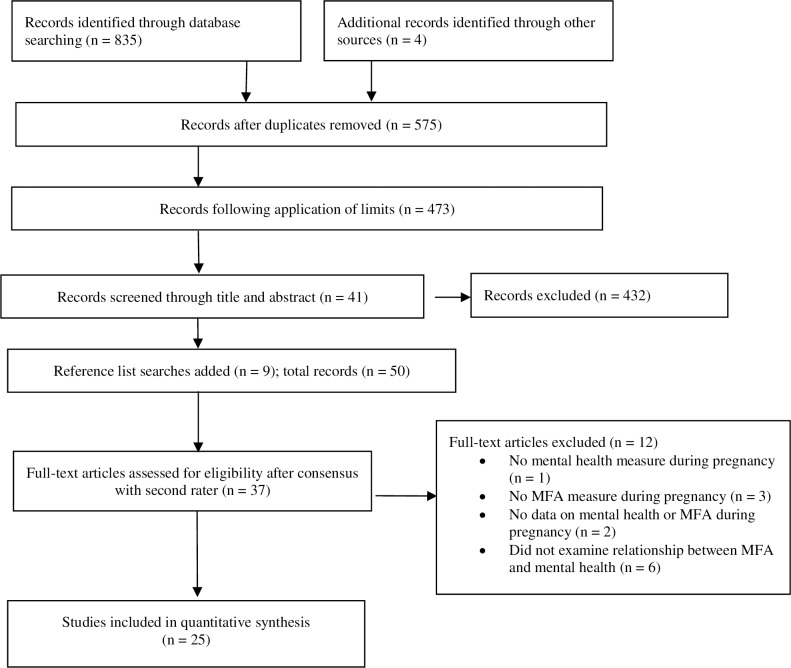
BACKGROUND: An emerging body of literature suggests there is a relationship between a pregnant woman's psychological wellbeing and the development of maternal-fetal attachment (MFA) and early postpartum bonding. The nature of this relationship is not well understood because of the limited theoretical framework surrounding the construct of MFA and variations in study methods and data collection points. In this systematic review, we synthesize the published literature to determine the nature of the relationship from the antenatal to early postnatal period and to provide recommendations for future research and clinical practice. METHOD: Using the preferred reporting items for systematic reviews and meta-analyses (PRISMA) approach, four electronic databases were searched for peer-reviewed empirical studies, published in English. Articles were considered for inclusion if data was collected on at least one domain of maternal wellbeing/mental health and MFA during pregnancy or MFA during pregnancy and the mother-infant relationship during the early postpartum period (up to 12 weeks). No date parameters were applied to the search strategy. The review was registered with PROPSERO (registration number: CRD42018096174). RESULTS: 25 studies examining maternal mental health and MFA/postpartum bonding were selected for inclusion in this review. Key findings identified from the review were: a need to validate existing mental health measures or develop new measures specific for use in antenatal populations; inconsistencies in data collection points throughout pregnancy and postpartum; a lack of consensus about the construct of MFA and the way it is assessed; and a continued focus on postpartum outcomes. CONCLUSION: Scientific gaps remain in our understanding of the relationship between maternal mental health and both MFA and postpartum bonding which limit our theoretical understanding of the MFA construct. Recommendations for future research are to employ prospective longitudinal designs that span the full pregnancy and postpartum period, and for consistency in the terminology and methodology used when considering MFA. A re-focus of research attention on the theory behind MFA will allow a richer and more holistic account of the emerging relationship between mother and baby.
Overview
The claims and statistics of this paper haven’t been checked yet.
Run the check — free, no account needed. It reads the open-access text and checks the sources it cites.
Integrity signals
Registry
Cites
Statistics
Figures
Verification
Claims the paper makes
The claims and statistics of this paper haven’t been checked yet.
Run the check — free, no account needed. It reads the open-access text and checks the sources it cites.
Claims other papers make about this one
Each is checked against this paper’s own text: does it say what the citing paper says it does?
The source backs part of the claim, not all of it — or backs it for a different population, condition or comparison.
In the citing paper
“Three prior narrative reviews (Edwards, 2017; McNamara et al., 2019; Tichelman et al., 2019) reported that maternal depression, anxiety, and stress symptoms were associated with mother-infant bonding problems”
From Associations between maternal psychological distress and mother-infant bonding: a systematic review and meta-analysis (2023) · cites this paper as McNamara et al., 2019
Experimental — accuracy not yet measuredThe source backs part of the claim, not all of it — or backs it for a different population, condition or comparison.
In the citing paper
“A systematic review by McNamara et al. (2019) demonstrated that psychological distress is an important risk factor for poor preand postnatal bonding in mothers.”
From Mindfulness, Self-compassion, and Psychological Wellbeing as Correlates of Paternal Bonding in Pregnancy. (2025) · cites this paper as McNamara et al. (2019)
Experimental — accuracy not yet measuredThe check wasn’t confident either way, so it gives no verdict — never disputed.
In the citing paper
“though a separate SA-based study found no significant associations between poor breastfeeding outcomes and mental health [45].”
From Exploring the effects of mental health on bonding and caregiving among pregnant and postpartum persons with likely depression and/or PTSD in South Africa: a qualitative analysis (2026) · cites this paper as [45]
Experimental — accuracy not yet measured
Self-check
Percentages, sums and reported differences re-computed from the paper’s own numbers.
The self-check needs the paper’s full text.
Citations
Cites
Preferred Reporting Items for Systematic Reviews and Meta-Analyses: the PRISMA statement
Moher, D., Liberati, A., Tetzlaff, J., Altman, D. G., & for the PRISMA Group (2009) · BMJ · doi:10.1136/bmj.b2535 · Cited by 83,823
Preferred Reporting Items for Systematic Reviews and Meta-Analyses: The PRISMA Statement
Moher, D., Liberati, A., Tetzlaff, J., Altman, D. G., & The PRISMA Group (2009) · PLoS Medicine · doi:10.1371/journal.pmed.1000097 · Cited by 64,042
Preferred reporting items for systematic reviews and meta-analyses: The PRISMA statement
Moher, D., Liberati, A., Tetzlaff, J., Altman, D. G., & the PRISMA Group* (2009) · Annals of Internal Medicine · doi:10.7326/0003-4819-151-4-200908180-00135 · Cited by 37,554
Wang, G., Ma, R., Qiao, G., Wada, K., Aizawa, Y., & Satoh, T. (2015) · Integrative Medicine International · doi:10.1159/000368408 · Cited by 18,762
Stress, social support, and the buffering hypothesis
Cohen, S., & Wills, T. A. (1985) · Psychological Bulletin · doi:10.1037/0033-2909.98.2.310 · Cited by 18,093
Preferred reporting items for systematic reviews and meta-analyses: The PRISMA statement
Moher, D., Liberati, A., Tetzlaff, J., & Altman, D. G. (2010) · International Journal of Surgery · doi:10.1016/j.ijsu.2010.02.007 · Cited by 12,156
Diagnostic and Statistical Manual of Mental Disorders
Siegel, L. J., & Fletcher‐Janzen, E. (2008) · Wiley eBooks · doi:10.1002/9780470373699.speced0655 · Cited by 8,467
Attachment and loss: Retrospect and prospect.
Bowlby, J. (1982) · American Journal of Orthopsychiatry · doi:10.1111/j.1939-0025.1982.tb01456.x · Cited by 2,930 · cited 1×
“It is well recognized that early attachment relationships play an important role in a child’s psychological, cognitive and social development [30, 31].”
BackgroundDevelopment of a critical appraisal tool to assess the quality of cross-sectional studies (AXIS)
Downes, M. J., Brennan, M. L., Williams, H. C., & Dean, R. S. (2016) · BMJ Open · doi:10.1136/bmjopen-2016-011458 · Cited by 2,376 · cited 7×
“The checklist design of the AXIS does not provide a cut-off numerical score for study eligibility.”
MethodInfluentialThe challenge of defining wellbeing
Dodge, R., Daly, A., Huyton, J., & Sanders, L. (2012) · International Journal of Wellbeing · doi:10.5502/ijw.v2i3.4 · Cited by 2,166 · cited 1×
“These experiences may have a cumulative impact on an individual’s ability to balance psychological, social and physical resources with life challenges and stressors–a term referred to as ‘wellbeing’ [13].”
Background
Research works printed but not linked: 2
- S Berra, 2008, A tool (corrected) for the critical appraisal of epidemiological cross-sectional studies, Gaceta Sanitaria, 22, 492
- S Marcus, 2009, Depression during pregnancy: Rates, risks and consequences, Canadian Journal of Clinical Psychopharmacology, 16, 15
Cited by
Sorted by citations
A global analysis of the determinants of maternal health and transitions in maternal mortality
Souza, J. P., Day, L. T., Rezende-Gomes, A. C., Zhang, J., Mori, R., Baguiya, A., Jayaratne, K., Osoti, A. O., Vogel, J. P., Campbell, O. M. R., et al. (2023) · The Lancet Global Health · doi:10.1016/s2214-109x(23)00468-0 · Cited by 455
O’Dea, G. A., Youssef, G. J., Hagg, L. J., Francis, L. M., Spry, E. A., Rossen, L., Smith, I., Teague, S. J., Mansour, K., Booth, A., et al. (2023) · Archives of Women's Mental Health · doi:10.1007/s00737-023-01332-1 · Cited by 213
“Three prior narrative reviews (Edwards, 2017; McNamara et al., 2019; Tichelman et al., 2019) reported that maternal depression, anxiety, and stress symptoms were associated with mother-infant bonding problems, however, no metaanalysis of these associations was conducted.”
BackgroundLutkiewicz, K., Bieleninik, Ł., Cieślak, M., & Bidzan, M. (2020) · International Journal of Environmental Research and Public Health · doi:10.3390/ijerph17155427 · Cited by 153
“According to a systematic review conducted by McNamara et al. (2019), only two reports examined the relationship between anxiety and maternal–infant bonding [16].”
BackgroundResultInfluentialWittkowski, A., Vatter, S., Muhinyi, A., Garrett, C., & Henderson, M. (2020) · Clinical Psychology Review · doi:10.1016/j.cpr.2020.101906 · Cited by 121
McNab, S., Dryer, S., Fitzgerald, L., Gomez, P., Bhatti, A. M., Kenyi, E. E., Somji, A., Khadka, N., & Stalls, S. (2022) · BMC Pregnancy and Childbirth · doi:10.1186/s12884-022-04589-z · Cited by 102
Metadata
- Authors
- McNamara, J., Townsend, M. L., & Herbert, J. S.
- Affiliations
- University of Wollongong (AU)
- Corresponding author
- McNamara, Josephine
- Venue
- PLOS ONE
- Publisher
- Public Library of Science (PLoS)
- Published
- 2019-07-25
- Volume
- 14
- Issue
- 7
- Pages
- e0220032
- ISSN
- 1932-6203 (ISSN-L)
- PMC
- PMC6657859
- OpenAlex
- W2963294809
- Cited by
- 222
- References
- 132
- Citations by year
- 2026: 25 · 2025: 33 · 2024: 37 · 2023: 42 · 2022: 36 · 2021: 29 · 2020: 18 · 2019: 2
- FWCI
- 19.56
- Type
- journal article
- Language
- en
- Open access
- gold
- doi.org
- Licence
- Locations
- PLoS ONE (publishedVersion, cc-by)
- PubMed Central (publishedVersion, cc-by)
- PubMed (publishedVersion)
- Figshare (acceptedVersion)
- Research Online (University of Wollongong) (submittedVersion)
- DOAJ (DOAJ: Directory of Open Access Journals) (submittedVersion, cc-by-sa)
- Topics
- Health Sciences › Medicine › Public Health, Environmental and Occupational Health › Maternal Mental Health During Pregnancy and Postpartum
- Social Sciences › Psychology › Social Psychology › Attachment and Relationship Dynamics
- Health Sciences › Medicine › Obstetrics and Gynecology › Maternal and Perinatal Health Interventions
- Keywords
- maternal well-being, maternal mental health, maternal-fetal attachment, postpartum bonding, mother-infant relationship, prenatal period, early postpartum period, construct validity
- MeSH terms
- Maternal Health, Female, Humans, Mother-Child Relations, Pregnancy, Prospective Studies, Pregnant People, Postpartum Period
About these checks
Registry, retraction, Cites and statistics results are computed, not judged, with one exception: a printed reference that no index lists is read once by a model before it counts as a citation error. Claims are extracted by a model and kept only when their quote appears verbatim in the text; each cited source is then checked, with a model’s help, for whether it says what the claim relies on. Those verdicts can be wrong — read the claim’s quote and the cited source before relying on one.
Statistics and arithmetic are recomputed, not judged.
Confidence bands are shown only for fields calibrated on our annotated test set. None is calibrated yet, so no band is shown.
What counts as a claim ›How we measure confidence ›How we check this ›
Are you an author, or do you see a problem with this page? Request a review
