

Does sleep protect memories against interference? A failure to replicate
Open accessPublished version of a preprint
The DOI matches its Crossref record; 39 of the 39 references it cites were found in a registry or an index; none of the 42 sources its claims cite is checked for support yet.
Abstract
Across a broad spectrum of memory tasks, retention is superior following a night of sleep compared to a day of wake. However, this result alone does not clarify whether sleep merely slows the forgetting that would otherwise occur as a result of information processing during wakefulness, or whether sleep actually consolidates memories, protecting them from subsequent retroactive interference. Two influential studies suggested that sleep protects memories against the subsequent retroactive interference that occurs when participants learn new yet overlapping information (interference learning). In these studies, interference learning was much less detrimental to memory following a night of sleep compared to a day of wakefulness, an indication that sleep supports this important aspect of memory consolidation. In the current replication study, we repeated the protocol of and, additionally, we examined the impact of intrinsic motivation on performance in sleep and wake participants. We were unable to replicate the finding that sleep protects memories against retroactive interference, with the detrimental effects of interference learning being essentially the same in wake and sleep participants. We also found that while intrinsic motivation benefitted task acquisition it was not a modulator of sleep-wake differences in memory processing. Although we cannot accept the null hypothesis that sleep has no role to play in reducing the negative impact of interference, the findings draw into question prior evidence for sleep's role in protecting memories against interference. Moreover, the current study highlights the importance of replicating key findings in the study of sleep's impact on memory processing before drawing strong conclusions that set the direction of future research.
Overview
CoChat Summary
TL;DR
In a direct replication of Ellenbogen et al. (2009), sleep improved word-pair retention overall but did not preferentially protect memories against retroactive interference; the Sleep × Interference interaction was near zero. Intrinsic motivation correlated with task acquisition and retest performance but did not modulate sleep–wake differences.
Key findings
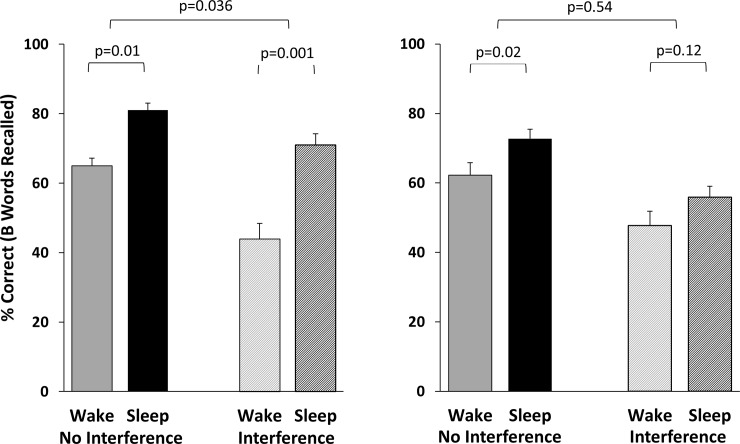
- Sleep and Wake groups showed similar interference-induced forgetting: Sleep dropped 16.9±2.3% from Retest 1 to Retest 2, and Wake dropped 14.6±3.0%; the Sleep × Interference interaction was not significant, F(1,95)=0.38, p=0.54, ηp2=0.004, failing to replicate the protective effect reported by Ellenbogen et al. (2009).
- Main effects were present: Sleep > Wake, F(1,95)=4.44, p=0.038, ηp2=0.04; and No-Interference > Interference, F(1,95)=70.61, p<.0001, ηp2=0.43. Pre-interference Retest 1 recall was 72.7±2.8% for Sleep vs 62.3±3.5% for Wake, t(95)=2.35, p=0.02, d=0.33; post-interference Retest 2 recall was 55.9±3.1% vs 47.7±4.1%, t(95)=1.59, p=0.12, d=0.23.
- Intrinsic motivation measures correlated with training and retest recall—e.g., Competence r=.55 at training, .49 at Retest 1, .39 at Retest 2; Enjoyment r=.42, .42, .36; Tension r=−.40, −.26, −.19; VAS Motivation r=.31, .23, .23—but none correlated with change from training to retest, and Fisher’s Z tests showed no Sleep vs Wake differences.
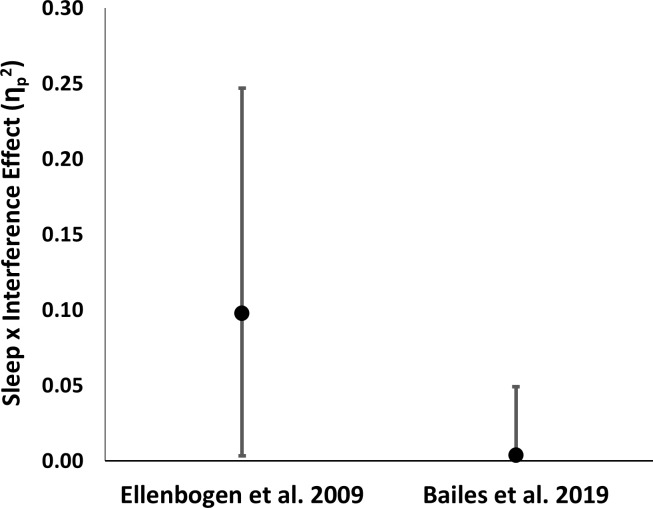
- The study was powered at 0.89 to detect the Ellenbogen et al. (2009) effect; the observed interaction effect was near zero (ηp2=0.004), and the original effect (ηp2=0.0985) fell outside the 90% confidence interval of the current effect.
Methods
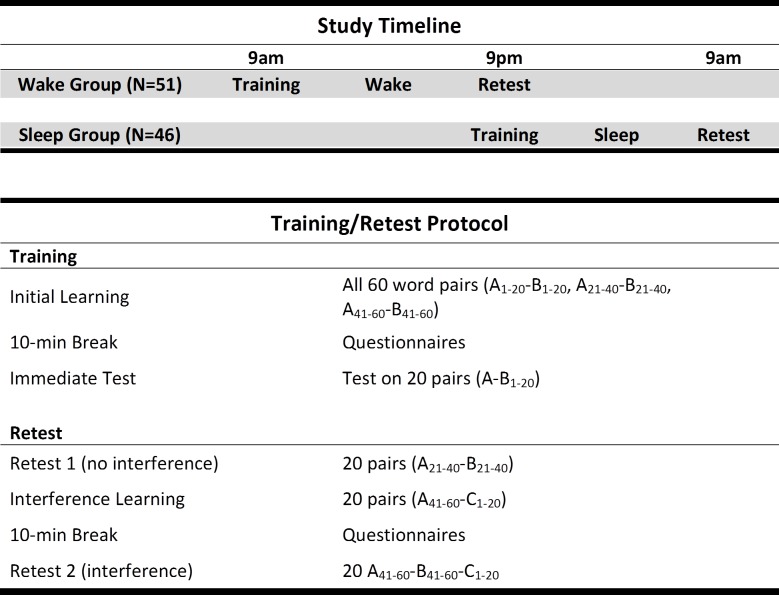
- Participants were 97 university students (age 23.2±1.9 yrs, range 18–28, 59 female); Sleep n=51, Wake n=46. Of 108 completers, 11 were excluded for stimulant/antidepressant medications (n=9) or reporting >2 hrs less sleep than typical the night before (n=2).
- The design replicated Ellenbogen et al. (2009): training at 9am or 9pm on 60 A-B word pairs, immediate test on 20 pairs, then 12 hrs later Retest 1 on a different 20 pairs before interference; participants then learned overlapping A-C pairs and completed Retest 2 on original B and new C words. Intrinsic motivation was measured with four Intrinsic Motivation Inventory items and two visual analog scale questions.
- Main analysis was a 2×2 ANOVA with Sleep/Wake (between) and Interference/No-Interference (within) on B-word recall at retest, plus t-tests and correlations; power analysis was conducted in G*Power, and the task was implemented in OpenSesame.
Limitations
- The paper states it cannot rule out a small protective effect of sleep against interference; the authors remain agnostic and note that all prior published reports were medium-to-large effects.
- The paper states a procedural difference from Ellenbogen et al. (2009): participants completed forms during the 10-minute breaks rather than non-verbal tasks, which may have produced added interference and influenced results.
- The paper states the motivation findings may reflect Type II error and that larger samples would be needed; payment may have affected intrinsic motivation ratings, and task differences (word pairs vs visual pairs) may explain differing motivation results. It also notes no handedness assessment, no Epworth Sleepiness Scale <10 requirement, and no screening for psychiatric, sleep, or neurological disorders, though medication exclusions were applied.
Model-written summary. Check it against the paper before relying on it.
Integrity signals
Registry
Cites
Statistics
Figures
Verification
Claims the paper makes
0 Valid · 1 Not valid · 29 Not checked · 43 Own results and interpretations
A result the paper reports from its own data — it cites no other source for it, so there is none to check. The quote shows it is in the paper.
In the paper
“Retest 1 –Prior to interference training: Sleep participants recalled more B words than Wake participants: 72.7±2.8%, 62.3±3.5%, t(95) = 2.35, p = 0.02, d = 0.33.”
- Also stated in: § Discussion · plain
“In the present study, as in the Ellenbogen studies, we found that, prior to interference training, those who slept had better memory for the word pairs than those who were awake during the 12hr interval.”
§ Does sleep protect memories against interference? A failure to replicate > Results > Paired associates performance
plain- Asserted: passes — The authors put it forward as true.
- Checkable: passes — It can be checked against evidence.
- Load-bearing: unclear — It is unclear whether the paper’s conclusions depend on it.
- Based: passes — The paper gives a reason why it holds.
- Also stated in: § Discussion · plain
A result the paper reports from its own data — it cites no other source for it, so there is none to check. The quote shows it is in the paper.
In the paper
“We also found that while intrinsic motivation benefitted task acquisition it was not a modulator of sleep-wake differences in memory processing.”
§ Does sleep protect memories against interference? A failure to replicate > Abstract
plain- Asserted: passes — The authors put it forward as true.
- Checkable: passes — It can be checked against evidence.
- Load-bearing: unclear — It is unclear whether the paper’s conclusions depend on it.
- Based: passes — The paper gives a reason why it holds.
A result the paper reports from its own data — it cites no other source for it, so there is none to check. The quote shows it is in the paper.
In the paper
“However, there were no significant correlations between any of these questionnaire measures and change in performance from training to retest.”
§ Does sleep protect memories against interference? A failure to replicate > Results > Intrinsic motivation
plain- Asserted: passes — The authors put it forward as true.
- Checkable: passes — It can be checked against evidence.
- Load-bearing: unclear — It is unclear whether the paper’s conclusions depend on it.
- Based: passes — The paper gives a reason why it holds.
A result the paper reports from its own data — it cites no other source for it, so there is none to check. The quote shows it is in the paper.
In the paper
“We also found that while intrinsic motivation benefitted task acquisition it was not a modulator of sleep-wake differences in memory processing.”
§ Does sleep protect memories against interference? A failure to replicate > Abstract
plainstates a cause- Asserted: passes — The authors put it forward as true.
- Checkable: passes — It can be checked against evidence.
- Load-bearing: unclear — It is unclear whether the paper’s conclusions depend on it.
- Based: passes — The paper gives a reason why it holds.
A result the paper reports from its own data — it cites no other source for it, so there is none to check. The quote shows it is in the paper.
In the paper
“As expected, there was a significant main effect of Sleep v. Wake, with memory for B words being superior in the Sleep group (F(1,95) = 4.44, p = 0.038, ηp2 = 0.04).”
§ Does sleep protect memories against interference? A failure to replicate > Results > Paired associates performance
plainstates a cause- Asserted: passes — The authors put it forward as true.
- Checkable: passes — It can be checked against evidence.
- Load-bearing: unclear — It is unclear whether the paper’s conclusions depend on it.
- Based: passes — The paper gives a reason why it holds.
26 more claims
Create a free account to see all 73 claims and to verify the 37 references still open.
- It may state two separate claims as one. 20
- Probably not a substantial claim. 30
Claims other papers make about this one
Each is checked against this paper’s own text: does it say what the citing paper says it does?
In the citing paper
“While a body of research has been in favour of sleep playing an active role in protecting new memories from interference by strengthening and stabilizing memory traces (e.g., Alger et al., 2012;Ellenbogen et al., 2009), more recent results have been conflicting, with some studies unable to replicate previous findings (e.g., Bailes et al., 2020;Pöhlchen et al., 2020).”
From The effect of sleep on novel word learning in healthy adults: a systematic review and meta-analysis (2021) · cites this paper as Bailes et al., 2020
Statistics recomputed
Every reported test result, recomputed from its test statistic and degrees of freedom. A result shows as not adding up only once an independent check has confirmed it.
- Consistentt(95) = 0.46reported p = .64 · recomputed p = .647
“t(95) = 0.46, p = .64”
- Consistentt(95) = 0.3reported p = .77 · recomputed p = .765
“t(95) = 0.30, p = .77”
- ConsistentF(1, 95) = 4.44reported p = .038 · recomputed p = .038
“F(1,95) = 4.44, p = .038”
- ConsistentF(1, 95) = 70.61reported p < .0001 · recomputed p < .001
“F(1,95) = 70.61, p < .0001”
- ConsistentF(1, 95) = 0.38reported p = .54 · recomputed p = .539
“F(1,95) = 0.38, p = .54”
5 more recomputed tests
Create a free account to see every test the Stats check recomputed.
Self-check
Percentages, sums and reported differences re-computed from the paper’s own numbers.
Each contradiction between two passages listed here was confirmed by an independent check.
Rated minor: it would not touch a result — a value no result rests on, a p-value that stays on the same side of the significance level, or a conflict that is clerical, resolved elsewhere in the paper, or outside its own findings.
In the paper
§ Does sleep protect memories against interference? A failure to replicate > Discussion
“The observed effect size for our sleep/wake x no-interference/interference interaction was near-zero (partial eta squared = 0.003)”
§ Does sleep protect memories against interference? A failure to replicate > Results > Paired associates performance
“F(1,95) = 0.38, p = 0.54, ηp2 = 0.004”
Rated minor: it would not touch a result — a value no result rests on, a p-value that stays on the same side of the significance level, or a conflict that is clerical, resolved elsewhere in the paper, or outside its own findings.
In the paper
§ Does sleep protect memories against interference? A failure to replicate > Results > Intrinsic motivation
“We found that three items in particular (Enjoyment, Competence, and Tension) correlated with performance (correct items) at training, Retest 1 (pre-interference learning), and Retest 2 (post-interference learning).”
§ Does sleep protect memories against interference? A failure to replicate > Results > Intrinsic motivation
“| Intrinsic Motivation Inventory | Tension | -.40 | < .001 | -.26 | .01 | -.19 | .06 |”
Citations
Cites
Statistical Power Analysis for the Behavioral Sciences
Muller, K. (1989) · Technometrics · doi:10.1080/00401706.1989.10488618 · Cited by 99,167
Faul, F., Erdfelder, E., Lang, A.-G., & Buchner, A. (2007) · Behavior Research Methods · doi:10.3758/bf03193146 · Cited by 65,971 · cited 1×
“Power analysis was conducted in GPower [35] using the module for within/between ANOVA interaction effects, and the “as in SPSS” option for type of partial eta squared effect size.”
MethodStatistical power analysis for the behavioral sciences
(1990) · Computers, Environment and Urban Systems · doi:10.1016/0198-9715(90)90050-4 · Cited by 65,269
Statistical Power Analysis for the Behavioral Sciences (2nd ed.).
Lachenbruch, P. A., & Cohen, J. (1989) · Journal of the American Statistical Association · doi:10.2307/2290095 · Cited by 37,395
A New Method for Measuring Daytime Sleepiness: The Epworth Sleepiness Scale
Johns, M. W. (1991) · Sleep · doi:10.1093/sleep/14.6.540 · Cited by 17,364
Memory - A century of consolidation
McGaugh, J. L. (2000) · Science · doi:10.1126/science.287.5451.248 · Cited by 4,250
Rasch, B., & Born, J. (2013) · Physiological Reviews · doi:10.1152/physrev.00032.2012 · Cited by 2,783 · cited 1×
“, fact-based information) improves following an interval filled with sleep as opposed to wakefulness [1-3].”
BackgroundInfluentialControl and information in the intrapersonal sphere: An extension of cognitive evaluation theory.
Ryan, R. M. (1982) · Journal of Personality and Social Psychology · doi:10.1037/0022-3514.43.3.450 · Cited by 2,721
McAuley, E., Duncan, T., & Tammen, V. V. (1989) · Research Quarterly for Exercise and Sport · doi:10.1080/02701367.1989.10607413 · Cited by 2,694
Facilitating Internalization: The Self‐Determination Theory Perspective
Deci, E. L., Eghrari, H., Patrick, B. C., & Leone, D. R. (1994) · Journal of Personality · doi:10.1111/j.1467-6494.1994.tb00797.x · Cited by 2,627
Cited by
Understanding the Need for Sleep to Improve Cognition
Leong, R. L. F., & Chee, M. W. L. (2022) · Annual Review of Psychology · doi:10.1146/annurev-psych-032620-034127 · Cited by 110
How robust are sleep-mediated memory benefits?
Cordi, M. J., & Rasch, B. (2021) · Current Opinion in Neurobiology · doi:10.1016/j.conb.2020.06.002 · Cited by 87
Systematic review and meta-analyses on the effects of afternoon napping on cognition
Leong, R. L. F., Lo, J. C., & Chee, M. W. L. (2022) · Sleep Medicine Reviews · doi:10.1016/j.smrv.2022.101666 · Cited by 51
Sleep’s contribution to memory formation
Lutz, N. D., Harkotte, M., & Born, J. (2025) · Physiological Reviews · doi:10.1152/physrev.00054.2024 · Cited by 60
Analyzing human sleep EEG: A methodological primer with code implementation
Cox, R., & Fell, J. (2020) · Sleep Medicine Reviews · doi:10.1016/j.smrv.2020.101353 · Cited by 60
Metadata
- Authors
- Bailes, C., Caldwell, M., Wamsley, E. J., & Tucker, M. A.
- Affiliations
- University of South Carolina (US)
- Furman University (US)
- Corresponding author
- Tucker, Matthew A.
- Venue
- PLOS ONE
- Publisher
- Public Library of Science (PLoS)
- Published
- 2020-02-13
- Volume
- 15
- Issue
- 2
- Pages
- e0220419
- ISSN
- 1932-6203 (ISSN-L)
- PMC
- PMC7018054
- OpenAlex
- W3005970542
- Semantic Scholar
- 677557785c869a76a0310393f024772ef39f2ee7
- Cited by
- 35
- References
- 39
- Citations by year
- 2026: 1 · 2025: 2 · 2024: 5 · 2023: 8 · 2022: 5 · 2021: 7 · 2020: 7
- FWCI
- 2.90
- Type
- journal article
- Language
- en
- Open access
- gold
- doi.org
- Licence
- Locations
- PLoS ONE (publishedVersion, cc-by)
- bioRxiv (Cold Spring Harbor Laboratory) (submittedVersion, cc-by)
- Europe PMC (PubMed Central) (publishedVersion, cc-by)
- PubMed Central (publishedVersion, cc-by)
- PubMed (publishedVersion)
- DOAJ (DOAJ: Directory of Open Access Journals) (submittedVersion)
- Funders
- National Institute of Mental Health (R15MH107891)
- Topics
- Life Sciences › Neuroscience › Cognitive Neuroscience › Sleep and Wakefulness Research
- Life Sciences › Neuroscience › Cognitive Neuroscience › Memory Processes and Influences
- Life Sciences › Neuroscience › Cognitive Neuroscience › Memory and Neural Mechanisms
- Keywords
- sleep, memory consolidation, retroactive interference, sleep-wake differences, memory retention, intrinsic motivation, replication failure, forgetting
- MeSH terms
- Data Accuracy, Memory Consolidation, Memory and Learning Tests, Adolescent, Adult, Female, Humans, Male, Motivation, Mental Recall, Sleep, Wakefulness, Reproducibility of Results, Young Adult
About these checks
Registry, retraction, Cites and statistics results are computed, not judged, with one exception: a printed reference that no index lists is read once by a model before it counts as a citation error. Claims are extracted by a model and kept only when their quote appears verbatim in the text; each cited source is then checked, with a model’s help, for whether it says what the claim relies on. Those verdicts can be wrong — read the claim’s quote and the cited source before relying on one.
A language model drew the claims from the paper on 2026-11-24, under version 3 of the claim definition (model deepseek-v4.1-flash, prompt extract-v3).
A second model labelled each claim on 2026-11-24 (model jev-1.13-20260917, definition revision gold-guideline-v0.2).
Statistics and arithmetic are recomputed, not judged.
Confidence bands are shown only for fields calibrated on our annotated test set. None is calibrated yet, so no band is shown.
What counts as a claim ›How we measure confidence ›How we check this ›
Are you an author, or do you see a problem with this page? Request a review
Data sources
Bibliographic data: Semantic Scholar, OpenAlex, Crossref.
Contains information from the Semantic Scholar Academic Graph Datasets, made available under the ODC Attribution License (ODC-BY 1.0).
Semantic Scholar’s data is described in: Kinney, R., et al. (2023). The Semantic Scholar Open Data Platform. arXiv:2301.10140.
