

Hate speech detection: Challenges and solutions
Open accessThe DOI matches its Crossref record; 36 of the 36 references it cites were found in a registry or an index.
Abstract
As online content continues to grow, so does the spread of hate speech. We identify and examine challenges faced by online automatic approaches for hate speech detection in text. Among these difficulties are subtleties in language, differing definitions on what constitutes hate speech, and limitations of data availability for training and testing of these systems. Furthermore, many recent approaches suffer from an interpretability problem-that is, it can be difficult to understand why the systems make the decisions that they do. We propose a multi-view SVM approach that achieves near state-of-the-art performance, while being simpler and producing more easily interpretable decisions than neural methods. We also discuss both technical and practical challenges that remain for this task.
Overview
The claims and statistics of this paper haven’t been checked yet.
Free: it reads the open-access text and checks the first 5 claims that cite a source we can check. Create a free account to check every claim.
Integrity signals
Registry
Cites
Statistics
Figures
Verification
Claims the paper makes
The claims and statistics of this paper haven’t been checked yet.
Free: it reads the open-access text and checks the first 5 claims that cite a source we can check. Create a free account to check every claim.
Claims other papers make about this one
Each is checked against this paper’s own text: does it say what the citing paper says it does?
The cited source says what the claim attributes to it.
In the citing paper
“Detecting hate speech is a challenging endeavour as there are several definitional conflicts and variances.”
From Misogynoir: challenges in detecting intersectional hate (2022) · cites this paper as MacAvaney et al. 2019
The cited source says what the claim attributes to it.
In the citing paper
“According to(MacAvaney etal. 2019), these opposing definitions complicate the assessment of hate speech systems, resulting in datasets derived from disparate sources and capturing disparate information.”
From Misogynoir: challenges in detecting intersectional hate (2022) · cites this paper as MacAvaney et al. 2019
Self-check
Percentages, sums and reported differences re-computed from the paper’s own numbers.
The self-check needs the paper’s full text.
Citations
Cites
BERT: Pre-training of Deep Bidirectional Transformers for Language Understanding
Devlin, J., Chang, M.-W., Lee, K., & Toutanova, K. (2018) · arXiv · doi:10.48550/arxiv.1810.04805 · Cited by 73,173 · cited 13×
“BERT is a recent transformer-based pre-trained contextualized embedding model extendable to a classification model with an additional output layer.”
BackgroundMethodInfluentialScikit-learn: Machine Learning in Python
Pedregosa, F., Varoquaux, G., Gramfort, A., Michel, V., Thirion, B., Grisel, O., Blondel, M., Müller, A., Nothman, J., Louppe, G., et al. (2012) · arXiv · doi:10.48550/arxiv.1201.0490 · Cited by 71,016
Convolutional Neural Networks for Sentence Classification
Kim, Y. (2014) · Proceedings of the 2014 Conference on Empirical Methods in Natural Language Processing (EMNLP) · doi:10.3115/v1/d14-1181 · Cited by 14,831 · cited 1×
“Their network structure is similar to the one proposed by [30], with convolutions of length 3 pooled over the entire document length.”
BackgroundA vector space model for automatic indexing
Salton, G., Wong, A., & Yang, C. S. (1975) · Communications of the ACM · doi:10.1145/361219.361220 · Cited by 7,521 · cited 1×
“In this setting, there are various ways to assign weights to the terms that may be more important, such as TF-IDF [23].”
BackgroundBag of Tricks for Efficient Text Classification
Joulin, A., Grave, E., Bojanowski, P., & Mikolov, T. (2017) · Proceedings of the 15th Conference of the European Chapter of the Association for Computational Linguistics: Volume 2, Short Papers · doi:10.18653/v1/e17-2068 · Cited by 4,545
Bag of Tricks for Efficient Text Classification
Joulin, A., Grave, E., Bojanowski, P., & Mikolov, T. (2016) · arXiv · doi:10.48550/arxiv.1607.01759 · Cited by 4,542 · cited 1×
“FastText [32].”
Popular Ensemble Methods: An Empirical Study
Opitz, D., & Maclin, R. (1999) · Journal of Artificial Intelligence Research · doi:10.1613/jair.614 · Cited by 2,953 · cited 1×
“Combining machine learning classifiers is not a new concept [35].”
BackgroundAutomated Hate Speech Detection and the Problem of Offensive Language
Davidson, T., Warmsley, D., Macy, M., & Weber, I. (2017) · Proceedings of the International AAAI Conference on Web and Social Media · doi:10.1609/icwsm.v11i1.14955 · Cited by 2,610
Jain, S., & Wallace, B. (2019) · Conference of the North American Chapter of the Association for Computational Linguistics: Human Language Technologies (NAACL-HLT) · doi:10.18653/v1/n19-1357 · Cited by 2,023 · cited 2×
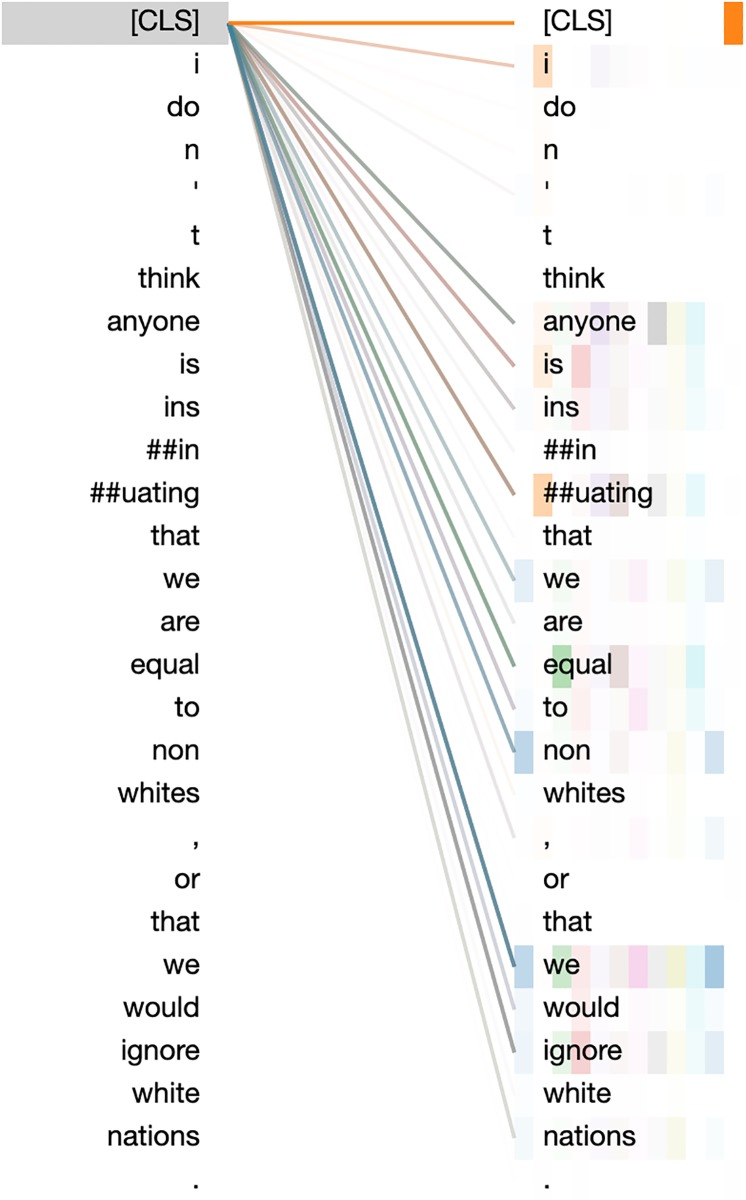
“These observations are in line with prior work that has found attention signals to be noisy and not necessarily indicative of term importance [39, 40].”
ResultHateful Symbols or Hateful People? Predictive Features for Hate Speech Detection on Twitter
Waseem, Z., & Hovy, D. (2016) · Proceedings of the NAACL Student Research Workshop · doi:10.18653/v1/n16-2013 · Cited by 1,655 · cited 3×
“Waseem and Hovy also provide a dataset from Twitter, consisting of 16,914 tweets labeled as racist, sexist, or neither [17].”
BackgroundMethodInfluential
Research works printed but not linked: 3
- Nockleby JT. Hate Speech. Encyclopedia of the American Constitution. 2000; 3: 1277– 79.
- Mikolov T, Sutskever I, Chen K, Corrado GS, Dean J. Distributed Representations of Words and Phrases and their Compositionality. In: Burges CJC, Bottou L, Welling M, Ghahramani Z, Weinberger KQ, editors. Advances in Neural Information Processing Systems 26. Curran Associates, Inc.; 2013. p. 3111–3119.
- Waseem Z. Are You a Racist or Am I Seeing Things? Annotator Influence on Hate Speech Detection on Twitter. In: NLP+CSS @ EMNLP; 2016. · DOI · Paper page
Cited by
Items 501–579 of 579
Bhattacharya, P., Simons, J. J., Yuen, C. T. H., & Quek, B. (2024) · SocArXiv (OSF Preprints) · doi:10.31235/osf.io/r8fhm
Enhancing Hate Speech Detection: Evaluation of Classification Models and Techniques
Dodda, R., Putta, P. R., Shulamite, E. C., & Ashwini, K. (2024) · Lecture notes in electrical engineering · doi:10.1007/978-981-97-8031-0_2
Shafiq, S. (2024) · GLOBAL PSYCHIATRY ARCHIVES · doi:10.52095/gpa.2024.7525.1096
A Multi-modal Framework to Counter Hate Speeches
Bhesra, K., & Agarwal, A. (2024) · Lecture notes in computer science · doi:10.1007/978-3-031-78119-3_14 · Cited by 2
Vecchi, L. P., Barbon, S., & Paraíso, E. C. (2025) · Lecture notes in computer science · doi:10.1007/978-3-031-79038-6_18
Hate Speech Detection Using Recurrent Neural Networks (RNN)
Pokkuluri, K. S., Sivakoti, R., Raja Rao, P. B. V., Murty, P. T. S., Pamarthi, N., Chintalapati, P. V., Babu, G. R., & N, S. S. S. N. U. D. (2025) · Lecture notes of the Institute for Computer Sciences, Social Informatics and Telecommunications Engineering · doi:10.1007/978-3-031-77081-4_5
Narayana, V. A., Rao, K. V., Reddy, L. C. S., Maheswari, K., Narasimharao, J., & Karunasree, B. (2024) · IEEE International Conference on Cybernetics, Cognition and Machine Learning Applications (ICCCMLA) · doi:10.1109/icccmla63077.2024.10871764
“The researchers utilized the stormfront and TRAC datasets as referenced in [4].”
Chaturvedi, T., Sangeetha, S. R., & Duraisamy, P. (2024) · International Journal of Health & Allied Sciences · doi:10.55691/2278-344x.1099 · Cited by 1
Khan, Z. R., & Punia, S. K. (2024) · International Conference on Advances in Computing, Communication and Networking (ICAC2N) · doi:10.1109/icac2n63387.2024.10895919
A Framework for Detection of Hate Speech in Social Media: Achieving Societal Resilience
Ojha, N. K., Vaish, A., Dwivedi, S., Markandey, B. K., & El-Gazzar, R. F. (2025) · Advances in social networking and online communities book series · doi:10.4018/979-8-3693-9904-0.ch010
The Use of Social Media as a Provocation Tool: A Case Analysis of Pope Francis' Visit to Indonesia
Evelin, V., Aristoteles, & Dewi, Y. F. (2025) · Journal of Law Politic and Humanities · doi:10.38035/jlph.v5i3.1233 · Cited by 1
“According to (MacAvaney et al., 2019) many violations go undetected, and offenders often face no legal consequences, highlighting the gap between the legal framework's reach and its actual implementation.”
Shaik, M. B., & Rao, D. S. (2025) · Lecture notes in networks and systems · doi:10.1007/978-981-96-1267-3_43
Automated Detection of Hate Speech in Hindi using Supervised Learning Models
Rajak, N., Phulre, A. K., Patel, S. C., Patel, N. D., & Khekare, G. S. (2024) · International Conference on Distributed Systems, Computer Networks and Cybersecurity (ICDSCNC) · doi:10.1109/icdscnc62492.2024.10939991
“[17].”
Hate Contagion: Measuring the spread and trajectory of hate on social mediaPreprint
Gallacher, J., & Bright, J. (2021) · PsyArXiv (OSF Preprints) · doi:10.31234/osf.io/b9qhd_v1 · Cited by 5
Abusive Content Detection with LangChain Integration Using Fine-Tuned RoBERTa
Pathak, A., & Rathor, S. (2025) · IEEE International Conference on Communication Systems and Network Technologies (CSNT) · doi:10.1109/csnt64827.2025.10968367
“The explainability feature can help establish intent in legal contexts, supporting investigations and legal proceedings [16].”
DETECÇÃO AUTOMÁTICA DE DISCURSO HOMOFÓBICO UTILIZANDO APRENDIZADO DE MÁQUINA
Silva, S. H. S., Medeiros, E. C., Moser, P. C., Silva, B. G. F., Carvalho, F. F. D., Fonsêca, J. C. B., de Andrade, R. C. D., & Domingues, M. A. D. O. (2025) · Aracê. · doi:10.56238/arev7n5-029
Systematic Literature Review Kekerasan dan Ujaran Kebencian di Media Online dan Televisi
Putra, S. J., & S.Sos., M. M. K. F. (2025) · Calathu Jurnal Ilmu Komunikasi · doi:10.37715/calathu.v7i1.4967
“Kesulitan-kesulitan tersebut antara lain adalah kehalusan bahasa, perbedaan definisi mengenai apa yang dimaksud dengan ujaran kebencian, dan keterbatasan ketersediaan data untuk identifikasi dan pencegahan (MacAvaney et al., 2019).”
Inflammable Intention Detector for Social Media
Saini, A., Jain, A., Naaz, S., Fatima, E., & Dhuriya, G. (2024) · International Conference on Communication, Computing and Energy Efficient Technologies (I3CEET) · doi:10.1109/i3ceet61722.2024.10994134
Hate Speech in Gus Miftah Instagram Comment Section: An Ice Tea Seller Case Study
Sirait, N. S. B., Purba, R., Silitonga, M. U. A., & Putri, D. M. (2025) · Linguistik Terjemahan Sastra (LINGTERSA) · doi:10.32734/lingtersa.v6i1.19205 · Cited by 1
Salameh, K., Hamza, S., & Atiani, S. (2025) · International Conference on New Trends in Computing Sciences (ICTCS) · doi:10.1109/ictcs65341.2025.10989352
“As a result, Detecting hate speech becomes needed to promote secure online environments and maintain human rights [3].”
Varsha, T. S., & Rajkumar, M. (2025) · AIP conference proceedings · doi:10.1063/5.0270501
Saha, P., Das, M., & Mukherjee, A. (2025) · Synthesis lectures on human language technologies · doi:10.1007/978-3-031-86595-4_3
Rodrigues, S., Ruzario, C., Pereira, C., & Tripathy, A. K. (2025) · Lecture notes in networks and systems · doi:10.1007/978-981-96-2299-3_32
Dunivin, Z. O., & Lanigan, A. (2025) · Oxford University Press eBooks · doi:10.1093/9780198945253.003.0064 · Cited by 1
Coats, S. (2025) · De Gruyter eBooks · doi:10.1515/9783111434018-011 · Cited by 2
Kumar, K. L., & Thinakaran, K. (2025) · AIP conference proceedings · doi:10.1063/5.0277143
Explaining Implicit Offensive Language in Dialogues
Wu, Z. Q., Li, X., Zhang, X., & Wang, T. (2025) · Lecture notes in computer science · doi:10.1007/978-981-96-9884-4_10
Regulating online hate will have unintended, but predictable, consequences
Davies, G. J., & Negrin, S. (2022) · doi:10.64628/aam.57md3wytk
Enhancing Ride-Hailing Safety through Real-Time Speech-Based Violence Detection
Waleed, M., Yasser, M., Magdy, M., Elkady, M., Hesham, T., & Abdelsalam, K. (2025) · International Journal of Telecommunications · doi:10.21608/ijt.2025.392310.1114
“MacAvaney et al. [ 5] developed a multi-view SVM for hate speech detection on static Twitter datasets but explicitly noted its inability to process streaming audio or run on edge devices.”
Contiendas universitarias de hoy ¿y mañana?: polarización política y precarización docente
Piramo, C. C. D., & Domínguez, A. R. (2025) · Revista Internacional de Teoría e Investigación Educativa · doi:10.5209/ritie.103058
Munn, L. (2025) · De Gruyter eBooks · doi:10.1515/9783111316857-033
Asim, M. N., Ahmed, S., & Dengel, A. R. (2025) · Springer eBooks · doi:10.1007/978-3-031-90454-7_2
Improving Hindi Hate Speech Detection: Optimized LSTM with Sparrow Search and G-BERT Model
Chauhan, S., Deepanshi, & Srivastava, J. (2025) · Lecture notes in networks and systems · doi:10.1007/978-981-96-7137-3_9
Few-Shot Detection of Hate Videos Using Multi-Modal Large Language Models
Ma, J., Aldeen, M. S., Luo, F., & Cheng, L. (2025) · ACM Workshop on Deepfake, Deception, and Disinformation Security (3D-Sec) · doi:10.1145/3733813.3764370 · Cited by 1
“Most works have focused on text-based hate speech detection in the past decade [12].”
Resume Parser for Computer Science and Information Technology Domains Using Text Mining
Yee, C. K., Junn, K. Y., Yi, V. P., Yee, F. W., June, T. L., & Moosavi, M. S. (2025) · Lecture notes in electrical engineering · doi:10.1007/978-981-96-7253-0_48
Techniques for Detecting Hate Speech in AI and Human-Generated Content
Goswami, C., Sheikh, A. I., Bhaskar, A., & Vaya, D. (2025) · Advances in computational intelligence and robotics book series · doi:10.4018/979-8-3373-3063-1.ch013
AuslegungAuslegung von Hassrede an der Schnittstelle von Linguistik und Justiz
Fuchs-Kreiß, J., & Oğlakcıoğlu, M. T. (2025) · De Gruyter eBooks · doi:10.1515/9783111683041-006
Analysis of Hate Speech Recognition Using SVM and Naïve Bayes Classifier
Chaudhari, A., & Borole, R. (2025) · Lecture notes in networks and systems · doi:10.1007/978-981-96-3860-4_30
Espín-Riofrio, C., Montalván, P. D. Á. O. Y., Carchi-Encalada, R., Candelario, M. M. A., Cruz-Chóez, A., Montesdeoca-Rodríguez, J., & Bailón-Guaranda, M. (2025) · LACCEI International Multi-Conference for Engineering, Education and Technology (LACCEI) · doi:10.18687/laccei2025.1.1.624
Cross-Platform Hate Speech Propagation Analysis using Machine Learning
Kalaivani, R., Megalan, A., Selvarathinam, S., & Pragadheesh, P. (2025) · International Conference on Innovative Mechanisms for Industry Applications · doi:10.1109/icimia67127.2025.11200817
“[20].”
Transformers and Deep Learning Models for Hate Speech Detection in the Dialects Arabic Language
Ouali, S., & Garouani, S. E. (2026) · Lecture notes in networks and systems · doi:10.1007/978-3-032-07785-1_12 · Cited by 1
The Prospects of Detecting and Flagging Online Hate Speech in Real-time
Tirumala, S. S., Minhas, S., & Khwakhali, U. S. (2025) · IEEE Intl Conf on Dependable, Autonomic and Secure Computing, Intl Conf on Pervasive Intelligence and Computing, Intl Conf on Cloud and Big Data Computing, Intl Conf on Cyber Science and Technology Congress (DASC/PiCom/CBDCom/CyberSciTech) · doi:10.1109/cyberscitech68397.2025.00080
“Targeted hate has sparked numerous communal incidents worldwide [2], such as the September 11 attacks on the Twin Towers [3], the Christchurch Mosque shooting in New Zealand, and the Capitol Hill occupation [4].”
Dobaria, H., Thakar, H. A., & Gopani, J. (2026) · Lecture notes in networks and systems · doi:10.1007/978-981-95-2878-3_37
Santos, G. L., dos Santos, V. G., Kearns, C., Sinclair, G., Black, J., Doidge, M., Fletcher, T., Kilvington, D., Liston, K., Endo, P., et al. (2026) · Journal Of Big Data · doi:10.1186/s40537-026-01379-8 · Cited by 1
Halama, M., Połys, K., & Domańska, J. (2025) · IEEE International Conference on Big Data (BigData) · doi:10.1109/bigdata66926.2025.11401764
“Similarly, Schmidt and Wie-gand [11] and MacAvaney et al. [12] provided extensive surveys of feature engineering techniques, supervised models, and the challenges of annotation and context modeling, with more recent works suggesting that LLMs can achieve performance comparable to or even surpassing…”
Leveraging Advanced Deep Learning Approaches for Detecting Implicit Hate Speech in Arabic
Himdi, H., Alahdal, S., Alsafari, S., & Alhayan, F. (2026) · Arabian Journal for Science and Engineering · doi:10.1007/s13369-026-11125-0
“These findings emphasize the imperative of implementing proficient detection methods that can comprehend contextual and nuanced intent [24].”
A Machine Learning Framework for Tiered Cyberbullying Severity Assessment and Escalation
Cinthuja, K., Preetha Evangeline, D., Rekha, M., Subramani, K., Deepika, J., & Abinaya, S. (2026) · International Conference on Image Processing and Capsule Networks (ICIPCN) · doi:10.1109/icipcn67432.2026.11438491 · Cited by 1
From tweets to traits: Profiling hate speech propagators on social media
Rawat, A., Chaturvedi, N., & Samant, S. S. (2026) · Social Sciences & Humanities Open · doi:10.1016/j.ssaho.2026.102761 · Cited by 1
Expanding the training data for neural network based hate speech classification
d'Sa, A. G. (2022) · theses.fr (ABES) · doi:10.70675/e5736942z9e13z4754z926fzad5d682c3a40
Transfer learning for abusive language detection
Bose, T. (2023) · theses.fr (ABES) · doi:10.70675/6b663c61zb592z4422zbc5fza68cbc285104 · Cited by 1
Sansegundo-Moreno, O. (2024) · theses.fr (ABES) · doi:10.70675/665d9111z27aez4cbdz99c9za6ff43fd03c9 · Cited by 1
Uddowla, A. N. M. A., Riad, S. M., Shorif, M. H., Uddin, M. B., & Patwary, M. J. A. (2025) · International Conference on Computer and Information Technology (ICCIT) · doi:10.1109/iccit68739.2025.11491106
“In comparison to neural approaches, the multi-view SVM strategy proposed in [13] enables roughly cutting-edge hate speech recognition.”
Bhuiyan, F. M., Hossain, M. F., Rizon, M. S. H., & Farha, S. (2025) · IEEE International Conference on Signal Processing, Information, Communication and Systems (SPICSCON) · doi:10.1109/spicscon69221.2025.11504163
“MacAvaney et al. studied empirically these problems they suggested learning methods more natural to transfer between datasets, raising a lot of the problems we are still dealing with today in practice [3].”
Yadav, A., & Singh, V. (2026) · International World Wide Web Conference (WWW) · doi:10.1145/3774905.3796488
“In real-world moderation applications, hateful content can be expressed in a single modality, be inconsistent across modalities, or depend on world knowledge that goes beyond learned representations [20].”
Beyond Humans: AI Perceptions of Speciesism in Figurative Language on Social Media
Bhattacherjee, M., & Sinha, S. (2026) · Topoi · doi:10.1007/s11245-026-10389-3
Deep Learning with a Human Touch: Detecting Cyberbullying Through Empathy-Informed Models
Jana, A., Sahoo, A., Nath, A., Sarkar, D., Ghosh, T., & Roy, D. (2026) · Smart innovation, systems and technologies · doi:10.1007/978-3-032-21164-4_15
Normalizing hostility: TikTok netizens and hate speech on Ahmad Sahroni
Syafiq, M., Simarmata, A. A., Purba, T. M., Pane, J. W., Tumanggor, H. J., & Putri, D. M. (2026) · Journal Albion Journal of English Literature Language and Culture · doi:10.33751/albion.v8i1.29
Temporal Anomaly Detection and Threat Intelligence Analysis in Telegram Cybersecurity Channels
Daranda, A., Kankevičienė, L., & Daranda, J. (2026) · Baltic Journal of Modern Computing · doi:10.22364/bjmc.2026.14.2.01
Empowering hate speech detection with BERT and traditional deep learning models
Shaik, M., Ganthi, S., Gonuguntla, P., Nagavarapu, S. S., Bolla, J. V., & Neelima, P. (2026) · AIP conference proceedings · doi:10.1063/5.0342483
Crowd-Sourced Lexicons and Genetic Algorithms for Accurate Hate Speech Detection in Social Media
Khaleel, Z. R., Al-Qaraghuli, M. H., Marzoog, D., Shendi, T. A., & Rady, A. A. (2026) · International Conference on Machine Intelligence and Smart Innovation (ICMISI) · doi:10.1109/icmisi69868.2026.11584224
“N-grams capture sequence of words in a document, making them more capable of detecting multi-word phrases or patterns that are indicative of hate speech [11].”
Leveraging Large Language Models and Social Media Scraping for Online Insurgent Narrative Detection
Mythili, R., Singh, A., S, K. R. M., S, S. S. M., K, R. B., Balaji, C., & Mithileysh Sathyanarayanan, S. (2026) · Procedia Computer Science · doi:10.1016/j.procs.2026.06.490
VoiceUp: A Smart Civic Issue Reporting Platform for Reliable Urban Complaint Management
Nirmaleswaran, V., Harishram, M., Tharsan, R., Sarma, J., V, Kasthuriarachchi, S., & Rajendran, K. (2026) · International Conference on Computational Intelligence and Communication Networks (CICN) · doi:10.1109/cicn70047.2026.11594189
“Similarly, research on hate-speech and abusive-language detection demonstrates that contextual language models are substantially more effective than simple keyword rules when the input is short, informal, and semantically ambiguous [3], [4].”
A Novel Deep Learning Approach for Hate Speech Detection on Social Platforms
Impana, K. P., Vikhyath, K. B., Pavana, M., Hemalatha, A. N., & Shetti, N. S. (2026) · Communications in computer and information science · doi:10.1007/978-3-032-19321-6_32
Some Final Thoughts on Online Hate: Where We’ve Been and Where We’re Going
E.Hawdon, J., Räsänen, P., & Costello, M. (2026) · Emerald Group Publishing Limited eBooks · doi:10.1108/978-1-83708-352-720261008
Demirci, F., Garip, Z. B., & Ekıncı, E. (2026) · Cluster Computing · doi:10.1007/s10586-026-06293-5
Detecção de Misoginia em Redes Sociais
Rangel, J., Feitosa, A., Rios, A., Ferrari, L., Junior, F., Belloze, K. T., Ogasawara, E., & Guedes, G. (2026) · Anais do Brazilian Workshop on Social Network Analysis and Mining (BraSNAM) · doi:10.5753/brasnam.2026.23131
Explainable AI for Detecting Harassment and Extremism in Voice Chat
Bhatti, U. A., Gulzar, Y., Ghadi, Y. Y., Sаpаyev, V., Kosimov, O., Sultanova, S., & Urozboev, K. (2026) · IGI Global eBooks · doi:10.4018/979-8-2600-1664-0.ch003
Santos, V. S., & Guedes, G. (2026) · Anais do Brazilian Workshop on Social Network Analysis and Mining (BraSNAM) · doi:10.5753/brasnam.2026.21838
Azmi, F. B., Mamat, N., Abdulghafor, R. A. A., Qasem, S. N., Albarrak, A. M., & Aborujilah, A. (2026) · IEEE Access · doi:10.1109/access.2026.3723882
Hate Speech Detection on Twitter Using TF-IDF and GAT with Imbalance Handling Techniques
Nath, B., Sahoo, D., Nanda, A., Sahoo, S. K., & Sarangi, S. K. (2026) · Lecture notes in networks and systems · doi:10.1007/978-3-032-19521-0_16
Kuhail, M. A., Dahu, B. M., Kittur, J., & Thornquist, E. (2026) · Journal of Computer Assisted Learning · doi:10.1002/jcal.70319 · Cited by 1
Tuo, B., Miller, T., & Demartini, G. (2026) · ACM Conference on Human-AI Complementarity and Alignment · doi:10.1145/3834580.3838739
“First, its linguistic subtlety—sarcasm, humor, euphemism, and metaphor—limits the reliability of automated classifiers [39].”
Language as data, hate as task: The epistemic normalisation of hate speech in AI
Ullmann, S. (2026) · Discourse Studies · doi:10.1177/14614456261487861
Siddiqui, J. A., & Dahar, N. N. (2026) · Social Sciences Spectrum · doi:10.71085/sss.05.04.611
“In a brief orderly test of the drama, MacAvaney et al. (2019) thought-out newspapers written before January 2020.”
Offensive Language Detection in Social Media Text Using N-Gram Features and Multinomial Naïve Bayes
Hisham, N. A. S. N., Zainal, M. A., Zolkafly, A. S., Canda, R., Kadir, K. A., & Sadjirin, R. (2026) · International Conference on Artificial Intelligence and Data Sciences (AiDAS) · doi:10.1109/aidas71914.2026.11712643
“Nevertheless, offensive meaning remains difficult to model because it may depend on context, sarcasm, target identity, spelling variation, quotation, and local community norms [6].”
Digital Precarity: Platform Power and Posthuman Vulnerability
Ibrahim, Y. (2026) · Routledge eBooks · doi:10.4324/9781003694014
Evaluating Machine Learning Techniques for Automated Hate Speech Detection
Alenizi, A. S., Al-Karawi, K. A., & Qerom, M. A. (2026) · Lecture notes in networks and systems · doi:10.1007/978-3-032-34132-7_5
Improving the Hate Speech Annotation Process with Large Language Models
Svetasheva, A., & Lee, K. (2026) · ACM SIGMIS Database the DATABASE for Advances in Information Systems · doi:10.1145/3848645.3848651 · Cited by 1
“This creates both conceptual and annotation problems where various scholars and annotators may have a range of ideas about what constitutes hate speech and what is not (MacAvaney et al., 2019).”
Campos, J. M. T. S., Chaves, D. T., Gomes, R. M., Meira, W., Gonçalves, M. A., & Leonardo, R. (2026) · Brazilian Symposium on Multimedia and the Web · doi:10.5753/webmedia.2026.30722
Metadata
- Authors
- MacAvaney, S., Yao, H.-R., Yang, E., Russell, K., Goharian, N., & Frieder, O.
- Affiliations
- Georgetown University (US)
- Corresponding author
- MacAvaney, Sean
- Venue
- PLOS ONE
- Publisher
- Public Library of Science (PLoS)
- Published
- 2019-08-20
- Volume
- 14
- Issue
- 8
- Pages
- e0221152
- ISSN
- 1932-6203 (ISSN-L)
- PMC
- PMC6701757
- OpenAlex
- W2969662548
- Cited by
- 566
- References
- 36
- Citations by year
- 2026: 33 · 2025: 79 · 2024: 86 · 2023: 116 · 2022: 103 · 2021: 104 · 2020: 42 · 2019: 3
- FWCI
- 28.43
- Type
- journal article
- Language
- en
- Open access
- gold
- doi.org
- Licence
- Locations
- PLoS ONE (publishedVersion, cc-by)
- Europe PMC (PubMed Central) (publishedVersion, cc-by)
- PubMed Central (publishedVersion, cc-by)
- PubMed (publishedVersion)
- DOAJ (DOAJ: Directory of Open Access Journals) (submittedVersion, cc-by-sa)
- Figshare (submittedVersion, cc-by)
- Topics
- Physical Sciences › Computer Science › Artificial Intelligence › Hate Speech and Cyberbullying Detection
- Physical Sciences › Computer Science › Artificial Intelligence › Sentiment Analysis and Opinion Mining
- Social Sciences › Sociology and Political Science › Misinformation and Its Impacts
- Keywords
- hate speech detection, online texts, interpretability, model interpretability, definition of hate speech, limited training data
- MeSH terms
- Machine Learning, Hate, Humans, Language, Violence, Data Mining, Social Media, Datasets as Topic
About these checks
Registry, retraction, Cites and statistics results are computed, not judged, with one exception: a printed reference that no index lists is read once by a model before it counts as a citation error. Claims are extracted by a model and kept only when their quote appears verbatim in the text; each cited source is then checked, with a model’s help, for whether it says what the claim relies on. Those verdicts can be wrong — read the claim’s quote and the cited source before relying on one.
Statistics and arithmetic are recomputed, not judged.
Confidence bands are shown only for fields calibrated on our annotated test set. None is calibrated yet, so no band is shown.
What counts as a claim ›How we measure confidence ›How we check this ›
Are you an author, or do you see a problem with this page? Request a review
Data sources
Bibliographic data: Semantic Scholar, OpenAlex, Crossref.
Contains information from the Semantic Scholar Academic Graph Datasets, made available under the ODC Attribution License (ODC-BY 1.0).
Semantic Scholar’s data is described in: Kinney, R., et al. (2023). The Semantic Scholar Open Data Platform. arXiv:2301.10140.
