

The DOI matches its Crossref record; 51 of the 53 references it cites were found in a registry or an index.
Why Cohen’s Kappa should be avoided as performance measure in classification
Open accessAbstract
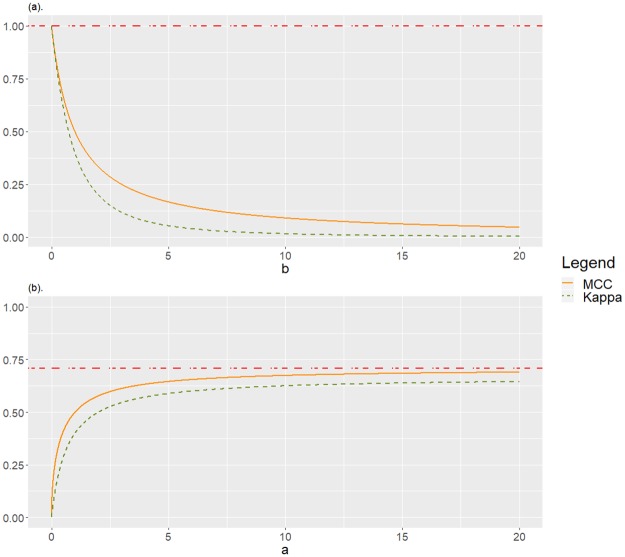
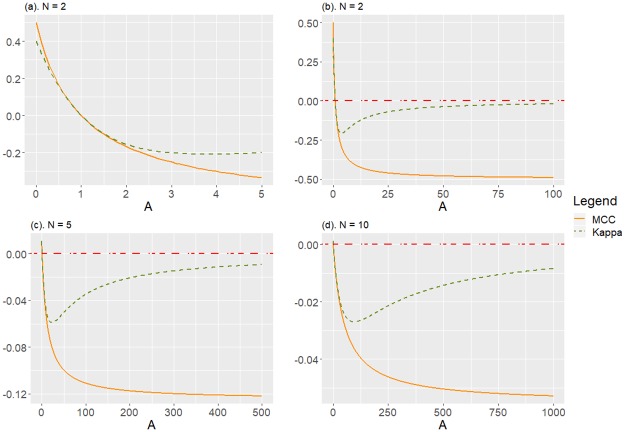
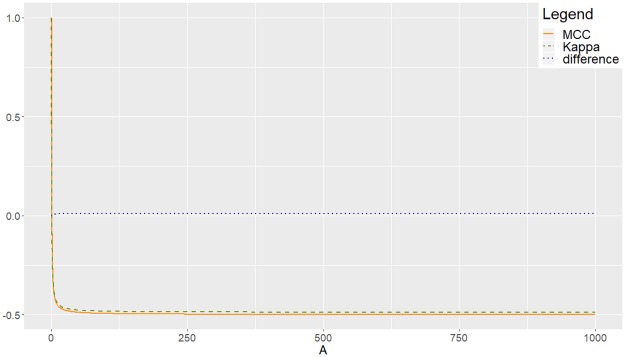
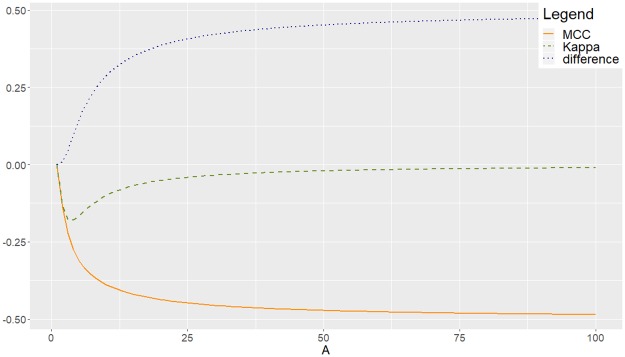
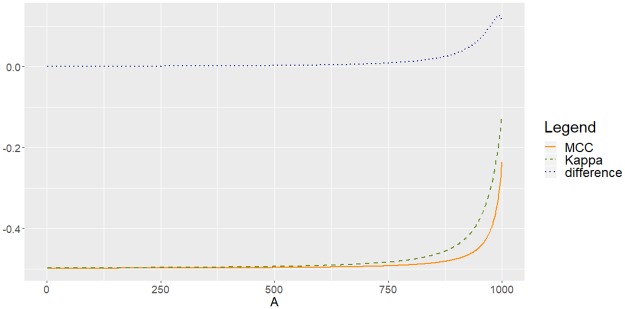
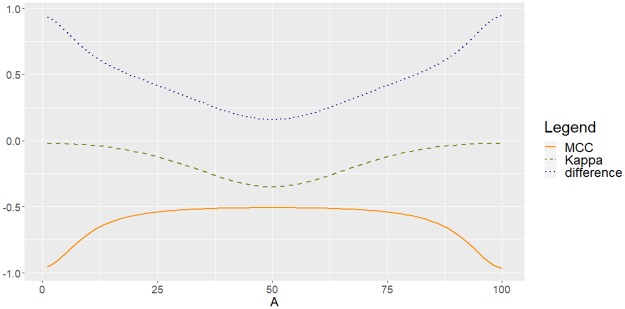
We show that Cohen's Kappa and Matthews Correlation Coefficient (MCC), both extended and contrasted measures of performance in multi-class classification, are correlated in most situations, albeit can differ in others. Indeed, although in the symmetric case both match, we consider different unbalanced situations in which Kappa exhibits an undesired behaviour, i.e. a worse classifier gets higher Kappa score, differing qualitatively from that of MCC. The debate about the incoherence in the behaviour of Kappa revolves around the convenience, or not, of using a relative metric, which makes the interpretation of its values difficult. We extend these concerns by showing that its pitfalls can go even further. Through experimentation, we present a novel approach to this topic. We carry on a comprehensive study that identifies an scenario in which the contradictory behaviour among MCC and Kappa emerges. Specifically, we find out that when there is a decrease to zero of the entropy of the elements out of the diagonal of the confusion matrix associated to a classifier, the discrepancy between Kappa and MCC rise, pointing to an anomalous performance of the former. We believe that this finding disables Kappa to be used in general as a performance measure to compare classifiers.
Overview
The claims and statistics of this paper haven’t been checked yet.
Run the check — free, no account needed. It reads the open-access text and checks the sources it cites.
Integrity signals
Registry
Cites
Statistics
Figures


Verification
Claims the paper makes
The claims and statistics of this paper haven’t been checked yet.
Run the check — free, no account needed. It reads the open-access text and checks the sources it cites.
Claims other papers make about this one
Each is checked against this paper’s own text: does it say what the citing paper says it does?
The cited source doesn’t support the claim as written.
In the citing paper
“Cohen’s Kappa is an useful metric for imbalanced datasets; however, the interpretation of its value is problematic [84].”
From A Survey of Underwater Acoustic Data Classification Methods Using Deep Learning for Shoreline Surveillance (2022) · cites this paper as [84]
Checked by a reasoning model — may be wrong.
Experimental — accuracy not yet measured
Self-check
Percentages, sums and reported differences re-computed from the paper’s own numbers.
The self-check needs the paper’s full text.
Citations
Cites
Scikit-learn: Machine Learning in Python
Pedregosa, F., Varoquaux, G., Gramfort, A., Michel, V., Thirion, B., Grisel, O., Blondel, M., Müller, A., Nothman, J., Louppe, G., et al. (2012) · arXiv · doi:10.48550/arxiv.1201.0490 · Cited by 71,016
A Coefficient of Agreement for Nominal Scales
Cohen, J. (1960) · Educational and Psychological Measurement · doi:10.1177/001316446002000104 · Cited by 42,398
Data Mining: Practical Machine Learning Tools and Techniques
Witten, I. H., Frank, E., & Hall, M. A. (2011) · Elsevier eBooks · doi:10.1016/c2009-0-19715-5 · Cited by 25,543
Content Analysis: An Introduction to its Methodology.
Shelley, M., & Krippendorff, K. (1984) · Journal of the American Statistical Association · doi:10.2307/2288384 · Cited by 24,346
Measures of the Amount of Ecologic Association Between Species
Dice, L. R. (1945) · Ecology · doi:10.2307/1932409 · Cited by 12,187
Building Predictive Models in R Using the caret Package
Kuhn, M. (2008) · Journal of Statistical Software · doi:10.18637/jss.v028.i05 · Cited by 8,863
A systematic analysis of performance measures for classification tasks
Sokolova, M., & Lapalme, G. (2009) · Information Processing & Management · doi:10.1016/j.ipm.2009.03.002 · Cited by 7,515
(2005) · PubMed · Cited by 7,011
Comparison of the predicted and observed secondary structure of T4 phage lysozyme
Matthews, B. W. (1975) · Biochimica et Biophysica Acta (BBA) - Protein Structure · doi:10.1016/0005-2795(75)90109-9 · Cited by 5,399 · cited 2×
“Matthews Correlation Coefficient MCC was first introduced in the binary case by B.W. Matthews [4] to assess the performance of protein secondary structure prediction, as the ϕ -coefficient, which is the measure of association obtained by discretization of the Pearson’s correlation coefficient for…”
MethodALLOUCHE, O., TSOAR, A., & KADMON, R. (2006) · Journal of Applied Ecology · doi:10.1111/j.1365-2664.2006.01214.x · Cited by 5,172
The kappa statistic in reliability studies: use, interpretation, and sample size requirements
Sim, J., & Wright, C. C. (2005) · Physical Therapy · doi:10.1093/ptj/85.3.257 · Cited by 4,093
High agreement but low Kappa: I. the problems of two paradoxes
Feinstein, A. R., & Cicchetti, D. V. (1990) · Journal of Clinical Epidemiology · doi:10.1016/0895-4356(90)90158-l · Cited by 3,034
Byrt, T., Bishop, J., & Carlin, J. B. (1993) · Journal of Clinical Epidemiology · doi:10.1016/0895-4356(93)90018-v · Cited by 2,179 · cited 2×
“This same obstacle is extensively studied in [20]-[22].”
BackgroundAn assessment of support vector machines for land cover classification
Huang, C., Davis, L. S., & Townshend, J. R. G. (2002) · International Journal of Remote Sensing · doi:10.1080/01431160110040323 · Cited by 1,854
Reliability of Content Analysis: The Case of Nominal Scale Coding
Scott, W. A. (1955) · Public Opinion Quarterly · doi:10.1086/266577 · Cited by 1,853
High agreement but low kappa: II. Resolving the paradoxes
Cicchetti, D. V., & Feinstein, A. R. (1990) · Journal of Clinical Epidemiology · doi:10.1016/0895-4356(90)90159-m · Cited by 1,838
Coefficient Kappa: Some Uses, Misuses, and Alternatives
Brennan, R. L., & Prediger, D. J. (1981) · Educational and Psychological Measurement · doi:10.1177/001316448104100307 · Cited by 1,676
Comparing global vegetation maps with the Kappa statistic
Monserud, R. A., & Leemans, R. (1992) · Ecological Modelling · doi:10.1016/0304-3800(92)90003-w · Cited by 1,106
Reliability in content analysis: some common misconceptions and recommendations.
Krippendorff, K. (2004) · Human Communication Research · doi:10.1093/hcr/30.3.411 · Cited by 1,027
Duro, D. C., Franklin, S. E., & Dubé, M. G. (2011) · Remote Sensing of Environment · doi:10.1016/j.rse.2011.11.020 · Cited by 1,020
An experimental comparison of performance measures for classification
Ferri, C., Hernández-Orallo, J., & Modroiu, R. (2009) · Pattern Recognition Letters · doi:10.1016/j.patrec.2008.08.010 · Cited by 889
Facing Imbalanced Data--Recommendations for the Use of Performance Metrics
Jeni, L. A., Cohn, J. F., & de la Torre, F. N. (2013) · International Conference on Affective Computing and Intelligent Interaction and workshops · doi:10.1109/acii.2013.47 · Cited by 828
Misinterpretation and misuse of the kappa statistic
MACLURE, M., & WILLETT, W. C. (1987) · American Journal of Epidemiology · doi:10.1093/aje/126.2.161 · Cited by 808
Comparing two K-category assignments by a K-category correlation coefficient
Gorodkin, J. (2004) · Computational Biology and Chemistry · doi:10.1016/j.compbiolchem.2004.09.006 · Cited by 545
A Comparison of MCC and CEN Error Measures in Multi-Class Prediction
Jurman, G., Riccadonna, S., & Furlanello, C. (2012) · PLoS ONE · doi:10.1371/journal.pone.0041882 · Cited by 406
McLaughlin, M. L. (2012) · Routledge eBooks · doi:10.4324/9780203856208 · Cited by 388
Cameron, M. L., Briggs, K. K., & Steadman, J. R. (2003) · The American Journal of Sports Medicine · doi:10.1177/03635465030310012601 · Cited by 311
Measures of Association for Cross Classifications III: Approximate Sampling Theory
Goodman, L. A., & Kruskal, W. (1979) · Springer series in statistics · doi:10.1007/978-1-4612-9995-0_3 · Cited by 299
Diversity of decision-making models and the measurement of interrater agreement
Uebersax, J. S. (1987) · Psychological Bulletin · doi:10.1037/0033-2909.101.1.140 · Cited by 254
Clinicians are right not to like Cohen's
de Vet, H. C. W., Mokkink, L. B., Terwee, C. B., Hoekstra, O. S., & Knol, D. L. (2013) · BMJ · doi:10.1136/bmj.f2125 · Cited by 251
Measures of Association for Cross Classifications III: Approximate Sampling Theory
Goodman, L. A., & Kruskal, W. (1963) · Journal of the American Statistical Association · doi:10.1080/01621459.1963.10500850 · Cited by 248
Data Mining, Fourth Edition: Practical Machine Learning Tools and Techniques
Witten, I. H., Frank, E., Hall, M. A., & Pal, C. (2016) · Morgan Kaufmann Publishers Inc. eBooks · Cited by 199
On Similarity Indices and Correction for Chance Agreement
Albatineh, A. N., Niewiadomska–Bugaj, M., & Mihalko, D. (2006) · Journal of Classification · doi:10.1007/s00357-006-0017-z · Cited by 162
Classification-algorithm evaluation: Five performance measures based onconfusion matrices
Forbes, A. D. (1995) · The Journal of Clinical Monitoring · doi:10.1007/bf01617722 · Cited by 147
Assumptions behind Intercoder Reliability Indices
Zhao, X., Liu, J. S., & Deng, K. (2013) · Annals of the International Communication Association · doi:10.1080/23808985.2013.11679142 · Cited by 113
Delta: A new measure of agreement between two raters
Andrés, A. M., & Femia, P. (2004) · British Journal of Mathematical and Statistical Psychology · doi:10.1348/000711004849268 · Cited by 110
INTEROBSERVER AGREEMENT IN THE CLASSIFICATION OF CEREBRAL PALSY
Blair, E. M., & Stanley, F. J. (1985) · Developmental Medicine & Child Neurology · doi:10.1111/j.1469-8749.1985.tb14133.x · Cited by 100
Analysing Intraclass Correlation for Dichotomous Variables
Mak, T. K. (1988) · Journal of the Royal Statistical Society Series C (Applied Statistics) · doi:10.2307/2347309 · Cited by 87
On Similarity Coefficients for 2×2 Tables and Correction for Chance
Warrens, M. J. (2008) · Psychometrika · doi:10.1007/s11336-008-9059-y · Cited by 84
MEASURING AGREEMENT WHEN TWO OBSERVERS CLASSIFY PEOPLE INTO CATEGORIES NOT DEFINED IN ADVANCE
Brennan, R. L., & Light, R. J. (1974) · British Journal of Mathematical and Statistical Psychology · doi:10.1111/j.2044-8317.1974.tb00535.x · Cited by 74
A Formal Proof of a Paradox Associated with Cohen’s Kappa
Warrens, M. J. (2010) · Journal of Classification · doi:10.1007/s00357-010-9060-x · Cited by 67
Powers, D. M. W. (2012) · Flinders Academic Commons (Flinders University) · doi:10.13140/rg.2.1.3492.0487 · Cited by 51
Association, agreement, and equity
Krippendorff, K. (1987) · Quality & Quantity · doi:10.1007/bf00167603 · Cited by 49
Interpretation of low kappa values
Donker, D. K., Hasman, A., & van Geijn, H. P. (1993) · International Journal of Bio-Medical Computing · doi:10.1016/0020-7101(93)90059-f · Cited by 48
Claessen, F. M. A. P., van den Ende, K. I. M., Doornberg, J. N., Guitton, T. G., Eygendaal, D. E., van den Bekerom, M. P. J., van der Lugt, J., Schep, N. W. L., Boerboom, A. L., van der Pluim, M., et al. (2015) · Journal of Shoulder and Elbow Surgery · doi:10.1016/j.jse.2015.03.029 · Cited by 39
Classification for Single-Trial N170 During Responding to Facial Picture With Emotion
Tian, Y., Zhang, H., Pang, Y., & Lin, J. (2018) · Frontiers in Computational Neuroscience · doi:10.3389/fncom.2018.00068 · Cited by 25
Bexkens, R., Claessen, F. M. A. P., Kodde, I. F., Oh, L. S., Eygendaal, D. E., & van den Bekerom, M. P. J. (2018) · Shoulder & Elbow · doi:10.1177/1758573218791813 · Cited by 20
A fast and efficient gene-network reconstruction method from multiple over-expression experiments
Stokić, D., Hanel, R., & Thurner, S. (2009) · BMC Bioinformatics · doi:10.1186/1471-2105-10-253 · Cited by 17
Immunological assays employed for the elucidation of an histoplasmosis outbreak in São Paulo, SP
Passos, A. N., Kohara, V. S., de Freitas, R. S., & Vicentini, A. P. (2014) · Brazilian Journal of Microbiology · doi:10.1590/s1517-83822014000400028 · Cited by 11
Reconstructing Linear Gene Regulatory Networks
Supper, J., Spieth, C., & Zell, A. (2007) · Springer eBooks · doi:10.1007/978-3-540-71783-6_26 · Cited by 9
On Association Coefficients, Correction for Chance, and Correction for Maximum Value
Warrens, M. J. (2013) · Journal of modern mathematics frontier · doi:10.14355/jmmf.2013.0204.01 · Cited by 5
Research works printed but not linked: 2
- M. Kuhn, 2008, Caret package, Journal of statistical software, 28, 1
- X. Zhao, 2013, Communication Yearbook, 419
Cited by
Sorted by citations
Chicco, D., & Jurman, G. (2020) · BMC Genomics · doi:10.1186/s12864-019-6413-7 · Cited by 6,143
“Despite its popularity, in the learning context there are a number of issues causing the kappa measure to produce unreliable results (for instance, its high sensitivity to the distribution of the marginal totals [73–75]), stimulating research for more reliable alternatives [76].”
BackgroundGoEmotions: A Dataset of Fine-Grained Emotions
Demszky, D., Movshovitz-Attias, D., Ko, J., Cowen, A., Nemade, G., & Ravi, S. (2020) · Proceedings of the 58th Annual Meeting of the Association for Computational Linguistics · doi:10.18653/v1/2020.acl-main.372 · Cited by 873
Towards a guideline for evaluation metrics in medical image segmentation
Müller, D., Soto-Rey, I., & Kramer, F. (2022) · BMC Research Notes · doi:10.1186/s13104-022-06096-y · Cited by 668
Classification Model Evaluation Metrics
Vujović, Ž. (2021) · International Journal of Advanced Computer Science and Applications · doi:10.14569/ijacsa.2021.0120670 · Cited by 624
Bentivoglio, R., Isufi, E., Jonkman, S. N., & Taormina, R. (2022) · Hydrology and earth system sciences · doi:10.5194/hess-26-4345-2022 · Cited by 529
Metadata
- Authors
- Delgado, R., & Tibau, X.-A.
- Affiliations
- Universitat Autònoma de Barcelona (ES)
- Corresponding author
- Delgado, Rosario
- Venue
- PLOS ONE
- Publisher
- Public Library of Science (PLoS)
- Published
- 2019-09-26
- Volume
- 14
- Issue
- 9
- Pages
- e0222916
- ISSN
- 1932-6203 (ISSN-L)
- PMC
- PMC6762152
- OpenAlex
- W2975256032
- Cited by
- 324
- References
- 53
- Citations by year
- 2026: 22 · 2025: 47 · 2024: 53 · 2023: 60 · 2022: 69 · 2021: 50 · 2020: 22 · 2019: 1
- FWCI
- 16.20
- Type
- journal article
- Language
- en
- Open access
- gold
- doi.org
- Licence
- Locations
- PLoS ONE (publishedVersion, cc-by)
- Europe PMC (PubMed Central) (publishedVersion, cc-by)
- PubMed Central (publishedVersion, cc-by)
- PubMed (publishedVersion)
- Dipòsit Digital de Documents de la UAB (Universitat Autònoma de Barcelona) (submittedVersion, cc-by)
- RePEc: Research Papers in Economics (submittedVersion)
- LA Referencia (Red Federada de Repositorios Institucionales de Publicaciones Científicas) (submittedVersion, cc-by)
- DOAJ (DOAJ: Directory of Open Access Journals) (submittedVersion, cc-by-sa)
- Topics
- Physical Sciences › Computer Science › Artificial Intelligence › Imbalanced Data Classification Techniques
- Physical Sciences › Computer Science › Artificial Intelligence › Machine Learning and Data Classification
- Social Sciences › Decision Sciences › Statistics, Probability and Uncertainty › Reliability and Agreement in Measurement
- Keywords
- Cohen's kappa, Matthews correlation coefficient, multi-class classification, class imbalance, confusion matrix, entropy (information theory), classifier comparison
- MeSH terms
- Supervised Machine Learning, Data Analysis, Classification, Models, Theoretical, Reproducibility of Results, Datasets as Topic
About these checks
Registry, retraction, Cites and statistics results are computed, not judged, with one exception: a printed reference that no index lists is read once by a model before it counts as a citation error. Claims are extracted by a model and kept only when their quote appears verbatim in the text; each cited source is then checked, with a model’s help, for whether it says what the claim relies on. Those verdicts can be wrong — read the claim’s quote and the cited source before relying on one.
Statistics and arithmetic are recomputed, not judged.
Confidence bands are shown only for fields calibrated on our annotated test set. None is calibrated yet, so no band is shown.
What counts as a claim ›How we measure confidence ›How we check this ›
Are you an author, or do you see a problem with this page? Request a review
