

The DOI matches its Crossref record; 51 of the 53 references it cites were found in a registry or an index.
Why Cohen’s Kappa should be avoided as performance measure in classification
Open accessAbstract
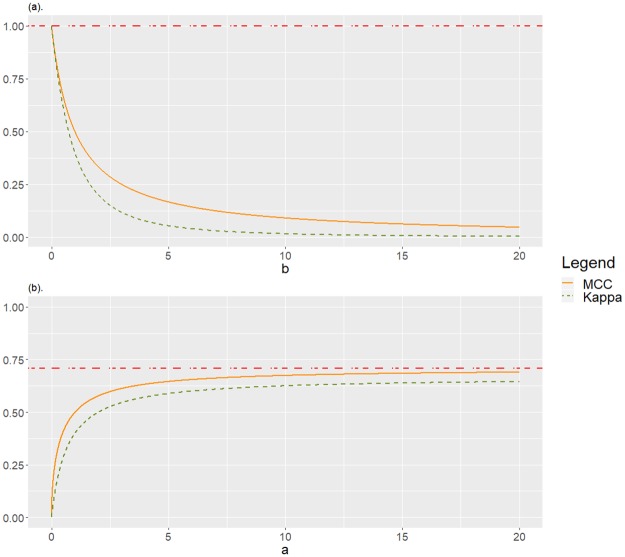
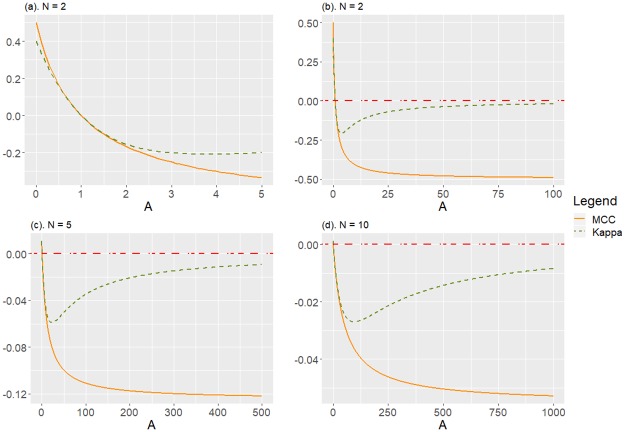
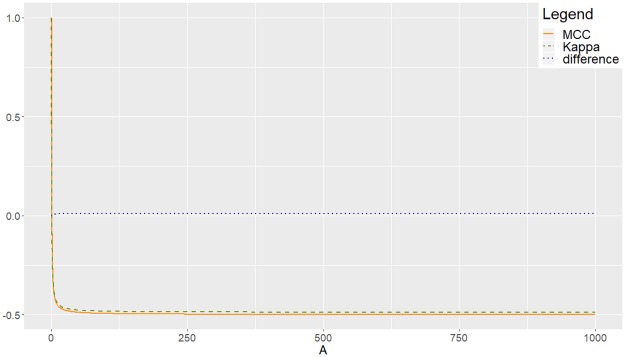
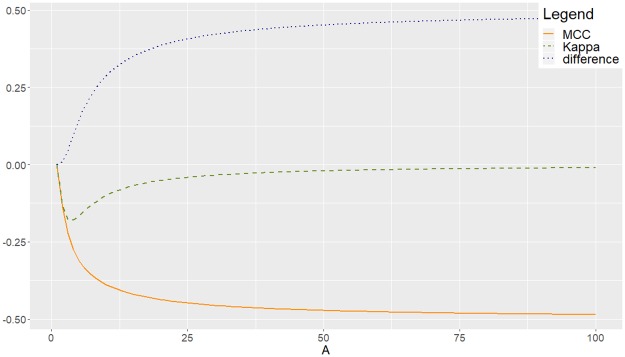
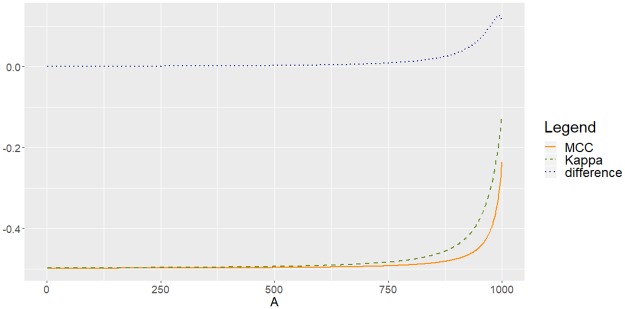
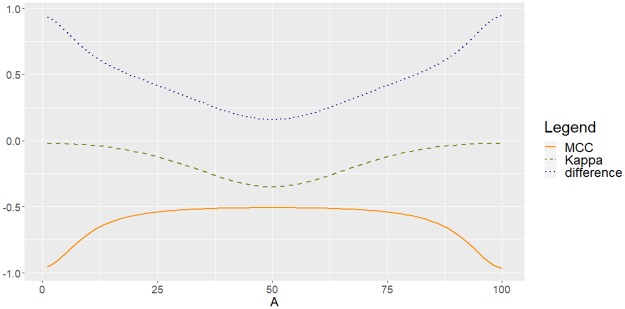
We show that Cohen's Kappa and Matthews Correlation Coefficient (MCC), both extended and contrasted measures of performance in multi-class classification, are correlated in most situations, albeit can differ in others. Indeed, although in the symmetric case both match, we consider different unbalanced situations in which Kappa exhibits an undesired behaviour, i.e. a worse classifier gets higher Kappa score, differing qualitatively from that of MCC. The debate about the incoherence in the behaviour of Kappa revolves around the convenience, or not, of using a relative metric, which makes the interpretation of its values difficult. We extend these concerns by showing that its pitfalls can go even further. Through experimentation, we present a novel approach to this topic. We carry on a comprehensive study that identifies an scenario in which the contradictory behaviour among MCC and Kappa emerges. Specifically, we find out that when there is a decrease to zero of the entropy of the elements out of the diagonal of the confusion matrix associated to a classifier, the discrepancy between Kappa and MCC rise, pointing to an anomalous performance of the former. We believe that this finding disables Kappa to be used in general as a performance measure to compare classifiers.
Overview
The claims and statistics of this paper haven’t been checked yet.
Run the check — free, no account needed. It reads the open-access text and checks the sources it cites.
Integrity signals
Registry
Cites
Statistics
Figures


Verification
Claims the paper makes
The claims and statistics of this paper haven’t been checked yet.
Run the check — free, no account needed. It reads the open-access text and checks the sources it cites.
Claims other papers make about this one
Each is checked against this paper’s own text: does it say what the citing paper says it does?
The cited source doesn’t support the claim as written.
In the citing paper
“Cohen’s Kappa is an useful metric for imbalanced datasets; however, the interpretation of its value is problematic [84].”
From A Survey of Underwater Acoustic Data Classification Methods Using Deep Learning for Shoreline Surveillance (2022) · cites this paper as [84]
Checked by a reasoning model — may be wrong.
Experimental — accuracy not yet measured
Self-check
Percentages, sums and reported differences re-computed from the paper’s own numbers.
The self-check needs the paper’s full text.
Citations
Cites
Scikit-learn: Machine Learning in Python
Pedregosa, F., Varoquaux, G., Gramfort, A., Michel, V., Thirion, B., Grisel, O., Blondel, M., Müller, A., Nothman, J., Louppe, G., et al. (2012) · arXiv · doi:10.48550/arxiv.1201.0490 · Cited by 71,016
A Coefficient of Agreement for Nominal Scales
Cohen, J. (1960) · Educational and Psychological Measurement · doi:10.1177/001316446002000104 · Cited by 42,398
Data Mining: Practical Machine Learning Tools and Techniques
Witten, I. H., Frank, E., & Hall, M. A. (2011) · Elsevier eBooks · doi:10.1016/c2009-0-19715-5 · Cited by 25,543
Content Analysis: An Introduction to its Methodology.
Shelley, M., & Krippendorff, K. (1984) · Journal of the American Statistical Association · doi:10.2307/2288384 · Cited by 24,346
Measures of the Amount of Ecologic Association Between Species
Dice, L. R. (1945) · Ecology · doi:10.2307/1932409 · Cited by 12,187
Building Predictive Models in R Using the caret Package
Kuhn, M. (2008) · Journal of Statistical Software · doi:10.18637/jss.v028.i05 · Cited by 8,863
A systematic analysis of performance measures for classification tasks
Sokolova, M., & Lapalme, G. (2009) · Information Processing & Management · doi:10.1016/j.ipm.2009.03.002 · Cited by 7,515
(2005) · PubMed · Cited by 7,011
Comparison of the predicted and observed secondary structure of T4 phage lysozyme
Matthews, B. W. (1975) · Biochimica et Biophysica Acta (BBA) - Protein Structure · doi:10.1016/0005-2795(75)90109-9 · Cited by 5,399 · cited 2×
“Matthews Correlation Coefficient MCC was first introduced in the binary case by B.W. Matthews [4] to assess the performance of protein secondary structure prediction, as the ϕ -coefficient, which is the measure of association obtained by discretization of the Pearson’s correlation coefficient for…”
MethodALLOUCHE, O., TSOAR, A., & KADMON, R. (2006) · Journal of Applied Ecology · doi:10.1111/j.1365-2664.2006.01214.x · Cited by 5,172
Research works printed but not linked: 2
- M. Kuhn, 2008, Caret package, Journal of statistical software, 28, 1
- X. Zhao, 2013, Communication Yearbook, 419
Cited by
Sorted by citations
Chicco, D., & Jurman, G. (2020) · BMC Genomics · doi:10.1186/s12864-019-6413-7 · Cited by 6,143
“Despite its popularity, in the learning context there are a number of issues causing the kappa measure to produce unreliable results (for instance, its high sensitivity to the distribution of the marginal totals [73–75]), stimulating research for more reliable alternatives [76].”
BackgroundGoEmotions: A Dataset of Fine-Grained Emotions
Demszky, D., Movshovitz-Attias, D., Ko, J., Cowen, A., Nemade, G., & Ravi, S. (2020) · Proceedings of the 58th Annual Meeting of the Association for Computational Linguistics · doi:10.18653/v1/2020.acl-main.372 · Cited by 873
Towards a guideline for evaluation metrics in medical image segmentation
Müller, D., Soto-Rey, I., & Kramer, F. (2022) · BMC Research Notes · doi:10.1186/s13104-022-06096-y · Cited by 668
Classification Model Evaluation Metrics
Vujović, Ž. (2021) · International Journal of Advanced Computer Science and Applications · doi:10.14569/ijacsa.2021.0120670 · Cited by 624
Bentivoglio, R., Isufi, E., Jonkman, S. N., & Taormina, R. (2022) · Hydrology and earth system sciences · doi:10.5194/hess-26-4345-2022 · Cited by 529
Chicco, D., Warrens, M. J., & Jurman, G. (2021) · IEEE Access · doi:10.1109/access.2021.3084050 · Cited by 503
Sabanayagam, C., Xu, D., Ting, D. S. W., Nusinovici, S., Banu, R., Hamzah, H., Lim, C., Tham, Y.-C., Cheung, C. Y., Tai, E. S., et al. (2020) · The Lancet Digital Health · doi:10.1016/s2589-7500(20)30063-7 · Cited by 279
Diogo, V. S., Ferreira, H. A., Prata, D. P., & Initiative, A. D. N. (2022) · Alzheimer s Research & Therapy · doi:10.1186/s13195-022-01047-y · Cited by 200
Opitz, J. (2024) · Transactions of the Association for Computational Linguistics · doi:10.1162/tacl_a_00675 · Cited by 244
A review of model evaluation metrics for machine learning in genetics and genomics
Miller, C., Portlock, T., Nyaga, D. M., & O'Sullivan, J. M. (2024) · Frontiers in Bioinformatics · doi:10.3389/fbinf.2024.1457619 · Cited by 187
Ågren, A. M., Larson, J., Paul, S. S., Laudon, H., & Lidberg, W. (2021) · Geoderma · doi:10.1016/j.geoderma.2021.115280 · Cited by 127
Dorol--Beauroy-Eustache, O., & Mishara, B. L. (2021) · Preventive Medicine · doi:10.1016/j.ypmed.2021.106684 · Cited by 125
A Deep Learning Approach for Human Activities Recognition From Multimodal Sensing Devices
Ihianle, I. K., Nwajana, A. O., Ebenuwa, S. H., Otuka, R. I., Owa, K., & Orisatoki, M. O. (2020) · IEEE Access · doi:10.1109/access.2020.3027979 · Cited by 138
Urban tree species classification using UAV-based multi-sensor data fusion and machine learning
Hartling, S., Sagan, V., & Maimaitijiang, M. (2021) · GIScience & Remote Sensing · doi:10.1080/15481603.2021.1974275 · Cited by 118
Yu, H., Cooper, A., & Infante, D. (2020) · Ecological Modelling · doi:10.1016/j.ecolmodel.2020.109202 · Cited by 96
A comparative study on online machine learning techniques for network traffic streams analysis
Shahraki, A., Abbasi, M., Taherkordi, A., & Jurcut, A. D. (2022) · Computer Networks · doi:10.1016/j.comnet.2022.108836 · Cited by 105
Ghosh, S., Rao, G. R., & Thomas, T. (2021) · Energy storage materials · doi:10.1016/j.ensm.2021.05.024 · Cited by 104
Weighted kappa measures for ordinal multi-class classification performance
Yılmaz, A. E., & Demirhan, H. (2023) · Applied Soft Computing · doi:10.1016/j.asoc.2023.110020 · Cited by 109
Domingos, L. C. F., Santos, P. E., Skelton, P. S. M., Brinkworth, R. S. A., & Sammut, K. (2022) · Sensors · doi:10.3390/s22062181 · Cited by 93
“Cohen’s Kappa is an useful metric for imbalanced datasets; however, the interpretation of its value is problematic [84].”
BackgroundPasrija, P., Jha, P. K., Upadhyaya, P., Khan, M. S., & Chopra, M. (2022) · Current Topics in Medicinal Chemistry · doi:10.2174/1568026622666220701091339 · Cited by 92
Using deep learning to value free-form text data for predictive maintenance
Cadavid, J. P. U., Lamouri, S., Grabot, B., & Fortin, A. (2021) · International Journal of Production Research · doi:10.1080/00207543.2021.1951868 · Cited by 78
Olczak, J., Emilson, F., Razavian, A. S., Antonsson, T., Stark, A., & Gordon, M. (2020) · Acta Orthopaedica · doi:10.1080/17453674.2020.1837420 · Cited by 70
Pawłuszek-Filipiak, K., & Borkowski, A. (2020) · Remote Sensing · doi:10.3390/rs12183054 · Cited by 68
Interrater reliability estimators tested against true interrater reliabilities
Zhao, X., Feng, G. C., Ao, S. H., & Liu, P. L. (2022) · BMC Medical Research Methodology · doi:10.1186/s12874-022-01707-5 · Cited by 93
Zhang, X., Akber, M. Z., & Zheng, W. (2022) · Journal of Building Engineering · doi:10.1016/j.jobe.2022.104997 · Cited by 59
Phinzi, K., Abriha, D., & Szabó, S. (2021) · Remote Sensing · doi:10.3390/rs13152980 · Cited by 55
Combining Machine Learning and Molecular Dynamics to Predict P‑Glycoprotein Substrates
Esposito, C., Wang, S., Lange, U. E. W., Oellien, F., & Riniker, S. (2020) · Journal of Chemical Information and Modeling · doi:10.1021/acs.jcim.0c00525 · Cited by 55
Ma, J., Guan, Y., Xing, F., Eltzov, E., Wang, Y., Li, X., & Tai, B. (2023) · Journal of Hazardous Materials · doi:10.1016/j.jhazmat.2023.131030 · Cited by 52
Fair evaluation of classifier predictive performance based on binary confusion matrix
Vanacore, A., Pellegrino, M. S., & Ciardiello, A. (2022) · Computational Statistics · doi:10.1007/s00180-022-01301-9 · Cited by 51
BenchMetrics: a systematic benchmarking method for binary classification performance metrics
Canbek, G., Temizel, T. T., & Sağıroğlu, Ş. (2021) · Neural Computing and Applications · doi:10.1007/s00521-021-06103-6 · Cited by 51
Hanna, M. G., Olson, N. H., Zarella, M. D., Dash, R. C., Herrmann, M. D., Furtado, L. V., Stram, M. N., Raciti, P. M., Hassell, L. A., Mays, A., et al. (2023) · Archives of Pathology & Laboratory Medicine · doi:10.5858/arpa.2023-0042-cp · Cited by 52
FastForest: Increasing random forest processing speed while maintaining accuracy
Yates, D., & Islam, M. Z. (2020) · Information Sciences · doi:10.1016/j.ins.2020.12.067 · Cited by 53
Evaluating Eye Movement Event Detection: A Review of the State of the Art
Startsev, M., & Zemblys, R. (2022) · Behavior Research Methods · doi:10.3758/s13428-021-01763-7 · Cited by 48
Distilled GPT for source code summarization
Su, C.-Y., & McMillan, C. (2024) · Automated Software Engineering · doi:10.1007/s10515-024-00421-4 · Cited by 49
Insights From the Virtual Team Science: Rapid Deployment During COVID-19
Kilcullen, M., Feitosa, J., & Eduardo Salas, A. (2021) · Human Factors The Journal of the Human Factors and Ergonomics Society · doi:10.1177/0018720821991678 · Cited by 46
Selecting patients with HER2-low breast cancer: Getting out of the tangle
Baez‐Navarro, X., Salgado, R., Denkert, C., Lennerz, J. K., Penault-Llorca, F. M., Viale, G., Bartlett, J. M. S., & van Deurzen, C. H. M. (2022) · European Journal of Cancer · doi:10.1016/j.ejca.2022.08.022 · Cited by 42
Benati, G., Calcagni, F., Martellozzo, F., Ghermandi, A., & Langemeyer, J. (2024) · Ecosystem Services · doi:10.1016/j.ecoser.2023.101594 · Cited by 40
Liang, Z., & Martell, M. A. C. (2021) · Frontiers in Digital Health · doi:10.3389/fdgth.2021.665946 · Cited by 40
Martín, A., Miró, J., Amadó, C., Ruz, F., Ruíz, A., Ortega, O., & Clavé, P. (2022) · Dysphagia · doi:10.1007/s00455-022-10547-w · Cited by 38
Valuing free-form text data from maintenance logs through transfer learning with CamemBERT
Cadavid, J. P. U., Grabot, B., Lamouri, S., Pellerin, R., & Fortin, A. (2020) · Enterprise Information Systems · doi:10.1080/17517575.2020.1790043 · Cited by 38
Barnes, L. D., Lee, K., Kempa-Liehr, A. W., & Hallum, L. E. (2022) · PLoS ONE · doi:10.1371/journal.pone.0272167 · Cited by 43
Forest Fire Risk Zone Mapping of Eravikulam National Park in India
Pradeep, G. S., Patel, N., Kuriakose, S. L., Ajin, R. S., Oniga, V.-E., Rajaneesh, A., Mammen, P. C., Prasad, M. K., Nikhil, S., & Danumah, J. H. (2021) · Croatian journal of forest engineering · doi:10.5552/crojfe.2022.1137 · Cited by 39
Dhar, J., & Jodder, A. K. (2020) · Ingénierie des systèmes d information · doi:10.18280/isi.250502 · Cited by 39
Ravindran, K. K. G., della Monica, C., Atzori, G., Lambert, D., Hassanin, H., Revell, V. L., & Dijk, D. (2023) · JMIR mhealth and uhealth · doi:10.2196/46338 · Cited by 35
Empirical analysis of performance assessment for imbalanced classification
Gaudreault, J.-G., & Branco, P. (2024) · Machine Learning · doi:10.1007/s10994-023-06497-5 · Cited by 33
Augmenting assessment with AI coding of online student discourse: A question of reliability
Misiejuk, K., Kaliisa, R., & Scianna, J. (2024) · Computers and Education: Artificial Intelligence · doi:10.1016/j.caeai.2024.100216 · Cited by 33
A Comprehensive Review on Deep Synergistic Drug Prediction Techniques for Cancer
Kumar, V., & Dogra, N. (2021) · Archives of Computational Methods in Engineering · doi:10.1007/s11831-021-09617-3 · Cited by 33
Wood–Leaf Classification of Tree Point Cloud Based on Intensity and Geometric Information
Sun, J., Wang, P., Gao, Z., Liu, Z., Li, Y., Gan, X., & Liu, Z. (2021) · Remote Sensing · doi:10.3390/rs13204050 · Cited by 33
Sun, J., Zhang, Y., Weishan, Q., & Chai, G. (2022) · Remote Sensing · doi:10.3390/rs14153653 · Cited by 34
Alqarni, F., Sagheer, A., Alabbad, A., & Hamdoun, H. (2025) · Scientific Reports · doi:10.1038/s41598-025-99515-6 · Cited by 45
Metrics Related to Confusion Matrix as Tools for Conformity Assessment Decisions
Božić, D., Runje, B., Lisjak, D., & Kolar, D. (2023) · Applied Sciences · doi:10.3390/app13148187 · Cited by 30
Casagrande, A., Fabris, F., & Girometti, R. (2020) · Medical & Biological Engineering & Computing · doi:10.1007/s11517-020-02261-2 · Cited by 30
Neto, E. J. D. M., & Clementino, M. B. M. (2022) · PLoS ONE · doi:10.1371/journal.pone.0272287 · Cited by 38
Murariu, M.-G., Dorobanțu, F. R., & Tarniceriu, D. G. (2023) · Electronics · doi:10.3390/electronics12091958 · Cited by 30
Computationally Identifying Funneling and Focusing Questions in Classroom Discourse
Alic, S., Demszky, D., Mancenido, Z., Liu, J., Hill, H., & Jurafsky, D. (2022) · Workshop on Innovative Use of NLP for Building Educational Applications · doi:10.18653/v1/2022.bea-1.27 · Cited by 54
AI-Driven sleep staging from actigraphy and heart rate
Song, T.-A., Chowdhury, S. R., Malekzadeh, M., Harrison, S. L., Blackwell-Hoge, T., Redline, S. S., Stone, K. L., Saxena, R., Purcell, S., & Dutta, J. (2023) · PLoS ONE · doi:10.1371/journal.pone.0285703 · Cited by 32
Flood Hazard Risk Mapping Using a Pseudo Supervised Random Forest
Esfandiari, M., Abdi, G., Jabari, S., McGrath, H., & Coleman, D. (2020) · Remote Sensing · doi:10.3390/rs12193206 · Cited by 29
Spatial database of planted forests in East Asia
Abbasi, A. O., Tang, X., Harris, N. L., Goldman, E. D., Gamarra, J. G. P., Herold, M., Kim, H. S., Luo, W., Silva, C. A., Tchebakova, N. M., et al. (2023) · Scientific Data · doi:10.1038/s41597-023-02383-w · Cited by 30
Interpretation of Artificial Intelligence Models in Healthcare
Ardakani, A. A., Airom, O., Khorshidi, H., Bureau, N. J., Salvi, M., Molinari, F., & Acharya, U. R. (2024) · Journal of Ultrasound in Medicine · doi:10.1002/jum.16524 · Cited by 30
Uhl, J. H., & Leyk, S. (2022) · Remote Sensing of Environment · doi:10.1016/j.rse.2022.113117 · Cited by 27
Guidelines for the prediction of species interactions through binary classification
Poisot, T. (2023) · Methods in Ecology and Evolution · doi:10.1111/2041-210x.14071 · Cited by 27
Brecheisen, Z. S., & Richter, D. D. (2021) · CATENA · doi:10.1016/j.catena.2021.105264 · Cited by 26
A semi-hard voting combiner scheme to ensemble multi-class probabilistic classifiers
Delgado, R. (2021) · Applied Intelligence · doi:10.1007/s10489-021-02447-7 · Cited by 26
Self-citationAyre, K., Bittar, A., Kam, J., Verma, S., Howard, L. M., & Dutta, R. (2021) · PLoS ONE · doi:10.1371/journal.pone.0253809 · Cited by 24
Ågren, A. M., Hasselquist, E. M., Stendahl, J., Nilsson, M. B., & Paul, S. S. (2022) · SOIL · doi:10.5194/soil-8-733-2022 · Cited by 24
Best practices for machine learning in antibody discovery and development
Wossnig, L., Furtmann, N., Buchanan, A. G., Kumar, S., & Greiff, V. (2024) · Drug Discovery Today · doi:10.1016/j.drudis.2024.104025 · Cited by 25
Ravindran, K. K. G., della Monica, C., Atzori, G., Nilforooshan, R., Hassanin, H., Revell, V. L., & Dijk, D. (2025) · SLEEP · doi:10.1093/sleep/zsaf122 · Cited by 23
Awe, O. O., Opateye, G. O., Johnson, C. A. G., Tayo, O. T., & Dias, R. (2023) · STEAM-H: Science, Technology, Engineering, Agriculture, Mathematics & Health · doi:10.1007/978-3-031-41352-0_18 · Cited by 25
Collado, A. A., Carrasco‐Velar, R., García‐Pedrajas, N., & García, G. C. (2020) · Journal of Chemical Information and Modeling · doi:10.1021/acs.jcim.0c00908 · Cited by 22
Diagnosis of Acute Poisoning using explainable artificial intelligence
Chary, M. A., Boyer, E. W., & Burns, M. M. (2021) · Computers in Biology and Medicine · doi:10.1016/j.compbiomed.2021.104469 · Cited by 23
Us vs. Them: A Dataset of Populist Attitudes, News Bias and Emotions
Cabot, .-L. H., Abadi, D., Fischer, A. H., & Shutova, E. (2021) · Conference of the European Chapter of the Association for Computational Linguistics · doi:10.18653/v1/2021.eacl-main.165 · Cited by 27
Measurement of key performance indicators of user experience based on software requirements
Atoum, I. (2023) · Science of Computer Programming · doi:10.1016/j.scico.2023.102929 · Cited by 22
A call to interpret disagreement components during classification assessment
Pontius, R. G., Francis, T., & Millones, M. (2025) · International Journal of Geographical Information Systems · doi:10.1080/13658816.2025.2469830 · Cited by 21
Validity of the personality disorder diagnosis in the Swedish National Patient Register
Kouppis, E., & Ekselius, L. (2020) · Acta Psychiatrica Scandinavica · doi:10.1111/acps.13166 · Cited by 21
Jovanović, L., Bačanin, N., Šimić, V., Mani, J. P., Zivkovic, M. Z., & Šarac, M. (2023) · Soft Computing · doi:10.1007/s00500-023-09496-9 · Cited by 21
Non-animal models for blood–brain barrier permeability evaluation of drug-like compounds
Dehnbostel, F. O., Dixit, V. A., Preißner, R., & Banerjee, P. (2024) · Scientific Reports · doi:10.1038/s41598-024-59734-9 · Cited by 24
A deep learning approach for lower back-pain risk prediction during manual lifting
Snyder, K., Thomas, B., Lu, M., Jha, R., Barim, M. S., Hayden, M. A., & Werren, D. M. (2021) · PLoS ONE · doi:10.1371/journal.pone.0247162 · Cited by 20
Filho, C. R. M., do Valle, R. F., Silva, M. M. A. P. D. M., Mendes, R. G., Rolim, G. D. S., Pissarra, T. C. T., de Melo, M. C., Valera, C. A., Pacheco, F. A. L., & Fernandes, L. F. S. (2023) · Sustainability · doi:10.3390/su15086949 · Cited by 20
Artificial Intelligence–Guided Segmentation and Path Planning Software for Transthoracic Lung Biopsy
Too, C. W., Fong, K. Y., Hang, G., Sato, T., Nyam, C. Q., Ng, K. W., Ng, K. W., Ng, W. L., & Kawai, T. (2024) · Journal of Vascular and Interventional Radiology · doi:10.1016/j.jvir.2024.02.006 · Cited by 20
Kishore, B. S. P. C., Kumar, A., Saikia, P., Lele, N. V., Pandey, A. C., Srivastava, P., Bhattacharya, B. K., & Khan, M. L. (2020) · Journal of Asia-Pacific Biodiversity · doi:10.1016/j.japb.2020.07.001 · Cited by 21
Lin, P., Moni, M. A., Eapen, V., & Gau, S. (2021) · Frontiers in Psychiatry · doi:10.3389/fpsyt.2021.637022 · Cited by 20
Impact of model choice in predicting urban forest storm damage when data is uncertain
Lambert, C., Landry, S., Andreu, M. G., Koeser, A. K., Starr, G., & Staudhammer, C. L. (2022) · Landscape and Urban Planning · doi:10.1016/j.landurbplan.2022.104467 · Cited by 19
Pseudo-online framework for BCI evaluation: a MOABB perspective using various MI and SSVEP datasets
Carrara, I., & Papadopoulo, T. (2023) · Journal of Neural Engineering · doi:10.1088/1741-2552/ad171a · Cited by 19
Moradi, E., Elsisi, M., Mahmoud, K., Lehtonen, M., & Darwish, M. M. F. (2025) · International Journal of Electrical Power & Energy Systems · doi:10.1016/j.ijepes.2025.110731 · Cited by 18
TractLearn: A geodesic learning framework for quantitative analysis of brain bundles
Attyé, A., Renard, F., Baciu, M. V., Roger, É., Lamalle, L., Dehail, P., Cassoudesalle, H., & Calamante, F. (2021) · NeuroImage · doi:10.1016/j.neuroimage.2021.117927 · Cited by 18
Comparison of algorithms for error prediction in manufacturing with automl and a cost-based metric
Gerling, A., Ziekow, H., Heß, A., Schreier, U., Seiffer, C., & Abdeslam, D. O. (2022) · Journal of Intelligent Manufacturing · doi:10.1007/s10845-021-01890-0 · Cited by 18
Shortcomings and areas for improvement in digital pathology image segmentation challenges
Foucart, A., Debeir, O., & Decaestecker, C. (2022) · Computerized Medical Imaging and Graphics · doi:10.1016/j.compmedimag.2022.102155 · Cited by 21
Simeth, J., Jiang, J., Nosov, A., Wibmer, A. G., Zeléfsky, M. J., Tyagi, N., & Veeraraghavan, H. (2023) · Medical Physics · doi:10.1002/mp.16320 · Cited by 21
Lee, J. Y., Lee, G.-G., & Hong, H. (2023) · Journal of Science Education and Technology · doi:10.1007/s10956-023-10042-3 · Cited by 22
How do we identify flash droughts? A case study in Central European Croplands
Alencar, P. H. L., & Paton, E. N. (2022) · Hydrology research · doi:10.2166/nh.2022.003 · Cited by 17
Sun, Z., Liu, H., Huyan, J., Li, W., Guo, M., Hao, X., & Pei, L. (2021) · Construction and Building Materials · doi:10.1016/j.conbuildmat.2021.124894 · Cited by 17
A Cardiotocographic Classification using Feature Selection: A comparative Study
Prasetyo, S. E., Prastyo, P. H., & Arti, S. (2021) · JITCE (Journal of Information Technology and Computer Engineering) · doi:10.25077/jitce.5.01.25-32.2021 · Cited by 19
Green Space Quality Analysis Using Machine Learning Approaches
Rustamov, J., Rustamov, Z., & Zaki, N. (2023) · Sustainability · doi:10.3390/su15107782 · Cited by 17
Griffith, D. M., Byrd, K. B., Anderegg, L. D. L., Allan, E., Gatziolis, D., Roberts, D. A., Yacoub, R., & Nemani, R. (2023) · Proceedings of the National Academy of Sciences · doi:10.1073/pnas.2215533120 · Cited by 16
Assessing the role of school-based sex education in sexual health behaviours: a systematic review
Niland, R., Flinn, C., & Nearchou, F. (2024) · Cogent Psychology · doi:10.1080/23311908.2024.2309752 · Cited by 29
Smart prediction and optimization of air quality index with artificial intelligence
Mubeen, M., He, S., Rahman, M. S., Wang, L., Zhang, X., Ahmed, B., He, Z., & Han, Y. (2025) · Journal of Environmental Sciences · doi:10.1016/j.jes.2025.02.041 · Cited by 15
Data-Driven Model for Estimating the Probability of Riverine Levee Breach Due to Overtopping
Flynn, S., Zamanian, S., Vahedifard, F., Shafieezadeh, A., & Schaaf, D. M. (2021) · Journal of Geotechnical and Geoenvironmental Engineering · doi:10.1061/(asce)gt.1943-5606.0002743 · Cited by 15
Herfurth, K., Harpaz, Y., Roesch, J., Mueller, N., Walther, K., Kaltenhäuser, M., Pauli, E., Goldstein, A., Hamer, H. M., Buchfelder, M., et al. (2022) · Frontiers in Human Neuroscience · doi:10.3389/fnhum.2022.996989 · Cited by 16
de Sena, S., Häggman, M., Ranta, J., Roienko, O., Ilén, E., Acosta, N., Salama, J., Kirjavainen, T., Stevenson, N. J., Airaksinen, M., et al. (2024) · Heliyon · doi:10.1016/j.heliyon.2024.e33295 · Cited by 15
Comparing ϕ and the F-measure as performance metrics for software-related classifications
Lavazza, L., & Morasca, S. (2022) · Empirical Software Engineering · doi:10.1007/s10664-022-10199-2 · Cited by 15
Metadata
- Authors
- Delgado, R., & Tibau, X.-A.
- Affiliations
- Universitat Autònoma de Barcelona (ES)
- Corresponding author
- Delgado, Rosario
- Venue
- PLOS ONE
- Publisher
- Public Library of Science (PLoS)
- Published
- 2019-09-26
- Volume
- 14
- Issue
- 9
- Pages
- e0222916
- ISSN
- 1932-6203 (ISSN-L)
- PMC
- PMC6762152
- OpenAlex
- W2975256032
- Cited by
- 324
- References
- 53
- Citations by year
- 2026: 22 · 2025: 47 · 2024: 53 · 2023: 60 · 2022: 69 · 2021: 50 · 2020: 22 · 2019: 1
- FWCI
- 16.20
- Type
- journal article
- Language
- en
- Open access
- gold
- doi.org
- Licence
- Locations
- PLoS ONE (publishedVersion, cc-by)
- Europe PMC (PubMed Central) (publishedVersion, cc-by)
- PubMed Central (publishedVersion, cc-by)
- PubMed (publishedVersion)
- Dipòsit Digital de Documents de la UAB (Universitat Autònoma de Barcelona) (submittedVersion, cc-by)
- RePEc: Research Papers in Economics (submittedVersion)
- LA Referencia (Red Federada de Repositorios Institucionales de Publicaciones Científicas) (submittedVersion, cc-by)
- DOAJ (DOAJ: Directory of Open Access Journals) (submittedVersion, cc-by-sa)
- Topics
- Physical Sciences › Computer Science › Artificial Intelligence › Imbalanced Data Classification Techniques
- Physical Sciences › Computer Science › Artificial Intelligence › Machine Learning and Data Classification
- Social Sciences › Decision Sciences › Statistics, Probability and Uncertainty › Reliability and Agreement in Measurement
- Keywords
- Cohen's kappa, Matthews correlation coefficient, multi-class classification, class imbalance, confusion matrix, entropy (information theory), classifier comparison
- MeSH terms
- Supervised Machine Learning, Data Analysis, Classification, Models, Theoretical, Reproducibility of Results, Datasets as Topic
About these checks
Registry, retraction, Cites and statistics results are computed, not judged, with one exception: a printed reference that no index lists is read once by a model before it counts as a citation error. Claims are extracted by a model and kept only when their quote appears verbatim in the text; each cited source is then checked, with a model’s help, for whether it says what the claim relies on. Those verdicts can be wrong — read the claim’s quote and the cited source before relying on one.
Statistics and arithmetic are recomputed, not judged.
Confidence bands are shown only for fields calibrated on our annotated test set. None is calibrated yet, so no band is shown.
What counts as a claim ›How we measure confidence ›How we check this ›
Are you an author, or do you see a problem with this page? Request a review
