

Tumor Necrosis Factor (TNF) blocking agents are associated with lower risk for Alzheimer’s disease in patients with rheumatoid arthritis and psoriasis
Open accessPublished version of a preprint
The DOI matches its Crossref record; 66 of the 66 references it cites were found in a registry or an index.
Abstract
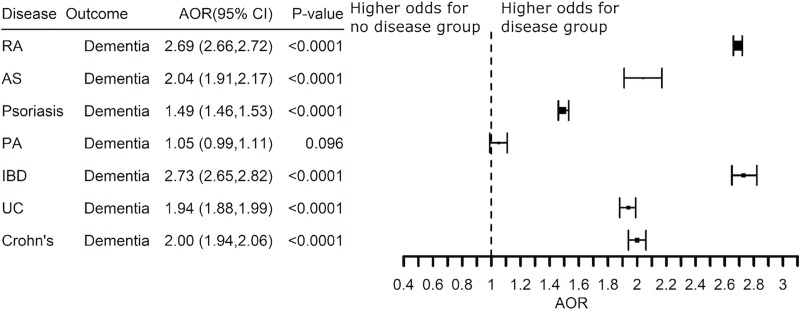
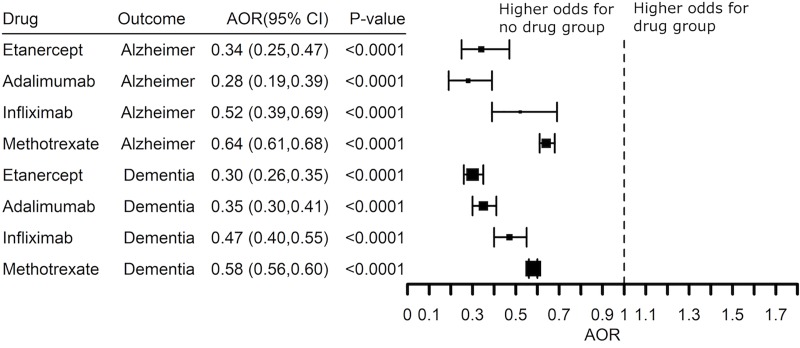
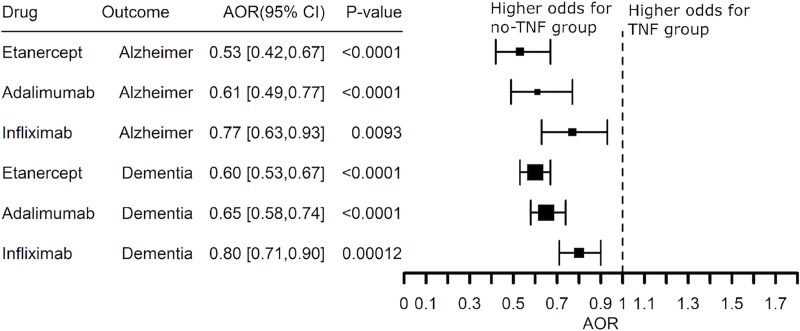
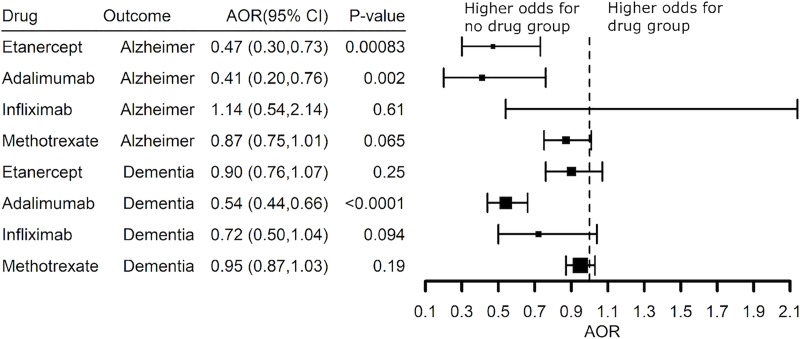
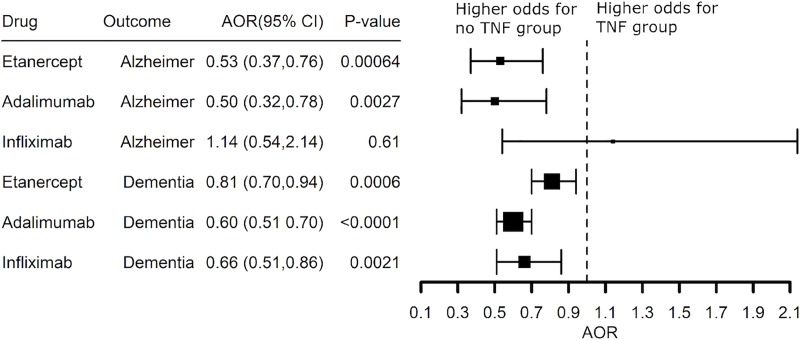
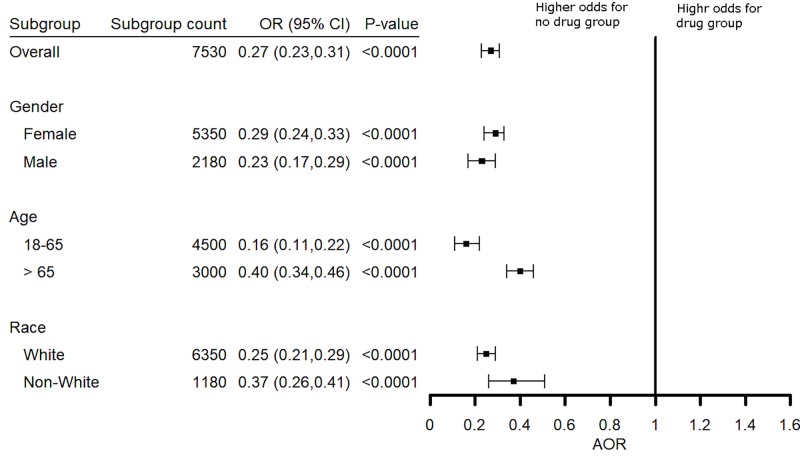
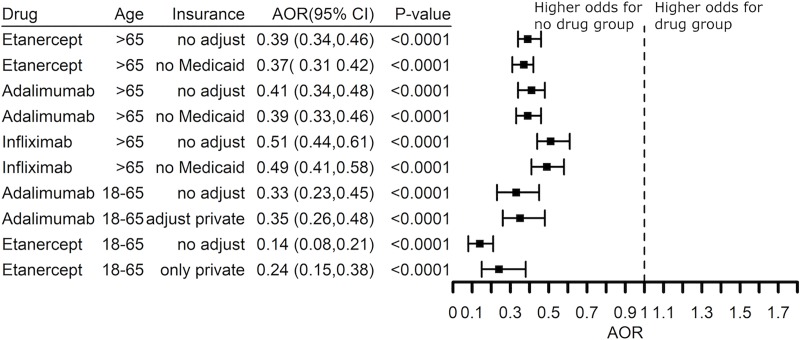
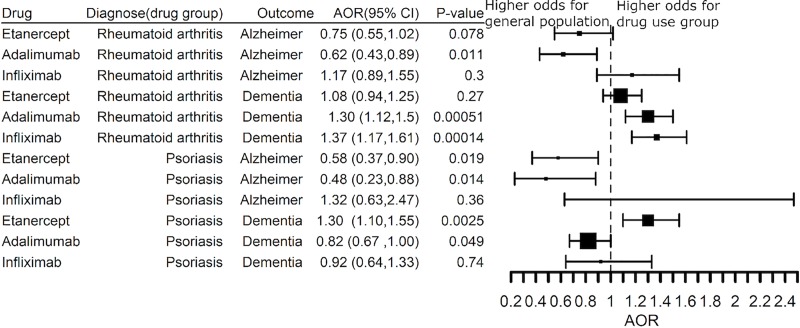
This large, retrospective case-control study of electronic health records from 56 million unique adult patients examined whether or not treatment with a Tumor Necrosis Factor (TNF) blocking agent is associated with lower risk for Alzheimer's disease (AD) in patients with rheumatoid arthritis (RA), psoriasis, and other inflammatory diseases which are mediated in part by TNF and for which a TNF blocker is an approved treatment. The analysis compared the diagnosis of AD as an outcome measure in patients receiving at least one prescription for a TNF blocking agent (etanercept, adalimumab, and infliximab) or for methotrexate. Adjusted odds ratios (AORs) were estimated using the Cochran-Mantel-Haenszel (CMH) method and presented with 95% confidence intervals (CIs) and p-values. RA was associated with a higher risk for AD (Adjusted Odds Ratio (AOR) = 2.06, 95% Confidence Interval: (2.02-2.10), P-value <0.0001) as did psoriasis (AOR = 1.37 (1.31-1.42), P <0.0001), ankylosing spondylitis (AOR = 1.57 (1.39-1.77), P <0.0001), inflammatory bowel disease (AOR = 2.46 (2.33-2.59), P < 0.0001), ulcerative colitis (AOR = 1.82 (1.74-1.91), P <0.0001), and Crohn's disease (AOR = 2.33 (2.22-2.43), P <0.0001). The risk for AD in patients with RA was lower among patients treated with etanercept (AOR = 0.34 (0.25-0.47), P <0.0001), adalimumab (AOR = 0.28 (0.19-0.39), P < 0.0001), or infliximab (AOR = 0.52 (0.39-0.69), P <0.0001). Methotrexate was also associated with a lower risk for AD (AOR = 0.64 (0.61-0.68), P <0.0001), while lower risk was found in patients with a prescription history for both a TNF blocker and methotrexate. Etanercept and adalimumab also were associated with lower risk for AD in patients with psoriasis: AOR = 0.47 (0.30-0.73 and 0.41 (0.20-0.76), respectively. There was no effect of gender or race, while younger patients showed greater benefit from a TNF blocker than did older patients. This study identifies a subset of patients in whom systemic inflammation contributes to risk for AD through a pathological mechanism involving TNF and who therefore may benefit from treatment with a TNF blocking agent.
Overview
The claims and statistics of this paper haven’t been checked yet.
Free: it reads the open-access text and checks the first 5 claims that cite a source we can check. Create a free account to check every claim.
Integrity signals
Registry
Cites
Statistics
Figures

Verification
Claims the paper makes
The claims and statistics of this paper haven’t been checked yet.
Free: it reads the open-access text and checks the first 5 claims that cite a source we can check. Create a free account to check every claim.
Claims other papers make about this one
Each is checked against this paper’s own text: does it say what the citing paper says it does?
The source backs part of the claim, not all of it — or backs it for a different population, condition or comparison.
In the citing paper
“Studies have demonstrated that a proinflammatory state (148–150), inflammatory disease (e.g., rheumatoid arthritis) (151), and immune challenges (e.g., acute infection) (152, 153) all increase the risk for dementia over multiple decades.”
From Connecting aging biology and inflammation in the omics era (2022) · cites this paper as [151]
Experimental — accuracy not yet measured
Self-check
Percentages, sums and reported differences re-computed from the paper’s own numbers.
The self-check needs the paper’s full text.
Citations
Cites
NIA‐AA Research Framework: Toward a biological definition of Alzheimer's disease
Jack, C. R., Bennett, D. A., Blennow, K., Carrillo, M. C., Dunn, B., Haeberlein, S. B., Holtzman, D. M., Jagust, W., Jessen, F., Karlawish, J., et al. (2018) · Alzheimer's & Dementia · doi:10.1016/j.jalz.2018.02.018 · Cited by 10,537
Neurotoxic reactive astrocytes are induced by activated microglia
Liddelow, S. A., Guttenplan, K. A., Clarke, L. E., Bennett, F. C., Bohlen, C. J., Schirmer, L., Bennett, M. L., Münch, A. E., Chung, W.-S., Peterson, T. C., et al. (2017) · Nature · doi:10.1038/nature21029 · Cited by 7,971
Neuroinflammation in Alzheimer's disease
Heneka, M. T., Carson, M. J., Khoury, J. E., Landreth, G. E., Brosseron, F., Feinstein, D. L., Jacobs, A. H., Wyss-Coray, T., Vitorica, J., Ransohoff, R. M., et al. (2015) · The Lancet Neurology · doi:10.1016/s1474-4422(15)70016-5 · Cited by 6,226 · cited 2×
“TLR4 encodes the Toll like receptor 4, a receptor in microglia, monocytes and macrophages that triggers TNF release when activated by lipopolysaccharide, or in the case of microglia, by amyloid beta peptide [41].”
BackgroundFate Mapping Analysis Reveals That Adult Microglia Derive from Primitive Macrophages
Ginhoux, F., Greter, M., Leboeuf, M., Nandi, S., See, P., Gokhan, S., Mehler, M. F., Conway, S. J., Ng, L. G., Stanley, E. R., et al. (2010) · Science · doi:10.1126/science.1194637 · Cited by 5,175 · cited 1×
“Microglia cells, the resident macrophages in the brain, derive embryonically from the same myeloid stem cells in bone marrow that give rise to monocytes and macrophages elsewhere in the body [4].”
Background2016 Alzheimer's disease facts and figures
Alzheimer's Association (2016) · Alzheimer's & Dementia · doi:10.1016/j.jalz.2016.03.001 · Cited by 5,069
Scheltens, P., Blennow, K., Breteler, M. M. B., de Strooper, B., Frisoni, G. B., Salloway, S., & Van der Flier, W. M. (2016) · The Lancet · doi:10.1016/s0140-6736(15)01124-1 · Cited by 3,125
Diagnosis and Management of Rheumatoid Arthritis: A Review
Aletaha, D., & Smolen, J. S. (2018) · JAMA · doi:10.1001/jama.2018.13103 · Cited by 2,313
Two Phase 3 Trials of Bapineuzumab in Mild-to-Moderate Alzheimer's Disease
Salloway, S., Sperling, R., Fox, N. C., Blennow, K., Klunk, W., Raskind, M., Sabbagh, M., Honig, L. S., Porsteinsson, A. P., Ferris, S., et al. (2014) · New England Journal of Medicine · doi:10.1056/nejmoa1304839 · Cited by 1,960 · cited 1×
“Even with carefully selected patients enrolled in large, multi-center, Phase 3 clinical trials, AD is misdiagnosed based solely on clinical criteria in up to 25% of patients [35, 36].”
BackgroundMicroglia in Alzheimer’s disease
Hansen, D. V., Hanson, J. E., & Sheng, M. (2018) · Journal of Cell Biology · doi:10.1083/jcb.201709069 · Cited by 1,935 · cited 1×
“Neuroinflammatory changes around the amyloid plaques include reactive astrocytosis and microglial cell activation [3].”
BackgroundMicroglia emerge as central players in brain disease
Salter, M. W., & Stevens, B. (2017) · Nature Medicine · doi:10.1038/nm.4397 · Cited by 1,767 · cited 1×
“Microglia activation and gliosis formerly were considered secondary to neurodegeneration in AD, however, recent genetic studies in late-onset AD implicate microglia- and astrocyterelated pathways in disease pathogenesis.[10, 48, 49] One focus of interest is TREM2, an innate immune receptor expressed on microglia and m…”
Result
Cited by
Items 101–157 of 157
Zhao, J., Zhao, D. B., Wang, J., Luo, X., & Guo, R. (2022) · European Journal of Inflammation · doi:10.1177/1721727x221095383 · Cited by 6
Kawami, M., Ojima, T., Yumoto, R., & Takano, M. (2022) · Toxicological Research · doi:10.1007/s43188-022-00127-3 · Cited by 7
“Recently, there have been clinical reports related to the application of MTX to neurological diseases, such as Alzheimer’s disease [3, 4], indicating that extensive clinical use of MTX will continue and increase in the future.”
BackgroundVázquez, N. M., Ortiz-Marquez, F., Ramírez-García, T., Gillis-Onieva, C., Cabezudo‐García, P., García-Studer, A., Mucientes, A., Lisbona-Montañez, J. M., Borregón-Garrido, P., Ruiz‐Limón, P., et al. (2025) · Frontiers in Medicine · doi:10.3389/fmed.2025.1561140 · Cited by 8
Du, K., Zuo, Y.-L., Zhang, Z.-M., Li, A., Zuo, Q., Zhang, C., Guo, R., Chen, P., Du, W.-S., & Li, S. (2025) · Scientific Reports · doi:10.1038/s41598-025-97428-y · Cited by 4
“Indirect support for this hypothesis comes from studies on related conditions, such as Rheumatoid Arthritis (RA), where TNF-α inhibitors, also used in PMR, have been associated with a reduced AD risk 68 .”
KGiA: Drug repurposing through disease-aware knowledge graph augmentation
Oğuztüzün, Ç., Gao, Z., Li, H., & Xu, R. (2025) · Journal of Biomedical Informatics · doi:10.1016/j.jbi.2025.104857 · Cited by 7
Self-citationWilliams, J., & Marzo‐Ortega, H. (2025) · Joint Bone Spine · doi:10.1016/j.jbspin.2025.105981 · Cited by 5
Neuroinflammation in Dementia—Therapeutic Directions in a COVID-19 Pandemic Setting
Łuc, M., Woźniak, M., & Rymaszewska, J. (2022) · Cells · doi:10.3390/cells11192959 · Cited by 4
“Similar results were obtained in patients with psoriasis who were treated with etanercept, infliximab or adalimumab [160].”
ResultBiologics for the management of dementia
Chaurasiya, A., Katke, S., Panchal, K., & Nirmal, J. (2022) · Elsevier eBooks · doi:10.1016/b978-0-12-824331-2.00001-7 · Cited by 6
Ding, Q., Lamberts, J. T., Konieczny, A., Bringedahl, T. B., & Garcia, K. Y. T. (2023) · Current Alzheimer Research · doi:10.2174/0115672050289966240110041616 · Cited by 5
Marr, C., McDowell, B., Holmes, C., Edwards, C. J., Cardwell, C. R., McHenry, M., Meenagh, G., Teeling, J. L., & McGuinness, B. (2024) · Journal of Alzheimer s Disease · doi:10.3233/jad-231329 · Cited by 5
“Twocross-sectionalstudiesoflarge healthrecorddatabaseshavereportedsignificantly lowerriskofAD[17]anddementia(AD,vascular andmixedcause)[11]inRApatientsbeingtreated withmethotrexate.”
Dias, R. F. C., Justino, A. B., Nascimento, E. A., Morais, S. A. L., de Oliveira, A., Cunha, L. C. S., Martins, C. H. G., da Costa, M. S., da Silva, C. V., Freitas, G. R. O. E., et al. (2022) · Revista Virtual de Química · doi:10.21577/1984-6835.20210109 · Cited by 5
Consequences of the Lack of TNFR1 in Ouabain Response in the Hippocampus of C57BL/6J Mice
Kinoshita, P. F., Orellana, A. M., Andreotti, D. Z., de Souza, G. A., de Mello, N. P., Lima, L. D. S., Kawamoto, E. M., & Scavone, C. (2022) · Biomedicines · doi:10.3390/biomedicines10112937 · Cited by 4
“The use of TNF blockers in patients with rheumatoid arthritis (RA) and psoriasis is associated with a lower risk of AD [31].”
Sillau, S., Coughlan, C. M., Ahmed, M. M., Nair, K. V., Araya, P., Galbraith, M. D., Bettcher, B. M., Espinosa, J. M., Chial, H. J., Epperson, N., et al. (2024) · medRxiv · doi:10.1101/2024.07.14.24310223 · Cited by 4
“However, studies of other inflammatory diseases, such as periodontitis, detected an increase in AD risk, and NSAID treatment in clinical trials showed no benefit to participants with either AD or mild cognitive impairment (MCI) (for discussion see 16,18,19 ).”
BackgroundNeuropathologic evaluation of cerebrovascular disease in patients with rheumatoid arthritis
Larsen, R. A., Constantopoulos, E., Kodishala, C., Lovering, E., Kumar, R., Hulshizer, C. A., Lennon, R. J., Crowson, C. S., Nguyen, A. T., & Myasoedova, E. (2023) · Rheumatology · doi:10.1093/rheumatology/kead396 · Cited by 4
Xiong, J., Chen, X., Huang, K., & Pan, Y. (2025) · Clinical Cosmetic and Investigational Dermatology · doi:10.2147/ccid.s505143 · Cited by 3
“9 Notably, a groundbreaking 2008 study by Tobinick Edward L et al demonstrated that etanercept, a TNF-α inhibitor, could lead to rapid and substantial improvements in speech in AD patients.”
Han, B., Peng, D., Wang, J., & Lu, Z. (2020) · Journal of Inorganic and Organometallic Polymers and Materials · doi:10.1007/s10904-020-01783-4 · Cited by 2
Chung, D., Noh, Y., Yu, Y. M., & Ah, Y. (2025) · Gerontology · doi:10.1159/000544123 · Cited by 3
Marta, B., Białecka, M. A., Machoy‐Mokrzyńska, A., Malinowski, D., & Rać, M. E. (2025) · Archives of Medical Science · doi:10.5114/aoms/201446 · Cited by 6
“Clinical evidence for the importance of TNF-α in the pathogenesis of CNS diseases, including AD, is provided by observational studies of patients with systemic inflammatory diseases treated with TNF-α inhibitors [72, 73].”
Williams, J., Southworth, J., Rogers, K., & Zhao, S. S. (2025) · Rheumatology Advances in Practice · doi:10.1093/rap/rkaf121 · Cited by 2
“We also showed increased risk of dementia, and although the overall event number was low across groups, this is in keeping with previous large-scale studies showing increased risk of Alzheimer’s disease in RA (OR 2.06; 95% CI 2.02, 2.10) [19].”
InfluentialMangoni, A. A., Hulin, J.-A., & Tommasi, S. (2026) · Pharmacological Reviews · doi:10.1016/j.pharmr.2026.100147 · Cited by 2
Barak-Levitt, J., & Ziv, M. (2025) · Acta Dermato Venereologica · doi:10.2340/actadv.v105.43243 · Cited by 3
Ali, A. A., Wahid, A. M., Khalil, M. G., Mohamed, A. A., Kamal, M. M., & Abu‐Elfotuh, K. (2021) · International Journal of Pharma Medicine and Biological Sciences · doi:10.18178/ijpmbs.10.3.94-102 · Cited by 1
Wu, Y., Yan, Y., Qi, J., Liu, Y., Wang, T., Chen, H., Guan, X., Chu, Z., & Zeng, P. (2024) · Progress in Neuro-Psychopharmacology and Biological Psychiatry · doi:10.1016/j.pnpbp.2024.111203 · Cited by 2
Immunotherapy of Alzheimer’s Disease
Tondo, G., Marchi, F. D., Anselmi, M., & Comi, C. (2024) · Springer eBooks · doi:10.1007/978-3-031-68237-7_51 · Cited by 1
Exploring the skin as an open window onto neurodegenerative diseases
Lozzi, F., Camera, E., Cardinali, G., & Nardo, A. D. (2025) · Translational Neurodegeneration · doi:10.1186/s40035-025-00522-4 · Cited by 4
“Alzheimer’s disease Psoriasis [61, 62, 67] Melanoma [54, 55, 58, 59] Parkinson’s disease Melanoma [123–130, 135, 151] Bullous pemphigoid [131, 132, 135, 141, 143–145, 151] Seborrheic dermatitis [ 76 , 131, 132, 135 , 146, Some evidence suggests a connection between AD and melanoma.”
Kushnir, C. N., Taylor‐Bateman, V., Davies, N. M., & Anderson, E. L. (2026) · Brain Behavior & Immunity - Health · doi:10.1016/j.bbih.2026.101185 · Cited by 1
“However, observational studies examining the association between prescribed DMARD usage and the risk of AD have yielded mixed and contradictory results (Chou et al., 2016; Huang et al., 2019; Xie et al., 2024; Sattui et al., 2022; Watad et al., 2022; Zhou et al., 2020).”
Udaiyappan, J. P., Balakrishnan, R., Tamilarasan, M. M., Balasubramanian, B., & Abass, K. S. (2026) · Inflammation · doi:10.1007/s10753-026-02492-9 · Cited by 3
The interplay between epidermal cells and the cutaneous sensory nervous: a systematic review
Wang, F., An, X., Fan, D., & Shang, J. (2026) · Frontiers in Immunology · doi:10.3389/fimmu.2026.1809838 · Cited by 1
Wu, C.-Y., Xiong, L. Y., Wong, Y. Y., Noor, S., Bradley-Ridout, G., & Swardfager, W. (2024) · The Journal of Prevention of Alzheimer s Disease · doi:10.14283/jpad.2024.78 · Cited by 2
“In this systematic review, 3 out of the 4 included case-control studies had a concern of time-window bias (35, 36, 40), because the studies did not attempt to balance lengths of exposure window between cases and controls.”
InfluentialBerger, S., Moseholm, K. F., Hegelund, E. R., Tesch, F., Nguyen, M. C. S., Mortensen, L. H., Jensen, M. K., Schmitt, J. M., & Mukamal, K. J. (2024) · Drugs & Aging · doi:10.1007/s40266-024-01112-1 · Cited by 1
Davis, P. B., Wang, Q., & Xu, R. (2022) · Alzheimer s & Dementia · doi:10.1002/alz.12460 · Cited by 1
Self-citationHuang, Y., Su, Y., & Wang, T. (2021) · Frontiers in Drug Chemistry and Clinical Research · doi:10.15761/fdccr.1000150
Heo, J., Hyeon, J., & Youn, Y. C. (2022) · Journal of Geriatric Neurology · doi:10.53991/jgn.2021.00031
Dou, X., Dai, M., Ma, J., Sun, Y. P., Chen, R., & Lin, Y. (2022) · Research Square · doi:10.21203/rs.3.rs-1371727/v1
Lee, Y.-H., Huang, S., Chen, C., Hong, J.-P., Chen, Y.-W., & Lin, H. (2023) · Journal of Clinical Medicine · doi:10.3390/jcm12030950 · Cited by 1
“DMARDs and immune-modulation agents afford a protective effect against AD and all types of dementia; however, our study noted a different outcome among patients with axSpA [35].”
ResultSakr, R., Mohamed, H., Abo–Elmatty, D. M., Wahba, N. S., & Wahba, A. S. (2023) · Records of Pharmaceutical and Biomedical Sciences/Records of Pharmaceutical & Biomedical Sciences · doi:10.21608/rpbs.2023.189840.1206 · Cited by 1
Lu, W., Zhang, B., Wang, Q., Yu, H., Xu, J., & Liu, A. (2023) · Research Square · doi:10.21203/rs.3.rs-3316044/v1
Samy, M. V. G., & Perumal, S. (2023) · Inflammopharmacology · doi:10.1007/s10787-023-01348-0 · Cited by 1
“Blocking TNF with inhibitors may benefit as a good treatment for AD therapy (Chang et al. 2017; Zhou et al. 2020; Perry et al. 2001).”
Assessing Risk Factors for Cognitive Decline Using Electronic Health Records: A Scoping ReviewPreprint
Wang, L., Yang, R. C., Sha, Z., Kuraszkiewicz, A. M., Leonik, C., Zhou, L., & Marshall, G. A. (2023) · medRxiv · doi:10.1101/2023.11.06.23298163
Mohammadikia, E., Mohebbi, F., & Babaei, H. (2022) · Journal of Sports Physiology and Athletic Conditioning · doi:10.61186/jspac.37976.2.4.48
A Novel Effect of Id2 in Microglia TNFα Regulation
Wang, W., Asiru, Luo, G., Chen, Y., Cui, Y., Ping, S., & Chen, Y. (2024) · Molecular Neurobiology · doi:10.1007/s12035-024-04278-2
“However, despite the development of several NF-κB associated drugs, the efficacy of targeting NF-κB in treating CNS disorders still remain elusive [8, 10, 11].”
Assessing Risk Factors for Cognitive Decline Using Electronic Health Record Data: A Scoping ReviewPreprint
Wang, L., Yang, R. C., Sha, Z., Kuraszkiewicz, A. M., Leonik, C., Zhou, L., & Marshall, G. A. (2024) · Research Square · doi:10.21203/rs.3.rs-4671544/v1
Peng, J., Tan, J., & Chen, H. (2025) · Joint Bone Spine · doi:10.1016/j.jbspin.2025.105857
Katabathula, S., Gurney, M. E., Perry, G. L., Davis, P. B., & Xu, R. (2025) · Journal of Alzheimer s Disease · doi:10.1177/13872877251351622 · Cited by 1
“16,17 Consequently, it becomes essential to consider the medical conditions of individuals to thoroughly investigate the heterogeneity present and to accurately identify high-risk groups within the MCI population.”
Self-citationOlexson, M., Vera, A. O., Ro, C., & Enos, C. (2025) · JAAD International · doi:10.1016/j.jdin.2025.06.006
“Interleukin-17 has been implicated in blood-brain barrier disruption and amyloid beta production, 4 whereas tumor necrosis factor-� has been associated with impaired amyloid clearance and accelerated cognitive decline, 2,5 highlighting the relevance of targeting these pathways.”
Kushnir, C. N., Taylor‐Bateman, V., Davies, N. M., & Anderson, E. L. (2025) · medRxiv · doi:10.1101/2025.08.01.25332834
“However, observational studies examining the association between prescribed DMARD usage and the risk of AD have yielded mixed and contradictory results [10, 11, 12, 13, 14, 15].”
McDowell, B., Marr, C., Holmes, C., Edwards, C. J., Cardwell, C., McHenry, M., Meenagh, G., & McGuinness, B. (2024) · Figshare · doi:10.6084/m9.figshare.26552719
McDowell, B., Marr, C., Holmes, C., Edwards, C. J., Cardwell, C., McHenry, M., Meenagh, G., & McGuinness, B. (2024) · Figshare · doi:10.6084/m9.figshare.26552722
The role of diet in the risk of Alzheimer’s disease
Grant, W. B. (2026) · Elsevier eBooks · doi:10.1016/b978-0-443-33841-0.00031-2
Tariq, M. J., Kanwal, M., Ata, A., Nadeem, H., & Siddiqui, M. (2026) · ACS Chemical Neuroscience · doi:10.1021/acschemneuro.5c00449
Yin, T., Metkar, S. K., Yeşiltepe, M., & D'adamio, L. (2026) · bioRxiv (Cold Spring Harbor Laboratory) · doi:10.64898/2026.04.28.721316
Human microbiomes in neurodegenerative diseases: an overview of their potential involvement
Borrego-Ruiz, A., & Borrego, J. J. (2026) · Exploration of Neuroprotective Therapy · doi:10.37349/ent.2026.1004153
Luo, A., Yang, Q., Zhang, Z., Yang, Y., Li, X., Deng, Y., He, L., & Zhou, M. (2026) · Revue du Rhumatisme · doi:10.1016/j.rhum.2026.05.006
Self-citationDoes inflammatory bowel disease play a role in cognitive decline? A systematic review
Bertulli, A. M., Bezzio, C., Marsano, S., Corradini, I., Stranges, S., Matteoli, M., & Armuzzi, A. (2026) · Journal of Crohn s and Colitis · doi:10.1093/ecco-jcc/jjag057
Tian, R., Huang, Y., Chen, M., Lai, S., Liang, H., Huang, X., Lin, L., Wen, J., Jun, L., & Deng, L. (2026) · Research Square · doi:10.21203/rs.3.rs-8930822/v1
Xu, L., Zhang, Y., Jiang, L., Xing, J. F., Hu, J., Lan, T., & Ta, G. (2026) · Frontiers in Cellular Neuroscience · doi:10.3389/fncel.2026.1902577
Tansey, M. G., Bozeat, S., Ackerman, P., Atri, A., Barnum, C. J., Brundin, P., de Carvalho, C. M. A., Fleisher, A., Graf, A., Head, E., et al. (2026) · Alzheimer s & Dementia Translational Research & Clinical Interventions · doi:10.1002/trc2.70287
“121,122 Therefore,onecanexpectthatgenetics,inflammaging,andthepres-ence of chronic systemic inflammatory disease interact to influence immune cell responses across the lifespan to modify risk for AD development and progression.”
Metadata
- Authors
- Zhou, M., Xu, R., Kaelber, D. C., & Gurney, M. E.
- Affiliations
- Case Western Reserve University (US)
- MetroHealth (US)
- Tetra Therapeutics (United States) (US)
- Corresponding author
- Xu, Rong
- Gurney, Mark E.
- Venue
- PLOS ONE
- Publisher
- Public Library of Science (PLoS)
- Published
- 2020-03-23
- Volume
- 15
- Issue
- 3
- Pages
- e0229819
- ISSN
- 1932-6203 (ISSN-L)
- PMC
- PMC7089534
- OpenAlex
- W3012855465
- Cited by
- 157
- References
- 66
- Citations by year
- 2026: 14 · 2025: 21 · 2024: 23 · 2023: 27 · 2022: 38 · 2021: 21 · 2020: 13
- FWCI
- 18.65
- Type
- journal article
- Language
- en
- Open access
- gold
- doi.org
- Licence
- Locations
- PLoS ONE (publishedVersion, cc-by)
- medRxiv (acceptedVersion)
- Europe PMC (PubMed Central) (publishedVersion, cc-by)
- PubMed Central (publishedVersion, cc-by)
- PubMed (publishedVersion)
- DOAJ (DOAJ: Directory of Open Access Journals) (submittedVersion, cc-by-sa)
- Figshare (submittedVersion, cc-by)
- Funders
- Eunice Kennedy Shriver National Institute of Child Health and Human Development (DP2HD084068)
- National Institute on Aging (R01 AG057557, R01 AG061388, R56 AG062272)
- American Cancer Society (RSG-16-049-01 - MPC)
- National Institute of Mental Health (MH091791, MH107077)
- Topics
- Health Sciences › Medicine › Rheumatology › Rheumatoid Arthritis Research and Therapies
- Health Sciences › Medicine › Psychiatry and Mental health › Dementia and Cognitive Impairment Research
- Life Sciences › Neuroscience › Cellular and Molecular Neuroscience › Alzheimer's disease research and treatments
- Keywords
- Alzheimer's disease, TNF-alpha inhibitors, rheumatoid arthritis, psoriasis, ankylosing spondylitis, inflammatory bowel disease, Crohn's disease, ulcerative colitis, etanercept, adalimumab, infliximab, methotrexate, anti-TNF therapy, neurodegeneration risk, electronic health records, pharmacoepidemiology
- MeSH terms
- Etanercept, Adalimumab, Infliximab, Tumor Necrosis Factor Inhibitors, Adolescent, Adult, Aged, Alzheimer Disease, Arthritis, Rheumatoid, Colitis, Ulcerative, Female, Humans, Male, Methotrexate, Middle Aged, Retrospective Studies, Risk, Arthritis, Psoriatic, Case-Control Studies, Antirheumatic Agents, Young Adult
About these checks
Registry, retraction, Cites and statistics results are computed, not judged, with one exception: a printed reference that no index lists is read once by a model before it counts as a citation error. Claims are extracted by a model and kept only when their quote appears verbatim in the text; each cited source is then checked, with a model’s help, for whether it says what the claim relies on. Those verdicts can be wrong — read the claim’s quote and the cited source before relying on one.
Statistics and arithmetic are recomputed, not judged.
Confidence bands are shown only for fields calibrated on our annotated test set. None is calibrated yet, so no band is shown.
What counts as a claim ›How we measure confidence ›How we check this ›
Are you an author, or do you see a problem with this page? Request a review
Data sources
Bibliographic data: Semantic Scholar, OpenAlex, Crossref.
Contains information from the Semantic Scholar Academic Graph Datasets, made available under the ODC Attribution License (ODC-BY 1.0).
Semantic Scholar’s data is described in: Kinney, R., et al. (2023). The Semantic Scholar Open Data Platform. arXiv:2301.10140.
