

Tumor Necrosis Factor (TNF) blocking agents are associated with lower risk for Alzheimer’s disease in patients with rheumatoid arthritis and psoriasis
Open accessPublished version of a preprint
The DOI matches its Crossref record; 66 of the 66 references it cites were found in a registry or an index.
Abstract
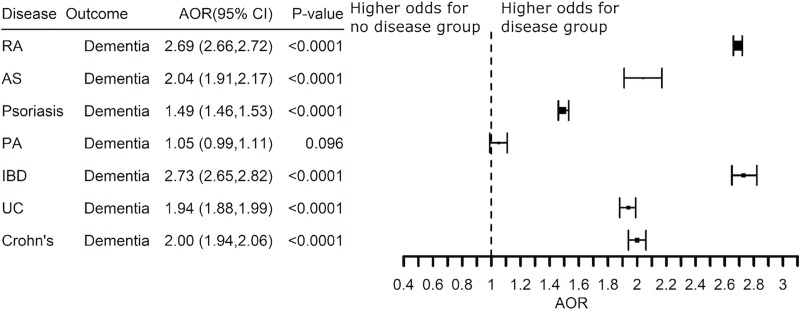
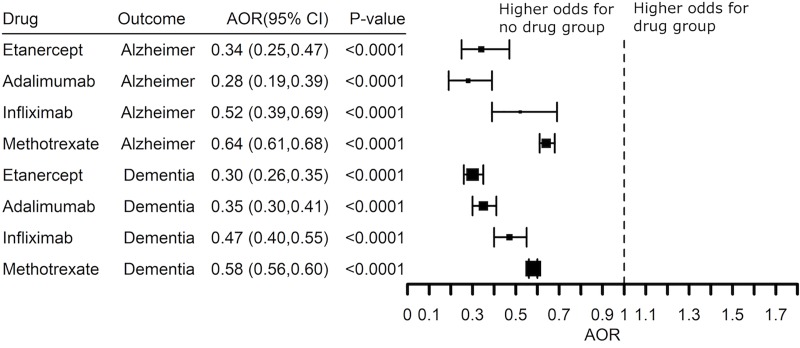
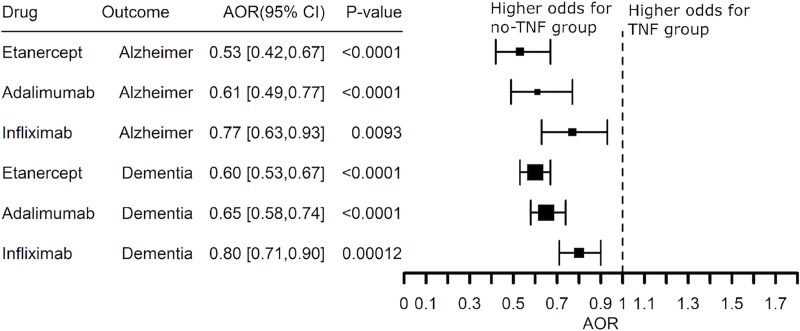
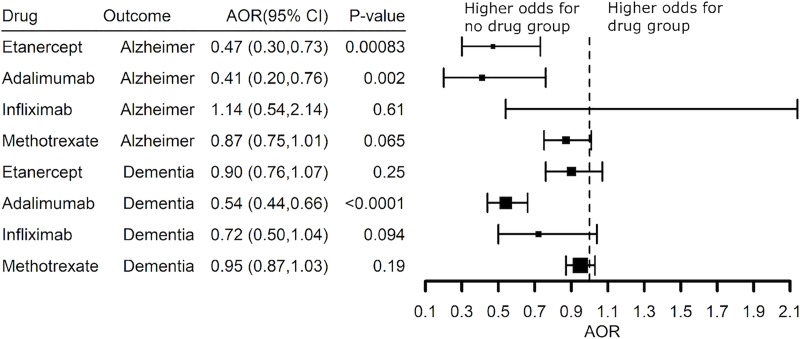
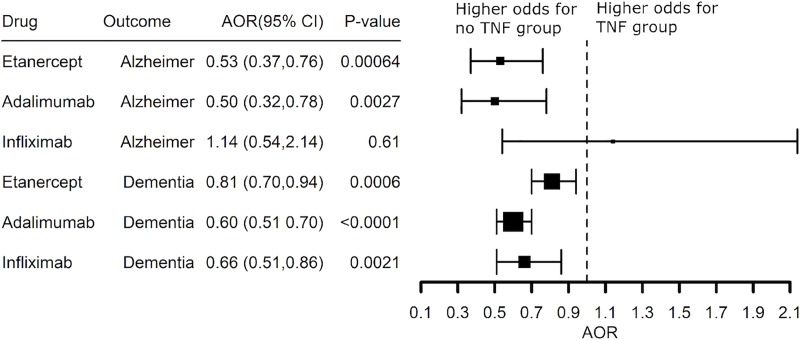
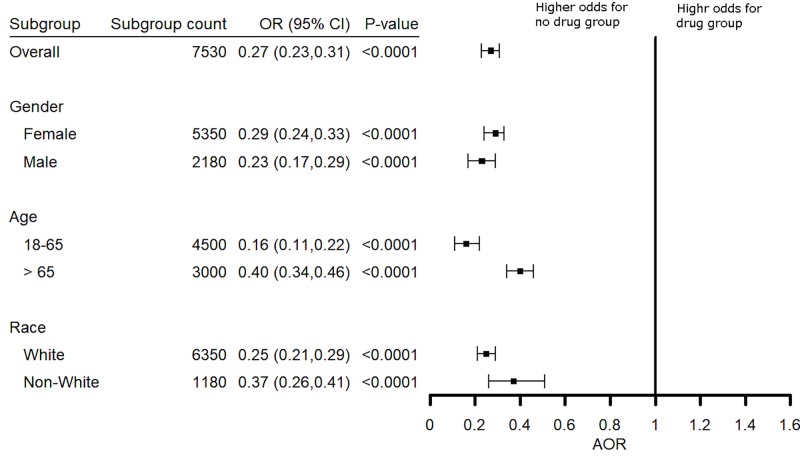
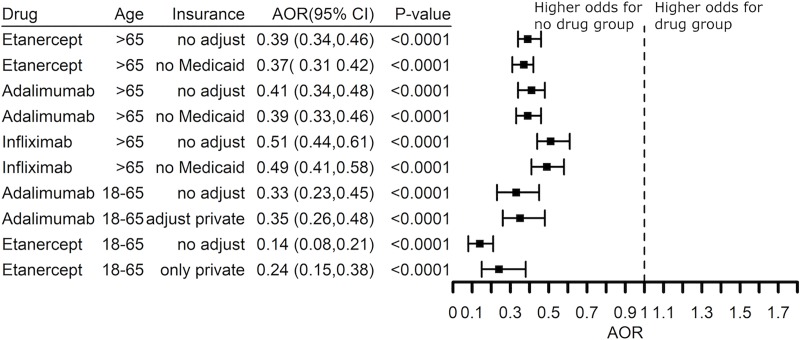
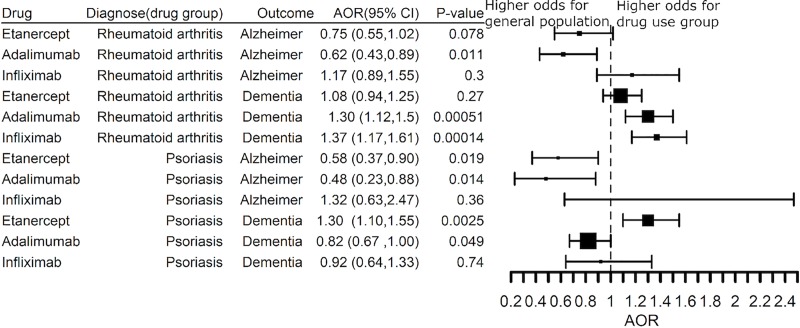
This large, retrospective case-control study of electronic health records from 56 million unique adult patients examined whether or not treatment with a Tumor Necrosis Factor (TNF) blocking agent is associated with lower risk for Alzheimer's disease (AD) in patients with rheumatoid arthritis (RA), psoriasis, and other inflammatory diseases which are mediated in part by TNF and for which a TNF blocker is an approved treatment. The analysis compared the diagnosis of AD as an outcome measure in patients receiving at least one prescription for a TNF blocking agent (etanercept, adalimumab, and infliximab) or for methotrexate. Adjusted odds ratios (AORs) were estimated using the Cochran-Mantel-Haenszel (CMH) method and presented with 95% confidence intervals (CIs) and p-values. RA was associated with a higher risk for AD (Adjusted Odds Ratio (AOR) = 2.06, 95% Confidence Interval: (2.02-2.10), P-value <0.0001) as did psoriasis (AOR = 1.37 (1.31-1.42), P <0.0001), ankylosing spondylitis (AOR = 1.57 (1.39-1.77), P <0.0001), inflammatory bowel disease (AOR = 2.46 (2.33-2.59), P < 0.0001), ulcerative colitis (AOR = 1.82 (1.74-1.91), P <0.0001), and Crohn's disease (AOR = 2.33 (2.22-2.43), P <0.0001). The risk for AD in patients with RA was lower among patients treated with etanercept (AOR = 0.34 (0.25-0.47), P <0.0001), adalimumab (AOR = 0.28 (0.19-0.39), P < 0.0001), or infliximab (AOR = 0.52 (0.39-0.69), P <0.0001). Methotrexate was also associated with a lower risk for AD (AOR = 0.64 (0.61-0.68), P <0.0001), while lower risk was found in patients with a prescription history for both a TNF blocker and methotrexate. Etanercept and adalimumab also were associated with lower risk for AD in patients with psoriasis: AOR = 0.47 (0.30-0.73 and 0.41 (0.20-0.76), respectively. There was no effect of gender or race, while younger patients showed greater benefit from a TNF blocker than did older patients. This study identifies a subset of patients in whom systemic inflammation contributes to risk for AD through a pathological mechanism involving TNF and who therefore may benefit from treatment with a TNF blocking agent.
Overview
The claims and statistics of this paper haven’t been checked yet.
Free: it reads the open-access text and checks the first 5 claims that cite a source we can check. Create a free account to check every claim.
Integrity signals
Registry
Cites
Statistics
Figures

Verification
Claims the paper makes
The claims and statistics of this paper haven’t been checked yet.
Free: it reads the open-access text and checks the first 5 claims that cite a source we can check. Create a free account to check every claim.
Claims other papers make about this one
Each is checked against this paper’s own text: does it say what the citing paper says it does?
The source backs part of the claim, not all of it — or backs it for a different population, condition or comparison.
In the citing paper
“Studies have demonstrated that a proinflammatory state (148–150), inflammatory disease (e.g., rheumatoid arthritis) (151), and immune challenges (e.g., acute infection) (152, 153) all increase the risk for dementia over multiple decades.”
From Connecting aging biology and inflammation in the omics era (2022) · cites this paper as [151]
Experimental — accuracy not yet measured
Self-check
Percentages, sums and reported differences re-computed from the paper’s own numbers.
The self-check needs the paper’s full text.
Citations
Cites
NIA‐AA Research Framework: Toward a biological definition of Alzheimer's disease
Jack, C. R., Bennett, D. A., Blennow, K., Carrillo, M. C., Dunn, B., Haeberlein, S. B., Holtzman, D. M., Jagust, W., Jessen, F., Karlawish, J., et al. (2018) · Alzheimer's & Dementia · doi:10.1016/j.jalz.2018.02.018 · Cited by 10,537
Neurotoxic reactive astrocytes are induced by activated microglia
Liddelow, S. A., Guttenplan, K. A., Clarke, L. E., Bennett, F. C., Bohlen, C. J., Schirmer, L., Bennett, M. L., Münch, A. E., Chung, W.-S., Peterson, T. C., et al. (2017) · Nature · doi:10.1038/nature21029 · Cited by 7,971
Neuroinflammation in Alzheimer's disease
Heneka, M. T., Carson, M. J., Khoury, J. E., Landreth, G. E., Brosseron, F., Feinstein, D. L., Jacobs, A. H., Wyss-Coray, T., Vitorica, J., Ransohoff, R. M., et al. (2015) · The Lancet Neurology · doi:10.1016/s1474-4422(15)70016-5 · Cited by 6,226 · cited 2×
“TLR4 encodes the Toll like receptor 4, a receptor in microglia, monocytes and macrophages that triggers TNF release when activated by lipopolysaccharide, or in the case of microglia, by amyloid beta peptide [41].”
BackgroundFate Mapping Analysis Reveals That Adult Microglia Derive from Primitive Macrophages
Ginhoux, F., Greter, M., Leboeuf, M., Nandi, S., See, P., Gokhan, S., Mehler, M. F., Conway, S. J., Ng, L. G., Stanley, E. R., et al. (2010) · Science · doi:10.1126/science.1194637 · Cited by 5,175 · cited 1×
“Microglia cells, the resident macrophages in the brain, derive embryonically from the same myeloid stem cells in bone marrow that give rise to monocytes and macrophages elsewhere in the body [4].”
Background2016 Alzheimer's disease facts and figures
Alzheimer's Association (2016) · Alzheimer's & Dementia · doi:10.1016/j.jalz.2016.03.001 · Cited by 5,069
Scheltens, P., Blennow, K., Breteler, M. M. B., de Strooper, B., Frisoni, G. B., Salloway, S., & Van der Flier, W. M. (2016) · The Lancet · doi:10.1016/s0140-6736(15)01124-1 · Cited by 3,125
Diagnosis and Management of Rheumatoid Arthritis: A Review
Aletaha, D., & Smolen, J. S. (2018) · JAMA · doi:10.1001/jama.2018.13103 · Cited by 2,313
Two Phase 3 Trials of Bapineuzumab in Mild-to-Moderate Alzheimer's Disease
Salloway, S., Sperling, R., Fox, N. C., Blennow, K., Klunk, W., Raskind, M., Sabbagh, M., Honig, L. S., Porsteinsson, A. P., Ferris, S., et al. (2014) · New England Journal of Medicine · doi:10.1056/nejmoa1304839 · Cited by 1,960 · cited 1×
“Even with carefully selected patients enrolled in large, multi-center, Phase 3 clinical trials, AD is misdiagnosed based solely on clinical criteria in up to 25% of patients [35, 36].”
BackgroundMicroglia in Alzheimer’s disease
Hansen, D. V., Hanson, J. E., & Sheng, M. (2018) · Journal of Cell Biology · doi:10.1083/jcb.201709069 · Cited by 1,935 · cited 1×
“Neuroinflammatory changes around the amyloid plaques include reactive astrocytosis and microglial cell activation [3].”
BackgroundMicroglia emerge as central players in brain disease
Salter, M. W., & Stevens, B. (2017) · Nature Medicine · doi:10.1038/nm.4397 · Cited by 1,767 · cited 1×
“Microglia activation and gliosis formerly were considered secondary to neurodegeneration in AD, however, recent genetic studies in late-onset AD implicate microglia- and astrocyterelated pathways in disease pathogenesis.[10, 48, 49] One focus of interest is TREM2, an innate immune receptor expressed on microglia and m…”
Result
Cited by
Wang, Q. Q., Kaelber, D. C., Xu, R., & Volkow, N. D. (2021) · Molecular Psychiatry · doi:10.1038/s41380-020-00880-7 · Cited by 634
Self-citationWang, Q., Xu, R., & Volkow, N. D. (2021) · World Psychiatry · doi:10.1002/wps.20806 · Cited by 617
Self-citationNeuroinflammation in Alzheimer’s Disease: Current Progress in Molecular Signaling and Therapeutics
Thakur, S., Dhapola, R., Sarma, P., Medhi, B., & Reddy, D. H. (2023) · Inflammation · doi:10.1007/s10753-022-01721-1 · Cited by 557
Wang, Q., Berger, N. A., & Xu, R. (2021) · JAMA Oncology · doi:10.1001/jamaoncol.2020.6178 · Cited by 390
Self-citationNeuroinflammation in Alzheimer’s Disease
Onyango, I. G., Jauregui, G. V., Čarná, M., Bennett, J. P., & Stokin, G. B. (2021) · Biomedicines · doi:10.3390/biomedicines9050524 · Cited by 330
“Indeed, patients with rheumatic disorders that are treated with TNF-blocking agents have a lower risk for developing AD [353].”
BackgroundKoźmiński, P., Halik, P. K., Chesori, R., & Gniazdowska, E. (2020) · International Journal of Molecular Sciences · doi:10.3390/ijms21103483 · Cited by 326
Role of chronic neuroinflammation in neuroplasticity and cognitive function: A hypothesis
Lecca, D., Jung, Y. J., Scerba, M. T., Hwang, I., Kim, Y. K., Kim, S., Modrow, S., Tweedie, D., Hsueh, S., Liu, D., et al. (2022) · Alzheimer's & Dementia · doi:10.1002/alz.12610 · Cited by 218
Connecting aging biology and inflammation in the omics era
Walker, K. A., Basisty, N., Wilson, D. M., & Ferrucci, L. (2022) · Journal of Clinical Investigation · doi:10.1172/jci158448 · Cited by 189
“, rheumatoid arthritis) (151), and immune challenges (e.”
BackgroundTherapeutic Potential of TNF-α Inhibition for Alzheimer’s Disease Prevention
Torres-Acosta, N., O’Keefe, J. H., O’Keefe, E. L., Isaacson, R., & Small, G. (2020) · Journal of Alzheimer's Disease · doi:10.3233/jad-200711 · Cited by 126
“68 Zhou [15] 56 million Alzheimer’s Disease infliximab 0.”
BackgroundInfluentialThe Role of TNF-α in Alzheimer’s Disease: A Narrative Review
Plantone, D., Pardini, M., Righi, D., Manco, C., Colombo, B. M., & De Stefano, N. (2023) · Cells · doi:10.3390/cells13010054 · Cited by 111
“A large retrospective case-control analysis, encompassing 56 million adult patients afflicted with inflammatory conditions, revealed a diminished risk of AD development with the administration of TNF-α inhibitors [93].”
BackgroundInsulin Resistance Exacerbates Alzheimer Disease via Multiple Mechanisms
Wei, Z., Koya, J., & Reznik, S. E. (2021) · Frontiers in Neuroscience · doi:10.3389/fnins.2021.687157 · Cited by 115
The role of peripheral inflammatory insults in Alzheimer’s disease: a review and research roadmap
Walker, K. A., Le Page, L. M., Terrando, N., Duggan, M. R., Heneka, M. T., & Bettcher, B. M. (2023) · Molecular Neurodegeneration · doi:10.1186/s13024-023-00627-2 · Cited by 113
“inflammatory insults Prompted largely by research demonstrating an elevation of inflammatory biomarkers in patients with AD dementia, reduced risk of AD among patients taking anti-inflammatory drugs for treatment of autoimmune inflammatory conditions [165, 166], and considerable evidence from genetic studies pointing…”
BackgroundTNF and TNF receptors as therapeutic targets for rheumatic diseases and beyond
Siegmund, D., & Wajant, H. (2023) · Nature Reviews Rheumatology · doi:10.1038/s41584-023-01002-7 · Cited by 133
Psoriasis and Systemic Inflammatory Disorders
Tashiro, T., & Sawada, Y. (2022) · International Journal of Molecular Sciences · doi:10.3390/ijms23084457 · Cited by 104
“Tumor Necrosis Factor (TNF) inhibitors decreased the risk of AD in patients with psoriasis [91].”
BackgroundThe Potential Role of Cytokines and Growth Factors in the Pathogenesis of Alzheimer’s Disease
Ogunmokun, G., Dewanjee, S., Chakraborty, P., Valupadas, C., Chaudhary, A., Kolli, V., Anand, U., Vallamkondu, J., Goel, P., Paluru, H. P. R., et al. (2021) · Cells · doi:10.3390/cells10102790 · Cited by 85
Tau at the interface between neurodegeneration and neuroinflammation
Didonna, A. (2020) · Genes & Immunity · doi:10.1038/s41435-020-00113-5 · Cited by 82
“In this regard, it is noteworthy that TNF-blocking agents are able to reduce the risk of AD in patients with rheumatoid arthritis and psoriasis [151].”
BackgroundChronic effects of inflammation on tauopathies
Langworth-Green, C., Patel, S., Jaunmuktane, Z., Jabbari, E., Morris, H. R., Thom, M., Lees, A. J., Hardy, J., Zandi, M. S., & Duff, K. (2023) · The Lancet Neurology · doi:10.1016/s1474-4422(23)00038-8 · Cited by 86
Amin, R., Quispe, C., Docea, A. O., Ydyrys, A., Kulbayeva, M., Durna Daştan, S., Calina, D., & Sharifi-Rad, J. (2022) · Neurochemistry International · doi:10.1016/j.neuint.2022.105376 · Cited by 74
Lee, D.-Y., Shin, Y.-J., Kim, J.-K., Jang, H., Joo, M.-K., & Kim, D. (2021) · Food & Function · doi:10.1039/d1fo02167b · Cited by 75
The necroptosis cell death pathway drives neurodegeneration in Alzheimer’s disease
Balusu, S., & Strooper, B. D. (2024) · Acta Neuropathologica · doi:10.1007/s00401-024-02747-5 · Cited by 85
“Inflammatory conditions such as rheumatoid arthritis (RA), psoriasis, and inflammatory bowel disease, where TNF plays a significant role, are associated with a higher likelihood of developing AD [29, 135, 138, 187].”
BackgroundDiabetes, stroke, and neuroresilience: looking beyond hyperglycemia
Krinock, M. J., & Singhal, N. S. (2021) · Annals of the New York Academy of Sciences · doi:10.1111/nyas.14583 · Cited by 63
Szandruk-Bender, M., Wiatrak, B., & Szeląg, A. (2022) · Journal of Clinical Medicine · doi:10.3390/jcm11133704 · Cited by 58
“inflammatory disorders but not IBD [37].”
BackgroundInfluentialThe Functions and Phenotypes of Microglia in Alzheimer’s Disease
Fujikawa, R., & Tsuda, M. (2023) · Cells · doi:10.3390/cells12081207 · Cited by 47
“It has been reported that the risk of AD is lower in patients with rheumatoid arthritis and psoriasis who have been treated with TNF-α blocking agents [76].”
BackgroundMethodBiomaterials-based anti-inflammatory treatment strategies for Alzheimer’s disease
Chu, J., Zhang, W., Liu, Y., Gong, B., Ji, W., Yin, T., Gao, C., Liangwen, D., Hao, M., Chen, C., et al. (2023) · Neural Regeneration Research · doi:10.4103/1673-5374.374137 · Cited by 53
“Some lncRNAs and circRNAs can mediate neuroinflammation by regulating miRNAs (Yang et al., 2019; Zhou et al., 2020a; Li et al., 2022b).”
Desai, R. J., Varma, V. R., Gerhard, T., Segal, J., Mahesri, M., Chin, K., Horton, D. B., Kim, S. C., Schneeweiss, S., & Thambisetty, M. (2022) · JAMA Network Open · doi:10.1001/jamanetworkopen.2022.6567 · Cited by 45
Blood inflammation relates to neuroinflammation and survival in frontotemporal lobar degeneration
Malpetti, M., Swann, P., Tsvetanov, K. A., Chouliaras, L., Strauss, A., Chikaura, T., Murley, A. G., Ashton, N. J., Barker, P. J., Jones, P. S., et al. (2024) · Brain · doi:10.1093/brain/awae269 · Cited by 52
“Epidemiological studies suggest that blocking TNF-α might reduce risk for Alzheimer’s disease in those with autoimmune conditions 50,51 ; whereas the upregulation of TNF-α leads to the exacerbation of pathology.”
Sood, A., & Raji, M. A. (2020) · Clinical Rheumatology · doi:10.1007/s10067-020-05372-1 · Cited by 52
“[72] Retrospective case-control study 51,440 RA patients; 309,660 psoriasis patients Anti-TNF reduced risk of dementia in RA and psoriasis; previous use of methotrexate reduced risk of dementia”
In search of an anti-inflammatory drug for Alzheimer disease
Gyengesi, E., & Münch, G. (2020) · Nature Reviews Neurology · doi:10.1038/s41582-019-0307-9 · Cited by 43
Lindbohm, J. V., Mars, N., Sipilä, P. N., Singh‐Manoux, A., Runz, H., FinnGen, Livingston, G., Seshadri, S. S., Xavier, R. J., Hingorani, A. D., et al. (2022) · Nature Aging · doi:10.1038/s43587-022-00293-x · Cited by 43
Comorbidity‐driven multi‐modal subtype analysis in mild cognitive impairment of Alzheimer's disease
Katabathula, S., Davis, P. B., & Xu, R. (2022) · Alzheimer s & Dementia · doi:10.1002/alz.12792 · Cited by 47
Self-citationAggarwal, M., Alkhayyat, M. M., Saleh, M. A., Sarmini, M. T., Singh, A., Garg, R., Garg, P., Mansoor, E., Padival, R., & Cohen, B. L. (2022) · Journal of Clinical Gastroenterology · doi:10.1097/mcg.0000000000001714 · Cited by 46
Prevalence of cognitive impairment in patients with rheumatoid arthritis: a cross sectional study
McDowell, B., Marr, C., Holmes, C., Edwards, C. J., Cardwell, C. R., McHenry, M., Meenagh, G., & McGuinness, B. (2022) · BMC Psychiatry · doi:10.1186/s12888-022-04417-w · Cited by 44
TNF-α: The shape of small molecules to come?
Dömling, A. S. S., & Li, X. (2021) · Drug Discovery Today · doi:10.1016/j.drudis.2021.06.018 · Cited by 44
“patients with RA, psoriasis, and other inflammatory diseases, which are mediated, in part, by TNF and for which a TNF blocker is an approved treatment.(5)”
BackgroundAssociation of autoimmune diseases with Alzheimer's disease: A mendelian randomization study
Yeung, C. H. C., Yeung, S. L. A., & Schooling, C. M. (2022) · Journal of Psychiatric Research · doi:10.1016/j.jpsychires.2022.09.052 · Cited by 42
Tondo, G., Marchi, F. D., Bonardi, F., Menegon, F., Verrini, G., Aprile, D., Anselmi, M., Mazzini, L., & Comi, C. (2024) · Journal of Clinical Medicine · doi:10.3390/jcm13113098 · Cited by 46
“Interestingly, patients treated with TNF-blocking agents for other non-neurological disorders were associated with a lower risk of developing AD [189].”
BackgroundImmune modulation to treat Alzheimer’s disease
Duggan, M. R., Morgan, D., Price, B. R., Rajbanshi, B., Martín‐Peña, A., Tansey, M. G., & Walker, K. A. (2025) · Molecular Neurodegeneration · doi:10.1186/s13024-025-00828-x · Cited by 49
Zhou, M., Zheng, C., & Xu, R. (2020) · Bioinformatics · doi:10.1093/bioinformatics/btaa451 · Cited by 34
Self-citationLiu, S., Yuan, X., Su, H., Liu, F., Zhuang, Z., & Chen, Y. (2022) · Frontiers in Immunology · doi:10.3389/fimmu.2022.892368 · Cited by 40
“The result may illustrate that TNF-a blocking agents protect psoriasis patients from AD on molecular levels (33).”
BackgroundWang, W., Davis, P. B., Qi, X., Gurney, M. E., Perry, G. L., Volkow, N. D., Kaelber, D. C., & Xu, R. (2025) · Journal of Alzheimer s Disease · doi:10.1177/13872877251351329 · Cited by 38
“, 46 , 47 We The slope of the survival curve for the semaglutide group remained fl atter than that of the comparison groups throughout the 3-year follow-up, suggesting that semaglutide slowed down the development of dementia.”
Self-citationSuppression of Fli-1 protects against pericyte loss and cognitive deficits in Alzheimer's disease
Li, P., Wu, Y., Hamlett, E. D., Goodwin, A. J., Halushka, P. V., Carroll, S. L., Liu, M., & Fan, H. (2022) · Molecular Therapy · doi:10.1016/j.ymthe.2022.01.023 · Cited by 33
Arbo, B. D., Schimith, L. E., dos Santos, M. G., & Hort, M. A. (2022) · European Journal of Pharmacology · doi:10.1016/j.ejphar.2022.174800 · Cited by 34
A novel molecular class that recruits HDAC/MECP2 complexes to PU.1 motifs reduces neuroinflammation
Ralvenius, W. T., Mungenast, A. E., Woolf, H., Huston, M. M., Gillingham, T. Z., Godin, S. K., Penney, J., Cam, H. P., Gao, F., Fernandez, C. G., et al. (2023) · Journal of Experimental Medicine · doi:10.1084/jem.20222105 · Cited by 29
Watad, ., McGonagle, D., Anis, S., Carmeli, R., Cohen, A. D., Tsur, A. M., Ben‐Shabat, N., Bragazzi, N. L., Lidar, M., & Amital, H. (2022) · Pharmacological Research · doi:10.1016/j.phrs.2022.106325 · Cited by 30
Jain, S., Singh, R., Paliwal, S., & Sharma, S. K. (2023) · Mini-Reviews in Medicinal Chemistry · doi:10.2174/1389557523666230511122435 · Cited by 39
Role of TET1-mediated epigenetic modulation in Alzheimer's disease
Armstrong, M. J., Jin, Y., Vattathil, S., Huang, Y., Schroeder, J. P., Bennet, D. A., Qin, Z. S., Wingo, T. S., & Jin, P. (2023) · Neurobiology of Disease · doi:10.1016/j.nbd.2023.106257 · Cited by 35
Zhou, M., Wang, Q., Zheng, C., Rush, A. J., Volkow, N. D., & Xu, R. (2021) · Molecular Psychiatry · doi:10.1038/s41380-020-01011-y · Cited by 33
Self-citationDesai, R. J., Varma, V. R., Gerhard, T., Segal, J., Mahesri, M., Chin, K., Nonnenmacher, E., Gabbeta, A., Mammen, A. M., Varma, S., et al. (2020) · Alzheimer's & Dementia: Translational Research & Clinical Interventions · doi:10.1002/trc2.12095 · Cited by 27
Repositioning of Immunomodulators: A Ray of Hope for Alzheimer’s Disease?
Munafò, A., Burgaletto, C., Benedetto, G. D., Mauro, M. D., Mauro, R. D., Bernardini, R., & Cantarella, G. (2020) · Frontiers in Neuroscience · doi:10.3389/fnins.2020.614643 · Cited by 31
Zheng, C., Fillmore, N. R., Ramos‐Cejudo, J., Brophy, M. T., Osorio, R. S., Gurney, M. E., Qiu, W. Q., Au, R., Perry, G. L., Dubreuil, M., et al. (2021) · Alzheimer s & Dementia · doi:10.1002/alz.12465 · Cited by 30
Self-citationExosomes: A missing link between chronic systemic inflammation and Alzheimer’s disease?
Ozansoy, M., Mikati, H., Velioğlu, H. A., & Yuluğ, B. (2023) · Biomedicine & Pharmacotherapy · doi:10.1016/j.biopha.2022.114161 · Cited by 30
Myasoedova, E., Sattui, S. E., Lee, J., O'Brien, J. T., & Makris, U. E. (2024) · The Lancet Rheumatology · doi:10.1016/s2665-9913(24)00190-5 · Cited by 33
Sattui, S. E., Navarro-Millán, I. Y., Xie, F., Rajan, M., Yun, H., & Curtis, J. R. (2022) · Seminars in Arthritis and Rheumatism · doi:10.1016/j.semarthrit.2022.152083 · Cited by 28
Inflammatory bowel disease and risk of dementia: An updated meta-analysis
Liu, N., Wang, Y., He, L., Sun, J., Wang, X., & Li, H. (2022) · Frontiers in Aging Neuroscience · doi:10.3389/fnagi.2022.962681 · Cited by 28
Inflammation, Autoimmunity and Neurodegenerative Diseases, Therapeutics and Beyond
Garmendia, J. V., Sanctis, C. V. D., Das, V., Annadurai, N., Hajdúch, M., & Sanctis, J. B. D. (2023) · Current Neuropharmacology · doi:10.2174/1570159x22666231017141636 · Cited by 30
“Patients with RA treated with TNF-blocking agents (etanercept, adalimumab, infliximab) rarely develop AD [224, 225].”
BackgroundCommon Factors of Alzheimer’s Disease and Rheumatoid Arthritis—Pathomechanism and Treatment
Trzeciak, P., Herbet, M., & Dudka, J. (2021) · Molecules · doi:10.3390/molecules26196038 · Cited by 27
“One of the newest studies conducted in 2020 confirms the above-mentioned findings and additionally indicates the potential protective effect of anti-TNF drugs in patients with RA [104].”
ResultGorenflo, M. P., Davis, P. B., Kendall, E. K., Olaker, V. R., Kaelber, D. C., & Xu, R. (2022) · Journal of Alzheimer s Disease · doi:10.3233/jad-220901 · Cited by 23
“Indeed, some of our previous work reveals that tumor necrosis factor inhibitors, another class of anti-inflammatories, are associated with reduced incidence of AD in patients with rheumatoid arthritis, which is characterized by high levels of inflammation [42, 43].”
Self-citationDetection of molecular signatures and pathways shared by Alzheimer’s disease and type 2 diabetes
Shu, J., Li, N., Wei, W., & Zhang, L. (2021) · Gene · doi:10.1016/j.gene.2021.146070 · Cited by 31
The emerging role of IL‐38 in diseases: A comprehensive review
Chen, W., Xi, S., Ke, Y., & Lei, Y. (2023) · Immunity Inflammation and Disease · doi:10.1002/iid3.991 · Cited by 26
The Relationship Between Alzheimer’s Disease and Skin Diseases: A Review
Zhang, H., Zhang, D., Tang, K., & Sun, Q. (2021) · Clinical Cosmetic and Investigational Dermatology · doi:10.2147/ccid.s322530 · Cited by 24
Adipose tissue as a therapeutic target for vascular damage in Alzheimer's disease
Bettinetti‐Luque, M., Trujillo‐Estrada, L., García‐Fuentes, E., Andreo‐Lopez, J., Sanchez-Varo, R. M., Garrido‐Sánchez, L., Mediavilla, A. G., López, M. G., García‐Caballero, M., Gutiérrez, A., et al. (2023) · British Journal of Pharmacology · doi:10.1111/bph.16243 · Cited by 24
“Etanercept, which is in Phase II clinical trials, reduces neuroinflammation, TNF level and amyloid plaque accumulation and improves cognitive functions (Figure 4) (Tufan & Tufan, 2015; Zhou et al., 2020).”
BackgroundAssociation between psoriasis and dementia: A systematic review
Zhao, J., Li, T., & Wang, J. (2021) · Neurología · doi:10.1016/j.nrl.2020.12.007 · Cited by 23
Gwinnutt, J. M., Toyoda, T., Barraclough, M. L., Verstappen, S. M. M., Hornberger, M., & MacGregor, A. J. (2022) · Seminars in Arthritis and Rheumatism · doi:10.1016/j.semarthrit.2022.152131 · Cited by 24
Serafini, S., Ferretti, G., Monterosso, P., Angiolillo, A., Costanzo, A. D., & Matrone, C. (2024) · Antioxidants · doi:10.3390/antiox13020216 · Cited by 29
A phase 2, open-label study of anti-inflammatory NE3107 in patients with dementias
Haroon, J. M., Jordan, K., Mahdavi, K. D., Rindner, E., Becerra, S. A., Surya, J. R., Zielinski, M. A., Venkatraman, V., Goodenowe, D. B., Hofmeister, K., et al. (2024) · Medicine · doi:10.1097/md.0000000000039027 · Cited by 26
“[14,32,39] Indeed, neuroinflammation is believed to be a founding event in AD, perhaps occuring even prior to A β plaque deposition.”
BackgroundSattui, S. E., Rajan, M., Lieber, S. B., Lui, G. E., Sterling, M. R., Curtis, J. R., Mandl, L. A., & Navarro-Millán, I. Y. (2021) · Seminars in Arthritis and Rheumatism · doi:10.1016/j.semarthrit.2020.09.022 · Cited by 21
Mohamad, H. E., Abo–Elmatty, D. M., Wahba, N. S., Shaheen, M. A., Sakr, R., & Wahba, A. S. (2022) · Life Sciences · doi:10.1016/j.lfs.2022.120613 · Cited by 21
Idrissi, F. E., Gressier, B., Devos, D., & Bélarbi, K. (2021) · Frontiers in Pharmacology · doi:10.3389/fphar.2021.630003 · Cited by 22
“…and certolizumab pegol) that were found to be associated with lower Alzheimer ’ s disease risk in patients with rheumatoid arthritis and psoriasis (Zhou et al., 2020) and proved positive immune and cognitive outcomes in rodent models of Alzheimer ’ s disease (Kim et al., 2016; Paouri et al.,…”
BackgroundLambuk, L., Ahmad, S., Sadikan, M. Z., Nordin, N. A., Kadir, R., Nasir, N. A. A., Chen, X., Boer, J. C., Plebanski, M., & Mohamud, R. (2022) · Frontiers in Immunology · doi:10.3389/fimmu.2022.857812 · Cited by 22
Rheumatoid Arthritis and Cognitive Impairment or Dementia: An Updated Review of Epidemiological Data
Sharma, S. R., & Chen, Y. (2023) · Journal of Alzheimer s Disease · doi:10.3233/jad-230234 · Cited by 23
“Protective effects were also noted among those treated with methotrexate (0.64, 0.61-0.68) [ 24].”
InfluentialXie, W., Hou, Y., Xiao, S., Zhang, X., & Zhang, Z. (2024) · RMD Open · doi:10.1136/rmdopen-2023-004016 · Cited by 19
“RMD Open RMD Open RMD Open (figure 2, online supplemental figure S1).”
BackgroundTolédano, A., Rodríguez‐Casado, A., Álvarez, M., & Toledano‐Díaz, A. (2024) · Brain Sciences · doi:10.3390/brainsci14111101 · Cited by 21
HIV disease duration, but not active brain infection, predicts cortical amyloid beta deposition
Morgello, S., Cortes, E. P., Gensler, G. R., Meloni, G., Jacobs, M. M., Murray, J., Borukov, V., & Crary, J. F. (2021) · AIDS · doi:10.1097/qad.0000000000002893 · Cited by 16
“Relevant to neurodegeneration, some literature suggests autoimmune diseases characterized by innate immunity confer increased risk for Alzheimer’s disease, and that exposure to anti-TNFa agents mitigates risk [37,38].”
BackgroundWang, Y., Wu, T. Z., Tsai, M., Rezzonico, M. G., Abdel‐Haleem, A. M., Xie, L., Gandham, V. D., Ngu, H., Stark, K. L., Glock, C., et al. (2023) · eLife · doi:10.7554/elife.83451 · Cited by 18
“A pathogenic role for inflammatory cytokines in neurodegeneration is supported by the increased risk for AD in people with rheumatoid arthritis (RA), psoriasis, and other inflammatory diseases, and a significantly reduced incidence of AD for those patients that received treatment with TNF blocking agents (Zhou et al.,…”
BackgroundClark, I. A. (2020) · Reviews in Medical Virology · doi:10.1002/rmv.2210 · Cited by 16
The Role of Immunity in Alzheimer's Disease
McManus, R. M. (2022) · Advanced Biology · doi:10.1002/adbi.202101166 · Cited by 18
Blood mRNA Expression in Alzheimer's Disease and Dementia With Lewy Bodies
Donaghy, P. C., Cockell, S., Martin-Ruiz, C. M., Coxhead, J., Kane, J. P. M., Erskine, D., Koss, D. J., Taylor, J., Morris, C. M., O'Brien, J. T., et al. (2022) · American Journal of Geriatric Psychiatry · doi:10.1016/j.jagp.2022.02.003 · Cited by 16
Karnik, S. J., Margetts, T. J., Wang, H. S., Movilă, A., Oblak, A. L., Fehrenbacher, J. C., Kacena, M. A., & Plotkin, L. I. (2024) · Current Osteoporosis Reports · doi:10.1007/s11914-023-00847-x · Cited by 16
Kern, D. M., Lovestone, S., & Cepeda, M. S. (2021) · Alzheimer s & Dementia Translational Research & Clinical Interventions · doi:10.1002/trc2.12163 · Cited by 14
Fighting fire with fire: The immune system might be key in our fight against Alzheimer’s disease
Dujardin, P., Vandenbroucke, R. E., & Hoecke, L. V. (2022) · Drug Discovery Today · doi:10.1016/j.drudis.2022.01.004 · Cited by 15
Psoriasis and progression of Parkinson's disease: a Mendelian randomization study
Li, C., Li, X., Lin, J., Cui, Y., & Shang, H. (2022) · Journal of the European Academy of Dermatology and Venereology · doi:10.1111/jdv.18459 · Cited by 15
Generalized Pustular Psoriasis and Systemic Organ Dysfunctions
Teshima, R., Saito‐Sasaki, N., & Sawada, Y. (2024) · International Journal of Molecular Sciences · doi:10.3390/ijms25116270 · Cited by 17
“The impact of skin inflammation extends beyond the skin itself, affecting multiple other organs and contributing to the pathogenesis of a wide range of systemic inflammatory diseases [25–28].”
BackgroundRazak, A. M., Zakaria, S. N. A., Sani, N. F. A., Rani, N. A., Hakimi, N. H., Said, M. M., Tan, J. K., Gan, H. K., Nordin, M. F. M., & Makpol, S. (2023) · Frontiers in Pharmacology · doi:10.3389/fphar.2023.1006265 · Cited by 15
“The aberrant release of TNF-α causes psoriasis, psoriatic arthritis, and non-infectious uveitis (NIU) (Zhou et al., 2020; Jang et al., 2021).”
BackgroundLiterature Overview of the Relation Between Psoriasis and Alzheimer
Yang, Q., Wang, J., Mi, N., & Zou, Y. (2023) · Neuropsychiatric Disease and Treatment · doi:10.2147/ndt.s403854 · Cited by 13
“47) than those patients without such treatment.(49) One of the most important axis is IL-12/23 axis in psoriasis development, and IL-12/ IL-23 common subunit p40 targeted by monoclonal antibodies are widely used in treating psoriasis.”
BackgroundNowowiejska, J., Baran, A. M., Hermanowicz, J. M., Sieklucka, B., Krahel, J. A., Kiluk, P., Pawlak, D., & Flisiak, I. (2022) · Journal of Clinical Medicine · doi:10.3390/jcm11092430 · Cited by 13
“For instance, there was evidence of the improvement observed in AD patients after administration of anti-TNFα agents for psoriasis [26].”
BackgroundSaik, O., & Klimontov, V. V. (2021) · International Journal of Molecular Sciences · doi:10.3390/ijms222212419 · Cited by 19
Pan, Y., & Xu, R. (2022) · BMC Medical Informatics and Decision Making · doi:10.1186/s12911-022-01869-8 · Cited by 11
Self-citationTargeting hypercoagulation to alleviate Alzheimer’s disease progression in metabolic syndrome
Khan, S. I., Pati, S., Singh, S., Akhtar, M., Khare, P., Khan, S., Shafi, S., & Najmi, A. K. (2021) · International Journal of Obesity · doi:10.1038/s41366-021-00977-1 · Cited by 10
“Application of antiinflammatory agents such TNF-alpha inhibitors in reducing the risk of AD in MetS could be another potential intervention as inflammation is central to the pathogenesis of both MetS and AD [34, 35].”
BackgroundPsoriasis and neurodegenerative diseases—a review
Nowowiejska, J., Baran, A. M., & Flisiak, I. (2022) · Frontiers in Molecular Neuroscience · doi:10.3389/fnmol.2022.917751 · Cited by 10
“The most valuable study was described earlier—their team found out that treatment of psoriatics with anti-TNFα agents decreases the risk of AD (Zhou et al., 2020).”
BackgroundGrech, V.-S., Lotsaris, K., Kefala, V., & Rallis, E. A. (2025) · Genes · doi:10.3390/genes16121463 · Cited by 11
“In parallel, Zhou et al. [34] analyzed more than 56 million electronic health records and reported that treatment with TNF-α inhibitors, including etanercept, adalimumab, and infliximab, was associated with a significantly lower risk of AD among patients with rheumatoid arthritis and psoriasis.”
The brain-joint axis: links between osteoarthritis and neurodegenerative disorders in aging
Rabie, M. A., Madry, H., Cucchiarini, M., & Sayed, N. S. E. (2025) · Journal of Advanced Research · doi:10.1016/j.jare.2025.10.023 · Cited by 17
Liao, O., Xie, S., Ye, J., Du, Q., & Lou, G. (2024) · World Journal of Psychiatry · doi:10.5498/wjp.v14.i1.15 · Cited by 8
Microglia-mediated neuron death requires TNF and is exacerbated by mutant Huntingtin
Young, A. P., & Denovan‐Wright, E. M. (2024) · Pharmacological Research · doi:10.1016/j.phrs.2024.107443 · Cited by 9
Ramey, G. D., Tang, A., Phongpreecha, T., Yang, M. M., Woldemariam, S. R., Oskotsky, T., Montine, T. J., Allen, I. E., Miller, Z., Aghaeepour, N., et al. (2025) · Cell Reports Medicine · doi:10.1016/j.xcrm.2025.101980 · Cited by 13
Fazel, S. D., Carollo, M., Tap, L., Spini, A., Trifirò, G., & Mattace-Raso, F. U. S. (2025) · Drugs & Aging · doi:10.1007/s40266-025-01190-9 · Cited by 10
“The relatively young average age of participants in these studies, along with the short follow-up periods, also limited the generalizability of the findings, particularly in older patients with RA, where dementia risk is typically higher [52, 59].”
InfluentialLuo, A., Yang, Q., Zhang, Z., Yang, Y., Li, X., Deng, Y., He, L., & Zhou, M. (2024) · Joint Bone Spine · doi:10.1016/j.jbspin.2024.105793 · Cited by 8
Self-citationA novel peptide ‘T14’ reflects age and photo-aging in human skin
Rocha, S., Garcia‐Ratés, S., Moswete, T., Kalleberg, K., VILLA, A. M., Harcup, J., & Greenfield, S. A. (2023) · Aging · doi:10.18632/aging.204844 · Cited by 9
Almazán, J. L., Cortes-Flores, E., Ramírez-Olvera, A., Palomero‐Rivero, M., Camacho‐Concha, N., Guerra‐Crespo, M., Prieto, G. A., Pérez‐Martínez, L., & Pedraza‐Alva, G. (2025) · Brain Behavior and Immunity · doi:10.1016/j.bbi.2025.06.019 · Cited by 6
Kim, H. S., Jung, H., Park, Y., Heo, S., Kim, S., & Moon, M. (2024) · Aging and Disease · doi:10.14336/ad.2024.0406 · Cited by 10
Kamsrijai, U., Thaweethee-Sukjai, B., Teerapattarakan, N., Wanchai, K., & Jirarattanawan, P. (2023) · Physiology and Pharmacology · doi:10.61186/phypha.27.3.296 · Cited by 7
Association between psoriasis and dementia: A systematic review
Zhao, J., Li, T., & Wang, J. (2023) · Neurología (English Edition) · doi:10.1016/j.nrleng.2023.12.005 · Cited by 19
Metadata
- Authors
- Zhou, M., Xu, R., Kaelber, D. C., & Gurney, M. E.
- Affiliations
- Case Western Reserve University (US)
- MetroHealth (US)
- Tetra Therapeutics (United States) (US)
- Corresponding author
- Xu, Rong
- Gurney, Mark E.
- Venue
- PLOS ONE
- Publisher
- Public Library of Science (PLoS)
- Published
- 2020-03-23
- Volume
- 15
- Issue
- 3
- Pages
- e0229819
- ISSN
- 1932-6203 (ISSN-L)
- PMC
- PMC7089534
- OpenAlex
- W3012855465
- Cited by
- 157
- References
- 66
- Citations by year
- 2026: 14 · 2025: 21 · 2024: 23 · 2023: 27 · 2022: 38 · 2021: 21 · 2020: 13
- FWCI
- 18.65
- Type
- journal article
- Language
- en
- Open access
- gold
- doi.org
- Licence
- Locations
- PLoS ONE (publishedVersion, cc-by)
- medRxiv (acceptedVersion)
- Europe PMC (PubMed Central) (publishedVersion, cc-by)
- PubMed Central (publishedVersion, cc-by)
- PubMed (publishedVersion)
- DOAJ (DOAJ: Directory of Open Access Journals) (submittedVersion, cc-by-sa)
- Figshare (submittedVersion, cc-by)
- Funders
- Eunice Kennedy Shriver National Institute of Child Health and Human Development (DP2HD084068)
- National Institute on Aging (R01 AG057557, R01 AG061388, R56 AG062272)
- American Cancer Society (RSG-16-049-01 - MPC)
- National Institute of Mental Health (MH091791, MH107077)
- Topics
- Health Sciences › Medicine › Rheumatology › Rheumatoid Arthritis Research and Therapies
- Health Sciences › Medicine › Psychiatry and Mental health › Dementia and Cognitive Impairment Research
- Life Sciences › Neuroscience › Cellular and Molecular Neuroscience › Alzheimer's disease research and treatments
- Keywords
- Alzheimer's disease, TNF-alpha inhibitors, rheumatoid arthritis, psoriasis, ankylosing spondylitis, inflammatory bowel disease, Crohn's disease, ulcerative colitis, etanercept, adalimumab, infliximab, methotrexate, anti-TNF therapy, neurodegeneration risk, electronic health records, pharmacoepidemiology
- MeSH terms
- Etanercept, Adalimumab, Infliximab, Tumor Necrosis Factor Inhibitors, Adolescent, Adult, Aged, Alzheimer Disease, Arthritis, Rheumatoid, Colitis, Ulcerative, Female, Humans, Male, Methotrexate, Middle Aged, Retrospective Studies, Risk, Arthritis, Psoriatic, Case-Control Studies, Antirheumatic Agents, Young Adult
About these checks
Registry, retraction, Cites and statistics results are computed, not judged, with one exception: a printed reference that no index lists is read once by a model before it counts as a citation error. Claims are extracted by a model and kept only when their quote appears verbatim in the text; each cited source is then checked, with a model’s help, for whether it says what the claim relies on. Those verdicts can be wrong — read the claim’s quote and the cited source before relying on one.
Statistics and arithmetic are recomputed, not judged.
Confidence bands are shown only for fields calibrated on our annotated test set. None is calibrated yet, so no band is shown.
What counts as a claim ›How we measure confidence ›How we check this ›
Are you an author, or do you see a problem with this page? Request a review
Data sources
Bibliographic data: Semantic Scholar, OpenAlex, Crossref.
Contains information from the Semantic Scholar Academic Graph Datasets, made available under the ODC Attribution License (ODC-BY 1.0).
Semantic Scholar’s data is described in: Kinney, R., et al. (2023). The Semantic Scholar Open Data Platform. arXiv:2301.10140.
