

The DOI matches its Crossref record; 51 of the 52 references it cites were found in a registry or an index, and 1 are not checked yet.
Mexican and Spanish university students’ Internet addiction and academic procrastination: Correlation and potential factors
Open accessAbstract
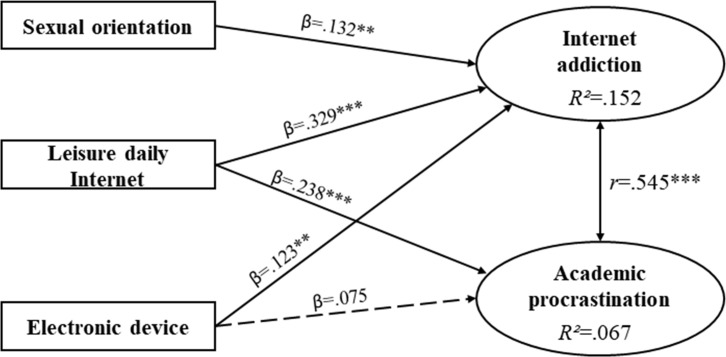
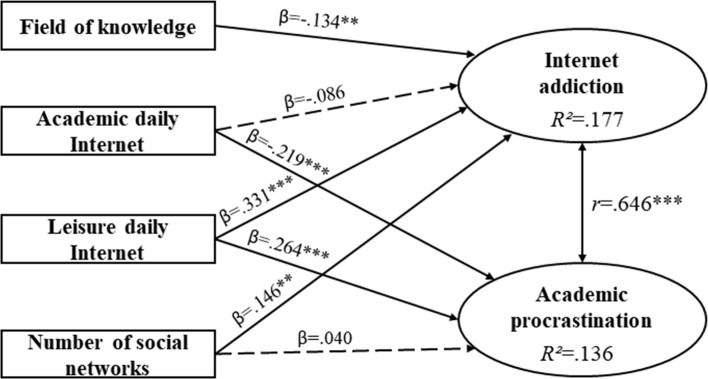
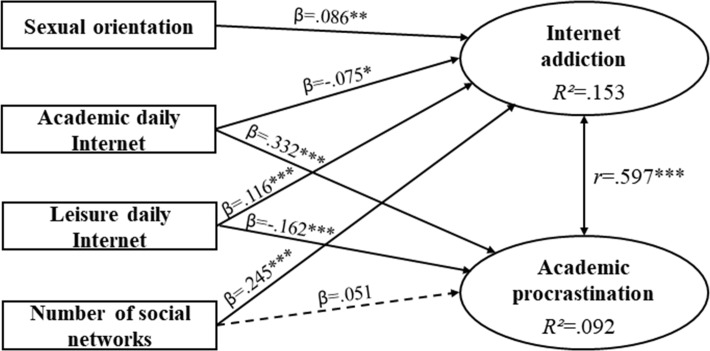
The 21st-century problem of Internet addiction is increasing globally, but especially among university students. Not surprisingly, then, problematic Internet use is associated with university students' academic procrastination. Because studies are scarce in Mexico and Spain has one of the highest rates of Internet addiction in Europe, this paper (i) analyzed the presence and degree of Internet addiction among university students in Mexico and Spain, (ii) determined potential sociodemographic factors influencing Internet addiction, and (iii) established the type of correlation between Internet addiction and academic procrastination. The cross-sectional study design used an online questionnaire to measure problematic Internet use and academic procrastination through convenience sampling at one university in Mexico and one in Spain. The questionnaire contained three sections: participants' sociodemographic data, the Internet Addiction Test, and the Academic Procrastination Scale. The final sample comprised 758 university students, 387 from Mexico, and 371 from Spain, aged from 18 to 35 (M = 20.08, SD = 3.16). Results revealed similar prevalence rates of problematic and daily Internet use for leisure, potentially influencing Internet addiction in all three models (i.e., Mexico, Spain, and Total). Additionally, significant positive correlation was revealed between problematic Internet use and academic procrastination (p < .001). Finally, findings showed relevant data on Internet addiction's prevalence in Mexican and Spanish university contexts, along with its influential sociodemographic factors.
Overview
The claims and statistics of this paper haven’t been checked yet.
Run the check — free, no account needed. It reads the open-access text and checks the sources it cites.
Integrity signals
Registry
Cites
Statistics
Figures
Verification
Claims the paper makes
The claims and statistics of this paper haven’t been checked yet.
Run the check — free, no account needed. It reads the open-access text and checks the sources it cites.
Claims other papers make about this one
Each is checked against this paper’s own text: does it say what the citing paper says it does?
The cited source says what the claim attributes to it.
In the citing paper
“Se encontró que en ambos países hay cifras similares de uso problemático y diario de internet para el ocio.”
From Uso de redes sociales y procrastinación en estudiantes universitarios: una revisión sistemática (2023) · cites this paper as Aznar-Díaz et al. (2020)
The cited source says what the claim attributes to it.
In the citing paper
“También se encontró una correlación positiva y significativa entre las dos variables estudiadas (p < .001).”
From Uso de redes sociales y procrastinación en estudiantes universitarios: una revisión sistemática (2023) · cites this paper as Aznar-Díaz et al. (2020)
Self-check
Percentages, sums and reported differences re-computed from the paper’s own numbers.
The self-check needs the paper’s full text.
Citations
Cites
Testing Structural Equation Models.
Mueller, C. W., Bollen, K. A., & Long, J. S. (1994) · Contemporary Sociology A Journal of Reviews · doi:10.2307/2074955 · Cited by 14,211
Testing Structural Equation Models.
Clogg, C. C., Bollen, K. A., & Long, J. S. (1995) · Social Forces · doi:10.2307/2580595 · Cited by 8,246
Measures of Multivariate Skewness and Kurtosis with Applications
Mardia, K. V. (1970) · Biometrika · doi:10.1093/biomet/57.3.519 · Cited by 5,125
Steel, P. (2007) · Psychological bulletin · doi:10.1037/0033-2909.133.1.65 · Cited by 3,417 · cited 1×
“Such neglect is procrastination, and in relation to academics, the term “academic procrastination” (AP) arises, meaning postponing a task until the last minute (deadline) or even being unable to complete it [34, 35].”
Background(1998) · Medical Entomology and Zoology · Cited by 1,425
Relationships among smartphone addiction, stress, academic performance, and satisfaction with life
Samaha, M., & Hawi, N. S. (2016) · Computers in Human Behavior · doi:10.1016/j.chb.2015.12.045 · Cited by 1,246
The psychometric properties of the Internet addiction test
Widyanto, L., & McMurran, M. (2004) · CyberPsychology & Behavior · doi:10.1089/cpb.2004.7.443 · Cited by 1,073
MODELOS DE ECUACIONES ESTRUCTURALES
Ruíz, M. Á. G., Pardo, A., & Martín, R. S. (2010) · Redalyc (Universidad Autónoma del Estado de México) · Cited by 725
Internet Addiction on Campus: The Vulnerability of College Students
KANDELL, J. J. (1998) · CyberPsychology & Behavior · doi:10.1089/cpb.1998.1.11 · Cited by 705
Younes, F., Halawi, G., Jabbour, H., El Osta, N., Karam, L., Hajj, A., & Rabbaa Khabbaz, L. (2016) · PLOS ONE · doi:10.1371/journal.pone.0161126 · Cited by 475
Rindskopf, D. (1984) · Sociological Methods & Research · doi:10.1177/0049124184013001004 · Cited by 455
Factor structure for Young’s Internet Addiction Test: A confirmatory study
Chang, M. K., & Law, S. P.-M. (2008) · Computers in Human Behavior · doi:10.1016/j.chb.2008.03.001 · Cited by 357
Balkıs, M., & Duru, E. (2017) · Electronic Journal of Research in Educational Psychology · doi:10.14204/ejrep.41.16042 · Cited by 250
Internet addiction: a 21stcentury epidemic?
Christakis, D. A. (2010) · BMC Medicine · doi:10.1186/1741-7015-8-61 · Cited by 249
Yang, Z., Asbury, K., & Griffiths, M. D. (2019) · International Journal of Mental Health and Addiction · doi:10.1007/s11469-018-9961-1 · Cited by 241
Problematic Use of the Internet and Smartphones in University Students: 2006–2017
Carbonell, X., Chamarro, A., Oberst, U., Rodrigo, B., & Prades, M. (2018) · International Journal of Environmental Research and Public Health · doi:10.3390/ijerph15030475 · Cited by 240
Addictive Online Games: Examining the Relationship Between Game Genres and Internet Gaming Disorder
Lemmens, J. S., & Hendriks, S. J. F. (2016) · Cyberpsychology Behavior and Social Networking · doi:10.1089/cyber.2015.0415 · Cited by 183
Rozgonjuk, D., Kattago, M., & Täht, K. (2018) · Computers in Human Behavior · doi:10.1016/j.chb.2018.08.003 · Cited by 176
Validation of the Short Form of the Academic Procrastination Scale
Yockey, R. D. (2016) · Psychological Reports · doi:10.1177/0033294115626825 · Cited by 176
Internet addiction and procrastination among Chinese young adults: A moderated mediation model
Geng, J., Han, L., Gao, F., Jou, M., & Huang, C.-C. (2018) · Computers in Human Behavior · doi:10.1016/j.chb.2018.03.013 · Cited by 160
Mamun, M. A., Hossain, M. S., Siddique, A. B., Sikder, M. T., Kuss, D. J., & Griffiths, M. D. (2019) · Asian Journal of Psychiatry · doi:10.1016/j.ajp.2019.07.005 · Cited by 138
El papel de la procrastinación académica como factor de la deserción universitaria
Garzón-Umerenkova, A., & Flores, J. G. (2016) · Revista Complutense de Educación · doi:10.5209/rev_rced.2017.v28.n1.49682 · Cited by 125
Kircaburun, K., & Griffiths, M. D. (2018) · Journal of Behavioral Addictions · doi:10.1556/2006.7.2018.109 · Cited by 117
Fernández‐Villa, T., Alguacil, J., Gómez, A. A., Carral, J. M. C., Delgado‐Rodríguez, M., Garcı́a-Martı́n, M., Jiménez-Mejías, E., Llorca, J., Molina, A. J., Ortiz-Moncada, R., et al. (2015) · Adicciones · doi:10.20882/adicciones.751 · Cited by 115
Stavropoulos, V., Beard, C. L., Griffiths, M. D., Burleigh, T. L., Gomez, R., & Pontes, H. M. (2017) · International Journal of Mental Health and Addiction · doi:10.1007/s11469-017-9786-3 · Cited by 98
Ballarotto, G., Volpi, B., Marzilli, E., & Tambelli, R. (2018) · BioMed Research International · doi:10.1155/2018/5769250 · Cited by 92
Time Management: Procrastination Tendency in Individual and Collaborative Tasks
Gafni, R., & Geri, N. (2010) · Interdisciplinary Journal of Information Knowledge and Management · doi:10.28945/1127 · Cited by 89
Tateno, M., Teo, A. R., Shiraishi, M., Tayama, M., Kawanishi, C., & Kato, T. A. (2018) · Psychiatry and Clinical Neurosciences · doi:10.1111/pcn.12686 · Cited by 75
Cerniglia, L., Griffiths, M. D., Cimino, S., De Palo, V., Monacis, L., Sinatra, M., & Tambelli, R. (2019) · Psychology Research and Behavior Management · doi:10.2147/prbm.s211873 · Cited by 74
Pathological Internet Use Is on the Rise Among European Adolescents
Kaess, M., Parzer, P., Brunner, R. M., Koenig, J., Durkee, T., Carli, V., Wasserman, C., Hoven, C. W., Sarchiapone, M., Bobes, J., et al. (2016) · Journal of Adolescent Health · doi:10.1016/j.jadohealth.2016.04.009 · Cited by 70
Cimino, S., & Cerniglia, L. (2018) · BioMed Research International · doi:10.1155/2018/4038541 · Cited by 62
Servidio, R. C. (2016) · Computers in Human Behavior · doi:10.1016/j.chb.2016.11.019 · Cited by 52
Traits associated with internet addiction in young adults: Potential risk factors
Lyvers, M., Karantonis, J., Edwards, M. S., & Thorberg, F. A. (2016) · Addictive Behaviors Reports · doi:10.1016/j.abrep.2016.04.001 · Cited by 50
Díaz, I. A., Kopecký, K., Rodríguez, J. M. R., Reche, M. P. C., & Torres, J. M. T. (2020) · Investigación Bibliotecológica Archivonomía Bibliotecología e Información · doi:10.22201/iibi.24488321xe.2020.82.58118 · Cited by 46
Zhou, N., Cao, H., Li, X., Zhang, J., Yao, Y., Geng, X., Lin, X., Hou, S., Liu, F., Chen, X., et al. (2018) · Psychology of Addictive Behaviors · doi:10.1037/adb0000358 · Cited by 42
Análisis de la adicción al smartphone en estudiantes universitarios
Rodríguez, J. M. R., & Díaz, I. A. (2019) · Revista de Educación a Distancia (RED) · doi:10.6018/red/60/08 · Cited by 41
Bolat, N., Yavuz, M., Eliaçık, K., & Zorlu, A. (2017) · Psychology Health & Medicine · doi:10.1080/13548506.2017.1394474 · Cited by 40
Internet addiction in university medical students
Capetillo-Ventura, N., & Juárez-Treviño, M. (2015) · Medicina Universitaria · doi:10.1016/j.rmu.2015.02.003 · Cited by 38
Abuso del Móvil en Estudiantes Universitarios y Perfiles de victimización y agresión
del Río, M. I. P., Mendo-Lázaro, S., del Barco, B. L., & Castaño, E. F. (2017) · Adicciones · doi:10.20882/adicciones.837 · Cited by 35
Problematic Internet use, maladaptive future time perspective and school context
Babarro, J. M., Díaz-Aguado, M. J., & Falcón, L. (2018) · Psicothema · doi:10.7334/psicothema2017.282 · Cited by 31
Problematic Internet use in a sample of Colombian university students
Puerta-Cortés, D. X., & Carbonell, X. (2013) · LA Referencia (Red Federada de Repositorios Institucionales de Publicaciones Científicas) · Cited by 31
Future Teachers’ Smartphone Uses and Dependence
Ruiz‐Palmero, J., Rivas, E. S., García, M. G., & Vega, E. S. (2019) · Education Sciences · doi:10.3390/educsci9030194 · Cited by 27
The Internet Addiction Test in a Young Adult U.S. Population
Rosenthal, S. R., Cha, Y., & Clark, M. A. (2018) · Cyberpsychology Behavior and Social Networking · doi:10.1089/cyber.2018.0143 · Cited by 25
Lee, S.-Y., & Song, X. (2010) · Elsevier eBooks · doi:10.1016/b978-0-08-044894-7.01370-1 · Cited by 21
Zamalloa, C. O. Z., & Cuba-Fuentes, M. S. (2017) · Medwave · doi:10.5867/medwave.2017.01.6857 · Cited by 19
Use and abuse of social media by adolescents: a study in Mexico
Valencia-Ortíz, R., & Garrido, C. M. C. (2019) · Pixel-Bit Revista de Medios y Educación · doi:10.12795/pixelbit.2019.i54.01 · Cited by 19
Uzun, A. M., Ünal, E., & Tokel, S. T. (2014) · Mevlana International Journal of Education · doi:10.13054/mije.14.18.4.1 · Cited by 17
Ansiedad social, adicción al internet y al cibersexo: su relación con la percepción de salud
Castro, J. A., Vinaccia, S., & Ballester-Arnal, R. (2018) · Terapia psicológica · doi:10.4067/s0718-48082018000300134 · Cited by 10
Gürgân, U., & GÜNDOĞDU, İ. (2019) · Necatibey Eğitim Fakültesi Elektronik Fen ve Matematik Eğitimi Dergisi · doi:10.17522/balikesirnef.547262 · Cited by 8
Ineme, M. E., Ineme, K. M., Akpabio, G. A., & Osinowo, H. O. (2017) · Zenodo (CERN European Organization for Nuclear Research) · doi:10.5281/zenodo.495769 · Cited by 5
Adicción a internet en jóvenes y adultos pertenecientes a la Universidad Nacional Autónoma de México
Martínez, S. A. G., Ramírez, O. R., & Arias, A. G. T. (2016) · Cited by 1
Comparison of Internet Addiction between Teenagers and Young Adults
Thomas, M., & Tripathi, P. (2019) · Indian Journal of Health and Wellbeing · Cited by 1
Research works printed but not linked: 8
- JA Castro, 2018, Social anxiety, Internet and Cibersex addiction: its relationship with health perception, Ter Psicol, 36, 134
- MI Polo, 2017, Mobile abuse in university students and profiles of victimization and aggression., Adicciones, 29, 245
- V Parra, 2016, Addiction and factors of Internet misuse, in a sample of university students., EDUTEC, 56, 60
- JM Romero-Rodríguez, 2019, Analysis of smartphone addiction in university students. Influential factors and correlation with self-esteem., RED. Rev Educ Dist, 60, 8
- A Garzón, 2017, The role of academic procrastination as factor of university abandonment., Rev Complut Educ., 28, 307
- I Aznar-Díaz, 2020, Pathologies associated with Problematic Internet Use. A systematic review and meta-analysis in WoS and Scopus., Invest Biblio., 34, 229
- C Navarro, 2012, Analysis of gender differences in degree choice., Estud sobre Edu., 22, 115
- McCloskey JD. Finally, my thesis on academic procrastination (Master’s thesis). 2011. Available from ProQuest, UMI Dissertations Publishing. (1506326).
Cited by
Sorted by citations
Xie, J., Xu, X., Zhang, Y., Tan, Y., Wu, D., Shi, M., & Huang, H. (2023) · Frontiers in Psychology · doi:10.3389/fpsyg.2023.1298361 · Cited by 125
Gečaitė-Stončienė, J., Saudargienė, A., Pranckevičienė, A., Liaugaudaitė, V., Griškova-Bulanova, I., Šimkutė, D., Naginienė, R., Dainauskas, L. L., Čeidaitė, G., & Burkauskas, J. (2021) · Frontiers in Psychiatry · doi:10.3389/fpsyt.2021.634464 · Cited by 91
Liu, S., Zou, S., Zhang, D., Wang, X., & Wu, X. (2022) · Journal of Affective Disorders · doi:10.1016/j.jad.2022.04.043 · Cited by 101
Suárez-Perdomo, A., Ruiz-Alfonso, Z., & Garcés-Delgado, Y. (2022) · Computers & Education · doi:10.1016/j.compedu.2022.104459 · Cited by 66
Development and validation the Problematic ChatGPT Use Scale: a preliminary report
Yu, S., Chen, H.-R., & Yang, Y.-W. (2024) · Current Psychology · doi:10.1007/s12144-024-06259-z · Cited by 65
Metadata
- Authors
- Aznar-Díaz, I., Romero-Rodríguez, J.-M., García-González, A., & Ramírez-Montoya, M.-S.
- Affiliations
- Tecnológico de Monterrey (MX)
- Venue
- PLOS ONE
- Publisher
- Public Library of Science (PLoS)
- Published
- 2020-05-22
- Volume
- 15
- Issue
- 5
- Pages
- e0233655
- ISSN
- 1932-6203 (ISSN-L)
- PMC
- PMC7244110
- OpenAlex
- W3028162204
- Cited by
- 113
- References
- 52
- Citations by year
- 2026: 9 · 2025: 16 · 2024: 21 · 2023: 27 · 2022: 24 · 2021: 13 · 2020: 3
- FWCI
- 22.41
- Type
- journal article
- Language
- en
- Open access
- gold
- doi.org
- Licence
- Locations
- PLoS ONE (publishedVersion, cc-by)
- PubMed Central (publishedVersion, cc-by)
- PubMed (publishedVersion)
- LA Referencia (Red Federada de Repositorios Institucionales de Publicaciones Científicas) (submittedVersion, cc-by)
- DOAJ (DOAJ: Directory of Open Access Journals) (submittedVersion, cc-by-sa)
- Greater South Information System
- Funders
- Ministerio de Educación, Cultura y Deporte (EST18/00046)
- Topics
- Social Sciences › Sociology and Political Science › Impact of Technology on Adolescents
- Social Sciences › Psychology › Clinical Psychology › Perfectionism, Procrastination, Anxiety Studies
- Social Sciences › Business, Management and Accounting › Organizational Behavior and Human Resource Management › Cyberloafing and Workplace Behavior
- Keywords
- internet addiction, problematic internet use, academic procrastination, university students, sociodemographic factors, prevalence, Mexico, Spain, leisure internet use
- MeSH terms
- Procrastination, Correlation of Data, Adolescent, Adult, Cross-Sectional Studies, Female, Humans, Male, Mexico, Surveys and Questionnaires, Spain, Students, Universities, Behavior, Addictive, Internet, Young Adult
About these checks
Registry, retraction, Cites and statistics results are computed, not judged, with one exception: a printed reference that no index lists is read once by a model before it counts as a citation error. Claims are extracted by a model and kept only when their quote appears verbatim in the text; each cited source is then checked, with a model’s help, for whether it says what the claim relies on. Those verdicts can be wrong — read the claim’s quote and the cited source before relying on one.
Statistics and arithmetic are recomputed, not judged.
Confidence bands are shown only for fields calibrated on our annotated test set. None is calibrated yet, so no band is shown.
What counts as a claim ›How we measure confidence ›How we check this ›
Are you an author, or do you see a problem with this page? Request a review
