

The DOI matches its Crossref record; 166 of the 173 references it cites were found in a registry or an index; none of the 23 sources its claims cite is checked for support yet.
Evolution and impact of bias in human and machine learning algorithm interaction
Open accessAbstract
Traditionally, machine learning algorithms relied on reliable labels from experts to build predictions. More recently however, algorithms have been receiving data from the general population in the form of labeling, annotations, etc. The result is that algorithms are subject to bias that is born from ingesting unchecked information, such as biased samples and biased labels. Furthermore, people and algorithms are increasingly engaged in interactive processes wherein neither the human nor the algorithms receive unbiased data. Algorithms can also make biased predictions, leading to what is now known as algorithmic bias. On the other hand, human's reaction to the output of machine learning methods with algorithmic bias worsen the situations by making decision based on biased information, which will probably be consumed by algorithms later. Some recent research has focused on the ethical and moral implication of machine learning algorithmic bias on society. However, most research has so far treated algorithmic bias as a static factor, which fails to capture the dynamic and iterative properties of bias. We argue that algorithmic bias interacts with humans in an iterative manner, which has a long-term effect on algorithms' performance. For this purpose, we present an iterated-learning framework that is inspired from human language evolution to study the interaction between machine learning algorithms and humans. Our goal is to study two sources of bias that interact: the process by which people select information to label (human action); and the process by which an algorithm selects the subset of information to present to people (iterated algorithmic bias mode). We investigate three forms of iterated algorithmic bias (personalization filter, active learning, and random) and how they affect the performance of machine learning algorithms by formulating research questions about the impact of each type of bias. Based on statistical analyses of the results of several controlled experiments, we found that the three different iterated bias modes, as well as initial training data class imbalance and human action, do affect the models learned by machine learning algorithms. We also found that iterated filter bias, which is prominent in personalized user interfaces, can lead to more inequality in estimated relevance and to a limited human ability to discover relevant data. Our findings indicate that the relevance blind spot (items from the testing set whose predicted relevance probability is less than 0.5 and who thus risk being hidden from humans) amounted to 4% of all relevant items when using a content-based filter that predicts relevant items. A similar simulation using a real-life rating data set found that the same filter resulted in a blind spot size of 75% of the relevant testing set.
Overview
AI snapshot
Written from the paper’s full text.
TL;DR
The paper proposes an iterated-learning framework to study how algorithmic and human biases interact and evolve in recommendation/filtering loops. Across synthetic and MovieLens simulations, iterated filter bias consistently shifted learned relevance boundaries, increased prediction inequality, and enlarged blind spots that hide relevant items, while random selection and active learning often did not.
Key findings
- Iterated filter bias had significant effects in 2D synthetic data: boundary shift p<.001, effect size = 1.96; class-1 blind spot p=2.4e-10, effect size = -1.22; all-classes blind spot p=5.9e-12, effect size = -1.44. Active learning and random selection did not significantly affect boundary shift (p=.15 and .77, respectively).
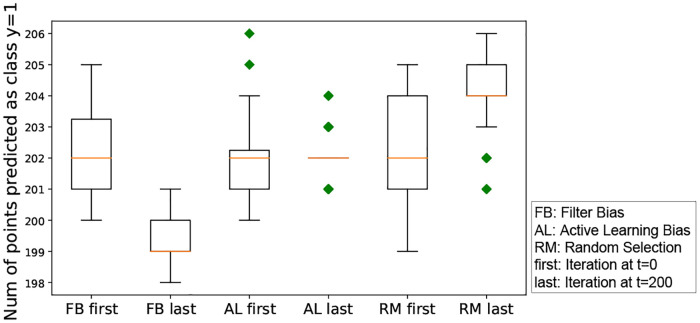
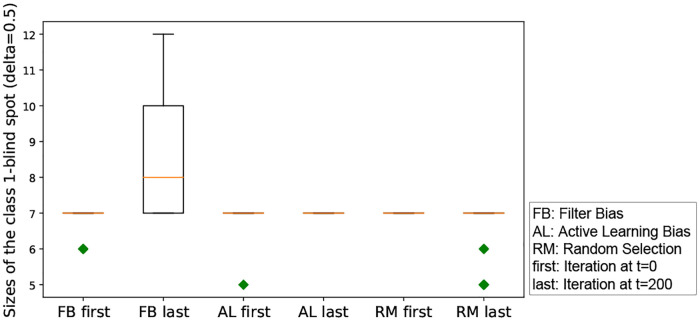
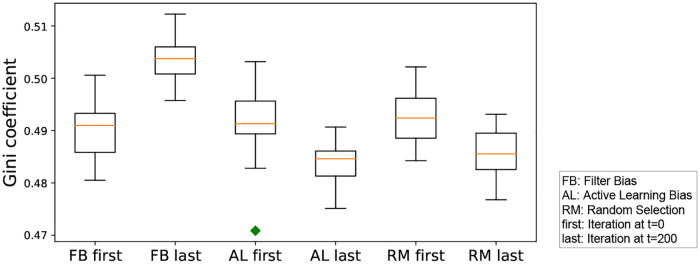
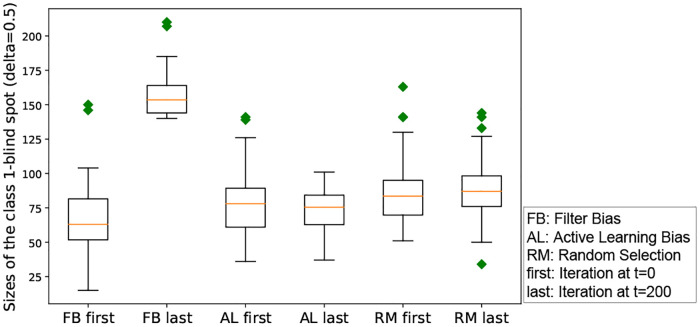
- On MovieLens real data, filter bias significantly decreased points predicted as class y=1 (p=7.1e-15, ES=1.88), increased class-1 blind spot (p=7.0e-15, ES=-1.89), and increased Gini inequality (p=7.7e-15, ES=-1.83); active learning also affected boundary shift and blind spot, while random selection did not significantly affect boundary or blind spot but decreased inequality.
- The abstract reports a relevance blind spot of 4% of all relevant items for a content-based filter in one simulation, and a blind spot size of 75% of the relevant testing set in a similar simulation using a real-life rating data set.
- Initial class imbalance and human action mattered: imbalanced initialization significantly affected boundary shift for all three bias modes (Kruskal-Wallis p=5.5e-19 filter, 3.27e-17 active learning, 1.34e-15 random); higher human action probability increased filter-bias boundary shift (p_action=1: p=0.4e-11, ES=3.087; p_action=0.5: p=1.8e-6, ES=0.87; p_action=0.01: p=.259). With class-dependent human action ratio 10:1, filter bias increased class-1 blind spot (p=1.1e-10, ES=-1.2) and random selection decreased it (p=.0008, ES=0.7).
Methods
- The authors use an iterated-learning framework inspired by language evolution, simplifying recommendation into a two-class classification problem (relevant/non-relevant) with a Naive Bayes classifier. They compare three selection mechanisms: random, active-bias, and filter-bias; human action probabilities of 1, 0.5, and 0.01; and a class-dependent action ratio of 10:1, running 200 iterations and 40 independent simulations per condition.
- Synthetic data: 2D Gaussian classes centered at {-2,0} and {2,0} with σ=1 and 1000 points per class, split into testing (200/class), validation (200/class), initialization ratios 10/100, 100/100, and 100/10, plus 3D, 4D, and 10D synthetic sets. Real data: MovieLens with 100,004 ratings on 9,125 movies from 671 users; user 547 (2,312 movies rated; 18 genres after filtering; PCA to 11 features) was studied first, then 7 more users; ratings were discretized as [1,3]=class 0 and (3,5]=class 1, with unbiased initialization only.
- Main analyses measure boundary shift, Gini coefficient, and blind spot size (δ=0.5), using Shapiro-Wilk, Mann-Whitney U, t-test, ANOVA, Kruskal-Wallis, and effect sizes.
Limitations
- The paper states future work will extend the framework to more users in a collaborative filtering setting, test additional parameters/configurations such as top-N recommendation list size and different active learning types beyond uncertainty-based active learning, and conduct human experiments similar to the simulated research questions.
- Evident from the text: the findings rely on simulations rather than human experiments, use a simplified two-class content-based recommendation setup with Naive Bayes and independent-feature assumptions, and the real-data experiments focus on one user at a time and only the 8 most active MovieLens users, with genres as item features and PCA.
- Evident from the text: for the real-life data set, the authors only explore unbiased initialization and assume action probabilities of 1, so human-action and class-imbalance effects are not tested on the real data.
Model-written summary. Check it against the paper before relying on it.
Integrity signals
Registry
Cites
Statistics
Figures

Verification
Claims the paper makes
71 Own result · 34 Own interpretation · 16 No basis given · 12 Not checked yet
The paper states this without a source or data behind it here, so there is nothing to check it against. The quote shows it is in the paper.
In the paper
“A similar simulation using a real-life rating data set found that the same filter resulted in a blind spot size of 75% of the relevant testing set.”
§ Evolution and impact of bias in human and machine learning algorithm interaction > Abstract
plaindirect- Asserted: passes — The authors put it forward as true.
- Checkable: passes — It can be checked against evidence.
- Load-bearing: unclear — It is unclear whether the paper’s conclusions depend on it.
- Based: unclear — It is unclear why the paper says it holds.
A result the paper reports from its own data — it cites no other source for it, so there is none to check. The quote shows it is in the paper.
In the paper
“Based on statistical analyses of the results of several controlled experiments, we found that the three different iterated bias modes, as well as initial training data class imbalance and human action, do affect the models learned by machine learning algorithms.”
§ Evolution and impact of bias in human and machine learning algorithm interaction > Abstract
plaindirect- Asserted: passes — The authors put it forward as true.
- Checkable: passes — It can be checked against evidence.
- Load-bearing: passes — The paper’s conclusions depend on it.
- Based: passes — The paper gives a reason why it holds.
A result the paper reports from its own data — it cites no other source for it, so there is none to check. The quote shows it is in the paper.
In the paper
“Our findings indicate that the relevance blind spot (items from the testing set whose predicted relevance probability is less than 0.5 and who thus risk being hidden from humans) amounted to 4% of all relevant items when using a content-based filter that predicts relevant items.”
§ Evolution and impact of bias in human and machine learning algorithm interaction > Abstract
hedged- Asserted: passes — The authors put it forward as true.
- Checkable: passes — It can be checked against evidence.
- Load-bearing: passes — The paper’s conclusions depend on it.
- Based: passes — The paper gives a reason why it holds.
A result the paper reports from its own data — it cites no other source for it, so there is none to check. The quote shows it is in the paper.
In the paper
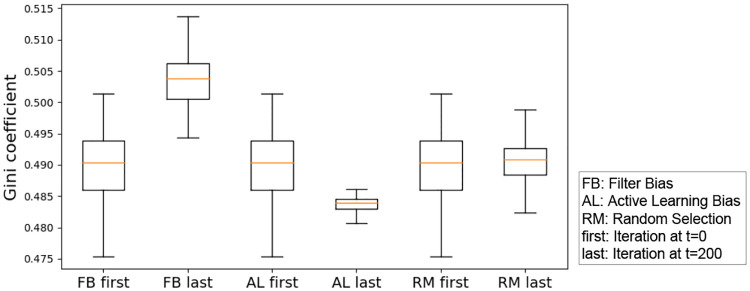
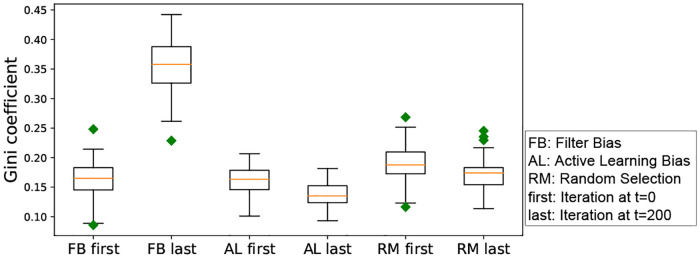
“Despite the small effect, the iterated algorithmic bias forms affect this distribution in different ways, and iterated filter bias causes the largest heterogeneity level as can be seen in Fig 6.”
§ Evolution and impact of bias in human and machine learning algorithm interaction > Results > Experiments on 2D synthetic data
plaindirect- Asserted: passes — The authors put it forward as true.
- Checkable: passes — It can be checked against evidence.
- Load-bearing: unclear — It is unclear whether the paper’s conclusions depend on it.
- Based: passes — The paper gives a reason why it holds.
A result the paper reports from its own data — it cites no other source for it, so there is none to check. The quote shows it is in the paper.
In the paper
“On the other hand, the boundary shift of filter bias has a big difference when the ratio is 1:10, indicating that filter bias has a dramatic impact on the boundary shift when the imbalanced initialization ratio is high and more points are from the irrelevant class.”
§ Evolution and impact of bias in human and machine learning algorithm interaction > Results > Experiments on 2D synthetic data
hedgeddirect- Asserted: passes — The authors put it forward as true.
- Checkable: passes — It can be checked against evidence.
- Load-bearing: passes — The paper’s conclusions depend on it.
- Based: passes — The paper gives a reason why it holds.
A result the paper reports from its own data — it cites no other source for it, so there is none to check. The quote shows it is in the paper.
In the paper
“In all cases and regardless of whether extreme filtering, AL, or random selection is used to collect feedback from the user, the initial class imbalance has a significant impact on the shift in the learned model’s boundary between relevant and non-relevant items.”
§ Evolution and impact of bias in human and machine learning algorithm interaction > Results > Experiments on 2D synthetic data
plaindirect- Asserted: passes — The authors put it forward as true.
- Checkable: passes — It can be checked against evidence.
- Load-bearing: passes — The paper’s conclusions depend on it.
- Based: passes — The paper gives a reason why it holds.
A result the paper reports from its own data — it cites no other source for it, so there is none to check. The quote shows it is in the paper.
In the paper
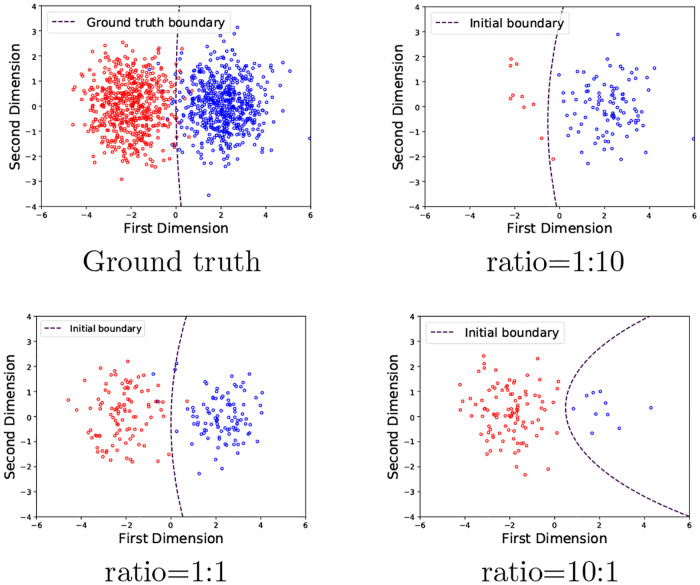
“As shown in Fig 8, highly imbalanced class initialization leads to a bigger difference between the learned boundary and the ground-truth boundary.”
- Also stated in: § Conclusion · plain
“Highly imbalanced class initialization leads to a bigger difference between the learned boundary and the ground-truth boundary.”
§ Evolution and impact of bias in human and machine learning algorithm interaction > Results > Experiments on 2D synthetic data
plaindirect- Asserted: passes — The authors put it forward as true.
- Checkable: passes — It can be checked against evidence.
- Load-bearing: passes — The paper’s conclusions depend on it.
- Based: passes — The paper gives a reason why it holds.
- Also stated in: § Conclusion · plain
A result the paper reports from its own data — it cites no other source for it, so there is none to check. The quote shows it is in the paper.
In the paper
“The results indicate significant differences for the filter bias condition (p <.001 by Mann-Whitney test or t-test, effect size = 1.96).”
§ Evolution and impact of bias in human and machine learning algorithm interaction > Results > Experiments on 2D synthetic data
hedgedcorrelational- Asserted: passes — The authors put it forward as true.
- Checkable: passes — It can be checked against evidence.
- Load-bearing: passes — The paper’s conclusions depend on it.
- Based: passes — The paper gives a reason why it holds.
A result the paper reports from its own data — it cites no other source for it, so there is none to check. The quote shows it is in the paper.
In the paper
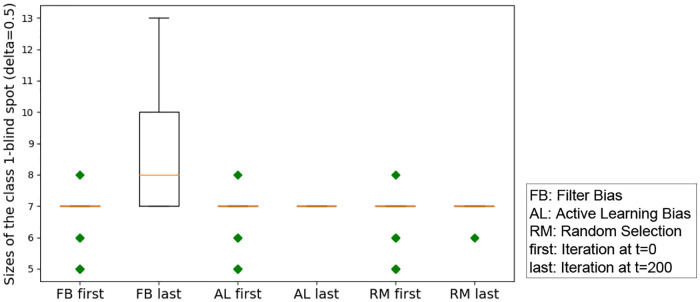
“Filter bias has significant effects on the class-1-blind spot, while random selection and active learning do not have a significant effect on the class-1-blind spot size (see Fig 7).”
§ Evolution and impact of bias in human and machine learning algorithm interaction > Results > Experiments on 2D synthetic data
plaindirect- Asserted: passes — The authors put it forward as true.
- Checkable: passes — It can be checked against evidence.
- Load-bearing: passes — The paper’s conclusions depend on it.
- Based: passes — The paper gives a reason why it holds.
A result the paper reports from its own data — it cites no other source for it, so there is none to check. The quote shows it is in the paper.
In the paper
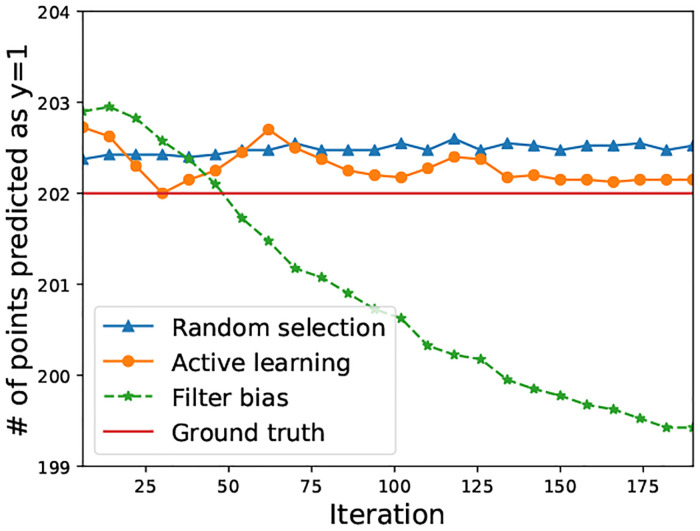
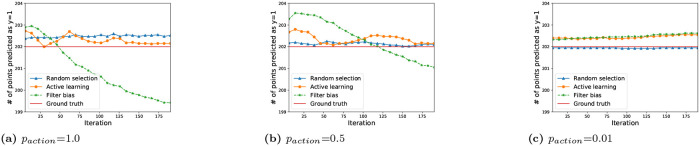
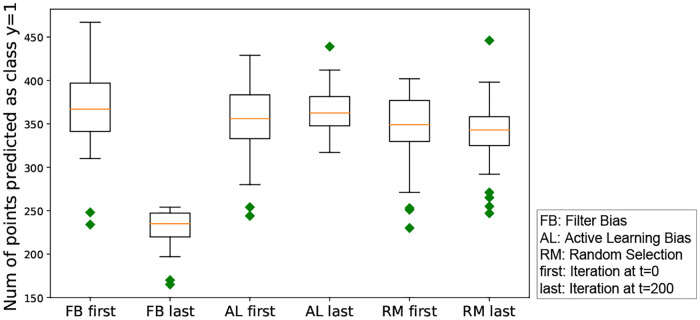
“Filter bias, on the other hand, results in decreasing numbers of points predicted in the target category class 1, consistent with an overly restrictive category boundary.”
§ Evolution and impact of bias in human and machine learning algorithm interaction > Results > Experiments on 2D synthetic data
plaindirect- Asserted: passes — The authors put it forward as true.
- Checkable: passes — It can be checked against evidence.
- Load-bearing: passes — The paper’s conclusions depend on it.
- Based: passes — The paper gives a reason why it holds.
- It may state two separate claims as one. 33
- The quote only partly states this claim. 5
- Borderline: one of the tests for a substantial claim is unclear. 1
- Probably not a substantial claim. 11
A result the paper reports from its own data — it cites no other source for it, so there is none to check. The quote shows it is in the paper.
In the paper
“We also found that iterated filter bias, which is prominent in personalized user interfaces, can lead to more inequality in estimated relevance and to a limited human ability to discover relevant data.”
§ Evolution and impact of bias in human and machine learning algorithm interaction > Abstract
plaindirect- Asserted: passes — The authors put it forward as true.
- Checkable: passes — It can be checked against evidence.
- Load-bearing: passes — The paper’s conclusions depend on it.
- Based: passes — The paper gives a reason why it holds.
It may state two separate claims as one.
A result the paper reports from its own data — it cites no other source for it, so there is none to check. The quote shows it is in the paper.
In the paper
“The Number of label-changed points with ratio = 10:1 is higher than 2 for ratio = 1:1 in the iterated filter bias mode, and a similar result can be seen with iterated active learning bias and iterated random selection (see Fig 9).”
§ Evolution and impact of bias in human and machine learning algorithm interaction > Results > Experiments on 2D synthetic data
plaincorrelational- Asserted: passes — The authors put it forward as true.
- Checkable: passes — It can be checked against evidence.
- Load-bearing: passes — The paper’s conclusions depend on it.
- Based: passes — The paper gives a reason why it holds.
It may state two separate claims as one.
A result the paper reports from its own data — it cites no other source for it, so there is none to check. The quote shows it is in the paper.
In the paper
“Fig 5 shows that random selection and active learning bias converge to the ground-truth boundary.”
§ Evolution and impact of bias in human and machine learning algorithm interaction > Results > Experiments on 2D synthetic data
plain- Asserted: passes — The authors put it forward as true.
- Checkable: passes — It can be checked against evidence.
- Load-bearing: passes — The paper’s conclusions depend on it.
- Based: passes — The paper gives a reason why it holds.
It may state two separate claims as one.
A result the paper reports from its own data — it cites no other source for it, so there is none to check. The quote shows it is in the paper.
In the paper
“Both Filter bias and active learning bias show no significant difference between the two ratios.”
§ Evolution and impact of bias in human and machine learning algorithm interaction > Results > Experiments on 2D synthetic data
plain- Asserted: passes — The authors put it forward as true.
- Checkable: passes — It can be checked against evidence.
- Load-bearing: passes — The paper’s conclusions depend on it.
- Based: passes — The paper gives a reason why it holds.
It may state two separate claims as one. The quote only partly states this claim.
A result the paper reports from its own data — it cites no other source for it, so there is none to check. The quote shows it is in the paper.
In the paper
“Both active learning and random selection decrease the inequality.”
- Also stated in: § Experiments on 2D synthetic data · boosted
“random selection significantly decrease the Gini coefficient, as well as the active learning.”
§ Evolution and impact of bias in human and machine learning algorithm interaction > Results > Experiments on 2D synthetic data
boosteddirect- Asserted: passes — The authors put it forward as true.
- Checkable: passes — It can be checked against evidence.
- Load-bearing: passes — The paper’s conclusions depend on it.
- Based: passes — The paper gives a reason why it holds.
It may state two separate claims as one.
- Also stated in: § Experiments on 2D synthetic data · boosted
A result the paper reports from its own data — it cites no other source for it, so there is none to check. The quote shows it is in the paper.
In the paper
“Table 16 shows that there is a significant increase in the class-1 blind spot sizes in the testing set for iterated filter bias and active learning bias.”
§ Evolution and impact of bias in human and machine learning algorithm interaction > Results > Experiments on the real-life data set
plaindirect- Asserted: passes — The authors put it forward as true.
- Checkable: passes — It can be checked against evidence.
- Load-bearing: passes — The paper’s conclusions depend on it.
- Based: passes — The paper gives a reason why it holds.
The quote only partly states this claim.
The paper states this without a source or data behind it here, so there is nothing to check it against. The quote shows it is in the paper.
In the paper
“A similar impact was found when the initial labeled (training) set is class imbalanced with more relevant items than non relevant items.”
§ Evolution and impact of bias in human and machine learning algorithm interaction > Results > Experiments on the real-life data set
plaincorrelational- Asserted: passes — The authors put it forward as true.
- Checkable: passes — It can be checked against evidence.
- Load-bearing: unclear — It is unclear whether the paper’s conclusions depend on it.
- Based: unclear — It is unclear why the paper says it holds.
Borderline substantial claim. It is unclear whether the paper’s conclusions depend on it. It is unclear why the paper says it holds.
A result the paper reports from its own data — it cites no other source for it, so there is none to check. The quote shows it is in the paper.
In the paper
“On the other hand, random selection decreases the class-1 blind spot size.”
§ Evolution and impact of bias in human and machine learning algorithm interaction > Results > Experiments on 2D synthetic data
plaindirect- Asserted: passes — The authors put it forward as true.
- Checkable: passes — It can be checked against evidence.
- Load-bearing: unclear — It is unclear whether the paper’s conclusions depend on it.
- Based: passes — The paper gives a reason why it holds.
The quote only partly states this claim.
A result the paper reports from its own data — it cites no other source for it, so there is none to check. The quote shows it is in the paper.
In the paper
“Both iterated filter bias and iterated active learning bias have a significantly effect on the boundary shift”
§ Evolution and impact of bias in human and machine learning algorithm interaction > Conclusion
plaindirect- Asserted: passes — The authors put it forward as true.
- Checkable: passes — It can be checked against evidence.
- Load-bearing: passes — The paper’s conclusions depend on it.
- Based: passes — The paper gives a reason why it holds.
It may state two separate claims as one.
A result the paper reports from its own data — it cites no other source for it, so there is none to check. The quote shows it is in the paper.
In the paper
“We conclude that both iterated filter bias and iterated active learning bias have a significantly effect on the boundary shift, while random selection does not have a significant effect.”
§ Evolution and impact of bias in human and machine learning algorithm interaction > Results > Experiments on the real-life data set
plaindirect- Asserted: passes — The authors put it forward as true.
- Checkable: passes — It can be checked against evidence.
- Load-bearing: passes — The paper’s conclusions depend on it.
- Based: passes — The paper gives a reason why it holds.
It may state two separate claims as one.
A result the paper reports from its own data — it cites no other source for it, so there is none to check. The quote shows it is in the paper.
In the paper
“while both active learning and random selection result in a significant decrease in the Gini coefficient.”
§ Evolution and impact of bias in human and machine learning algorithm interaction > Results > Experiments on the real-life data set
plaindirect- Asserted: passes — The authors put it forward as true.
- Checkable: passes — It can be checked against evidence.
- Load-bearing: passes — The paper’s conclusions depend on it.
- Based: passes — The paper gives a reason why it holds.
It may state two separate claims as one.
A result the paper reports from its own data — it cites no other source for it, so there is none to check. The quote shows it is in the paper.
In the paper
“Both Filter bias and active learning bias show no significant difference between the two ratios.”
§ Evolution and impact of bias in human and machine learning algorithm interaction > Results > Experiments on 2D synthetic data
plain- Asserted: passes — The authors put it forward as true.
- Checkable: passes — It can be checked against evidence.
- Load-bearing: passes — The paper’s conclusions depend on it.
- Based: passes — The paper gives a reason why it holds.
It may state two separate claims as one.
The paper states this without a source or data behind it here, so there is nothing to check it against. The quote shows it is in the paper.
In the paper
“For both filter bias and active learning, the number of points predicted as class y = 1, with and without the class-dependent human action probability, show no significant difference.”
§ Evolution and impact of bias in human and machine learning algorithm interaction > Conclusion
plain- Asserted: passes — The authors put it forward as true.
- Checkable: passes — It can be checked against evidence.
- Load-bearing: passes — The paper’s conclusions depend on it.
- Based: passes — The paper gives a reason why it holds.
It may state two separate claims as one.
A result the paper reports from its own data — it cites no other source for it, so there is none to check. The quote shows it is in the paper.
In the paper
“The p-value is 3.4e-15 (<0.01), which indicates that they have different effects on the boundary shift (see Fig 12).”
§ Evolution and impact of bias in human and machine learning algorithm interaction > Results > Experiments on 2D synthetic data
hedgedcorrelational- Asserted: passes — The authors put it forward as true.
- Checkable: passes — It can be checked against evidence.
- Load-bearing: passes — The paper’s conclusions depend on it.
- Based: passes — The paper gives a reason why it holds.
The quote only partly states this claim.
A result the paper reports from its own data — it cites no other source for it, so there is none to check. The quote shows it is in the paper.
In the paper
“while both active learning and random selection show a significant decrease in the Gini coefficient”
§ Evolution and impact of bias in human and machine learning algorithm interaction > Conclusion
plaindirect- Asserted: passes — The authors put it forward as true.
- Checkable: passes — It can be checked against evidence.
- Load-bearing: passes — The paper’s conclusions depend on it.
- Based: passes — The paper gives a reason why it holds.
It may state two separate claims as one.
The paper states this without a source or data behind it here, so there is nothing to check it against. The quote shows it is in the paper.
In the paper
“Common to both recommender systems and information filters is: (1) selection, of a subset of data about which people express their preference, by a process that is not random sampling, and (2) an iterative learning process in which people’s responses to the selected subset are used to train the algorithm for subsequent iterations.”
§ Evolution and impact of bias in human and machine learning algorithm interaction > Introduction
plain- Asserted: passes — The authors put it forward as true.
- Checkable: passes — It can be checked against evidence.
- Load-bearing: passes — The paper’s conclusions depend on it.
- Based: passes — The paper gives a reason why it holds.
It may state two separate claims as one.
The paper states this without a source or data behind it here, so there is nothing to check it against. The quote shows it is in the paper.
In the paper
“The data used to train and optimize performance of these systems are based on human actions. Thus, data that are observed and omitted are not randomly selected, but are the consequences of people’s choices.”
§ Evolution and impact of bias in human and machine learning algorithm interaction > Introduction
plaindirect- Asserted: passes — The authors put it forward as true.
- Checkable: passes — It can be checked against evidence.
- Load-bearing: passes — The paper’s conclusions depend on it.
- Based: passes — The paper gives a reason why it holds.
It may state two separate claims as one.
The paper states this without a source or data behind it here, so there is nothing to check it against. The quote shows it is in the paper.
In the paper
“However, most research has so far treated algorithmic bias as a static factor, which fails to capture the dynamic and iterative properties of bias.”
- Also stated in: § Relationship between iterated algorithmic bias and other types of bias · plain
“we observe that most previous research has treated algorithmic bias as a static factor, which fails to capture the iterative nature of bias that is borne from continuous interaction between humans and algorithms.”
§ Evolution and impact of bias in human and machine learning algorithm interaction > Abstract
plaindirect- Asserted: passes — The authors put it forward as true.
- Checkable: passes — It can be checked against evidence.
- Load-bearing: passes — The paper’s conclusions depend on it.
- Based: passes — The paper gives a reason why it holds.
Probably not a substantial claim.
- Also stated in: § Relationship between iterated algorithmic bias and other types of bias · plain
A conclusion the paper draws from its own results — it cites no other source for it, so there is none to check. The quote shows it is in the paper.
In the paper
“We argue that algorithmic bias interacts with humans in an iterative manner, which has a long-term effect on algorithms’ performance.”
- Also stated in: § Relationship between iterated algorithmic bias and other types of bias · hedged
“We argue that algorithmic bias evolves with human interaction in an iterative manner, which may have a long-term effect on algorithm performance and humans’ discovery and learning.”
§ Evolution and impact of bias in human and machine learning algorithm interaction > Abstract
plainconditional- Asserted: passes — The authors put it forward as true.
- Checkable: passes — It can be checked against evidence.
- Load-bearing: passes — The paper’s conclusions depend on it.
- Based: unclear — It is unclear why the paper says it holds.
It may state two separate claims as one.
- Also stated in: § Relationship between iterated algorithmic bias and other types of bias · hedged
A conclusion the paper draws from its own results — it cites no other source for it, so there is none to check. The quote shows it is in the paper.
In the paper
“On the other hand, human’s reaction to the output of machine learning methods with algorithmic bias worsen the situations by making decision based on biased information, which will probably be consumed by algorithms later.”
§ Evolution and impact of bias in human and machine learning algorithm interaction > Abstract
hedgeddirect- Asserted: passes — The authors put it forward as true.
- Checkable: passes — It can be checked against evidence.
- Load-bearing: passes — The paper’s conclusions depend on it.
- Based: unclear — It is unclear why the paper says it holds.
It may state two separate claims as one.
In the paper
“Perfors et al. showed that, when certain assumptions about the independence of language and the world are abandoned, the learners converge to languages that depend on the structure as well as their prior biases [78].”
§ Evolution and impact of bias in human and machine learning algorithm interaction > Related work > Iterated learning and language evolution
What the sources say
- Not checked yetcites [78] A Perfors, 2014, Language evolution can be shaped by the structure of the world, Cognitive science source
plaindirect- Asserted: passes — The authors put it forward as true.
- Checkable: passes — It can be checked against evidence.
- Load-bearing: fails — The paper’s conclusions may not depend on it.
- Based: passes — The paper gives a reason why it holds.
Probably not a substantial claim. The paper’s conclusions may not depend on it.
A conclusion the paper draws from its own results — it cites no other source for it, so there is none to check. The quote shows it is in the paper.
In the paper
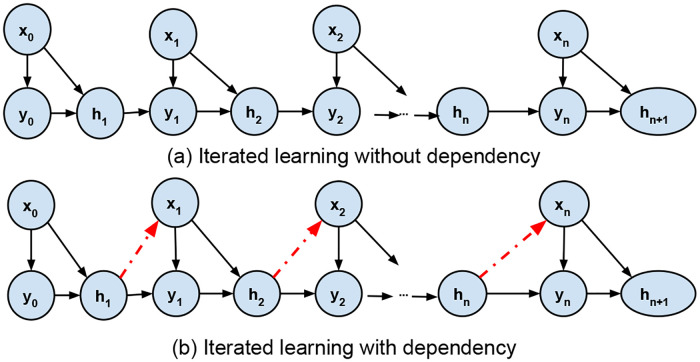
“More specifically in our setting, there is a dependency between the previous output and the next input, and it is this dependency that can generate iterated bias.”
§ Evolution and impact of bias in human and machine learning algorithm interaction > Related work > Iterated learning and language evolution
plaindirect- Asserted: passes — The authors put it forward as true.
- Checkable: passes — It can be checked against evidence.
- Load-bearing: passes — The paper’s conclusions depend on it.
- Based: passes — The paper gives a reason why it holds.
It may state two separate claims as one.
A conclusion the paper draws from its own results — it cites no other source for it, so there is none to check. The quote shows it is in the paper.
In the paper
“Specifically, the selection of relevant data allows the possibility of learning that an input that is predicted to be relevant is not, but does not allow the possibility of learning that an input that is predicted to be irrelevant is actually relevant.”
§ Evolution and impact of bias in human and machine learning algorithm interaction > Iterated algorithmic bias in online learning > Iterated learning with iterated filter-bias dependency
plaindirect- Asserted: passes — The authors put it forward as true.
- Checkable: passes — It can be checked against evidence.
- Load-bearing: passes — The paper’s conclusions depend on it.
- Based: passes — The paper gives a reason why it holds.
It may state two separate claims as one.
A conclusion the paper draws from its own results — it cites no other source for it, so there is none to check. The quote shows it is in the paper.
In the paper
“By deriving the transition matrices implied by iterated application of data selection biases, we can see that both active learning and filtering have different goals, but focus on an ever more extreme (and therefore not representative) subset of data.”
§ Evolution and impact of bias in human and machine learning algorithm interaction > Iterated algorithmic bias in online learning > Iterated learning with iterated active-bias dependency
plaindirect- Asserted: passes — The authors put it forward as true.
- Checkable: passes — It can be checked against evidence.
- Load-bearing: passes — The paper’s conclusions depend on it.
- Based: passes — The paper gives a reason why it holds.
It may state two separate claims as one.
In the paper
“After sufficient iterations, this process generates a certain hypothesis. This iterated learning chain is expected to converge the hypothesis to the prior distribution of all hypotheses in case that the learner is a Bayesian learner [69].”
§ Evolution and impact of bias in human and machine learning algorithm interaction > Related work > Iterated learning and language evolution
What the sources say
- Not checked yetcites [69] TL Griffiths, 2005
plaindirect- Asserted: passes — The authors put it forward as true.
- Checkable: passes — It can be checked against evidence.
- Load-bearing: fails — The paper’s conclusions may not depend on it.
- Based: passes — The paper gives a reason why it holds.
Probably not a substantial claim. The paper’s conclusions may not depend on it. It may state two separate claims as one.
In the paper
“Generally, selecting biased training samples leads to a biased model [96].”
§ Evolution and impact of bias in human and machine learning algorithm interaction > Related work > Relationship between iterated algorithmic bias and other types of bias
What the sources say
- Not checked yetcites [96] Heckman JJ. Sample selection bias as a specification error (with an application to the estimation of labor supply functions); 1977. source
plaindirect- Asserted: passes — The authors put it forward as true.
- Checkable: passes — It can be checked against evidence.
- Load-bearing: fails — The paper’s conclusions may not depend on it.
- Based: passes — The paper gives a reason why it holds.
Probably not a substantial claim. The paper’s conclusions may not depend on it.
In the paper
“For a rating based recommendation system, the ranking is based on the prediction from the system, or the probability of relevance from prediction. In both situations, the selected data point x is likely to be highly rated or relevant, given h.”
§ Evolution and impact of bias in human and machine learning algorithm interaction > Iterated algorithmic bias in online learning > Iterated learning with iterated filter-bias dependency
What the sources say
- Not checked yetcites [2] SE Robertson, 1977, The probability ranking principle in IR, Journal of documentation source
hedgedcorrelational- Asserted: passes — The authors put it forward as true.
- Checkable: passes — It can be checked against evidence.
- Load-bearing: passes — The paper’s conclusions depend on it.
- Based: passes — The paper gives a reason why it holds.
It may state two separate claims as one.
A conclusion the paper draws from its own results — it cites no other source for it, so there is none to check. The quote shows it is in the paper.
In the paper
“Alternatively, the utility of acting may depend on the value of y*. For example, it may be that there is greater perceived utility in acting when the value of y* is very low, as in the case of an angry customer or disappointed user.”
§ Evolution and impact of bias in human and machine learning algorithm interaction > Iterated algorithmic bias in online learning > Iterated learning with human action bias
hedgedconditional- Asserted: passes — The authors put it forward as true.
- Checkable: passes — It can be checked against evidence.
- Load-bearing: fails — The paper’s conclusions may not depend on it.
- Based: fails — The paper may give no reason why it holds.
Probably not a substantial claim. The paper’s conclusions may not depend on it. The paper may give no reason why it holds. It may state two separate claims as one.
None of the sources cited for this claim have been checked yet.
In the paper
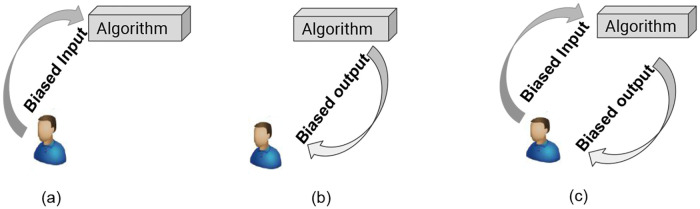
“The post-algorithmic bias emerges when users interpret the output of machine learning algorithms [97–100].”
§ Evolution and impact of bias in human and machine learning algorithm interaction > Related work > Relationship between iterated algorithmic bias and other types of bias
What the sources say
- Not checked yetcites [97] Baeza-Yates R. Data and algorithmic bias in the web. In: Proceedings of the 8th ACM Conference on Web Science. ACM; 2016. p. 1–1. source
- Not checked yetcites [98] Pedreshi D, Ruggieri S, Turini F. Discrimination-aware data mining. In: Proceedings of the 14th ACM SIGKDD international conference on Knowledge discovery and data mining. ACM; 2008. p. 560–568. source
- Not checked yetcites [99] White R. Beliefs and biases in web search. In: Proceedings of the 36th international ACM SIGIR conference on Research and development in information retrieval. ACM; 2013. p. 3–12. source
- Not checked yetcites [100] M Ayub, 2019, Modeling user rating preference behavior to improve the performance of the collaborative filtering based recommender systems, PloS one source
plaindirect- Asserted: passes — The authors put it forward as true.
- Checkable: passes — It can be checked against evidence.
- Load-bearing: fails — The paper’s conclusions may not depend on it.
- Based: passes — The paper gives a reason why it holds.
Probably not a substantial claim. The paper’s conclusions may not depend on it.
None of the sources cited for this claim have been checked yet.
In the paper
“Iterated learning was found to produce meaningful structure patterns in language learning [72–76].”
§ Evolution and impact of bias in human and machine learning algorithm interaction > Related work > Iterated learning and language evolution
What the sources say
- Not checked yetcites [72] S Kirby, 2014, Iterated learning and the evolution of language, Current opinion in neurobiology source
- Not checked yetcites [73] S Kirby, 2008, Cumulative cultural evolution in the laboratory: An experimental approach to the origins of structure in human language, Proceedings of the National Academy of Sciences source
- Not checked yetcites [74] ML Kalish, 2007, Iterated learning: Intergenerational knowledge transmission reveals inductive biases, Psychonomic Bulletin & Review source
- Not checked yetcites [75] Smith K. Iterated learning in populations of Bayesian agents. In: Proceedings of the 31st annual conference of the cognitive science society. Citeseer; 2009. p. 697–702.
- Not checked yetcites [76] K Smith, 2003, Iterated learning: A framework for the emergence of language, Artificial life source
plaindirect- Asserted: passes — The authors put it forward as true.
- Checkable: passes — It can be checked against evidence.
- Load-bearing: fails — The paper’s conclusions may not depend on it.
- Based: passes — The paper gives a reason why it holds.
Probably not a substantial claim. The paper’s conclusions may not depend on it.
A conclusion the paper draws from its own results — it cites no other source for it, so there is none to check. The quote shows it is in the paper.
In the paper
“The selection of inputs depends on the hypothesis, and therefore information is not unbiased, p(x|hn)≠q(x).”
§ Evolution and impact of bias in human and machine learning algorithm interaction > Iterated algorithmic bias in online learning > Iterated learning with iterated filter-bias dependency
plaindirect- Asserted: passes — The authors put it forward as true.
- Checkable: passes — It can be checked against evidence.
- Load-bearing: passes — The paper’s conclusions depend on it.
- Based: passes — The paper gives a reason why it holds.
It may state two separate claims as one.
A conclusion the paper draws from its own results — it cites no other source for it, so there is none to check. The quote shows it is in the paper.
In the paper
“The limiting behavior depends on the iterated active learning bias, . This is, in most cases, in opposition to the goal of filtering, the algorithm will only select data point(s) which are closest to the learned model’s boundary, if we are learning a classifier for example.”
§ Evolution and impact of bias in human and machine learning algorithm interaction > Iterated algorithmic bias in online learning > Iterated learning with iterated active-bias dependency
hedgeddirect- Asserted: passes — The authors put it forward as true.
- Checkable: passes — It can be checked against evidence.
- Load-bearing: passes — The paper’s conclusions depend on it.
- Based: passes — The paper gives a reason why it holds.
It may state two separate claims as one.
- The authors state this as an assumption: A simplified algorithm where only the very uncertain data are selected, and a mixture of random sampling and active learning, is assumed.
The paper states this without a source or data behind it here, so there is nothing to check it against. The quote shows it is in the paper.
In the paper
“Humans’ choices, when labelling data, are also highly non-random, and would reflect not only their opinions about the presented content, but also inferences about why the content was presented.”
§ Evolution and impact of bias in human and machine learning algorithm interaction > Introduction
hedgedcorrelational- Asserted: passes — The authors put it forward as true.
- Checkable: passes — It can be checked against evidence.
- Load-bearing: passes — The paper’s conclusions depend on it.
- Based: unclear — It is unclear why the paper says it holds.
It may state two separate claims as one.
A conclusion the paper draws from its own results — it cites no other source for it, so there is none to check. The quote shows it is in the paper.
In the paper
“Finally, the bias that is introduced into the data at any point can be amplified after retraining models and this in turn would further impact the predictions or recommendations.”
§ Evolution and impact of bias in human and machine learning algorithm interaction > Introduction
hedgeddirect- Asserted: passes — The authors put it forward as true.
- Checkable: passes — It can be checked against evidence.
- Load-bearing: passes — The paper’s conclusions depend on it.
- Based: unclear — It is unclear why the paper says it holds.
It may state two separate claims as one.
In the paper
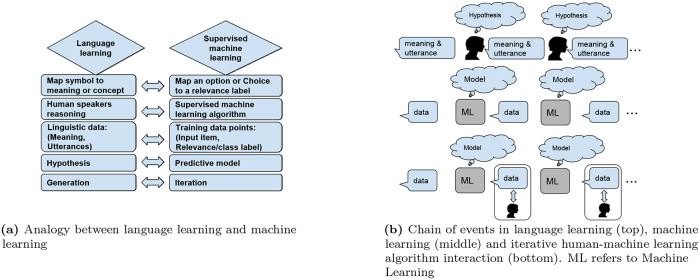
“Language learning and machine learning have several properties in common (see Fig 1). For example, a ‘hypothesis’ in language is analogous to a ‘model’ in machine learning. Learning a language which gets transmitted throughout consecutive generations of humans is analogous to learning an online model throughout consecutive iterations of machine learning [69].”
§ Evolution and impact of bias in human and machine learning algorithm interaction > Related work > Iterated learning and language evolution
What the sources say
- Not checked yetcites [69] TL Griffiths, 2005
plaincorrelational- Asserted: passes — The authors put it forward as true.
- Checkable: passes — It can be checked against evidence.
- Load-bearing: fails — The paper’s conclusions may not depend on it.
- Based: passes — The paper gives a reason why it holds.
Probably not a substantial claim. The paper’s conclusions may not depend on it. It may state two separate claims as one.
The paper states this without a source or data behind it here, so there is nothing to check it against. The quote shows it is in the paper.
In the paper
“One reason is that recommendation systems have more direct interaction options with humans, while information retrieval focuses on getting relevant information only.”
§ Evolution and impact of bias in human and machine learning algorithm interaction > Related work > Relationship between iterated algorithmic bias and other types of bias
plaincorrelational- Asserted: passes — The authors put it forward as true.
- Checkable: passes — It can be checked against evidence.
- Load-bearing: passes — The paper’s conclusions depend on it.
- Based: fails — The paper may give no reason why it holds.
Probably not a substantial claim. The paper may give no reason why it holds. It may state two separate claims as one.
A conclusion the paper draws from its own results — it cites no other source for it, so there is none to check. The quote shows it is in the paper.
In the paper
“Unlike standard learning theory, the training data are no longer randomly sampled. This in return puts in questions the guarantees about learning from such data.”
§ Evolution and impact of bias in human and machine learning algorithm interaction > Introduction
plaindirect- Asserted: passes — The authors put it forward as true.
- Checkable: passes — It can be checked against evidence.
- Load-bearing: passes — The paper’s conclusions depend on it.
- Based: passes — The paper gives a reason why it holds.
It may state two separate claims as one.
A conclusion the paper draws from its own results — it cites no other source for it, so there is none to check. The quote shows it is in the paper.
In the paper
“Either of the individual sources of bias could yield instability, thus motivating the need for a better understanding of the performance of such systems in the context of human-algorithm interactions.”
§ Evolution and impact of bias in human and machine learning algorithm interaction > Introduction
hedgedconditional- Asserted: passes — The authors put it forward as true.
- Checkable: passes — It can be checked against evidence.
- Load-bearing: passes — The paper’s conclusions depend on it.
- Based: passes — The paper gives a reason why it holds.
It may state two separate claims as one.
A conclusion the paper draws from its own results — it cites no other source for it, so there is none to check. The quote shows it is in the paper.
In the paper
“where the choice of whether to act depends on the relative utility of acting as opposed to not acting. For example, if it is especially effortful to act, then people will be biased against acting.”
§ Evolution and impact of bias in human and machine learning algorithm interaction > Iterated algorithmic bias in online learning > Iterated learning with human action bias
plaindirect- Asserted: passes — The authors put it forward as true.
- Checkable: passes — It can be checked against evidence.
- Load-bearing: passes — The paper’s conclusions depend on it.
- Based: fails — The paper may give no reason why it holds.
Probably not a substantial claim. The paper may give no reason why it holds. It may state two separate claims as one.
- The authors state this as an assumption: The choice of whether to act can be formalized using Luce choice, a special case of softmax.
A conclusion the paper draws from its own results — it cites no other source for it, so there is none to check. The quote shows it is in the paper.
In the paper
“This means that the nature of the model, and hence which items will be judged to be relevant to the user, changes depending on the iterated algorithmic bias, with filtering bias exerting the biggest influence.”
- Also stated in: § Conclusion · hedged
“indicating that the nature of the model, and hence which items will be judged to be relevant to the user, changes depending on the iterated algorithmic bias, with filtering bias exerting the biggest influence.”
§ Evolution and impact of bias in human and machine learning algorithm interaction > Results > Experiments on the real-life data set
plaindirect- Asserted: passes — The authors put it forward as true.
- Checkable: passes — It can be checked against evidence.
- Load-bearing: passes — The paper’s conclusions depend on it.
- Based: passes — The paper gives a reason why it holds.
It may state two separate claims as one.
- Also stated in: § Conclusion · hedged
A conclusion the paper draws from its own results — it cites no other source for it, so there is none to check. The quote shows it is in the paper.
In the paper
“Active learning aims to help learn correct boundary, therefore it highly depends on the initial data points.”
§ Evolution and impact of bias in human and machine learning algorithm interaction > Results > Experiments on the real-life data set
boosteddirect- Asserted: passes — The authors put it forward as true.
- Checkable: passes — It can be checked against evidence.
- Load-bearing: passes — The paper’s conclusions depend on it.
- Based: passes — The paper gives a reason why it holds.
Probably not a substantial claim.
- Rests on an assumption: Active learning aims to help learn the correct boundary.
A conclusion the paper draws from its own results — it cites no other source for it, so there is none to check. The quote shows it is in the paper.
In the paper
“Active learning affects points close to the boundary, thus it has limited effects overall.”
§ Evolution and impact of bias in human and machine learning algorithm interaction > Results > Experiments on the real-life data set
plaindirect- Asserted: passes — The authors put it forward as true.
- Checkable: passes — It can be checked against evidence.
- Load-bearing: passes — The paper’s conclusions depend on it.
- Based: passes — The paper gives a reason why it holds.
It may state two separate claims as one.
- Rests on an assumption: Active learning bias already prefers points that are close to the boundary.
A conclusion the paper draws from its own results — it cites no other source for it, so there is none to check. The quote shows it is in the paper.
In the paper
“Therefore, it slightly decreases the inequality.”
§ Evolution and impact of bias in human and machine learning algorithm interaction > Results > Experiments on 2D synthetic data
plaindirect- Asserted: passes — The authors put it forward as true.
- Checkable: passes — It can be checked against evidence.
- Load-bearing: unclear — It is unclear whether the paper’s conclusions depend on it.
- Based: passes — The paper gives a reason why it holds.
The quote only partly states this claim.
- Rests on an assumption: Random selection with class-dependent human action probability prefers points from class y = 1, however randomly.
A conclusion the paper draws from its own results — it cites no other source for it, so there is none to check. The quote shows it is in the paper.
In the paper
“Thus we conclude that human action affects the boundary shift: the more frequent human action is, the more significant is the effect on the boundary shift for only the iterated filter algorithmic bias.”
§ Evolution and impact of bias in human and machine learning algorithm interaction > Results > Experiments on 2D synthetic data
boosteddirect- Asserted: passes — The authors put it forward as true.
- Checkable: passes — It can be checked against evidence.
- Load-bearing: passes — The paper’s conclusions depend on it.
- Based: passes — The paper gives a reason why it holds.
It may state two separate claims as one.
The paper relies on this without support.
People and algorithms are increasingly engaged in interactive processes wherein neither the human nor the algorithms receive unbiased data.
“Furthermore, people and algorithms are increasingly engaged in interactive processes wherein neither the human nor the algorithms receive unbiased data.”
The authors state this as an assumption.
A Bayesian model for prediction is assumed for the algorithm.
“Following Griffiths’ model for human learners, we assume a Bayesian model for prediction.”
The authors state this as an assumption.
People's response is always observed in the above analysis.
“The above analysis assumes that people’s response is always observed.”
The authors state this as an assumption.
People have some target hypothesis h*, which represents optimal performance for the algorithm.
“Assume that people have some target hypothesis, h*, which represents optimal performance for the algorithm.”
The authors state this as an assumption.
A simplified algorithm where only the very uncertain data are selected, and a mixture of random sampling and active learning, is assumed.
“Assuming a simplified algorithm where only the very uncertain data are selected, we can investigate the limiting behavior of an algorithm with the active learning bias. Assuming a mixture of random sampling and active learning, we obtain:”
The authors state this as an assumption.
The choice of whether to act can be formalized using Luce choice, a special case of softmax.
“We can formalize this choice using Luce choice [56], a special case of softmax [137]”
The paper relies on this without support.
The synthetic dataset represents a typical classification problem and is comparable to the real-life dataset after selecting one user and corresponding items.
“The synthetic dataset represents a typical classification problem, it is the same for our real-life dataset after selecting one user and corresponding items.”
The paper relies on this without support.
In the real world, some data can be invisible to some users because of bias either from users or from the algorithm itself.
“In the real world, some data can be invisible to some users because of bias either from users or from the algorithm itself.”
The paper relies on this without support.
Class imbalance can emerge from the algorithm intentionally asking users to rate only the most popular items, a common strategy used to collect initial ratings for new users.
“Class imbalance can also emerge from the algorithm intentionally asking users to rate only the most popular items, a common strategy used to collect initial ratings for new users.”
The authors state this as an assumption.
In RQ2, humans have a prior probability to act that is not dependent on the true label of the item presented.
“In research question 2 (RQ 2), we assumed that humans have a prior probability to act which is not dependent on the true label of the item presented.”
The authors state this as an assumption.
Humans have a higher probability to label or rate when the item presented is from relevant class y = 1.
“we try to simulate this by assuming that humans have a higher probability to label or rate when the item presented is from relevant class y = 1 (see Eq 15).”
The paper relies on this without support.
Filter bias already prefers points from class y = 1.
“since filter bias already prefers points from class y = 1.”
The paper relies on this without support.
Active learning bias already prefers points that are close to the boundary.
“since this bias already prefers points that are close to the boundary.”
The paper relies on this without support.
Both random selection and active learning are used to build an accurate model in machine learning.
“both random selection and active learning are used to build an accurate model in machine learning.”
The paper relies on this without support.
Random selection with class-dependent human action probability prefers points from class y = 1, however randomly.
“Random selection with class-dependent human action probability prefer points from class y = 1, however randomly.”
The paper relies on this without support.
Active learning aims to help learn the correct boundary.
“Active learning aims to help learn correct boundary”
The paper relies on this without support.
Humans and AI algorithms are both increasingly intertwined in feedback loops that end up feeding biased data to both humans and algorithms.
“Humans and AI algorithms are both increasingly intertwined in feedback loops that end up feeding biased data to both humans and algorithms.”
Claims other papers make about this one
Each is checked against this paper’s own text: does it say what the citing paper says it does?
In the citing paper
“but it is possible for algorithmic bias to occur even with unbiased training data if the model’s design or decision-making mechanisms introduce bias [54,55].”
From Ethical Considerations of Using ChatGPT in Health Care (2023) · cites this paper as [54]
Self-check
Percentages, sums and reported differences re-computed from the paper’s own numbers.
Each contradiction between two passages listed here was confirmed by an independent check.
Rated major: it would touch a result — a value a result rests on, reported and recomputed p-values on opposite sides of the significance level, two passages that conflict with no sign which is right, or a cited work retracted before this paper was published.
In the paper
§ Evolution and impact of bias in human and machine learning algorithm interaction > Results > Experiments on the real-life data set
“On the other hand, there is no significant difference with active learning bias and random selection.”
§ Evolution and impact of bias in human and machine learning algorithm interaction > Results > Experiments on the real-life data set
“| Mann-Whitney test p-value | 7.1e- 15 | 0.002 | 0.42 | | t-test p-value | 7.6e- 25 | 0.0004 | 0.84 |”
Rated major: it would touch a result — a value a result rests on, reported and recomputed p-values on opposite sides of the significance level, two passages that conflict with no sign which is right, or a cited work retracted before this paper was published.
In the paper
§ Evolution and impact of bias in human and machine learning algorithm interaction > Results > Experiments on the real-life data set
“Table 16 shows that there is a significant increase in the class-1 blind spot sizes in the testing set for iterated filter bias and active learning bias.”
§ Evolution and impact of bias in human and machine learning algorithm interaction > Results > Experiments on the real-life data set
“Both random selection and active learning do not have a significant impact. | | Filter Bias | Active Learning | Random Selection | | --- | --- | --- | --- | | Mann-Whitney test p-value | 7.0e- 15 | 0.0002 | 0.15 | | t-test p-value | 4.2e- 26 | 0.0001 | 0.46 | | effect size | -1.89 | 0.66 | 0.16 |”
Rated minor: it would not touch a result — a value no result rests on, a p-value that stays on the same side of the significance level, or a conflict that is clerical, resolved elsewhere in the paper, or outside its own findings.
In the paper
§ Evolution and impact of bias in human and machine learning algorithm interaction > Experimental data sets
“User 547 has rated 2312 movies throughout the 10 years.”
§ Evolution and impact of bias in human and machine learning algorithm interaction > Results > Experiments on the real-life data set
“| User ID = 547 | 2391 | 1409 | 982 | FB | (7.6e-25, 1.88) | (4.2e-26, -1.89) | (7.4e-25, -1.83) |”
Rated minor: it would not touch a result — a value no result rests on, a p-value that stays on the same side of the significance level, or a conflict that is clerical, resolved elsewhere in the paper, or outside its own findings.
In the paper
§ Evolution and impact of bias in human and machine learning algorithm interaction > Results > Experiments on 2D synthetic data
“Filter bias has significant effects on the class-1-blind spot, while random selection and active learning do not have a significant effect on the class-1-blind spot size (see Fig 7).”
§ Evolution and impact of bias in human and machine learning algorithm interaction > Results > Experiments on 2D synthetic data
“| Mann-Whitney test p-value | 2.4e-10 | 0.03 | 0.06 | | t-test p-value | 2.2e-10 | 0.03 | 0.06 |”
Rated minor: it would not touch a result — a value no result rests on, a p-value that stays on the same side of the significance level, or a conflict that is clerical, resolved elsewhere in the paper, or outside its own findings.
In the paper
§ Evolution and impact of bias in human and machine learning algorithm interaction > Results > Experiments on 2D synthetic data
“The other bias modes are not affected by different human action probabilities.”
§ Evolution and impact of bias in human and machine learning algorithm interaction > Results > Experiments on 2D synthetic data
“| paction = 1 | Mann-Whitney test p-value | 0.4e- 11 | 0.9e- 5 | 0.486 | | paction = 1 | t-test p-value | 7.1e- 14 | 0.002 | 0.52 |”
Rated minor: it would not touch a result — a value no result rests on, a p-value that stays on the same side of the significance level, or a conflict that is clerical, resolved elsewhere in the paper, or outside its own findings.
In the paper
§ Evolution and impact of bias in human and machine learning algorithm interaction > Results > Experiments on 2D synthetic data
“For AL, the effect size has the opposite sign (positive) implying a significant decrease in hidden items (both relevant and non-relevant) based on the Mann-Whitney U test.”
§ Evolution and impact of bias in human and machine learning algorithm interaction > Results > Experiments on 2D synthetic data
“| Mann-Whitney test p-value | 5.9e-12 | 0.5 | 0.47 | | t-test p-value | 1.4e-19 | 0.18 | 0.13 | | effect size | -1.44 | -0.3 | -0.29 |”
Rated minor: it would not touch a result — a value no result rests on, a p-value that stays on the same side of the significance level, or a conflict that is clerical, resolved elsewhere in the paper, or outside its own findings.
In the paper
§ Evolution and impact of bias in human and machine learning algorithm interaction > Results > Experiments on 2D synthetic data
“The negative effect size for filter bias shows that it decreases the number of points which are predicted to be in class y = 1.”
§ Evolution and impact of bias in human and machine learning algorithm interaction > Results > Experiments on 2D synthetic data
“| effect size | 1.6 | -0.2 | -1.1 |”
Citations
Cites
Statistical Power Analysis for the Behavioral Sciences
Muller, K. E., & Cohen, J. (1989) · Technometrics · doi:10.2307/1270020 · Cited by 99,603
Statistical power analysis for the behavioral sciences
Cohen, J. (1990) · Computers Environment and Urban Systems · doi:10.1016/0198-9715(90)90050-4 · Cited by 65,417
Cortes, C., & Vapnik, V. (1995) · Machine Learning · doi:10.1007/bf00994018 · Cited by 59,421
(1990) · Choice Reviews Online · doi:10.5860/choice.27-3338 · Cited by 35,305
Cortes, C., & Vapnik, V. N. (1995) · Machine Learning · doi:10.1023/a:1022627411411 · Cited by 34,565
Reinforcement Learning: An Introduction
Sutton, R. S., & Barto, A. G. (1998) · IEEE Transactions on Neural Networks · doi:10.1109/tnn.1998.712192 · Cited by 27,225
Reinforcement Learning: An Introduction
Sutton, R. S., & Barto, A. (2005) · IEEE Transactions on Neural Networks · doi:10.1109/tnn.2004.842673 · Cited by 25,268
An analysis of variance test for normality (complete samples)
SHAPIRO, S. S., & WILK, M. B. (1965) · Biometrika · doi:10.1093/biomet/52.3-4.591 · Cited by 23,480
Nearest neighbor pattern classification
Cover, T., & Hart, P. (1967) · IEEE Transactions on Information Theory · doi:10.1109/tit.1967.1053964 · Cited by 16,936 · cited 1×
“K-nearest neighbors [31, 32] and non-negative matrix factorization (NMF) [33–37], that have close analogs in the psychology literatures on concept learning, e.”
BackgroundAdvances in Neural Information Processing Systems 19
(2007) · The MIT Press eBooks · doi:10.52202/085713 · Cited by 16,043
On a Test of Whether one of Two Random Variables is Stochastically Larger than the Other
Mann, H. B., & Whitney, D. R. (1947) · The Annals of Mathematical Statistics · doi:10.1214/aoms/1177730491 · Cited by 14,320
Learning the parts of objects by non-negative matrix factorization
Lee, D. D., & Seung, H. S. (1999) · Nature · doi:10.1038/44565 · Cited by 14,193
Use of Ranks in One-Criterion Variance Analysis
Kruskal, W. H., & Wallis, W. A. (1952) · Journal of the American Statistical Association · doi:10.1080/01621459.1952.10483441 · Cited by 13,912 · cited 1×
“Therefore, we perform a non-parametric statistical test using the Kruskal-wallis test [40] on each form of algorithmic bias.”
MethodHosmer, D. W., Lemeshow, S., & Sturdivant, R. X. (2013) · Wiley Series in Probability and Statistics · doi:10.1002/9781118548387 · Cited by 13,861
The perceptron: A probabilistic model for information storage and organization in the brain.
Rosenblatt, F. (1958) · Psychological Review · doi:10.1037/h0042519 · Cited by 12,280 · cited 1×
“While iterated learning ensembles the online learning process [79], they differ in several ways.”
BackgroundBaeza-Yates, R. A., & Ribeiro-Neto, B. A. (1999) · Cited by 11,505
Matrix Factorization Techniques for Recommender Systems
Koren, Y., Bell, R. M., & Volinsky, C. (2009) · Computer · doi:10.1109/mc.2009.263 · Cited by 11,232
Adomavičius, G., & Tuzhilin, A. (2005) · IEEE Transactions on Knowledge and Data Engineering · doi:10.1109/tkde.2005.99 · Cited by 10,539 · cited 1×
“Recommender systems, on the other hand, generally do not await an explicit query to provide results [16].”
BackgroundRUBIN, D. B. (1976) · Biometrika · doi:10.1093/biomet/63.3.581 · Cited by 9,925
Item-based collaborative filtering recommendation algorithms
Sarwar, B., Karypis, G., Konstan, J., & Riedl, J. (2001) · Proceedings of the 10th international conference on World Wide Web · doi:10.1145/371920.372071 · Cited by 9,135
Griffiths, T. L., & Steyvers, M. (2004) · Proceedings of the National Academy of Sciences · doi:10.1073/pnas.0307752101 · Cited by 6,049 · cited 1×
“exemplar models [38–40] and probabilistic topic models [41, 42].”
BackgroundThe MovieLens Datasets: History and Context
Harper, F., & Konstan, J. (2016) · TIIS · doi:10.1145/2827872 · Cited by 5,938
Evaluating collaborative filtering recommender systems
Herlocker, J. L., Konstan, J. A., Terveen, L. G., & Riedl, J. T. (2004) · ACM Transactions on Information Systems · doi:10.1145/963770.963772 · Cited by 5,798
Amazon.com recommendations: item-to-item collaborative filtering
Linden, G., Smith, B., & York, J. (2003) · IEEE Internet Computing · doi:10.1109/mic.2003.1167344 · Cited by 5,403
(2009) · Minds at UW (University of Wisconsin) · Cited by 4,791
Using collaborative filtering to weave an information tapestry
Goldberg, D., Nichols, D., Oki, B. M., & Terry, D. B. (1992) · Communications of the ACM · doi:10.1145/138859.138867 · Cited by 4,071
Resnick, P., & Varian, H. R. (1997) · Communications of the ACM · doi:10.1145/245108.245121 · Cited by 3,772
Probabilistic Principal Component Analysis
Tipping, M. E., & Bishop, C. M. (1999) · Journal of the Royal Statistical Society Series B: Statistical Methodology · doi:10.1111/1467-9868.00196 · Cited by 3,679
Probabilistic Matrix Factorization
Mnih, A., & Salakhutdinov, R. (2007) · neural information processing systems · Cited by 3,538
Elimination by aspects: A theory of choice
Tversky, A. (1972) · Psychological Review · doi:10.1037/h0032955 · Cited by 3,365
On the Optimality of the Simple Bayesian Classifier under Zero-One Loss
Domingos, P., & Pazzani, M. J. (1997) · Machine Learning · doi:10.1023/a:1007413511361 · Cited by 3,175
Context theory of classification learning
Medin, D. L., & Schaffer, M. M. (1978) · Psychological Review · doi:10.1037/0033-295x.85.3.207 · Cited by 3,061
Barocas, S., & Selbst, A. D. (2014) · doi:10.2139/ssrn.2477899 · Cited by 3,048
Fab: content-based, collaborative recommendation
Balabanović, M., & Shoham, Y. (1997) · Communications of the ACM · doi:10.1145/245108.245124 · Cited by 2,934
Shardanand, U., & Maes, P. (1995) · CHI Conference on Human Factors in Computing Systems · doi:10.1145/223904.223931 · Cited by 2,821
Relevance feedback in information retrieval
Rocchio, J. J. (1971) · Medical Entomology and Zoology · Cited by 2,680
Content-Based Recommendation Systems
Pazzani, M. J., & Billsus, D. (2007) · Lecture Notes in Computer Science · doi:10.1007/978-3-540-72079-9_10 · Cited by 2,600
Konstan, J. A., Miller, B., Maltz, D. A., Herlocker, J. L., Gordon, L. R., & Riedl, J. (1997) · Communications of the ACM · doi:10.1145/245108.245126 · Cited by 2,367 · cited 1×
“movies, books, news) based on their user profile [12, 13, 26].”
BackgroundAgents that reduce work and information overload
Maes, P. (1994) · Communications of the ACM · doi:10.1145/176789.176792 · Cited by 2,365
Item-based top- N recommendation algorithms
Deshpande, M., & Karypis, G. (2004) · ACM Transactions on Information Systems · doi:10.1145/963770.963776 · Cited by 2,249
Confirmation, disconfirmation, and information in hypothesis testing
Klayman, J., & Ha, Y.-W. (1987) · Psychological Review · doi:10.1037/0033-295x.94.2.211 · Cited by 2,094
Active Learning with Statistical Models
Cohn, D. A., Zoubin Ghahramani, A., & Jordan, M. I. (1996) · Journal of Artificial Intelligence Research · doi:10.1613/jair.295 · Cited by 2,054
The foundations of cost-sensitive learning
Elkan, C. (2001) · Cited by 1,945
Improving recommendation lists through topic diversification
Ziegler, C.-N., McNee, S. M., Konstan, J. A., & Lausen, G. (2005) · International World Wide Web Conference (WWW) · doi:10.1145/1060745.1060754 · Cited by 1,920
Recommender systems in e-commerce
Schafer, J. B., Konstan, J. A., & Riedl, J. (1999) · ACM Conference on Electronic Commerce (EC) · doi:10.1145/336992.337035 · Cited by 1,702
Man is to Computer Programmer as Woman is to Homemaker? Debiasing Word Embeddings
Bolukbasi, T., Chang, K.-W., Zou, J., Saligrama, V., & Kalai, A. (2016) · arXiv · doi:10.48550/arxiv.1607.06520 · Cited by 1,615
The Distance-Weighted k-Nearest-Neighbor Rule
Dudani, S. A. (1976) · IEEE Transactions on Systems Man and Cybernetics · doi:10.1109/tsmc.1976.5408784 · Cited by 1,480 · cited 1×
“K-nearest neighbors [31, 32] and non-negative matrix factorization (NMF) [33–37], that have close analogs in the psychology literatures on concept learning, e.”
BackgroundLearning and Revising User Profiles: The Identification of Interesting Web Sites
Pazzani, M. J., & Billsus, D. (1997) · Machine Learning · doi:10.1023/a:1007369909943 · Cited by 1,208
Individual choice behavior: A theoretical analysis.
Luce, R. D. (2005) · doi:10.1037/14396-000 · Cited by 1,157
Topics in semantic representation
Griffiths, T. L., Steyvers, M., & Tenenbaum, J. B. (2007) · Psychological Review · doi:10.1037/0033-295x.114.2.211 · Cited by 1,122
THE PROBABILITY RANKING PRINCIPLE IN IR
ROBERTSON, S. E. (1977) · Journal of Documentation · doi:10.1108/eb026647 · Cited by 1,103 · cited 3×
“For instance, in the probabilistic retrieval model, optimal retrieval is obtained when search results are ranked according to their relevance probabilities [2].”
BackgroundInfluentialExtended Boolean information retrieval
Salton, G., Fox, E. A., & Wu, H. (1983) · Communications of the ACM · doi:10.1145/182.358466 · Cited by 1,058 · cited 1×
“The ratings range in [1, 5] and include missing values.”
BackgroundRecommendation as classification: using social and content-based information in recommendation
Basu, C., Hirsh, H., & Cohen, W. W. (1998) · Cited by 955
Kirby, S., Cornish, H., & Smith, K. (2008) · Proceedings of the National Academy of Sciences · doi:10.1073/pnas.0707835105 · Cited by 941
Probabilistic models of information retrieval based on measuring the divergence from randomness
Amati, G., & van Rijsbergen, C. J. (2002) · ACM Transactions on Information Systems · doi:10.1145/582415.582416 · Cited by 886
Lambrecht, A., & Tucker, C. (2019) · Management Science · doi:10.1287/mnsc.2018.3093 · Cited by 854
The Annals of Mathematical Statistics
King, W. I. (1930) · The Annals of Mathematical Statistics · doi:10.1214/aoms/1177733256 · Cited by 832
Learning and evaluating classifiers under sample selection bias
Zadrozny, B. (2004) · Twenty-first international conference on Machine learning - ICML '04 · doi:10.1145/1015330.1015425 · Cited by 800
Social Data: Biases, Methodological Pitfalls, and Ethical Boundaries
Olteanu, A., Castillo, C., Diaz, F., & Kıcıman, E. (2019) · Frontiers in Big Data · doi:10.3389/fdata.2019.00013 · Cited by 763
Social Data: Biases, Methodological Pitfalls, and Ethical Boundaries
Olteanu, A., Castillo, C., Diaz, F., & Kiciman, E. (2016) · doi:10.2139/ssrn.2886526 · Cited by 763
Choice, similarity, and the context theory of classification.
Nosofsky, R. M. (1984) · Journal of Experimental Psychology Learning Memory and Cognition · doi:10.1037//0278-7393.10.1.104 · Cited by 736
The double-edged sword of pedagogy: Instruction limits spontaneous exploration and discovery
Bonawitz, E. B., Shafto, P., Gweon, H., Goodman, N. D., Spelke, E. S., & Schulz, L. (2011) · Cognition · doi:10.1016/j.cognition.2010.10.001 · Cited by 734
Self-citationEvaluating the accuracy of implicit feedback from clicks and query reformulations in Web search
Joachims, T., Granka, L. A., Pan, B., Hembrooke, H. A., Radlinski, F., & Gay, G. K. (2007) · ACM Transactions on Information Systems · doi:10.1145/1229179.1229181 · Cited by 695
Cost-sensitive learning by cost-proportionate example weighting
Zadrozny, B., Langford, J., & Abe, N. (2004) · Third IEEE International Conference on Data Mining · doi:10.1109/icdm.2003.1250950 · Cited by 680
Discrimination-aware data mining
Pedreshi, D., Ruggieri, S., & Turini, F. (2008) · Proceedings of the 14th ACM SIGKDD international conference on Knowledge discovery and data mining · doi:10.1145/1401890.1401959 · Cited by 676
Bias in algorithmic filtering and personalization
Bozdag, E. (2013) · Ethics and Information Technology · doi:10.1007/s10676-013-9321-6 · Cited by 649
A comparative study of fairness-enhancing interventions in machine learning
Friedler, S. A., Scheidegger, C., Venkatasubramanian, S., Choudhary, S., Hamilton, E. P., & Roth, D. (2019) · Proceedings of the Conference on Fairness, Accountability, and Transparency · doi:10.1145/3287560.3287589 · Cited by 601
Recommender systems and their ethical challenges
Milano, S., Taddeo, M., & Floridi, L. (2020) · AI & SOCIETY · doi:10.1007/s00146-020-00950-y · Cited by 556
Unbiased Learning-to-Rank with Biased Feedback
Joachims, T., Swaminathan, A., & Schnabel, T. (2017) · Proceedings of the Tenth ACM International Conference on Web Search and Data Mining · doi:10.1145/3018661.3018699 · Cited by 531
Proceedings of the 20th Annual Conference of the Cognitive Science Society
Gernsbacher, M. A., & Derry, S. J. (1998) · Cited by 473
Algorithmic Bias in Autonomous Systems
Danks, D., & London, A. J. (2017) · Proceedings of the Twenty-Sixth International Joint Conference on Artificial Intelligence · doi:10.24963/ijcai.2017/654 · Cited by 472 · cited 1×
“Algorithmic bias can be categorized based on the time in which it occurs during the machine learning process [95].”
BackgroundAutomatic Query expansion using SMART : TREC 3
Buckley, C., Salton, G., Allan, J., & Singhal, A. (1994) · Cited by 464
Innateness and culture in the evolution of language
Kirby, S., Dowman, M., & Griffiths, T. L. (2007) · Proceedings of the National Academy of Sciences · doi:10.1073/pnas.0608222104 · Cited by 442
Baeza-Yates, R. (2018) · Communications of the ACM · doi:10.1145/3209581 · Cited by 432
Language Evolution by Iterated Learning With Bayesian Agents
Griffiths, T. L., & Kalish, M. L. (2007) · Cognitive Science · doi:10.1080/15326900701326576 · Cited by 404
Heckman, J. J. (1977) · National Bureau of Economic Research · doi:10.3386/w0172 · Cited by 402 · cited 1×
“Generally, selecting biased training samples leads to a biased model [96].”
Ten simple rules for responsible big data research
Zook, M., Barocas, S., boyd, D., Crawford, K., Keller, E., Gangadharan, S. P., Goodman, A. A., Hollander, R. D., Koenig, B. A., Metcalf, J., et al. (2017) · PLoS Computational Biology · doi:10.1371/journal.pcbi.1005399 · Cited by 394
Choice, similarity, and the context theory of classification.
Nosofsky, R. M. (1984) · Journal of Experimental Psychology Learning Memory and Cognition · doi:10.1037/0278-7393.10.1.104 · Cited by 391
Modeling User Exposure in Recommendation
Liang, D., Charlin, L., McInerney, J., & Blei, D. M. (2016) · International World Wide Web Conference (WWW) · doi:10.1145/2872427.2883090 · Cited by 381
Information Filtering: Overview of Issues, Research and Systems
Hanani, U., Shapira, B., & Shoval, P. (2001) · User Modeling and User-Adapted Interaction · doi:10.1023/a:1011196000674 · Cited by 370
Extending the Bounds of Rationality: Evidence and Theories of Preferential Choice
Rieskamp, J., Busemeyer, J. R., & Mellers, B. A. (2006) · Journal of Economic Literature · doi:10.1257/jel.44.3.631 · Cited by 368
Khribi, M. K., Jemni, M., & Nasraoui, O. (2008) · IEEE International Conference on Advanced Learning Technologies (ICALT) · doi:10.1109/icalt.2008.198 · Cited by 365
Self-citationBennett, J., Elkan, C., Liu, B., Smyth, P., & Tikk, D. (2007) · ACM SIGKDD Explorations Newsletter · doi:10.1145/1345448.1345459 · Cited by 364
How algorithmic confounding in recommendation systems increases homogeneity and decreases utility
Chaney, A. J. B., Stewart, B., & Engelhardt, B. E. (2018) · ACM Conference on Recommender Systems (RecSys) · doi:10.1145/3240323.3240370 · Cited by 345
Algorithmic Bias: From Discrimination Discovery to Fairness-aware Data Mining
Hajian, S., Bonchi, F., & Castillo, C. (2016) · Proceedings of the 22nd ACM SIGKDD International Conference on Knowledge Discovery and Data Mining · doi:10.1145/2939672.2945386 · Cited by 334
Online Learning: Theory, Algorithms, and Applications
Shalev‐Shwartz, S. (2007) · Cited by 316
Iterated learning and the evolution of language
Kirby, S., Griffiths, T., & Smith, K. (2014) · Current Opinion in Neurobiology · doi:10.1016/j.conb.2014.07.014 · Cited by 313
Iterated Learning: A Framework for the Emergence of Language
Smith, K., Kirby, S., & Brighton, H. (2003) · Artificial Life · doi:10.1162/106454603322694825 · Cited by 291
Concepts and Applications of Inferential Statistics
Lowry, R. K. (2014) · Cited by 283
Kleinberg, J., Ludwig, J., Mullainathan, S., & Rambachan, A. (2018) · AEA Papers and Proceedings · doi:10.1257/pandp.20181018 · Cited by 278
A rational account of pedagogical reasoning: Teaching by, and learning from, examples
Shafto, P., Goodman, N. D., & Griffiths, T. L. (2014) · Cognitive Psychology · doi:10.1016/j.cogpsych.2013.12.004 · Cited by 266
Self-citationNoise Tolerance Under Risk Minimization
Manwani, N., & SASTRY, P. S. (2012) · IEEE Transactions on Cybernetics · doi:10.1109/tsmcb.2012.2223460 · Cited by 259
Garcia, M. (2016) · World Policy Journal · doi:10.1215/07402775-3813015 · Cited by 257 · cited 1×
“Garcia [85] stated that algorithmic bias may worsen racist bias in certain circumstances.”
BackgroundBuchsbaum, D., Alison Gopnik, C., Griffiths, T. L., & Shafto, P. (2011) · Cognition · doi:10.1016/j.cognition.2010.12.001 · Cited by 243
Self-citationCritiquing Big Data: Politics, Ethics, Epistemology
Crawford, K., Miltner, K. M., & Gray, M. L. (2014) · International journal of communication · Cited by 235
Evolving agents for personalized information filtering
Sheth, B., & Maes, P. (2002) · doi:10.1109/caia.1993.366590 · Cited by 231
Iterated learning: Intergenerational knowledge transmission reveals inductive biases
Kalish, M. L., Griffiths, T. L., & Lewandowsky, S. (2007) · Psychonomic Bulletin & Review · doi:10.3758/bf03194066 · Cited by 220 · cited 2×
“It is known that iterated interaction can be considered to generate Markov chains in the long-run, which gives us a well-formed framework to analyze the asymptotic effects of local decision [72, 74].”
BackgroundImproving Recommender Systems by Incorporating Social Contextual Information
Ma, H., Zhou, T. C., Lyu, M. R.-T., et al. (2011) · ACM Transactions on Information Systems · doi:10.1145/1961209.1961212 · Cited by 218
Proceedings of the 31st Annual Conference of the Cognitive Science Society
Taatgen, N. A., & van Rijn, H. (2009) · Max Planck Institute for Plasma Physics · Cited by 213
Mining search engine query logs for query recommendation
Zhang, Z., & Nasraoui, O. (2006) · International World Wide Web Conference (WWW) · doi:10.1145/1135777.1136004 · Cited by 211 · cited 1×
“their browsing or purchase history) data [49–54], or even query patterns [55].”
BackgroundSelf-citationBeliefs and biases in web search
White, R. W. (2013) · International ACM SIGIR Conference on Research and Development in Information Retrieval (SIGIR) · doi:10.1145/2484028.2484053 · Cited by 204
On the exponential value of labeled samples
Castelli, V., & Cover, T. M. (1995) · Pattern Recognition Letters · doi:10.1016/0167-8655(94)00074-d · Cited by 202
A Web Usage Mining Framework for Mining Evolving User Profiles in Dynamic Web Sites
Nasraoui, O., Soliman, M., Saka, E., et al. (2008) · IEEE Transactions on Knowledge and Data Engineering · doi:10.1109/tkde.2007.190667 · Cited by 201
Self-citationCorrecting sample selection bias in maximum entropy density estimation
Dudı́k, M., Phillips, S. J., & Schapire, R. E. (2005) · Cited by 197
Shafto, P., Goodman, N. D., & Frank, M. C. (2012) · Perspectives on Psychological Science · doi:10.1177/1745691612448481 · Cited by 184 · cited 1×
“In [60], a computational framework was proposed for modeling how people’s inferences may change as a consequence of reasoning about why data were selected.”
BackgroundSelf-citationJoint Modeling of User Check-in Behaviors for Real-time Point-of-Interest Recommendation
Yin, H., Cui, B., Zhou, X., Wang, W., Huang, Z. H., & Sadiq, S. W. (2016) · ACM Transactions on Information Systems · doi:10.1145/2873055 · Cited by 169
Feng, Z.-K., Niu, W., Zhang, R., et al. (2019) · Journal of Hydrology · doi:10.1016/j.jhydrol.2019.06.045 · Cited by 164
Dynamic User Modeling in Social Media Systems
Yin, H., Cui, B., Chen, L., Hu, Z., & Zhou, X. (2015) · ACM Transactions on Information Systems · doi:10.1145/2699670 · Cited by 163
On Effective Location-Aware Music Recommendation
Cheng, Z., & Shen, J. (2016) · ACM Transactions on Information Systems · doi:10.1145/2846092 · Cited by 157
Epistemic trust: modeling children’s reasoning about others’ knowledge and intent
Shafto, P., Eaves, B., Navarro, D., & Perfors, A. (2012) · Developmental Science · doi:10.1111/j.1467-7687.2012.01135.x · Cited by 144 · cited 1×
“However, the framework proposed here is in fact more general; it proposes a theory of why data are missing, and formalizes the problem as one of understanding human behavior [66, 140, 141].”
BackgroundSelf-citationLambrecht, A., & Tucker, C. E. (2016) · SSRN Electronic Journal · doi:10.2139/ssrn.2852260 · Cited by 144
Learning to trust and trusting to learn: a theoretical framework
Landrum, A. R., Eaves, B., & Shafto, P. (2015) · Trends in Cognitive Sciences · doi:10.1016/j.tics.2014.12.007 · Cited by 136
Self-citationKirkpatrick, K. (2016) · Communications of the ACM · doi:10.1145/2983270 · Cited by 136
Forsati, R., Mahdavi, M., Shamsfard, M., & Sarwat, M. (2014) · ACM Transactions on Information Systems · doi:10.1145/2641564 · Cited by 126
Lian, D., Zheng, K., Ge, Y., Cao, L., Chen, E., & Xie, X. (2018) · ACM Transactions on Information Systems · doi:10.1145/3182166 · Cited by 114
Algorithmic bias amplifies opinion fragmentation and polarization: A bounded confidence model
Sîrbu, A., Pedreschi, D., Giannotti, F., & Kertész, J. (2019) · PLOS ONE · doi:10.1371/journal.pone.0213246 · Cited by 112
Incorporating User Expectations and Behavior into the Measurement of Search Effectiveness
Moffat, A., Bailey, P., Scholer, F., & Thomas, P. (2017) · ACM Transactions on Information Systems · doi:10.1145/3052768 · Cited by 108
Joint Modeling of User Check-in Behaviors for Point-of-Interest Recommendation
Yin, H., Zhou, X., Shao, Y., Wang, H., & Sadiq, S. W. (2015) · ACM International Conference on Information and Knowledge Management (CIKM) · doi:10.1145/2806416.2806500 · Cited by 108
Leveraging position bias to improve peer recommendation
Lerman, K., & Hogg, T. (2014) · PLoS ONE · doi:10.1371/journal.pone.0098914 · Cited by 96
Algorithmic Glass Ceiling in Social Networks
Stoica, A.-A., Riederer, C., & Chaintreau, A. (2018) · International World Wide Web Conference (WWW) · doi:10.1145/3178876.3186140 · Cited by 95
Niu, W., Feng, Z.-K., Chen, Y., et al. (2020) · Journal of Hydrologic Engineering · doi:10.1061/(asce)he.1943-5584.0001902 · Cited by 95
Learning with annotation noise
Beigman, E., & Klebanov, B. B. (2009) · doi:10.3115/1687878.1687919 · Cited by 90
Data and algorithmic bias in the web
Baeza-Yates, R. A. (2016) · ACM Conference on Web Science (WebSci) · doi:10.1145/2908131.2908135 · Cited by 84
Yuan, Q., Cong, G., Zhao, K., Ma, Z., & Sun, A. (2015) · ACM Transactions on Information Systems · doi:10.1145/2699667 · Cited by 81
Non-Discriminatory Machine Learning through Convex Fairness Criteria
Goel, N., Yaghini, M., & Faltings, B. (2018) · Proceedings of the 2018 AAAI/ACM Conference on AI, Ethics, and Society · doi:10.1145/3278721.3278722 · Cited by 79
Transparency in Fair Machine Learning: the Case of Explainable Recommender Systems
Abdollahi, B., & Nasraoui, O. (2018) · Human-computer interaction series · doi:10.1007/978-3-319-90403-0_2 · Cited by 78
Self-citationDeconvolving Feedback Loops in Recommender SystemsPreprint
Sinha, A., Gleich, D., & Ramani, K. (2017) · Neural Information Processing Systems · doi:10.48550/arxiv.1703.01049 · Cited by 77
Proceedings of the Thirty-First Annual Conference of the Cognitive Science Society
Taatgen, N. A., & Rijn, V. H. (2009) · University of Groningen research database (University of Groningen / Centre for Information Technology) · Cited by 76
Billsus, D., & Pazzani, M. J. (2007) · Springer eBooks · doi:10.1007/978-3-540-72079-9_18 · Cited by 73
A Bayesian View of Language Evolution by Iterated Learning
Griffiths, T. L., & Kalish, M. L. (2005) · eScholarship (California Digital Library) · Cited by 67
Artificial intelligence applications
Richards, J. (1987) · Elsevier eBooks · doi:10.1016/b978-0-08-034112-5.50013-9 · Cited by 62
Language Evolution Can Be Shaped by the Structure of the World
Perfors, A., & Navarro, D. (2014) · Cognitive Science · doi:10.1111/cogs.12102 · Cited by 60
SOME THOUGHTS ON CLASSIFICATION FOR RETRIEVAL
Jones, K. S. (1970) · Journal of Documentation · doi:10.1108/eb026488 · Cited by 53 · cited 2×
“The ratings range in [1, 5] and include missing values.”
BackgroundMethodAyub, M., Ghazanfar, M. A., Mehmood, Z., Saba, T., Alharbey, R., Munshi, A. M., & Alrige, M. (2019) · PLoS ONE · doi:10.1371/journal.pone.0220129 · Cited by 53
Recommendation Algorithm based on Link Prediction and Domain Knowledge in Retail Transactions
Li, J., Zhang, L., Meng, F., et al. (2014) · Procedia Computer Science · doi:10.1016/j.procs.2014.05.339 · Cited by 52
Deep Classifiers from Image Tags in the Wild
Izadinia, H., Russell, B., Farhadi, A., et al. (2015) · doi:10.1145/2814815.2814821 · Cited by 46
Position Bias in Recommender Systems for Digital Libraries
Collins, A., Tkaczyk, D., Aizawa, A., & Beel, J. (2018) · Lecture Notes in Computer Science · doi:10.1007/978-3-319-78105-1_37 · Cited by 44
Unbiased Learning-to-Rank with Biased Feedback
Joachims, T., Swaminathan, A., & Schnabel, T. (2018) · International Joint Conference on Artificial Intelligence · doi:10.24963/ijcai.2018/738 · Cited by 44
Incremental Fairness in Two-Sided Market Platforms: On Smoothly Updating Recommendations
Patro, G. K., Chakraborty, A., Ganguly, N., & Gummadi, K. P. (2020) · AAAI Publications (The Association for the Advancement of Artificial Intelligence (AAAI)) · doi:10.1609/aaai.v34i01.5349 · Cited by 42
Social recommendation model based on user interaction in complex social networks
Li, Y., Liu, J., & Ren, J. (2019) · PLoS ONE · doi:10.1371/journal.pone.0218957 · Cited by 35
Unifying Pedagogical Reasoning and Epistemic Trust
Eaves, B., & Shafto, P. (2012) · Advances in child development and behavior · doi:10.1016/b978-0-12-397919-3.00011-3 · Cited by 34
Self-citationBiases in Automated Music Playlist Generation
Jannach, D., Kamehkhosh, I., & Bonnin, G. (2016) · ACM Conference on User Modeling, Adaptation and Personalization (UMAP) · doi:10.1145/2930238.2930283 · Cited by 27
Automatic Query Expansion Using SMART: TREC 3
Buckley, C., Salton, G., Allan, J., & Singhal, A. (1994) · doi:10.6028/nist.sp.500-225.cornell · Cited by 26
A Hybrid Recommender System Guided by Semantic User Profiles for Search in the E-learning Domain
Zhuhadar, L., & Nasraoui, O. (2010) · Journal of Emerging Technologies in Web Intelligence · doi:10.4304/jetwi.2.4.272-281 · Cited by 25
Self-citationModeling the Assimilation-Contrast Effects in Online Product Rating Systems
Zhang, X., Zhao, J., & Lui, J. C. S. (2017) · ACM Conference on Recommender Systems (RecSys) · doi:10.1145/3109859.3109885 · Cited by 24
Nasraoui, O., & Pavuluri, M. (2006) · Lecture notes in computer science · doi:10.1007/11899402_4 · Cited by 22
Self-citationNon-Discriminatory Machine Learning Through Convex Fairness Criteria
Goel, N., Yaghini, M., & Faltings, B. V. (2018) · Proceedings of the AAAI Conference on Artificial Intelligence · doi:10.1609/aaai.v32i1.11662 · Cited by 18
Shafto, P., & Nasraoui, O. (2016) · ACM Conference on Recommender Systems (RecSys) · doi:10.1145/2959100.2959188 · Cited by 17
Self-citationIterated Algorithmic Bias in the Interactive Machine Learning Process of Information Filtering
Sun, W., Nasraoui, O., & Shafto, P. (2018) · International Joint Conference on Knowledge Discovery, Knowledge Engineering and Knowledge Management · doi:10.5220/0006938301100118 · Cited by 15
Self-citationHuman-Algorithm Interaction Biases in the Big Data Cycle: A Markov Chain Iterated Learning FrameworkPreprint
Nasraoui, O., & Shafto, P. (2016) · arXiv (Cornell University) · doi:10.48550/arxiv.1608.07895 · Cited by 14
Self-citationTechnological Workforce and Its Impact on Algorithmic Justice in Politics
Williams, J. D., Lopez, D., Shafto, P., & Lee, K. (2019) · Customer Needs and Solutions · doi:10.1007/s40547-019-00103-3 · Cited by 14
Self-citationBadami, M., Nasraoui, O., Sun, W., & Shafto, P. (2017) · IEEE International Conference on Big Data (BigData) · doi:10.1109/bigdata.2017.8258231 · Cited by 13
Self-citationConvergence Bounds for Language Evolution by Iterated Learning
Griffiths, T. L., Klein, D., & Rafferty, A. N. (2009) · eScholarship (California Digital Library) · Cited by 13
PrCP: Pre-recommendation Counter-Polarization
Badami, M., Nasraoui, O., & Shafto, P. (2018) · International Joint Conference on Knowledge Discovery, Knowledge Engineering and Knowledge Management · doi:10.5220/0006938702820289 · Cited by 13
Self-citationAbdollahi, B., & Nasraoui, O. (2014) · ACM Conference on Web Science (WebSci) · doi:10.1145/2615569.2615665 · Cited by 12
Self-citationAutomatic Personalization in E-Learning Based on Recommendation Systems
Khribi, M. K., Jemni, M., & Nasraoui, O. (2011) · IGI Global eBooks · doi:10.4018/978-1-60960-842-2.ch002 · Cited by 12
Self-citationSpinelli, L., & Crovella, M. E. (2017) · ACM Web Science Conference (WebSci) · doi:10.1145/3091478.3091483 · Cited by 10
The Intentional Selection Assumption
Colantonio, J. A., Durkin, K. L., Caglar, L. R., Shafto, P., & Bonawitz, E. B. (2021) · Frontiers in Psychology · doi:10.3389/fpsyg.2021.569275 · Cited by 8
Self-citationChoice from among Intentionally Selected Options
Shafto, P., & Bonawitz, E. B. (2015) · The Psychology of learning and motivation/The psychology of learning and motivation · doi:10.1016/bs.plm.2015.03.006 · Cited by 7
Self-citationExplaining Choice Behavior: The Intentional Selection Assumption.
Durkin, K. L., Caglar, L. R., Bonawitz, E. B., & Shafto, P. (2015) · eScholarship (California Digital Library) · Cited by 6
Self-citationMcNair, D. (2018) · InTech eBooks · doi:10.5772/intechopen.73176 · Cited by 6
Zhang, X., Xie, H. L., Zhao, J., et al. (2018) · International Joint Conference on Artificial Intelligence · doi:10.24963/ijcai.2018/763 · Cited by 6
Reasoning in teaching and misleading situations.
Warner, R., Stoess, T., & Shafto, P. (2011) · eScholarship (California Digital Library) · Cited by 5
Self-citationExploring high-dimensional classification boundaries
Wickham, H., & Caragea, D. (2005) · Cited by 3
PrCP: Pre-recommendation Counter-Polarization
Badami, M., Nasraoui, O., & Shafto, P. (2018) · Proceedings of the 10th International Joint Conference on Knowledge Discovery, Knowledge Engineering and Knowledge Management · doi:10.5220/0006938700002053
Self-citationIterated Algorithmic Bias in the Interactive Machine Learning Process of Information Filtering
Sun, W., Nasraoui, O., & Shafto, P. (2018) · Proceedings of the 10th International Joint Conference on Knowledge Discovery, Knowledge Engineering and Knowledge Management · doi:10.5220/0006938300002053
Self-citation
Research works printed but not linked: 11
- Spark KJ. Artificial Intelligence: What can it offer to Information Retrieval. Proceedings of the Informatics 3, Aslib, ed, London. 1978;.
- McFadden DL. Quantal choice analaysis: A survey. In: Annals of Economic and Social Measurement, Volume 5, number 4. NBER; 1976. p. 363–390.
- TL Griffiths, 2005, Proceedings of the Cognitive Science Society
- Smith K. Iterated learning in populations of Bayesian agents. In: Proceedings of the 31st annual conference of the cognitive science society. Citeseer; 2009. p. 697–702.
- KJ Rothman, 2008, Modern epidemiology
- Dwork C, Immorlica N, Kalai AT, Leiserson MD. Decoupled classifiers for group-fair and efficient machine learning. In: Conference on Fairness, Accountability and Transparency; 2018. p. 119–133.
- Barocas S. Data mining and the discourse on discrimination. In: Data Ethics Workshop, Conference on Knowledge Discovery and Data Mining; 2014.
- Schnabel T, Swaminathan A, Singh A, Chandak N, Joachims T. Recommendations as treatments: Debiasing learning and evaluation. arXiv preprint arXiv:160205352. 2016;.
- A Sinha, 2016, Advances in neural information processing systems, 3243
- S Milano, 2020, AI & SOCIETY, 1
- A Stuart, 1994, Distribution theory
Cited by
Sorted by citations
Beyond the Imitation Game: Quantifying and extrapolating the capabilities of language models
Srivastava, A., Rastogi, A., Rao, A., Shoeb, A. A. M., Abid, A., Fisch, A., Brown, A. R., Santoro, A., Gupta, A., Garriga-Alonso, A., et al. (2022) · arXiv · doi:10.48550/arxiv.2206.04615 · Cited by 569
Ethical Considerations of Using ChatGPT in Health Care
Wang, C., Liu, S., Yang, H., Guo, J., Wu, Y., & Liu, J. (2023) · Journal of Medical Internet Research · doi:10.2196/48009 · Cited by 541
“Data bias can directly contribute to algorithmic bias [53], but it is possible for algorithmic bias to occur even with unbiased training data if the model’s design or decision-making mechanisms introduce bias [54,55].”
Algorithmic bias in data-driven innovation in the age of AI
Akter, S., McCarthy, G., Sajib, S., Michael, K., Dwivedi, Y. K., D’Ambra, J., & Shen, K. N. (2021) · International Journal of Information Management · doi:10.1016/j.ijinfomgt.2021.102387 · Cited by 440
Pagano, T. P., Loureiro, R. B., Lisboa, F. V. N., Peixoto, R. M., Guimarães, G. A. D. S., Cruz, G. O. R., Araujo, M. M., dos Santos, L. L., Cruz, M. A. S., Oliveira, E. L. S., et al. (2023) · Big Data and Cognitive Computing · doi:10.3390/bdcc7010015 · Cited by 421
“The first occurs when the goal is to provide relevant information or preferences [52].”
BackgroundA framework for AI-powered service innovation capability: Review and agenda for future research
Akter, S., Hossain, M. A., Sajib, S., Sultana, S., Rahman, M., Vrontis, D., & McCarthy, G. (2023) · Technovation · doi:10.1016/j.technovation.2023.102768 · Cited by 336
Metadata
- Authors
- Sun, W., Nasraoui, O., & Shafto, P.
- Affiliations
- University of Louisville (US)
- Rutgers, The State University of New Jersey (US)
- Corresponding author
- Nasraoui, Olfa
- Venue
- PLOS ONE
- Publisher
- Public Library of Science (PLoS)
- Published
- 2020-08-13
- Volume
- 15
- Issue
- 8
- Pages
- e0235502
- ISSN
- 1932-6203 (ISSN-L)
- PMC
- PMC7425868
- OpenAlex
- W3048367007
- Semantic Scholar
- fba50a0f6e7f1bb47e80ffa8c523396aa747a6ae
- Cited by
- 116
- References
- 173
- Citations by year
- 2026: 15 · 2025: 29 · 2024: 16 · 2023: 21 · 2022: 26 · 2021: 8 · 2020: 1
- FWCI
- 19.26
- Type
- journal article
- Language
- en
- Open access
- gold
- doi.org
- Licence
- Locations
- PLoS ONE (publishedVersion, cc-by)
- PubMed Central (publishedVersion, cc-by)
- PubMed (publishedVersion)
- RePEc: Research Papers in Economics (submittedVersion)
- DOAJ (DOAJ: Directory of Open Access Journals) (submittedVersion, cc-by-sa)
- Funders
- Division of Information and Intelligent Systems (1549981)
- Topics
- Physical Sciences › Computer Science › Artificial Intelligence › Ethics and Social Impacts of AI
- Physical Sciences › Computer Science › Artificial Intelligence › Machine Learning and Algorithms
- Physical Sciences › Computer Science › Artificial Intelligence › Hate Speech and Cyberbullying Detection
- Keywords
- algorithmic bias, human-machine interaction, iterated learning, filter bubbles, personalization, active learning (machine learning), class imbalance, personalized interfaces, information filtering, relevance prediction
- MeSH terms
- Machine Learning, Humans, Learning, Bias
About these checks
Registry, retraction, Cites and statistics results are computed, not judged, with one exception: a printed reference that no index lists is read once by a model before it counts as a citation error. Claims are extracted by a model and kept only when their quote appears verbatim in the text; each cited source is then checked, with a model’s help, for whether it says what the claim relies on. Those verdicts can be wrong — read the claim’s quote and the cited source before relying on one.
A language model drew the claims from the paper on 2026-10-07, under version 3 of the claim definition (model deepseek-v4.1-flash, prompt extract-v3).
A second model labelled each claim on 2026-10-07 (model jev-1.13-20260917, definition revision gold-guideline-v0.2).
Statistics and arithmetic are recomputed, not judged.
Confidence bands are shown only for fields calibrated on our annotated test set. None is calibrated yet, so no band is shown.
What counts as a claim ›How we measure confidence ›How we check this ›
Are you an author, or do you see a problem with this page? Request a review
