

The DOI matches its Crossref record; 60 of the 60 references it cites were found in a registry or an index.
Acute mental health responses during the COVID-19 pandemic in Australia
Open accessPublished version of a preprint
Abstract
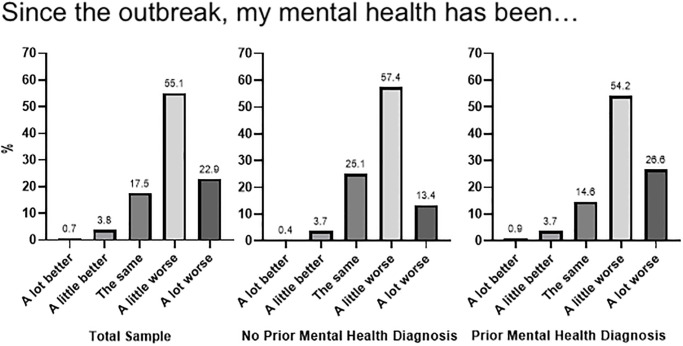
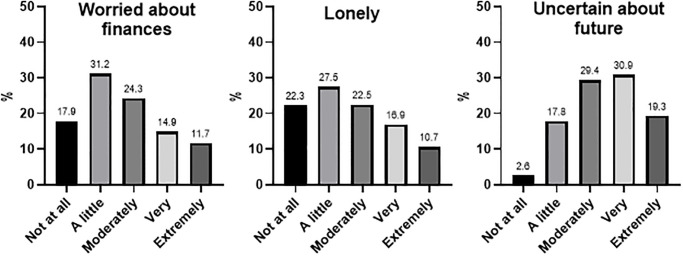
The acute and long-term mental health impacts of the COVID-19 pandemic are unknown. The current study examined the acute mental health responses to the COVID-19 pandemic in 5070 adult participants in Australia, using an online survey administered during the peak of the outbreak in Australia (27th March to 7th April 2020). Self-report questionnaires examined COVID-19 fears and behavioural responses to COVID-19, as well as the severity of psychological distress (depression, anxiety and stress), health anxiety, contamination fears, alcohol use, and physical activity. 78% of respondents reported that their mental health had worsened since the outbreak, one quarter (25.9%) were very or extremely worried about contracting COVID-19, and half (52.7%) were worried about family and friends contracting COVID-19. Uncertainty, loneliness and financial worries (50%) were common. Rates of elevated psychological distress were higher than expected, with 62%, 50%, and 64% of respondents reporting elevated depression, anxiety and stress levels respectively, and one in four reporting elevated health anxiety in the past week. Participants with self-reported history of a mental health diagnosis had significantly higher distress, health anxiety, and COVID-19 fears than those without a prior mental health diagnosis. Demographic (e.g., non-binary or different gender identity; Aboriginal and Torres Strait Islander status), occupational (e.g., being a carer or stay at home parent), and psychological (e.g., perceived risk of contracting COVID-19) factors were associated with distress. Results revealed that precautionary behaviours (e.g., washing hands, using hand sanitiser, avoiding social events) were common, although in contrast to previous research, higher engagement in hygiene behaviours was associated with higher stress and anxiety levels. These results highlight the serious acute impact of COVID-19 on the mental health of respondents, and the need for proactive, accessible digital mental health services to address these mental health needs, particularly for those most vulnerable, including people with prior history of mental health problems. Longitudinal research is needed to explore long-term predictors of poor mental health from the COVID-19 pandemic.
Overview
The claims and statistics of this paper haven’t been checked yet.
Run the check — free, no account needed. It reads the open-access text and checks the sources it cites.
Integrity signals
Registry
Cites
Statistics
Figures
Verification
Claims the paper makes
The claims and statistics of this paper haven’t been checked yet.
Run the check — free, no account needed. It reads the open-access text and checks the sources it cites.
Claims other papers make about this one
Each is checked against this paper’s own text: does it say what the citing paper says it does?
The source backs part of the claim, not all of it — or backs it for a different population, condition or comparison.
In the citing paper
“This increase has been further exacerbated by the COVID-19 pandemic, where health anxiety and fears of COVID-19 were common [10].”
From Illness Anxiety Disorder: A Review of the Current Research and Future Directions (2024) · cites this paper as [10]
Experimental — accuracy not yet measuredThe cited source says what the claim attributes to it.
In the citing paper
“Finally, the sample is being recruited during the COVID-19 period, which is likely to elevate participants’ levels of psychological distress and mental health symptoms [54].”
From A mobile health intervention (LifeBuoy App) to help young people manage suicidal thoughts: protocol for a mixed-methods randomized controlled trial (2020) · cites this paper as [54]
In the citing paper
“Although we found that individuals with mental illness had higher levels of depressive symptoms and anxiety at the start of lockdown (which is echoed in COVID-19 studies33, 34, 35 from various countries), they had the same trajectories over the subsequent weeks.”
From Trajectories of anxiety and depressive symptoms during enforced isolation due to COVID-19 in England: a longitudinal observational study (2021) · cites this paper as [33]
Self-check
Percentages, sums and reported differences re-computed from the paper’s own numbers.
The self-check needs the paper’s full text.
Citations
Cites
Diagnostic and Statistical Manual of Mental Disorders
American Psychiatric Association (2013) · doi:10.1176/appi.books.9780890425596 · Cited by 116,369
Wu, Z., & McGoogan, J. M. (2020) · JAMA · doi:10.1001/jama.2020.2648 · Cited by 17,016 · cited 1×
“The 418 expected severity of the COVID-19 illness differs markedly to the reality for most people, as studies show 419 that 80% of people will experience no or mild symptoms (40).”
BackgroundDiagnostic and Statistical Manual of Mental Disorders(DSM)
Leong, F. T. L. (2008) · Sage eBooks · doi:10.4135/9781412963978.n182 · Cited by 10,861
Wang, C., Pan, R., Wan, X., Tan, Y., Xu, L., Ho, C. S., & Ho, R. C. (2020) · International Journal of Environmental Research and Public Health · doi:10.3390/ijerph17051729 · Cited by 9,923 · cited 9×
“However, some recent research has emerged 59 from China with community participants (8-10), and health care worker samples (11).”
BackgroundMethodInfluentialSelf-rated health and mortality: a review of twenty-seven community studies.
Idler, E. L., & Benyamini, Y. (1997) · Journal of Health and Social Behavior · doi:10.2307/2955359 · Cited by 8,598 · cited 1×
“self-rated health [36], with responses on a 5-point scale from Poor to Excellent.”
BackgroundLai, J., Ma, S., Wang, Y., Cai, Z., Hu, J., Wei, N., Wu, J., Du, H., Chen, T., Li, R., et al. (2020) · JAMA Network Open · doi:10.1001/jamanetworkopen.2020.3976 · Cited by 8,015 · cited 1×
“However, some recent research has emerged 59 from China with community participants (8-10), and health care worker samples (11).”
Background(1995) · Cited by 6,909
Bush, K. (1998) · Archives of Internal Medicine · doi:10.1001/archinte.158.16.1789 · Cited by 6,196
Holmes, E. A., O'Connor, R. C., Perry, V. H., Tracey, I., Wessely, S., Arseneault, L., Ballard, C., Christensen, H., Cohen Silver, R., Everall, I., et al. (2020) · The Lancet Psychiatry · doi:10.1016/s2215-0366(20)30168-1 · Cited by 5,715
Self-citationQiu, J., Shen, B., Zhao, M., Wang, Z., Xie, B., & Xu, Y. (2020) · General Psychiatry · doi:10.1136/gpsych-2020-100213 · Cited by 4,307 · cited 5×
“However, some recent research has emerged 59 from China with community participants (8-10), and health care worker samples (11).”
BackgroundMethodInfluential
Research works printed but not linked: 2
- SB Harvey, Expected impact of COVID-19 on the mental health of health professionals, A systematic review and meta-analysis of studies from the current and previous pandemics. under review
- Australian Bureau of Statistics, 2014, National Health Survey: First Results, 2014–15
Cited by
Sorted by citations
Fancourt, D., Steptoe, A., & Bu, F. (2021) · The Lancet Psychiatry · doi:10.1016/s2215-0366(20)30482-x · Cited by 1,161
The trajectory of loneliness in response to COVID-19
Luchetti, M., Lee, J. H., Aschwanden, D., Sesker, A., Strickhouser, J. E., Terracciano, A., & Sutin, A. R. (2020) · American Psychologist · doi:10.1037/amp0000690 · Cited by 903
Nochaiwong, S., Ruengorn, C., Thavorn, K., Hutton, B., Awiphan, R., Phosuya, C., Ruanta, Y., Wongpakaran, N., & Wongpakaran, T. (2021) · Scientific Reports · doi:10.1038/s41598-021-89700-8 · Cited by 743
Alcohol and other substance use during the COVID-19 pandemic: A systematic review
Roberts, A. D. L., Rogers, J., Mason, R., Siriwardena, A. N., Hogue, T. E., Whitley, G. A., & Law, G. R. (2021) · Drug and Alcohol Dependence · doi:10.1016/j.drugalcdep.2021.109150 · Cited by 459
“+ + 1 McPhee, 2020 + + + + + + + + + 0 Narasimha et al., 2020 + + – + + + + + + 1 Newby, 2020 + + + + + + + + + 0 Ochalek, 2020 + + + + – + + – + 2 Panno, 2020 + + + + + + + + + 0 Rodriguez, 2020 + + + + + + + + + 0 Rogers, 2020 + + + + + + + + + 0 Rolland, 2020 + + + + + + ?”
Prevalence of anxiety in the COVID-19 pandemic: An updated meta-analysis of community-based studies
Santabárbara, J., Lasheras, I., Lipnicki, D. M., Bueno‐Notivol, J., Pérez-Moreno, M. A., López‐Antón, R., de la Cámara, C., Lobo, A., & Gracia‐García, P. (2020) · Progress in Neuro-Psychopharmacology and Biological Psychiatry · doi:10.1016/j.pnpbp.2020.110207 · Cited by 461
Metadata
- Authors
- Newby, J. M., O’Moore, K., Tang, S., Christensen, H., & Faasse, K.
- Affiliations
- Black Dog Institute (AU)
- UNSW Sydney (AU)
- Corresponding author
- Newby, Jill M.
- Venue
- PLOS ONE
- Publisher
- Public Library of Science (PLoS)
- Published
- 2020-07-28
- Volume
- 15
- Issue
- 7
- Pages
- e0236562
- ISSN
- 1932-6203 (ISSN-L)
- PMC
- PMC7386645
- OpenAlex
- W3046129790
- Cited by
- 471
- References
- 58
- Citations by year
- 2026: 11 · 2025: 18 · 2024: 49 · 2023: 75 · 2022: 122 · 2021: 162 · 2020: 34
- FWCI
- 39.26
- Type
- journal article
- Language
- en
- Open access
- gold
- doi.org
- Licence
- Locations
- PLoS ONE (publishedVersion, cc-by)
- medRxiv (acceptedVersion)
- PubMed Central (publishedVersion, cc-by)
- PubMed (publishedVersion)
- UNSWorks (UNSW Sydney) (submittedVersion, cc-by-nc-nd)
- HRB National Drugs Library (Health Research Board) (submittedVersion, cc-by)
- DOAJ (DOAJ: Directory of Open Access Journals) (submittedVersion, cc-by-sa)
- Informationszentrum Lebenswissenschaften (ZB MED) (submittedVersion, cc-by)
- Topics
- Social Sciences › Psychology › Clinical Psychology › COVID-19 and Mental Health
- Health Sciences › Medicine › Public Health, Environmental and Occupational Health › Maternal Mental Health During Pregnancy and Postpartum
- Health Sciences › Medicine › Psychiatry and Mental health › Mental Health Treatment and Access
- Keywords
- COVID-19 pandemic, psychological distress, depression, anxiety, stress, health anxiety, fear of contamination, fear of COVID-19, preventive behavior, hygiene practices, loneliness, financial worry, uncertainty, Aboriginal and Torres Strait Islander peoples, non-binary gender identity, caregivers, stay-at-home parents, digital mental health services, Australia
- MeSH terms
- COVID-19, Australian Aboriginal and Torres Strait Islander Peoples, Adult, Anxiety, Australia, Depression, Fear, Humans, Health Knowledge, Attitudes, Practice, Pneumonia, Viral, Surveys and Questionnaires, Stress, Psychological, Coronavirus Infections, Pandemics, Social Media
About these checks
Registry, retraction, Cites and statistics results are computed, not judged, with one exception: a printed reference that no index lists is read once by a model before it counts as a citation error. Claims are extracted by a model and kept only when their quote appears verbatim in the text; each cited source is then checked, with a model’s help, for whether it says what the claim relies on. Those verdicts can be wrong — read the claim’s quote and the cited source before relying on one.
Statistics and arithmetic are recomputed, not judged.
Confidence bands are shown only for fields calibrated on our annotated test set. None is calibrated yet, so no band is shown.
What counts as a claim ›How we measure confidence ›How we check this ›
Are you an author, or do you see a problem with this page? Request a review
