

The DOI matches its Crossref record; 44 of the 45 references it cites were found in a registry or an index.
Influence of COVID-19 confinement on students’ performance in higher education
Open accessAbstract
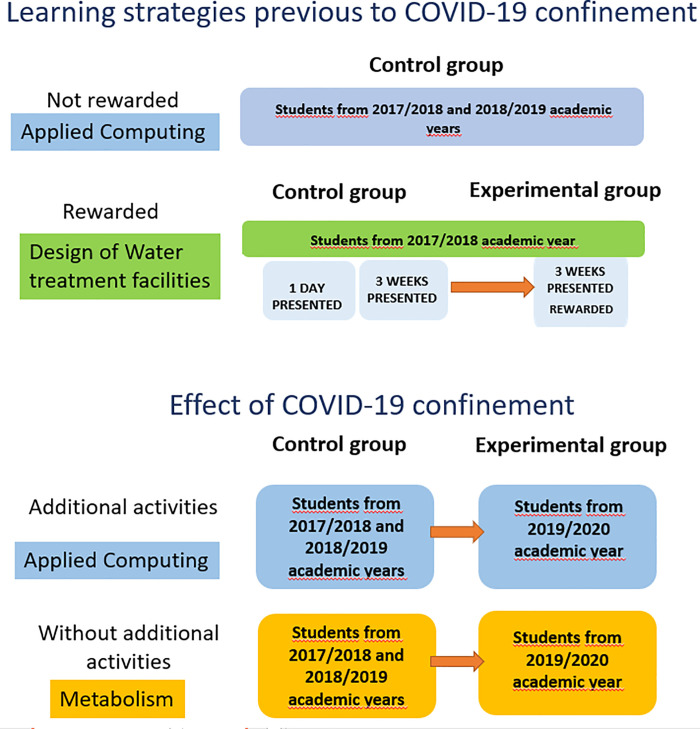
This study analyzes the effects of COVID-19 confinement on the autonomous learning performance of students in higher education. Using a field experiment with 458 students from three different subjects at Universidad Autónoma de Madrid (Spain), we study the differences in assessments by dividing students into two groups. The first group (control) corresponds to academic years 2017/2018 and 2018/2019. The second group (experimental) corresponds to students from 2019/2020, which is the group of students that had their face-to-face activities interrupted because of the confinement. The results show that there is a significant positive effect of the COVID-19 confinement on students' performance. This effect is also significant in activities that did not change their format when performed after the confinement. We find that this effect is significant both in subjects that increased the number of assessment activities and subjects that did not change the student workload. Additionally, an analysis of students' learning strategies before confinement shows that students did not study on a continuous basis. Based on these results, we conclude that COVID-19 confinement changed students' learning strategies to a more continuous habit, improving their efficiency. For these reasons, better scores in students' assessment are expected due to COVID-19 confinement that can be explained by an improvement in their learning performance.
Overview
The claims and statistics of this paper haven’t been checked yet.
Run the check — free, no account needed. It reads the open-access text and checks the sources it cites.
Integrity signals
Registry
Cites
Statistics
Figures
Verification
Claims the paper makes
The claims and statistics of this paper haven’t been checked yet.
Run the check — free, no account needed. It reads the open-access text and checks the sources it cites.
Claims other papers make about this one
Each is checked against this paper’s own text: does it say what the citing paper says it does?
In the citing paper
“Our results then seem to confirm, at a larger scale, those of Gonzalez et al. (2020) in a different university in Madrid.”
From Emergency remote teaching and students’ academic performance in higher education during the COVID-19 pandemic: A case study (2021) · cites this paper as Gonzalez et al., 2020
In the citing paper
“As mentioned in Section 6, while counter-intuitive, this result confirms, across a larger number of courses, the findings of Gonzalez et al. (2020) in a very similar albeit smaller context.”
From Emergency remote teaching and students’ academic performance in higher education during the COVID-19 pandemic: A case study (2021) · cites this paper as Gonzalez et al. (2020)
In the citing paper
“At the university level, in a single university, for 458 students in STEM faculties, learning outcomes actually improved (Gonzalez et al., 2020).”
From Learning loss during Covid-19: An early systematic review (2022) · cites this paper as Gonzalez et al. (2020)
Self-check
Percentages, sums and reported differences re-computed from the paper’s own numbers.
The self-check needs the paper’s full text.
Citations
Cites
On a Test of Whether one of Two Random Variables is Stochastically Larger than the Other
Mann, H. B., & Whitney, D. R. (1947) · The Annals of Mathematical Statistics · doi:10.1214/aoms/1177730491 · Cited by 14,320 · cited 1×
“Means were compared by a Kruskal-Wallis test [46] and, when differences were found, by a Mann-Whitney post hoc test [47] to determine which pairs of means were different.”
MethodUse of Ranks in One-Criterion Variance Analysis
Kruskal, W. H., & Wallis, W. A. (1952) · Journal of the American Statistical Association · doi:10.1080/01621459.1952.10483441 · Cited by 13,912 · cited 1×
“Means were compared by a Kruskal-Wallis test [46] and, when differences were found, by a Mann-Whitney post hoc test [47] to determine which pairs of means were different.”
MethodZimmerman, B. J. (2008) · American Educational Research Journal · doi:10.3102/0002831207312909 · Cited by 3,735 · cited 1×
“Related to autonomous learning, many studies have been performed regarding the concept of self-regulated learning (SRL), in which students are active and responsible for their own learning process [18, 19] as well as being knowledgeable, self-aware and able to select their own approach to learning [20, 21].”
BackgroundFundamentals of item response theory
(1992) · Choice Reviews Online · doi:10.5860/choice.29-4185 · Cited by 3,420
Zimmerman, B. J., & Martinez-Pons, M. (1990) · Journal of Educational Psychology · doi:10.1037/0022-0663.82.1.51 · Cited by 1,825 · cited 1×
“Related to autonomous learning, many studies have been performed regarding the concept of self-regulated learning (SRL), in which students are active and responsible for their own learning process [18, 19] as well as being knowledgeable, self-aware and able to select their own approach to learning [20, 21].”
BackgroundComputerized Adaptive Testing: A Primer
Wainer, H., Dorans, N. J., Flaugher, R. L., Green, B. F., & Mislevy, R. J. (1990) · Medical Entomology and Zoology · Cited by 1,169
La evaluación online en la educación superior en tiempos de la COVID-19
García‐Peñalvo, F. J., Corell, A., García, V. A., & de Prado, M. G. (2020) · Education in the Knowledge Society (EKS) · doi:10.14201/eks.23086 · Cited by 866
The MOOC model for digital practice
McAuley, A. B. T., Stewart, B. E., Siemens, G., & Cormier, D. (2010) · Cited by 698
Comparing online and blended learner's self-regulated learning strategies and academic performance
Broadbent, J. (2017) · The Internet and Higher Education · doi:10.1016/j.iheduc.2017.01.004 · Cited by 679
Wainer, H., Dorans, N. J., Flaugher, R. L., Green, B. F., & Mislevy, R. J. (2000) · Routledge eBooks · doi:10.4324/9781410605931 · Cited by 659
Research works printed but not linked: 2
- FJ García-Peñalvo, 2020, Online Assessment in Higher Education in the Time of COVID-19, Education in the Knowledge Society, 21, 12
- FM Lord, 1980, Applications of item response theory to practical problems
Cited by
Sorted by citations
College students’ use and acceptance of emergency online learning due to COVID-19
Patricia Aguilera-Hermida, A. (2020) · International Journal of Educational Research Open · doi:10.1016/j.ijedro.2020.100011 · Cited by 1,286
Kapasia, N., Paul, P., Roy, A., Saha, J., Zaveri, A., Mallick, R., Barman, B., Das, P., & Chouhan, P. (2020) · Children and Youth Services Review · doi:10.1016/j.childyouth.2020.105194 · Cited by 845
Barrot, J. S., Llenares, I. I., & del Rosario, L. S. (2021) · Education and Information Technologies · doi:10.1007/s10639-021-10589-x · Cited by 764
Iglesias-Pradas, S., Hernández-García, Á., Chaparro-Peláez, J., & Prieto, J. L. (2021) · Computers in Human Behavior · doi:10.1016/j.chb.2021.106713 · Cited by 693
“As mentioned in Section 6, while counterintuitive, this result confirms, across a larger number of courses, the findings of Gonzalez et al. (2020) in a very similar albeit smaller context.”
ResultTurnbull, D., Chugh, R., & Luck, J. (2021) · Education and Information Technologies · doi:10.1007/s10639-021-10633-w · Cited by 529
Metadata
- Authors
- Gonzalez, T., de la Rubia, M. A., Hincz, K. P., Comas-Lopez, M., Subirats, L., Fort, S., & Sacha, G. M.
- Affiliations
- Universidad Autónoma de Madrid (ES)
- Universitat Oberta de Catalunya (ES)
- EURECAT Centre Tecnològic de Catalunya (ES)
- Corresponding author
- Sacha, G. M.
- Venue
- PLOS ONE
- Publisher
- Public Library of Science (PLoS)
- Published
- 2020-10-09
- Volume
- 15
- Issue
- 10
- Pages
- e0239490
- ISSN
- 1932-6203 (ISSN-L)
- PMC
- PMC7546684
- OpenAlex
- W3091995338
- Cited by
- 743
- References
- 45
- Citations by year
- 2026: 23 · 2025: 52 · 2024: 71 · 2023: 142 · 2022: 203 · 2021: 230 · 2020: 22
- FWCI
- 226.20
- Type
- journal article
- Language
- en
- Open access
- gold
- doi.org
- Licence
- Locations
- PLoS ONE (publishedVersion, cc-by)
- PubMed Central (publishedVersion, cc-by)
- PubMed (publishedVersion)
- RePEc: Research Papers in Economics (submittedVersion)
- DOAJ (DOAJ: Directory of Open Access Journals) (submittedVersion, cc-by-sa)
- Hispana (submittedVersion)
- Biblos-e Archivo (Universidad Autónoma de Madrid) (submittedVersion, public-domain)
- Funders
- Erasmus+ Program (2017-1-ES01-KA203-038266)
- Topics
- Social Sciences › Education › Education during COVID-19 pandemic
- Social Sciences › Education › Educational Outcomes and Influences
- Social Sciences › Education › E-Learning and COVID-19
- Keywords
- COVID-19 lockdown, university students, student performance, self-directed learning, learning strategies, assessment performance, student workload, Universidad Autónoma de Madrid
- MeSH terms
- Betacoronavirus, COVID-19, SARS-CoV-2, Adult, Educational Measurement, Female, Humans, Male, Models, Theoretical, Pneumonia, Viral, Spain, Students, Medical, Coronavirus Infections, Education, Distance, Young Adult, Pandemics
About these checks
Registry, retraction, Cites and statistics results are computed, not judged, with one exception: a printed reference that no index lists is read once by a model before it counts as a citation error. Claims are extracted by a model and kept only when their quote appears verbatim in the text; each cited source is then checked, with a model’s help, for whether it says what the claim relies on. Those verdicts can be wrong — read the claim’s quote and the cited source before relying on one.
Statistics and arithmetic are recomputed, not judged.
Confidence bands are shown only for fields calibrated on our annotated test set. None is calibrated yet, so no band is shown.
What counts as a claim ›How we measure confidence ›How we check this ›
Are you an author, or do you see a problem with this page? Request a review
