

The DOI matches its Crossref record; 45 of the 46 references it cites were found in a registry or an index, and 1 are not checked yet.
Residual clinical damage after COVID-19: A retrospective and prospective observational cohort study
Open accessAbstract
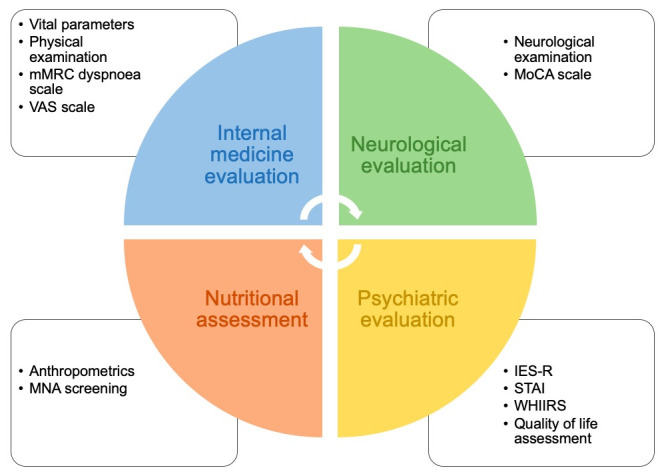
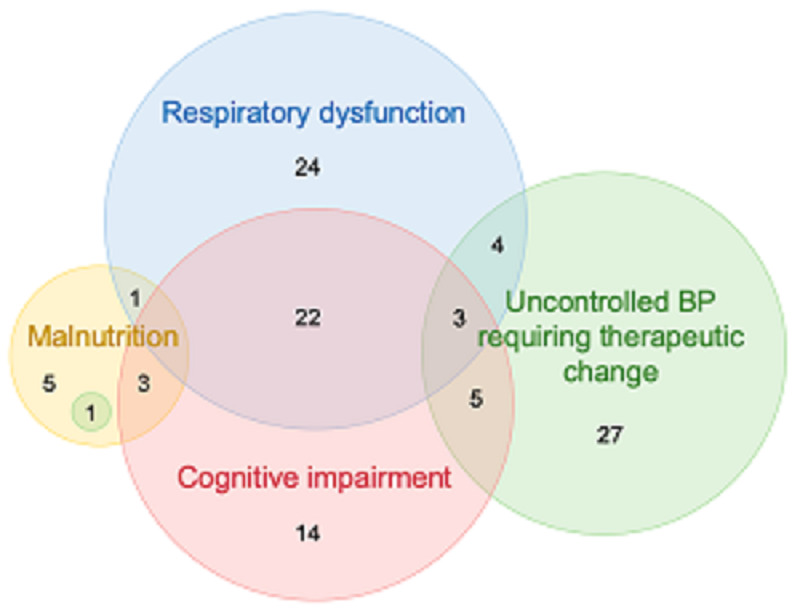
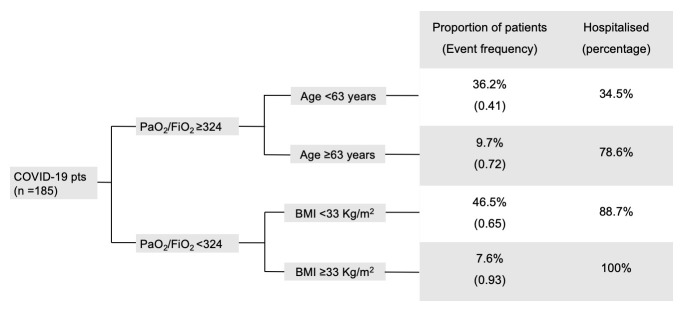
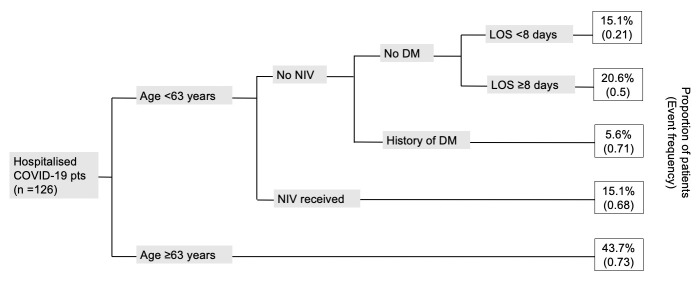
Data on residual clinical damage after Coronavirus disease-2019 (COVID-19) are lacking. The aims of this study were to investigate whether COVID-19 leaves behind residual dysfunction, and identify patients who might benefit from post-discharge monitoring. All patients aged ≥18 years admitted to the Emergency Department (ED) for COVID-19, and evaluated at post-discharge follow-up between 7 April and 7 May, 2020, were enrolled. Primary outcome was need of follow-up, defined as the presence at follow-up of at least one among: respiratory rate (RR) >20 breaths/min, uncontrolled blood pressure (BP) requiring therapeutic change, moderate to very severe dyspnoea, malnutrition, or new-onset cognitive impairment, according to validated scores. Post-traumatic stress disorder (PTSD) served as secondary outcome. 185 patients were included. Median [interquartile range] time from hospital discharge to follow-up was 23 [20-29] days. 109 (58.9%) patients needed follow-up. At follow-up evaluation, 58 (31.3%) patients were dyspnoeic, 41 (22.2%) tachypnoeic, 10 (5.4%) malnourished, 106 (57.3%) at risk for malnutrition. Forty (21.6%) patients had uncontrolled BP requiring therapeutic change, and 47 (25.4%) new-onset cognitive impairment. PTSD was observed in 41 (22.2%) patients. At regression tree analysis, the ratio of arterial oxygen partial pressure to fractional inspired oxygen (PaO2/FiO2) and body mass index (BMI) at ED presentation, and age emerged as independent predictors of the need of follow-up. Patients with PaO2/FiO2 <324 and BMI ≥33 Kg/m2 had the highest odds to require follow-up. Among hospitalised patients, age ≥63 years, or age <63 plus non-invasive ventilation or diabetes identified those with the highest probability to need follow-up. PTSD was independently predicted by female gender and hospitalisation, the latter being protective (odds ratio, OR, 4.03, 95% confidence interval, CI, 1.76 to 9.47, p 0.0011; OR 0.37, 95% CI 0.14 to 0.92, p 0.033, respectively). COVID-19 leaves behind physical and psychological dysfunctions. Follow-up programmes should be implemented for selected patients.
Overview
The claims and statistics of this paper haven’t been checked yet.
Run the check — free, no account needed. It reads the open-access text and checks the sources it cites.
Integrity signals
Registry
Cites
Statistics
Figures
Verification
Claims the paper makes
The claims and statistics of this paper haven’t been checked yet.
Run the check — free, no account needed. It reads the open-access text and checks the sources it cites.
Claims other papers make about this one
Each is checked against this paper’s own text: does it say what the citing paper says it does?
In the citing paper
“with severity of psychiatric symptoms after virus clearance being proportional to the severity of systemic inflammation during the acute infection and significantly contributing to the quality of life of survivors (De Lorenzo et al., 2020, Ma et al., 2020, Mazza et al., 2020, Varatharaj et al., 2020).”
From Persistent psychopathology and neurocognitive impairment in COVID-19 survivors: effect of inflammatory biomarkers at three-month follow-up (2021) · cites this paper as De Lorenzo et al., 2020
In the citing paper
“Emerging data show that COVID-19 outbreak is associated with delirium, fatigue, confusion, depression, anxiety, post-traumatic stress disorder (PTSD), obsessive–compulsive symptoms, and insomnia in the context of acute viral infection or at short-term follow-up after clinical recovery”
From Persistent psychopathology and neurocognitive impairment in COVID-19 survivors: effect of inflammatory biomarkers at three-month follow-up (2021) · cites this paper as De Lorenzo et al., 2020
Self-check
Percentages, sums and reported differences re-computed from the paper’s own numbers.
The self-check needs the paper’s full text.
Citations
Cites
Clinical features of patients infected with 2019 novel coronavirus in Wuhan, China
Huang, C., Wang, Y., Li, X., Ren, L., Zhao, J., Hu, Y., Zhang, L., Fan, G., Xu, J., Gu, X., et al. (2020) · The Lancet · doi:10.1016/s0140-6736(20)30183-5 · Cited by 48,884
Classification and Regression Trees.
Ryzin, J. V., Breiman, L., Friedman, J. H., Olshen, R. A., & Stone, C. J. (1986) · Journal of the American Statistical Association · doi:10.2307/2288003 · Cited by 21,030
Wang, D., Hu, B., Hu, C., Zhu, F., Liu, X., Zhang, J., Wang, B., Xiang, H., Cheng, Z., Xiong, Y., et al. (2020) · JAMA · doi:10.1001/jama.2020.1585 · Cited by 20,148
La certeza de lo impredecible: Cultura Educación y Sociedad en tiempos de COVID19
Martínez González, M. (2020) · DSPACE System - Metalibrary (University of the Coast) · Cited by 18,463
Classification And Regression Trees
Breiman, L., Friedman, J. H., Olshen, R. A., & Stone, C. J. (2017) · doi:10.1201/9781315139470 · Cited by 11,417
EuroQol: the current state of play
Brooks, R. (1996) · Health Policy · doi:10.1016/0168-8510(96)00822-6 · Cited by 5,815
Holmes, E. A., O'Connor, R. C., Perry, V. H., Tracey, I., Wessely, S., Arseneault, L., Ballard, C., Christensen, H., Cohen Silver, R., Everall, I., et al. (2020) · The Lancet Psychiatry · doi:10.1016/s2215-0366(20)30168-1 · Cited by 5,715 · cited 1×
“COVID-19 follow-up cannot be separated from an accurate cognitive and psychological monitoring [39].”
BackgroundCOVID-19 and the cardiovascular system
Zheng, Y.-Y., Ma, Y.-T., Zhang, J.-Y., & Xie, X. (2020) · Nature Reviews Cardiology · doi:10.1038/s41569-020-0360-5 · Cited by 2,970 · cited 1×
“This is consistent with the hypothesis that SARS-CoV-2 infection may be associated with chronic cardiovascular damage [30], and highlights the need of cardiovascular care in the management of COVID-19 patients.”
ResultBestall, J. C., Paul, E. A., Garrod, R., Garnham, R., Jones, P. W., & Wedzicha, J. A. (1999) · Thorax · doi:10.1136/thx.54.7.581 · Cited by 2,927 · cited 1×
“The modified Medical Research Council (mMRC) scale for dyspnoea was used to quantify residual shortness of breath [12], and a visuo-analog scale (VAS) for self-rated health status [13].”
MethodLechien, J. R., Chiesa-Estomba, C. M., De Siati, D. R., Horoi, M., Le Bon, S. D., Rodriguez, A., Dequanter, D., Blecic, S., El Afia, F., Distinguin, L., et al. (2020) · European Archives of Oto-Rhino-Laryngology · doi:10.1007/s00405-020-05965-1 · Cited by 2,668 · cited 1×
“Gastrointestinal symptoms [34] and smell and taste disturbances [35] associated with SARS-CoV-2 infection are possible mechanisms underlying this phenomenon.”
Background
Cited by
Sorted by citations
Four-Month Clinical Status of a Cohort of Patients After Hospitalization for COVID-19
Morin, L., Savale, L., Pham, T. O., Colle, R., Figueiredo, S., Harrois, A., Gasnier, M., Lecoq, A.-L., Meyrignac, O., Noël, N., et al. (2021) · JAMA · doi:10.1001/jama.2021.3331 · Cited by 612
“Duration of ICU stay, median (IQR), d 9 (4-19) 6.”
BackgroundMazza, M. G., Palladini, M., De Lorenzo, R., Magnaghi, C., Poletti, S., Furlan, R., Ciceri, F., Rovere-Querini, P., & Benedetti, F. (2021) · Brain, Behavior, and Immunity · doi:10.1016/j.bbi.2021.02.021 · Cited by 513
Psychiatric and neuropsychiatric sequelae of COVID-19 – A systematic review
Schou, T. M., Joca, S. R. L., Wegener, G., & Bay-Richter, C. (2021) · Brain Behavior and Immunity · doi:10.1016/j.bbi.2021.07.018 · Cited by 424
“Sleep disturbances following COVID-19 was reported in 24 studies (Al-Aly et al., 2021; Boari et al., 2021; D’Cruz et al., 2021; De Lorenzo et al., 2020; Frontera et al., 2021; Gautam et al., 2021; Gennaro et al., 2021; Graham et al., 2021; Huang et al., 2021a; Huang et al., 2021b; Iqbal et al.,…”
InfluentialPhysical and mental health complications post-COVID-19: Scoping review
Shanbehzadeh, S., Tavahomi, M., Zanjari, N., Ebrahimi-Takamjani, I., & Amiri-arimi, S. (2021) · Journal of Psychosomatic Research · doi:10.1016/j.jpsychores.2021.110525 · Cited by 334
Persistent neuropsychiatric symptoms after COVID-19: a systematic review and meta-analysis
Badenoch, J., Rengasamy, E. R., Watson, C. J., Jansen, K., Chakraborty, S., Sundaram, R. D., Hafeez, D., Burchill, E., Saini, A., Thomas, L., et al. (2021) · Brain Communications · doi:10.1093/braincomms/fcab297 · Cited by 288
Metadata
- Authors
- De Lorenzo, R., Conte, C., Lanzani, C., Benedetti, F., Roveri, L., Mazza, M. G., Brioni, E., Giacalone, G., Canti, V., Sofia, V., D’Amico, M., Di Napoli, D., Ambrosio, A., Scarpellini, P., Castagna, A., Landoni, G., Zangrillo, A., Bosi, E., Tresoldi, M., Ciceri, F., & Rovere-Querini, P.
- Affiliations
- Vita-Salute San Raffaele University (IT)
- IRCCS Ospedale San Raffaele (IT)
- ORCID
- Venue
- PLoS ONE
- Publisher
- Public Library of Science (PLoS)
- Published
- 2020-10-14
- Volume
- 15
- Issue
- 10
- Pages
- e0239570
- ISSN
- 1932-6203 (ISSN-L)
- PMC
- PMC7556454
- OpenAlex
- W3092984339
- Cited by
- 179
- References
- 46
- Citations by year
- 2026: 5 · 2025: 9 · 2024: 21 · 2023: 23 · 2022: 64 · 2021: 56 · 2020: 1
- FWCI
- 15.58
- Type
- journal article
- Language
- en
- Open access
- gold
- doi.org
- Licence
- Locations
- PLoS ONE (publishedVersion, cc-by)
- PubMed Central (publishedVersion, cc-by)
- PubMed (publishedVersion)
- DOAJ (DOAJ: Directory of Open Access Journals) (submittedVersion, cc-by-sa)
- Informationszentrum Lebenswissenschaften (ZB MED) (submittedVersion, cc-by)
- Archivio Istituzionale della Ricerca - Università Vita-Salute San Raffaele (submittedVersion)
- Topics
- Health Sciences › Medicine › Clinical Neurology › Long-Term Effects of COVID-19
- Health Sciences › Medicine › Infectious Diseases › COVID-19 Clinical Research Studies
- Social Sciences › Psychology › Clinical Psychology › COVID-19 and Mental Health
- Keywords
- COVID-19 pandemic, long COVID, post-discharge follow-up, dyspnea, tachypnea, malnutrition, uncontrolled hypertension, post-traumatic stress disorder, PaO2/FiO2 ratio, body mass index, emergency department
- MeSH terms
- COVID-19, Aftercare, Aged, Dyspnea, Female, Follow-Up Studies, Humans, Male, Middle Aged, Pneumonia, Viral, Stress Disorders, Post-Traumatic, Coronavirus Infections, Malnutrition, Pandemics, Cognitive Dysfunction
About these checks
Registry, retraction, Cites and statistics results are computed, not judged, with one exception: a printed reference that no index lists is read once by a model before it counts as a citation error. Claims are extracted by a model and kept only when their quote appears verbatim in the text; each cited source is then checked, with a model’s help, for whether it says what the claim relies on. Those verdicts can be wrong — read the claim’s quote and the cited source before relying on one.
Statistics and arithmetic are recomputed, not judged.
Confidence bands are shown only for fields calibrated on our annotated test set. None is calibrated yet, so no band is shown.
What counts as a claim ›How we measure confidence ›How we check this ›
Are you an author, or do you see a problem with this page? Request a review
