

The DOI matches its Crossref record; 71 of the 71 references it cites were found in a registry or an index.
Detection of diverse carbapenem and multidrug resistance genes and high-risk strain types among carbapenem non-susceptible clinical isolates of target gram-negative bacteria in Kenya
Open accessAbstract
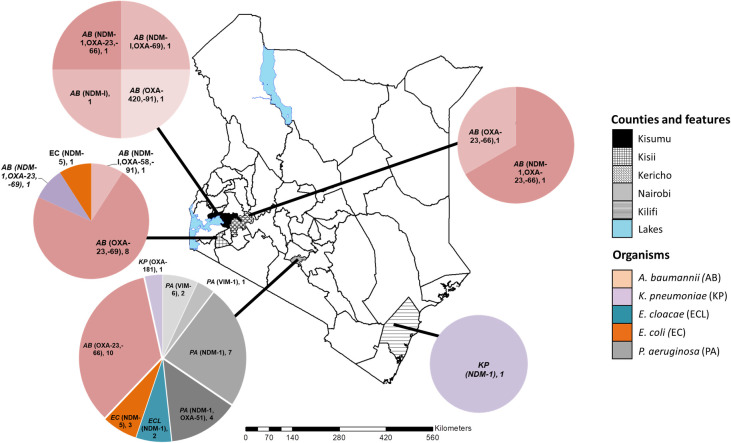
Carbapenem-resistant gram-negative bacteria are an increasingly significant clinical threat globally. This risk may be underestimated in Kenya as only four carbapenemase genes in three bacterial species have been described. The study aimed to understand the antibiotic resistance profiles, genes, sequence types, and distribution of carbapenem-resistant gram-negative bacteria from patients in six hospitals across five Kenyan counties by bacterial culture, antibiotic susceptibility testing, and whole-genome sequence analysis. Forty-eight, non-duplicate, carbapenem non-susceptible, clinical isolates were identified across the five counties (predominantly in Nairobi and Kisii): twenty-seven Acinetobacter baumannii, fourteen Pseudomonas aeruginosa, three Escherichia coli, two Enterobacter cloacae, and two Klebsiella pneumoniae. All isolates were non-susceptible to β-lactam drugs with variable susceptibility to tigecycline (66%), minocycline (52.9%), tetracycline (29.4%), and levofloxacin (22.9%). Thirteen P. aeruginosa isolates were resistant to all antibiotics tested. Eleven carbapenemase genes were identified: blaNDM-1, blaOXA-23, -58, -66, -69, and -91 in A. baumannii (STs 1, 2, 164 and a novel ST1475), blaNDM-1 in E. cloacae (STs 25,182), blaNDM-1, blaVIM-1and -6, blaOXA-50 in P. aeruginosa (STs 316, 357, 654, and1203), blaOXA-181, blaNDM-1 in K. pneumoniae (STs 147 and 219), and blaNDM-5 in E. coli (ST164). Five A. baumannii isolates had two carbapenemases, blaNDM-1, and either blaOXA-23 (4) or blaOXA-58 (1). AmpC genes were detected in A. baumannii (blaADC-25), E. cloacae (blaDHA-1 and blaACT-6, 16), and K. pneumoniae (bla CMY). Significant multiple-drug resistant genes were the pan-aminoglycoside resistance16srRNA methyltransferase arm A, rmt B, rmt C, and rmt F genes. This study is the first to report blaOXA-420, -58, -181, VIM-6, and blaNDM-5 in Kenyan isolates. High-risk STs of A. baumannii (ST1475, ST2), E. cloacae ST182, K. pneumoniae ST147, P. aeruginosa (ST357, 654), and E. coli ST167, ST648 were identified which present considerable therapeutic danger. The study recommends urgent carbapenem use regulation and containment of high-risk carbapenem-resistant bacteria.
Overview
The claims and statistics of this paper haven’t been checked yet.
Run the check — free, no account needed. It reads the open-access text and checks the sources it cites.
Integrity signals
Registry
Cites
Statistics
Figures
Verification
Claims the paper makes
The claims and statistics of this paper haven’t been checked yet.
Run the check — free, no account needed. It reads the open-access text and checks the sources it cites.
Claims other papers make about this one
Each is checked against this paper’s own text: does it say what the citing paper says it does?
The source backs part of the claim, not all of it — or backs it for a different population, condition or comparison.
In the citing paper
“The cooccurrence of class I and class II integrons has also been reported, which possess a variety of resistance genes, such as ant(4′)-IIb, dfrA, aadAB, qnrVC1, gyrA, and parC.147,177,179,181,182,[184][185][186][187]”
From Antimicrobial Resistance Rates and Surveillance in Sub-Saharan Africa: Where Are We Now? (2022) · cites this paper as [147]
Experimental — accuracy not yet measured
Self-check
Percentages, sums and reported differences re-computed from the paper’s own numbers.
The self-check needs the paper’s full text.
Citations
Cites
Identification of acquired antimicrobial resistance genes
Zankari, E., Hasman, H., Cosentino, S., Vestergaard, M., Rasmussen, S., Lund, O., Aarestrup, F. M., & Larsen, M. V. (2012) · Journal of Antimicrobial Chemotherapy · doi:10.1093/jac/dks261 · Cited by 4,980
Kraken: ultrafast metagenomic sequence classification using exact alignments
Wood, D. E., & Salzberg, S. L. (2014) · Genome Biology · doi:10.1186/gb-2014-15-3-r46 · Cited by 4,521
Maiden, M. C. J., Bygraves, J. A., Feil, E. J., Morelli, G., Russell, J. E., Urwin, R., Zhang, Q., Zhou, J., Zurth, K., Caugant, D. A., et al. (1998) · Proceedings of the National Academy of Sciences · doi:10.1073/pnas.95.6.3140 · Cited by 3,891
Jolley, K. A., Bray, J. E., & Maiden, M. C. J. (2018) · Wellcome Open Research · doi:10.12688/wellcomeopenres.14826.1 · Cited by 3,551
Updated Functional Classification of β-Lactamases
Bush, K., & Jacoby, G. A. (2010) · Antimicrobial Agents and Chemotherapy · doi:10.1128/aac.01009-09 · Cited by 2,367
Jacoby, G. A. (2009) · Clinical Microbiology Reviews · doi:10.1128/cmr.00036-08 · Cited by 2,277
Plasmids and the spread of resistance
Carattoli, A. (2013) · International Journal of Medical Microbiology · doi:10.1016/j.ijmm.2013.02.001 · Cited by 1,094
The global epidemiology of carbapenemase-producing Enterobacteriaceae
van Duin, D., & Doi, Y. (2016) · Virulence · doi:10.1080/21505594.2016.1222343 · Cited by 1,016
Carbapenemase-Producing Klebsiella pneumoniae, a Key Pathogen Set for Global Nosocomial Dominance
Pitout, J. D. D., Nordmann, P., & Poirel, L. (2015) · Antimicrobial Agents and Chemotherapy · doi:10.1128/aac.01019-15 · Cited by 856
Evans, B. A., & Amyes, S. G. B. (2014) · Clinical Microbiology Reviews · doi:10.1128/cmr.00117-13 · Cited by 817
Diancourt, L., Passet, V., Nemec, A., Dijkshoorn, L., & Brisse, S. (2010) · PLoS ONE · doi:10.1371/journal.pone.0010034 · Cited by 740
Carbapenem resistance: overview of the problem and future perspectives
Meletis, G. (2015) · Therapeutic Advances in Infectious Disease · doi:10.1177/2049936115621709 · Cited by 726
Founou, R. C., Founou, L. L., & Essack, S. Y. (2017) · PLoS ONE · doi:10.1371/journal.pone.0189621 · Cited by 714
The difficult-to-control spread of carbapenemase producers among Enterobacteriaceae worldwide
Nordmann, P., & Poirel, L. (2014) · Clinical Microbiology and Infection · doi:10.1111/1469-0691.12719 · Cited by 682
Multidrug-Resistant Bacteria in the Community
van Duin, D., & Paterson, D. L. (2016) · Infectious Disease Clinics of North America · doi:10.1016/j.idc.2016.02.004 · Cited by 662
Metallo-β-lactamases: a last frontier for β-lactams?
Cornaglia, G., Giamarellou, H., & Rossolini, G. M. (2011) · The Lancet Infectious Diseases · doi:10.1016/s1473-3099(11)70056-1 · Cited by 614
Multidrug-Resistant Enterobacter cloacae Complex Emerging as a Global, Diversifying Threat
Annavajhala, M. K., Gomez‐Simmonds, A., & Uhlemann, A. (2019) · Frontiers in Microbiology · doi:10.3389/fmicb.2019.00044 · Cited by 343
Karah, N., Sundsfjord, A., Towner, K. J., & Samuelsen, Ø. (2012) · Drug Resistance Updates · doi:10.1016/j.drup.2012.06.001 · Cited by 277
Martı́nez-Martı́nez, L., Pascual, Á., Hernández-Allés, S., Alvarez-Díaz, D., Suárez, A. I., Tran, J. H., Benedi, V. J., & Jacoby, G. A. (1999) · Antimicrobial Agents and Chemotherapy · doi:10.1128/aac.43.7.1669 · Cited by 249
Detection of NDM-1-Producing Klebsiella pneumoniae in Kenya
Poirel, L., Revathi, G., Bernabeu, S., & Nordmann, P. (2010) · Antimicrobial Agents and Chemotherapy · doi:10.1128/aac.01247-10 · Cited by 209
Chavda, K. D., Chen, L., Fouts, D. E., Sutton, G. G., Brinkac, L. M., Jenkins, S. G., Bonomo, R. A., Adams, M. D., & Kreiswirth, B. N. (2016) · mBio · doi:10.1128/mbio.02093-16 · Cited by 201
The spread of carbapenemase-producing bacteria in Africa: a systematic review
Manenzhe, R. I., Zar, H. J., Nicol, M. P., & Kaba, M. (2014) · Journal of Antimicrobial Chemotherapy · doi:10.1093/jac/dku356 · Cited by 189
Emergence of NDM-1 Metallo-β-Lactamase in Pseudomonas aeruginosa Clinical Isolates from Serbia
Jovčić, B., Lepšanović, Z., Šuljagić, V., Rackov, G., Begović, J., Topisirović, L., & Kojić, M. (2011) · Antimicrobial Agents and Chemotherapy · doi:10.1128/aac.00226-11 · Cited by 183
Brolund, A., Lagerqvist, N., Byfors, S., Struelens, M. J., Monnet, D. L., Albiger, B., Kohlenberg, A., & European Antimicrobial Resistance Genes Surveillance Network (EURGen-Net) capacity survey group (2019) · Eurosurveillance · doi:10.2807/1560-7917.es.2019.24.9.1900123 · Cited by 175
Grönthal, T., Österblad, M., Eklund, M., Jalava, J., Nykäsenoja, S., Pekkanen, K., & Rantala, M. (2018) · Eurosurveillance · doi:10.2807/1560-7917.es.2018.23.27.1700497 · Cited by 170
Djahmi, N., Dunyach‐Remy, C., Pantel, A., Dekhil, M., Sotto, A., & Lavigne, J. (2014) · BioMed Research International · doi:10.1155/2014/305784 · Cited by 170
Mushi, M. F., Mshana, S. E., Imirzalioglu, C., & Bwanga, F. (2014) · BioMed Research International · doi:10.1155/2014/303104 · Cited by 167
Okoche, D., Asiimwe, B., Katabazi, F. A., Kato, L., & Najjuka, C. F. (2015) · PLoS ONE · doi:10.1371/journal.pone.0135745 · Cited by 154
Samuelsen, Ø., Toleman, M. A., Sundsfjord, A., Rydberg, J., Leegaard, T. M., Walder, M., Lia, A., Ranheim, T. E., Rajendra, Y., Hermansen, N. O., et al. (2009) · Antimicrobial Agents and Chemotherapy · doi:10.1128/aac.00824-09 · Cited by 150
Berçot, B., Poirel, L., & Nordmann, P. (2011) · Diagnostic Microbiology and Infectious Disease · doi:10.1016/j.diagmicrobio.2011.08.016 · Cited by 103
Schaufler, K., Semmler, T., Wieler, L. H., Trott, D. J., Pitout, J. D. D., Peirano, G., Bonnedahl, J., Dolejská, M., Literák, I., Fuchs, S., et al. (2019) · Antimicrobial Agents and Chemotherapy · doi:10.1128/aac.00243-19 · Cited by 98
Zafer, M. M., Al-Agamy, M. H., El‐Mahallawy, H. A., Amin, M. A., & Ashour, M. S. E.-D. (2014) · BioMed Research International · doi:10.1155/2014/101635 · Cited by 96
Kiiru, J., Kariuki, S., Goddeeris, B. M., & Butaye, P. (2012) · BMC Microbiology · doi:10.1186/1471-2180-12-155 · Cited by 95
A systematic review: the current status of carbapenem resistance in East Africa
Ssekatawa, K., Byarugaba, D. K., Wampande, E., & Ejobi, F. (2018) · BMC Research Notes · doi:10.1186/s13104-018-3738-2 · Cited by 93
Storberg, V. (2014) · Infection Ecology & Epidemiology · doi:10.3402/iee.v4.20342 · Cited by 86
Haller, S., Kramer, R., Becker, K., Bohnert, J. A., Eckmanns, T., Hans, J. B., Hecht, J., Heidecke, C.-D., Hübner, N., Krämer, A., et al. (2019) · Eurosurveillance · doi:10.2807/1560-7917.es.2019.24.50.1900734 · Cited by 82
Metallo-β-lactamase-producing Pseudomonas aeruginosa isolated from a large tertiary centre in Kenya
Pitout, J. D. D., Revathi, G., Chow, B. L., Kabera, B., Kariuki, S., Nordmann, P., & Poirel, L. (2008) · Clinical Microbiology and Infection · doi:10.1111/j.1469-0691.2008.02030.x · Cited by 82
Huang, Y., Yu, X., Xie, M., Wang, X., Liao, K., Xue, W., Chan, E. W., Zhang, R., & Chen, S. (2016) · Antimicrobial Agents and Chemotherapy · doi:10.1128/aac.00859-16 · Cited by 82
Henson, S., Boinett, C. J., Ellington, M. J., Kagia, N., Mwarumba, S., Nyongesa, S., Mturi, N., Kariuki, S., Scott, J. A. G., Thomson, N. R., et al. (2017) · International Journal of Medical Microbiology · doi:10.1016/j.ijmm.2017.07.006 · Cited by 81
Shrestha, S., Tada, T., Miyoshi‐Akiyama, T., Ohara, H., Shimada, K., Satou, K., Teruya, K., Nakano, K., Shiroma, A., Sherchand, J. B., et al. (2015) · International Journal of Antimicrobial Agents · doi:10.1016/j.ijantimicag.2015.07.012 · Cited by 68
First report of NDM-1-producing Acinetobacter baumannii in East Africa
Revathi, G., Siu, L.-K. K., Lu, P., & Huang, L.-Y. (2013) · International Journal of Infectious Diseases · doi:10.1016/j.ijid.2013.07.016 · Cited by 68
Mitgang, E. A., Hartley, D., Malchione, M. D., Koch, M., & Goodman, J. L. (2018) · International Journal of Antimicrobial Agents · doi:10.1016/j.ijantimicag.2018.05.019 · Cited by 64
Antibiotic prescribing patterns at a leading referral hospital in Kenya: A point prevalence survey
Godman, B., MOMANYI, L., Opanga, S. A., Nyamu, D. G., Oluka, M. N., & Kurdi, A. B. (2019) · Journal of Research in Pharmacy Practice · doi:10.4103/jrpp.jrpp_18_68 · Cited by 64
Karah, N., Haldorsen, B. C., Hermansen, N. O., Tveten, Y., Ragnhildstveit, E., Skutlaberg, D. H., Tofteland, S., Sundsfjord, A., & Samuelsen, Ø. (2010) · Journal of Medical Microbiology · doi:10.1099/jmm.0.028340-0 · Cited by 59
Emergence of NDM-5-producing Escherichia coli sequence type 167 clone in Italy
Giufrè, M., Errico, G., Accogli, M., Monaco, M., Villa, L., Distasi, M. A., Gaudio, T. D., Pantosti, A., Carattoli, A., & Cerquetti, M. (2018) · International Journal of Antimicrobial Agents · doi:10.1016/j.ijantimicag.2018.02.020 · Cited by 59
Tang, B., Chang, J., Cao, L., Luo, Q., Xu, H., Lyu, W., Qian, M., Ji, X., Zhang, Q., Xia, X., et al. (2019) · BMC Microbiology · doi:10.1186/s12866-019-1454-2 · Cited by 59
Touati, M., Diene, S. M., Dekhil, M., Djahoudı, A., Racherache, A., & Rolain, J. (2013) · Antimicrobial Agents and Chemotherapy · doi:10.1128/aac.00032-13 · Cited by 56
Torres‐González, P., Bobadilla-del-Valle, M., Tovar-Calderón, E., Leal-Vega, F. J., Hernández-Cruz, A., Martínez‐Gamboa, A., Niembro-Ortega, M. D., Sifuentes‐Osornio, J., & Ponce‐de‐León, A. (2015) · Antimicrobial Agents and Chemotherapy · doi:10.1128/aac.00055-15 · Cited by 56
Koh, T. H., Khoo, C. T., Tan, T. T., Arshad, M. A. B. M., Ang, L., Lau, L. J., Hsu, L. Y., & Ooi, E. E. (2010) · Journal of Clinical Microbiology · doi:10.1128/jcm.01905-09 · Cited by 54
Mataseje, L. F., Peirano, G., Church, D. L., Conly, J. M., Mulvey, M. R., & Pitout, J. D. D. (2016) · Antimicrobial Agents and Chemotherapy · doi:10.1128/aac.02591-15 · Cited by 53
Emergence of NDM – 1 in the Clinical Isolates of Pseudomonas aeruginosa in India
Khajuria, A. (2013) · JOURNAL OF CLINICAL AND DIAGNOSTIC RESEARCH · doi:10.7860/jcdr/2013/5509.3137 · Cited by 49
Hammami, S., Gautier, V., Ghozzi, R., Costa, A. D., Benredjeb, S., & Arlet, G. (2009) · Clinical Microbiology and Infection · doi:10.1111/j.1469-0691.2009.03023.x · Cited by 47
Yin, S., Chen, P., You, B. R., Zhang, Y., Jiang, B., Huang, G., Yang, Z., Chen, Y., Chen, J., Yuan, Z., et al. (2018) · Frontiers in Microbiology · doi:10.3389/fmicb.2018.01135 · Cited by 47
IMP-1 and a Novel Metallo-β-Lactamase, VIM-6, in Fluorescent Pseudomonads Isolated in Singapore
Koh, T. H., Wang, G. C. Y., & Sng, L. (2004) · Antimicrobial Agents and Chemotherapy · doi:10.1128/aac.48.6.2334-2336.2004 · Cited by 43
VIM-2 metallo- -lactamase-producing Pseudomonas aeruginosa causing an outbreak in South Africa
Jacobson, R. K., Minenza, N., Nicol, M. P., & Bamford, C. (2012) · Journal of Antimicrobial Chemotherapy · doi:10.1093/jac/dks100 · Cited by 42
Metallo-β-lactamase–producing Pseudomonas aeruginosa isolates in Tunisia
Mansour, W., Poirel, L., Bettaieb, D., Bouallègue, O., Boujâafar, N., & Nordmann, P. (2009) · Diagnostic Microbiology and Infectious Disease · doi:10.1016/j.diagmicrobio.2009.04.003 · Cited by 41
Karah, N., Giske, C. G., Sundsfjord, A., & Samuelsen, Ø. (2011) · Microbial Drug Resistance · doi:10.1089/mdr.2011.0089 · Cited by 39
Pasterán, F. G., Faccone, D. F., Gomez, S. A., BUNDER, S. D., Spinelli, F., Rapoport, M., Petroni, A., Galas, M., Corso, A. C., & on behalf of the Pseudomonas aeruginosa KPC Group (2012) · Journal of Antimicrobial Chemotherapy · doi:10.1093/jac/dks032 · Cited by 39
Carattoli, A., Fortini, D., Galetti, R., García-Fernández, A., Nardi, G., Orazi, D., Capone, A., Majolino, I., Proia, A. S., Mariani, B., et al. (2013) · Eurosurveillance · doi:10.2807/1560-7917.es2013.18.46.20633 · Cited by 39
Moyo, S. J., Haldorsen, B. C., Aboud, S., Blomberg, B., Maselle, S. Y., Sundsfjord, A., Langeland, N., & Samuelsen, Ø. (2014) · Antimicrobial Agents and Chemotherapy · doi:10.1128/aac.01436-13 · Cited by 31
Pobiega, M., Maciąg, J., Chmielarczyk, A., Romaniszyn, D., Pomorska-Wesołowska, M., Ziółkowski, G., Heczko, P. B., Bulanda, M., & Wójkowska‐Mach, J. (2015) · Diagnostic Microbiology and Infectious Disease · doi:10.1016/j.diagmicrobio.2015.07.022 · Cited by 29
Mathlouthi, N., Lamine, Y. B., Somai, R., Bouhalila-Besbes, S., Bakour, S., Rolain, J., & Chouchani, C. (2017) · Microbial Drug Resistance · doi:10.1089/mdr.2016.0306 · Cited by 28
Golle, A., Janežič, S., & Rupnik, M. (2017) · PLoS ONE · doi:10.1371/journal.pone.0186736 · Cited by 27
Outbreak of metallo- -lactamase VIM-2-positive strains of Pseudomonas aeruginosa in the Ivory Coast
Jeannot, K., Guessennd, N., Fournier, P., Muller, E., Gbonon, V., & Plésiat, P. (2013) · Journal of Antimicrobial Chemotherapy · doi:10.1093/jac/dkt296 · Cited by 24
Outbreaks of multidrug-resistant Acinetobacter baumannii strains in a Kenyan teaching hospital
Huber, C. A., Sartor, A. L., McOdimba, F., Shah, R., Shivachi, P., Sidjabat, H. E., Revathi, G., & Paterson, D. L. (2014) · Journal of Global Antimicrobial Resistance · doi:10.1016/j.jgar.2014.03.007 · Cited by 23
Castanheira, M., Bell, J. M., Turnidge, J. D., Mendes, R. E., & Jones, R. N. (2009) · Clinical Microbiology and Infection · doi:10.1111/j.1469-0691.2009.02903.x · Cited by 17
Saisi, H., Makobe, C. K., Kangongo, M., & Kariuki, S. (2019) · Advances in Microbiology · doi:10.4236/aim.2019.910052 · Cited by 16
Du, N., Liu, S., Niu, M., Duan, Y., Zhang, S., Yao, J., Mao, J., Chen, R., & Du, Y. (2017) · Annals of Clinical Microbiology and Antimicrobials · doi:10.1186/s12941-017-0232-y · Cited by 16
Maina, D., Revathi, G., & Whitelaw, A. C. (2017) · Microbiologia medica · doi:10.4081/mm.2017.7076 · Cited by 10
Broad spectrum antibiotic use among in-patients at a hospital in Nairobi, Kenya
Mariita, K. M., Chirima, H. A., & Maina, C. K. (2018) · International Journal of Basic & Clinical Pharmacology · doi:10.18203/2319-2003.ijbcp20185154 · Cited by 5
Khan, A., Hanson, B., Dinh, A. Q., Wanger, A. R., Ostrosky-Zeichner, L. L., Miller, W. R., & Arias, C. A. (2018) · Open Forum Infectious Diseases · doi:10.1093/ofid/ofy210.712 · Cited by 1
Research works printed but not linked: 2
- World Health Organization, 2014, Antimicrobial Resistance: Global Report on Surveillance
- KJS Mukaya, 2018, Antimicrobial Resistance Profile and Genetic Profiling of Pseudomonas aeruginosa Strains Obtained from Different Inpatient Wards at Kenyatta National Hospital, IOSR Journal of Pharmacy and Biological Sciences (IOSR-JPBS), 13
Cited by
Sorted by citations
Antimicrobial Resistance Rates and Surveillance in Sub-Saharan Africa: Where Are We Now?
Kariuki, S., Kering, K., Wairimu, C., Onsare, R., & Mbae, C. (2022) · Infection and Drug Resistance · doi:10.2147/idr.s342753 · Cited by 245
Muraya, A. W., Kyanya, C. K., Kiyaga, S., Smith, H. J., Kibet, C. K., Martin, M. J., Kimani, J., & Musila, L. A. (2022) · Pathogens · doi:10.3390/pathogens11050545 · Cited by 69
Self-citationMaina, J. W., Onyambu, F., Kibet, P. S., & Musyoki, A. M. (2023) · Annals of Clinical Microbiology and Antimicrobials · doi:10.1186/s12941-023-00636-5 · Cited by 55
Arowolo, M. T., Orababa, O. Q., Olaitan, M. O., Osibeluwo, B. V., Essiet, U. U., Batholomew, O. H., Ogunrinde, O. G., Lagoke, O. A., Soriwei, J. D., Ishola, O. D., et al. (2023) · PLoS ONE · doi:10.1371/journal.pone.0287762 · Cited by 55
Kiyaga, S., Kyanya, C. K., Muraya, A. W., Smith, H. J., Mills, E. G., Kibet, C. K., Mboowa, G., & Musila, L. A. (2022) · Frontiers in Microbiology · doi:10.3389/fmicb.2022.835403 · Cited by 54
Self-citation
Metadata
- Authors
- Musila, L., Kyany’a, C., Maybank, R., Stam, J., Oundo, V., & Sang, W.
- Affiliations
- United States Army Medical Research Directorate - Africa (KE)
- Walter Reed Army Institute of Research (US)
- Corresponding author
- Musila, Lillian
- Venue
- PLOS ONE
- Publisher
- Public Library of Science (PLoS)
- Published
- 2021-02-22
- Volume
- 16
- Issue
- 2
- Pages
- e0246937
- ISSN
- 1932-6203 (ISSN-L)
- PMC
- PMC7899328
- OpenAlex
- W3132704259
- Cited by
- 55
- References
- 71
- Citations by year
- 2026: 4 · 2025: 8 · 2024: 9 · 2023: 11 · 2022: 18 · 2021: 5
- FWCI
- 3.41
- Type
- journal article
- Language
- en
- Open access
- gold
- doi.org
- Licence
- Locations
- PLoS ONE (publishedVersion, cc-by)
- PubMed Central (publishedVersion, cc-by)
- PubMed (publishedVersion)
- DOAJ (DOAJ: Directory of Open Access Journals) (submittedVersion, cc-by-sa)
- Funders
- Armed Forces Health Surveillance Branch (PROMIS ID 20160270153 FY17)
- Topics
- Health Sciences › Medicine › Microbiology (medical) › Antibiotic Resistance in Bacteria
- Health Sciences › Medicine › Infectious Diseases › Antibiotic Use and Resistance
- Health Sciences › Medicine › Microbiology (medical) › Infections and bacterial resistance
- Keywords
- carbapenem resistance, carbapenemase genes, multidrug resistance, Acinetobacter baumannii, Pseudomonas aeruginosa, Escherichia coli, Enterobacter cloacae, Klebsiella pneumoniae, NDM-1, OXA-23, OXA-58, VIM-1, AmpC beta-lactamase, sequence types, antimicrobial resistance surveillance, Kenya, clinical isolates, whole genome sequencing, tigecycline
- MeSH terms
- Anti-Bacterial Agents, Genes, Bacterial, Gram-Negative Bacteria, Humans, Kenya, Carbapenems, Gram-Negative Bacterial Infections, Genes, MDR, Drug Resistance, Bacterial
About these checks
Registry, retraction, Cites and statistics results are computed, not judged, with one exception: a printed reference that no index lists is read once by a model before it counts as a citation error. Claims are extracted by a model and kept only when their quote appears verbatim in the text; each cited source is then checked, with a model’s help, for whether it says what the claim relies on. Those verdicts can be wrong — read the claim’s quote and the cited source before relying on one.
Statistics and arithmetic are recomputed, not judged.
Confidence bands are shown only for fields calibrated on our annotated test set. None is calibrated yet, so no band is shown.
What counts as a claim ›How we measure confidence ›How we check this ›
Are you an author, or do you see a problem with this page? Request a review
