

Ecological momentary interventions for mental health: A scoping review
Open accessThe DOI matches its Crossref record; 82 of the 82 references it cites were found in a registry or an index.
Abstract
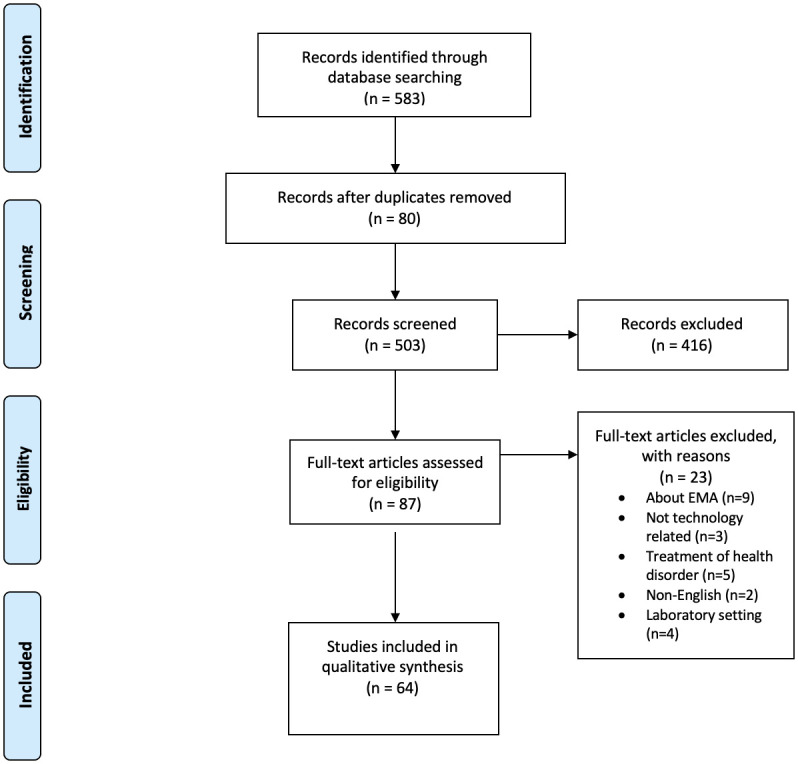
Background: The development of mobile computing technology has enabled the delivery of psychological interventions while people go about their everyday lives. The original visions of the potential of these “ecological momentary interventions” were presented over a decade ago, and the widespread adoption of smartphones in the intervening years has led to a variety of research studies exploring the feasibility of these aspirations. However, there is a dearth of research describing the different dimensions, characteristics, and features of these interventions, as constructed. Objective: To provide an overview of the definitions given for “ecological momentary interventions” in the treatment of common mental health disorders, and describe the set of technological and interaction possibilities which have been used in the design of these interventions. Methods: A systematic search identified relevant literature published between 2009 and 2020 in the PubMed, PsycInfo, and ACM Guide to the Computing Literature databases. Following screening, data were extracted from eligible articles using a standardized extraction worksheet. Selected articles were then thematically categorized. Results: The search identified 583 articles of which 64 met the inclusion criteria. The interventions target a range of mental health problems, with diverse aims, intervention designs and evaluation approaches. The studies employed a variety of features for intervention delivery, but recent research is overwhelmingly comprised of studies based on smartphone apps (30 of 42 papers that described an intervention). Twenty two studies employed sensors for the collection of data in order to provide just-in-time support or predict psychological states. Conclusions: With the shift towards smartphone apps, the vision for EMIs has begun to be realised. Recent years have seen increased exploration of the use of sensors and machine learning, but the role of humans in the delivery of EMI is also varied. The variety of capabilities exhibited by EMIs motivates development of a more precise vocabulary for capturing both automatic and human tailoring of these interventions.
Overview
The claims and statistics of this paper haven’t been checked yet.
Free: it reads the open-access text and checks the first 5 claims that cite a source we can check. Create a free account to check every claim.
Integrity signals
Registry
Cites
Statistics
Figures
Verification
Claims the paper makes
The claims and statistics of this paper haven’t been checked yet.
Free: it reads the open-access text and checks the first 5 claims that cite a source we can check. Create a free account to check every claim.
Claims other papers make about this one
Each is checked against this paper’s own text: does it say what the citing paper says it does?
The source backs part of the claim, not all of it — or backs it for a different population, condition or comparison.
In the citing paper
“Additionally, transformative digital mental health concepts such as ecological momentary assessment (EMA) and ecological momentary interventions (EMI) are on the rise and based on apps/smartphones [64–66].”
From Interventions to build resilience and to ameliorate negative psychosocial effects of the COVID-19 pandemic on children and adolescents: a systematic review and meta-analysis (2024) · cites this paper as [64]
Experimental — accuracy not yet measured
Self-check
Percentages, sums and reported differences re-computed from the paper’s own numbers.
The self-check needs the paper’s full text.
Citations
Cites
Scoping studies: towards a methodological framework
Arksey, H., & O'Malley, L. (2005) · International Journal of Social Research Methodology · doi:10.1080/1364557032000119616 · Cited by 36,742
Kessler, R. C., Berglund, P., Demler, O., Jin, R., Merikangas, K. R., & Walters, E. E. (2005) · Archives of General Psychiatry · doi:10.1001/archpsyc.62.6.593 · Cited by 20,391
Scoping studies: advancing the methodology
Levac, D., Colquhoun, H., & O'Brien, K. K. (2010) · Implementation Science · doi:10.1186/1748-5908-5-69 · Cited by 15,268
Murray, C. J. L., Vos, T., Lozano, R., Naghavi, M., Flaxman, A. D., Michaud, C., Ezzati, M., Shibuya, K., Salomon, J. A., Abdalla, S., et al. (2012) · The Lancet · doi:10.1016/s0140-6736(12)61689-4 · Cited by 8,888
From game design elements to gamefulness: defining "gamification"
Deterding, S., Dixon, D., Khaled, R., & Nacke, L. (2011) · Proceedings of the 15th International Academic MindTrek Conference: Envisioning Future Media Environments · doi:10.1145/2181037.2181040 · Cited by 8,402 · cited 1×
“Gamification refers to the use of game design elements in non-game contexts [78].”
BackgroundEcological momentary assessment
Shiffman, S., Stone, A. A., & Hufford, M. R. (2008) · Annual Review of Clinical Psychology · doi:10.1146/annurev.clinpsy.3.022806.091415 · Cited by 6,454
Nahum-Shani, I., Smith, S. N., Spring, B. J., Collins, L. M., Witkiewitz, K., Tewari, A., & Murphy, S. A. (2018) · Annals of Behavioral Medicine · doi:10.1007/s12160-016-9830-8 · Cited by 2,171 · cited 3×
“, a just-in-time adaptive intervention (JITAI) is “an intervention design aiming to provide the right type/amount of support, at the right time, by adapting to an individual’s changing internal and contextual state” [9].”
BackgroundInfluentialHeron, K. E., & Smyth, J. M. (2010) · British Journal of Health Psychology · doi:10.1348/135910709x466063 · Cited by 1,438
What are scoping studies? A review of the nursing literature
Davis, K., Drey, N., & Gould, D. (2009) · International Journal of Nursing Studies · doi:10.1016/j.ijnurstu.2009.02.010 · Cited by 855 · cited 1×
“A scoping review requires analytical reinterpretation of the literature and is commonly undertaken to clarify a complex concept and refine subsequent research inquiries [13].”
BackgroundPersonal Sensing: Understanding Mental Health Using Ubiquitous Sensors and Machine Learning
Mohr, D. C., Zhang, M., & Schueller, S. M. (2017) · Annual Review of Clinical Psychology · doi:10.1146/annurev-clinpsy-032816-044949 · Cited by 802 · cited 2×
“[17] was used to categorize sensors for automated monitoring, the features that are derived through data collected from sensors, and the prediction of behavioral markers and clinical targets.”
MethodSelf-citation
Cited by
Artificially intelligent chatbots in digital mental health interventions: a review
Boucher, E. M., Harake, N. R., Ward, H. E., Stoeckl, S. E., Vargas, J., Minkel, J., Parks, A. C., & Zilca, R. (2021) · Expert Review of Medical Devices · doi:10.1080/17434440.2021.2013200 · Cited by 440
“intervention and helping to reduce the likelihood of future problems [81].”
BackgroundDesigning for Emotion Regulation Interventions: An Agenda for HCI Theory and Research
Slovak, P., Antle, A., Theofanopoulou, N., Daudén Roquet, C., Gross, J., & Isbister, K. (2023) · ACM Transactions on Computer-Human Interaction · doi:10.1145/3569898 · Cited by 142
“, emerging EMA-as-intervention approaches [8])? (2) We lack research on innovative approaches to information delivery that would embed didactic learning into participants’ lives (rather than relying on traditional module-based delivery or simple reminders).”
BackgroundEvaluation of the Current State of Chatbots for Digital Health: Scoping Review
Xue, J., Zhang, B., Zhao, Y., Zhang, Q., Zheng, C., Jiang, J., Li, H., Liu, N., Li, Z., Fu, W., et al. (2023) · Journal of Medical Internet Research · doi:10.2196/47217 · Cited by 132
“The use of AI for diagnostics can help identify individuals at risk, enabling early intervention and minimizing future complications [33].”
Reimagining Healthcare: Unleashing the Power of Artificial Intelligence in Medicine
Iqbal, J., Cortés Jaimes, D. C., Makineni, P., Subramani, S., Hemaida, S., Thugu, T. R., Butt, A. N., Sikto, J. T., Kaur, P., Lak, M. A., et al. (2023) · Cureus · doi:10.7759/cureus.44658 · Cited by 94
“AI-assisted diagnostics, on the other hand, might aid in the early identification of those at risk, allowing for more effective intervention and problem avoidance [106,107].”
BackgroundGötzl, C., Hiller, S., Rauschenberg, C., Schick, A., Fechtelpeter, J., Fischer-Abaigar, U., Koppe, G., Durstewitz, D., Reininghaus, U., & Krumm, S. (2022) · Child and Adolescent Psychiatry and Mental Health · doi:10.1186/s13034-022-00522-6 · Cited by 105
“However, in context of mHealth apps, research on users’ perceptions has primarily focused on apps that don’t rely on machine learning algorithms or the use of multimodal data (eg, in form of EMA, sensor data) [25, 36, 37].”
Background
Metadata
- Authors
- Balaskas, A., Schueller, S. M., Cox, A. L., & Doherty, G.
- Affiliations
- Trinity College Dublin (IE)
- University of California, Irvine (US)
- University College London (GB)
- Corresponding author
- Doherty, Gavin
- Venue
- PLOS ONE
- Publisher
- Public Library of Science (PLoS)
- Published
- 2021-03-11
- Volume
- 16
- Issue
- 3
- Pages
- e0248152
- ISSN
- 1932-6203 (ISSN-L)
- PMC
- PMC7951936
- OpenAlex
- W3135402573
- Cited by
- 235
- References
- 82
- Citations by year
- 2026: 55 · 2025: 54 · 2024: 47 · 2023: 37 · 2022: 36 · 2021: 6
- FWCI
- 27.98
- Type
- journal article
- Language
- en
- Open access
- gold
- doi.org
- Licence
- Locations
- PLoS ONE (publishedVersion, cc-by)
- PubMed Central (publishedVersion, cc-by)
- PubMed (publishedVersion)
- DOAJ (DOAJ: Directory of Open Access Journals) (submittedVersion, cc-by-sa)
- UCL Discovery (University College London) (submittedVersion)
- eScholarship (California Digital Library) (submittedVersion)
- eScholarship (California Digital Library) (submittedVersion, cc-by)
- Funders
- Science Foundation Ireland (17/RC-PHD/3488)
- European Regional Development Fund (Grant 13/RC/2106_P2)
- Topics
- Social Sciences › Psychology › Applied Psychology › Digital Mental Health Interventions
- Health Sciences › Health Professions › General Health Professions › Mobile Health and mHealth Applications
- Social Sciences › Psychology › Experimental and Cognitive Psychology › Mental Health Research Topics
- Keywords
- ecological momentary intervention, mobile mental health intervention, mobile application, sensors, machine learning, common mental disorders, intervention design
- MeSH terms
- Smartphone, Ecological Momentary Assessment, Mental Disorders, Humans, Psychotherapy, Brief, Mobile Applications
About these checks
Registry, retraction, Cites and statistics results are computed, not judged, with one exception: a printed reference that no index lists is read once by a model before it counts as a citation error. Claims are extracted by a model and kept only when their quote appears verbatim in the text; each cited source is then checked, with a model’s help, for whether it says what the claim relies on. Those verdicts can be wrong — read the claim’s quote and the cited source before relying on one.
Statistics and arithmetic are recomputed, not judged.
Confidence bands are shown only for fields calibrated on our annotated test set. None is calibrated yet, so no band is shown.
What counts as a claim ›How we measure confidence ›How we check this ›
Are you an author, or do you see a problem with this page? Request a review
How to cite
Cite CoChat for the checks on this page, and the paper for its own findings.
- This page
- CoChat. (2026). Citation check: Ecological momentary interventions for mental health: A scoping review. https://app.cochat.ai/papers/10.1371/journal.pone.0248152
- The paper
- Balaskas, A., Schueller, S. M., Cox, A. L., & Doherty, G. (2021). Ecological momentary interventions for mental health: A scoping review. PLOS ONE. https://doi.org/10.1371/journal.pone.0248152
Data sources
Bibliographic data: Semantic Scholar, OpenAlex, Crossref.
Contains information from the Semantic Scholar Academic Graph Datasets, made available under the ODC Attribution License (ODC-BY 1.0).
Semantic Scholar’s data is described in: Kinney, R., et al. (2023). The Semantic Scholar Open Data Platform. arXiv:2301.10140.
