

Ecological momentary interventions for mental health: A scoping review
Open accessThe DOI matches its Crossref record; 82 of the 82 references it cites were found in a registry or an index.
Abstract
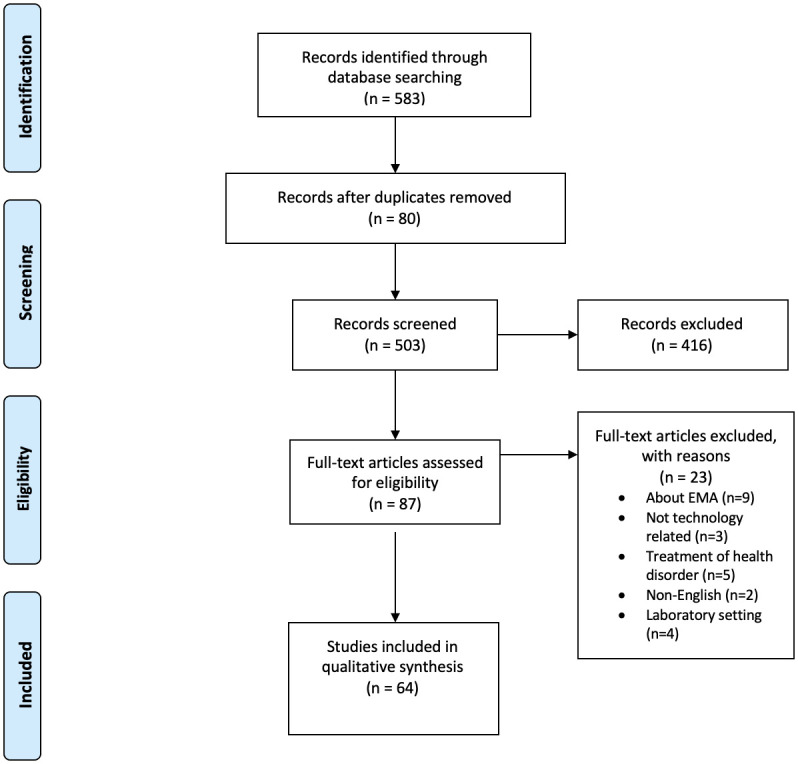
Background: The development of mobile computing technology has enabled the delivery of psychological interventions while people go about their everyday lives. The original visions of the potential of these “ecological momentary interventions” were presented over a decade ago, and the widespread adoption of smartphones in the intervening years has led to a variety of research studies exploring the feasibility of these aspirations. However, there is a dearth of research describing the different dimensions, characteristics, and features of these interventions, as constructed. Objective: To provide an overview of the definitions given for “ecological momentary interventions” in the treatment of common mental health disorders, and describe the set of technological and interaction possibilities which have been used in the design of these interventions. Methods: A systematic search identified relevant literature published between 2009 and 2020 in the PubMed, PsycInfo, and ACM Guide to the Computing Literature databases. Following screening, data were extracted from eligible articles using a standardized extraction worksheet. Selected articles were then thematically categorized. Results: The search identified 583 articles of which 64 met the inclusion criteria. The interventions target a range of mental health problems, with diverse aims, intervention designs and evaluation approaches. The studies employed a variety of features for intervention delivery, but recent research is overwhelmingly comprised of studies based on smartphone apps (30 of 42 papers that described an intervention). Twenty two studies employed sensors for the collection of data in order to provide just-in-time support or predict psychological states. Conclusions: With the shift towards smartphone apps, the vision for EMIs has begun to be realised. Recent years have seen increased exploration of the use of sensors and machine learning, but the role of humans in the delivery of EMI is also varied. The variety of capabilities exhibited by EMIs motivates development of a more precise vocabulary for capturing both automatic and human tailoring of these interventions.
Overview
The claims and statistics of this paper haven’t been checked yet.
Free: it reads the open-access text and checks the first 5 claims that cite a source we can check. Create a free account to check every claim.
Integrity signals
Registry
Cites
Statistics
Figures
Verification
Claims the paper makes
The claims and statistics of this paper haven’t been checked yet.
Free: it reads the open-access text and checks the first 5 claims that cite a source we can check. Create a free account to check every claim.
Claims other papers make about this one
Each is checked against this paper’s own text: does it say what the citing paper says it does?
The source backs part of the claim, not all of it — or backs it for a different population, condition or comparison.
In the citing paper
“Additionally, transformative digital mental health concepts such as ecological momentary assessment (EMA) and ecological momentary interventions (EMI) are on the rise and based on apps/smartphones [64–66].”
From Interventions to build resilience and to ameliorate negative psychosocial effects of the COVID-19 pandemic on children and adolescents: a systematic review and meta-analysis (2024) · cites this paper as [64]
Experimental — accuracy not yet measured
Self-check
Percentages, sums and reported differences re-computed from the paper’s own numbers.
The self-check needs the paper’s full text.
Citations
Cites
Scoping studies: towards a methodological framework
Arksey, H., & O'Malley, L. (2005) · International Journal of Social Research Methodology · doi:10.1080/1364557032000119616 · Cited by 36,742
Kessler, R. C., Berglund, P., Demler, O., Jin, R., Merikangas, K. R., & Walters, E. E. (2005) · Archives of General Psychiatry · doi:10.1001/archpsyc.62.6.593 · Cited by 20,391
Scoping studies: advancing the methodology
Levac, D., Colquhoun, H., & O'Brien, K. K. (2010) · Implementation Science · doi:10.1186/1748-5908-5-69 · Cited by 15,268
Murray, C. J. L., Vos, T., Lozano, R., Naghavi, M., Flaxman, A. D., Michaud, C., Ezzati, M., Shibuya, K., Salomon, J. A., Abdalla, S., et al. (2012) · The Lancet · doi:10.1016/s0140-6736(12)61689-4 · Cited by 8,888
From game design elements to gamefulness: defining "gamification"
Deterding, S., Dixon, D., Khaled, R., & Nacke, L. (2011) · Proceedings of the 15th International Academic MindTrek Conference: Envisioning Future Media Environments · doi:10.1145/2181037.2181040 · Cited by 8,402 · cited 1×
“Gamification refers to the use of game design elements in non-game contexts [78].”
BackgroundEcological momentary assessment
Shiffman, S., Stone, A. A., & Hufford, M. R. (2008) · Annual Review of Clinical Psychology · doi:10.1146/annurev.clinpsy.3.022806.091415 · Cited by 6,454
Nahum-Shani, I., Smith, S. N., Spring, B. J., Collins, L. M., Witkiewitz, K., Tewari, A., & Murphy, S. A. (2018) · Annals of Behavioral Medicine · doi:10.1007/s12160-016-9830-8 · Cited by 2,171 · cited 3×
“, a just-in-time adaptive intervention (JITAI) is “an intervention design aiming to provide the right type/amount of support, at the right time, by adapting to an individual’s changing internal and contextual state” [9].”
BackgroundInfluentialHeron, K. E., & Smyth, J. M. (2010) · British Journal of Health Psychology · doi:10.1348/135910709x466063 · Cited by 1,438
What are scoping studies? A review of the nursing literature
Davis, K., Drey, N., & Gould, D. (2009) · International Journal of Nursing Studies · doi:10.1016/j.ijnurstu.2009.02.010 · Cited by 855 · cited 1×
“A scoping review requires analytical reinterpretation of the literature and is commonly undertaken to clarify a complex concept and refine subsequent research inquiries [13].”
BackgroundPersonal Sensing: Understanding Mental Health Using Ubiquitous Sensors and Machine Learning
Mohr, D. C., Zhang, M., & Schueller, S. M. (2017) · Annual Review of Clinical Psychology · doi:10.1146/annurev-clinpsy-032816-044949 · Cited by 802 · cited 2×
“[17] was used to categorize sensors for automated monitoring, the features that are derived through data collected from sensors, and the prediction of behavioral markers and clinical targets.”
MethodSelf-citation
Cited by
Items 201–234 of 234
Martens, J., Forkmann, T., & Höller, I. (2026) · JMIR Research Protocols · doi:10.2196/72138
“The search strategy was based on previous literature on the concepts of interest [6,36-38].”
Cheung, Y., Ngai, J., Yeung, K., Li, A. W. K., & Ying, H. Y. (2026) · International Review of Psychiatry · doi:10.1080/09540261.2026.2631758
Sprang, G., Mennicke, A. M., Ray, C. M., Clear, E. R., & Coker, A. L. (2026) · Journal of Family Violence · doi:10.1007/s10896-026-01084-3
Thielecke, J., Roozeboom, M. B., Niks, I. M. W., de Korte, E., & Shahmohammadi, S. (2026) · JMIR Formative Research · doi:10.2196/84032
“To be able to act on work-related stress in a timely manner, an important precondition is that work-related stress and contributing factors can be measured close to real-time and with enough detail to inform actions [11,12].”
Mournet, A. M., Bentley, K. H., Krall, H. R., Flics, M. J., Hawes, M. T., Edershile, E. A., AhnAllen, C. G., & Kleiman, E. M. (2026) · Journal of Affective Disorders · doi:10.1016/j.jad.2026.121628
“Other psychiatric inpatient units should seek to implement a similar approach given the limited time needed from clinicians and the increasing accessibility and scalability of EMI technology (Balaskas et al., 2021).”
Skeen, S. J., Tokarz, S., Gasik, R. E., Smith, E. A., Theall, K. P., & Clum, G. A. (2026) · JMIR Human Factors · doi:10.2196/80705 · Cited by 1
“Just-in-time adaptive interventions (JITAIs), delivered via smartphone, and often reliant on ecological momentary assessment (EMA) inputs [29,30], can prompt users with brief psychoeducational and coping skills refreshers whenever necessary [24,31].”
Urben, S., Giovannini, J., Dietsche, A., Kheir, M. A., Schmidt, L., Koenig, J., Stringaris, A. K., Plessen, K. J., Kaess, M., & Mürner-Lavanchy, I. M. (2026) · BMJ Open · doi:10.1136/bmjopen-2025-111168
“Likewise, ecological momentary interventions or just- in-time adapted interventions 133 could be developed based on the acquired knowledge from this study.”
An Application-Oriented Survey of Digital Solutions in Mental Healthcare
Kertész, G., Pintér, Á., Bringye, Z., Gáspár, B., Egres, K., van Elst, L. T., Pirker, J., & Möller, K. (2026) · IEEE International Conference on Computational Cybernetics (ICCC) · doi:10.1109/iccc68994.2026.11511591
“Methodological work on mobile ecological momentary interventions interventions describes the use of tailored notifications, sensor-based triggers, and just-in-time adaptive components, supported by smartphone capabilities for continuous data capture [89].”
David, D., Tomoiagă, C. T., & Sîrbu, V. (2026) · Behaviour Research and Therapy · doi:10.1016/j.brat.2026.105070
Change in caregiver emotional ratings in response to neuro-oncology caregiver navigation sessions
Reblin, M., Sutton, S. K., Wells, K. J., Witte, D., Forsyth, P. A., & Byrne, M. M. (2026) · Neuro-Oncology Practice · doi:10.1093/nop/npag043
Speech markers of psychological change following a psychedelic 5-MeO-DMT retreat
Kuc, J., McAlpine, R. G., Sellers, A., Blackburne, G., Lametti, D. R., & Skipper, J. I. (2026) · Journal of Psychopharmacology · doi:10.1177/02698811261443690
“EMAs are now used both as a monitoring tool and as an intervention in mental health contexts (Balaskas et al., 2021), illustrating their versatility in capturing evolving linguistic markers of psychological well-being.”
Julià, A., Jaén, I., García‐Palacios, A., Pascual, J. C., Sintes, A., Lara, A., Méndez, I., Romero, S., Solerdelcoll, M., Puntí, J., et al. (2026) · doi:10.2196/preprints.102006
Kaufman, J. R., Patrick, R. E., Ren, B., Maciarz, J., Gregg, A. P., Ozonsi, R., Dickinson, R. A., & Weisenbach, S. L. (2026) · Journal of Affective Disorders · doi:10.1016/j.jad.2026.122088
Licht-Handler, A. S., Lin, C., Stelzer, E., & Killikelly, C. (2026) · JMIR Research Protocols · doi:10.2196/87021
“This has the benefit that information and skills get practiced and integrated into real life and that support can be accessed anywhere [40].”
Ewald, S., Berkowitz, T. S., Hiskens-Ravest, S., Bufton, K., Bates, M. T., Eric, O., Fuller‐Tyszkiewicz, M., King, G., & Westrupp, E. M. (2026) · JMIR Pediatrics and Parenting · doi:10.2196/87917 · Cited by 1
“While in-the-moment delivery can be highly effective [29,100], some parents may be more receptive to learning new skills when not experiencing high emotional dysregulation [101].”
Sarrión-Castelló, P., Desdentado, L., Rodríguez, A. D., Westerhof, G. J., Bohlmeijer, E. T., Cebolla, A., & Baños, R. (2026) · Contemporary Clinical Trials Communications · doi:10.1016/j.conctc.2026.101663
“When microinterventions are delivered at fixed or on-demand times via mobile devices, they are referred to as ecological momentary interventions (EMIs; [23,24]).”
Marschin, V., & Herbert, C. (2026) · Frontiers in Sports and Active Living · doi:10.3389/fspor.2026.1774292
“On top of that, the interventions were delivered fully online in participants’ natural environments, thereby reflecting real-world digital health applications and the increasing use of digitally delivered mental health interventions (28, 38, 39).”
Forecasting stress transitions using ecological momentary assessment data and machine learning
van der Linden, R., Burychka, D., Doukani, A., Gonçalves, G., Henrotte, E., Herrero, R., Imwinkelried, M., Krasniqi, E., Lam, S., Riisager, L. G., et al. (2026) · Internet Interventions · doi:10.1016/j.invent.2026.100969
“A key advantage of mHealth is its ability to support ecological momentary assessments (EMAs), which consists of repeatedly sampling individuals’ current behaviors and experiences in their natural environments (Balaskas et al., 2021; Shiffman et al., 2008).”
Koning, E., Breda, V., Panjeh, S., & Brietzke, E. M. (2026) · Bipolar Disorders · doi:10.1111/bdi.70146
“…ecological momentary interventions have demonstrated potential to promote the self-management of negative emotions, stress, substance use issues, and anxiety; however, more work is needed to reduce participant burden, improve compliance, and ensure that EMA-based care is high quality [63–67].”
Mobile Apps for Anxiety and Depression in Children and Young People: A Therapist in Your Pocket?
Lau, N., & Srinakarin, K. (2026) · Elsevier eBooks · doi:10.1016/b978-0-443-29009-1.00144-x
Uyttebroek, L., Beames, J. R., Wampers, M., van Aubel, E., Weermeijer, J. D. M., & Myin‐Germeys, I. (2026) · Internet Interventions · doi:10.1016/j.invent.2026.100979
“…has demonstrated the potential for integrating ambulatory methods, such as Ecological Momentary Interventions (EMI) (Heron and Smyth, 2010) and Ecological Momentary Assessment (EMA) (Stone and Shiffman, 1994), into the treatment of mental health disorders (Balaskas et al., 2021; Bell et al., 2017).”
Hughes, C. D. (2026) · Oxford University Press eBooks · doi:10.1093/9780197851449.003.0520
Kornacka, M., Barnes, S., Skorupski, J., Skorupski, M. S., Jaskulska, A., Para, M., & Szastok, M. (2026) · Psychiatria i Psychologia Kliniczna · doi:10.15557/pipk.2026.0018
A multimodal tableware system for supporting mindful eating in solo dining: a pilot study
Zhang, M., Ding, S., Zhang, Z., Kong, Q., & Li, X. (2026) · Frontiers in Public Health · doi:10.3389/fpubh.2026.1830317
“Eating behaviors represent routine lifestyle activities with cumulative long-term health consequences (2), highlighting the need for interventions that can be naturally embedded into everyday contexts (3).”
Gual-Montolio, P., Suso‐Ribera, C., Díaz-Sanahuja, L., García‐Palacios, A., Bretón-López, J. M., & Alonso-Olea, I. (2026) · Behavioral Sciences · doi:10.3390/bs16091546
“…with the widespread adoption of smartphones, which enable automated data collection, passive sensing through embedded sensors (e.g., accelerometers and GPS), and real-time transmission of information to clinicians and researchers (Balaskas et al., 2021; Firth et al., 2017; Hallgren et al., 2017).”
Ali, S. A., & Maheshwari, S. (2026) · IGI Global eBooks · doi:10.4018/979-8-3373-8444-3.ch010
Tu, T. J.-L., Syu, J.-N., Chen, P. S., Gao, R. R.-Y., Lin, S., & Lin, E. C. (2026) · Journal of Telemedicine and Telecare · doi:10.1177/1357633x261489680
Wise Empathy Improves Well-Being on Instagram
Depow, G. J., Oveis, C., Zohar, E., & Inzlicht, M. (2026) · Social Media + Society · doi:10.1177/20563051261487089
“Our findings are ecologically valid because they are based on real experiences of participants’ own feeds in everyday life (Balaskas et al., 2021; Shiffman et al., 2008).”
Rauschenberg, C., Schirmbeck, F. N., Fechtelpeter, J., Wierzba, E., Hiller, S., Kahr, K., Kessler, A. S., Hornbacher, L. L. F., Götzl, C., Schick, A., et al. (2026) · Translational Psychiatry · doi:10.1038/s41398-026-04475-8
Rodríguez‐Medina, J., González‐Sanguino, C., Betegón, E., Lanchares, A. A., & Boemo, T. (2026) · JMIR Research Protocols · doi:10.2196/106072
“This is consistent with work highlighting the value of mobile technologies [12] and continuous monitoring [14].”
Ko, Y., Kim, J., Park, S., Kim, H., Seo, J. H., Park, I. H., Lee, J., & Kim, J. (2026) · Journal of Medical Internet Research · doi:10.2196/101125
“Existing modular programs may not fully capture the need for real-time, context-respon-sive support, such as ecological momentary interventions and just-in-time adaptive interventions (JITAIs), which are critical when patients face abrupt anticipatory anxiety or early panic [29-31].”
Lee, J., Park, S., & Nam, S. (2026) · Behavioral Sciences · doi:10.3390/bs16101956
“The screening function was not intended for medical diagnosis but for identifying distress through structured questions so that tailored feedback could be given (Balaskas et al., 2021).”
Feasibility, Acceptability, and Efficacy of an Ecological Momentary Intervention for Autistic Adults
Parenteau, C. I., Nahmias, A. S., & Lerner, M. D. (2026) · Journal of Autism and Developmental Disorders · doi:10.1007/s10803-026-07574-z
Mason, L., Yarmey, V., Li, S., Muzamil, M., Kumar, S., Linardon, J., Sherry, S., Lacroix, É., Mills, J. S., Keshen, A., et al. (2026) · Body Image · doi:10.1016/j.bodyim.2026.102211
Metadata
- Authors
- Balaskas, A., Schueller, S. M., Cox, A. L., & Doherty, G.
- Affiliations
- Trinity College Dublin (IE)
- University of California, Irvine (US)
- University College London (GB)
- Corresponding author
- Doherty, Gavin
- Venue
- PLOS ONE
- Publisher
- Public Library of Science (PLoS)
- Published
- 2021-03-11
- Volume
- 16
- Issue
- 3
- Pages
- e0248152
- ISSN
- 1932-6203 (ISSN-L)
- PMC
- PMC7951936
- OpenAlex
- W3135402573
- Cited by
- 235
- References
- 82
- Citations by year
- 2026: 55 · 2025: 54 · 2024: 47 · 2023: 37 · 2022: 36 · 2021: 6
- FWCI
- 27.98
- Type
- journal article
- Language
- en
- Open access
- gold
- doi.org
- Licence
- Locations
- PLoS ONE (publishedVersion, cc-by)
- PubMed Central (publishedVersion, cc-by)
- PubMed (publishedVersion)
- DOAJ (DOAJ: Directory of Open Access Journals) (submittedVersion, cc-by-sa)
- UCL Discovery (University College London) (submittedVersion)
- eScholarship (California Digital Library) (submittedVersion)
- eScholarship (California Digital Library) (submittedVersion, cc-by)
- Funders
- Science Foundation Ireland (17/RC-PHD/3488)
- European Regional Development Fund (Grant 13/RC/2106_P2)
- Topics
- Social Sciences › Psychology › Applied Psychology › Digital Mental Health Interventions
- Health Sciences › Health Professions › General Health Professions › Mobile Health and mHealth Applications
- Social Sciences › Psychology › Experimental and Cognitive Psychology › Mental Health Research Topics
- Keywords
- ecological momentary intervention, mobile mental health intervention, mobile application, sensors, machine learning, common mental disorders, intervention design
- MeSH terms
- Smartphone, Ecological Momentary Assessment, Mental Disorders, Humans, Psychotherapy, Brief, Mobile Applications
About these checks
Registry, retraction, Cites and statistics results are computed, not judged, with one exception: a printed reference that no index lists is read once by a model before it counts as a citation error. Claims are extracted by a model and kept only when their quote appears verbatim in the text; each cited source is then checked, with a model’s help, for whether it says what the claim relies on. Those verdicts can be wrong — read the claim’s quote and the cited source before relying on one.
Statistics and arithmetic are recomputed, not judged.
Confidence bands are shown only for fields calibrated on our annotated test set. None is calibrated yet, so no band is shown.
What counts as a claim ›How we measure confidence ›How we check this ›
Are you an author, or do you see a problem with this page? Request a review
Data sources
Bibliographic data: Semantic Scholar, OpenAlex, Crossref.
Contains information from the Semantic Scholar Academic Graph Datasets, made available under the ODC Attribution License (ODC-BY 1.0).
Semantic Scholar’s data is described in: Kinney, R., et al. (2023). The Semantic Scholar Open Data Platform. arXiv:2301.10140.
