

The DOI matches its Crossref record; 55 of the 56 references it cites were found in a registry or an index, and 1 are not checked yet.
Distance learning in higher education during COVID-19: The role of basic psychological needs and intrinsic motivation for persistence and procrastination–a multi-country study
Open accessAbstract
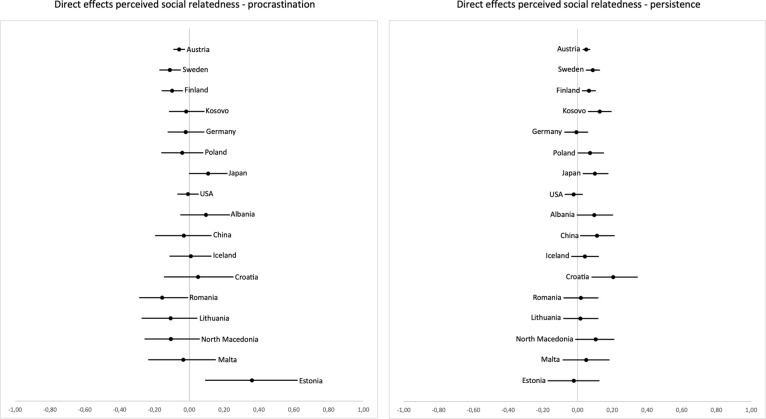
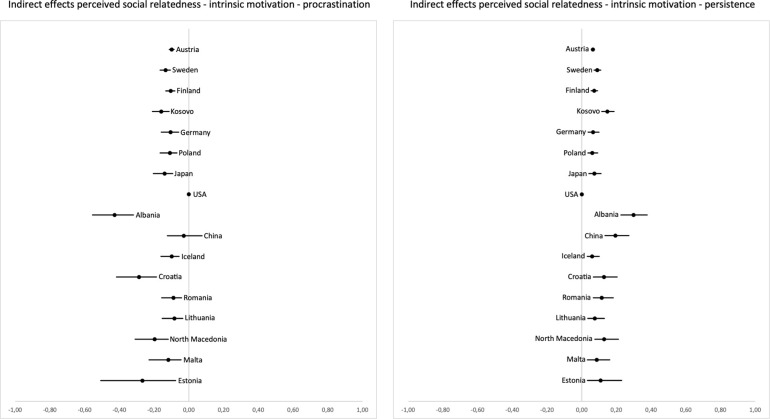
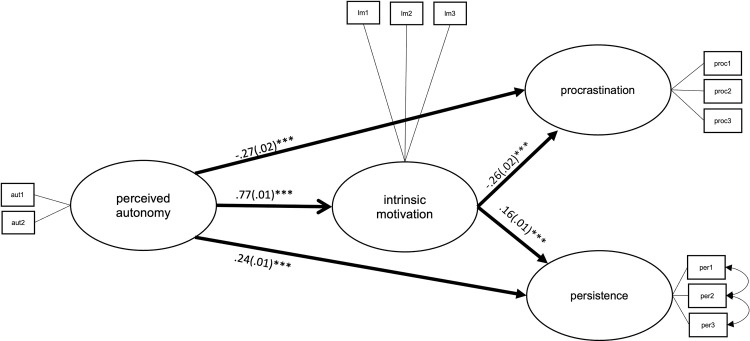
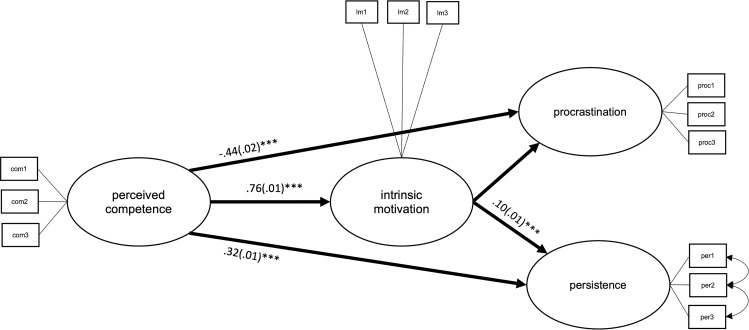
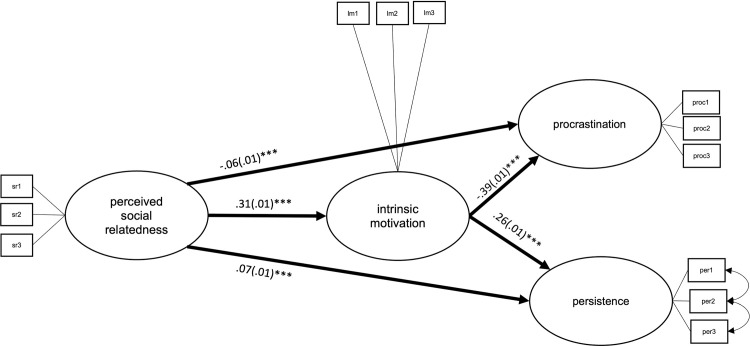
Due to the COVID-19 pandemic, higher educational institutions worldwide switched to emergency distance learning in early 2020. The less structured environment of distance learning forced students to regulate their learning and motivation more independently. According to self-determination theory (SDT), satisfaction of the three basic psychological needs for autonomy, competence and social relatedness affects intrinsic motivation, which in turn relates to more active or passive learning behavior. As the social context plays a major role for basic need satisfaction, distance learning may impair basic need satisfaction and thus intrinsic motivation and learning behavior. The aim of this study was to investigate the relationship between basic need satisfaction and procrastination and persistence in the context of emergency distance learning during the COVID-19 pandemic in a cross-sectional study. We also investigated the mediating role of intrinsic motivation in this relationship. Furthermore, to test the universal importance of SDT for intrinsic motivation and learning behavior under these circumstances in different countries, we collected data in Europe, Asia and North America. A total of N = 15,462 participants from Albania, Austria, China, Croatia, Estonia, Finland, Germany, Iceland, Japan, Kosovo, Lithuania, Poland, Malta, North Macedonia, Romania, Sweden, and the US answered questions regarding perceived competence, autonomy, social relatedness, intrinsic motivation, procrastination, persistence, and sociodemographic background. Our results support SDT’s claim of universality regarding the relation between basic psychological need fulfilment, intrinsic motivation, procrastination, and persistence. However, whereas perceived competence had the highest direct effect on procrastination and persistence, social relatedness was mainly influential via intrinsic motivation.
Overview
The claims and statistics of this paper haven’t been checked yet.
Run the check — free, no account needed. It reads the open-access text and checks the sources it cites.
Integrity signals
Registry
Cites
Statistics
Figures
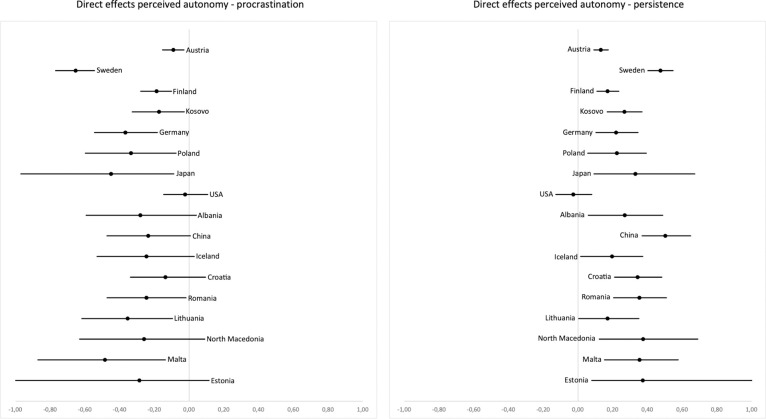
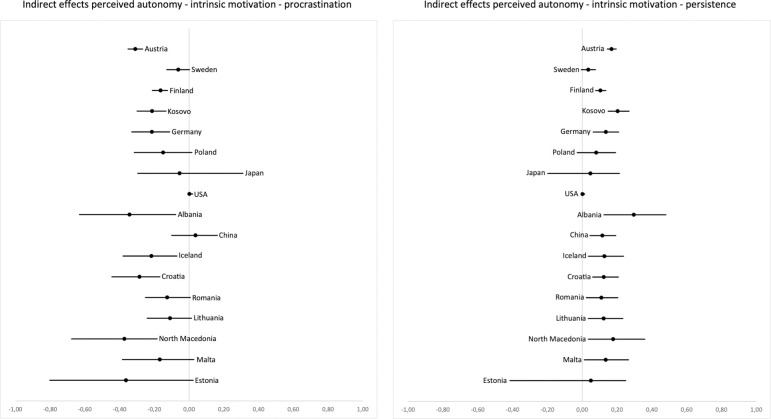
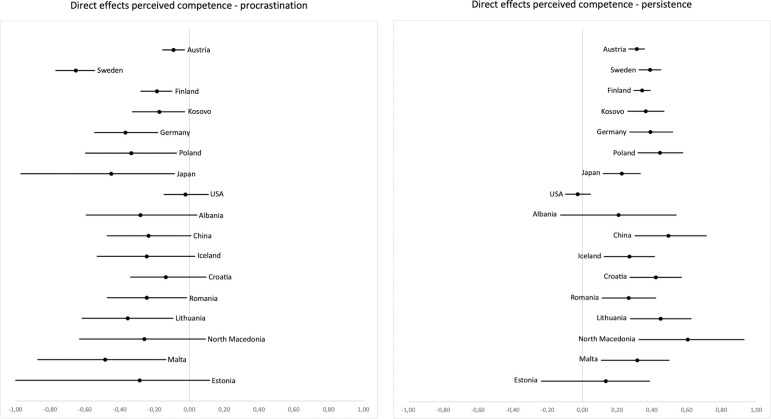
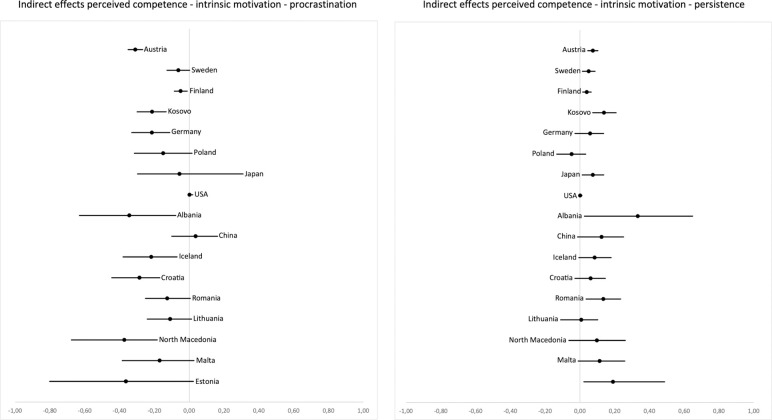
Verification
Claims the paper makes
The claims and statistics of this paper haven’t been checked yet.
Run the check — free, no account needed. It reads the open-access text and checks the sources it cites.
Claims other papers make about this one
Each is checked against this paper’s own text: does it say what the citing paper says it does?
The cited source says what the claim attributes to it.
In the citing paper
“show that the research in this cluster is mainly related to understanding and intrinsicmotivation [18].”
From Mapping the Research Landscape: A Comprehensive Bibliometric Analysis of Self-Determination Theory in Higher Education (2024) · cites this paper as [18]
Self-check
Percentages, sums and reported differences re-computed from the paper’s own numbers.
The self-check needs the paper’s full text.
Citations
Cites
Hu, L., & Bentler, P. M. (1999) · Structural Equation Modeling A Multidisciplinary Journal · doi:10.1080/10705519909540118 · Cited by 108,788
Ryan, R. M., & Deci, E. L. (2000) · American Psychologist · doi:10.1037//0003-066x.55.1.68 · Cited by 54,599
(2013) · Cited by 44,563
The "what" and "why" of goal pursuits: Human needs and the self-determination of behavior
Deci, E. L., & Ryan, R. M. (2000) · Psychological Inquiry · doi:10.1207/s15327965pli1104_01 · Cited by 34,210
Self-determination theory: A macrotheory of human motivation, development, and health
Deci, E. L., & Ryan, R. M. (2008) · Canadian Psychology / Psychologie canadienne · doi:10.1037/a0012801 · Cited by 6,664
The Difference between Emergency Remote Teaching and Online Learning
Hodges, C. B., Moore, S., Lockee, B. B., Trust, T., & Bond, M. A. (2024) · Handbook of Research in Online Learning · doi:10.1163/9789004702813_021 · Cited by 6,253
Motivation in Education: Theory, Research, and Applications
Pintrich, P. R., & Schunk, D. H. (1995) · Cited by 5,724
Moral Identity and Developmental Theory
Lapsley, D. K. (2015) · Human Development · doi:10.1159/000435926 · Cited by 3,843
Daily Well-Being: The Role of Autonomy, Competence, and Relatedness
Reis, H. T., Sheldon, K. M., Gable, S. L., Roscoe, J., & Ryan, R. M. (2000) · Personality and Social Psychology Bulletin · doi:10.1177/0146167200266002 · Cited by 2,067
A checklist for testing measurement invariance
van de Schoot, R., Lugtig, P., & Hox, J. (2012) · European Journal of Developmental Psychology · doi:10.1080/17405629.2012.686740 · Cited by 2,064
Research works printed but not linked: 2
- ER Pelikan, 2021, Distance Learning in Higher Education During COVID-19: Basic Psychological Needs and Intrinsic Motivation
- A Glöckner-Rist, 2014, In: Zusammenstellung sozialwissenschaftlicher Items und Skalen [Summary of items and scales in social science] ZIS Version 1300
Cited by
Sorted by citations
Mendoza, N. B., Yan, Z., & King, R. B. (2022) · Computers & Education · doi:10.1016/j.compedu.2022.104663 · Cited by 122
Akram, H., & Li, S. (2024) · Perceptual and Motor Skills · doi:10.1177/00315125241248709 · Cited by 142
Fong, C. J. (2022) · Educational Psychology · doi:10.1080/01443410.2022.2026891 · Cited by 76
Ng, L.-K., & Lo, C. K. (2022) · Sustainability · doi:10.3390/su14095428 · Cited by 102
Martin, A. J., Ginns, P., & Collie, R. J. (2022) · Learning and Instruction · doi:10.1016/j.learninstruc.2022.101712 · Cited by 63
Metadata
- Authors
- Pelikan, E. R., Korlat, S., Reiter, J., Holzer, J., Mayerhofer, M., Schober, B., Spiel, C., Hamzallari, O., Uka, A., Chen, J., Välimäki, M., Puharić, Z., Anusionwu, K. E., Okocha, A. N., Zabrodskaja, A., Salmela-Aro, K., Käser, U., Schultze-Krumbholz, A., Wachs, S., Friðriksson, F., Gunnþórsdóttir, H., Höller, Y., Aoyama, I., Ieshima, A., Toda, Y., Konjufca, J., Llullaku, N., Gedutienė, R., Borg Axisa, G., Avirovic Bundalevska, I., Keskinova, A., Radulovic, M., Lewandowska-Walter, A., Michałek-Kwiecień, J., Plichta, P., Pyżalski, J., Walter, N., Cautisanu, C., Voda, A. I., Gao, S., Islam, S., Wistrand, K., Wright, M. F., & Lüftenegger, M.
- Affiliations
- University of Vienna (AT)
- Aleksandër Moisiu University (AL)
- Bedër University (AL)
- Central South University (CN)
- Veleučilište u Bjelovaru (HR)
- Tallinn University (EE)
- University of Bonn (DE)
- University of Potsdam (DE)
- University of Akureyri (IS)
- Tsuru University (JP)
- The University of Osaka (JP)
- Osaka Kyoiku University (JP)
- University of Prishtina (XK)
- Klaipėda University (LT)
- Ss. Cyril and Methodius University in Skopje (MK)
- University of Gdańsk (PL)
- University of Wrocław (PL)
- Adam Mickiewicz University in Poznań (PL)
- Örebro University (SE)
- Pennsylvania State University (US)
- Corresponding author
- Pelikan, Elisabeth R.
- ORCID
- Pelikan, Elisabeth R.
- Korlat, Selma
- Reiter, Julia
- Holzer, Julia
- Mayerhofer, Martin
- Schober, Barbara
- Spiel, Christiane
- Hamzallari, Oriola
- Uka, Ana
- Chen, Jiarui
- Puharić, Zrinka
- Anusionwu, Kelechi Evans
- Okocha, Angela Nkem
- Zabrodskaja, Anastassia
- Wachs, Sebastian
- Friðriksson, Finnur
- Gunnþórsdóttir, Hermína
- Höller, Yvonne
- Aoyama, Ikuko
- Ieshima, Akihiko
- Toda, Yuichi
- Konjufca, Jon
- Llullaku, Njomza
- Avirovic Bundalevska, Irena
- Keskinova, Angelka
- Radulovic, Makedonka
- Lewandowska-Walter, Aleksandra
- Michałek-Kwiecień, Justyna
- Plichta, Piotr
- Pyżalski, Jacek
- Walter, Natalia
- Cautisanu, Cristina
- Gao, Shang
- Islam, Sirajul
- Wistrand, Kai
- Wright, Michelle F.
- Lüftenegger, Marko
- Venue
- PLOS ONE
- Publisher
- Public Library of Science (PLoS)
- Published
- 2021-10-06
- Volume
- 16
- Issue
- 10
- Pages
- e0257346
- ISSN
- 1932-6203 (ISSN-L)
- PMC
- PMC8494346
- OpenAlex
- W3202963999
- Cited by
- 141
- References
- 54
- Citations by year
- 2026: 16 · 2025: 22 · 2024: 24 · 2023: 44 · 2022: 34 · 2021: 1
- FWCI
- 25.23
- Type
- journal article
- Language
- en
- Open access
- gold
- doi.org
- Licence
- Locations
- PLoS ONE (publishedVersion, cc-by)
- Europe PMC (PubMed Central) (publishedVersion, other-oa)
- PubMed Central (publishedVersion, cc-by)
- PubMed (publishedVersion)
- UTUPub (University of Turku) (submittedVersion, other-oa)
- UTUPub (University of Turku) (submittedVersion, cc-by)
- DOAJ (DOAJ: Directory of Open Access Journals) (submittedVersion, cc-by-sa)
- Työväentutkimus Vuosikirja (submittedVersion)
- publish.UP (University of Potsdam) (submittedVersion, cc-by)
- Funders
- academy of finland (308351, 336138, 345117)
- Vienna Science and Technology Fund (COV20-025)
- MEGA Bildungsstiftung (COV20-025)
- Topics
- Social Sciences › Psychology › Social Psychology › Motivation and Self-Concept in Sports
- Social Sciences › Psychology › Clinical Psychology › Perfectionism, Procrastination, Anxiety Studies
- Social Sciences › Education › Education during COVID-19 pandemic
- Keywords
- distance education, COVID-19 pandemic, self-determination theory, basic psychological needs, intrinsic motivation, procrastination, persistence, perceived competence, autonomy, social relatedness, learning behavior, cross-cultural universality
- MeSH terms
- Procrastination, COVID-19, SARS-CoV-2, Adult, Cross-Sectional Studies, Europe, Female, Humans, Male, Motivation, Surveys and Questionnaires, Students, Universities, Education, Distance, Personal Autonomy, Young Adult, Pandemics
About these checks
Registry, retraction, Cites and statistics results are computed, not judged, with one exception: a printed reference that no index lists is read once by a model before it counts as a citation error. Claims are extracted by a model and kept only when their quote appears verbatim in the text; each cited source is then checked, with a model’s help, for whether it says what the claim relies on. Those verdicts can be wrong — read the claim’s quote and the cited source before relying on one.
Statistics and arithmetic are recomputed, not judged.
Confidence bands are shown only for fields calibrated on our annotated test set. None is calibrated yet, so no band is shown.
What counts as a claim ›How we measure confidence ›How we check this ›
Are you an author, or do you see a problem with this page? Request a review
