

Warning: Humans cannot reliably detect speech deepfakes
Open accessThe DOI matches its Crossref record; 39 of the 42 references it cites were found in a registry or an index, and 3 are not checked yet; 27 of the 43 sources its claims cite were checked for support.
Abstract
Speech deepfakes are artificial voices generated by machine learning models. Previous literature has highlighted deepfakes as one of the biggest security threats arising from progress in artificial intelligence due to their potential for misuse. However, studies investigating human detection capabilities are limited. We presented genuine and deepfake audio to n = 529 individuals and asked them to identify the deepfakes. We ran our experiments in English and Mandarin to understand if language affects detection performance and decision-making rationale. We found that detection capability is unreliable. Listeners only correctly spotted the deepfakes 73% of the time, and there was no difference in detectability between the two languages. Increasing listener awareness by providing examples of speech deepfakes only improves results slightly. As speech synthesis algorithms improve and become more realistic, we can expect the detection task to become harder. The difficulty of detecting speech deepfakes confirms their potential for misuse and signals that defenses against this threat are needed.
Verified 2026-11-20 · 3 references not checked yet
Overview
CoChat Summary
## TL;DR
This study tested 529 people on whether they could distinguish genuine from synthetic speech in English and Mandarin. Human detection was unreliable: participants identified deepfakes correctly 73% of the time in the unary setting, with no significant language difference and only a small boost from familiarization.
## Key findings
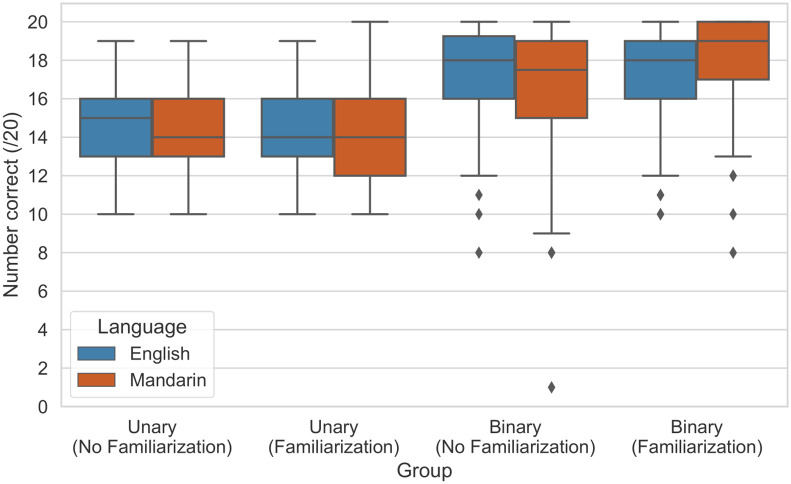
- In the unary task, participants classified clips correctly 70.35% of the time overall; they spotted deepfakes correctly 73% of the time and bona fide clips correctly 67.78% of the time.
- In the binary task, performance improved: participants correctly recognized deepfake audio in 85.59% of trials, and this improvement from contextual reference audio was statistically significant (p < 0.001).
- Familiarization with five deepfake examples improved detection accuracy by 3.84% on average (p = 0.001); in the unary and binary regressions the gains were 3.76% (p = 0.017) and 3.85% (p = 0.032), respectively.
- Detection did not significantly differ by language: Mandarin-speaking participants outperformed English-speaking participants by 1.79%, but this was not statistically significant (p = 0.202).
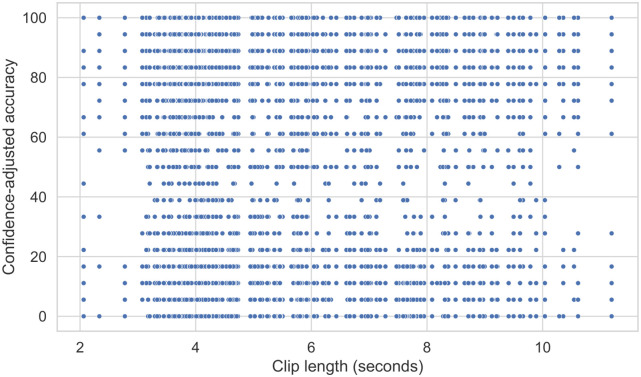
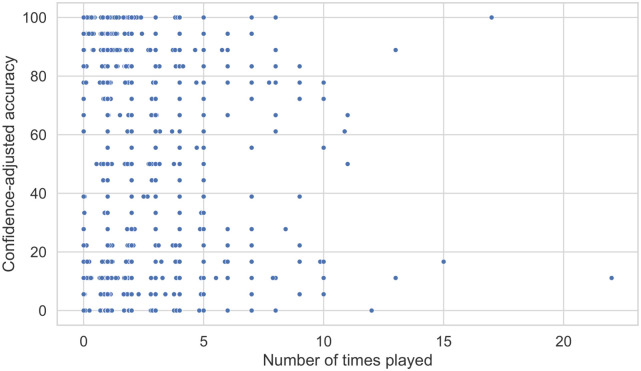
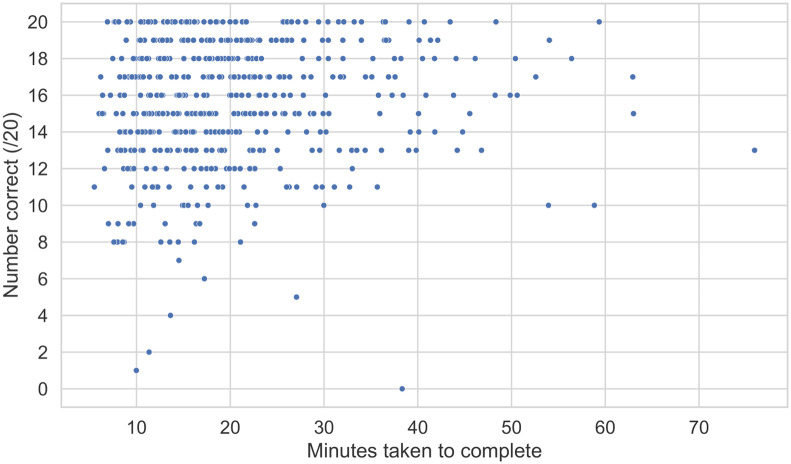
- Human performance was stable over time and not helped by repeated listening: clip replays had no relationship with accuracy (ρ = −0.05, p < 0.001), and total task time also showed no meaningful improvement (ρ = 0.10, p = 0.018).
## Methods
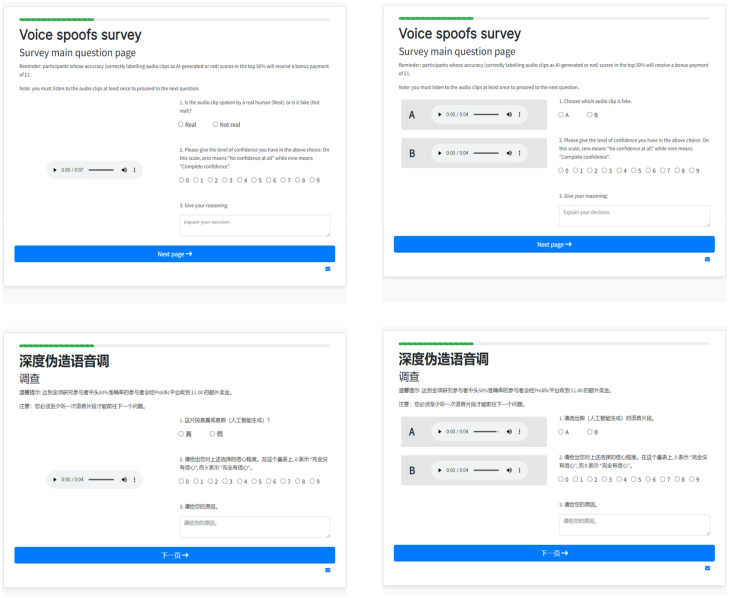
- Online experiment with 529 Prolific participants fluent in English or Mandarin; mean age was 28.9 years and 50.6% identified as male.
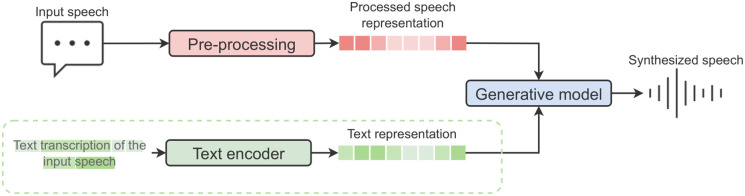
- Stimuli were 100 clips total: bona fide speech from LJSpeech (English) and CSMSC (Mandarin), plus deepfakes generated from the same sentences using pre-trained VITS text-to-speech models; clip lengths ranged from 2 to 11 seconds.
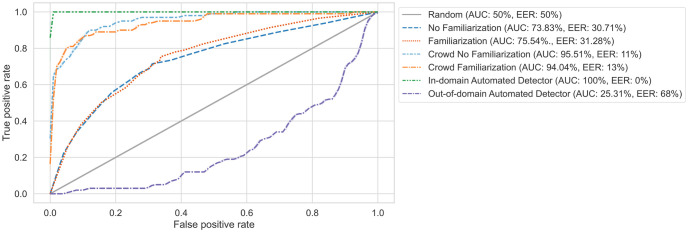
- Participants were randomly assigned to unary vs binary judging, and to familiarization vs control; the main analysis used linear regression on confidence-weighted accuracy scores, with additional comparisons to automated LFCC-LCNN detectors and AUROC/EER metrics.
## Limitations
- The paper states that the setup “does not necessarily reflect more realistic scenarios” because the deepfake proportion was balanced 50/50, whereas AI-generated content is still rare, and participants were warned about deepfakes in advance.
- The stimuli minimized contextual information, so the study does not test cases where speaker identity, emotional status, conversational context, or political affiliation might help detection.
- The deepfakes were generated with an older approach and “may not faithfully reflect performance under the most current conditions” — stated in the paper.
Model-written summary. Check it against the paper before relying on it.
Integrity signals
Registry
Cites
Statistics
Figures
Verification
Claims the paper makes
22 Valid · 0 Not valid · 13 Not checked · 63 Own results and interpretations
The sources with a verdict support this claim; the rest weren’t checked yet, have no full text we could read, or their verdicts aren’t rated yet.
In the paper
“Existing speech deepfake detection research focuses on developing machine learning systems in the context of voice authentication [7–9].”
§ Warning: Humans cannot reliably detect speech deepfakes > Introduction
What the sources say
- Not checked — no full text of the sourcecites [7] Wu Z, Yamagishi J, Kinnunen T, Hanilçi C, Sahidullah M, Sizov A, et al. ASVspoof: The Automatic Speaker Verification Spoofing and Countermeasures Challenge. IEEE Journal of Selected Topics in Signal Processing. 2017; 11(4): 588– 604. doi: 10.1109/JSTSP.2017.2671435 source
- Supportedcites [8] Nautsch A, Wang X, Evans NWD, Kinnunen TH, Vestman V, Todisco M, et al. ASVspoof 2019: Spoofing Countermeasures for the Detection of Synthesized, Converted and Replayed Speech. IEEE Transactions on Biometrics, Behavior, and Identity Science. 2021; 3(2): 252– 265. doi: 10.1109/TBIOM.2021.3059479 source
The Introduction (p. 1) describes research on automatic spoofing-detection systems intended to protect automatic speaker verification, a voice-authentication technology. The Conclusions (p. 11) report a shift toward deep architectures and ensemble systems, supporting the claim's characterization of this research as developing machine-learning systems. (LLM, conf=0.88)
- Supportedcites [9] Yamagishi J, Wang X, Todisco M, Sahidullah M, Patino J, Nautsch A, et al. ASVspoof 2021: accelerating progress in spoofed and deepfake speech detection. arXiv preprint arXiv:210900537. 2021 Sep 1 [Cited 2023 Jan 19]. source
The Abstract (p. 1) describes a challenge devoted to developing countermeasures that protect automatic speaker verification systems and includes a speech-deepfake detection task. The Introduction (p. 1) likewise places detection-system development in the speaker-verification context, while the CM baselines section (p. 4) describes trained detection models. (LLM, conf=0.86)
plain- Asserted: passes — The authors put it forward as true.
- Checkable: passes — It can be checked against evidence.
- Load-bearing: passes — The paper’s conclusions depend on it.
- Based: passes — The paper gives a reason why it holds.
The cited sources support only part of this claim — read each source’s verdict below.
In the paper
“Multiple studies deem other uses of speech deepfakes as more concerning, such as misleading people through voice impersonations [5, 6].”
§ Warning: Humans cannot reliably detect speech deepfakes > Introduction
What the sources say
- Supportedcites [5] Caldwell M, Andrews J, Tanay T, Griffin L. AI-enabled future crime. Crime Science. 2020; 9(1): 1– 13. doi: 10.1186/s40163-020-00123-8 source
The Introduction describes deceptive deepfake impersonations, including phone calls used to gain access to secure systems, and reports that audio/video impersonation ranked as the most concerning crime considered. The paper rates audio and video impersonation together rather than speech alone, but it supports the cited example of concerning voice impersonation. (LLM, conf=0.87)
- Partly supportedcites [6] Mirsky Y, Demontis A, Kotak J, Shankar R, Gelei D, Yang L, et al. The threat of offensive ai to organizations. Computers & Security. 2022; p. 103006. sourceExperimental — accuracy not yet measured
The ‘Impersonation (Identity Theft)’ section describes deepfakes that reenact a victim’s voice for scams and phishing. ‘From the Literature Survey’ ranks AI-enabled impersonation among the highest threats, but compares it with other AI threats, not specifically with other uses of speech deepfakes. The paper therefore supports the concern about misleading voice impersonation, but not the claim’s narrower comparison. (LLM, conf=0.82)
plain- Asserted: passes — The authors put it forward as true.
- Checkable: passes — It can be checked against evidence.
- Load-bearing: passes — The paper’s conclusions depend on it.
- Based: passes — The paper gives a reason why it holds.
- Supported
Every source the paper cites for this claim was checked and supports it.
In the paper
“crowd performance is on par with the in-domain detector.”
§ Warning: Humans cannot reliably detect speech deepfakes > Results > Comparing human performance to automated detectors
What the sources say
- Supportedcites [24] Groh M, Epstein Z, Firestone C, Picard R. Deepfake detection by human crowds, machines, and machine-informed crowds. Proceedings of the National Academy of Sciences. 2021; 119(1): e2110013119. doi: 10.1073/pnas.2110013119 PMC8740705 34969837 source
The Results (Experiment 2, page not provided) explicitly say the crowd mean was on par with the leading model on sampled holdout videos. The claim is supported for that comparison; the passage does not present it as a result across all videos. (LLM, conf=0.94)
plain- Asserted: passes — The authors put it forward as true.
- Checkable: passes — It can be checked against evidence.
- Load-bearing: passes — The paper’s conclusions depend on it.
- Based: passes — The paper gives a reason why it holds.
- Supported
Every source the paper cites for this claim was checked and supports it.
In the paper
“The ASVspoof 2021 challenge used LFCC-LCNNs as baseline models for spoof detection [9].”
§ Warning: Humans cannot reliably detect speech deepfakes > Materials and methods > Benchmarking against automated deepfake detectors
What the sources say
- Supportedcites [9] Yamagishi J, Wang X, Todisco M, Sahidullah M, Patino J, Nautsch A, et al. ASVspoof 2021: accelerating progress in spoofed and deepfake speech detection. arXiv preprint arXiv:210900537. 2021 Sep 1 [Cited 2023 Jan 19]. source
Section 4.2 (p. 4) identifies an LFCC-LCNN system as baseline B3 among the four countermeasure baselines used for ASVspoof 2021. (LLM, conf=0.95)
plain- Asserted: passes — The authors put it forward as true.
- Checkable: passes — It can be checked against evidence.
- Load-bearing: unclear — It is unclear whether the paper’s conclusions depend on it.
- Based: passes — The paper gives a reason why it holds.
- Supported
The cited sources support only part of this claim — read each source’s verdict below.
In the paper
“There is no improvement when evaluating videos either [24–26].”
§ Warning: Humans cannot reliably detect speech deepfakes > Background > Related work on human deepfake detection capabilities
What the sources say
- Partly supportedcites [24] Groh M, Epstein Z, Firestone C, Picard R. Deepfake detection by human crowds, machines, and machine-informed crowds. Proceedings of the National Academy of Sciences. 2021; 119(1): e2110013119. doi: 10.1073/pnas.2110013119 PMC8740705 34969837 sourceExperimental — accuracy not yet measured
The Results for Experiment 1 report no evidence that participants improved at detecting deepfakes over the first 10 videos they saw (P = 0.112), and the Discussion repeats that conclusion. The claim turns that limited, evidence-based finding into an unqualified statement that there is no improvement when evaluating videos. (LLM, conf=0.85)
- Partly supportedcites [25] Köbis NC, Doležalová B, Soraperra I. Fooled twice: People cannot detect deepfakes but think they can. iScience. 2021; 24(11): 103364. doi: 10.1016/j.isci.2021.103364 34820608 PMC8602050 sourceExperimental — accuracy not yet measured
The Results section, “Interventions to increase accuracy” (page unavailable), reports that raising awareness and offering financial incentives did not significantly improve participants’ accuracy when classifying deepfake videos. That supports a limited no-improvement finding, but not the broader claim that evaluating videos yields no improvement under other conditions or over time. (LLM, conf=0.84)
- Not checked — no full text of the sourcecites [26] Tahir R, Batool B, Jamshed H, Jameel M, Anwar M, Ahmed F, et al. Seeing is believing: Exploring perceptual differences in deepfake videos. In: Proceedings of the 2021 CHI Conference on Human Factors in Computing Systems; 2021. p. 1–16. source
plain- Asserted: passes — The authors put it forward as true.
- Checkable: passes — It can be checked against evidence.
- Load-bearing: unclear — It is unclear whether the paper’s conclusions depend on it.
- Based: passes — The paper gives a reason why it holds.
- Partly supported
39 more claims · 2 with their cited sources checked
Create a free account to see all 98 claims and every source verdict.
- Probably not a substantial claim. 41
- It may state two separate claims as one. 18
- The quote only partly states this claim. 3
Claims other papers make about this one
Each is checked against this paper’s own text: does it say what the citing paper says it does?
The cited source says what the claim attributes to it.
In the citing paper
“A study [26] found that humans could correctly identify deepfake audio with an accuracy of only 73%.”
From Audio Deepfake Detection: What Has Been Achieved and What Lies Ahead (2025) · cites this paper as [26]
Experimental — accuracy not yet measured
Citations
Cites
SciPy 1.0: fundamental algorithms for scientific computing in Python
Virtanen, P., Gommers, R., Oliphant, T. E., Haberland, M., Reddy, T., Cournapeau, D., Burovski, E., Peterson, P., Weckesser, W., Bright, J., et al. (2020) · Nature Methods · doi:10.1038/s41592-019-0686-2 · Cited by 38,430 · cited 1×
“We completed the analysis using the SciPy [45] and statsmodels [46] Python packages.”
MethodSciPy 1.0: fundamental algorithms for scientific computing in Python
Virtanen, P., Gommers, R., Oliphant, T. E., Haberland, M., Reddy, T., Cournapeau, D., Burovski, E., Peterson, P., Weckesser, W., Bright, J., et al. (2019) · Apollo - University of Cambridge Repository · doi:10.17863/cam.64134 · Cited by 10,460
Statsmodels: Econometric and Statistical Modeling with Python
Seabold, S., & Perktold, J. (2010) · Proceedings of the Python in Science Conference · doi:10.25080/majora-92bf1922-011 · Cited by 6,465 · cited 1×
“We completed the analysis using the SciPy [45] and statsmodels [46] Python packages.”
MethodAnalyzing and Improving the Image Quality of StyleGAN
Karras, T., Laine, S., Aittala, M., Hellsten, J., Lehtinen, J., & Aila, T. (2020) · 2020 IEEE/CVF Conference on Computer Vision and Pattern Recognition (CVPR) · doi:10.1109/cvpr42600.2020.00813 · Cited by 6,332 · cited 2×
“Modality Year Author Deepfake stimuli Image 2021 Nightingale & Farid [23] Faces generated using StyleGAN2 [31] 2022 Bray et al.”
MethodAnalyzing and Improving the Image Quality of StyleGAN
Karras, T., Laine, S., Aittala, M., Hellsten, J., Lehtinen, J., & Aila, T. (2019) · arXiv · doi:10.48550/arxiv.1912.04958 · Cited by 6,332
FaceForensics++: Learning to Detect Manipulated Facial Images
Rossler, A., Cozzolino, D., Verdoliva, L., Riess, C., Thies, J., & Niessner, M. (2019) · 2019 IEEE/CVF International Conference on Computer Vision (ICCV) · doi:10.1109/iccv.2019.00009 · Cited by 3,314
Proceedings of The 32nd International Conference on Machine Learning
Germain, M., Gregor, K., Murray, I., & Larochelle, H. (2015) · Cited by 2,020
Celeb-DF: A Large-Scale Challenging Dataset for DeepFake Forensics
Li, Y., Yang, X., Sun, P., Qi, H., & Lyu, S. (2020) · 2020 IEEE/CVF Conference on Computer Vision and Pattern Recognition (CVPR) · doi:10.1109/cvpr42600.2020.00327 · Cited by 1,846 · cited 2×
“[26] Face-swap videos from Celeb-DF [33], FaceForensics++ [34] and DeepFaceLab [35] 2022 Appel & Prietzel [21] Face-swap videos of politicians”
Method(2018) · doi:10.21437/interspeech.2018-1456 · Cited by 1,366
Leskovec, J., Rajaraman, A., & Ullman, J. D. (2014) · Cambridge University Press eBooks · doi:10.1017/cbo9781139924801 · Cited by 1,069
Research works printed but not linked: 10
- Goodfellow I, Bengio Y, Courville A. Deep Learning. MIT Press; 2016.
- Schick N. Deep Fakes and the Infocalypse: What You Urgently Need To Know. Hachette; 2020.
- Goodfellow I, Pouget-Abadie J, Mirza M, Xu B, Warde-Farley D, Ozair S, et al. Generative Adversarial Nets. In: Advances in Neural Information Processing Systems; 2014. Available from: https://proceedings.neurips.cc/paper_files/paper/2014/file/5ca3e9b122f61f8f06494c97b1afccf3-Paper.pdf
- Geirhos T, Zimmerman RS, Bilodeau BL, Brendal W, Kim, B. Don’t trust your eyes: on the (un)reliability of feature visualizations. arXiv preprint arXiv: 230604719. 2023 Jun 13 [Cited 2023 Jun 13].
- Watson G, Khanjani Z, Janeja VP. Audio Deepfake Perceptions in College Going Populations. arXiv preprint arXiv:211203351. 2021 Dec 6 [Cited 2023 Jan 19].
- Dolhansky B, Bitton J, Pflaum B, Lu J, Howes R, Wang M, et al. The Deepfake Detection Challenge Dataset. arXiv preprint arXiv:200607397. [Cited 2023 Mar 27]. Dataset.
- Kumar K, Kumar R, De Boissiere T, Gestin L, Teoh WZ, Sotelo J, et al. MelGAN: Generative adversarial networks for conditional waveform synthesis. In: Proceedings of Advances in Neural Information Processing Systems; 2019; 32.
- Kim J, Kong J, Son J. Conditional variational autoencoder with adversarial learning for end-to-end text-to-speech. In: International Conference on Machine Learning. PMLR; 2021. p. 5530–5540. Available from: https://proceedings.mlr.press/v139/kim21f.html.
- Ma H, Yi J, Wang C, Yan X, Tao J, Wang T, et al. FAD: A Chinese Dataset for Fake Audio Detection. arXiv preprint arXiv:220712308. 2022 Jul 12. [Cited 2023 Jan 19].
- Chesney R, Citron D. Deepfakes and the new disinformation war: The coming age of post-truth geopolitics. Foreign Affairs. 2019 Jan/Feb;98:147.
Cited by
Creative partnerships with generative AI. Possibilities for education and beyond
Creely, E., & Blannin, J. (2025) · Thinking Skills and Creativity · doi:10.1016/j.tsc.2024.101727 · Cited by 91
Human performance in detecting deepfakes: A systematic review and meta-analysis of 56 papers
Diel, A., Lalgi, T., Schröter, I. C., MacDorman, K. F., Teufel, M., & Bäuerle, A. (2024) · Computers in Human Behavior Reports · doi:10.1016/j.chbr.2024.100538 · Cited by 64
“…voice banking; Judge & Hayton, 2022), AI-generated voices can be misused to impersonate, commit fraud or scientific misconduct, or spread misinformation (Farid, 2022; Khanjani et al., 2023; Mai, Bray, Davies, & Griffin, 2023; Strupp, 2019; Suwajanakorn, Seitz, & Kemelmacher-Shlizerman, 2017).”
Audio Deepfake Detection: What Has Been Achieved and What Lies Ahead
Zhang, B., Cui, H., Nguyen, V., & Whitty, M. (2025) · Sensors · doi:10.3390/s25071989 · Cited by 72
“A study [26] found that humans could correctly identify deepfake audio with an accuracy of only 73%.”
People are poorly equipped to detect AI-powered voice clones
Barrington, S., Cooper, E. A., & Farid, H. (2025) · Scientific Reports · doi:10.1038/s41598-025-94170-3 · Cited by 131
“This study reveals that, generally speaking, people are poorly equipped to identify AI-generated voice clones, both in terms of identity matching and naturalness.”
Labeling AI-Generated Content: Promises, Perils, and Future Directions
Wittenberg, C., Epstein, Z., Berinsky, A. J., & Rand, D. G. (2024) · An MIT Exploration of Generative AI · doi:10.21428/e4baedd9.0319e3a6 · Cited by 74
Assessing the Current Limitations of Large Language Models in Advancing Health Care Education
Kim, J., & Vajravelu, B. N. (2025) · JMIR Formative Research · doi:10.2196/51319 · Cited by 46
Perception and deception: Exploring individual responses to deepfakes across different modalities
Ahmed, S., & Chua, H. W. (2023) · Heliyon · doi:10.1016/j.heliyon.2023.e20383 · Cited by 29
“Recent research also confirms that individuals not only fall for video deepfakes [12,14,36] but also cannot reliably recognize audio deepfakes [54].”
BackgroundLabeling AI-generated media online
Wittenberg, C., Epstein, Z., Péloquin-Skulski, G., Berinsky, A. J., & Rand, D. G. (2025) · PNAS Nexus · doi:10.1093/pnasnexus/pgaf170 · Cited by 45
“…with the concept of AI (3, 24), many people report limited exposure to and direct experience with generative AI technologies (25, 26) and often struggle to discern whether images, audio, and video have been created using AI (e.g. (27 – 30); for studies of AI-generated text, see also (31, 32)).”
As Good as a Coin Toss: Human Detection of AI-Generated Content
Cooke, D., Edwards, A., Barkoff, S., & Kelly, K. (2025) · Communications of the ACM · doi:10.1145/3729417 · Cited by 106
Kulangareth, N. V., Kaufman, J. M., Oreskovic, J., & Fossat, Y. (2024) · JMIR Biomedical Engineering · doi:10.2196/56245 · Cited by 43
“Indeed, when humans were asked to distinguish between audio deepfakes and authentic voices, one of the primary justifications for a fake audio classification was unnatural pauses in the recordings [10].”
BackgroundInfluentialMultimodal analysis of disinformation and misinformation
Wilson, A., Wilkes, S., Teramoto, Y., & Hale, S. A. (2023) · Royal Society Open Science · doi:10.1098/rsos.230964 · Cited by 41
Confidence as a metacognitive contributor to and consequence of misinformation experiences
Rapp, D. N., & Withall, M. M. (2024) · Current Opinion in Psychology · doi:10.1016/j.copsyc.2023.101735 · Cited by 17
Cortical-striatal brain network distinguishes deepfake from real speaker identity
Roswandowitz, C., Kathiresan, T., Pellegrino, E., Dellwo, V., & Frühholz, S. (2024) · Communications Biology · doi:10.1038/s42003-024-06372-6 · Cited by 21
Explore the World of Audio Deepfakes: A Guide to Detection Techniques for Non-Experts
Schäfer, K., Choi, J., & Zmudzinski, S. (2024) · ACM International Workshop on Multimedia AI against Disinformation (MAD) · doi:10.1145/3643491.3660289 · Cited by 24
“As it is increasingly challenging for humans to distinguish be-tween fake and genuine speeches [29, 32], interdisciplinary discussions and studies are necessary to address and mitigate the potential negative consequences of synthesized speeches.”
Background"Better Be Computer or I'm Dumb": A Large-Scale Evaluation of Humans as Audio Deepfake Detectors
Warren, K., Tucker, T., Crowder, A., Olszewski, D., Lu, A., Fedele, C., Pasternak, M., Layton, S., Butler, K., Gates, C., et al. (2024) · Proceedings of the 2024 on ACM SIGSAC Conference on Computer and Communications Security · doi:10.1145/3658644.3670325 · Cited by 15
Identifying and preventing future forms of crimes using situational crime prevention
Johnson, S. D. (2024) · Security Journal · doi:10.1057/s41284-024-00441-5 · Cited by 27
“In a similar study, Mai et al. (2023) found that participants were also poor at discriminating between speech generated by a GAN and that generated by real people.”
Voice clones sound realistic but not (yet) hyperrealistic
Lavan, N., Irvine, M., Rosi, V., & McGettigan, C. (2025) · PLoS ONE · doi:10.1371/journal.pone.0332692 · Cited by 37
Deepfake Detection in Video and Audio Clips: A Comprehensive Survey and Analysis
Jbara, W. A., Hussein, N. A.-H. K., & Soud, J. H. (2024) · Mesopotamian Journal of CyberSecurity · doi:10.58496/mjcs/2024/025 · Cited by 21
Comprehensive multiparametric analysis of human deepfake speech recognition
Malinka, K., Firc, A., Šalko, M., Prudký, D., Radačovská, K., & Hanáček, P. (2024) · EURASIP Journal on Image and Video Processing · doi:10.1186/s13640-024-00641-4 · Cited by 20
“Using unary and binary selection methods, Mai et al. [14] explored speech deepfake detection among 529 participants across English and Mandarin.”
BackgroundMethodInvestigating voiced and unvoiced regions of speech for audio deepfake detection
Sivaraman, G., Tak, H., & Khoury, E. (2025) · IEEE International Conference on Acoustics Speech and Signal Processing · doi:10.1109/icassp49660.2025.10890861 · Cited by 17
“The advent of generative AI technologies has revolutionized the speech synthesis, making it possible to generate realistic speech contents that are indistinguishable from human speech [1].”
A Comparative Study of Deep Audio Models for Spectrogram- and Waveform-Based SingFake Detection
Nguyen-Duc, M., Nguyen, L. V., Nguyen-Ho-Nhat, H., Nguyen, T., & Lee, O. (2025) · IEEE Access · doi:10.1109/access.2025.3571728 · Cited by 13
Unmasking Illusions: Understanding Human Perception of Audiovisual DeepfakesPreprint
Hashmi, A., Shahzad, S. A., Lin, C., Tsao, Y., & Wang, H. (2024) · doi:10.36227/techrxiv.171560542.29368554/v1 · Cited by 35
An Average Joe, a Laptop, and a Dream: Assessing the Potency of Homemade Political Deepfakes
Murphy, G., Ching, D., Meehan, E., Twomey, J., Bolger, A., & Linehan, C. (2025) · Applied Cognitive Psychology · doi:10.1002/acp.70061 · Cited by 11
Labor, Power, and Belonging: The Work of Voice in the Age of AI Reproduction
Almeda, S. G., Netzorg, R., Li, I., Tam, E., Ma, S., & Wei, B. T. (2025) · ACM Conference on Fairness, Accountability, and Transparency (FAccT) · doi:10.1145/3715275.3732082 · Cited by 17
“Prior work has shown that untrained listeners cannot reliably distinguish be-tween audio produced by SOTA voice cloning models, and the original voices they are emulating [18, 36], and that these models outputs are only readily distinguishable to voice experts and with automatic methods [9, 34, 46].”
Speech DF Arena: A Leaderboard for Speech DeepFake Detection Models
Dowerah, S., Kulkarni, A., Kulkarni, A., Tran, H. M., Kalda, J., Fedorchenko, A., Fauve, B., Lolive, D., Alumäe, T., & Magimai.-Doss, M. (2026) · IEEE Open Journal of Signal Processing · doi:10.1109/ojsp.2026.3652496 · Cited by 50
“Although recent studies have demonstrated the increasing difficulty of audio deepfake detection [6], [7], newly published work offers a promising solution [4], [8], [10], [11], [12], [14].”
Roe, J., Perkins, M., Somoray, K., Miller, D., & Furze, L. (2025) · International Journal of Educational Technology in Higher Education · doi:10.1186/s41239-025-00568-4 · Cited by 23
“While early AI-manipulated and synthetic media had obvious inconsistencies, recent iterations have become significantly harder for humans to detect, with one study finding listeners could only correctly identify audio deepfakes 73% of the time (Mai et al., 2023).”
Herrmann, B., & Cui, M. E. (2025) · Audiology Research · doi:10.3390/audiolres15010014 · Cited by 5
Voices that captivate: The impact of AI-generated voiceover on video Ad engagement
Bai, Y. L., Xue, Z., Zhang, M., Tan, Q., & Li, Y. (2025) · International Journal of Information Management · doi:10.1016/j.ijinfomgt.2025.102962 · Cited by 10
McDermott, Y., Hausknecht, A. C., & Liefgreen, A. (2026) · Oñati Socio-legal Series · doi:10.35295/osls.iisl.2375 · Cited by 6
“2022, Mai et al. 2023).”
Munich Sentence (MuSe) Database: Completion norms and audio recordings for 619 German sentences
Sterner, E., Stadler, M., & Knolle, F. (2026) · Behavior Research Methods · doi:10.3758/s13428-026-02993-3 · Cited by 3
“…identity of synthetic voices, studies show that people can still distinguish real voices with an accuracy between 60% and 80% (Barrington et al., 2025; Lavan et al., 2024; Mai et al., 2023; Müller et al., 2022; Watson et al., 2021), even though this ability may decline with advancing technology.”
Can Deepfakes Violate an Individual’s Moral Right to Privacy?
Lundgren, B. (2025) · Ethical Theory and Moral Practice · doi:10.1007/s10677-025-10514-y · Cited by 5
ERP correlates of semantic inconsistencies in deepfakes
Monahhova, E., Morozova, A. N., Bredikhin, D., Gorodnicheva, J., Bekim, A., Shestakova, A. N., & Klucharev, V. A. (2026) · NeuroImage · doi:10.1016/j.neuroimage.2026.121727 · Cited by 2
Adank, P., & Wang, H. (2026) · The Journal of the Acoustical Society of America · doi:10.1121/10.0043094 · Cited by 5
The Darker Tones of Generative AI: Navigating Risk in Sound Coloration
Hadi, W. M., & Hamarsheh, A. (2025) · Advances in computational intelligence and robotics book series · doi:10.4018/979-8-3373-0832-6.ch005 · Cited by 2
Graded Suspiciousness of Adversarial Texts to Humans
Tonni, S. M., Faustini, P., & Dras, M. (2025) · Computational Linguistics · doi:10.1162/coli_a_00555 · Cited by 2
“Domo arigato, Mr. Roboto”: A qualitative content analysis of AI music in WorldCat
Berkowitz, A. E. (2025) · The Journal of Academic Librarianship · doi:10.1016/j.acalib.2025.103026 · Cited by 1
“Eh? Aye!”: Categorisation bias for natural human vs AI-augmented voices is influenced by dialect
Kirk, N. W. (2025) · Computers in Human Behavior Artificial Humans · doi:10.1016/j.chbah.2025.100153 · Cited by 4
Lakshmanan, V. S. L., Ferri, D., Agarwal, R., Kaur, B., Mysha, F., Lim, P., & Gerling, G. J. (2025) · Systems and Information Engineering Design Symposium · doi:10.1109/sieds65500.2025.11021162 · Cited by 2
“Yet others have used human listeners and found they can detect deepfakes only 73% of the time [1].”
La metamorfosis de la verdad: Deepfakes y el desafío de la autenticidad en la sociedad digital
Gallo, A. A. (2025) · Derecom Derecho de la Comunicación · doi:10.5209/dere.102344 · Cited by 4
Parenteau, I. (2025) · Filozofija i drustvo · doi:10.2298/fid2502387p · Cited by 1
Deepfakes y violencia de género digital. Una respuesta penal incierta
Pena, A. M. N. (2025) · Estudios Penales y Criminológicos · doi:10.15304/epc.46.10259 · Cited by 5
Naresh, B., Ch, R., Reddy, K. S., Srinivas, S., Sheikh, A. N. Q., & Raghavendar, K. (2025) · International Conference on Applications of Machine Intelligence and Data Analytics (ICAMIDA) · doi:10.1109/icamida64673.2025.11209741 · Cited by 3
“As an example, LRP can mark areas on the spectrogram or the MFCC representation that a ff ect classification of an audio signal as either real or artificial [23].”
Subjective Perception and Objective Evaluation of Speech Naturalness for Deepfake Detection
Zhang, S., Peng, L., Xie, L., & Zhao, Z. (2025) · International Conference on Culture-oriented Science & Technology (ICCST) · doi:10.1109/cost68045.2025.00022 · Cited by 1
“It is an important evaluation criterion for the human ear to perceive and judge whether a given speech signal is natural speech [2].”
Voice Spoofing Detection Based on the RVC Deep Learning CNN Model
Alameri, B. M., & Munilla, J. (2025) · IEEE International Conference on Signals and Systems (ICSigSys) · doi:10.1109/icsigsys67277.2025.11269120 · Cited by 1
“The state-of-the-art study Mai et al. suggests that the underlying characteristics that distinguish bona fide speech from deepfakes are not yet fully understood, hampering the development of robust and generalizable detection systems[15].”
Çelik, B., ZEYBEK, B., Karadeniz, M. B., Koçyiğit, A., Arsalı, O., EFEOĞLU, E., & Türetken, B. (2026) · Alexandria Engineering Journal · doi:10.1016/j.aej.2026.01.009 · Cited by 1
Sharevski, F., Loop, J. V., Evans, B., & Ponticello, A. (2025) · New Security Paradigms Workshop · doi:10.1145/3774761.3774918 · Cited by 3
Witness Sensing for Verifying the Human Origin of Digital Media
Lenz, I., Rong, Y. C., Bliss, D. W., Liss, J., & Berisha, V. (2025) · IEEE International Conference on Computer Vision Workshops · doi:10.1109/iccvw69036.2025.00172 · Cited by 1
“…synthetic content have shown that we can identify certain artifacts in synthesized content but increasingly struggle as the quality of content improves and as models increasingly capture subtle human traits such as personal style, emotional expression, and contextual coherence [4, 10, 26].”
Davydov, S. G., Matveeva, N. N., & Saponova, A. V. (2025) · Moscow University Journalism Bulletin · doi:10.55959/msu.vestnik.journ.5.2025.5478 · Cited by 3
Zheng, H., Gui, H., & Ou, M. (2026) · Behaviour and Information Technology · doi:10.1080/0144929x.2026.2660875 · Cited by 2
El fenómeno de la desinformación: Revisión de experiencias internacionales y en Chile (Informe 1)
Ramírez, P. A., Bachmann, I., Brossi, L., Elórtegui-Gómez, C., Escobar, M. J., Ibarra, P., Lara, J., Padilla, F., & Peña, P. (2023) · doi:10.61670/informe-1_2023 · Cited by 9
Linguistic traces of stochastic empathy in language models
Kleinberg, B., Zegers, J., Festor, J., Vida, S., Präsent, J., Loconte, R., & Peereboom, S. (2024) · arXiv · doi:10.48550/arxiv.2410.01675 · Cited by 1
Auto Annotation of Linguistic Features for Audio Deepfake Discernment
Nwosu, K., Evered, C., Khanjani, Z., Bhalli, N., Davis, L. S., Mallinson, C., & Janeja, V. P. (2024) · Proceedings of the AAAI Symposium Series · doi:10.1609/aaaiss.v2i1.27682
“However, current methods that rely on automatic detection are “brittle” (Mai et al. 2023), and are frequently disrupted by adversarial models.”
MethodSteffes, B., & Zichler, A. (2024) · Datenschutz und Datensicherheit - DuD · doi:10.1007/s11623-023-1899-1 · Cited by 2
“Dieses Ergebnis lässt sich vermutlich auf ein höheres Misstrauen gegenüber den gezeigten Inhalten zurückführen und nicht auf eine tatsächliche Verbesserung der Erkennungsleistung von Deepfakes [69, 73].”
Patil, S., & Licari, F. W. (2024) · The Journal of the American Dental Association · doi:10.1016/j.adaj.2024.04.006
Bartuzi-Trokielewicz, E. (2024) · Cybersecurity and Law · doi:10.35467/cal/188556
Kismawadi, E. R. (2024) · Advances in business information systems and analytics book series · doi:10.4018/979-8-3693-6890-9.ch005 · Cited by 2
Disrupting the Aesthetic Spaces with Cloned Voices
Väkevä, L. (2025) · Springer eBooks · doi:10.1007/978-3-031-86410-0_3
dos Santos, R. P., Cardin, V. S. G., & Tena, L. P. (2025) · Cuadernos de Educación y Desarrollo · doi:10.55905/cuadv17n4-121
Generative AI and Deepfakes: Challenges to Epistemic Justice and Comprehensive Regulations
Deng, Y. (2025) · AMINTAPHIL · doi:10.1007/978-3-031-93783-5_11
Perception of humanness is affected by speech content
Wester, J., & Larrouy-Maestri, P. (2026) · Speech Communication · doi:10.1016/j.specom.2026.103398 · Cited by 2
Unveiling Identity Deception in Cybercrime: ChatGPT's Mimicry of Human Writing Styles
THOMPSON, C. K., & Ishihara, S. (2025) · International Journal of Speech Language and the Law · doi:10.3138/ijsll-2024-0007 · Cited by 2
Vigilance towards AI voices can be nudged through a change in ‘MINDSET’
Kirk, N. W. (2026) · Journal of Cybersecurity · doi:10.1093/cybsec/tyag001
Detecting Deepfakes using ConvNeXt and TimeSformer
Rajesh, T. M., & Dhangi, S. (2025) · IEEE Global Conference for Advancement in Technology (GCAT) · doi:10.1109/gcat66372.2025.11368376 · Cited by 1
“Recent research findings show that only about 73 percent of deepfakes can be correctly identified by humans, highlighting the urgency to have automated tools [1].”
Deepfake Voice Detection Using Bayesian Optimization and Root Mean Square Energy-Adjusted Features
Sugara, R., & Zahra, A. (2025) · Beyond Technology Summit on Informatics International Conference (BTS-I2C) · doi:10.1109/bts-i2c67944.2025.11399301
“Therefore, developing reliable methods for detecting deepfake voices has become a crucial and pressing challenge [7].”
An Analysis of the Human Ability to Detect Deepfakes With Geopolitical Content
Brienza, M., Golotta, M., Romano, M., Nardi, D., & Bloisi, D. D. (2026) · IEEE Transactions on Computational Social Systems · doi:10.1109/tcss.2026.3667623
“Kimberly et al. [34] show that only 73% of individuals could correctly identify speech-deepfakes.”
Wolf, E., Samaradivakara, Y., Gokhale, O., Ahmed, S., Wang, Y., Pataranutaporn, P., & Maes, P. (2026) · CHI Conference Extended Abstracts on Human Factors in Computing Systems (CHI EA) · doi:10.1145/3772363.3798358 · Cited by 3
Evolving AASIST: Towards Scalable and Generalizable Anti-Spoofing Models
Pandey, A., Shah, A. J., & Patil, H. A. (2026) · IEEE International Conference on Acoustics Speech and Signal Processing · doi:10.1109/icassp55912.2026.11464456
A survey of AI-generated voices and their detection
Sun, C., Yang, T., & Lyu, S. (2026) · APSIPA Transactions on Signal and Information Processing · doi:10.1108/atsip-09-2025-0093 · Cited by 2
“Perceptual studies confirm that accentual and prosodic features strongly influence how listeners evaluate synthetic voices (Bakkouche et al. , 2025), while dialectal contrasts such as /u/-fronting in California English or the low-back merger in Midwestern English remain salient and measurable (Labov and Boberg, 2006;…”
InfluentialExploring Dysphonic Artificial Intelligence Voice Cloning for Speech Intelligibility in Noise
Bottalico, P., Nudelman, C. J., Fogerty, D., Tardini, V., & Ishikawa, K. (2026) · Journal of Voice · doi:10.1016/j.jvoice.2026.04.034
Deepfake Forensics: Threats and Detection of AI-Manipulated Media
Cardoso, P. M. C., Oliveira, R. S., Gomes, T. F. N., Bastos, E. S., & Lopes, S. F. S. F. (2026) · Advances in computational intelligence and robotics book series · doi:10.4018/979-8-3373-7660-8.ch015 · Cited by 1
Deepfake Audio Detection Using Convolutional Neural Networks and Mel-Spectrogram Analysis
Shafi, A. M., & Mouti, S. (2026) · International Conference on Innovative Research in Applied Science, Engineering and Technology (IRASET) · doi:10.1109/iraset68627.2026.11538779
“…with artificial voices are not just theoretical; they have been exploited in high-profile fraud cases and misinformation campaigns: Financial Fraud: AI-generated voices have been used in a $35 million bank scam, where fraudsters cloned a CEO’s voice to authorize fraudulent transactions [2].”
InfluentialHuman Detection of Voice-Cloned Speech Under GSM, VoLTE and VoIP Conditions
Warzych, J., Łuczyński, M., & Klink, J. H. (2026) · Acoustics · doi:10.3390/acoustics8020041
“Moreover, these studies reveal that listeners frequently exhibit high confidence in incorrect judgments, further amplifying the risk of successful deception [6,7].”
InfluentialThe Generalization Gap: Do Audio Deepfake Detectors Actually Protect Against Modern Vishing?
Martínez-Echevarría, V. G., Palacios, R., López, G., & Gupta, A. D. (2026) · Electronics · doi:10.3390/electronics15132846 · Cited by 1
Bi, C., & Zhu, Y. (2026) · Cogent Arts and Humanities · doi:10.1080/23311983.2026.2696098
Evaluating AI models’ capability to automate voice phishing attacks
Heiding, F., Verdun, C. M., Lermen, S., Kao, A., Albiero, V., Deason, L., Veliche, I.-E., & Lehane, C. M. (2026) · Expert Systems with Applications · doi:10.1016/j.eswa.2026.133620 · Cited by 5
Inappropriate access of patient records is damaging for the NHS
Tunçdoğan, A. (2026) · BMJ · doi:10.1136/bmj-2026-100300
When Text-to-Speech Speaks in Your Voice: A Study on Public Perception
Sanchez, A., Zhong, J., Deligianni, A., Ross, A., & King, S. (2026) · ACM Conference on Conversational User Interfaces (CUI) · doi:10.1145/3816046.3816200 · Cited by 2
“Recently, research on speech deepfake detection has raised concerns about the public’s ability to distinguish real from generated voices [41].”
Maltby, H., Wall, J., Glackin, C., Moniri, M., Salami, I., Li, L., & Cannings, N. (2026) · Computer Speech & Language · doi:10.1016/j.csl.2026.102037 · Cited by 1
Villacura-Herrera, C., Zaal, F. T. J. M., & Cox, R. F. A. (2026) · Computers in Human Behavior Reports · doi:10.1016/j.chbr.2026.101221
Online Fraud in the Age of Artificial Intelligence: A Behavioral Economics Perspective
Radu, C.-G., DAVID, I.-S., & Mihai-Ciprian, D. O. R. U. (2026) · Proceedings of the ... International Conference on Business Excellence · doi:10.2478/picbe-2026-0331
“Studies show that people cannot reliably distinguish between a real voice and one cloned by AI, with successful detection rates often being random (Mai et al., 2023).”
Interpretable detection of singing voice manipulations using audio-language models
Gohari, M., Salvi, D., Bestagini, P., & Adami, N. (2026) · Computer Vision and Image Understanding · doi:10.1016/j.cviu.2026.104898
Managing threats from emerging technologies in emergency contexts
Neylan, J., Patel, S. S., Lenk, T., & Erickson, T. B. (2026) · Journal of Emergency Management · doi:10.5055/jem.1020
Hanna, H. W., & Al-Orfali, A. K. (2026) · Communications in computer and information science · doi:10.1007/978-3-032-39720-1_12
"Strange voice, strange face": cloning through artificial intelligence as a means of fraud
Asadov, R. B. (2026) · Полицейская и следственная деятельность · doi:10.25136/2409-7810.2026.3.82267
AI agents in human social decision-making: A framework from social inference to social action
Yin, Y., Yu, G., Pan, J., & Zhu, L. (2026) · Cognitive Science Research · doi:10.1016/j.csres.2026.09.001
Human perception of audio deepfakes: the role of language and speaking style
Segundo, E. S., López-Jareño, A., Wang, X., & Yamagishi, J. (2026) · Speech Communication · doi:10.1016/j.specom.2026.103487 · Cited by 3
Impact of AI Deepfake Awareness on Trust and Perceived Reputational Risk in Multinational Banks
Sandy, C. A. N., Laurdian, M. C., & Mulyadin, T. (2026) · International Conference on ICT for Smart Society (ICISS) · doi:10.1109/iciss71466.2026.11715166
“Human detection performance remains limited, particularly for visual and audio deepfakes, increasing exposure to fraud and misinformation in digital banking [16], [17].”
How close is too close? Digital replicas and protection of the “unfixed” voice
Chubb, J., Harrison, P. S., Tompkinson, J., & Thompson, E. (2026) · AI and Ethics · doi:10.1007/s43681-026-01323-9 · Cited by 1
Metadata
- Authors
- Mai, K. T., Bray, S., Davies, T., & Griffin, L. D.
- Affiliations
- University College London (GB)
- Venue
- PLOS ONE
- Publisher
- Public Library of Science (PLoS)
- Published
- 2023-08-02
- Volume
- 18
- Issue
- 8
- Pages
- e0285333
- ISSN
- 1932-6203 (ISSN-L)
- PMC
- PMC10395974
- OpenAlex
- W4385483249
- Cited by
- 98
- References
- 37
- Citations by year
- 2026: 42 · 2025: 34 · 2024: 18 · 2023: 4
- FWCI
- 9.21
- Type
- journal article
- Language
- en
- Open access
- gold
- doi.org
- Licence
- Locations
- PLoS ONE (publishedVersion, cc-by)
- PubMed Central (publishedVersion, cc-by)
- PubMed (publishedVersion)
- RePEc: Research Papers in Economics (submittedVersion)
- Funders
- Engineering and Physical Sciences Research Council (EP/R513143/1, EP/S022503/1)
- Dawes Centre for Future Crime
- Topics
- Physical Sciences › Computer Science › Artificial Intelligence › Speech Recognition and Synthesis
- Physical Sciences › Computer Science › Computer Vision and Pattern Recognition › Digital Media Forensic Detection
- Physical Sciences › Computer Science › Signal Processing › Speech and Audio Processing
- Keywords
- deepfake detection, synthetic speech, speech synthesis, AI misuse, decision-making rationale
- MeSH terms
- Artificial Intelligence, Humans, Language, Phonetics, Speech, Speech Perception
About these checks
Registry, retraction, Cites and statistics results are computed, not judged, with one exception: a printed reference that no index lists is read once by a model before it counts as a citation error. Claims are extracted by a model and kept only when their quote appears verbatim in the text; each cited source is then checked, with a model’s help, for whether it says what the claim relies on. Those verdicts can be wrong — read the claim’s quote and the cited source before relying on one.
The claim verdicts this report counts are experimental: their accuracy is not yet measured.
A language model drew the claims from the paper on 2026-09-30, under version 3 of the claim definition (model deepseek-v4.1-flash, prompt extract-v3).
A second model labelled each claim on 2026-09-30 (model jev-1.13-20260917, definition revision gold-guideline-v0.2).
Cited sources are checked with a language model’s help (gpt-6-sol).
Statistics and arithmetic are recomputed, not judged.
Confidence bands are shown only for fields calibrated on our annotated test set. None is calibrated yet, so no band is shown.
What counts as a claim ›How we measure confidence ›How we check this ›
Are you an author, or do you see a problem with this page? Request a review
Data sources
Bibliographic data: Semantic Scholar, OpenAlex, Crossref.
Contains information from the Semantic Scholar Academic Graph Datasets, made available under the ODC Attribution License (ODC-BY 1.0).
Semantic Scholar’s data is described in: Kinney, R., et al. (2023). The Semantic Scholar Open Data Platform. arXiv:2301.10140.
