

Trans–Holocene Bayesian chronology for tree and field crop use from El Gigante rockshelter, Honduras
Open accessThe DOI matches its Crossref record; 63 of the 63 references it cites were found in a registry or an index; 1 of the 52 sources its claims cite were checked for support.
Abstract
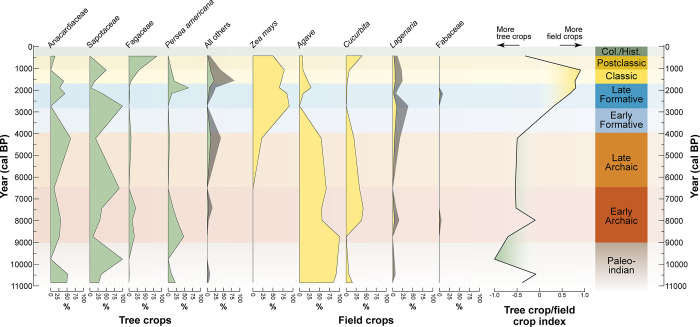
El Gigante rockshelter in western Honduras provides a deeply stratified archaeological record of human–environment interaction spanning the entirety of the Holocene. Botanical materials are remarkably well preserved and include important tree (e.g., ciruela (Spondias), avocado (Persea americana)) and field (maize (Zea mays), beans (Phaseolus), and squash (Cucurbita)) crops. Here we provide a major update to the chronology of tree and field crop use evident in the sequence. We report 375 radiocarbon dates, a majority of which are for short-lived botanical macrofossils (e.g., maize cobs, avocado seeds, or rinds). Radiocarbon dates were used in combination with stratigraphic details to establish a Bayesian chronology for ~9,800 identified botanical samples spanning the last 11,000 years. We estimate that at least 16 discrete intervals of use occurred during this time, separated by gaps of ~100–2,000 years. The longest hiatus in rockshelter occupation was between ~6,400 and 4,400 years ago and the deposition of botanical remains peaked at ~2,000 calendar years before present (cal BP). Tree fruits and squash appeared early in the occupational sequence (~11,000 cal BP) with most other field crops appearing later in time (e.g., maize at ~4,400 cal BP; beans at ~2,200 cal BP). The early focus on tree fruits and squash is consistent with early coevolutionary partnering with humans as seed dispersers in the wake of megafaunal extinction in Mesoamerica. Tree crops predominated through much of the Holocene, and there was an overall shift to field crops after 4,000 cal BP that was largely driven by increased reliance on maize farming.
Overview
CoChat Summary
TL;DR
This paper presents a Bayesian radiocarbon chronology for El Gigante rockshelter, Honduras, based on 375 radiocarbon dates and ~9,800 identified botanical samples spanning the last ~11,000 years. It identifies at least 16 discrete intervals of rockshelter use, early tree fruits and squash by ~11,000 cal BP, later maize (~4,400 cal BP) and beans (~2,200 cal BP), and a shift to field crops after ~4,000 cal BP driven by maize.
Key findings
- 375 radiocarbon dates, mostly short-lived botanical macrofossils, support a Bayesian chronology for ~9,800 botanical samples; the authors estimate at least 16 discrete use intervals separated by gaps of ~100–2,000 years, with the longest hiatus ~6,400–4,400 years ago and peak botanical deposition at ~2,000 cal BP.
- Tree fruits and squash appeared early (~11,000 cal BP): earliest directly dated avocado 11,105–10,700 cal BP (PSUAMS-9358), hog plum 11,085–10,705 cal BP (UCIAMS-90929), bottle gourd 11,150–10,765 cal BP (PSUAMS-8058), and Cucurbita squash 11,090–10,720 cal BP (PSUAMS-8055); tree crops predominated through much of the Holocene.
- Maize appears at ~4,400 cal BP (Zea mays 4,525–4,155 cal BP, AA-93157) and beans at ~2,200 cal BP (Phaseolus vulgaris 2,300–2,005 cal BP, PSUAMS-8042); after ~4,000 cal BP there was an overall shift to field crops driven by increased maize farming.
- Agave was persistently exploited through the last 11,000 years, with the earliest dated quid at 10,655–10,300 cal BP (PSUAMS-5391).
Methods
- The study compiles 375 radiocarbon dates; 369 dates (excluding six modern/pre-habitation outliers) characterize depositional history, while 292 dates from intact strata with proper superpositioning form the Bayesian model in OxCal v.4.4 using IntCal20; the model has 18 phases and is used to infer ages for 9,429 undated paleoethnobotanical specimens.
- Macrobotanical samples directly dated at PSUAMS and UCIAMS (307 dates) were pretreated with acid/base/acid, combusted, graphitized, and measured by AMS; additional dates came from AA, Beta, and ISGS laboratories.
- Proxy records include a 50-year-bandwidth kernel density estimate of calibrated dates, sedimentation rates from stratum thicknesses, botanical deposition rates, and a tree-crop/field-crop index scaled from -1 to +1; these were resampled at 50-year intervals in PAST v.4.09, yielding n = 215 observations spanning 11,000–300 years.
Limitations
- Stated: cave/rockshelter age-depth profiles are difficult and discontinuous, with shallow strata and redeposition; 82 dates were omitted from the model due to looting/stratigraphic disturbance, missing provenience, outliers, or poor model agreement; calibration curve reversals at ~2,300 and 1,700 cal BP likely affected phase boundaries during intensive use, making modeled gaps difficult to discern, though convergence indices remained above 95% (dipping to ~97%).
- Stated: the 14C sample prioritizes direct dating of paleobotanical materials, especially maize, raising questions about representativeness; the authors caution that relative site-use intensity should not be assigned solely from density of 14C-dated events.
- Evident from the text: the chronology depends on the 292-date modeled subset, many phases in mixed layers are not readily discernible stratigraphically, Late Formative disturbance/redeposition has deleterious effects on preservation of earlier Archaic strata, and domestication status of early bottle gourds and squash remains unresolved pending morphological/ancient DNA work.
Model-written summary. Check it against the paper before relying on it.
Integrity signals
Registry
Cites
Statistics
Figures
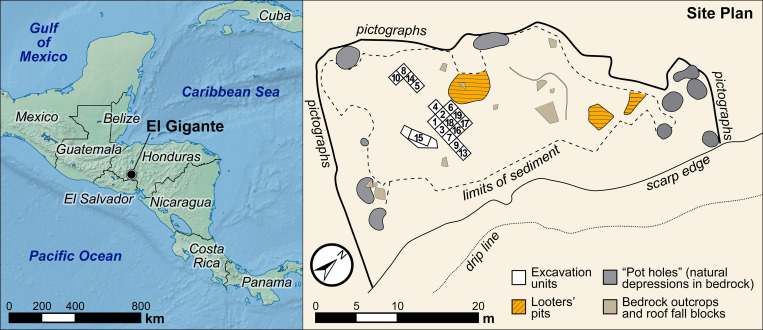
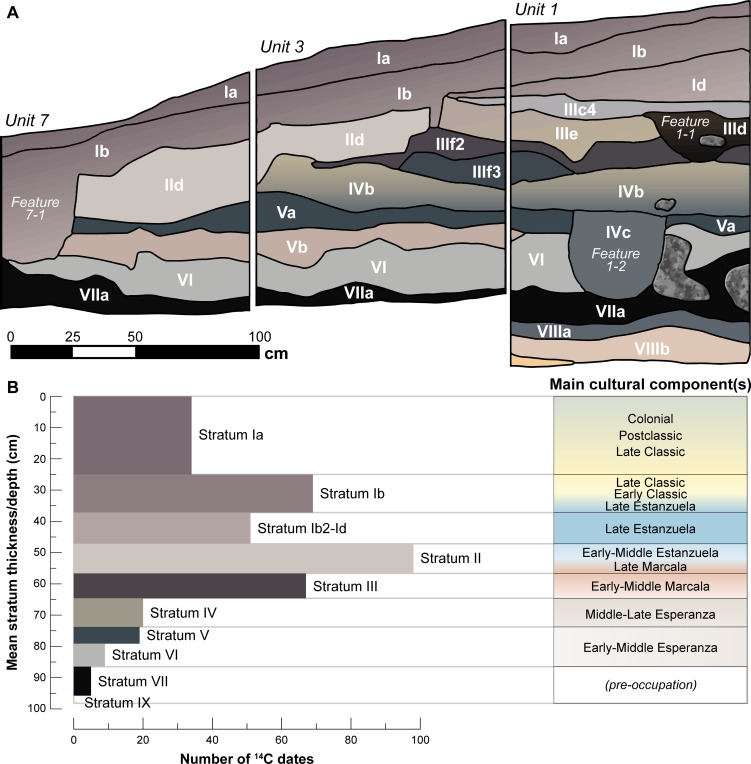
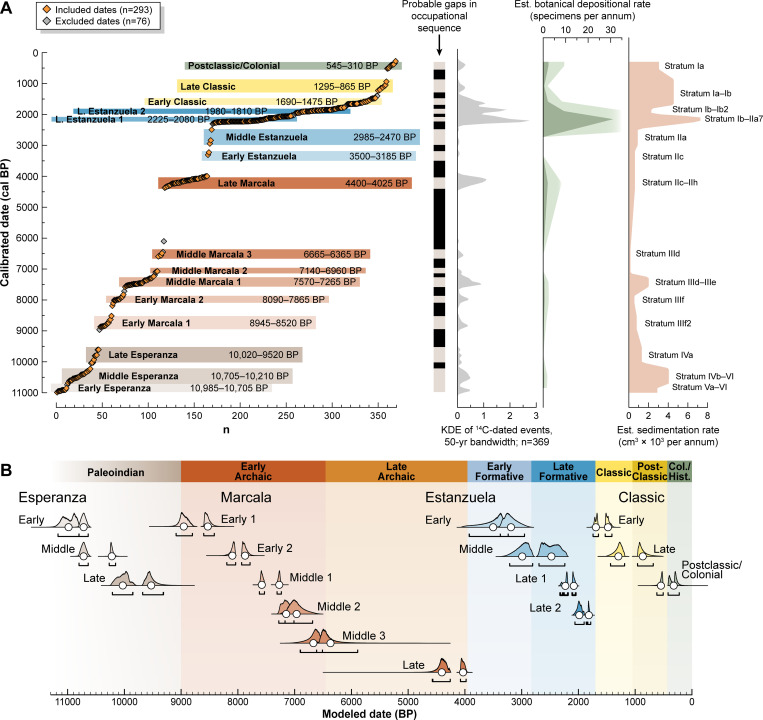
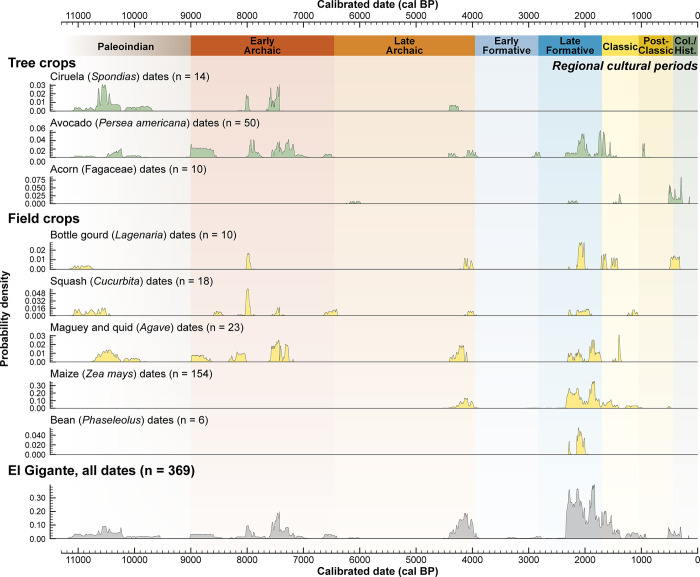
Verification
Claims the paper makes
1 Valid · 0 Not valid · 35 Not checked · 99 Own results and interpretations
The cited sources support only part of this claim — read each source’s verdict below.
In the paper
“El Gigante’s trans–Holocene deposits provide insights into the coevolutionary relationships involved in the domestication, adoption, and use of tree and field crops [24, 28, 36, 38].”
§ Trans–Holocene Bayesian chronology for tree and field crop use from El Gigante rockshelter, Honduras > Discussion
What the sources say
- Not checked yetcites [24] Kistler L, Thakar HB, VanDerwarker AM, Domic A, Bergström A, George RJ, et al. Archaeological Central American maize genomes suggest ancient gene flow from South America. Proc Natl Acad Sci USA. 2020; 117: 33124– 33129. doi: 10.1073/pnas.2015560117 33318213 PMC7777085 source
- Partly supportedcites [28] Kennett DJ, Thakar HB, VanDerwarker AM, Webster DL, Culleton BJ, Harper TK, et al. High-precision chronology for Central American maize diversification from El Gigante rockshelter, Honduras. Proceedings of the National Academy of Sciences. 2017; 114: 9026– 9031. doi: 10.1073/pnas.1705052114 28784803 PMC5576806 sourceExperimental — accuracy not yet measured
Our copy supports the general burden of the sentence: the Bayesian chronology spans rockshelter use from 11,010 to 980 cal B.P. (Discussion) with well-preserved macrobotanical assemblages that 'reveal how early farmers selected specific morphological traits' and document the arrival and adoption of maize at 4,340 cal B.P. and beans (Phaseolus) in the Late Formative (El Gigante Rockshelter). However, the 'tree crops' component is treated as gathered agroforest product rather than domestication: the El Gigante Rockshelter section lists avocado (Persea), hog plum (Spondias), mamey sapote (Pouteria), mesquite (Prosopis), acorns (Quercus), soursop (Annona) and hackberry (Celtis) as a 'list of diverse agroforest products' consistent with dietary expansion, and all domestication/selection discussion in the Introduction and Discussion concerns maize (a field crop). The specific framing of 'coevolutionary relationships' is also not stated in our copy, which speaks instead of farmer-driven selection and reduced teosinte introgression. (LLM, conf=0.72)
- Not checked yetcites [36] Scheffler TE, Hirth KG, Hasemann G. The El Gigante Rockshelter: Preliminary Observations on an Early to Late Holocene Occupation in Southern Honduras. Latin Am antiq. 2012; 23: 597– 610. doi: 10.7183/1045-6635.23.4.597 source
- Not checked yetcites [38] Scheffler TE. The El Gigante rockshelter, Honduras. Pennsylvania State University, University Park.; 2008.
plainstates an association- Asserted: passes — The authors put it forward as true.
- Checkable: passes — It can be checked against evidence.
- Load-bearing: passes — The paper’s conclusions depend on it.
- Based: passes — The paper gives a reason why it holds.
A result the paper reports from its own data — it cites no other source for it, so there is none to check. The quote shows it is in the paper.
In the paper
“Tree fruits and squash appeared early in the occupational sequence (~11,000 cal BP)”
§ Trans–Holocene Bayesian chronology for tree and field crop use from El Gigante rockshelter, Honduras > Abstract
plain- Asserted: passes — The authors put it forward as true.
- Checkable: passes — It can be checked against evidence.
- Load-bearing: passes — The paper’s conclusions depend on it.
- Based: passes — The paper gives a reason why it holds.
A result the paper reports from its own data — it cites no other source for it, so there is none to check. The quote shows it is in the paper.
In the paper
“The largest number (68) were excluded because of looting or stratigraphic disturbance, mostly the result of extensive re-modeling of the rockshelter’s floor and re-deposition of materials that occurred during the Late Formative period.”
§ Trans–Holocene Bayesian chronology for tree and field crop use from El Gigante rockshelter, Honduras > Methods > Chronological analysis and Bayesian sequencing
plainstates a cause- Asserted: passes — The authors put it forward as true.
- Checkable: passes — It can be checked against evidence.
- Load-bearing: unclear — It is unclear whether the paper’s conclusions depend on it.
- Based: passes — The paper gives a reason why it holds.
A result the paper reports from its own data — it cites no other source for it, so there is none to check. The quote shows it is in the paper.
In the paper
“maize at ~4,400 cal BP”
§ Trans–Holocene Bayesian chronology for tree and field crop use from El Gigante rockshelter, Honduras > Abstract
plain- Asserted: passes — The authors put it forward as true.
- Checkable: passes — It can be checked against evidence.
- Load-bearing: passes — The paper’s conclusions depend on it.
- Based: passes — The paper gives a reason why it holds.
A result the paper reports from its own data — it cites no other source for it, so there is none to check. The quote shows it is in the paper.
In the paper
“The KDE of 14C-dated events corroborates the observation of approximately 16 occupational phases.”
§ Trans–Holocene Bayesian chronology for tree and field crop use from El Gigante rockshelter, Honduras > Results
plainstates an association- Asserted: passes — The authors put it forward as true.
- Checkable: passes — It can be checked against evidence.
- Load-bearing: unclear — It is unclear whether the paper’s conclusions depend on it.
- Based: passes — The paper gives a reason why it holds.
71 more claims
Create a free account to see all 135 claims and to verify the 50 references still open.
- It may state two separate claims as one. 43
- Probably not a substantial claim. 23
Citations
Cites
Bayesian Analysis of Radiocarbon Dates
Bronk Ramsey, C. (2009) · Radiocarbon · doi:10.1017/s0033822200033865 · Cited by 8,725
The IntCal20 Northern Hemisphere Radiocarbon Age Calibration Curve (0–55 cal kBP)
Reimer, P. J., Austin, W. E. N., Bard, E., Bayliss, A., Blackwell, P. G., Bronk Ramsey, C., Butzin, M., Cheng, H., Edwards, R. L., Friedrich, M., et al. (2020) · Radiocarbon · doi:10.1017/rdc.2020.41 · Cited by 7,900
Discussion Reporting of 14 C Data
Stuiver, M., & Polach, H. A. (1977) · Radiocarbon · doi:10.1017/s0033822200003672 · Cited by 5,640
Current perspectives and the future of domestication studies
Larson, G., Piperno, D. R., Allaby, R. G., Purugganan, M. D., Andersson, L., Arroyo-Kalin, M., Barton, L., Climer Vigueira, C., Denham, T., Dobney, K., et al. (2014) · Proceedings of the National Academy of Sciences · doi:10.1073/pnas.1323964111 · Cited by 875
The origins of agriculture in the lowland neotropics
(1998) · Choice Reviews Online · doi:10.5860/choice.36-1574 · Cited by 672
Piperno, D. R., & Flannery, K. V. (2001) · Proceedings of the National Academy of Sciences · doi:10.1073/pnas.98.4.2101 · Cited by 435
Seed Dispersal Anachronisms: Rethinking the Fruits Extinct Megafauna Ate
Guimarães, P. R., Galetti, M., & Jordano, P. (2008) · PLoS ONE · doi:10.1371/journal.pone.0001745 · Cited by 432
Piperno, D. R. (2011) · Current Anthropology · doi:10.1086/659998 · Cited by 427
Agaves of Continental North America
Gentry, H. S. (1982) · doi:10.2307/j.ctv1t4m2h4 · Cited by 371
The Initial Domestication of Cucurbita pepo in the Americas 10,000 Years Ago
Smith, B. D. (1997) · Science · doi:10.1126/science.276.5314.932 · Cited by 351 · cited 3×
“Guilá Naquitz in the Valley of Oaxaca contains the earliest domesticated squash (Cucurbita pepo, ~10,000 cal BP) [10] and maize (Zea mays ssp.”
Background
Research works printed but not linked: 4
- Flannery KV, editor. Guilá Naquitz: archaic foraging and early agriculture in Oaxaca, Mexico. Orlando: Academic Press; 1986.
- Hammer Ø, Harper DT, Ryan PD. PAST: Paleontological Statistics Software Package for Education and Data Analysis. Reference manual. National History Museum, University of Oslo. Electronic document, https://www.nhm.uio.no/english/research/infrastructure/past/downloads/past4manual.pdf; 2022.
- Smith CE. Plant Remains. In: Byers DS, editor. The Prehistory of the Tehuacán Valley: Environment and Subsistence. University of Texas Press, Austin; 1967. pp. 220– 255.
- Smith CE. Preceramic plant remains from Guilá Naquitz. In: Flannery KV, editor. Guilá Naquitz, Archaic Foraging and Early Agriculture in Oaxaca, Mexico. Academic Press, Inc., Orlando, FL.; 1986. pp. 265– 301.
Cited by
Two teosintes made modern maize
Yang, N., Wang, Y., Liu, X., Jin, M., Vallebueno-Estrada, M., Calfee, E., Chen, L., Dilkes, B. P., Gui, S., Fan, X., et al. (2023) · Science · doi:10.1126/science.adg8940 · Cited by 164
“Archaeological samples demonstrate the presence of maize as a staple grain in the neotropical lowlands of Central America subsequent to mexicana admixture, between 4700 and 4000 cal BP ( 59 , 61 , 62 ).”
BackgroundSelf-citationCheptoo, A., Ebere, R. A., & Arimi, J. M. (2025) · Journal of Food Processing and Preservation · doi:10.1155/jfpp/4810929 · Cited by 17
Zeder, M. A. (2025) · Journal of World Prehistory · doi:10.1007/s10963-025-09198-0 · Cited by 11
Early evidence of avocado domestication from El Gigante Rockshelter, Honduras
VanDerwarker, A. M., Thakar, H. B., Hirth, K. G., Domic, A. I., Harper, T. K., George, R. J., Johnson, E. S., Newhall, V., Scheffler, T. E., McCool, W. C., et al. (2025) · Proceedings of the National Academy of Sciences · doi:10.1073/pnas.2417072122 · Cited by 11
Self-citationArchaeobotanical evidence supports indigenous cucurbit long-term use in the Mesoamerican Neotropics
Domic, A. I., VanDerwarker, A. M., Thakar, H. B., Hirth, K. G., Capriles, J. M., Harper, T. K., Scheffler, T. E., Kistler, L., & Kennett, D. J. (2024) · Scientific Reports · doi:10.1038/s41598-024-60723-1 · Cited by 8
Self-citation
Metadata
- Authors
- Kennett, D. J., Harper, T. K., VanDerwarker, A., Thakar, H. B., Domic, A., Blake, M., Benz, B. F., George, R. J., Scheffler, T. E., Culleton, B. J., Kistler, L., & Hirth, K. G.
- Affiliations
- University of California, Santa Barbara (US)
- Pennsylvania State University (US)
- University of British Columbia (CA)
- Texas Wesleyan University (US)
- Texas A&M University (US)
- University of Hawaii at Hilo (US)
- Smithsonian Institution (US)
- Corresponding author
- Kennett, Douglas J.
- Hirth, Kenneth G.
- ORCID
- Venue
- PLOS ONE
- Publisher
- Public Library of Science (PLoS)
- Published
- 2023-06-23
- Volume
- 18
- Issue
- 6
- Pages
- e0287195
- ISSN
- 1932-6203 (ISSN-L)
- PMC
- PMC10289419
- OpenAlex
- W4381838970
- Cited by
- 13
- References
- 62
- Citations by year
- 2026: 4 · 2025: 4 · 2024: 2 · 2023: 3
- FWCI
- 5.49
- Type
- journal article
- Language
- en
- Open access
- gold
- doi.org
- Licence
- Locations
- PLoS ONE (publishedVersion, cc-by)
- PubMed Central (publishedVersion, public-domain)
- PubMed (publishedVersion)
- eScholarship (California Digital Library) (submittedVersion, public-domain)
- DOAJ (DOAJ: Directory of Open Access Journals) (submittedVersion)
- Funders
- National Science Foundation Archaeology Program, Directorate for Social, Behavioral and Economic Sciences (BCS-1757375, BCS-100343, BCS-1757383, BCS-1757374)
- Topics
- Social Sciences › Archeology › Archaeology and ancient environmental studies
- Social Sciences › Arts and Humanities › History › Historical Studies in Central America
- Social Sciences › Arts and Humanities › History › Amazonian Archaeology and Ethnohistory
- Keywords
- Holocene, Bayesian chronology, radiocarbon dating, tree crops, field crops, maize, squash, beans, avocado, Spondias, human-nature relationship, seed dispersal, megafaunal extinction, western Honduras
- MeSH terms
- Agriculture, Archaeology, Bayes Theorem, Zea mays, Honduras, Humans, Crops, Agricultural, Persea, Anacardiaceae, Cucurbita
About these checks
Registry, retraction, Cites and statistics results are computed, not judged, with one exception: a printed reference that no index lists is read once by a model before it counts as a citation error. Claims are extracted by a model and kept only when their quote appears verbatim in the text; each cited source is then checked, with a model’s help, for whether it says what the claim relies on. Those verdicts can be wrong — read the claim’s quote and the cited source before relying on one.
The claim verdicts this report counts are experimental: their accuracy is not yet measured.
A language model drew the claims from the paper on 2026-11-24, under version 3 of the claim definition (model deepseek-v4.1-flash, prompt extract-v3).
A second model labelled each claim on 2026-11-24 (model jev-1.13-20260917, definition revision gold-guideline-v0.2).
Cited sources are checked with a language model’s help (qwen3.8-omni-flash).
Statistics and arithmetic are recomputed, not judged.
Confidence bands are shown only for fields calibrated on our annotated test set. None is calibrated yet, so no band is shown.
What counts as a claim ›How we measure confidence ›How we check this ›
Are you an author, or do you see a problem with this page? Request a review
Data sources
Bibliographic data: Semantic Scholar, OpenAlex, Crossref.
Contains information from the Semantic Scholar Academic Graph Datasets, made available under the ODC Attribution License (ODC-BY 1.0).
Semantic Scholar’s data is described in: Kinney, R., et al. (2023). The Semantic Scholar Open Data Platform. arXiv:2301.10140.
