

The DOI matches its Crossref record; 21 of the 21 references it cites were found in a registry or an index.
Western Australian medical students’ attitudes towards artificial intelligence in healthcare
Open accessAbstract
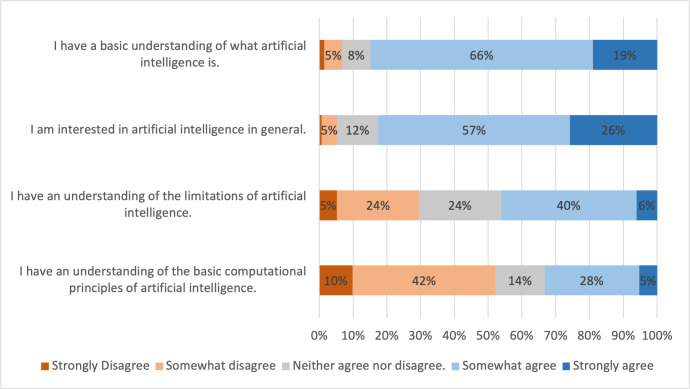
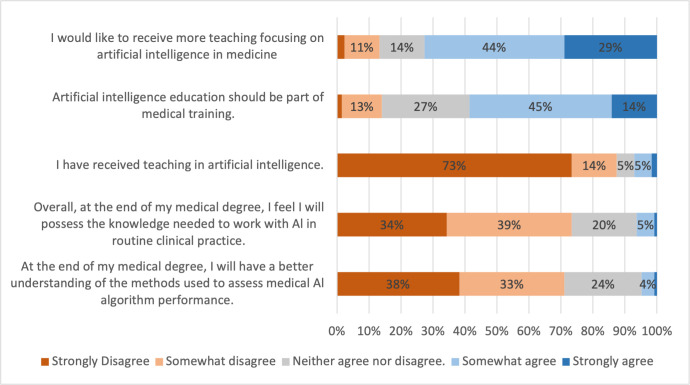
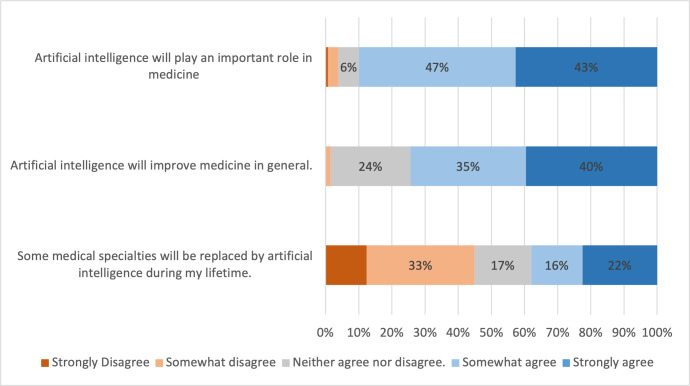
INTRODUCTION: Surveys conducted internationally have found widespread interest in artificial intelligence (AI) amongst medical students. No similar surveys have been conducted in Western Australia (WA) and it is not known how medical students in WA feel about the use of AI in healthcare or their understanding of AI. We aim to assess WA medical students' attitudes towards AI in general, AI in healthcare, and the inclusion of AI education in the medical curriculum. METHODS: A digital survey instrument was developed based on a review of available literature and consultation with subject matter experts. The survey was piloted with a group of medical students and refined based on their feedback. We then sent this anonymous digital survey to all medical students in WA (approximately 1539 students). Responses were open from the 7th of September 2021 to the 7th of November 2021. Students' categorical responses were qualitatively analysed, and free text comments from the survey were qualitatively analysed using open coding techniques. RESULTS: Overall, 134 students answered one or more questions (8.9% response rate). The majority of students (82.0%) were 20-29 years old, studying medicine as a postgraduate degree (77.6%), and had started clinical rotations (62.7%). Students were interested in AI (82.6%), self-reported having a basic understanding of AI (84.8%), but few agreed that they had an understanding of the basic computational principles of AI (33.3%) or the limitations of AI (46.2%). Most students (87.5%) had not received teaching in AI. The majority of students (58.6%) agreed that AI should be part of medical training and most (72.7%) wanted more teaching focusing on AI in medicine. Medical students appeared optimistic regarding the role of AI in medicine, with most (74.4%) agreeing with the statement that AI will improve medicine in general. The majority (56.6%) of medical students were not concerned about the impact of AI on their job security as a doctor. Students selected radiology (72.6%), pathology (58.2%), and medical administration (44.8%) as the specialties most likely to be impacted by AI, and psychiatry (61.2%), palliative care (48.5%), and obstetrics and gynaecology (41.0%) as the specialties least likely to be impacted by AI. Qualitative analysis of free text comments identified the use of AI as a tool, and that doctors will not be replaced as common themes. CONCLUSION: Medical students in WA appear to be interested in AI. However, they have not received education about AI and do not feel they understand its basic computational principles or limitations. AI appears to be a current deficit in the medical curriculum in WA, and most students surveyed were supportive of its introduction. These results are consistent with previous surveys conducted internationally.
Overview
The claims and statistics of this paper haven’t been checked yet.
Run the check — free, no account needed. It reads the open-access text and checks the sources it cites.
Integrity signals
Registry
Cites
Statistics
Figures
Verification
Claims the paper makes
The claims and statistics of this paper haven’t been checked yet.
Run the check — free, no account needed. It reads the open-access text and checks the sources it cites.
Claims other papers make about this one
Each is checked against this paper’s own text: does it say what the citing paper says it does?
In the citing paper
“Furthermore, studies from different parts of the world, such as Turkey [21], Australia [34], and India [17], demonstrated similar results and reported students had positive attitudes toward learning about AI technology during their education.”
From Shaping the future: perspectives on the Integration of Artificial Intelligence in health profession education: a multi-country survey (2024) · cites this paper as [34]
In the citing paper
“However, our results were consistent with a survey of Australian medical students (N = 134) in which only 14.8% were concerned about the impact of AI on their job security [34].”
From Shaping the future: perspectives on the Integration of Artificial Intelligence in health profession education: a multi-country survey (2024) · cites this paper as [34]
In the citing paper
“A comparison of our results with those of previous studies indicated variation in attitudes concerning the impact of AI technology on future healthcare professionals.”
From Shaping the future: perspectives on the Integration of Artificial Intelligence in health profession education: a multi-country survey (2024) · cites this paper as [34]
Self-check
Percentages, sums and reported differences re-computed from the paper’s own numbers.
The self-check needs the paper’s full text.
Citations
Cites
Medical students' attitude towards artificial intelligence: a multicentre survey
Pinto dos Santos, D., Giese, D., Brodehl, S., Chon, S. H., Staab, W., Kleinert, R., Maintz, D., & Baeßler, B. (2019) · European Radiology · doi:10.1007/s00330-018-5601-1 · Cited by 754
Burnout in medical students: A systematic review
IsHak, W., Nikravesh, R., Lederer, S., Perry, R., Ogunyemi, D., & Bernstein, C. (2013) · The Clinical Teacher · doi:10.1111/tct.12014 · Cited by 715
Sit, C., Srinivasan, R., Amlani, A., Muthuswamy, K., Azam, A., Monzon, L., & Poon, D. S. (2020) · Insights into Imaging · doi:10.1186/s13244-019-0830-7 · Cited by 507
Sapci, A. H., & Sapci, H. A. (2020) · JMIR Medical Education · doi:10.2196/19285 · Cited by 377
Gong, B., Nugent, J. P., Guest, W., Parker, W., Chang, P. J., Khosa, F., & Nicolaou, S. (2019) · Academic Radiology · doi:10.1016/j.acra.2018.10.007 · Cited by 325
Machine learning and medical education
Kolachalama, V. B., & Garg, P. S. (2018) · npj Digital Medicine · doi:10.1038/s41746-018-0061-1 · Cited by 320
Wood, E. A., Ange, B. L., & Miller, D. D. (2021) · Journal of Medical Education and Curricular Development · doi:10.1177/23821205211024078 · Cited by 261
Mousavi Baigi, S. F., Sarbaz, M., Ghaddaripouri, K., Ghaddaripouri, M., Mousavi, A. S., & Kimiafar, K. (2023) · Health Science Reports · doi:10.1002/hsr2.1138 · Cited by 255
What do medical students actually need to know about artificial intelligence?
McCoy, L. G., Nagaraj, S., Morgado, F., Harish, V., Das, S., & Celi, L. A. (2020) · npj Digital Medicine · doi:10.1038/s41746-020-0294-7 · Cited by 240
Grunhut, J., Wyatt, A. T., & Marques, O. (2021) · Journal of Medical Education and Curricular Development · doi:10.1177/23821205211036836 · Cited by 161
Trustworthy Augmented Intelligence in Health Care
Crigger, E., Reinbold, K., Hanson, C., Kao, A., Blake, K., & Irons, M. (2022) · Journal of Medical Systems · doi:10.1007/s10916-021-01790-z · Cited by 132
The need for health AI ethics in medical school education
Katznelson, G., & Gerke, S. (2021) · Advances in Health Sciences Education · doi:10.1007/s10459-021-10040-3 · Cited by 125
Artificial Intelligence May Cause a Significant Disruption to the Radiology Workforce
Mazurowski, M. A. (2019) · Journal of the American College of Radiology · doi:10.1016/j.jacr.2019.01.026 · Cited by 95
Bin Dahmash, A., Alabdulkareem, M., Alfutais, A., Kamel, A. M., Alkholaiwi, F., Alshehri, S., Al Zahrani, Y., & Almoaiqel, M. (2020) · BJR|Open · doi:10.1259/bjro.20200037 · Cited by 92
Santomartino, S. M., & Yi, P. H. (2022) · Academic Radiology · doi:10.1016/j.acra.2021.12.032 · Cited by 64
Dumić-Čule, I., Orešković, T., Brkljačić, B., Kujundžić Tiljak, M., & Orešković, S. (2020) · Croatian Medical Journal · doi:10.3325/cmj.2020.61.457 · Cited by 61 · cited 1×
“Medical students internationally agree that AI training should be part of their medical education [10, 11, 15, 17].”
Medical students need artificial intelligence and machine learning training
Pucchio, A., Eisenhauer, E. A., & Moraes, F. Y. (2021) · Nature Biotechnology · doi:10.1038/s41587-021-00846-2 · Cited by 61
AI added to the curriculum for doctors-to-be
Brouillette, M. (2019) · Nature Medicine · doi:10.1038/s41591-019-0648-3 · Cited by 56
Perceptions and attitudes of medical students regarding artificial intelligence in dermatology
Cho, S. I., Han, B., Hur, K., & Mun, J. (2020) · Journal of the European Academy of Dermatology and Venereology · doi:10.1111/jdv.16812 · Cited by 37
Trust in Artificial Intelligence: Australian Insights
Lockey, S., Gillespie, N. A., & Curtis, C. (2020) · The University of Queensland · doi:10.14264/b32f129 · Cited by 35
Blacketer, C., Parnis, R., B. Franke, K., Wagner, M., Wang, D., Tan, Y., Oakden‐Rayner, L., Gallagher, S., Perry, S. W., Licinio, J., et al. (2021) · Internal Medicine Journal · doi:10.1111/imj.15479 · Cited by 17
Cited by
Sorted by citations
A scoping review of artificial intelligence in medical education: BEME Guide No. 84
Gordon, M., Daniel, M., Ajiboye, A., Uraiby, H., Xu, N. Y., Bartlett, R., Hanson, J., Haas, M., Spadafore, M., Grafton-Clarke, C., et al. (2024) · Medical Teacher · doi:10.1080/0142159x.2024.2314198 · Cited by 679
Artificial intelligence in medical education - perception among medical students
Jackson, P., Ponath Sukumaran, G., Babu, C., Tony, M. C., Jack, D. S., Reshma, V. R., Davis, D., Kurian, N., & John, A. (2024) · BMC Medical Education · doi:10.1186/s12909-024-05760-0 · Cited by 185
Laupichler, M. C., Aster, A., Meyerheim, M., Raupach, T., & Mergen, M. (2024) · BMC Medical Education · doi:10.1186/s12909-024-05400-7 · Cited by 170
Busch, F., Hoffmann, L., Truhn, D., Ortiz-Prado, E., Makowski, M. R., Bressem, K. K., Adams, L. C., COMFORT Consortium, Abdala, N., Navarro, Á. A., et al. (2024) · BMC Medical Education · doi:10.1186/s12909-024-06035-4 · Cited by 108
Wang, X., Fei, F., Wei, J., Huang, M., Xiang, F., Tu, J., Wang, Y., & Gan, J. (2024) · Frontiers in Public Health · doi:10.3389/fpubh.2024.1433252 · Cited by 106
Metadata
- Authors
- Stewart, J., Lu, J., Gahungu, N., Goudie, A., Fegan, P. G., Bennamoun, M., Sprivulis, P., & Dwivedi, G.
- Affiliations
- The University of Western Australia (AU)
- Fiona Stanley Hospital (AU)
- Curtin University (AU)
- Government of Western Australia Department of Health (AU)
- Corresponding author
- Stewart, Jonathon
- ORCID
- Venue
- PLOS ONE
- Publisher
- Public Library of Science (PLoS)
- Published
- 2023-08-31
- Volume
- 18
- Issue
- 8
- Pages
- e0290642
- ISSN
- 1932-6203 (ISSN-L)
- PMC
- PMC10470885
- OpenAlex
- W4386323538
- Cited by
- 104
- References
- 21
- Citations by year
- 2026: 33 · 2025: 41 · 2024: 27 · 2023: 3
- FWCI
- 4.18
- Type
- journal article
- Language
- en
- Open access
- gold
- doi.org
- Licence
- Locations
- PLoS ONE (publishedVersion, cc-by)
- PubMed Central (publishedVersion, cc-by)
- UWA Profiles and Research Repository (UWA) (publishedVersion, cc-by)
- PubMed (publishedVersion)
- RePEc: Research Papers in Economics (submittedVersion)
- DOAJ (DOAJ: Directory of Open Access Journals) (submittedVersion, cc-by-sa)
- Funders
- Western Australian Health Translation Network
- the Australian Government’s Medical Research Future Fund
- Topics
- Health Sciences › Medicine › Health Informatics › Artificial Intelligence in Healthcare and Education
- Social Sciences › Education › Innovations in Medical Education
- Social Sciences › Education › Artificial Intelligence in Education
- Keywords
- artificial intelligence in healthcare, medical students' attitudes, Western Australia, AI literacy, student perceptions of AI
- MeSH terms
- Adult, Artificial Intelligence, Attitude, Australia, Delivery of Health Care, Female, Humans, Obstetrics, Pregnancy, Students, Medical, Young Adult
About these checks
Registry, retraction, Cites and statistics results are computed, not judged, with one exception: a printed reference that no index lists is read once by a model before it counts as a citation error. Claims are extracted by a model and kept only when their quote appears verbatim in the text; each cited source is then checked, with a model’s help, for whether it says what the claim relies on. Those verdicts can be wrong — read the claim’s quote and the cited source before relying on one.
Statistics and arithmetic are recomputed, not judged.
Confidence bands are shown only for fields calibrated on our annotated test set. None is calibrated yet, so no band is shown.
What counts as a claim ›How we measure confidence ›How we check this ›
Are you an author, or do you see a problem with this page? Request a review
