

ChatGPT versus human in generating medical graduate exam multiple choice questions—A multinational prospective study (Hong Kong S.A.R., Singapore, Ireland, and the United Kingdom)
Open accessThe DOI matches its Crossref record; 30 of the 30 references it cites were found in a registry or an index.
Abstract
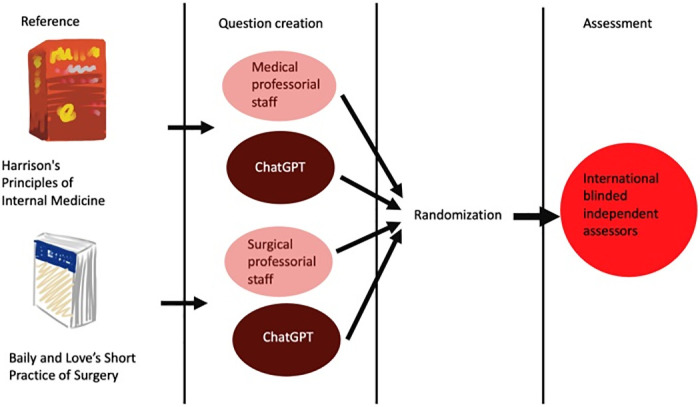
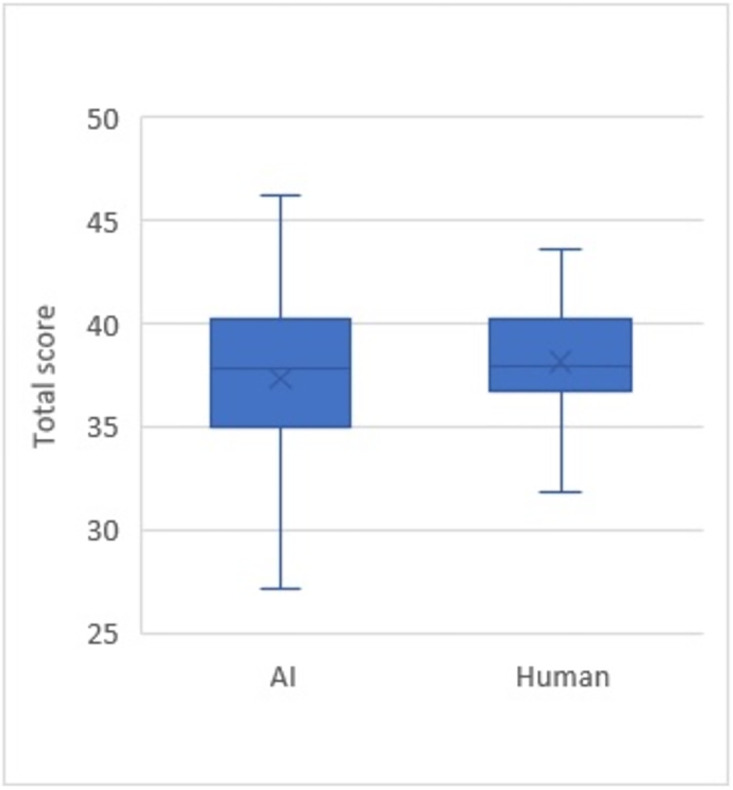
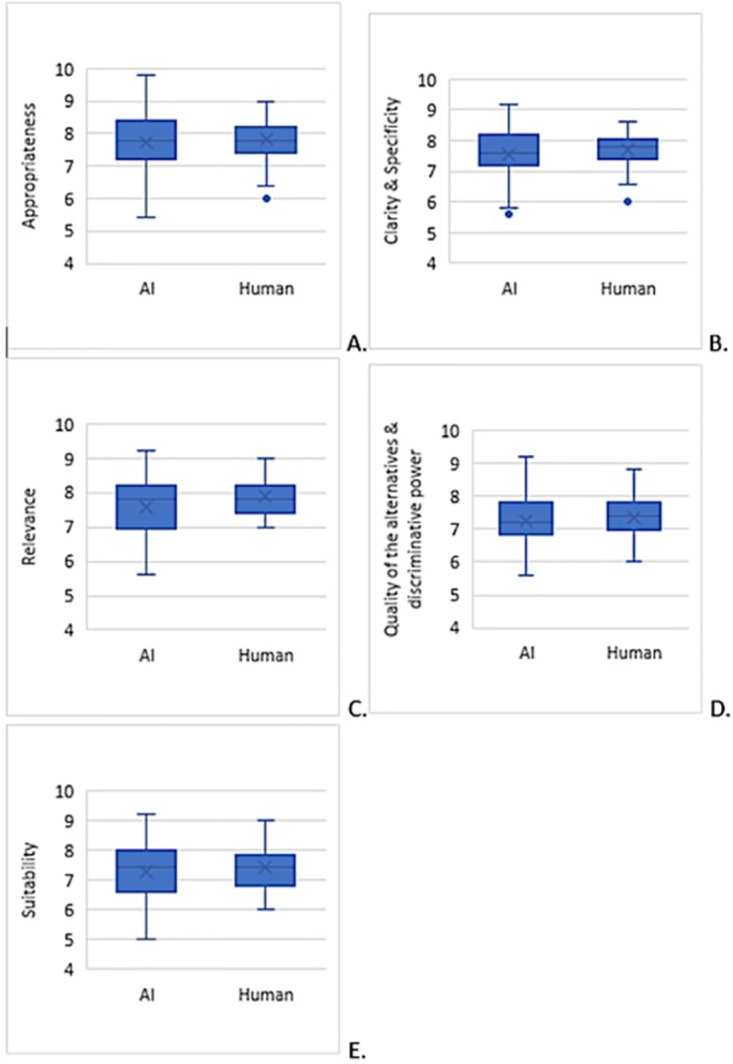
Introduction: Large language models, in particular ChatGPT, have showcased remarkable language processing capabilities. Given the substantial workload of university medical staff, this study aims to assess the quality of multiple-choice questions (MCQs) produced by ChatGPT for use in graduate medical examinations, compared to questions written by university professoriate staffs based on standard medical textbooks. Methods: 50 MCQs were generated by ChatGPT with reference to two standard undergraduate medical textbooks (Harrison’s, and Bailey & Love’s). Another 50 MCQs were drafted by two university professoriate staff using the same medical textbooks. All 100 MCQ were individually numbered, randomized and sent to five independent international assessors for MCQ quality assessment using a standardized assessment score on five assessment domains, namely, appropriateness of the question, clarity and specificity, relevance, discriminative power of alternatives, and suitability for medical graduate examination. Results: The total time required for ChatGPT to create the 50 questions was 20 minutes 25 seconds, while it took two human examiners a total of 211 minutes 33 seconds to draft the 50 questions. When a comparison of the mean score was made between the questions constructed by A.I. with those drafted by humans, only in the relevance domain that the A.I. was inferior to humans (A.I.: 7.56 +/- 0.94 vs human: 7.88 +/- 0.52; p = 0.04). There was no significant difference in question quality between questions drafted by A.I. versus humans, in the total assessment score as well as in other domains. Questions generated by A.I. yielded a wider range of scores, while those created by humans were consistent and within a narrower range. Conclusion: ChatGPT has the potential to generate comparable-quality MCQs for medical graduate examinations within a significantly shorter time.
Overview
The claims and statistics of this paper haven’t been checked yet.
Free: it reads the open-access text and checks the first 5 claims that cite a source we can check. Create a free account to check every claim.
Integrity signals
Registry
Cites
Statistics
Figures
Verification
Claims the paper makes
The claims and statistics of this paper haven’t been checked yet.
Free: it reads the open-access text and checks the first 5 claims that cite a source we can check. Create a free account to check every claim.
Claims other papers make about this one
Each is checked against this paper’s own text: does it say what the citing paper says it does?
The source backs part of the claim, not all of it — or backs it for a different population, condition or comparison.
In the citing paper
“Overall, while LLMs can quickly generate MCQs, their quality and difficulty often do not meet expectations.”
From MCQG-SRefine: Multiple Choice Question Generation and Evaluation with Iterative Self-Critique, Correction, and Comparison Feedback (2025) · cites this paper as Cheung et al. (2023)
Experimental — accuracy not yet measuredThe cited source says what the claim attributes to it.
In the citing paper
“This aligns with the previously mentioned finding of LLM-generated questions being less relevant than human-created ones [4].”
From Docimological Quality Analysis of LLM-Generated Multiple Choice Questions in Computer Science and Medicine (2024) · cites this paper as [4]
The cited source says what the claim attributes to it.
In the citing paper
“Cheung et al. reported that manual creation took 10 times longer than automatic generation [4].”
From Docimological Quality Analysis of LLM-Generated Multiple Choice Questions in Computer Science and Medicine (2024) · cites this paper as [4]
Self-check
Percentages, sums and reported differences re-computed from the paper’s own numbers.
The self-check needs the paper’s full text.
Citations
Cites
Machine learning: Trends, perspectives, and prospects
Jordan, M. I., & Mitchell, T. M. (2015) · Science · doi:10.1126/science.aaa8415 · Cited by 9,955
Artificial Intelligence in Education: A Review
Chen, L., Chen, P., & Lin, Z. (2020) · IEEE Access · doi:10.1109/access.2020.2988510 · Cited by 4,133
Kung, T. H., Cheatham, M., Medenilla, A., Sillos, C., De Leon, L., Elepaño, C., Madriaga, M., Aggabao, R., Diaz-Candido, G., Maningo, J., et al. (2023) · PLOS Digital Health · doi:10.1371/journal.pdig.0000198 · Cited by 4,115
Kung, T. H., Cheatham, M., ChatGPT, Medenilla, A., Sillos, C., De Leon, L., Elepaño, C., Madriaga, M., Aggabao, R., Diaz-Candido, G., et al. (2022) · doi:10.1101/2022.12.19.22283643 · Cited by 4,115
Haenlein, M., & Kaplan, A. (2019) · California Management Review · doi:10.1177/0008125619864925 · Cited by 2,655
Assessment in medical education
Epstein, R. M. (2007) · New England Journal of Medicine · doi:10.1056/nejmra054784 · Cited by 1,872
Artificial hallucinations in ChatGPT: implications in scientific writing
Alkaissi, H., & McFarlane, S. I. (2023) · Cureus · doi:10.7759/cureus.35179 · Cited by 1,540
Harrison's Principles of Internal Medicine
Bigby, J. (1988) · Archives of Dermatology · doi:10.1001/archderm.1988.01670020093028 · Cited by 1,234
On Faithfulness and Factuality in Abstractive Summarization
Maynez, J., Narayan, S., Bohnet, B., & McDonald, R. (2020) · Proceedings of the 58th Annual Meeting of the Association for Computational Linguistics · doi:10.18653/v1/2020.acl-main.173 · Cited by 1,185
On Faithfulness and Factuality in Abstractive Summarization
Maynez, J., Narayan, S., Bohnet, B., & McDonald, R. (2020) · arXiv · doi:10.48550/arxiv.2005.00661 · Cited by 1,185
Research works printed but not linked: 1
- 8. Wei J, Tay Y, Bommasani R, Raffel C, Zoph B, Borgeaud S, et al. Emergent abilities of large language models. arXiv preprint arXiv:220607682. 2022.
Cited by
Items 201–242 of 242
Artificial Intelligence as a Reading Comprehension Test Designer
Hakobyan, N. (2025) · International Journal of Educational Innovations · doi:10.46451/ijei.260110
Trends in ChatGPT Adoption for Education: A Bibliometric Analysis of Use
Mohammad, A. A. S., Mohammad, S. I., Vasudevan, A., Al-Daoud, K. I., Ramachandaran, S. D., Mohammad, A. I., LING, A. W. P., Hai, S. T., Rusuli, M. S. C., & Al-Momani, A. M. (2026) · Studies in systems, decision and control · doi:10.1007/978-3-032-02056-7_18
Bonilla, I. M., & Rueda, S. V. (2026) · Ciencia y reflexión : · doi:10.70747/cr.v5i1.787
Özdemir, B., Aydin, M. O., & Akdeniz, E. (2026) · Journal of Health Sciences and Medicine · doi:10.32322/jhsm.1842373
Arbor, S., Mojica-Henshaw, M. P., Ritchie, R. P., Fleet, V. V., & Arbor, T. C. (2026) · Artificial intelligence · doi:10.5772/intechopen.1012581
García-Ramírez, Y. (2026) · Proceedings on Engineering Sciences · doi:10.24874/pes08.01b.024 · Cited by 1
Роль искусственного интеллекта в оптимизации учебного процесса в медицинском вузе
Хуррамов, Ф., & Рахматуллаев, А. (2026) · Центральноазиатский журнал образования и инноваций · doi:10.70413/cajei-v05-i04-p2-054
A Feasibility Study on the Use of Large Language Models in Supporting Adaptive Learning
Cheng Keat, T. A. N. (2026) · Asian Journal of the Scholarship of Teaching and Learning · doi:10.24112/ajsotl.163476
Micaroz, M., & Frando, J. (2026) · International Journal of Educational Management and Development Studies · doi:10.53378/ijemds.353353
Kuzu, T. E., Esen, B. N., & Kurtaran, Z. (2026) · BMC Medical Education · doi:10.1186/s12909-026-09616-7
Artificial intelligence and academic anxiety? a meta-analysis
Wang, W., Diao, L., & Yu, J. (2026) · BMC Psychology · doi:10.1186/s40359-026-05018-y
Evaluating the instrumental quality of LLM-generated assessment items
Crk, I., & Gultepe, E. (2026) · Frontiers in Education · doi:10.3389/feduc.2026.1837523 · Cited by 1
Sangam, M. R., Praveen, K., Vinay, G., Kaur, A., & Deka, R. (2026) · National Journal of the Society of Medical Anatomists · doi:10.4103/njsoma.njsoma_3_26
Tahir, R., & Luo, Z. (2026) · IEEE Global Engineering Education Conference (EDUCON) · doi:10.1109/educon67543.2026.11574117
Mohammed, B. E. A., Mohammed, T. E. A., & Breitbach, A. P. (2026) · Sudan Journal of Medical Sciences · doi:10.18502/sjms.v21i2.19868
Quality of AI vs human-generated single best answer questions: a systematic review and meta-analysis
Shabbir, M., Bandy, A., Mehboob, B., Mahboob, U., Liaqat, A., Almarshad, F., & Adam, S. K. (2026) · Medicni perspektivi · doi:10.26641/2307-0404.2026.2.365915
Using AI-powered multiple-choice question generation for self-regulated learning
Barra, E., Pilicita, A., Conde, J., Pozo, A., López‐Pernas, S., & Reviriego, P. (2026) · Revista de Educación a Distancia (RED) · doi:10.6018/red.711091
“Further research (Cheung et al., 2023) showed comparable overall quality, highlighting the potential of these models to match human performance in critical aspects such as difficulty and clarity.”
Kaval, M. E., Sarsar, F., Demirci, G. K., Kurt, S. M., Inkaya, D., Boyacıoğlu, H., & Güneri, P. (2026) · Australian Endodontic Journal · doi:10.1111/aej.70108
Cheung, L. T., Vu, H., Osborne, B., Parange, N., & Maranna, S. (2026) · Online Learning · doi:10.24059/olj.v30isi2.5747
Alyakin, A., Stryker, J., Alber, D. A., Lee, J. V., Singh, S., Save, A., Kurland, D. B., Orillac, C. M., Valliani, A. A.-A., Neifert, S. N., et al. (2026) · Neurosurgery Open · doi:10.1227/neuprac.0000000000000275
Maini, E., Kumar, S. A., Marwaha, D., & Maini, B. (2026) · Smart innovation, systems and technologies · doi:10.1007/978-981-95-9101-5_41
Kaplan, C., & Özcan, H. (2026) · Istanbul University Journal of Health Sciences Research · doi:10.26650/iujhsr2026-1816060
Schoenhof, R., Haiber, T., Blumenstock, G., Tilsen, F., Haefner, J., Schönhof, R., Lethaus, B., & Hoefert, S. (2026) · Journal of Cranio-Maxillofacial Surgery · doi:10.1016/j.jcms.2026.109844
Schoenhof, R., Haiber, T., Blumenstock, G., Tilsen, F., Häfner, J., Schoenhof, R., Lethaus, B., & Hoefert, S. (2026) · Journal of Cranio-Maxillofacial Surgery · doi:10.1016/j.jcms.2026.109852
Anschuetz, W., Stricker, D., Canonica, C., Montavon, C., Geyter, C. D., & Huwendiek, S. (2026) · BMC Medical Education · doi:10.1186/s12909-026-10082-4
Professional roles, gender, and attitudes toward generative AI: evidence from Japan
Yamamura, E., & Ohtake, F. (2026) · AI and Ethics · doi:10.1007/s43681-026-01299-6
“GAI is expected to significantly affect various fields such as cyber security, customer support, software development [18], and medical examinations [6, 16].”
Hasei, J., Toda, Y., Nishimura, Y., IKEZAKI, T., Matsuoka, H., Takeuchi, K., Nakahara, R., & Ozaki, T. (2026) · Frontiers in Digital Health · doi:10.2196/preprints.109786
Alnomasy, N., Alrashedi, H., Dardouri, M., Mahmoud, S. K. M., Pangket, P. P., You, S. B., Tark, A., Becker, D., Maestrado, R. B., Mostoles, R., et al. (2026) · Nursing Reports · doi:10.3390/nursrep16090304
“…AI-generated questions may be limited to factual recall, ChatGPT-generated MCQs achieved slightly higher ratings for cognitive level and scenario relevance, suggesting that carefully designed prompts can support the generation of assessment items perceived as targeting higher-order thinking [8,16].”
Algorithm Aversion Towards AI-Generated Multiple-Choice Questions
Laupichler, M. C., Eigster, S., Ahmadi, S., Kadow, I. C. G., Raupach, T., & Rother, J. F. (2026) · Medical Science Educator · doi:10.1007/s40670-026-02866-6
Cassano, G., Ebbert, D., Mirriahi, N., & Blas, N. D. (2026) · Educational Technology Research and Development · doi:10.1007/s11423-026-10646-7 · Cited by 1
Tang, X., Filonczuk, A., Zhang, X., & Cheng, Y. (2026) · Springer eBooks · doi:10.1007/978-3-032-24819-0_19
Klimas, P., Wysokiński, P., Szmeja, S., Masalska, J., Toczydłowski, K. R., Król, P. A., Michalik, M., Mamczak, M., Strzępek, S. F., & Mazek, N. (2026) · Journal of Education Health and Sport · doi:10.12775/jehs.2026.95.73695
The Evolution of Question Generation: Analyzing the Impact of Large Language Models
Bhakuni, P., Singh, G. B., Punia, A., Suyal, H., & Sharma, N. (2026) · Wiley Interdisciplinary Reviews Data Mining and Knowledge Discovery · doi:10.1002/widm.70133
The Use of ChatGPT to Write Assessment Questions
Klausner, E. A., & Mark, K. S. (2026) · Pharmacy · doi:10.3390/pharmacy14070142
“Writing assessment questions is a thoughtful process that consumes instructors’ time [11,14–20].”
InfluentialHuang, J., & Chang, H.-H. (2026) · Applied Measurement in Education · doi:10.1080/08957347.2026.2740622 · Cited by 1
Oladunmoye, E. O., OLAOYE, P. D. A. O., & Alakeme, N. J. (2026) · African Multidisciplinary Journal of Development · doi:10.59568/amjd-2026-14-2-35
Fujiono, Hartono, R., & Wahyuni, S. (2025) · IDEAS Journal on English Language Teaching and Learning Linguistics and Literature
Zekraoui, O., Li, T., Nguyen, D.-D., Lafontaine, M.-L., Cordoba, T., Moustafa, M., MacLellan, D. L., Letendre, J., Meskawi, M., Chan, G., et al. (2026) · Canadian Urological Association Journal · doi:10.5489/cuaj.9845
FORGE: A Framework for Orchestrated Role-based Generation in EducationPreprint
Gonzalez, E. M., & Grogan, P. T. (2026) · Research Square · doi:10.21203/rs.3.rs-11446615/v1
Asim, N., Shah, M. I., Hassan, B., Baig, L., Mahboob, U., & Khan, B. J. (2026) · Khyber Journal Of Medical Sciences · doi:10.70520/kjms.v19i3.954
Bantidos, M. G., Dafli, E., Karagiannidis, E., Fyntanidou, B., Gilou, S. C., Nasoufidou, A., & Bamidis, P. D. (2026) · JMIR Medical Education · doi:10.2196/100839
Naqvi, M. M. H., Jawaid, M., Fatima, S. T., Ali, A., & Azhar, T. (2026) · Pakistan Armed Forces Medical Journal · doi:10.51253/pafmj.v76i6.12930
Metadata
- Authors
- Cheung, B. H. H., Lau, G. K. K., Wong, G. T. C., Lee, E. Y. P., Kulkarni, D., Seow, C. S., Wong, R., & Co, M. T.-H.
- Affiliations
- University of Hong Kong (HK)
- University of Edinburgh (GB)
- National University Cancer Institute, Singapore (SG)
- Ollscoil na Gaillimhe – University of Galway (IE)
- Corresponding author
- Co, Michael Tiong-Hong
- ORCID
- Venue
- PLOS ONE
- Publisher
- Public Library of Science (PLoS)
- Published
- 2023-08-29
- Volume
- 18
- Issue
- 8
- Pages
- e0290691
- ISSN
- 1932-6203 (ISSN-L)
- PMC
- PMC10464959
- OpenAlex
- W4386249608
- Cited by
- 195
- References
- 28
- Citations by year
- 2026: 61 · 2025: 71 · 2024: 54 · 2023: 9
- FWCI
- 7.68
- Type
- journal article
- Language
- en
- Update notices
- correction (2025-06-27)
- Open access
- gold
- doi.org
- Licence
- Locations
- PLoS ONE (publishedVersion, cc-by)
- PubMed Central (publishedVersion, cc-by)
- PubMed (publishedVersion)
- DOAJ (DOAJ: Directory of Open Access Journals) (submittedVersion, cc-by-sa)
- Topics
- Health Sciences › Medicine › Health Informatics › Artificial Intelligence in Healthcare and Education
- Social Sciences › Education › Innovations in Medical Education
- Social Sciences › Education › Artificial Intelligence in Education
- Keywords
- ChatGPT, large language models, multiple-choice questions, medical education, medical textbooks
- MeSH terms
- Artificial Intelligence, Education, Medical, Graduate, Educational Measurement, United Kingdom, Hong Kong, Humans, Ireland, Prospective Studies, Singapore
About these checks
Registry, retraction, Cites and statistics results are computed, not judged, with one exception: a printed reference that no index lists is read once by a model before it counts as a citation error. Claims are extracted by a model and kept only when their quote appears verbatim in the text; each cited source is then checked, with a model’s help, for whether it says what the claim relies on. Those verdicts can be wrong — read the claim’s quote and the cited source before relying on one.
Statistics and arithmetic are recomputed, not judged.
Confidence bands are shown only for fields calibrated on our annotated test set. None is calibrated yet, so no band is shown.
What counts as a claim ›How we measure confidence ›How we check this ›
Are you an author, or do you see a problem with this page? Request a review
Data sources
Bibliographic data: Semantic Scholar, OpenAlex, Crossref.
Contains information from the Semantic Scholar Academic Graph Datasets, made available under the ODC Attribution License (ODC-BY 1.0).
Semantic Scholar’s data is described in: Kinney, R., et al. (2023). The Semantic Scholar Open Data Platform. arXiv:2301.10140.
