

Host Cell Invasion and Virulence Mediated by Candida albicans Ssa1
Open accessThe DOI matches its Crossref record; 68 of the 69 references it cites were found in a registry or an index.
Abstract
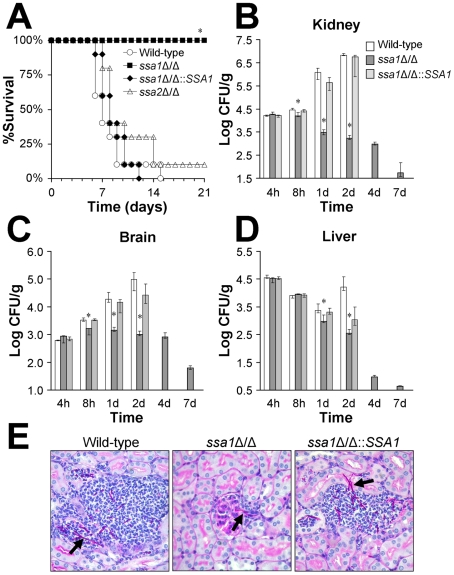
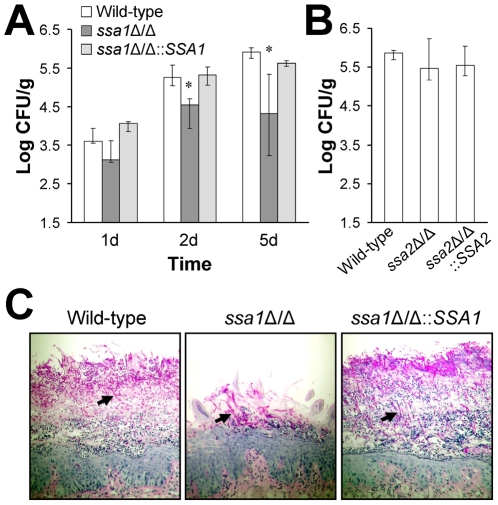
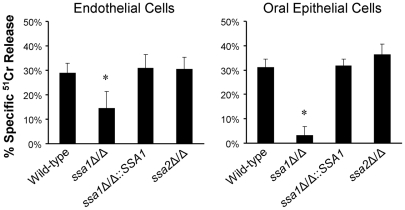
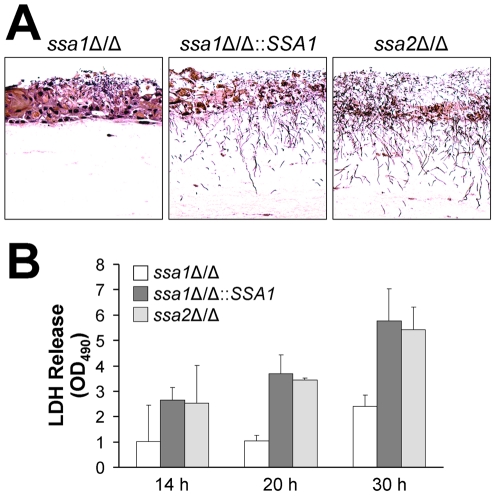
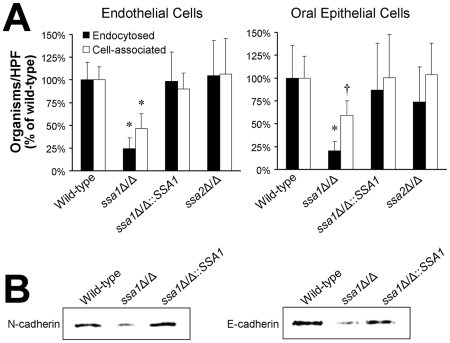
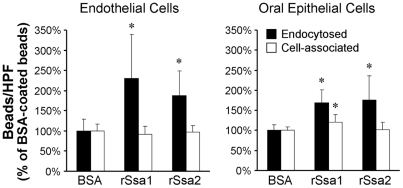
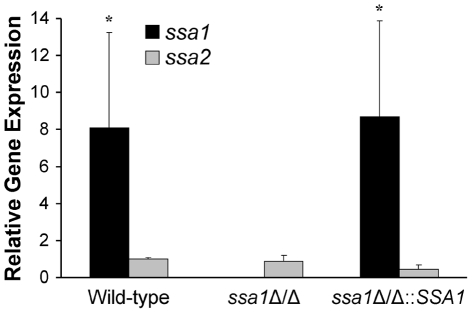
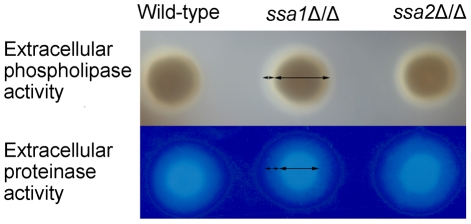
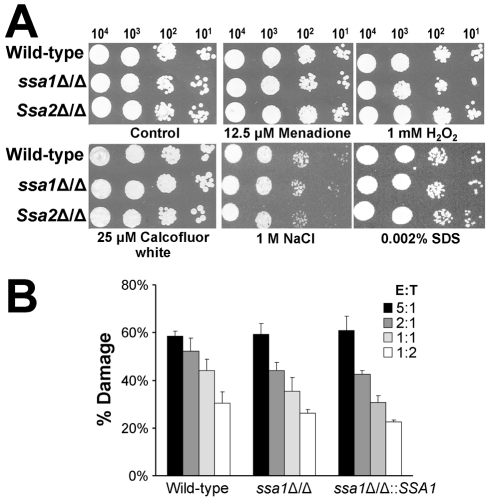
Candida albicans Ssa1 and Ssa2 are members of the HSP70 family of heat shock proteins that are expressed on the cell surface and function as receptors for antimicrobial peptides such as histatins. We investigated the role of Ssa1 and Ssa2 in mediating pathogenic host cell interactions and virulence. A C. albicans ssa1Δ/Δ mutant had attenuated virulence in murine models of disseminated and oropharyngeal candidiasis, whereas an ssa2Δ/Δ mutant did not. In vitro studies revealed that the ssa1Δ/Δ mutant caused markedly less damage to endothelial cells and oral epithelial cell lines. Also, the ssa1Δ/Δ mutant had defective binding to endothelial cell N-cadherin and epithelial cell E-cadherin, receptors that mediate host cell endocytosis of C. albicans. As a result, this mutant had impaired capacity to induce its own endocytosis by endothelial cells and oral epithelial cells. Latex beads coated with recombinant Ssa1 were avidly endocytosed by both endothelial cells and oral epithelial cells, demonstrating that Ssa1 is sufficient to induce host cell endocytosis. These results indicate that Ssa1 is a novel invasin that binds to host cell cadherins, induces host cell endocytosis, and is critical for C. albicans to cause maximal damage to host cells and induce disseminated and oropharyngeal disease.
Overview
The claims and statistics of this paper haven’t been checked yet.
Free: it reads the open-access text and checks the first 5 claims that cite a source we can check. Create a free account to check every claim.
Integrity signals
Registry
Cites
Statistics
Figures
Verification
Claims the paper makes
The claims and statistics of this paper haven’t been checked yet.
Free: it reads the open-access text and checks the first 5 claims that cite a source we can check. Create a free account to check every claim.
Claims other papers make about this one
Each is checked against this paper’s own text: does it say what the citing paper says it does?
The source backs part of the claim, not all of it — or backs it for a different population, condition or comparison.
In the citing paper
“Previously, we identified two C. albicans invasins, Als3 and Ssa1 that mediate invasion of oral epithelial cells by interacting with E-cadherin and EGFR [16,17,19].”
From Candida albicans stimulates formation of a multi-receptor complex that mediates epithelial cell invasion during oropharyngeal infection (2023) · cites this paper as [19]
Experimental — accuracy not yet measuredIn the citing paper
“These invasins bind epithelial cell E-cadherin and initiate endocytosis through an actin-dependent mechanism that requires clathrin [199, 201–205].”
From Mechanisms of fungal dissemination (2021) · cites this paper as [202]
Self-check
Percentages, sums and reported differences re-computed from the paper’s own numbers.
The self-check needs the paper’s full text.
Citations
Cites
Analysis of Relative Gene Expression Data Using Real-Time Quantitative PCR and the 2−ΔΔCT Method
Livak, K. J., & Schmittgen, T. D. (2001) · Methods · doi:10.1006/meth.2001.1262 · Cited by 180,860 · cited 1×
“The results were analyzed by the 2 method [65] using ACT1 as the endogenous control.”
MethodJaffe, E. A., Nachman, R. L., Becker, C. G., & Minick, C. R. (1973) · Journal of Clinical Investigation · doi:10.1172/jci107470 · Cited by 6,856 · cited 1×
“[60] and cultured as described [32] in M-199 medium supplemented with 10% fetal bovine serum and 10% defined bovine calf serum (Gemini Bio-Products), and containing 2 mM L-glutamine with penicillin and streptomycin (Irvine Scientific).”
MethodWisplinghoff, H., Bischoff, T., Tallent, S. M., Seifert, H., Wenzel, R. P., & Edmond, M. B. (2004) · Clinical Infectious Diseases · doi:10.1086/421946 · Cited by 4,496 · cited 1×
“albicans are associated with a 37% mortality [1].”
BackgroundIsogenic strain construction and gene mapping in Candida albicans.
Fonzi, W. A., & Irwin, M. Y. (1993) · Genetics · doi:10.1093/genetics/134.3.717 · Cited by 1,687
Rapid Hypothesis Testing with Candida albicans through Gene Disruption with Short Homology Regions
Wilson, R. B., Davis, D., & Mitchell, A. P. (1999) · Journal of Bacteriology · doi:10.1128/jb.181.6.1868-1874.1999 · Cited by 762 · cited 3×
“These PCR products were then used to successively transform the Ura- ssa1D/D strain [57].”
MethodAls3 Is a Candida albicans Invasin That Binds to Cadherins and Induces Endocytosis by Host Cells
Phan, Q. T., Myers, C. L., Fu, Y., Sheppard, D. C., Yeaman, M. R., Welch, W. H., Ibrahim, A. S., Edwards, J. E., & Filler, S. G. (2007) · PLoS Biology · doi:10.1371/journal.pbio.0050064 · Cited by 641 · cited 6×
“Assessment of surface expression of Als3 and Ssa1 Flow cytometry was used to quantify the amount of Als3 on the surface of the various strains using a slight modification of our previously described method [37].”
BackgroundMethodSelf-citation[27] Preparation of high molecular weight RNA
Köhrer, K., & Domdey, H. (1991) · Methods in Enzymology · doi:10.1016/0076-6879(91)94030-g · Cited by 563 · cited 1×
“At a later time, the cells were thawed on ice and the fungal RNA was extracted by the hot phenol method [64].”
MethodCritical Role of Bcr1-Dependent Adhesins in C. albicans Biofilm Formation In Vitro and In Vivo
Nobile, C. J., Andes, D. R., Nett, J. E., Smith, F. J., Yue, F., Phan, Q.-T., Edwards, J. E., Filler, S. G., & Mitchell, A. P. (2006) · PLoS Pathogens · doi:10.1371/journal.ppat.0020063 · Cited by 507
Self-citationEvidence implicating phospholipase as a virulence factor of Candida albicans
Ibrahim, A. S., Mirbod, F., Filler, S. G., Banno, Y., Cole, G. T., Kitajima, Y., Edwards, J. E., Nozawa, Y., & Ghannoum, M. A. (1995) · Infection and Immunity · doi:10.1128/iai.63.5.1993-1998.1995 · Cited by 351 · cited 2×
“albicans causes host cell damage is incompletely understood, it is probable that phospholipases and aspartyl proteases secreted by the organism participate in this process [35,40–46].”
BackgroundSelf-citationCellular interactions of Candida albicans with human oral epithelial cells and enterocytes
Dalle, F., Wächtler, B., L'Ollivier, C., Holland, G., Bannert, N., Wilson, D., Labruère, C., Bonnin, A., & Hube, B. (2010) · Cellular Microbiology · doi:10.1111/j.1462-5822.2009.01394.x · Cited by 347 · cited 1×
“albicans invades endothelial cells and oral epithelial cells is by inducing its own endocytosis [27,31,33,35].”
Background
Cited by
Items 101–200 of 220
Desai, J., Cheng, S., Ying, T., Nguyen, M., Clancy, C., Lanni, F., & Mitchell, A. (2015) · Pathogens · doi:10.3390/pathogens4030573 · Cited by 27
“albicans hyphae induce their own endocytosis via the surface invasins Als3 and Ssa1 [9,12,13].”
BackgroundInsights and Perspectives on the Role of Proteostasis and Heat Shock Proteins in Fungal Infections
Neves‐da‐Rocha, J., Santos-Saboya, M. J., Lopes, M. E. R., Rossi, A., & Martinez-Rossi, N. M. (2023) · Microorganisms · doi:10.3390/microorganisms11081878 · Cited by 32
“albicans SSA1 mutant exhibits attenuated virulence in murine models of disseminated and oropharyngeal candidiasis [87].”
BackgroundCooperative Role of MAPK Pathways in the Interaction of Candida albicans with the Host Epithelium
Correia, I., Prieto, D., Román, E., Wilson, D., Hube, B., Alonso‐Monge, R., & Plá, J. (2019) · Microorganisms · doi:10.3390/microorganisms8010048 · Cited by 28
“albicans hyphal cells and it is mediated by interactions between the fungal invasins Als3 and Ssa1 and host E-cadherin [4,5], while active penetration requires living C.”
BackgroundInfluentialLi, S.-X., Song, Y.-J., Zhang, Y.-S., Wu, H.-T., Guo, H., Zhu, K.-J., Li, D.-M., & Zhang, H. (2017) · Frontiers in Microbiology · doi:10.3389/fmicb.2017.00285 · Cited by 25
“These genes have long been known for their prominent roles in host tissue adhesion and invasion (Phan et al., 2007; Sun et al., 2010).”
BackgroundArita, G. S., Faria, D. R., Capoci, I. R. G., Kioshima, É. S., Mendonca, P., & Svidzinski, T. I. E. (2022) · Microbiological Research · doi:10.1016/j.micres.2022.126996 · Cited by 25
Antivirulence and avirulence genes in human pathogenic fungi
Siscar-Lewin, S., Hube, B., & Brunke, S. (2019) · Virulence · doi:10.1080/21505594.2019.1688753 · Cited by 30
“It acts as an invasin, and a ssa1Δ/Δ mutant shows attenuated virulence in mouse models of both disseminated and oropharyngeal candidiasis [109].”
BackgroundJia, L., Krüger, T., Blango, M. G., von Eggeling, F., Kniemeyer, O., & Brakhage, A. A. (2020) · mSphere · doi:10.1128/msphere.00535-20 · Cited by 26
“albicans to cause maximal host cell damage (51).”
BackgroundPote, S. T., Sonawane, M. S., Rahi, P., Shah, S. R., Shouche, Y. S., Patole, M. S., Thakar, M. R., & Sharma, R. K. (2020) · Infection and Drug Resistance · doi:10.2147/idr.s238002 · Cited by 25
Horianopoulos, L. C., Lee, C. W. J., Hu, G., Caza, M., & Kronstad, J. W. (2021) · Frontiers in Microbiology · doi:10.3389/fmicb.2021.727039 · Cited by 24
Curvelo, J. A. D. R., Barreto, A. L. S., Portela, M. B., Alviano, D. S., Holandino, C., Souto-Padrón, T. C. B. S., & Soares, R. M. D. A. (2014) · Archives of Oral Biology · doi:10.1016/j.archoralbio.2014.05.007 · Cited by 27
Shen, H., Yu, Y., Chen, S.-M., Sun, J., Fang, W. Y., Guo, S., Hou, W.-T., Qiu, X.-R., Zhang, Y., Chen, Y., et al. (2020) · Frontiers in Microbiology · doi:10.3389/fmicb.2020.01648 · Cited by 24
“We also thank Dr. Filler SG (State University of New York) for kindly providing ssa1 mutant C. albicans and Dr. Jun Gu (Changhai Hospital, Shanghai, China) for kindly providing the C. albicans isolates 0304103.”
BackgroundMethodInfluentialSelf-citationWang, X. (2021) · Infectious diseases · doi:10.5772/intechopen.87410 · Cited by 22
Cuéllar‐Cruz, M., Gutiérrez‐Sánchez, G., López-Romero, E., Ruiz‐Baca, E., Villagómez-Castro, J. C., & Rodríguez‐Sifuentes, L. (2013) · Open Life Sciences · doi:10.2478/s11535-013-0138-9 · Cited by 23
Anuța, V., Talianu, M.-T., Dinu‐Pîrvu, C., Ghica, M. V., Prisada, R. M., Kaya, M. G. A., & Popa, L. (2022) · International Journal of Molecular Sciences · doi:10.3390/ijms23147520 · Cited by 26
“Agglutinin-like sequence-3 (Als3) represents one of the invasins implied in endocytosis [93], along with the heat shock protein Ssa1 from the Hsp70 family [90,94].”
BackgroundDifferent Host Immunological Response to C. albicans by Human Oral and Vaginal Epithelial Cells
Gao, Y. J., Liang, G., Wang, Q., She, X., Shi, D., Shen, Y., Su, X.-H., Wang, X., Wang, W., Li, D., et al. (2019) · Mycopathologia · doi:10.1007/s11046-018-0301-6 · Cited by 23
Liu, W., Zou, Z., Huang, X., Shen, H., He, L. J., Chen, S. M., Li, L. P., Yan, L., Zhang, S. Q., Zhang, J. D., et al. (2016) · Scientific Reports · doi:10.1038/srep34854 · Cited by 20
Going with the Flo: The Role of Flo11-Dependent and Independent Interactions in Yeast Mat Formation
Reynolds, T. B. (2018) · Journal of Fungi · doi:10.3390/jof4040132 · Cited by 19
Hgc1 Independence of Biofilm Hyphae in Candida albicans
Sharma, A., Solis, N. V., Huang, M. Y., Lanni, F., Filler, S. G., & Mitchell, A. P. (2023) · mBio · doi:10.1128/mbio.03498-22 · Cited by 21
“albicans was measured using the previously described (51)Cr release assay (28, 42).”
MethodSelf-citationRossato, L. L., Moreno, L. F., Jamalian, A., Stielow, J. B., de Almeida, S. R., de Hoog, S., & Freeke, J. (2018) · mSphere · doi:10.1128/msphere.00514-17 · Cited by 24
Candida albicans Virulence Traits in Commensalism and Disease
Fróis-Martins, R., Lagler, J., & LeibundGut‐Landmann, S. (2024) · Current Clinical Microbiology Reports · doi:10.1007/s40588-024-00235-8 · Cited by 23
“The cell wall proteins Als3, Hwp1, Hyr1, and Ssa1 are involved in host cell adhesion and invasiveness [66–69] with relevance for fungal virulence during superficial and systemic infections [67, 69].”
Davis, S., Tams, R. N., Solis, N. V., Wagner, A. S., Chen, T., Jackson, J. W., Hasim, S., Montedonico, A. E., Dinsmore, J. T., Sparer, T. E., et al. (2018) · Infection and Immunity · doi:10.1128/iai.00815-17 · Cited by 19
“Percent cytotoxicity was calculated as described in the manufacturer’s protocol by comparing samples to epithelial cells treated with lysis solution (24).”
MethodSelf-citationWeissman, Z., Pinsky, M., Wolfgeher, D. J., Kron, S. J., Truman, A. W., & Kornitzer, D. (2018) · Biochimica et Biophysica Acta (BBA) - Proteins and Proteomics · doi:10.1016/j.bbapap.2018.09.001 · Cited by 19
Devasundaram, S., Gopalan, A., Das, S. D., & Raja, A. (2016) · Frontiers in Microbiology · doi:10.3389/fmicb.2016.01275 · Cited by 15
Naseem, S., Douglas, L. M., & Konopka, J. B. (2019) · mBio · doi:10.1128/mbio.02503-19 · Cited by 18
“albicans to initially colonize the oral cavity by binding to the epithelial cells lining the oral mucosa (10, 11).”
1 From Commensal to Pathogen: Candida albicans
Whittington, A., Gow, N. A. R., & Hube, B. (2013) · Springer eBooks · doi:10.1007/978-3-642-39432-4_1 · Cited by 20
Nayak, A., Khedri, A., Chavarria, A., Sanders, K. N., Ghalei, H., & Khoshnevis, S. (2024) · npj Antimicrobials and Resistance · doi:10.1038/s44259-024-00040-9 · Cited by 18
“Thesemolecularchaperonesareveryimportant forhyphalmorphogenesis,bio fi lm formation, and host-cell invasion in response to temperature cues, and their inhibition leads to signi fi cantly reduced fungal virulence 46 – 50 .”
Naglik, J. R., Tang, S. X., & Moyes, D. L. (2013) · Current Fungal Infection Reports · doi:10.1007/s12281-013-0129-y · Cited by 18
Sun, Z., Wang, Q., Sun, M., & Li, S. (2019) · FEMS Microbiology Letters · doi:10.1093/femsle/fnz188 · Cited by 12
Otang, W. M., Grierson, D. S., & Ndip, R. N. (2011) · International Journal of Molecular Sciences · doi:10.3390/ijms12129226 · Cited by 12
“arctotoides leaves was prepared as previously described [4].”
BackgroundMethodCan host receptors for fungi be targeted for treatment of fungal infections?
Filler, S. G. (2013) · Trends in Microbiology · doi:10.1016/j.tim.2013.05.006 · Cited by 16
“The other invasin is Ssa1, which is a 70 kDa heat shock protein [14].”
BackgroundSelf-citationCritical roles of adherens junctions in diseases of the oral mucosa
Kingsley, C., & Kourtidis, A. (2022) · Tissue Barriers · doi:10.1080/21688370.2022.2084320 · Cited by 12
Buldain, I., Pellón, A., Zaldibar, B., Antoran, A., Martin–Souto, L., Aparicio-Fernandez, L., Areitio, M., Mayayo, E., Rementería, A., Hernando, F. L., et al. (2019) · Vaccines · doi:10.3390/vaccines7040212 · Cited by 11
“In addition, proteins of this family have been previously described as antigens [36–38] or virulence factors of important pathogenic fungi [48,49].”
BackgroundRick, E., Woolnough, K., Richardson, M., Monteiro, W. R., Craner, M., Bourne, M., Cousins, D. J., Swoboda, I., Wardlaw, A. J., & Pashley, C. H. (2024) · Allergy · doi:10.1111/all.16032 · Cited by 11
“Secondly, cytosolic proteins such as HSP70, ribosomal proteins and metabolic enzymes are part of the surface proteome of A. fumigatus 39 and Paracoccidioides .”
BackgroundGlass, K. A., Longley, S. J., Bliss, J. M., & Shaw, S. K. (2015) · Virulence · doi:10.1080/21505594.2015.1042643 · Cited by 11
“Ssa1 is another adhesion molecule that binds to host cadherins and leads to endocytosis.(20) Putative homologs to C.”
BackgroundRecent Advances in Vaginal Delivery for the Treatment of Vulvovaginal Candidiasis
Kaur, S., & Kaur, S. (2020) · Current Molecular Pharmacology · doi:10.2174/1573405616666200621200047 · Cited by 11
Ssa1-targeted antibody prevents host invasion by Candida albicans
Qiu, X.-R., Shen, C.-R., Jiang, L., Ji, P., Zhang, Y., Hou, W.-T., Zhang, W., Shen, H., & An, M. (2023) · Frontiers in Microbiology · doi:10.3389/fmicb.2023.1182914 · Cited by 11
Effects of the Tobacco Defensin NaD1 Against Susceptible and Resistant Strains of Candida albicans
Shevchenko, O. V., Voropaev, A. D., Bogdanov, I. V., Ovchinnikova, T. V., & Finkina, E. I. (2024) · Pathogens · doi:10.3390/pathogens13121092 · Cited by 10
Teng, W., Subsomwong, P., Narita, K., Nakane, A., & Asano, K. (2024) · Cells · doi:10.3390/cells13020127 · Cited by 9
“Significant differential proteins between”
Serum bridging molecules drive candidal invasion of human but not mouse endothelial cells
Phan, Q. T., Solis, N. V., Lin, J., Swidergall, M., Singh, S., Liu, H., Sheppard, D. C., Ibrahim, A. S., Mitchell, A. P., & Filler, S. G. (2022) · PLoS Pathogens · doi:10.1371/journal.ppat.1010681 · Cited by 11
Self-citationThe pathogenicity and future treatment strategies of Candida albicans
Wu, J., Jiang, C., Wang, H., Chen, T., Chen, X., & Da, W. (2026) · Frontiers in Cellular and Infection Microbiology · doi:10.3389/fcimb.2026.1752304 · Cited by 10
“Inducible endocytosis is mainly achieved through two invasive proteins, ALS3 and SSA1, which achieve this by binding to the N-cadherin and E-cadherin of host endothelial cells and epithelial cells (Sun et al., 2010).”
Discovering a new paradigm: Gut microbiota as a central modulator of sexual health
Marano, G., Anesini, M. B., Milintenda, M., Acanfora, M., d’Abate, C., Lisci, F. M., Pirona, I., Traversi, G., Pola, R., Gaetani, E., et al. (2025) · World Journal of Gastrointestinal Pathophysiology · doi:10.4291/wjgp.v16.i3.107823 · Cited by 7
“Two key proteins, Als3 and Ssa1, function in the “invasion” process[69,70].”
Evaluating Common Humoral Responses against Fungal Infections with Yeast Protein Microarrays
Coelho, P. S. R., Im, H., Clemons, K. V., Snyder, M. P., & Stevens, D. A. (2015) · Journal of Proteome Research · doi:10.1021/acs.jproteome.5b00365 · Cited by 7
“protection against experimental infections (22-27).”
Commensal to Pathogen Transition of Candida albicans
Niemiec, M. J., Kapitan, M., Polke, M., & Jacobsen, I. D. (2017) · Elsevier eBooks · doi:10.1016/b978-0-12-809633-8.12077-1 · Cited by 9
Epithelial Infection With Candida albicans Elicits a Multi-System Response in Planarians
Maciel, E. I., Arevalo, A. V., Ziman, B., Nobile, C. J., & Oviedo, N. J. (2021) · Frontiers in Microbiology · doi:10.3389/fmicb.2020.629526 · Cited by 9
“Ssa1 and Als3) that bind to cadherins on host cell surfaces (Filler, 2013; Moreno-Ruiz et al., 2009; Nobile et al., 2006; Phan et al., 2007; Sun et al., 2010).”
BackgroundYang, J., Feng, W., Zhang, J., Xi, Z., Ma, Y., Wang, Y., Ji, Y., Wang, Y., & Zhang, W. (2016) · Experimental and Therapeutic Medicine · doi:10.3892/etm.2016.3464 · Cited by 5
Altmeier, S., & LeibundGut‐Landmann, S. (2017) · Springer eBooks · doi:10.1007/978-3-319-50842-9_2 · Cited by 5
Pathogenicity Mechanism of Candida albicans
Pattnaik, S., Maharana, L., & Sethi, M. (2021) · Infectious diseases · doi:10.5772/intechopen.99737 · Cited by 9
“, Als3 and Ssa1 freaks displayed diminished grip and intrusion of cells of epithelium [43].”
BackgroundCommensal to Pathogen Transition of Candida albicans
Jacobsen, I. D., Niemiec, M. J., Kapitan, M., & Polke, M. (2020) · Elsevier eBooks · doi:10.1016/b978-0-12-809633-8.21281-8 · Cited by 6
Surviving the Storm: How Candida Species Master Adaptation for Pathogenesis
Rana, A., Gupta, N., Asif, S., & Thakur, A. (2024) · Springer eBooks · doi:10.1007/978-981-97-4909-6_5 · Cited by 5
de Figueiredo, S. M., Campolina, S. S., Rosa, C. A., Gontijo, M., Tirone, T., Assunção, C. B., Freire, T. F. A., Christo, P. P., & Caligiorne, R. B. (2014) · Medical Mycology Case Reports · doi:10.1016/j.mmcr.2013.12.001 · Cited by 4
“albicans invasins bind to receptors such as N-cadherin and HER2 on the endothelial cell surface [14–16].”
BackgroundLo, S. G., Wong, S. F., Mak, J. W., Choo, K. K., & Ng, K. P. (2019) · Medical Mycology · doi:10.1093/mmy/myz061 · Cited by 3
Mishra, A. K., Solis, N. V., Dietz, S. M., Crouch, A. L., Filler, S. G., & Anderson, M. Z. (2025) · PLoS Genetics · doi:10.1371/journal.pgen.1011650 · Cited by 3
“The extent of epithelial cell damage caused by the different strains of C. albicans was measured using the 51 Cr release assay as previously described [49].”
Self-citationHuang, Y., Song, N., Jing, D., Liu, W., Li, D., Zhou, X., & Li, X. (2025) · Microbiology Spectrum · doi:10.1128/spectrum.00810-25 · Cited by 4
“Ssa1, a novel essential for epithelial cell endocytosis and systemic infection (51), harbored 40 Kla sites, most of which were downregulated in tolerant cells, indicating a possible role in modulating host–pathogen interactions.”
Critical parameters of fungal pathogenicity at the epithelial interphase
Möslinger, A., Allert, S., Vylkova, S., & Hube, B. (2026) · microLife · doi:10.1093/femsml/uqag001 · Cited by 3
“While Hyr1 and Ssa1 function exclusively as invasins in induced endocytosis, Als3 might also contribute to active penetration (Wächtler et al. 2012 , Phan et al. 2023 ).”
InfluentialPadró-Villegas, L., & Mora-Montes, H. M. (2026) · Journal of Fungi · doi:10.3390/jof12060414 · Cited by 4
“Adhesion to epithelial/endothelial cells, mediates endocytosis, immune evasion [78–80,”
Handayani, S., Nurdiana, N., Winarsih, S., & Endharti, A. T. (2022) · Open Access Macedonian Journal of Medical Sciences · doi:10.3889/oamjms.2022.8086 · Cited by 3
“albicans invades the host by induced endocytosis [26], this fungal expresses surface proteins E-cadherin and N-cadherin (Figure 6).”
BackgroundProtein-Protein Interactions in Host–Pathogen Interactions
Poluri, K. M., Gulati, K., Tripathi, D. K., & Nagar, N. (2023) · Springer eBooks · doi:10.1007/978-981-99-2423-3_5 · Cited by 8
Yang, L., Cheng, T., & Shao, J. (2023) · Medical Mycology · doi:10.1093/mmy/myad077 · Cited by 4
Liu, H., Lin, J., Phan, Q. T., Gravelat, F. N., Sheppard, D. C., & Filler, S. G. (2023) · mSphere · doi:10.1128/msphere.00314-23 · Cited by 3
Self-citationLiang, X., Pacuła‐Miszewska, A. J., Vartak, R., Prajapati, M., Zheng, H., Zhao, C., Mao, G., Patel, K. R., Fedosova, N. U., Ścianowski, J., et al. (2024) · Current Issues in Molecular Biology · doi:10.3390/cimb46030157 · Cited by 3
Flores-Suárez, B., Bonilla‐Lemus, P., Rojas-Hernández, S., Terrazas-Valdés, L. L., & Carrasco‐Yépez, M. M. (2024) · Journal of Parasitology · doi:10.1645/22-86 · Cited by 4
Dev, R. (2021) · Journal of Pure and Applied Microbiology · doi:10.22207/jpam.15.1.42 · Cited by 4
Host-Fungal Interactions: Pathogenicity versus Immunity
Tavanti, A., Naglik, J. R., & Osherov, N. (2012) · International Journal of Microbiology · doi:10.1155/2012/562480 · Cited by 5
Jiang, W., Liu, P., Zhang, J., & Yang, W. (2019) · Indian Journal of Microbiology · doi:10.1007/s12088-019-00847-5 · Cited by 4
Candida albicans Ssa: An Hsp70 Homologue and Virulence Factor
Puri, S., & Edgerton, M. (2013) · Heat shock proteins · doi:10.1007/978-94-007-6787-4_14 · Cited by 4
Self-citationTissue-engineered models of oral soft tissue diseases
Moharamzadeh, K., Colley, H. E., Hearnden, V. L., & Murdoch, C. (2017) · Elsevier eBooks · doi:10.1016/b978-0-08-100961-1.00015-3 · Cited by 5
Systemic Acetylome Analysis of Evolution in Fluconazole Resistance Candida auris
Zhou, X., Jing, D., Huang, Y., Song, N., Li, D., Liu, W., Liu, C., & Li, X. (2025) · Journal of Proteome Research · doi:10.1021/acs.jproteome.4c01031 · Cited by 2
Increased fungal burden in the gastrointestinal tract of brain-dead organ donors
Nachman, E. J., Ardis, C. K., Ardis, A. K. B., Nieto, J., Bresson, M. M., Robertson, C. M., Seale, M. N., Villafuerte, N. M., Lyu, Z., Preisner, E. C., et al. (2025) · Microbiology Spectrum · doi:10.1128/spectrum.03341-24 · Cited by 2
“We focused on invasion ( SSA1 ) (27), adhesions (AWP1) (28), and survival in macrophages ( SKN7 , YAP1 , MSN4,VPS34, HOG1 ) (29–31) for N. glabratus isolates (Table S3).”
Álvaro-Moya, M., Blesa, A., Prieto, D., Román, E., Plá, J., & Alonso‐Monge, R. (2025) · Journal of Proteome Research · doi:10.1021/acs.jproteome.4c00691 · Cited by 2
Dectin-1 stimulating β-glucans inhibit Chlamydia infections both in vitro and in vivo
Kintner, J., Callaghan, M., Bulawa, L., Chu, A., Ma, Z., Williams, D. L., Schoborg, R. V., Kruppa, M., & Hall, J. V. (2025) · Pathogens and Disease · doi:10.1093/femspd/ftaf002 · Cited by 3
“Another group of surface-exposed Candida proteins that are important for attac hment/inv asion ar e the heat shoc k 70 pr oteins, Ssa1, and Ssa2 (Li et al. 2006 , Sun et al. 2010 ).”
O’Donnell, L. E., Robertson, D. P., & Ramage, G. (2015) · Springer eBooks · doi:10.1007/978-3-662-47194-4_2 · Cited by 7
Cytotoxic or cytoprotective chaperones: An unfolded biology in oral lesions
Kashyap, B., Sridhar Reddy, P., & Rajguru, J. P. (2017) · Clinical Research and Trials · doi:10.15761/crt.1000181 · Cited by 2
“demonstrated that sHsp is involved in Candida albicans adaptation to specific environmental stresses, homeostasis of intracellular stress protectants, immune evasion, as well as pathogenicity [96-99].”
BackgroundAbrantes, P. M. D. S., Fisher, R., Bouic, P. J., McArthur, C. P., Fielding, B. C., Africa, C. W. J., & Synexa Life Sciences, P. B. 3. (2021) · AIMS Microbiology · doi:10.3934/microbiol.2021020 · Cited by 4
“The presence of Hsp70 (SSA1) in most tested isolates, the ability of this protein to affect the fungicidal activity of the host’s antimicrobial peptides [16] and its association with oropharyngeal disease [17] are factors that can directly influence the treatment outcomes of HIV patients.”
BackgroundAl-Garawi, N. A.-H. D., Suhail, A. A., & Meri, M. A. (2022) · Medical Science Journal for Advance Research · doi:10.46966/msjar.v3i1.34 · Cited by 6
Yeh, S., Yeh, C.-C., Lan, C., & Chen, B. (2019) · Toxins · doi:10.3390/toxins11020119 · Cited by 4
Activation of oral epithelial EphA2-EFGR signaling by Candida albicans virulence factorsPreprint
Swidergall, M., Solis, N. V., Millet, N., Huang, M. Y., Lin, J., Phan, Q. T., Lazarus, M. D., Wang, Z., Mitchell, A. P., & Filler, S. G. (2018) · bioRxiv (Cold Spring Harbor Laboratory) · doi:10.1101/491076 · Cited by 2
“This interaction triggers 68 rearrangement of the epithelial cell cytoskeleton, leading to the formation of pseudopods that 69 engulf the organism and pull it into the host cell (4-7).”
Self-citationPhan, Q., Solis, N., Cravener, M. V., Swidergall, M., Lin, J., Huang, M.-N. Y., Liu, H., Singh, S., Ibrahim, A., Mazzone, M., et al. (2023) · bioRxiv · doi:10.1101/2023.02.23.529756 · Cited by 6
“Previously, we identified two C. albicans invasins, Als3 and Ssa1 that mediate invasion of oral epithelial cells by interacting with E-cadherin and EGFR (Phan et al., 2007; Sun et al., 2010; Zhu et al., 2012).”
Self-citationMolecular Cues and Mechanisms of Pathogenesis in Candida
Sahoo, S., & Rao, K. H. (2024) · Springer eBooks · doi:10.1007/978-981-97-4909-6_6 · Cited by 1
Martin–Souto, L., Abio-Dorronsoro, L., Areitio, M., Aparicio-Fernandez, L., Rodriguez-Erenaga, O., Martín-Gómez, M. T., Antoran, A., Rementería, A., Buldain, I., & Ramirez‐Garcia, A. (2025) · Journal of Proteome Research · doi:10.1021/acs.jproteome.5c00260 · Cited by 1
A comprehensive review of neurotropic fungal infections: clinical manifestations and vaccines
Khodadad, N., Fani, M., Barati, M., Keikha, N., Nasiri-Jahrodi, A., & Firouzeh, N. (2025) · Neurological Sciences · doi:10.1007/s10072-025-08696-5 · Cited by 1
“One way that C.albicans invades these cells is by inducing its own endocytosis, which is triggered when the C.albicans invasins, Als3 and Ssa1, bind to receptors on the endothelial cell surface [ 42 , 43 ].”
Kanchanapiboon, J., Tuntoaw, S., Poonsatha, S., Maiuthed, A., Rukthong, P., Thumanu, K., Siriwong, S., Thunyaharn, S., Wachisuthon, D., Sakpetch, A., et al. (2026) · Microbial Pathogenesis · doi:10.1016/j.micpath.2026.108417 · Cited by 1
Influence of fungi on epithelial homeostasis and role in inflammatory diseases
Peterson, L. F., Wang, J., Gow, N. A. R., LeibundGut‐Landmann, S., & Brewer, M. G. (2026) · Clinical Microbiology Reviews · doi:10.1128/cmr.00319-25 · Cited by 1
“Following attachment, Als3p in tandem with Ssa1p, a member of the Hsp70 family (146), promotes endocytosis by interacting with host cell receptors, including E-cadherin, HER2, and EGFR (147).”
In vitro models of hematogenously disseminated candidiasis
Filler, S. G. (2014) · Virulence · doi:10.4161/viru.27453 · Cited by 2
“The correlation between host cell damage and virulence has been demonstrated most clearly using the human umbilical vein endothelial cell model.(19,36-38) However, some mutant strains have significantly impaired capacity to damage endothelial cells in vitro, yet have normal or even increased virulence during dissemina…”
BackgroundSelf-citationResponses of White Blood Cells to Killed Candida albicans as a Preventive Strategy
Ibrahim, A. (2021) · Infectious diseases · doi:10.5772/intechopen.96946 · Cited by 1
Management of Candida albicans infections by lactic acid bacteria
Vikrant, V., Sharma, A., Priyanka, P., & Azmi, W. (2023) · Annals of Phytomedicine An International Journal · doi:10.54085/ap.2023.12.2.8
Aspergillosis: interactions of Aspergillus fumigatus andHuman Airway Cells
Safari, M. (2013) · WestminsterResearch (University of Westminster) · doi:10.34737/8z158 · Cited by 1
Puri, S., Kumar, R., Chadha, S., Tati, S., Conti, H. R., Hube, B., Cullen, P. J., & Edgerton, M. (2013) · PLoS ONE · doi:10.1371/annotation/13ef5e14-c192-4bb2-af91-886024500b4b · Cited by 1
Self-citationPhan, Q., Solis, N., Lin, J., Swidergall, M., Singh, S., Liu, H., Sheppard, D., Ibrahim, A., Mitchell, A., & Filler, S. (2021) · bioRxiv · doi:10.1101/2021.09.18.460925 · Cited by 1
“89 albicans Als3 and Ssa1, invasins that are expressed by hyphae (5, 6, 8).”
BackgroundSelf-citationAntifungal Activity of Cationic Conjugated Polyelectrolytes and Oligomers against Candida albicans
Ingersol, L. J. (2014) · UNM’s Digital Repository (University of New Mexico)
CANDIDA YEASTS AND CARCINOGENIC ACETALDEHYDE IN UPPER DIGESTIVE TRACT CARCINOGENESIS
Nieminen, M. T. (2014) · Helda - University of Helsinki Institutional Repository
Gazda - patogén kölcsönhatás vizsgálata Candida fertőzések során
Németh, T. (2014) · SZTE Repository of Dissertations (University of Szeged) · doi:10.14232/phd.2021
de Almeida, J. R. F. (2018) · Digital Library of Theses and Dissertations (Universidade de São Paulo) · doi:10.11606/t.9.2018.tde-05032018-172654 · Cited by 1
Distinct myeloid cell subpopulations in controlling systemic candidiasis
Teo, Y. J. (2018) · doi:10.32657/10220/46873
“does not require viable fungi, where the expression of invasins by Candida, such as Als3 [24] and Ssa1 [25], triggers its own engulfment by the host cells”
BackgroundJia, L., Krüger, T., Blango, M. G., Kniemeyer, O., & Brakhage, A. A. (2020) · bioRxiv (Cold Spring Harbor Laboratory) · doi:10.1101/2020.04.03.021493
Chronic invasive candidiasis in murine CARD9-deficiency
Landekic, M. (2021) · eScholarship@McGill (McGill) · doi:10.82308/17175 · Cited by 1
Oral and Dental Infections: Fungi
López‐Pintor, R. M., Serrano, J., & Hernández, G. (2021) · Elsevier eBooks · doi:10.1016/b978-0-12-818731-9.00114-2
La Malvasia istriana nel Triveneto. Risultati di un quinquennio di sperimentazione
Costacurta, A., Carraro, R., Niero, M., Molin, E., & Ostan, M. (2005) · Rivista di viticoltura e di enologia
(2021) · Elsevier eBooks · doi:10.1016/b978-0-12-816983-4.00003-1
Jia, L., Rafiq, M., Radosa, L., Hortschansky, P., Cunha, C., Cseresnyés, Z., Krüger, T., Schmidt, F., Heinekamp, T., Straßburger, M., et al. (2022) · SSRN Electronic Journal · doi:10.2139/ssrn.4158007
Metadata
- Authors
- Sun, J. N., Solis, N. V., Phan, Q. T., Bajwa, J. S., Kashleva, H., Thompson, A., Liu, Y., Dongari-Bagtzoglou, A., Edgerton, M., & Filler, S. G.
- Affiliations
- University at Buffalo, State University of New York (US)
- University of California, Los Angeles (US)
- University of Connecticut (US)
- Corresponding author
- Edgerton, Mira
- Filler, Scott G.
- Venue
- PLoS Pathogens
- Publisher
- Public Library of Science (PLoS)
- Published
- 2010-11-11
- Volume
- 6
- Issue
- 11
- Pages
- e1001181
- ISSN
- 1553-7366 (ISSN-L)
- 1553-7374
- PMC
- PMC2978716
- OpenAlex
- W2090227081
- Cited by
- 220
- References
- 69
- Citations by year
- 2026: 7 · 2025: 14 · 2024: 12 · 2023: 14 · 2022: 22 · 2021: 21 · 2020: 14 · 2019: 17 · 2018: 16 · 2017: 11 · 2016: 14 · 2015: 14 · 2014: 13 · 2013: 14 · 2012: 11
- FWCI
- 6.22
- Type
- journal article
- Language
- en
- Open access
- gold
- doi.org
- Locations
- PLoS Pathogens (publishedVersion, cc-by)
- Europe PMC (PubMed Central) (publishedVersion, cc-by)
- PubMed Central (publishedVersion, cc-by)
- PubMed (publishedVersion)
- eScholarship (California Digital Library) (submittedVersion, cc-by)
- DOAJ (DOAJ: Directory of Open Access Journals) (submittedVersion, cc-by-sa)
- eScholarship (California Digital Library) (submittedVersion)
- Figshare (submittedVersion, cc-by)
- Funders
- National Institutes of Health
- National Institute of Allergy and Infectious Diseases (R01AI054928)
- National Institute of Dental and Craniofacial Research (R01 DE 13986, R01DE013986, R01DE017088, R01DE010641)
- National Center for Research Resources (M01RR000425, M01-RR00425)
- NIH Clinical Center
- Topics
- Health Sciences › Medicine › Infectious Diseases › Antifungal resistance and susceptibility
- Life Sciences › Biochemistry, Genetics and Molecular Biology › Molecular Biology › Fungal and yeast genetics research
- Health Sciences › Medicine › Infectious Diseases › Fungal Infections and Studies
- Keywords
- Candida albicans, Ssa1, Ssa2, host cell invasion, virulence, cadherins, N-cadherin, E-cadherin, endothelial cells, oral epithelial cells, systemic candidiasis, oropharyngeal candidiasis, cell surface receptors
- MeSH terms
- Animals, Candida albicans, Candidiasis, DNA, Bacterial, Endocytosis, Epithelial Cells, Male, Mice, Inbred BALB C, Virulence, Cadherins, Polymerase Chain Reaction, HSP70 Heat-Shock Proteins, Endothelial Cells, Mice
About these checks
Registry, retraction, Cites and statistics results are computed, not judged, with one exception: a printed reference that no index lists is read once by a model before it counts as a citation error. Claims are extracted by a model and kept only when their quote appears verbatim in the text; each cited source is then checked, with a model’s help, for whether it says what the claim relies on. Those verdicts can be wrong — read the claim’s quote and the cited source before relying on one.
Statistics and arithmetic are recomputed, not judged.
Confidence bands are shown only for fields calibrated on our annotated test set. None is calibrated yet, so no band is shown.
What counts as a claim ›How we measure confidence ›How we check this ›
Are you an author, or do you see a problem with this page? Request a review
Data sources
Bibliographic data: Semantic Scholar, OpenAlex, Crossref.
Contains information from the Semantic Scholar Academic Graph Datasets, made available under the ODC Attribution License (ODC-BY 1.0).
Semantic Scholar’s data is described in: Kinney, R., et al. (2023). The Semantic Scholar Open Data Platform. arXiv:2301.10140.
