

Host Cell Invasion and Virulence Mediated by Candida albicans Ssa1
Open accessThe DOI matches its Crossref record; 68 of the 69 references it cites were found in a registry or an index.
Abstract
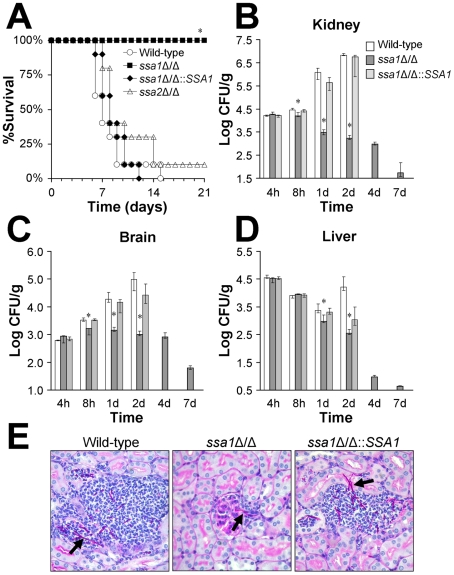
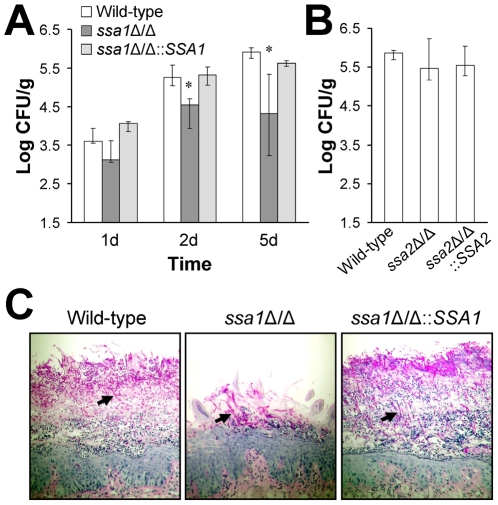
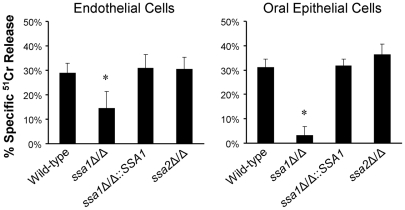
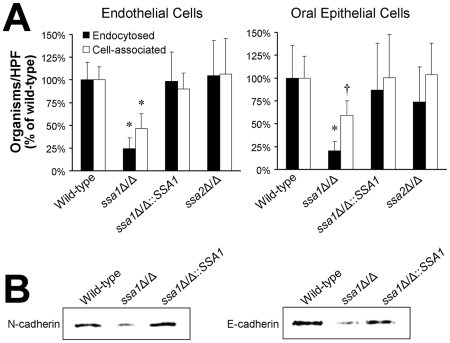
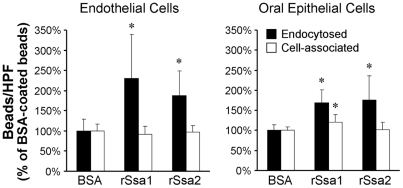
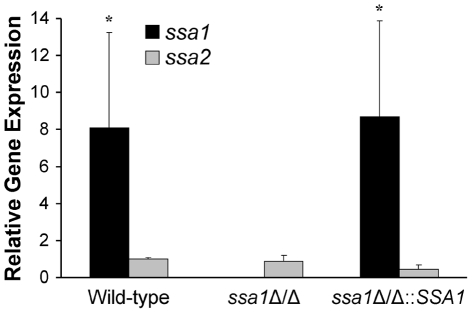
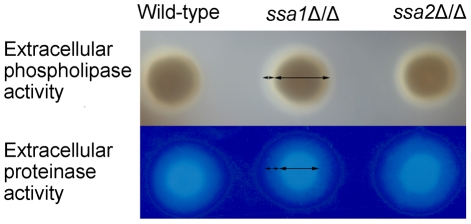
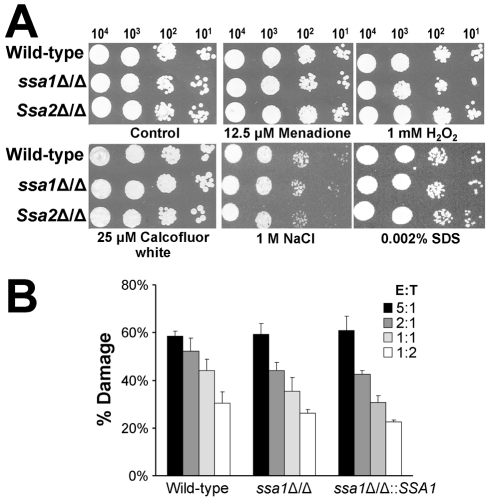
Candida albicans Ssa1 and Ssa2 are members of the HSP70 family of heat shock proteins that are expressed on the cell surface and function as receptors for antimicrobial peptides such as histatins. We investigated the role of Ssa1 and Ssa2 in mediating pathogenic host cell interactions and virulence. A C. albicans ssa1Δ/Δ mutant had attenuated virulence in murine models of disseminated and oropharyngeal candidiasis, whereas an ssa2Δ/Δ mutant did not. In vitro studies revealed that the ssa1Δ/Δ mutant caused markedly less damage to endothelial cells and oral epithelial cell lines. Also, the ssa1Δ/Δ mutant had defective binding to endothelial cell N-cadherin and epithelial cell E-cadherin, receptors that mediate host cell endocytosis of C. albicans. As a result, this mutant had impaired capacity to induce its own endocytosis by endothelial cells and oral epithelial cells. Latex beads coated with recombinant Ssa1 were avidly endocytosed by both endothelial cells and oral epithelial cells, demonstrating that Ssa1 is sufficient to induce host cell endocytosis. These results indicate that Ssa1 is a novel invasin that binds to host cell cadherins, induces host cell endocytosis, and is critical for C. albicans to cause maximal damage to host cells and induce disseminated and oropharyngeal disease.
Overview
The claims and statistics of this paper haven’t been checked yet.
Free: it reads the open-access text and checks the first 5 claims that cite a source we can check. Create a free account to check every claim.
Integrity signals
Registry
Cites
Statistics
Figures
Verification
Claims the paper makes
The claims and statistics of this paper haven’t been checked yet.
Free: it reads the open-access text and checks the first 5 claims that cite a source we can check. Create a free account to check every claim.
Claims other papers make about this one
Each is checked against this paper’s own text: does it say what the citing paper says it does?
The source backs part of the claim, not all of it — or backs it for a different population, condition or comparison.
In the citing paper
“Previously, we identified two C. albicans invasins, Als3 and Ssa1 that mediate invasion of oral epithelial cells by interacting with E-cadherin and EGFR [16,17,19].”
From Candida albicans stimulates formation of a multi-receptor complex that mediates epithelial cell invasion during oropharyngeal infection (2023) · cites this paper as [19]
Experimental — accuracy not yet measuredIn the citing paper
“These invasins bind epithelial cell E-cadherin and initiate endocytosis through an actin-dependent mechanism that requires clathrin [199, 201–205].”
From Mechanisms of fungal dissemination (2021) · cites this paper as [202]
Self-check
Percentages, sums and reported differences re-computed from the paper’s own numbers.
The self-check needs the paper’s full text.
Citations
Cites
Analysis of Relative Gene Expression Data Using Real-Time Quantitative PCR and the 2−ΔΔCT Method
Livak, K. J., & Schmittgen, T. D. (2001) · Methods · doi:10.1006/meth.2001.1262 · Cited by 180,860 · cited 1×
“The results were analyzed by the 2 method [65] using ACT1 as the endogenous control.”
MethodJaffe, E. A., Nachman, R. L., Becker, C. G., & Minick, C. R. (1973) · Journal of Clinical Investigation · doi:10.1172/jci107470 · Cited by 6,856 · cited 1×
“[60] and cultured as described [32] in M-199 medium supplemented with 10% fetal bovine serum and 10% defined bovine calf serum (Gemini Bio-Products), and containing 2 mM L-glutamine with penicillin and streptomycin (Irvine Scientific).”
MethodWisplinghoff, H., Bischoff, T., Tallent, S. M., Seifert, H., Wenzel, R. P., & Edmond, M. B. (2004) · Clinical Infectious Diseases · doi:10.1086/421946 · Cited by 4,496 · cited 1×
“albicans are associated with a 37% mortality [1].”
BackgroundIsogenic strain construction and gene mapping in Candida albicans.
Fonzi, W. A., & Irwin, M. Y. (1993) · Genetics · doi:10.1093/genetics/134.3.717 · Cited by 1,687
Rapid Hypothesis Testing with Candida albicans through Gene Disruption with Short Homology Regions
Wilson, R. B., Davis, D., & Mitchell, A. P. (1999) · Journal of Bacteriology · doi:10.1128/jb.181.6.1868-1874.1999 · Cited by 762 · cited 3×
“These PCR products were then used to successively transform the Ura- ssa1D/D strain [57].”
MethodAls3 Is a Candida albicans Invasin That Binds to Cadherins and Induces Endocytosis by Host Cells
Phan, Q. T., Myers, C. L., Fu, Y., Sheppard, D. C., Yeaman, M. R., Welch, W. H., Ibrahim, A. S., Edwards, J. E., & Filler, S. G. (2007) · PLoS Biology · doi:10.1371/journal.pbio.0050064 · Cited by 641 · cited 6×
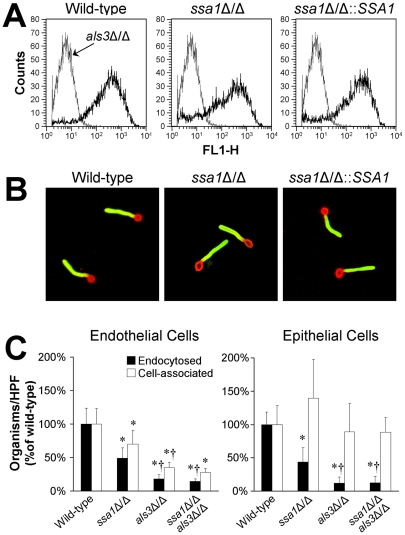
“Assessment of surface expression of Als3 and Ssa1 Flow cytometry was used to quantify the amount of Als3 on the surface of the various strains using a slight modification of our previously described method [37].”
BackgroundMethodSelf-citation[27] Preparation of high molecular weight RNA
Köhrer, K., & Domdey, H. (1991) · Methods in Enzymology · doi:10.1016/0076-6879(91)94030-g · Cited by 563 · cited 1×
“At a later time, the cells were thawed on ice and the fungal RNA was extracted by the hot phenol method [64].”
MethodCritical Role of Bcr1-Dependent Adhesins in C. albicans Biofilm Formation In Vitro and In Vivo
Nobile, C. J., Andes, D. R., Nett, J. E., Smith, F. J., Yue, F., Phan, Q.-T., Edwards, J. E., Filler, S. G., & Mitchell, A. P. (2006) · PLoS Pathogens · doi:10.1371/journal.ppat.0020063 · Cited by 507
Self-citationEvidence implicating phospholipase as a virulence factor of Candida albicans
Ibrahim, A. S., Mirbod, F., Filler, S. G., Banno, Y., Cole, G. T., Kitajima, Y., Edwards, J. E., Nozawa, Y., & Ghannoum, M. A. (1995) · Infection and Immunity · doi:10.1128/iai.63.5.1993-1998.1995 · Cited by 351 · cited 2×
“albicans causes host cell damage is incompletely understood, it is probable that phospholipases and aspartyl proteases secreted by the organism participate in this process [35,40–46].”
BackgroundSelf-citationCellular interactions of Candida albicans with human oral epithelial cells and enterocytes
Dalle, F., Wächtler, B., L'Ollivier, C., Holland, G., Bannert, N., Wilson, D., Labruère, C., Bonnin, A., & Hube, B. (2010) · Cellular Microbiology · doi:10.1111/j.1462-5822.2009.01394.x · Cited by 347 · cited 1×
“albicans invades endothelial cells and oral epithelial cells is by inducing its own endocytosis [27,31,33,35].”
Background
Cited by
Items 201–220 of 220
MDR in Candida: The Real Storm
Srivastava, P., Tiwari, S., Kumar, M., Murhekar, M. V., & Dwivedi, G. R. (2024) · Springer eBooks · doi:10.1007/978-981-97-4909-6_4
Gupta, M., Usmani, S. A., Arya, K., Chandra, S., Chaturvedi, S., Bhardwaj, N., Prasad, R., & Singh, A. (2024) · Springer eBooks · doi:10.1007/978-981-97-4909-6_12
Infection Models for Human Pathogenic Fungi
Jacobsen, I. D. (2024) · The mycota · doi:10.1007/978-3-031-64853-3_9
Marthe, L., Conan, N., Shekoory, A., Latour‐Lambert, P., Franetich, J., Pioche‐Durieu, C., Borgne, R. L., Verbavatz, J., Larsen, M., & Weiner, A. (2025) · bioRxiv (Cold Spring Harbor Laboratory) · doi:10.1101/2025.05.13.653632
“The C. albicans invasins Als3 and Ssa1 have been shown to bind e-cadherin to facilitate induced endocytosis[29,30], while C. albicans -secreted aspartic proteinases such as Sap5 can degrade e-cadherin[31].”
Factors associated with Candida albicans dissemination via the intestinal mucosa
Rochac-Argueta, E. (2018) · Scholars Archive - University at Albany (University at Albany, State University of New York) · doi:10.54014/qgpt-gnkg
The Oral Mucosa-Fungi Interactome
Neelakantan, P., Kalimuthu, S., Pudipeddi, A., Krom, B. P., Ramage, G., Butcher, M. C., & Brown, J. L. (2025) · Springer series on biofilms · doi:10.1007/978-3-031-82202-5_7 · Cited by 1
Tan, J., Liu, Q., Liu, Z., Cao, Y., Yu, X., Zhao, Q., Hu, N., Liu, Y., Wan, Y., Zhang, Y., et al. (2025) · mBio · doi:10.1128/mbio.01253-25
“Although the roles of large HSPs like Hsp90 and Hsp70 in C. albicans pathogenicity are well-established (47, 48), the functions of small HSPs remain poorly understood.”
InfluentialSelf-citationUnderstanding Fungi-Host Dynamics: The Role of Immuno Suppression and Real-World Clinical Scenario
Mazhar, S. S., Panche, A. N., Mohiuddin, I. M., Deshmukh, R., & Harke, S. N. (2025) · Current Fungal Infection Reports · doi:10.1007/s12281-025-00514-x
“Candida species express invasins (Als3 and Ssa1) [50, 51] on the hyphal surface during the essential pathogenic process of induced endocytosis, which mediates the binding of host epithelial surface proteins.”
Loiselet, A. (2019) · theses.fr (ABES) · doi:10.70675/8960b3ecz4598z4c60za01cz9399c6404ab8
L'interaction Hsp90/co-chaperonnes : nouvelle cible pour le traitement des candidoses invasives
Rouges, C. (2023) · theses.fr (ABES) · doi:10.70675/40b24a3fz159ez4d8ez8a34zdd8ffa1c22fa
E-cadherin involvement in host-pathogen interaction and cell signaling
Osman, I. O. (2022) · theses.fr (ABES) · doi:10.70675/924f03a2zc226z4ba7zbbaazcf7059e331a3
Charlet, R. (2022) · theses.fr (ABES) · doi:10.70675/11b08f90z8d0dz43efz96ffzf2527c076034
Etude structurale du remodeleur de la chromatine RSC chez Candida albicans
Dupeyron, R. (2023) · theses.fr (ABES) · doi:10.70675/5f7d1879zcfb3z42d7z91e1z9a2a37a29c1f
From confrontation to co-adaptation: the dynamic dialogue of Candida albicans and macrophages
Miramón, P., Wilson, H. B., & Lorenz, M. C. (2026) · Microbiology and Molecular Biology Reviews · doi:10.1128/mmbr.00191-22
“Hyr1 contrib utes to resistance against neutrophil-mediated killing, participates in epithelial receptor engagement, and may modulate complement interactions (120, 121), while surface-exposed stress proteins such as Ssa1/2 (Hsp70) participate in host cell engagement and invasion (122).”
THE UBC8-GID E3 UBIQUITIN LIGASE MODULE IS REQUIRED FOR STRESS RESPONSE IN CANDIDA ALBICANS
Zeng, Z., Chrustowicz, J., Spanos, C., Cholewa-Waclaw, J., Kelly, V., Zhao, Y., Scharf, D. H., Munro, C. A., Schulman, B. A., Alpi, A. F., et al. (2026) · Journal of Biological Chemistry · doi:10.1016/j.jbc.2026.113701
Metadata
- Authors
- Sun, J. N., Solis, N. V., Phan, Q. T., Bajwa, J. S., Kashleva, H., Thompson, A., Liu, Y., Dongari-Bagtzoglou, A., Edgerton, M., & Filler, S. G.
- Affiliations
- University at Buffalo, State University of New York (US)
- University of California, Los Angeles (US)
- University of Connecticut (US)
- Corresponding author
- Edgerton, Mira
- Filler, Scott G.
- Venue
- PLoS Pathogens
- Publisher
- Public Library of Science (PLoS)
- Published
- 2010-11-11
- Volume
- 6
- Issue
- 11
- Pages
- e1001181
- ISSN
- 1553-7366 (ISSN-L)
- 1553-7374
- PMC
- PMC2978716
- OpenAlex
- W2090227081
- Cited by
- 220
- References
- 69
- Citations by year
- 2026: 7 · 2025: 14 · 2024: 12 · 2023: 14 · 2022: 22 · 2021: 21 · 2020: 14 · 2019: 17 · 2018: 16 · 2017: 11 · 2016: 14 · 2015: 14 · 2014: 13 · 2013: 14 · 2012: 11
- FWCI
- 6.22
- Type
- journal article
- Language
- en
- Open access
- gold
- doi.org
- Locations
- PLoS Pathogens (publishedVersion, cc-by)
- Europe PMC (PubMed Central) (publishedVersion, cc-by)
- PubMed Central (publishedVersion, cc-by)
- PubMed (publishedVersion)
- eScholarship (California Digital Library) (submittedVersion, cc-by)
- DOAJ (DOAJ: Directory of Open Access Journals) (submittedVersion, cc-by-sa)
- eScholarship (California Digital Library) (submittedVersion)
- Figshare (submittedVersion, cc-by)
- Funders
- National Institutes of Health
- National Institute of Allergy and Infectious Diseases (R01AI054928)
- National Institute of Dental and Craniofacial Research (R01 DE 13986, R01DE013986, R01DE017088, R01DE010641)
- National Center for Research Resources (M01RR000425, M01-RR00425)
- NIH Clinical Center
- Topics
- Health Sciences › Medicine › Infectious Diseases › Antifungal resistance and susceptibility
- Life Sciences › Biochemistry, Genetics and Molecular Biology › Molecular Biology › Fungal and yeast genetics research
- Health Sciences › Medicine › Infectious Diseases › Fungal Infections and Studies
- Keywords
- Candida albicans, Ssa1, Ssa2, host cell invasion, virulence, cadherins, N-cadherin, E-cadherin, endothelial cells, oral epithelial cells, systemic candidiasis, oropharyngeal candidiasis, cell surface receptors
- MeSH terms
- Animals, Candida albicans, Candidiasis, DNA, Bacterial, Endocytosis, Epithelial Cells, Male, Mice, Inbred BALB C, Virulence, Cadherins, Polymerase Chain Reaction, HSP70 Heat-Shock Proteins, Endothelial Cells, Mice
About these checks
Registry, retraction, Cites and statistics results are computed, not judged, with one exception: a printed reference that no index lists is read once by a model before it counts as a citation error. Claims are extracted by a model and kept only when their quote appears verbatim in the text; each cited source is then checked, with a model’s help, for whether it says what the claim relies on. Those verdicts can be wrong — read the claim’s quote and the cited source before relying on one.
Statistics and arithmetic are recomputed, not judged.
Confidence bands are shown only for fields calibrated on our annotated test set. None is calibrated yet, so no band is shown.
What counts as a claim ›How we measure confidence ›How we check this ›
Are you an author, or do you see a problem with this page? Request a review
Data sources
Bibliographic data: Semantic Scholar, OpenAlex, Crossref.
Contains information from the Semantic Scholar Academic Graph Datasets, made available under the ODC Attribution License (ODC-BY 1.0).
Semantic Scholar’s data is described in: Kinney, R., et al. (2023). The Semantic Scholar Open Data Platform. arXiv:2301.10140.
