

The DOI matches its Crossref record; 87 of the 87 references it cites were found in a registry or an index.
IRF-3, IRF-5, and IRF-7 Coordinately Regulate the Type I IFN Response in Myeloid Dendritic Cells Downstream of MAVS Signaling
Open accessAbstract
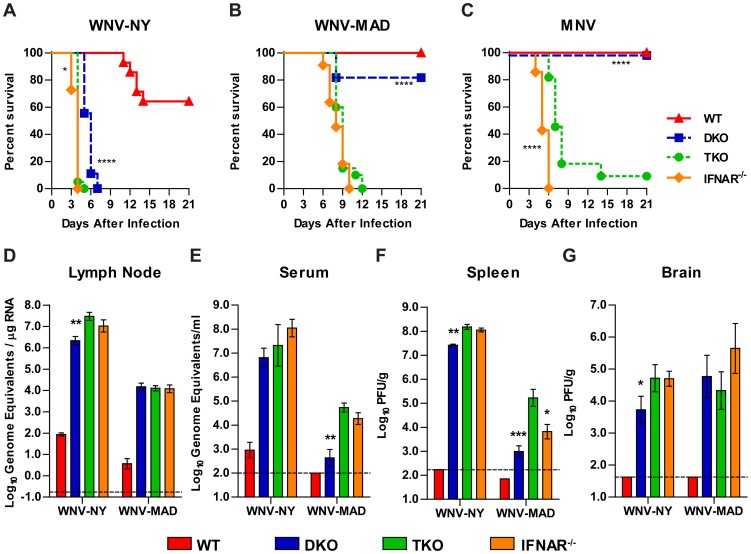
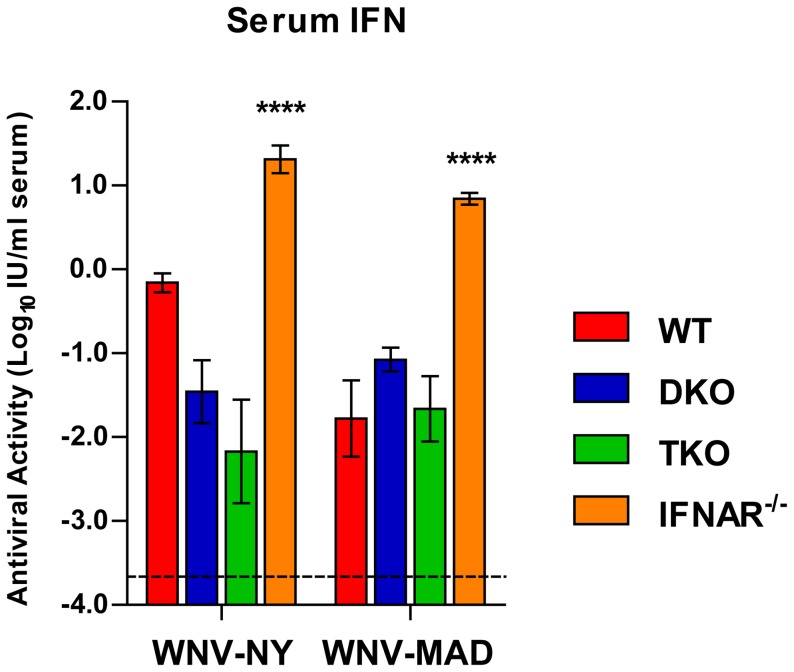
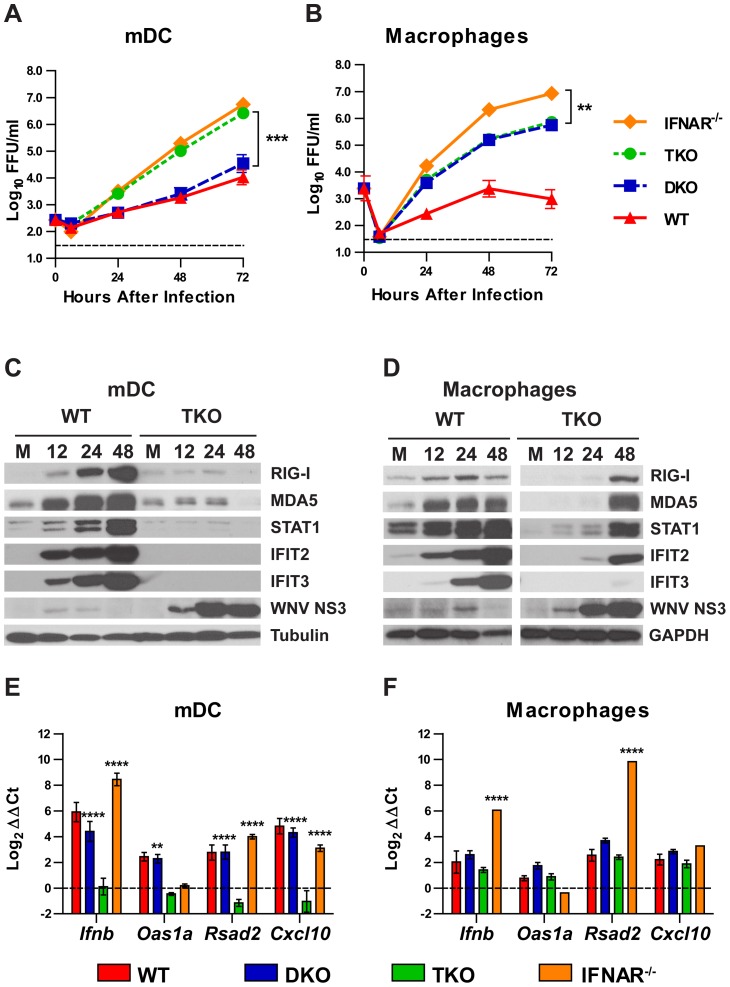
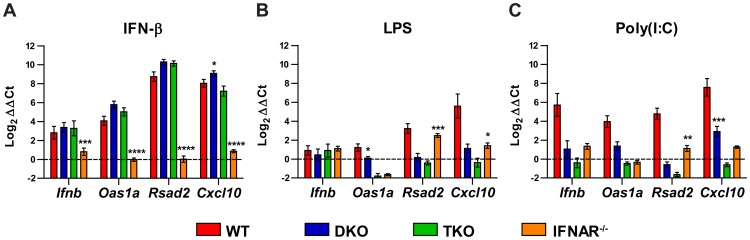
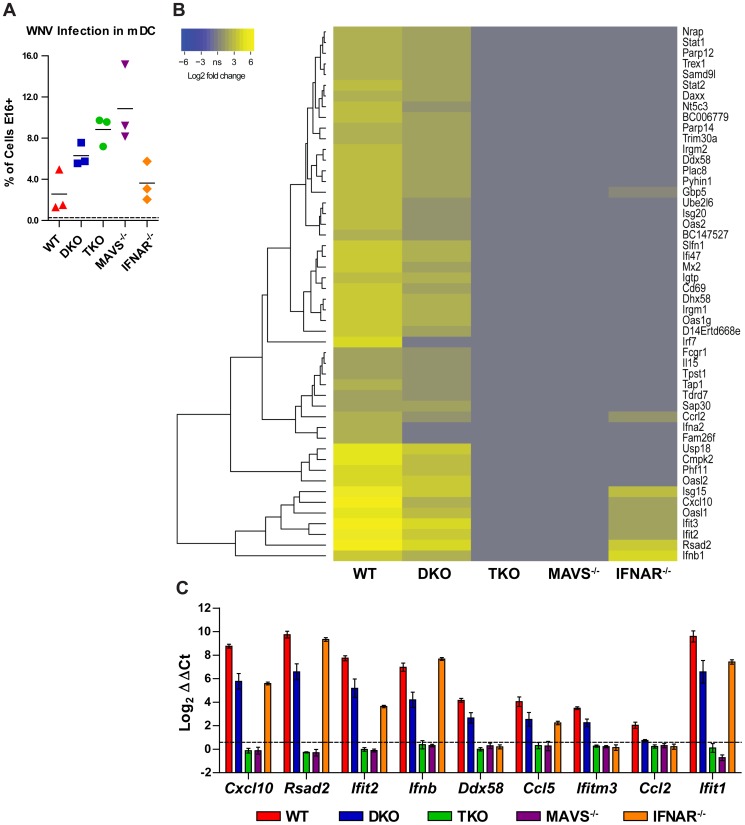
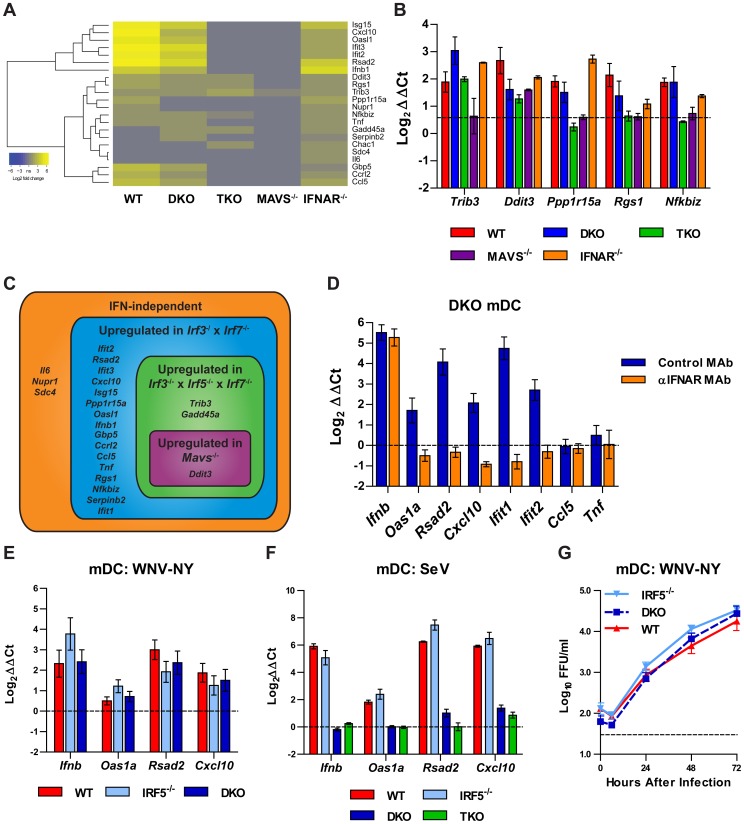
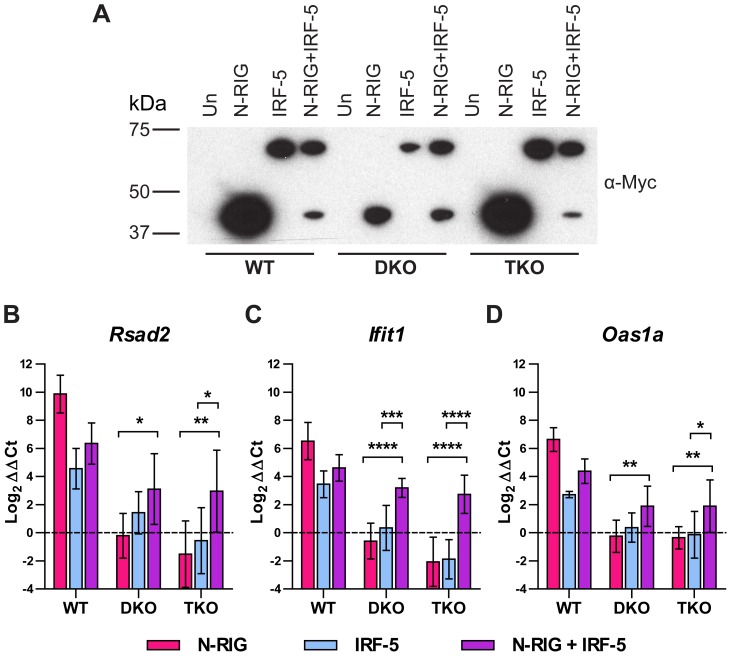
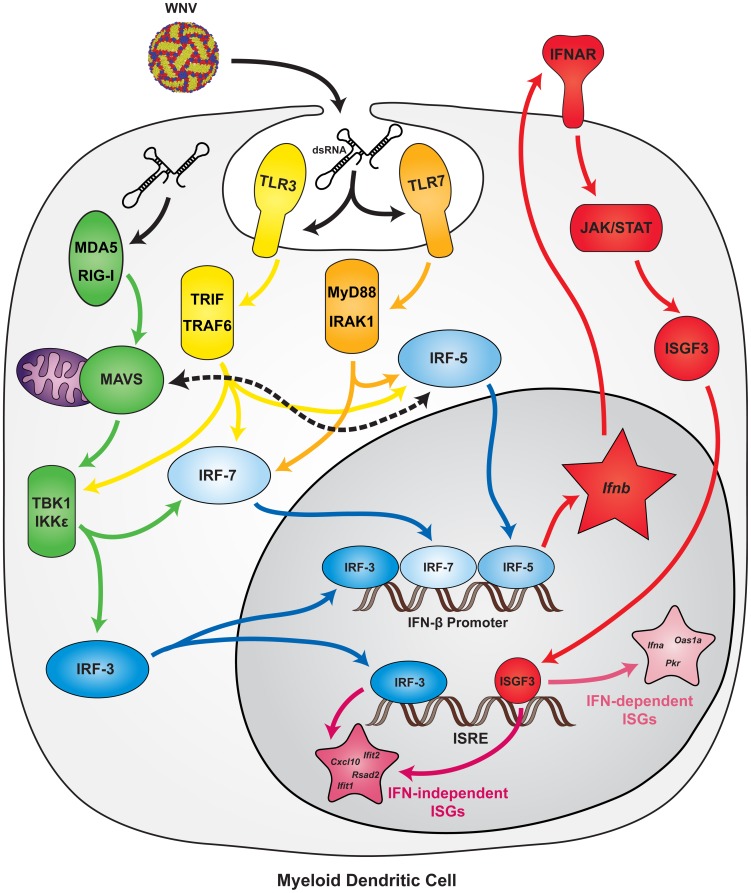
Although the transcription factors IRF-3 and IRF-7 are considered master regulators of type I interferon (IFN) induction and IFN stimulated gene (ISG) expression, Irf3(-/-)×Irf7(-/-) double knockout (DKO) myeloid dendritic cells (mDC) produce relatively normal levels of IFN-β after viral infection. We generated Irf3(-/-)×Irf5(-/-)×Irf7(-/-) triple knockout (TKO) mice to test whether IRF-5 was the source of the residual induction of IFN-β and ISGs in mDCs. In pathogenesis studies with two unrelated positive-sense RNA viruses (West Nile virus (WNV) and murine norovirus), TKO mice succumbed at rates greater than DKO mice and equal to or approaching those of mice lacking the type I IFN receptor (Ifnar(-/-)). In ex vivo studies, after WNV infection or exposure to Toll-like receptor agonists, TKO mDCs failed to produce IFN-β or express ISGs. In contrast, this response was sustained in TKO macrophages following WNV infection. To define IRF-regulated gene signatures, we performed microarray analysis on WNV-infected mDC from wild type (WT), DKO, TKO, or Ifnar(-/-) mice, as well as from mice lacking the RIG-I like receptor adaptor protein MAVS. Whereas the gene induction pattern in DKO mDC was similar to WT cells, remarkably, almost no ISG induction was detected in TKO or Mavs(-/-) mDC. The relative equivalence of TKO and Mavs(-/-) responses suggested that MAVS dominantly regulates ISG induction in mDC. Moreover, we showed that MAVS-dependent induction of ISGs can occur through an IRF-5-dependent yet IRF-3 and IRF-7-independent pathway. Our results establish IRF-3, -5, and -7 as the key transcription factors responsible for mediating the type I IFN and ISG response in mDC during WNV infection and suggest a novel signaling link between MAVS and IRF-5.
Overview
The claims and statistics of this paper haven’t been checked yet.
Run the check — free, no account needed. It reads the open-access text and checks the sources it cites.
Integrity signals
Registry
Cites
Statistics
Figures
Verification
Claims the paper makes
The claims and statistics of this paper haven’t been checked yet.
Run the check — free, no account needed. It reads the open-access text and checks the sources it cites.
Claims other papers make about this one
Each is checked against this paper’s own text: does it say what the citing paper says it does?
In the citing paper
“Enhanced IFN-regulatory factor activity might also explain the observed increase in CXCL9-11 and CXCL13 (Kanda and Watanabe, 2007; Lazear et al., 2013; Muthalagu et al., 2020).”
From SHP2 inhibition diminishes KRASG12C cycling and promotes tumor microenvironment remodeling (2021) · cites this paper as Lazear et al., 2013
Self-check
Percentages, sums and reported differences re-computed from the paper’s own numbers.
The self-check needs the paper’s full text.
Citations
Cites
Analysis of Relative Gene Expression Data Using Real-Time Quantitative PCR and the 2−ΔΔCT Method
Livak, K. J., & Schmittgen, T. D. (2001) · Methods · doi:10.1006/meth.2001.1262 · Cited by 180,860
limma: Linear Models for Microarray Data
Smyth, G. K. (2005) · Statistics for Biology and Health · doi:10.1007/0-387-29362-0_23 · Cited by 5,796
Mechanisms of type-I- and type-II-interferon-mediated signalling
Platanias, L. C. (2005) · Nature reviews. Immunology · doi:10.1038/nri1604 · Cited by 3,631
Bioinformatics and Computational Biology Solutions Using R and Bioconductor
Gentleman, R. C., Carey, V. J., Huber, W. K., Irizarry, R. A., & Dudoit, S. (2005) · Statistics in the health sciences · doi:10.1007/0-387-29362-0 · Cited by 3,470
A diverse range of gene products are effectors of the type I interferon antiviral response
Schoggins, J. W., Wilson, S. J., Panis, M., Murphy, M. Y., Jones, C. T., Bieniasz, P. D., & Rice, C. M. (2011) · Nature · doi:10.1038/nature09907 · Cited by 2,412
IRF-7 is the master regulator of type-I interferon-dependent immune responses
Honda, K., Yanai, H., Negishi, H., Asagiri, M., Sato, M., Mizutani, T., Shimada, N., Ohba, Y., Takaoka, A., Yoshida, N., et al. (2005) · Nature · doi:10.1038/nature03464 · Cited by 2,229
Interferon-inducible antiviral effectors
Sadler, A. J., & Williams, B. R. G. (2008) · Nature Reviews Immunology · doi:10.1038/nri2314 · Cited by 2,160
Type I Inteferon Gene Induction by the Interferon Regulatory Factor Family of Transcription Factors
Honda, K., Takaoka, A., & Taniguchi, T. (2006) · Immunity · doi:10.1016/j.immuni.2006.08.009 · Cited by 1,386
Toll-like receptor 3 mediates West Nile virus entry into the brain causing lethal encephalitis
Wang, T., Town, T., Alexopoulou, L., Anderson, J. F., Fikrig, E., & Flavell, R. A. (2004) · Nature Medicine · doi:10.1038/nm1140 · Cited by 1,142
Integral role of IRF-5 in the gene induction programme activated by Toll-like receptors
Takaoka, A., Yanai, H., Kondo, S., Duncan, G. S., Negishi, H., Mizutani, T., Kano, S., Honda, K., Ohba, Y., Mak, T. W., et al. (2005) · Nature · doi:10.1038/nature03308 · Cited by 1,066
Cited by
Sorted by citations
Shared and Distinct Functions of Type I and Type III Interferons
Lazear, H. M., Schoggins, J. W., & Diamond, M. S. (2019) · Immunity · doi:10.1016/j.immuni.2019.03.025 · Cited by 1,138
Self-citationA Mouse Model of Zika Virus Pathogenesis
Lazear, H. M., Govero, J., Smith, A. M., Platt, D. J., Fernandez, E., Miner, J. J., & Diamond, M. S. (2016) · Cell Host & Microbe · doi:10.1016/j.chom.2016.03.010 · Cited by 909
“, 2011), Irf3−/− Irf5−/− Irf7−/− TKO (Lazear et al., 2013), Mavs−/− (Suthar et al.”
BackgroundInfluentialSelf-citationGoubau, D., Deddouche, S., & Sousa, C. R. E. (2013) · Immunity · doi:10.1016/j.immuni.2013.05.007 · Cited by 875
“In addition to IRF-3 and IRF-7, IRF-5 might also induce type I IFN responses downstream of MAVS in some dendritic cells (Lazear et al., 2013).”
BackgroundType I Interferon in the Pathogenesis of Lupus
Crow, M. K. (2014) · The Journal of Immunology · doi:10.4049/jimmunol.1002795 · Cited by 581
“IRF5 might also be relevant to induction of IFN-I by cytoplasmic nucleic acid sensors (53, 54).”
BackgroundLi, W., Feng, G., Gauthier, J. M., Lokshina, I., Higashikubo, R., Evans, S., Liu, X., Hassan, A., Tanaka, S., Cicka, M., et al. (2019) · Journal of Clinical Investigation · doi:10.1172/jci126428 · Cited by 500
“Donor hearts that lacked expression of type I interferon receptor (IFNAR) or the combination of IRF3, IRF5 and IRF7 displayed increased neutrophil rolling velocity, failure of neutrophils to adhere to the vessel wall, and marked reductions in neutrophil extravasation into the myocardium compared to wildtype grafts (Fi…”
BackgroundInfluential
Metadata
- Authors
- Lazear, H. M., Lancaster, A., Wilkins, C., Suthar, M. S., Huang, A., Vick, S. C., Clepper, L., Thackray, L., Brassil, M. M., Virgin, H. W., Nikolich-Zugich, J., Moses, A. V., Gale, M., Früh, K., & Diamond, M. S.
- Affiliations
- Washington University in St. Louis (US)
- Oregon Health & Science University (US)
- University of Washington (US)
- Emory University (US)
- Vaccine and Gene Therapy Institute (US)
- Corresponding author
- Diamond, Michael S.
- ORCID
- Venue
- PLoS Pathogens
- Publisher
- Public Library of Science (PLoS)
- Published
- 2013-01-03
- Volume
- 9
- Issue
- 1
- Pages
- e1003118
- ISSN
- 1553-7366 (ISSN-L)
- 1553-7374
- PMC
- PMC3536698
- OpenAlex
- W2036679352
- Cited by
- 296
- References
- 85
- Citations by year
- 2026: 7 · 2025: 11 · 2024: 12 · 2023: 11 · 2022: 21 · 2021: 25 · 2020: 27 · 2019: 22 · 2018: 30 · 2017: 25 · 2016: 28 · 2015: 20 · 2014: 33 · 2013: 23
- FWCI
- 19.19
- Type
- journal article
- Language
- en
- Update notices
- correction (2013-05-03)
- Open access
- gold
- doi.org
- Locations
- PLoS Pathogens (publishedVersion, cc-by)
- PubMed Central (publishedVersion, cc-by)
- PubMed (publishedVersion)
- Digital Commons@Becker (Washington University School of Medicine) (submittedVersion)
- Carolina Digital Repository (University of North Carolina at Chapel Hill) (submittedVersion)
- DOAJ (DOAJ: Directory of Open Access Journals) (submittedVersion, cc-by-sa)
- Figshare (submittedVersion, cc-by)
- UNC Libraries
- Funders
- National Institutes of Health (n01ai50027-8-0-1, AI083019, AI057160)
- National Institute of Allergy and Infectious Diseases (N01 AI50027, U19AI083019, U54AI081680, N01 AI050027, R01AI074973, U54AI057160)
- Topics
- Life Sciences › Immunology and Microbiology › Immunology › interferon and immune responses
- Life Sciences › Immunology and Microbiology › Immunology › Immune Response and Inflammation
- Life Sciences › Immunology and Microbiology › Immunology › Immunotherapy and Immune Responses
- Keywords
- IRF3, IRF5, IRF7, type I interferon, myeloid dendritic cells, MAVS, interferon-stimulated genes, West Nile virus, murine norovirus, positive-strand RNA viruses, interferon-beta, Toll-like receptor signaling, RIG-I-like receptor signaling, transcription factors, macrophages, viral pathogenesis
- MeSH terms
- Animals, Dendritic Cells, Macrophages, Mice, Inbred C57BL, West Nile Fever, West Nile virus, Signal Transduction, Interferon-beta, Mice, Knockout, Viral Load, Myeloid Cells, Adaptor Proteins, Signal Transducing, Interferon Regulatory Factors, Interferon Regulatory Factor-3, Interferon Regulatory Factor-7, Toll-Like Receptors, Mice, Receptor, Interferon alpha-beta
About these checks
Registry, retraction, Cites and statistics results are computed, not judged, with one exception: a printed reference that no index lists is read once by a model before it counts as a citation error. Claims are extracted by a model and kept only when their quote appears verbatim in the text; each cited source is then checked, with a model’s help, for whether it says what the claim relies on. Those verdicts can be wrong — read the claim’s quote and the cited source before relying on one.
Statistics and arithmetic are recomputed, not judged.
Confidence bands are shown only for fields calibrated on our annotated test set. None is calibrated yet, so no band is shown.
What counts as a claim ›How we measure confidence ›How we check this ›
Are you an author, or do you see a problem with this page? Request a review
