

The DOI matches its Crossref record; 1 of the 1 references it cites were found in a registry or an index.
Yersinia pestis DNA from Skeletal Remains from the 6th Century AD Reveals Insights into Justinianic Plague
Overview
The claims and statistics of this paper haven’t been checked yet.
Run the check — free, no account needed. It reads the open-access text and checks the sources it cites.
Integrity signals
Registry
Cites
Statistics
Figures
Verification
Claims the paper makes
The claims and statistics of this paper haven’t been checked yet.
Run the check — free, no account needed. It reads the open-access text and checks the sources it cites.
Claims other papers make about this one
Each is checked against this paper’s own text: does it say what the citing paper says it does?
In the citing paper
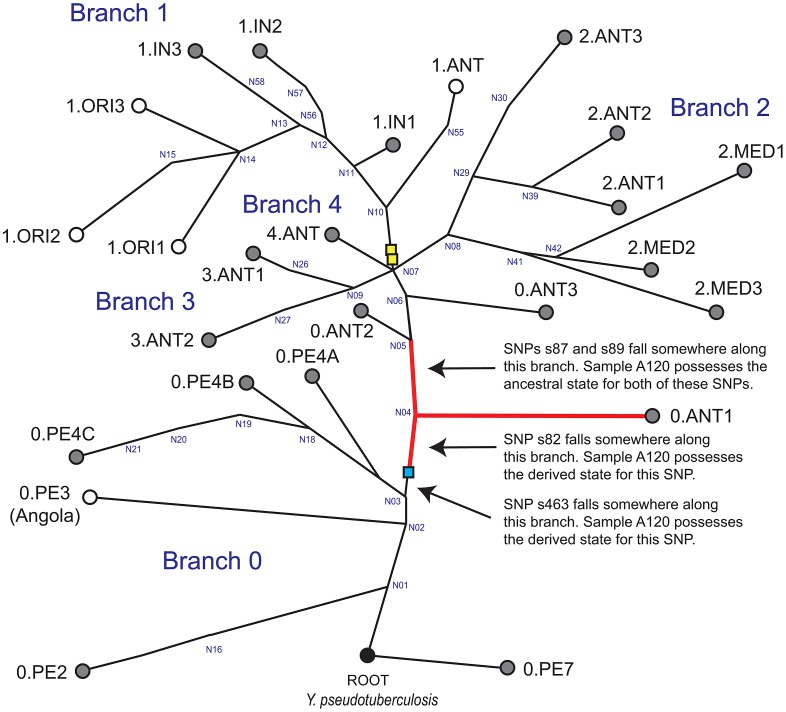
“Below the great polytomy, on Branch 0, lies the strain involved in the Justinianic Plague, which seems to fall between nodes 04 and 05 (Harbeck et al. 2013;Wagner et al. 2014).”
From Taking "Pandemic" Seriously: Making the Black Death Global (2015) · cites this paper as Harbeck et al. 2013
In the citing paper
“• Harbeck and colleagues (2013), working from human remains found in Bavaria, established that the strain that caused the Justinianic Plague seemed to lie on branch 0 between nodes 03 and 05.Wagner and colleagues (2014) have refined that conclusion to put the Justinianic strain specifically between nodes 04 and 05 (that is, between the current extant strains 0.ANT1 and 0.ANT2).”
From Taking "Pandemic" Seriously: Making the Black Death Global (2015) · cites this paper as Harbeck et al. 2013
In the citing paper
“Branch 0, between nodes 03 and 05, position of Justinianic Y. pestis strain as established by Harbeck et al. 2013; Wagner et al. 2014 refine location to a position between 0.ANT1 and 0.ANT2 = c.3335BP”
From Taking "Pandemic" Seriously: Making the Black Death Global (2015) · cites this paper as Harbeck et al. 2013
Self-check
Percentages, sums and reported differences re-computed from the paper’s own numbers.
The self-check needs the paper’s full text.
Citations
Cites
Yersinia pestis , the cause of plague, is a recently emerged clone of Yersinia pseudotuberculosis
Achtman, M., Zurth, K., Morelli, G., Torrea, G., Guiyoule, A., & Carniel, E. (1999) · Proceedings of the National Academy of Sciences · doi:10.1073/pnas.96.24.14043 · Cited by 1,126
Research works printed but not linked: 25
- Little LK (2007) Life and afterlife of the first plague pandemic. In: Little LK, editor. Plague and the end of Antiquity The pandemic of 541–750. Cambridge: Cambridge University Press. pp. 3–32.
- Sallares R (2007) Ecology, evolution and epidemiology of plague. In: Little LK, editor. Plague and the end of Antiquity The pandemic of 541–750. Cambridge: Cambridge University Press. pp. 231–290.
- KI Bos, 2011, A draft genome of Yersinia pestis from victims of the Black Death, Nature, 478, 506, 10.1038/nature10549 · DOI · Paper page
- EC Holmes, 2011, Genomics: Plague's progress, Nature, 478, 465, 10.1038/478465a · DOI
- R Devignat, 1951, Variétés de l'espèce Pasteurella pestis. Nouvelle hypothèse, Bull World Health Organ, 4, 247
- AP Anisimov, 2004, Intraspecific diversity of Yersinia pestis, Clin Microbiol Rev, 17, 434, 10.1128/CMR.17.2.434-464.2004 · DOI
- Y Li, 2009, Genotyping and phylogenetic analysis of Yersinia pestis by MLVA: insights into the worldwide expansion of Central Asia plague foci, PLoS One, 4, e6000, 10.1371/journal.pone.0006000 · DOI
- JM Riehm, 2012, Yersinia pestis lineages in Mongolia, PLoS ONE, 7, e30624, 10.1371/journal.pone.0030624 · DOI · Paper page
- M Achtman, 2004, Microevolution and history of the plague bacillus, Yersinia pestis, Proc Natl Acad Sci U S A, 101, 17837, 10.1073/pnas.0408026101 · DOI · Paper page
- G Morelli, 2010, Yersinia pestis genome sequencing identifies patterns of global phylogenetic diversity, Nat Genet, 42, 1140, 10.1038/ng.705 · DOI · Paper page
- Y Cui, 2013, Historical variations in mutation rate in an epidemic pathogen, Yersinia pestis, Proc Natl Acad Sci U S A, 110, 577, 10.1073/pnas.1205750110 · DOI
- S Haensch, 2010, Distinct clones of Yersinia pestis caused the black death, PLoS Pathog, 6, e1001134, 10.1371/journal.ppat.1001134 · DOI
- M Drancourt, 2004, Genotyping, Orientalis-like Yersinia pestis, and plague pandemics, Emerg Infect Dis, 10, 1585, 10.3201/eid1009.030933 · DOI
- M Drancourt, 2007, Yersinia pestis Orientalis in remains of ancient plague patients, Emerg Infect Dis, 13, 332, 10.3201/eid1302.060197 · DOI
- I Wiechmann, 2005, Detection of Yersinia pestis DNA in two early medieval skeletal finds from Aschheim (Upper Bavaria, 6th century A.D.), Am J Phys Anthropol, 126, 48, 10.1002/ajpa.10276 · DOI
- MB Prentice, 2004, Was the Black Death caused by Yersinia pestis?, Lancet Infect Dis, 4, 72, 10.1016/S1473-3099(04)00923-5 · DOI
- K Tsangaras, 2012, Museums and disease: using tissue archive and museums samples to study pathogens, Ann Anat, 194, 58, 10.1016/j.aanat.2011.04.003 · DOI
- G Vergnaud, 2005, Yersinia pestis genotyping, Emerg Infect Dis, 11, 1317, 10.3201/eid1108.040942 · DOI
- M Achtman, 2012, Insights from genomic comparisons of genetically monomorphic bacterial pathogens, Philos Trans R Soc Lond B Biol Sci, 367, 860, 10.1098/rstb.2011.0303 · DOI
- C Roberts, 2008, Using ancient DNA analysis in palaeopathology: a critical analysis of published papers, with recommendations for future work, Int J of Osteoarchaeol, 18, 600, 10.1002/oa.966 · DOI
- I Wiechmann, 2010, Yersinia pestis DNA sequences in late medieval skeletal finds, Bavaria, Emerg Infect Dis, 16, 1806, 10.3201/eid1611.100598 · DOI
- S Paabo, 2004, Genetic analyses from ancient DNA, Annu Rev Genet, 38, 645, 10.1146/annurev.genet.37.110801.143214 · DOI · Paper page
- Rosen W (2007) Justinian's Flea: Plague, empire, and the birth of Europe. London: Viking Penguin.
- T Schneider, 2008, Mehrfachbestattungen von Männern in der Merowingerzeit, Z Archaol Mittel, 36, 1
- McCormick M (2007) Towards a molecular history of the Justinianic Plague. In: Little LK, editor. Plague and the end of Antiquity The pandemic of 541–750. Cambridge: Cambridge University Press. pp. 290–312.
Cited by
Plague and Empire in the Early Modern Mediterranean World: The Ottoman Experience, 1347–1600
Varlik, N. (2015) · doi:10.1017/cbo9781139004046 · Cited by 146
Taking "Pandemic" Seriously: Making the Black Death Global
Green, M. (2015) · The Medieval Globe · doi:10.17302/tmg.1-1.3 · Cited by 95
Metadata
- Authors
- Harbeck, M., Seifert, L., Hänsch, S., Wagner, D. M., Birdsell, D., Parise, K. L., Wiechmann, I., Grupe, G., Thomas, A., Keim, P., Zöller, L., Bramanti, B., Riehm, J. M., & Scholz, H. C.
- Venue
- PLoS Pathogens
- Publisher
- Public Library of Science (PLoS)
- Published
- 2013-05-02
- Volume
- 9
- Issue
- 5
- Pages
- e1003349
- ISSN
- 1553-7374
- PMC
- PMC3642051
- Cited by
- 192
- References
- 1
- Language
- en
About these checks
Registry, retraction, Cites and statistics results are computed, not judged, with one exception: a printed reference that no index lists is read once by a model before it counts as a citation error. Claims are extracted by a model and kept only when their quote appears verbatim in the text; each cited source is then checked, with a model’s help, for whether it says what the claim relies on. Those verdicts can be wrong — read the claim’s quote and the cited source before relying on one.
Statistics and arithmetic are recomputed, not judged.
Confidence bands are shown only for fields calibrated on our annotated test set. None is calibrated yet, so no band is shown.
What counts as a claim ›How we measure confidence ›How we check this ›
Are you an author, or do you see a problem with this page? Request a review
How to cite
Cite CoChat for the checks on this page, and the paper for its own findings.
- This page
- CoChat. (2026). Citation check: Yersinia pestis DNA from Skeletal Remains from the 6th Century AD Reveals Insights into Justinianic Plague. https://app.cochat.ai/papers/10.1371/journal.ppat.1003349
- The paper
- Harbeck, M., Seifert, L., Hänsch, S., Wagner, D. M., Birdsell, D., Parise, K. L., Wiechmann, I., Grupe, G., Thomas, A., Keim, P., Zöller, L., Bramanti, B., Riehm, J. M., & Scholz, H. C. (2013). Yersinia pestis DNA from Skeletal Remains from the 6th Century AD Reveals Insights into Justinianic Plague. PLoS Pathogens. https://doi.org/10.1371/journal.ppat.1003349
