

A feast for Candida: Metabolic plasticity confers an edge for virulence
Open accessThe DOI matches its Crossref record; 50 of the 50 references it cites were found in a registry or an index.
Abstract
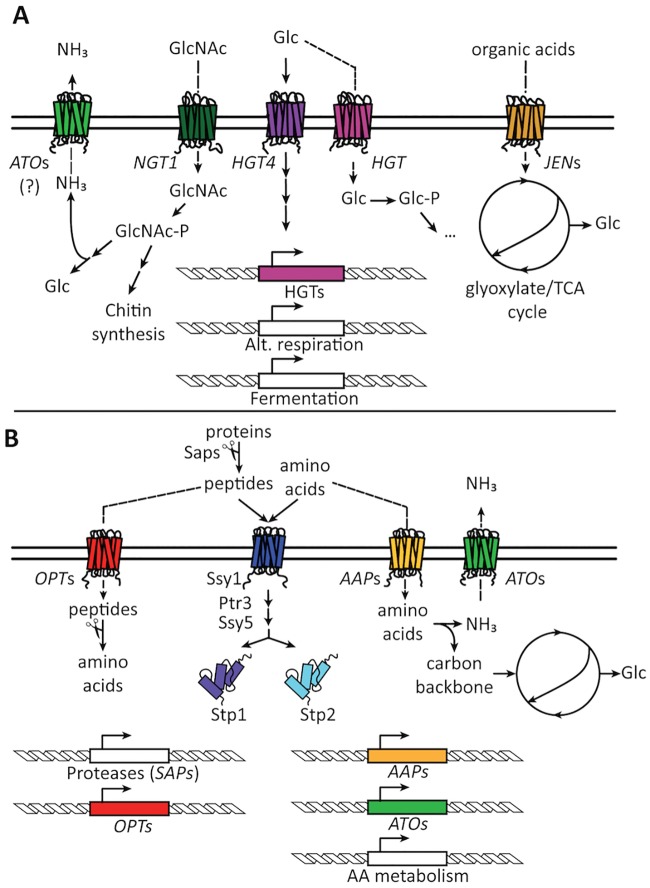
How is C. albicans sensing the nutrients in the host?Glucose remains the preferred carbon source (Fig 2A), and C. albicans detects this sugar via three sensing pathways that act in concert to activate glucose transport and metabolism: the sugar receptor-repressor pathway, the glucose repression pathway, and the adenylate cyclase pathway (reviewed in ref.[3]).Glucose metabolism via glycolysis and fermentation seems to be crucial during C. albicans gastrointestinal (GI) colonization, since genes controlled by the glycolysis transcriptional regulators Gal4 and Tye7 are highly expressed in the cecum of mice.Interestingly, whereas Tye7 is required for GI colonization, this transcription factor (TF) is dispensable for systemic infection [4].In contrast, glycolytic enzymes are critical for systemic pathogenesis [5].This suggests there are additional regulators yet to be discovered that control central metabolism in some host niches.
Overview
The claims and statistics of this paper haven’t been checked yet.
Free: it reads the open-access text and checks the first 5 claims that cite a source we can check. Create a free account to check every claim.
Integrity signals
Registry
Cites
Statistics
Figures
Verification
Claims the paper makes
The claims and statistics of this paper haven’t been checked yet.
Free: it reads the open-access text and checks the first 5 claims that cite a source we can check. Create a free account to check every claim.
Claims other papers make about this one
Each is checked against this paper’s own text: does it say what the citing paper says it does?
The source backs part of the claim, not all of it — or backs it for a different population, condition or comparison.
In the citing paper
“The ability to utilize alternative carbon sources plays an essential role in allowing C. albicans to transition from a commensal colonizer to a pathogenic microbe8–10.”
From Multifactor transcriptional control of alternative oxidase induction integrates diverse environmental inputs to enable fungal virulence (2023) · cites this paper as [9]
Experimental — accuracy not yet measured
Self-check
Percentages, sums and reported differences re-computed from the paper’s own numbers.
The self-check needs the paper’s full text.
Citations
Cites
Candida albicans Secreted Aspartyl Proteinases in Virulence and Pathogenesis
Naglik, J. R., Challacombe, S. J., & Hube, B. (2003) · Microbiology and Molecular Biology Reviews · doi:10.1128/mmbr.67.3.400-428.2003 · Cited by 1,179
Owen, D. H., & Katz, D. F. (1999) · Contraception · doi:10.1016/s0010-7824(99)00010-4 · Cited by 718
Transcriptional Response of Candida albicans upon Internalization by Macrophages
Lorenz, M. C., Bender, J. A., & Fink, G. R. (2004) · Eukaryotic Cell · doi:10.1128/ec.3.5.1076-1087.2004 · Cited by 712
Self-citationNoble, S. M., & Johnson, A. D. (2005) · Eukaryotic Cell · doi:10.1128/ec.4.2.298-309.2005 · Cited by 592
Fradin, C., De Groot, P., MacCallum, D., Schaller, M., Klis, F., Odds, F. C., & Hube, B. (2005) · Molecular Microbiology · doi:10.1111/j.1365-2958.2005.04557.x · Cited by 455
Hube, B., Monod, M., Schofield, D. A., Brown, A. J. P., & Gow, N. A. R. (1994) · Molecular Microbiology · doi:10.1111/j.1365-2958.1994.tb01269.x · Cited by 372
The Fungal Pathogen Candida albicans Autoinduces Hyphal Morphogenesis by Raising Extracellular pH
Vylkova, S., Carman, A. J., Danhof, H. A., Collette, J. R., Zhou, H., & Lorenz, M. C. (2011) · mBio · doi:10.1128/mbio.00055-11 · Cited by 365
Self-citationNiche-specific regulation of central metabolic pathways in a fungal pathogen
Barelle, C. J., Priest, C. L., MacCallum, D. M., Gow, N. A. R., Odds, F. C., & Brown, A. J. P. (2006) · Cellular Microbiology · doi:10.1111/j.1462-5822.2005.00676.x · Cited by 336
Ene, I. V., Adya, A. K., Wehmeier, S., Brand, A. C., MacCallum, D. M., Gow, N. A. R., & Brown, A. J. P. (2012) · Cellular Microbiology · doi:10.1111/j.1462-5822.2012.01813.x · Cited by 313
Zakikhany, K., Naglik, J. R., Schmidt-Westhausen, A., Holland, G., Schaller, M., & Hube, B. (2007) · Cellular Microbiology · doi:10.1111/j.1462-5822.2007.01009.x · Cited by 288
Cited by
Items 101–120 of 120
Influence of the microbiota on Candida albicans gastrointestinal colonization in healthy individuals
Delavy, M. (2023) · theses.fr (ABES) · doi:10.70675/da5a2f9dz2e64z4e1fz9280z36a010c349be
From confrontation to co-adaptation: the dynamic dialogue of Candida albicans and macrophages
Miramón, P., Wilson, H. B., & Lorenz, M. C. (2026) · Microbiology and Molecular Biology Reviews · doi:10.1128/mmbr.00191-22
Self-citationRana, A., Gangber, S. K., Tanwar, A., & Thakur, A. (2026) · bioRxiv (Cold Spring Harbor Laboratory) · doi:10.64898/2026.03.05.709770
Gómez-Gaviria, M., Ramírez-Sotelo, U., & Mora-Montes, H. M. (2026) · Journal of Fungi · doi:10.3390/jof12100791
Assessment of the metabolome in genomically diverse Candida albicans isolates
Alaban, L. R. (2022) · theses.fr (ABES) · doi:10.70675/6127ebd7z2b67z4728z960dzdc64762b4c70
Chew, S. Y., Brown, A. J. P., Lau, B. Y. C., Cheah, Y. K., Ho, K. L., Sandai, D., Yahaya, H., & Than, L. T. L. (2021) · Figshare · doi:10.6084/m9.figshare.13514605
Mahyon, N. I., Sabri, S., Jijew, G. C., Salleh, A. B., Leow, T. C., Lim, S. J., Oslan, S. N. H., Masomian, M., & Oslan, S. N. (2024) · Arabian Journal for Science and Engineering · doi:10.1007/s13369-024-09018-1
Chew, S. Y. (2019) · Universiti Putra Malaysia Institutional Repository (Universiti Putra Malaysia)
Burgain, A. (2020) · Corpus Université Laval (Université Laval)
Min, S. (2023) · DigitalGeorgetown (Georgetown University Library)
Karakterisatie van de Candida glabrata trehalase enzymen
Ende, M. V. (2022) · Lirias
Guan, B., Li, Y., Li, Q., Wu, J., Yi, J., Li, X., He, J., & Li, M. (2026) · Journal of Oral Microbiology · doi:10.1080/20002297.2026.2744234
Impacto da candidíase vulvovaginal experimental por Candida albicans no sistema reprodutor feminino
Mosca, V. A. B. (2025) · LA Referencia (Red Federada de Repositorios Institucionales de Publicaciones Científicas)
Characterization of Human Commensal Candida Albicans Hyphal Morphology
Williams, C. (2026) · Library, Museums and Press - UDSpace (University of Delaware)
Analyse des Mechanismus und der Regulierung von Histatin 5 Resistenz in \(Candida\) \(albicans\)
Hampe, I. A. I. (2017) · Online Publication Service of Würzburg University (Würzburg University)
Xu, S., Gao, K., Shuang, C., Cao, Y., & Zhang, T. (2026) · Bioresource Technology · doi:10.1016/j.biortech.2026.135938
Case, N. T. (2024) · TSpace (University of Toronto)
Metadata
- Authors
- Miramón, P., & Lorenz, M. C.
- Affiliations
- The University of Texas Health Science Center at Houston (US)
- Corresponding author
- Lorenz, Michael C.
- Venue
- PLOS Pathogens
- Publisher
- Public Library of Science (PLoS)
- Published
- 2017-02-09
- Volume
- 13
- Issue
- 2
- Pages
- e1006144
- ISSN
- 1553-7366 (ISSN-L)
- 1553-7374
- PMC
- PMC5300112
- OpenAlex
- W2587240328
- Cited by
- 106
- References
- 50
- Citations by year
- 2026: 10 · 2025: 8 · 2024: 11 · 2023: 11 · 2022: 12 · 2021: 14 · 2020: 19 · 2019: 13 · 2018: 3 · 2017: 5
- FWCI
- 1.02
- Type
- journal article
- Language
- en
- Open access
- gold
- doi.org
- Licence
- Locations
- PLoS Pathogens (publishedVersion, cc-by)
- Europe PMC (PubMed Central) (publishedVersion, cc-by)
- PubMed Central (publishedVersion, cc-by)
- PubMed (publishedVersion)
- DOAJ (DOAJ: Directory of Open Access Journals) (submittedVersion)
- Funders
- National Institutes of Health
- National Institute of Allergy and Infectious Diseases (R01AI075091)
- Topics
- Life Sciences › Biochemistry, Genetics and Molecular Biology › Molecular Biology › Fungal and yeast genetics research
- Health Sciences › Medicine › Infectious Diseases › Antifungal resistance and susceptibility
- Health Sciences › Medicine › Infectious Diseases › Fungal Infections and Studies
- Keywords
- Candida albicans, metabolic plasticity, virulence, glucose detection, glucose transport, glycolysis, GAL4, intestinal colonization, systemic infection, host-pathogen interaction, nutrient sensing
- MeSH terms
- Adaptation, Physiological, Animals, Candida albicans, Candidiasis, Humans, Virulence
About these checks
Registry, retraction, Cites and statistics results are computed, not judged, with one exception: a printed reference that no index lists is read once by a model before it counts as a citation error. Claims are extracted by a model and kept only when their quote appears verbatim in the text; each cited source is then checked, with a model’s help, for whether it says what the claim relies on. Those verdicts can be wrong — read the claim’s quote and the cited source before relying on one.
Statistics and arithmetic are recomputed, not judged.
Confidence bands are shown only for fields calibrated on our annotated test set. None is calibrated yet, so no band is shown.
What counts as a claim ›How we measure confidence ›How we check this ›
Are you an author, or do you see a problem with this page? Request a review
Data sources
Bibliographic data: Semantic Scholar, OpenAlex, Crossref.
Contains information from the Semantic Scholar Academic Graph Datasets, made available under the ODC Attribution License (ODC-BY 1.0).
Semantic Scholar’s data is described in: Kinney, R., et al. (2023). The Semantic Scholar Open Data Platform. arXiv:2301.10140.
