

A feast for Candida: Metabolic plasticity confers an edge for virulence
Open accessThe DOI matches its Crossref record; 50 of the 50 references it cites were found in a registry or an index.
Abstract
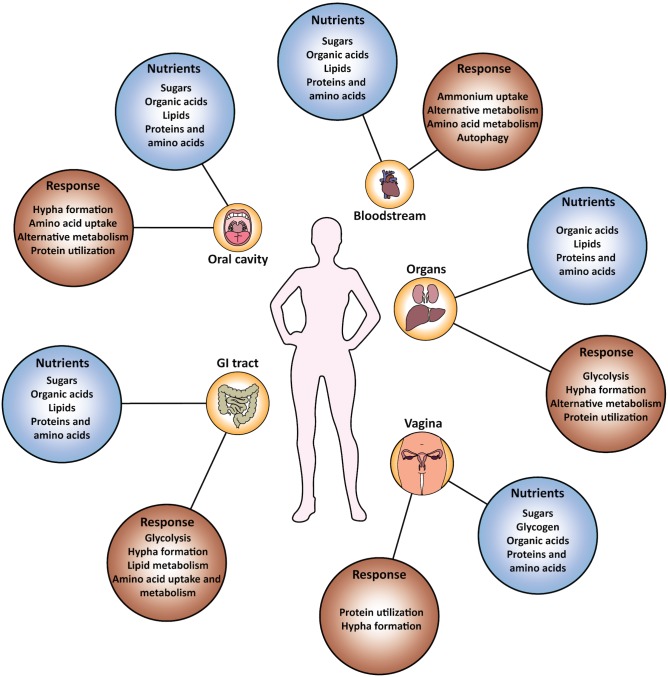
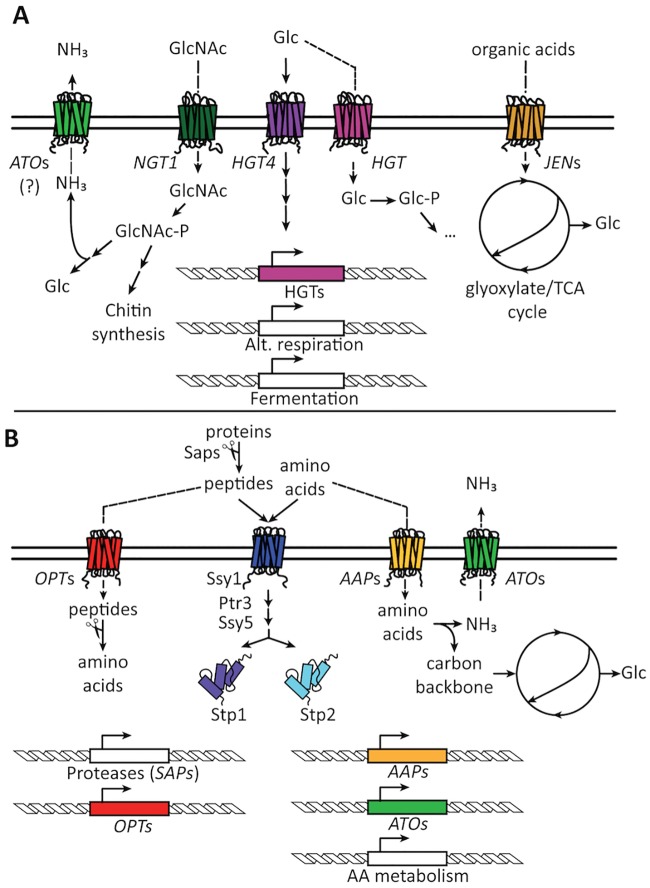
How is C. albicans sensing the nutrients in the host?Glucose remains the preferred carbon source (Fig 2A), and C. albicans detects this sugar via three sensing pathways that act in concert to activate glucose transport and metabolism: the sugar receptor-repressor pathway, the glucose repression pathway, and the adenylate cyclase pathway (reviewed in ref.[3]).Glucose metabolism via glycolysis and fermentation seems to be crucial during C. albicans gastrointestinal (GI) colonization, since genes controlled by the glycolysis transcriptional regulators Gal4 and Tye7 are highly expressed in the cecum of mice.Interestingly, whereas Tye7 is required for GI colonization, this transcription factor (TF) is dispensable for systemic infection [4].In contrast, glycolytic enzymes are critical for systemic pathogenesis [5].This suggests there are additional regulators yet to be discovered that control central metabolism in some host niches.
Overview
The claims and statistics of this paper haven’t been checked yet.
Free: it reads the open-access text and checks the first 5 claims that cite a source we can check. Create a free account to check every claim.
Integrity signals
Registry
Cites
Statistics
Figures
Verification
Claims the paper makes
The claims and statistics of this paper haven’t been checked yet.
Free: it reads the open-access text and checks the first 5 claims that cite a source we can check. Create a free account to check every claim.
Claims other papers make about this one
Each is checked against this paper’s own text: does it say what the citing paper says it does?
The source backs part of the claim, not all of it — or backs it for a different population, condition or comparison.
In the citing paper
“The ability to utilize alternative carbon sources plays an essential role in allowing C. albicans to transition from a commensal colonizer to a pathogenic microbe8–10.”
From Multifactor transcriptional control of alternative oxidase induction integrates diverse environmental inputs to enable fungal virulence (2023) · cites this paper as [9]
Experimental — accuracy not yet measured
Self-check
Percentages, sums and reported differences re-computed from the paper’s own numbers.
The self-check needs the paper’s full text.
Citations
Cites
Candida albicans Secreted Aspartyl Proteinases in Virulence and Pathogenesis
Naglik, J. R., Challacombe, S. J., & Hube, B. (2003) · Microbiology and Molecular Biology Reviews · doi:10.1128/mmbr.67.3.400-428.2003 · Cited by 1,179
Owen, D. H., & Katz, D. F. (1999) · Contraception · doi:10.1016/s0010-7824(99)00010-4 · Cited by 718
Transcriptional Response of Candida albicans upon Internalization by Macrophages
Lorenz, M. C., Bender, J. A., & Fink, G. R. (2004) · Eukaryotic Cell · doi:10.1128/ec.3.5.1076-1087.2004 · Cited by 712
Self-citationNoble, S. M., & Johnson, A. D. (2005) · Eukaryotic Cell · doi:10.1128/ec.4.2.298-309.2005 · Cited by 592
Fradin, C., De Groot, P., MacCallum, D., Schaller, M., Klis, F., Odds, F. C., & Hube, B. (2005) · Molecular Microbiology · doi:10.1111/j.1365-2958.2005.04557.x · Cited by 455
Hube, B., Monod, M., Schofield, D. A., Brown, A. J. P., & Gow, N. A. R. (1994) · Molecular Microbiology · doi:10.1111/j.1365-2958.1994.tb01269.x · Cited by 372
The Fungal Pathogen Candida albicans Autoinduces Hyphal Morphogenesis by Raising Extracellular pH
Vylkova, S., Carman, A. J., Danhof, H. A., Collette, J. R., Zhou, H., & Lorenz, M. C. (2011) · mBio · doi:10.1128/mbio.00055-11 · Cited by 365
Self-citationNiche-specific regulation of central metabolic pathways in a fungal pathogen
Barelle, C. J., Priest, C. L., MacCallum, D. M., Gow, N. A. R., Odds, F. C., & Brown, A. J. P. (2006) · Cellular Microbiology · doi:10.1111/j.1462-5822.2005.00676.x · Cited by 336
Ene, I. V., Adya, A. K., Wehmeier, S., Brand, A. C., MacCallum, D. M., Gow, N. A. R., & Brown, A. J. P. (2012) · Cellular Microbiology · doi:10.1111/j.1462-5822.2012.01813.x · Cited by 313
Zakikhany, K., Naglik, J. R., Schmidt-Westhausen, A., Holland, G., Schaller, M., & Hube, B. (2007) · Cellular Microbiology · doi:10.1111/j.1462-5822.2007.01009.x · Cited by 288
Lactate signalling regulates fungal β-glucan masking and immune evasion
Ballou, E. R., Avelar, G. M., Childers, D. S., Mackie, J., Bain, J. M., Wagener, J., Kastora, S. L., Panea, M. D., Hardison, S. E., Walker, L. A., et al. (2016) · Nature Microbiology · doi:10.1038/nmicrobiol.2016.238 · Cited by 269
The Pathogen Candida albicans Hijacks Pyroptosis for Escape from Macrophages
Uwamahoro, N., Verma-Gaur, J., Shen, H.-H., Qu, Y., Lewis, R., Lu, J., Bambery, K., Masters, S. L., Vince, J. E., Naderer, T., et al. (2014) · mBio · doi:10.1128/mbio.00003-14 · Cited by 264
Metabolism impacts upon Candida immunogenicity and pathogenicity at multiple levels
Brown, A. J. P., Brown, G. D., Netea, M. G., & Gow, N. A. R. (2014) · Trends in Microbiology · doi:10.1016/j.tim.2014.07.001 · Cited by 258
Leidich, S. D., Ibrahim, A. S., Fu, Y., Koul, A., Jessup, C., Vitullo, J., Fonzi, W., Mirbod, F., Nakashima, S., Nozawa, Y., et al. (1998) · Journal of Biological Chemistry · doi:10.1074/jbc.273.40.26078 · Cited by 241
Candida albicans Triggers NLRP3-Mediated Pyroptosis in Macrophages
Wellington, M., Koselny, K., Sutterwala, F. S., & Krysan, D. J. (2014) · Eukaryotic Cell · doi:10.1128/ec.00336-13 · Cited by 227
Stage‐specific gene expression of Candida albicans in human blood
Fradin, C., Kretschmar, M., Nichterlein, T., Gaillardin, C., D’Enfert, C., & Hube, B. (2003) · Molecular Microbiology · doi:10.1046/j.1365-2958.2003.03396.x · Cited by 226
Rubin-Bejerano, I., Fraser, I., Grisafi, P., & Fink, G. R. (2003) · Proceedings of the National Academy of Sciences · doi:10.1073/pnas.1834481100 · Cited by 223
Hube, B., Stehr, F., Bossenz, M., Mazur, A., Kretschmar, M., & Schäfer, W. (2000) · Archives of Microbiology · doi:10.1007/s002030000218 · Cited by 212
Glucose Promotes Stress Resistance in the Fungal Pathogen Candida albicans
Rodaki, A., Bohovych, I. M., Enjalbert, B., Young, T., Odds, F. C., Gow, N. A. R., & Brown, A. J. P. (2009) · Molecular Biology of the Cell · doi:10.1091/mbc.e09-01-0002 · Cited by 190
Wong, L., & Sissions, C. H. (2001) · Archives of Oral Biology · doi:10.1016/s0003-9969(01)00016-4 · Cited by 187
Vylkova, S., & Lorenz, M. C. (2014) · PLoS Pathogens · doi:10.1371/journal.ppat.1003995 · Cited by 174
Self-citationRamírez, M. A., & Lorenz, M. C. (2007) · Eukaryotic Cell · doi:10.1128/ec.00372-06 · Cited by 174
Self-citationPérez, J. C., Kumamoto, C. A., & Johnson, A. D. (2013) · PLoS Biology · doi:10.1371/journal.pbio.1001510 · Cited by 156
Transcriptomic Analysis of Vulvovaginal Candidiasis Identifies a Role for the NLRP3 Inflammasome
Bruno, V. M., Shetty, A. C., Yano, J., Fidel, P. L., Noverr, M. C., & Peters, B. M. (2015) · mBio · doi:10.1128/mbio.00182-15 · Cited by 155
Ene, I. V., Cheng, S.-C., Netea, M. G., & Brown, A. J. P. (2013) · Infection and Immunity · doi:10.1128/iai.01092-12 · Cited by 149
Alvarez, F. J., & Konopka, J. B. (2007) · Molecular Biology of the Cell · doi:10.1091/mbc.e06-10-0931 · Cited by 140
Identifying infection-associated genes of Candida albicans in the postgenomic era
Wilson, D., Thewes, S., Zakikhany, K., Fradin, C., Albrecht, A., Almeida, R., Brunke, S., Grosse, K., Martin, R., Mayer, F., et al. (2009) · FEMS Yeast Research · doi:10.1111/j.1567-1364.2009.00524.x · Cited by 115
Martínez, P., & Ljungdahl, P. O. (2005) · Molecular and Cellular Biology · doi:10.1128/mcb.25.21.9435-9446.2005 · Cited by 114
Sandai, D., Yin, Z., Selway, L., Stead, D., Walker, J., Leach, M. D., Bohovych, I., Ene, I. V., Kastora, S., Budge, S., et al. (2012) · mBio · doi:10.1128/mbio.00495-12 · Cited by 110
A family of oligopeptide transporters is required for growth of Candida albicans on proteins
Reuß, O., & Morschhäuser, J. (2006) · Molecular Microbiology · doi:10.1111/j.1365-2958.2006.05136.x · Cited by 101
Jacobsen, I. D., Brunke, S., Seider, K., Schwarzmüller, T., Firon, A., d'Enfért, C., Kuchler, K., & Hube, B. (2010) · Infection and Immunity · doi:10.1128/iai.01244-09 · Cited by 101
Peroxisomal Fatty Acid β-Oxidation Is Not Essential for Virulence of Candida albicans
Piekarska, K., Mol, E., van den Berg, M., Hardy, G., van den Burg, J., van Roermund, C., MacCallum, D., Odds, F., & Distel, B. (2006) · Eukaryotic Cell · doi:10.1128/ec.00093-06 · Cited by 93
Fernández-Arenas, E., Bleck, C. K. E., Nombela, C., Gil, C., Griffiths, G., & Diez-Orejas, R. (2009) · Cellular Microbiology · doi:10.1111/j.1462-5822.2008.01274.x · Cited by 85
Autophagy in the pathogen Candida albicans
Palmer, G. E., Kelly, M. N., & Sturtevant, J. E. (2007) · Microbiology · doi:10.1099/mic.0.2006/001610-0 · Cited by 85
Rodaki, A., Young, T., & Brown, A. J. P. (2006) · Eukaryotic Cell · doi:10.1128/ec.00115-06 · Cited by 84
Yamada‐Okabe, T., Sakamori, Y., Mio, T., & Yamada‐Okabe, H. (2001) · European Journal of Biochemistry · doi:10.1046/j.1432-1327.2001.02135.x · Cited by 83
Glucose Sensing Network in Candida albicans : a Sweet Spot for Fungal Morphogenesis
Sabina, J., & Brown, V. (2009) · Eukaryotic Cell · doi:10.1128/ec.00138-09 · Cited by 81
Childers, D. S., Raziunaite, I., Mol Avelar, G., Mackie, J., Budge, S., Stead, D., Gow, N. A. R., Lenardon, M. D., Ballou, E. R., MacCallum, D. M., et al. (2016) · PLOS Pathogens · doi:10.1371/journal.ppat.1005566 · Cited by 81
Kingsbury, J. M., & McCusker, J. H. (2010) · Microbiology · doi:10.1099/mic.0.034348-0 · Cited by 73
Robust Extracellular pH Modulation by Candida albicans during Growth in Carboxylic Acids
Danhof, H. A., Vylkova, S., Vesely, E. M., Ford, A. E., Gonzalez-Garay, M., & Lorenz, M. C. (2016) · mBio · doi:10.1128/mbio.01646-16 · Cited by 72
Self-citationSingh, P., Ghosh, S., & Datta, A. (2001) · Infection and Immunity · doi:10.1128/iai.69.12.7898-7903.2001 · Cited by 66
Vieira, N., Casal, M., Johansson, B., MacCallum, D. M., Brown, A. J. P., & Paiva, S. (2010) · Molecular Microbiology · doi:10.1111/j.1365-2958.2009.07003.x · Cited by 63
Martínez, P., & Ljungdahl, P. O. (2004) · Molecular Microbiology · doi:10.1046/j.1365-2958.2003.03845.x · Cited by 58
The Candida albicans ATO Gene Family Promotes Neutralization of the Macrophage Phagolysosome
Danhof, H. A., & Lorenz, M. C. (2015) · Infection and Immunity · doi:10.1128/iai.00984-15 · Cited by 57
Self-citationCharacterization of Virulence-Related Phenotypes in Candida Species of the CUG Clade
Priest, S. J., & Lorenz, M. C. (2015) · Eukaryotic Cell · doi:10.1128/ec.00062-15 · Cited by 48
Self-citationThe disruption of JEN1 from Candida albicans impairs the transport of lactate
Soares-Silva, I., Paiva, S., Kötter, P., Entian, K.-D., & Casal, M. (2004) · Molecular Membrane Biology · doi:10.1080/09687860400011373 · Cited by 47
Hyphal growth in Candida albicans does not require induction of hyphal-specific gene expression
Naseem, S., Araya, E., & Konopka, J. B. (2015) · Molecular Biology of the Cell · doi:10.1091/mbc.e14-08-1312 · Cited by 43
Regulatory Circuits That Enable Proliferation of the Fungus Candida albicans in a Mammalian Host
Pérez, J. C., & Johnson, A. D. (2013) · PLoS Pathogens · doi:10.1371/journal.ppat.1003780 · Cited by 38
Candida parapsilosis Secreted Lipase as an Important Virulence Factor
Toth, R., Toth, A., Vagvolgyi, C., & Gacser, A. (2017) · Current Protein & Peptide Science · doi:10.2174/1389203717666160813163054 · Cited by 36
A Multi-targeted Drug Candidate with Dual Anti-HIV and Anti-HSV Activity
Balzarini, J. M., Andreï, G., Balestra, E., Huskens, D., Vanpouille, C., Introini, A., Zicari, S., Liekens, S., Snoeck, R., Holý, A., et al. (2013) · PLoS Pathogens · doi:10.1371/journal.ppat.1003456 · Cited by 25
Cited by
Dadar, M., Tiwari, R., Karthik, K., Chakraborty, S., Shahali, Y., & Dhama, K. (2018) · Microbial Pathogenesis · doi:10.1016/j.micpath.2018.02.028 · Cited by 332
Virulence Factors in Candida species
Staniszewska, M. (2020) · Current Protein & Peptide Science · doi:10.2174/1389203720666190722152415 · Cited by 279
Ahmad, S., & Alfouzan, W. (2021) · Microorganisms · doi:10.3390/microorganisms9040807 · Cited by 269
Kumamoto, C. A., Gresnigt, M. S., & Hube, B. (2020) · Current Opinion in Microbiology · doi:10.1016/j.mib.2020.05.006 · Cited by 208
Mechanism of Candida pathogenesis: Revisiting the vital drivers
Mba, I. E., & Nweze, E. I. (2020) · European Journal of Clinical Microbiology & Infectious Diseases · doi:10.1007/s10096-020-03912-w · Cited by 143
Metadata
- Authors
- Miramón, P., & Lorenz, M. C.
- Affiliations
- The University of Texas Health Science Center at Houston (US)
- Corresponding author
- Lorenz, Michael C.
- Venue
- PLOS Pathogens
- Publisher
- Public Library of Science (PLoS)
- Published
- 2017-02-09
- Volume
- 13
- Issue
- 2
- Pages
- e1006144
- ISSN
- 1553-7366 (ISSN-L)
- 1553-7374
- PMC
- PMC5300112
- OpenAlex
- W2587240328
- Cited by
- 106
- References
- 50
- Citations by year
- 2026: 10 · 2025: 8 · 2024: 11 · 2023: 11 · 2022: 12 · 2021: 14 · 2020: 19 · 2019: 13 · 2018: 3 · 2017: 5
- FWCI
- 1.02
- Type
- journal article
- Language
- en
- Open access
- gold
- doi.org
- Licence
- Locations
- PLoS Pathogens (publishedVersion, cc-by)
- Europe PMC (PubMed Central) (publishedVersion, cc-by)
- PubMed Central (publishedVersion, cc-by)
- PubMed (publishedVersion)
- DOAJ (DOAJ: Directory of Open Access Journals) (submittedVersion)
- Funders
- National Institutes of Health
- National Institute of Allergy and Infectious Diseases (R01AI075091)
- Topics
- Life Sciences › Biochemistry, Genetics and Molecular Biology › Molecular Biology › Fungal and yeast genetics research
- Health Sciences › Medicine › Infectious Diseases › Antifungal resistance and susceptibility
- Health Sciences › Medicine › Infectious Diseases › Fungal Infections and Studies
- Keywords
- Candida albicans, metabolic plasticity, virulence, glucose detection, glucose transport, glycolysis, GAL4, intestinal colonization, systemic infection, host-pathogen interaction, nutrient sensing
- MeSH terms
- Adaptation, Physiological, Animals, Candida albicans, Candidiasis, Humans, Virulence
About these checks
Registry, retraction, Cites and statistics results are computed, not judged, with one exception: a printed reference that no index lists is read once by a model before it counts as a citation error. Claims are extracted by a model and kept only when their quote appears verbatim in the text; each cited source is then checked, with a model’s help, for whether it says what the claim relies on. Those verdicts can be wrong — read the claim’s quote and the cited source before relying on one.
Statistics and arithmetic are recomputed, not judged.
Confidence bands are shown only for fields calibrated on our annotated test set. None is calibrated yet, so no band is shown.
What counts as a claim ›How we measure confidence ›How we check this ›
Are you an author, or do you see a problem with this page? Request a review
Data sources
Bibliographic data: Semantic Scholar, OpenAlex, Crossref.
Contains information from the Semantic Scholar Academic Graph Datasets, made available under the ODC Attribution License (ODC-BY 1.0).
Semantic Scholar’s data is described in: Kinney, R., et al. (2023). The Semantic Scholar Open Data Platform. arXiv:2301.10140.
