

A feast for Candida: Metabolic plasticity confers an edge for virulence
Open accessThe DOI matches its Crossref record; 50 of the 50 references it cites were found in a registry or an index.
Abstract
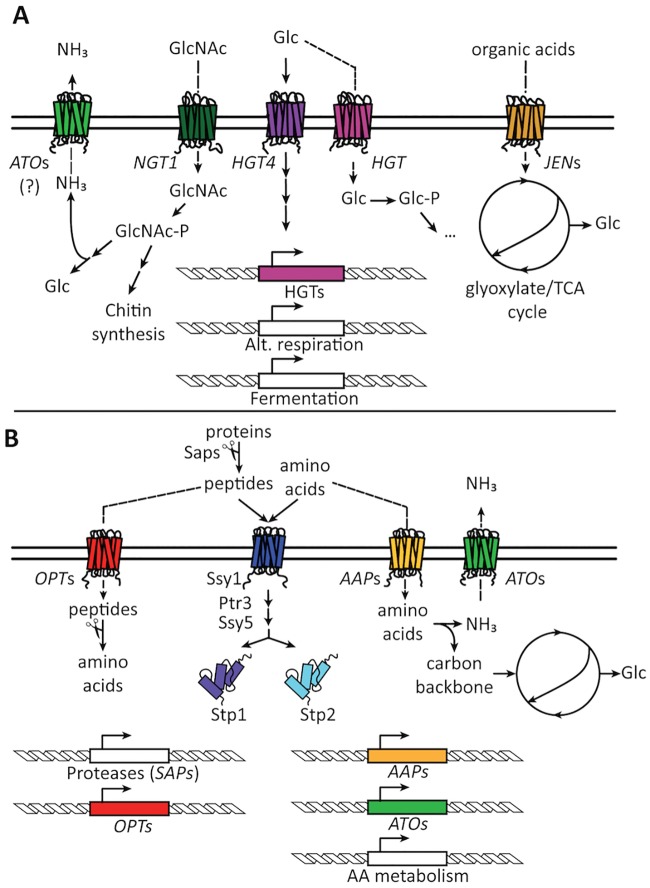
How is C. albicans sensing the nutrients in the host?Glucose remains the preferred carbon source (Fig 2A), and C. albicans detects this sugar via three sensing pathways that act in concert to activate glucose transport and metabolism: the sugar receptor-repressor pathway, the glucose repression pathway, and the adenylate cyclase pathway (reviewed in ref.[3]).Glucose metabolism via glycolysis and fermentation seems to be crucial during C. albicans gastrointestinal (GI) colonization, since genes controlled by the glycolysis transcriptional regulators Gal4 and Tye7 are highly expressed in the cecum of mice.Interestingly, whereas Tye7 is required for GI colonization, this transcription factor (TF) is dispensable for systemic infection [4].In contrast, glycolytic enzymes are critical for systemic pathogenesis [5].This suggests there are additional regulators yet to be discovered that control central metabolism in some host niches.
Overview
The claims and statistics of this paper haven’t been checked yet.
Free: it reads the open-access text and checks the first 5 claims that cite a source we can check. Create a free account to check every claim.
Integrity signals
Registry
Cites
Statistics
Figures
Verification
Claims the paper makes
The claims and statistics of this paper haven’t been checked yet.
Free: it reads the open-access text and checks the first 5 claims that cite a source we can check. Create a free account to check every claim.
Claims other papers make about this one
Each is checked against this paper’s own text: does it say what the citing paper says it does?
The source backs part of the claim, not all of it — or backs it for a different population, condition or comparison.
In the citing paper
“The ability to utilize alternative carbon sources plays an essential role in allowing C. albicans to transition from a commensal colonizer to a pathogenic microbe8–10.”
From Multifactor transcriptional control of alternative oxidase induction integrates diverse environmental inputs to enable fungal virulence (2023) · cites this paper as [9]
Experimental — accuracy not yet measured
Self-check
Percentages, sums and reported differences re-computed from the paper’s own numbers.
The self-check needs the paper’s full text.
Citations
Cites
Candida albicans Secreted Aspartyl Proteinases in Virulence and Pathogenesis
Naglik, J. R., Challacombe, S. J., & Hube, B. (2003) · Microbiology and Molecular Biology Reviews · doi:10.1128/mmbr.67.3.400-428.2003 · Cited by 1,179
Owen, D. H., & Katz, D. F. (1999) · Contraception · doi:10.1016/s0010-7824(99)00010-4 · Cited by 718
Transcriptional Response of Candida albicans upon Internalization by Macrophages
Lorenz, M. C., Bender, J. A., & Fink, G. R. (2004) · Eukaryotic Cell · doi:10.1128/ec.3.5.1076-1087.2004 · Cited by 712
Self-citationNoble, S. M., & Johnson, A. D. (2005) · Eukaryotic Cell · doi:10.1128/ec.4.2.298-309.2005 · Cited by 592
Fradin, C., De Groot, P., MacCallum, D., Schaller, M., Klis, F., Odds, F. C., & Hube, B. (2005) · Molecular Microbiology · doi:10.1111/j.1365-2958.2005.04557.x · Cited by 455
Hube, B., Monod, M., Schofield, D. A., Brown, A. J. P., & Gow, N. A. R. (1994) · Molecular Microbiology · doi:10.1111/j.1365-2958.1994.tb01269.x · Cited by 372
The Fungal Pathogen Candida albicans Autoinduces Hyphal Morphogenesis by Raising Extracellular pH
Vylkova, S., Carman, A. J., Danhof, H. A., Collette, J. R., Zhou, H., & Lorenz, M. C. (2011) · mBio · doi:10.1128/mbio.00055-11 · Cited by 365
Self-citationNiche-specific regulation of central metabolic pathways in a fungal pathogen
Barelle, C. J., Priest, C. L., MacCallum, D. M., Gow, N. A. R., Odds, F. C., & Brown, A. J. P. (2006) · Cellular Microbiology · doi:10.1111/j.1462-5822.2005.00676.x · Cited by 336
Ene, I. V., Adya, A. K., Wehmeier, S., Brand, A. C., MacCallum, D. M., Gow, N. A. R., & Brown, A. J. P. (2012) · Cellular Microbiology · doi:10.1111/j.1462-5822.2012.01813.x · Cited by 313
Zakikhany, K., Naglik, J. R., Schmidt-Westhausen, A., Holland, G., Schaller, M., & Hube, B. (2007) · Cellular Microbiology · doi:10.1111/j.1462-5822.2007.01009.x · Cited by 288
Cited by
Dadar, M., Tiwari, R., Karthik, K., Chakraborty, S., Shahali, Y., & Dhama, K. (2018) · Microbial Pathogenesis · doi:10.1016/j.micpath.2018.02.028 · Cited by 332
Virulence Factors in Candida species
Staniszewska, M. (2020) · Current Protein & Peptide Science · doi:10.2174/1389203720666190722152415 · Cited by 279
Ahmad, S., & Alfouzan, W. (2021) · Microorganisms · doi:10.3390/microorganisms9040807 · Cited by 269
Kumamoto, C. A., Gresnigt, M. S., & Hube, B. (2020) · Current Opinion in Microbiology · doi:10.1016/j.mib.2020.05.006 · Cited by 208
Mechanism of Candida pathogenesis: Revisiting the vital drivers
Mba, I. E., & Nweze, E. I. (2020) · European Journal of Clinical Microbiology & Infectious Diseases · doi:10.1007/s10096-020-03912-w · Cited by 143
The impact of carbon and nitrogen catabolite repression in microorganisms
Nair, A., & Sarma, S. J. (2021) · Microbiological Research · doi:10.1016/j.micres.2021.126831 · Cited by 144
Pellón, A., Nasab, S. D. S., & Moyes, D. L. (2020) · Frontiers in Cellular and Infection Microbiology · doi:10.3389/fcimb.2020.00081 · Cited by 113
Chew, S. Y., Chee, W. J. Y., & Than, L. T. L. (2019) · Journal of Biomedical Science · doi:10.1186/s12929-019-0546-5 · Cited by 101
Evasion of Immune Surveillance in Low Oxygen Environments Enhances Candida albicans Virulence
Lopes, J. P., Stylianou, M., Backman, E., Holmberg, S., Jass, J., Claesson, R., & Urban, C. F. (2018) · mBio · doi:10.1128/mbio.02120-18 · Cited by 88
“Hypoxia and carbon source availability are known to influence the cell wall composition (28).”
Williams, R. B., & Lorenz, M. C. (2020) · mBio · doi:10.1128/mbio.03070-19 · Cited by 87
Self-citationTao, L., Zhang, Y., Fan, S., Nobile, C. J., Guan, G., & Huang, G. (2017) · PLOS Genetics · doi:10.1371/journal.pgen.1006949 · Cited by 77
“albicans to utilize host-derived nutrients and to rapidly adapt to the ever-changing host environment are critical for its pathogenic and commensal life styles [45].”
BackgroundO’Connell, L. M., Santos, R., Springer, G. H., Burne, R. A., Nascimento, M. M., & Richards, V. P. (2020) · Applied and Environmental Microbiology · doi:10.1128/aem.02825-19 · Cited by 75
Metabolic Adaptations During Staphylococcus aureus and Candida albicans Co-Infection
Eichelberger, K. R., & Cassat, J. E. (2021) · Frontiers in Immunology · doi:10.3389/fimmu.2021.797550 · Cited by 67
Dunker, C., Polke, M., Schulze-Richter, B., Schubert, K., Rudolphi, S., Gressler, A. E., Pawlik, T., Prada Salcedo, J. P., Niemiec, M. J., Slesiona-Künzel, S., et al. (2021) · Nature Communications · doi:10.1038/s41467-021-24095-8 · Cited by 66
Borghi, M., Pariano, M., Solito, V., Puccetti, M., Bellet, M. M., Stincardini, C., Renga, G., Vacca, C., Sellitto, F., Mosci, P., et al. (2019) · Frontiers in Immunology · doi:10.3389/fimmu.2019.02364 · Cited by 63
“Indeed, not only the composition of the vaginal microbiome is expected to respond to dietary changes (33), but Candida itself is sensitive to nutrient availability (34), thus suggesting that the diet might be used to shift the balance of the host-Candida cross-talk toward a tolerogenic state.”
BackgroundRole of Cellular Metabolism during Candida-Host Interactions
Pellón, A., Begum, N., Nasab, S. D. S., Harzandi, A., Shoaie, S., & Moyes, D. L. (2022) · Pathogens · doi:10.3390/pathogens11020184 · Cited by 50
Mechanisms of genome evolution in Candida albicans
Ene, I. V., Bennett, R. J., & Anderson, M. Z. (2019) · Current Opinion in Microbiology · doi:10.1016/j.mib.2019.05.001 · Cited by 50
Laurian, R., Dementhon, K., Doumèche, B., Soulard, A., Noël, T., Lemaire, M., & Cotton, P. (2019) · Frontiers in Microbiology · doi:10.3389/fmicb.2019.00327 · Cited by 50
Burgain, A., Pic, É., Markey, L., Tebbji, F., Kumamoto, C. A., & Sellam, A. (2019) · PLoS Pathogens · doi:10.1371/journal.ppat.1007823 · Cited by 49
Metabolic Reprogramming in the Opportunistic Yeast Candida albicans in Response to Hypoxia
Burgain, A., Tebbji, F., Khemiri, I., & Sellam, A. (2020) · mSphere · doi:10.1128/msphere.00913-19 · Cited by 49
Miao, J., Regan, J., Cai, C., Palmer, G. E., Williams, D. L., Kruppa, M., & Peters, B. M. (2023) · mBio · doi:10.1128/mbio.00046-23 · Cited by 41
Morphogenic plasticity: the pathogenic attribute of Candida albicans
Prasad, P., & Tippana, M. (2023) · Current Genetics · doi:10.1007/s00294-023-01263-5 · Cited by 41
Todd, O. A., Noverr, M. C., & Peters, B. M. (2019) · mSphere · doi:10.1128/msphere.00780-19 · Cited by 41
Khemiri, I., Tebbji, F., & Sellam, A. (2020) · Frontiers in Microbiology · doi:10.3389/fmicb.2020.00935 · Cited by 40
“…al., 2004, 1; Mackie et al., 2016) and confirmed by our work, a homeostatic level of Cu is essential for C. albicans to metabolize different carbon sources, an important attribute for this yeast to colonize diverse niches with contrasting nutrients (Miramon and Lorenz, 2017; Burgain et al., 2019).”
BackgroundIn Vitro Incorporation of Helicobacter pylori into Candida albicans Caused by Acidic pH Stress
Sánchez-Alonzo, K., Parra-Sepúlveda, C., Vega, S., Bernasconi, H., Campos, V. L., Smith, C. T., Sáez, K. L., & García, A. (2020) · Pathogens · doi:10.3390/pathogens9060489 · Cited by 39
Sprenger, M., Hartung, T. S., Allert, S., Wisgott, S., Niemiec, M. J., Graf, K., Jacobsen, I. D., Kasper, L., & Hube, B. (2020) · Cellular Microbiology · doi:10.1111/cmi.13197 · Cited by 35
Oral Mycobiota: A Narrative Review
Defta, C. L., Albu, C.-C., Albu, Ş.-D., & Bogdan-Andreescu, C. F. (2024) · Dentistry Journal · doi:10.3390/dj12040115 · Cited by 35
Guo, Y., Wang, Y., Wang, Y., Jin, Y., & Wang, C. (2020) · Frontiers in Microbiology · doi:10.3389/fmicb.2020.596459 · Cited by 35
Alves, R. M. A., Kastora, S. L., Gomes-Gonçalves, A., Azevedo, N. F., Rodrigues, C. F., Silva, S. M., Demuyser, L., Dijck, P. V., Casal, M., Brown, A. J. P., et al. (2020) · npj Biofilms and Microbiomes · doi:10.1038/s41522-020-0114-5 · Cited by 34
The Role of Candida albicans Transcription Factor RLM1 in Response to Carbon Adaptation
Oliveira-Pacheco, J., Alves, R. M. A., Costa‐Barbosa, A., Cerqueira-Rodrigues, B., Pereira‐Silva, P., Paiva, S., Silva, S. M., Henriques, M., Pais, C., & Sampaio, P. (2018) · Frontiers in Microbiology · doi:10.3389/fmicb.2018.01127 · Cited by 33
Cottier, F., Tan, A. S. M., Yurieva, M., Liao, W. W. P., Lum, J., Poidinger, M., Zolezzi, F., & Pavelka, N. (2017) · G3 Genes Genomes Genetics · doi:10.1534/g3.117.300238 · Cited by 32
Weerasinghe, H., Stölting, H., Rose, A. J., & Traven, A. (2024) · Microbiology and Molecular Biology Reviews · doi:10.1128/mmbr.00171-22 · Cited by 31
Candida auris —macrophage cellular interactions and transcriptional response
Miramón, P., Pountain, A. W., & Lorenz, M. C. (2023) · Infection and Immunity · doi:10.1128/iai.00274-23 · Cited by 29
“These include pathways for the catabolism of carboxylic acids, amino acids, fatty acids, and N -acetylglucosamine (17, 23).”
BackgroundSelf-citationSatała, D., Juszczak, M., Wronowska, E., Surowiec, M., Kulig, K., Kozik, A., Rąpała‐Kozik, M., & Karkowska‐Kuleta, J. (2022) · Cellular Microbiology · doi:10.1155/2022/2599136 · Cited by 28
Chew, S. Y., Brown, A. J. P., Lau, B. Y. C., Cheah, Y. K., Ho, K. L., Sandai, D. A., Hassan, Y., & Than, L. T. L. (2021) · Journal of Biomedical Science · doi:10.1186/s12929-020-00700-8 · Cited by 28
Padder, S. A., Ramzan, A., Tahir, I., Rehman, R. U., & Shah, A. H. (2022) · Critical Reviews in Microbiology · doi:10.1080/1040841x.2021.1935447 · Cited by 27
Dumeaux, V., Massahi, S., Bettauer, V., Mottola, A., Dukovny, A., Khurdia, S. S., Costa, A. C. B. P., Omran, R. P., Simpson, S., Xie, J. L., et al. (2023) · eLife · doi:10.7554/elife.81406 · Cited by 25
Chen, T., Wagner, A. S., & Reynolds, T. B. (2022) · Frontiers in Fungal Biology · doi:10.3389/ffunb.2022.842501 · Cited by 25
Alves, R. M. A., Mota, S. M. D. S., Silva, S. M., Rodrigues, C. F., Brown, A. J. P., Henriques, M., Casal, M., & Paiva, S. (2017) · Biofouling · doi:10.1080/08927014.2017.1392514 · Cited by 24
Romo, J. A., Zhang, H., Cai, H., Kadosh, D., Köhler, J. R., Saville, S. P., Wang, Y., & Lopez-Ribot, J. L. (2019) · mSphere · doi:10.1128/msphere.00620-19 · Cited by 23
Cruz, I. L. R., Freitas, D. F. S., de Macedo, P. M., Gutierrez‐Galhardo, M. C., do Valle, A. C. F., Almeida, M. D. A., Coelho, R. A., Brito‐Santos, F., Figueiredo‐Carvalho, M. H. G., Zancopé‐Oliveira, R. M., et al. (2020) · Brazilian Journal of Microbiology · doi:10.1007/s42770-020-00297-y · Cited by 23
Liu, Z., Basso, P., Hossain, S., Liston, S. D., Robbins, N., Whitesell, L., Noble, S. M., & Cowen, L. E. (2023) · Nature Communications · doi:10.1038/s41467-023-40209-w · Cited by 22
Integrative functional analysis uncovers metabolic differences between Candida species
Begum, N., Lee, S., Portlock, T., Pellón, A., Nasab, S. D. S., Nielsen, J., Uhlén, M., Moyes, D. L., & Shoaie, S. (2022) · Communications Biology · doi:10.1038/s42003-022-03955-z · Cited by 21
Pountain, A. W., Collette, J. R., Farrell, W. M., & Lorenz, M. C. (2021) · mBio · doi:10.1128/mbio.03317-21 · Cited by 21
Self-citationJenull, S., Mair, T., Tscherner, M., Penninger, P., Zwolanek, F., Silao, F. G. S., Vicente, K. M. D. S., Riedelberger, M., Bandari, N. C., Shivarathri, R., et al. (2021) · Cell Reports · doi:10.1016/j.celrep.2021.109406 · Cited by 20
Respiration supports intraphagosomal filamentation and escape of Candida albicans from macrophages
Case, N. T., Westman, J., Hallett, M. T., Plumb, J. D., Farheen, A., Maxson, M. E., MacAlpine, J., Liston, S. D., Hube, B., Robbins, N., et al. (2023) · mBio · doi:10.1128/mbio.02745-23 · Cited by 20
Miramón, P., Pountain, A. W., van Hoof, A., & Lorenz, M. C. (2020) · Infection and Immunity · doi:10.1128/iai.00763-19 · Cited by 20
Self-citationJacobsen, I. D. (2019) · Virulence · doi:10.1080/21505594.2019.1682248 · Cited by 20
Mitochondrial Control of Fungal Cell Walls: Models and Relevance in Fungal Pathogens
Koch, B., & Traven, A. (2019) · Current Topics in Microbiology and Immunology · doi:10.1007/82_2019_183 · Cited by 19
Glucose Metabolism and Use of Alternative Carbon Sources in Medically-Important Fungi
Chew, S. Y., & Than, L. T. L. (2021) · Elsevier eBooks · doi:10.1016/b978-0-12-819990-9.00068-8 · Cited by 19
GNP2 Encodes a High-Specificity Proline Permease in Candida albicans
Garbe, E., Miramón, P., Gerwien, F., Ueberschaar, N., Hansske-Braun, L., Brandt, P., Böttcher, B., Lorenz, M. C., & Vylkova, S. (2022) · mBio · doi:10.1128/mbio.03142-21 · Cited by 18
Self-citationA Proteomic Landscape of Candida albicans in the Stepwise Evolution to Fluconazole Resistance
Song, N., Zhou, X., Li, D., Li, X., & Liu, W. (2022) · Antimicrobial Agents and Chemotherapy · doi:10.1128/aac.02105-21 · Cited by 17
Garbe, E., Gerwien, F., Driesch, D., Müller, T., Böttcher, B., Gräler, M. H., & Vylkova, S. (2022) · mSystems · doi:10.1128/msystems.00539-22 · Cited by 17
Effect of photodynamic antimicrobial chemotherapy on Candida albicans in the presence of glucose
de Oliveira-Silva, T., Alvarenga, L. H., Leal, C. R. L., Godoy-Miranda, B. A., Carribeiro, P., Suzuki, L. C., Ribeiro, M. S., Kato, I. T., Pavani, C., & Prates, R. A. (2019) · Photodiagnosis and Photodynamic Therapy · doi:10.1016/j.pdpdt.2019.05.032 · Cited by 16
A role for Candida albicans superoxide dismutase enzymes in glucose signaling
Broxton, C. N., He, B., Bruno, V. M., & Culotta, V. (2017) · Biochemical and Biophysical Research Communications · doi:10.1016/j.bbrc.2017.11.084 · Cited by 15
Lineage-specific selection and the evolution of virulence in the Candida clade
Singh-Babak, S. D., Babak, T., Fraser, H. B., & Johnson, A. D. (2021) · Proceedings of the National Academy of Sciences · doi:10.1073/pnas.2016818118 · Cited by 15
Cek1 regulates ß(1,3)-glucan exposure through calcineurin effectors in Candida albicans
Wagner, A. S., Lumsdaine, S. W., Mangrum, M. M., King, A. E., Hancock, T. J., Sparer, T. E., & Reynolds, T. B. (2022) · PLOS Genetics · doi:10.1371/journal.pgen.1010405 · Cited by 12
“These include limitations on nutrient availability [1–3], pH changes [4–6], or altered oxygen levels within specific host niches [7–10].”
de Andrade, I. B., Figueiredo‐Carvalho, M. H. G., Chaves, A. L. D. S., Coelho, R. A., Almeida‐Silva, F., Zancopé‐Oliveira, R. M., Frasés, S., Brito‐Santos, F., & Almeida‐Paes, R. (2022) · Mycoses · doi:10.1111/myc.13562 · Cited by 12
Radaković, N., Nikolić, A., Terzić, N., Stojković, P., Stankovic, N., Šolaja, B. A., Opsenica, I., & Pavić, A. (2022) · European Journal of Medicinal Chemistry · doi:10.1016/j.ejmech.2022.114137 · Cited by 10
Diverse mechanisms control amino acid‐dependent environmental alkalization by Candida albicans
Silao, F. G. S., Valeriano, V. D., Uddström, E., Falconer, E., & Ljungdahl, P. O. (2024) · Molecular Microbiology · doi:10.1111/mmi.15216 · Cited by 10
Host albumin redirects Candida albicans metabolism to engage an alternative pathogenicity pathway
Hitzler, S. U. J., Fernández-Fernández, C., Günther, K., Dietschmann, A., Hovhannisyan, H., Möslinger, A., Austermeier, S., Cristóvão, B., Vascelli, G., Zelante, T., et al. (2025) · Nature Communications · doi:10.1038/s41467-025-61701-5 · Cited by 10
Candida albicans cells exhibit media specific proteomic profiles during induction of filamentation
Legros, V., Albanèse, V., Chevreux, G., Camadro, J., & Auchère, F. (2024) · BMC Microbiology · doi:10.1186/s12866-024-03627-4 · Cited by 9
Candida albicans Hexokinase 2 Challenges the Saccharomyces cerevisiae Moonlight Protein Model
Laurian, R., Ravent, J., Dementhon, K., Lemaire, M., Soulard, A., & Cotton, P. (2021) · Microorganisms · doi:10.3390/microorganisms9040848 · Cited by 9
Mosca, V. A. B., Arita, G. S., Vilegas, L. V., Faria, D. R., Sakita, K. M., Rodrigues-Vendramini, F. A. V., Capoci, I. R. G., Becker, T. C. A., de Oliveira, A. G., Kioshima, É. S., et al. (2020) · Future Microbiology · doi:10.2217/fmb-2019-0223 · Cited by 9
Rani, P., Gautam, G., Anwar, T., Gourinath, S., & Datta, A. (2019) · International Journal of Biological Macromolecules · doi:10.1016/j.ijbiomac.2019.10.138 · Cited by 9
Commensal to Pathogen Transition of Candida albicans
Niemiec, M. J., Kapitan, M., Polke, M., & Jacobsen, I. D. (2017) · Elsevier eBooks · doi:10.1016/b978-0-12-809633-8.12077-1 · Cited by 9
Raj, K., Paul, D., Rishi, P., Shukla, G., Dhotre, D. P., & YogeshSouche (2024) · BMC Microbiology · doi:10.1186/s12866-024-03274-9 · Cited by 8
Lange, T., Sprague, J. L., Vij, R., Alonso‐Román, R., Jablonowski, N., Radosa, S., Krüger, T., Kniemeyer, O., Hillmann, F., Brakhage, A. A., et al. (2025) · PLoS Pathogens · doi:10.1371/journal.ppat.1013542 · Cited by 8
Ramos, M. L. M., Barrinha, A., Araújo, G. R. D. S., Alves, V., de Andrade, I. B., Corrêa-Junior, D., Motta, M. C. M., Almeida‐Paes, R., & Frasés, S. (2024) · Microbes and Infection · doi:10.1016/j.micinf.2024.105440 · Cited by 8
Bayot, J., Martin, C., Chevreux, G., Camadro, J., & Auchère, F. (2023) · Biochemical Journal · doi:10.1042/bcj20220505 · Cited by 8
Update of Vulvovaginal Candidiasis in Pregnant and Non-pregnant Patients
Ramírez-Lozada, T., Espinosa-Hernández, V. M., León, M. G. F.-D., & Martínez-Herrera, E. O. (2019) · Current Fungal Infection Reports · doi:10.1007/s12281-019-00357-3 · Cited by 8
Arévalo‐Jaimes, B. V., & Torrents, E. (2024) · Current Research in Microbial Sciences · doi:10.1016/j.crmicr.2024.100316 · Cited by 8
Clarifying and Imaging Candida albicans Biofilms
Lanni, F., Lagree, K., Huang, M. Y., Yan, L., Woolford, C. A., & Mitchell, A. P. (2020) · Journal of Visualized Experiments · doi:10.3791/60718 · Cited by 7
Strain variation in Candida albicans glycolytic gene regulation
Kim, M.-J., White, A. M., & Mitchell, A. P. (2024) · mSphere · doi:10.1128/msphere.00579-24 · Cited by 7
Grf10 regulates the response to copper, iron, and phosphate in Candida albicans
Wangsanut, T., Arnold, S. J. Y., Jilani, S. Z., Marzec, S., Monsour, R. C., & Rolfes, R. J. (2023) · G3 Genes Genomes Genetics · doi:10.1093/g3journal/jkad070 · Cited by 7
Mishra, A. A., Palmer, S. N., Zarek, C. M., Coughlin, L. A., Poulides, N. A., Dakour, J., Chiu, R. S.-Y., Sabaeifard, P., Li, W., Morrill, A. C., et al. (2026) · Cell Host & Microbe · doi:10.1016/j.chom.2026.05.007 · Cited by 7
Alqahtani, F. M., Handy, S. T., Sutton, C. L., & Farone, M. B. (2021) · Frontiers in Microbiology · doi:10.3389/fmicb.2021.708267 · Cited by 6
Commensal to Pathogen Transition of Candida albicans
Jacobsen, I. D., Niemiec, M. J., Kapitan, M., & Polke, M. (2020) · Elsevier eBooks · doi:10.1016/b978-0-12-809633-8.21281-8 · Cited by 6
Pavic, A., Radaković, N., Morić, I., Stankovic, N., Opsenica, D., & Šenerović, L. (2024) · npj Biofilms and Microbiomes · doi:10.1038/s41522-024-00608-3 · Cited by 5
Yasuma-Mitobe, K., Liao, C., Németh, T., Byrne, K. P., Billips, A., Ramos, R. J. J. F., Salinas, C. N., Chan, E., Perissinoto, M., Adami-Sampson, S., et al. (2026) · Cell Host & Microbe · doi:10.1016/j.chom.2026.05.008 · Cited by 4
Menon, A. C. T., Tebbji, F., Mecteau, M., Alikashani, A., Vincent, A. T., Rhéaume, É., Tardif, J., & Sellam, A. (2026) · mBio · doi:10.1128/mbio.00472-26 · Cited by 4
Storage-driven microbial and quality dynamics of brewer’s spent grain for food valorization
Aradwad, P. P., Ramakrishnan, D. K., Rauh, C., Abdelfattah, A., & Sturm, B. (2026) · Applied Food Research · doi:10.1016/j.afres.2026.102144 · Cited by 3
Rachana, A., Atheena, P. V., Britto, A. J., Chakraborty, U., & Raval, R. (2025) · Journal of Microbiological Methods · doi:10.1016/j.mimet.2025.107282 · Cited by 2
An emergent biofilm program from inactivation of Candida albicans master regulators Efg1 and Ndt80
Do, E., Żarnowski, R., Andes, D. R., & Mitchell, A. P. (2026) · PLoS Pathogens · doi:10.1371/journal.ppat.1014469 · Cited by 2
Ewald, J., Jansen, P. M., Brunke, S., Hiller, D., Luther, C. H., González‐Díaz, H., Dittrich, M. T., Fleißner, A., Hube, B., Schuster, S., et al. (2021) · bioRxiv (Cold Spring Harbor Laboratory) · doi:10.1101/2021.09.05.459012 · Cited by 2
Extracellular Vesicles Modulate Growth and Stress Adaptation in Fusarium circinatum
Ratsoma, F. M., Mokoena, N., Mpupa, S., Santana, Q. C., Wingfield, B. D., Steenkamp, E. T., & Motaung, T. E. (2025) · Plant Pathology · doi:10.1111/ppa.70012 · Cited by 2
Dufresne, K. (2025) · Lipids in Health and Disease · doi:10.1186/s12944-025-02489-7 · Cited by 2
Alaban, L. R., Bunescu, A., Abi‐Ghanem, J., Bequet, F., Lebrat, J., Tulinski, P., Kosmala, D., Bougnoux, M., d’Enfert, C., & Thomas, V. (2026) · Applied and Environmental Microbiology · doi:10.1128/aem.01512-25 · Cited by 2
Cytrynbaum, E. G., & McClean, M. N. (2025) · Advanced Drug Delivery Reviews · doi:10.1016/j.addr.2025.115740 · Cited by 1
Alvarado, M., Moreno‐Martínez, A. E., Micó, M., Navajas, J. A. G., Blázquez-Abellán, A., Mixão, V., Gabaldón, T., Mateo, E., Valentín, E., & de Groot, P. W. J. (2025) · FEMS Yeast Research · doi:10.1093/femsyr/foaf042 · Cited by 1
Garbe, E., Schäuble, S., Böttcher, B., Jesse, R., Driesch, D., van Wijlick, L., Elshafee, O., Schille, T. B., Hube, B., Panagiotou, G., et al. (2025) · mSystems · doi:10.1128/msystems.00226-25 · Cited by 1
de Andrade, A. R. C. (2023) · LA Referencia (Red Federada de Repositorios Institucionales de Publicaciones Científicas) · Cited by 1
Multiple phosphorylation sites regulate the activity of the repressor Mig1 in Candida albicans
Ramírez-Zavala, B., Betsova, D., Schwanfelder, S., Krüger, I., Mottola, A., Krüger, T., Kniemeyer, O., Brakhage, A. A., & Morschhäuser, J. (2023) · mSphere · doi:10.1128/msphere.00546-23 · Cited by 1
Hube, B., & Brunke, S. (2020) · Faculty Opinions – Post-Publication Peer Review of the Biomedical Literature · doi:10.3410/f.737216998.793573821
Evolution of antifungal drug resistance of the human-pathogenic fungus \(Candida\) \(albicans\)
Popp, C. (2021) · Online Publication Service of Würzburg University (Würzburg University) · doi:10.25972/opus-24351
ALTERNATIVE CARBON UTILIZATION AS A VIRULENCE DETERMINANT FOR CANDIDA ALBICANS
Williams, R. B. (2020) · Digital Commons-TMC (Texas Medical Center)
Étude de l'homéostasie de la taille chez la levure opportuniste Candida albicans
Chaillot, J. (2019) · Corpus Université Laval (Université Laval)
Characterization of secreted aspartyl proteases in Candida parapsilosis
Singh, D. K. (2020) · SZTE Repository of Dissertations (University of Szeged) · doi:10.14232/phd.10273
Resource utilisation and the evolution of antifungal resistance in Candida species
Duxbury, S. J. N. (2017) · Figshare
FATORES DE VIRULÊNCIA DE FUNGOS PATOGÊNICOS HUMANO
RODRIGUES, M. K. P. (2023) · Anais do I Congresso Brasileiro de Estudos Epidemiológicos On-line · doi:10.51161/epidemion2023/25407
Metadata
- Authors
- Miramón, P., & Lorenz, M. C.
- Affiliations
- The University of Texas Health Science Center at Houston (US)
- Corresponding author
- Lorenz, Michael C.
- Venue
- PLOS Pathogens
- Publisher
- Public Library of Science (PLoS)
- Published
- 2017-02-09
- Volume
- 13
- Issue
- 2
- Pages
- e1006144
- ISSN
- 1553-7366 (ISSN-L)
- 1553-7374
- PMC
- PMC5300112
- OpenAlex
- W2587240328
- Cited by
- 106
- References
- 50
- Citations by year
- 2026: 10 · 2025: 8 · 2024: 11 · 2023: 11 · 2022: 12 · 2021: 14 · 2020: 19 · 2019: 13 · 2018: 3 · 2017: 5
- FWCI
- 1.02
- Type
- journal article
- Language
- en
- Open access
- gold
- doi.org
- Licence
- Locations
- PLoS Pathogens (publishedVersion, cc-by)
- Europe PMC (PubMed Central) (publishedVersion, cc-by)
- PubMed Central (publishedVersion, cc-by)
- PubMed (publishedVersion)
- DOAJ (DOAJ: Directory of Open Access Journals) (submittedVersion)
- Funders
- National Institutes of Health
- National Institute of Allergy and Infectious Diseases (R01AI075091)
- Topics
- Life Sciences › Biochemistry, Genetics and Molecular Biology › Molecular Biology › Fungal and yeast genetics research
- Health Sciences › Medicine › Infectious Diseases › Antifungal resistance and susceptibility
- Health Sciences › Medicine › Infectious Diseases › Fungal Infections and Studies
- Keywords
- Candida albicans, metabolic plasticity, virulence, glucose detection, glucose transport, glycolysis, GAL4, intestinal colonization, systemic infection, host-pathogen interaction, nutrient sensing
- MeSH terms
- Adaptation, Physiological, Animals, Candida albicans, Candidiasis, Humans, Virulence
About these checks
Registry, retraction, Cites and statistics results are computed, not judged, with one exception: a printed reference that no index lists is read once by a model before it counts as a citation error. Claims are extracted by a model and kept only when their quote appears verbatim in the text; each cited source is then checked, with a model’s help, for whether it says what the claim relies on. Those verdicts can be wrong — read the claim’s quote and the cited source before relying on one.
Statistics and arithmetic are recomputed, not judged.
Confidence bands are shown only for fields calibrated on our annotated test set. None is calibrated yet, so no band is shown.
What counts as a claim ›How we measure confidence ›How we check this ›
Are you an author, or do you see a problem with this page? Request a review
Data sources
Bibliographic data: Semantic Scholar, OpenAlex, Crossref.
Contains information from the Semantic Scholar Academic Graph Datasets, made available under the ODC Attribution License (ODC-BY 1.0).
Semantic Scholar’s data is described in: Kinney, R., et al. (2023). The Semantic Scholar Open Data Platform. arXiv:2301.10140.
