

The Fungal Pathogen Candida albicans Autoinduces Hyphal Morphogenesis by Raising Extracellular pH
Open accessThe DOI matches its Crossref record; 71 of the 71 references it cites were found in a registry or an index.
Abstract
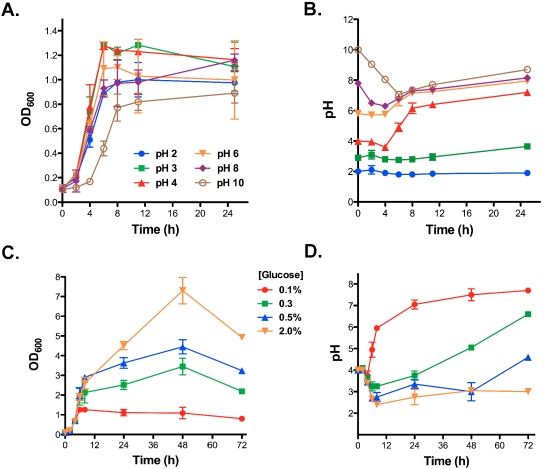
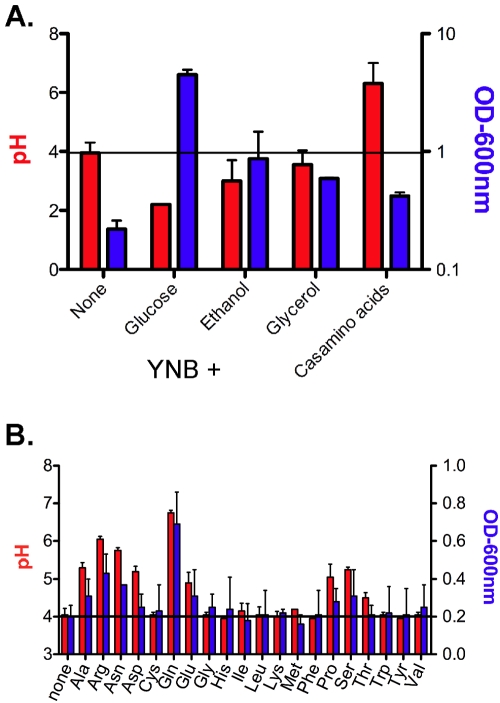
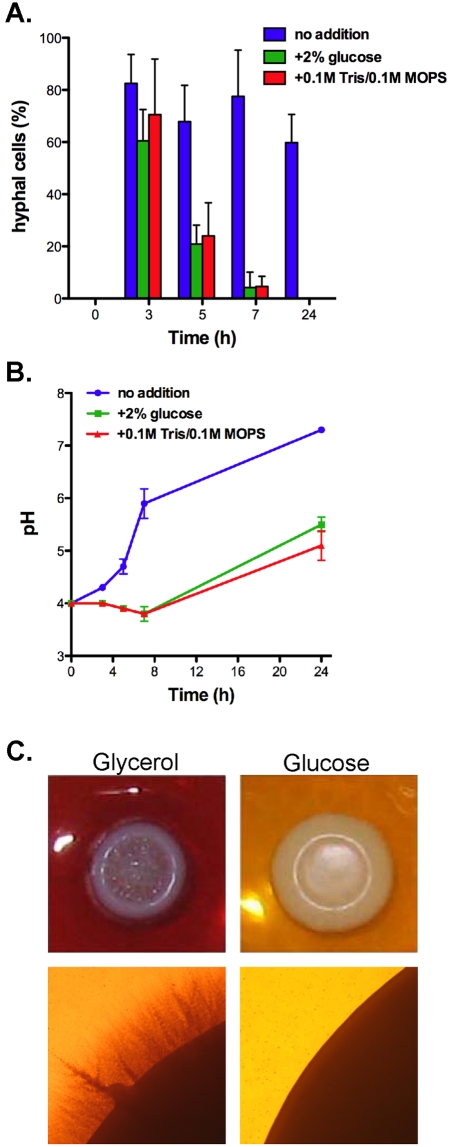
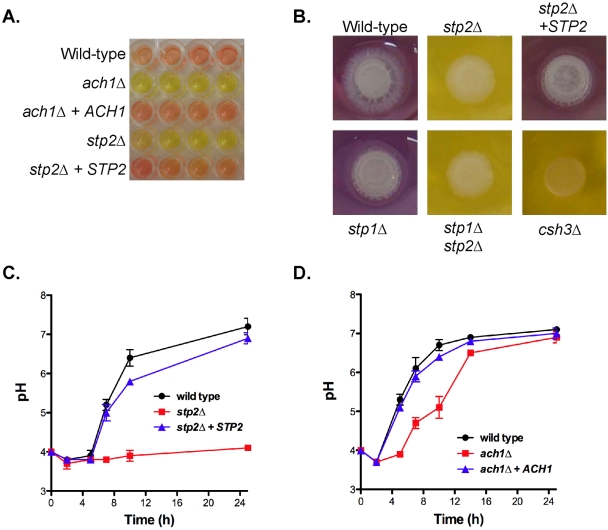
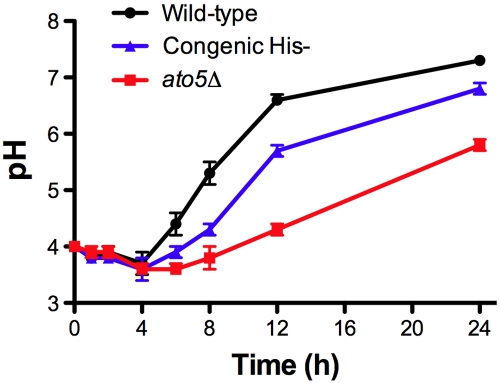
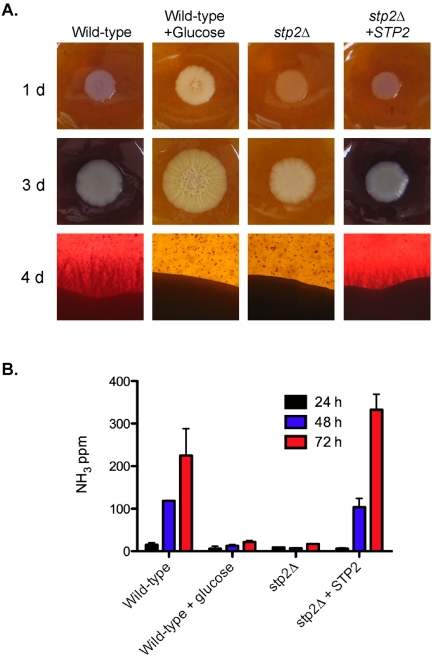
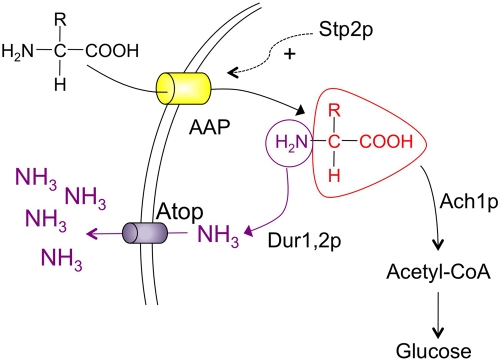
pH homeostasis is critical for all organisms; in the fungal pathogen Candida albicans , pH adaptation is critical for virulence in distinct host niches. We demonstrate that beyond adaptation, C. albicans actively neutralizes the environment from either acidic or alkaline pHs. Under acidic conditions, this species can raise the pH from 4 to >7 in less than 12 h, resulting in autoinduction of the yeast-hyphal transition, a critical virulence trait. Extracellular alkalinization has been reported to occur in several fungal species, but under the specific conditions that we describe, the phenomenon is more rapid than previously observed. Alkalinization is linked to carbon deprivation, as it occurs in glucose-poor media and requires exogenous amino acids. These conditions are similar to those predicted to exist inside phagocytic cells, and we find a strong correlation between the use of amino acids as a cellular carbon source and the degree of alkalinization. Genetic and genomic approaches indicate an emphasis on amino acid uptake and catabolism in alkalinizing cells. Mutations in four genes, STP2 , a transcription factor regulating amino acid permeases, ACH1 (acetyl-coenzyme A [acetyl-CoA] hydrolase), DUR1 , 2 (urea amidolyase), and ATO5 , a putative ammonia transporter, abolish or delay neutralization. The pH changes are the result of the extrusion of ammonia, as observed in other fungi. We propose that nutrient-deprived C. albicans cells catabolize amino acids as a carbon source, excreting the amino nitrogen as ammonia to raise environmental pH and stimulate morphogenesis, thus directly contributing to pathogenesis. IMPORTANCE Candida albicans is the most important fungal pathogen of humans, causing disease at multiple body sites. The ability to switch between multiple morphologies, including a rounded yeast cell and an elongated hyphal cell, is a key virulence trait in this species, as this reversible switch is thought to promote dissemination and tissue invasion in the host. We report here that C. albicans can actively alter the pH of its environment and induce its switch to the hyphal form. The change in pH is caused by the release of ammonia from the cells produced during the breakdown of amino acids. This phenomenon is unprecedented in a human pathogen and may substantially impact host physiology by linking morphogenesis, pH adaptation, carbon metabolism, and interactions with host cells, all of which are critical for the ability of C. albicans to cause disease.
Overview
The claims and statistics of this paper haven’t been checked yet.
Free: it reads the open-access text and checks the first 5 claims that cite a source we can check. Create a free account to check every claim.
Integrity signals
Registry
Cites
Statistics
Figures
Verification
Claims the paper makes
The claims and statistics of this paper haven’t been checked yet.
Free: it reads the open-access text and checks the first 5 claims that cite a source we can check. Create a free account to check every claim.
Claims other papers make about this one
Each is checked against this paper’s own text: does it say what the citing paper says it does?
The source backs part of the claim, not all of it — or backs it for a different population, condition or comparison.
In the citing paper
“amino acids, which are abundant inside macrophages are an important alternative carbon source for the immune evasion of C. albicans [24–28].”
From The F 1 F o -ATP synthase α subunit of Candida albicans induces inflammatory responses by controlling amino acid catabolism (2023) · cites this paper as [27]
Experimental — accuracy not yet measuredThe source backs part of the claim, not all of it — or backs it for a different population, condition or comparison.
In the citing paper
“Phagocytized C. albicans catabolizes amino acids to produce NH3 to neutralize the acidity of phagosomes [26,27], which induces filamentation for macrophage killing and escape [26,29], thus leading to host inflammatory responses [14].”
From The F 1 F o -ATP synthase α subunit of Candida albicans induces inflammatory responses by controlling amino acid catabolism (2023) · cites this paper as [27]
Experimental — accuracy not yet measuredThe source backs part of the claim, not all of it — or backs it for a different population, condition or comparison.
In the citing paper
“Phagocytized C. albicans produces NH3 through amino acid catabolism to neutralize the acidity of phagosomes, thereby inducing filamentation to destroy and escape from macrophages [26,27].”
From The F 1 F o -ATP synthase α subunit of Candida albicans induces inflammatory responses by controlling amino acid catabolism (2023) · cites this paper as [27]
Experimental — accuracy not yet measuredThe source backs part of the claim, not all of it — or backs it for a different population, condition or comparison.
In the citing paper
“C. albicans induces filamentation by neutralizing the acidity of phagosomes through amino acid catabolism [26,27].”
From The F 1 F o -ATP synthase α subunit of Candida albicans induces inflammatory responses by controlling amino acid catabolism (2023) · cites this paper as [27]
Experimental — accuracy not yet measured
Self-check
Percentages, sums and reported differences re-computed from the paper’s own numbers.
The self-check needs the paper’s full text.
Citations
Cites
Cluster analysis and display of genome-wide expression patterns
Eisen, M. B., Spellman, P. T., Brown, P. O., & Botstein, D. (1998) · Proceedings of the National Academy of Sciences · doi:10.1073/pnas.95.25.14863 · Cited by 16,184 · cited 1×
“clustering using the Cluster and TreeView algorithms (66).”
MethodSherman, F. (2002) · Methods in Enzymology · doi:10.1016/s0076-6879(02)50954-x · Cited by 4,121
[1] Getting started with yeast
Sherman, F. (1991) · Methods in Enzymology · doi:10.1016/0076-6879(91)94004-v · Cited by 4,067
Current Protocols in Molecular Biology
(2001) · John Wiley & Sons, Inc. eBooks · doi:10.1002/0471142727 · Cited by 2,398
Nonfilamentous C. albicans Mutants Are Avirulent
Lo, H.-J., Köhler, J. R., DiDomenico, B., Loebenberg, D., Cacciapuoti, A., & Fink, G. R. (1997) · Cell · doi:10.1016/s0092-8674(00)80358-x · Cited by 1,809 · cited 2×
“albicans induces hyphal morphogenesis, a key virulence trait in this species (2, 3).”
BackgroundEvolution of pathogenicity and sexual reproduction in eight Candida genomes
Butler, G., Rasmussen, M. D., Lin, M. F., Santos, M. A. S., Sakthikumar, S., Munro, C. A., Rheinbay, E., Grabherr, M., Forche, A., Reedy, J. L., et al. (2009) · Nature · doi:10.1038/nature08064 · Cited by 1,065 · cited 1×
“parapsilosis) have large Ato families, reminiscent of the expansion of gene families for a number of virulence-related traits, particularly those on the cell surface or secreted, such as secreted aspartyl proteases, lipases, and phospholipases, and GPIanchored cell wall proteins such as the ALS agglutinins (27).”
BackgroundSelf-citationOverview of manual and automated DNA sequencing by the dideoxy chain termination method
CHEN, E., KUANG, W., & LEE, A. (1991) · Methods · doi:10.1016/s1046-2023(05)80158-6 · Cited by 833
The glyoxylate cycle is required for fungal virulence
Lorenz, M. C., & Fink, G. R. (2001) · Nature · doi:10.1038/35083594 · Cited by 745
Self-citationThe SAT1 flipper, an optimized tool for gene disruption in Candida albicans
Reuß, O., Vik, Å., Kolter, R., & Morschhäuser, J. (2004) · Gene · doi:10.1016/j.gene.2004.06.021 · Cited by 742 · cited 3×
“Mutations in ARG1 and ARG3 were generated using the SAT-flipper method, as previously described (61).”
BackgroundMethodInfluentialTranscriptional Response of Candida albicans upon Internalization by Macrophages
Lorenz, M. C., Bender, J. A., & Fink, G. R. (2004) · Eukaryotic Cell · doi:10.1128/ec.3.5.1076-1087.2004 · Cited by 712 · cited 1×
“using an aminoallyl protocol (53) and hybridized to C.”
MethodSelf-citation
Cited by
Normal Bone Anatomy and Physiology
Clarke, B. (2008) · Clinical Journal of the American Society of Nephrology · doi:10.2215/cjn.04151206 · Cited by 2,192
Candida albicans pathogenicity mechanisms
Mayer, F. L., Wilson, D., & Hube, B. (2013) · Virulence · doi:10.4161/viru.22913 · Cited by 1,848
Pathogenesis and virulence of Candida albicans
Lopes, J. P., & Lionakis, M. S. (2022) · Virulence · doi:10.1080/21505594.2021.2019950 · Cited by 477
d'Enfert, C., Kaune, A.-K., Alaban, L.-R., Chakraborty, S., Cole, N., Delavy, M., Kosmala, D., Marsaux, B., Fróis-Martins, R., Morelli, M., et al. (2021) · FEMS Microbiology Reviews · doi:10.1093/femsre/fuaa060 · Cited by 347
Ene, I. V., Adya, A. K., Wehmeier, S., Brand, A. C., MacCallum, D. M., Gow, N. A. R., & Brown, A. J. P. (2012) · Cellular Microbiology · doi:10.1111/j.1462-5822.2012.01813.x · Cited by 313
“…drug resistance and virulence in a fungal pathogen Iuliana V. Ene,1 Ashok K. Adya,2 Silvia Wehmeier,1 Alexandra C. Brand,1 Donna M. MacCallum,1 Neil A. R. Gow1 and Alistair J. P. Brown1* 1Aberdeen Fungal Group, School of Medical Sciences, Institute of Medical Sciences, University of Aberdeen,”
Background
Metadata
- Authors
- Vylkova, S., Carman, A. J., Danhof, H. A., Collette, J. R., Zhou, H., & Lorenz, M. C.
- Affiliations
- The University of Texas Health Science Center at Houston (US)
- Venue
- mBio
- Publisher
- American Society for Microbiology
- Published
- 2011-07
- Volume
- 2
- Issue
- 3
- Pages
- e00055-11
- ISSN
- 2150-7511 (ISSN-L)
- 2161-2129
- PMC
- PMC3101780
- OpenAlex
- W2114950068
- Cited by
- 365
- References
- 68
- Citations by year
- 2026: 22 · 2025: 24 · 2024: 22 · 2023: 24 · 2022: 28 · 2021: 29 · 2020: 41 · 2019: 27 · 2018: 22 · 2017: 24 · 2016: 20 · 2015: 24 · 2014: 28 · 2013: 15 · 2012: 10
- FWCI
- 7.15
- Type
- journal article
- Language
- en
- Open access
- gold
- doi.org
- Licence
- cc-by-nc-sa
- creativecommons.org/licenses/by-nc-sa/3.0/ (vor)
- journals.asm.org/non-commercial-tdm-license (tdm)
- Locations
- mBio (publishedVersion, cc-by-nc-sa)
- PubMed Central (publishedVersion, cc-by-nc-sa)
- PubMed (publishedVersion)
- DOAJ (DOAJ: Directory of Open Access Journals) (submittedVersion, cc-by-sa)
- Funders
- National Institutes of Health
- National Institute of Allergy and Infectious Diseases (R01AI075091, R21AI071134)
- Topics
- Life Sciences › Biochemistry, Genetics and Molecular Biology › Molecular Biology › Fungal and yeast genetics research
- Health Sciences › Medicine › Infectious Diseases › Antifungal resistance and susceptibility
- Health Sciences › Medicine › Infectious Diseases › Fungal Infections and Studies
- Keywords
- Candida albicans, extracellular alkalinization, extracellular pH, hyphal morphogenesis, yeast-to-hypha transition, pH homeostasis, amino acid catabolism, carbon source, ammonia excretion, virulence, phagocytes
- MeSH terms
- Amino Acids, Candida albicans, Carbon, Culture Media, Fungal Proteins, Humans, Hydrogen-Ion Concentration, Mutation, Virulence, Hyphae, Virulence Factors
About these checks
Registry, retraction, Cites and statistics results are computed, not judged, with one exception: a printed reference that no index lists is read once by a model before it counts as a citation error. Claims are extracted by a model and kept only when their quote appears verbatim in the text; each cited source is then checked, with a model’s help, for whether it says what the claim relies on. Those verdicts can be wrong — read the claim’s quote and the cited source before relying on one.
Statistics and arithmetic are recomputed, not judged.
Confidence bands are shown only for fields calibrated on our annotated test set. None is calibrated yet, so no band is shown.
What counts as a claim ›How we measure confidence ›How we check this ›
Are you an author, or do you see a problem with this page? Request a review
How to cite
Cite CoChat for the checks on this page, and the paper for its own findings.
- This page
- CoChat. (2026). Citation check: The Fungal Pathogen Candida albicans Autoinduces Hyphal Morphogenesis by Raising Extracellular pH. https://app.cochat.ai/papers/10.1128/mbio.00055-11
- The paper
- Vylkova, S., Carman, A. J., Danhof, H. A., Collette, J. R., Zhou, H., & Lorenz, M. C. (2011). The Fungal Pathogen Candida albicans Autoinduces Hyphal Morphogenesis by Raising Extracellular pH. mBio. https://doi.org/10.1128/mbio.00055-11
Data sources
Bibliographic data: Semantic Scholar, OpenAlex, Crossref.
Contains information from the Semantic Scholar Academic Graph Datasets, made available under the ODC Attribution License (ODC-BY 1.0).
Semantic Scholar’s data is described in: Kinney, R., et al. (2023). The Semantic Scholar Open Data Platform. arXiv:2301.10140.
