

Lactoferrin binding protein B – a bi-functional bacterial receptor protein
Open accessThe DOI matches its Crossref record; 46 of the 46 references it cites were found in a registry or an index.
Abstract
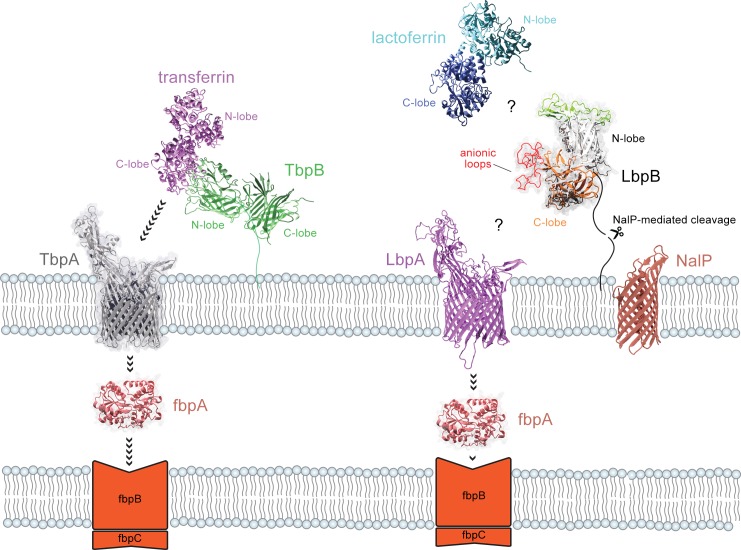
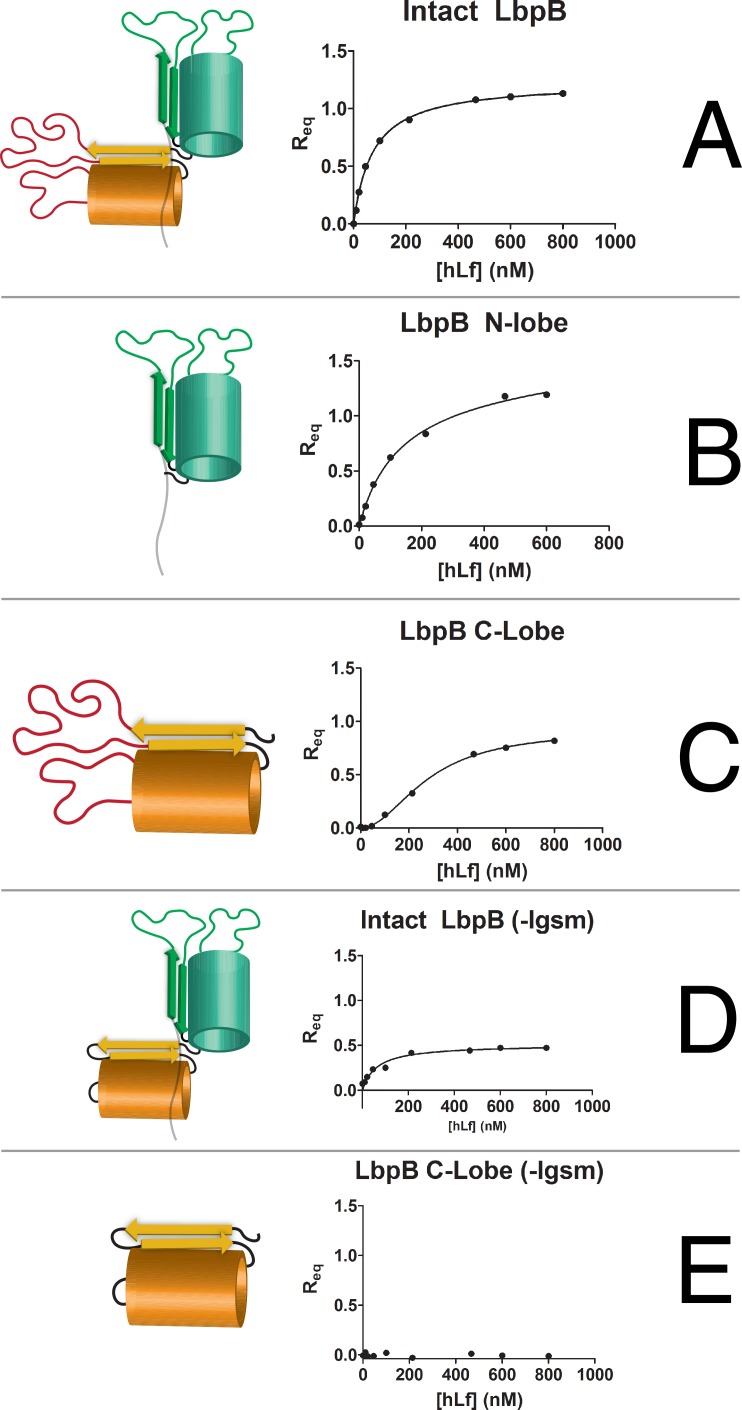
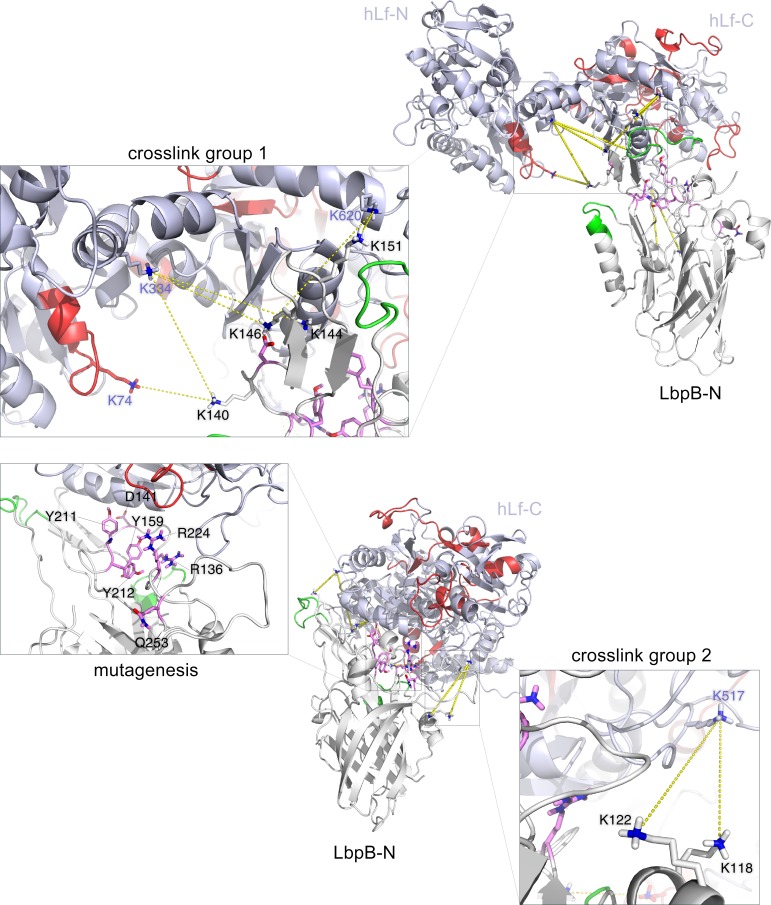
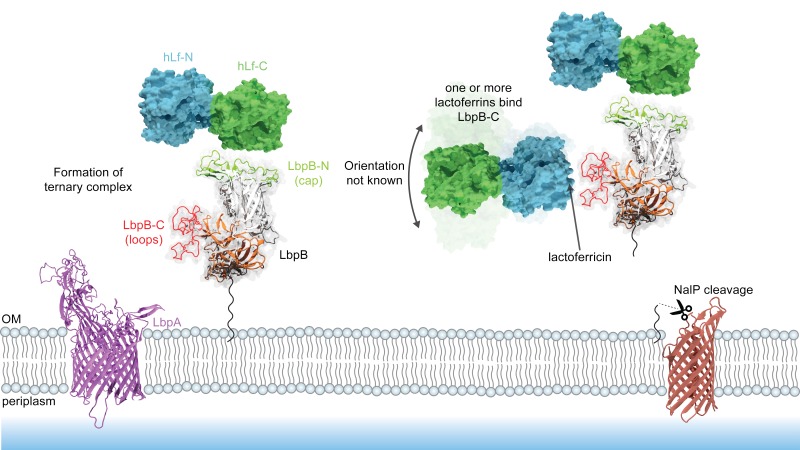
Lactoferrin binding protein B (LbpB) is a bi-lobed outer membrane-bound lipoprotein that comprises part of the lactoferrin (Lf) receptor complex in Neisseria meningitidis and other Gram-negative pathogens.Recent studies have demonstrated that LbpB plays a role in protecting the bacteria from cationic antimicrobial peptides due to large regions rich in anionic residues in the C-terminal lobe.Relative to its homolog, transferrin-binding protein B (TbpB), there currently is little evidence for its role in iron acquisition and relatively little structural and biophysical information on its interaction with Lf.In this study, a combination of crosslinking and deuterium exchange coupled to mass spectrometry, information-driven computational docking, bio-layer interferometry, and sitedirected mutagenesis was used to probe LbpB:hLf complexes.The formation of a 1:1 complex of iron-loaded Lf and LbpB involves an interaction between the Lf C-lobe and LbpB N-lobe, comparable to TbpB, consistent with a potential role in iron acquisition.The Lf N-lobe is also capable of binding to negatively charged regions of the LbpB Clobe and possibly other sites such that a variety of higher order complexes are formed.Our results are consistent with LbpB serving dual roles focused primarily on iron acquisition when exposed to limited levels of iron-loaded Lf on the mucosal surface and effectively binding apo Lf when exposed to high levels at sites of inflammation. Author summaryBacteria responsible for important infections in humans and food production animals survive and proliferate within their host by 'hijacking' iron from the host iron-binding proteins, transferrin and lactoferrin.The iron-hijacking process is mediated by a set of surface receptors that are specific for transferrin and lactoferrin from the host.In this study we focused on the receptors from important human pathogens responsible for meningitis and gonorrhea that are being targeted for development of vaccines, thus a detailed understanding of the structure and function of these proteins is needed to aid in vaccine
Overview
The claims and statistics of this paper haven’t been checked yet.
Free: it reads the open-access text and checks the first 5 claims that cite a source we can check. Create a free account to check every claim.
Integrity signals
Registry
Cites
Statistics
Figures
Verification
Claims the paper makes
The claims and statistics of this paper haven’t been checked yet.
Free: it reads the open-access text and checks the first 5 claims that cite a source we can check. Create a free account to check every claim.
Claims other papers make about this one
Each is checked against this paper’s own text: does it say what the citing paper says it does?
The source backs part of the claim, not all of it — or backs it for a different population, condition or comparison.
In the citing paper
“In some cases, obligate human bacterial pathogens, including Neisseria and Moraxella spp., exhibit species- specific binding to Fe- binding molecules such as transferrin and LTF through transferrin or LTF receptors, thus facilitating bacterial scavenging of host- restricted Fe pools 26,27 .”
From Nutritional immunity: the battle for nutrient metals at the host–pathogen interface (2022) · cites this paper as [27]
Experimental — accuracy not yet measured
Self-check
Percentages, sums and reported differences re-computed from the paper’s own numbers.
The self-check needs the paper’s full text.
Citations
Cites
In-gel digestion for mass spectrometric characterization of proteins and proteomes
Shevchenko, A., Tomas, H., Havli, J., Olsen, J. V., & Mann, M. (2006) · Nature Protocols · doi:10.1038/nprot.2006.468 · Cited by 4,942
HADDOCK: A Protein−Protein Docking Approach Based on Biochemical or Biophysical Information
Dominguez, C., Boelens, R., & Bonvin, A. M. J. J. (2003) · Journal of the American Chemical Society · doi:10.1021/ja026939x · Cited by 3,187
The HADDOCK2.2 Web Server: User-Friendly Integrative Modeling of Biomolecular Complexes
van Zundert, G. C. P., Rodrigues, J. P. G. L. M., Trellet, M., Schmitz, C., Kastritis, P. L., Karaca, E., Melquiond, A. S. J., van Dijk, M., de Vries, S. J., & Bonvin, A. M. J. J. (2016) · Journal of Molecular Biology · doi:10.1016/j.jmb.2015.09.014 · Cited by 2,785
Gene Splicing by Overlap Extension: Tailor-Made Genes Using the Polymerase Chain Reaction
Horton, R. M., Cai, Z., Ho, S. N., & Pease, L. R. (2013) · BioTechniques · doi:10.2144/000114017 · Cited by 1,289
Schatz, P. J. (1993) · Nature Biotechnology · doi:10.1038/nbt1093-1138 · Cited by 580
Leitner, A., Faini, M., Stengel, F., & Aebersold, R. (2016) · Trends in Biochemical Sciences · doi:10.1016/j.tibs.2015.10.008 · Cited by 355
Merkley, E. D., Rysavy, S., Kahraman, A., Hafen, R. P., Daggett, V., & Adkins, J. N. (2014) · Protein Science · doi:10.1002/pro.2458 · Cited by 319
Bacterial transferrin and lactoferrin receptors
Gray-Owen, S. D., & Schyvers, A. B. (1996) · Trends in Microbiology · doi:10.1016/0966-842x(96)10025-1 · Cited by 299 · cited 1×
“The ability to utilize host iron-binding glycoproteins as a source of iron for growth has been observed in Gram-negative bacteria that reside in the upper respiratory or genitourinary tracts of a variety of vertebrate hosts ranging from birds to humans [27, 28].”
Structural basis for iron piracy by pathogenic Neisseria
Noinaj, N., Easley, N. C., Oke, M., Mizuno, N., Gumbart, J., Boura, E., Steere, A. N., Zak, O., Aisen, P., Tajkhorshid, E., et al. (2012) · Nature · doi:10.1038/nature10823 · Cited by 262
Cornelissen, C. N., Kelley, M., Hobbs, M. M., Anderson, J. E., Cannon, J. G., Cohen, M. S., & Sparling, P. F. (1998) · Molecular Microbiology · doi:10.1046/j.1365-2958.1998.00710.x · Cited by 235
Zhu, X., & Mitchell, J. C. (2011) · Proteins: Structure, Function, and Bioinformatics · doi:10.1002/prot.23094 · Cited by 220
An automated decision‐tree approach to predicting protein interaction hot spots
Darnell, S. J., Page, D., & Mitchell, J. C. (2007) · Proteins: Structure, Function, and Bioinformatics · doi:10.1002/prot.21474 · Cited by 210
Cellular and molecular biology of Neisseria meningitidis colonization and invasive disease
Hill, D. J., Griffiths, N. J., Borodina, E., & Virji, M. (2010) · Clinical Science · doi:10.1042/cs20090513 · Cited by 187
Escape from bacterial iron piracy through rapid evolution of transferrin
Barber, M. F., & Elde, N. C. (2014) · Science · doi:10.1126/science.1259329 · Cited by 177
Baltes, N. (2002) · FEMS Microbiology Letters · doi:10.1016/s0378-1097(02)00570-0 · Cited by 107
Mass Spec Studio for Integrative Structural Biology
Rey, M., Sarpe, V., Burns, K. M., Buse, J., Baker, C. A. H., van Dijk, M., Wordeman, L., Bonvin, A. M. J. J., & Schriemer, D. C. (2014) · Structure · doi:10.1016/j.str.2014.08.013 · Cited by 104 · cited 1×
“A peptide list was next imported into our in-house software package MS Studio for deuteration analysis [44].”
Self-citationReceptors for transferrin in pathogenic bacteria are specific for the host's protein
Schryvers, A. B., & Gonzalez, G. C. (1990) · Canadian Journal of Microbiology · doi:10.1139/m90-026 · Cited by 92
Self-citationOpposing selective forces for expression of the gonococcal lactoferrin receptor
Anderson, J. E., Hobbs, M. M., Biswas, G. D., & Sparling, P. F. (2003) · Molecular Microbiology · doi:10.1046/j.1365-2958.2003.03496.x · Cited by 92
Moraes, T. F., Yu, R.-H., Strynadka, N. C. J., & Schryvers, A. B. (2009) · Molecular Cell · doi:10.1016/j.molcel.2009.06.029 · Cited by 89
Self-citationSenkovich, O., Cook, W. J., Mirza, S., Hollingshead, S. K., Protasevich, I. I., Briles, D. E., & Chattopadhyay, D. (2007) · Journal of Molecular Biology · doi:10.1016/j.jmb.2007.04.075 · Cited by 80
The structural basis of transferrin sequestration by transferrin-binding protein B
Calmettes, C., Alcantara, J., Yu, R.-H., Schryvers, A. B., & Moraes, T. F. (2012) · Nature Structural & Molecular Biology · doi:10.1038/nsmb.2251 · Cited by 79
Self-citationMorgenthau, A., Pogoutse, A., Adamiak, P., Moraes, T. F., & Schryvers, A. B. (2013) · Future Microbiology · doi:10.2217/fmb.13.125 · Cited by 78
Self-citationRecombinant Nepenthesin II for Hydrogen/Deuterium Exchange Mass Spectrometry
Yang, M., Hoeppner, M., Rey, M., Kádek, A., Man, P., & Schriemer, D. C. (2015) · Analytical Chemistry · doi:10.1021/acs.analchem.5b00831 · Cited by 78
Self-citationDel Tordello, E., Vacca, I., Ram, S., Rappuoli, R., & Serruto, D. (2014) · Proceedings of the National Academy of Sciences · doi:10.1073/pnas.1321556111 · Cited by 65
Roussel-Jazédé, V., Jongerius, I., Bos, M. P., Tommassen, J., & van Ulsen, P. (2010) · Infection and Immunity · doi:10.1128/iai.01193-09 · Cited by 59
Sarpe, V., Rafiei, A., Hepburn, M., Ostan, N., Schryvers, A. B., & Schriemer, D. C. (2016) · Molecular & Cellular Proteomics · doi:10.1074/mcp.o116.058685 · Cited by 59
Self-citationBonnah, R. A., & Schryvers, A. B. (1998) · Journal of Bacteriology · doi:10.1128/jb.180.12.3080-3090.1998 · Cited by 50
Self-citationStructural Variations within the Transferrin Binding Site on Transferrin-binding Protein B, TbpB
Calmettes, C., Yu, R.-H., Silva, L. P., Curran, D., Schriemer, D. C., Schryvers, A. B., & Moraes, T. F. (2011) · Journal of Biological Chemistry · doi:10.1074/jbc.m110.206102 · Cited by 46
Self-citationStructural insight into the lactoferrin receptors from pathogenic Neisseria
Noinaj, N., Cornelissen, C. N., & Buchanan, S. K. (2013) · Journal of Structural Biology · doi:10.1016/j.jsb.2013.02.009 · Cited by 42
Ogunnariwo, J. A., & Schryvers, A. B. (1992) · Avian Diseases · doi:10.2307/1591761 · Cited by 36
Self-citationMorgenthau, A., Beddek, A., & Schryvers, A. B. (2014) · PLoS ONE · doi:10.1371/journal.pone.0086243 · Cited by 35
Self-citationOldfield, N. J., Matar, S. A., Bidmos, F. A., Alamro, M., Neal, K. R., Turner, D. P. J., Bayliss, C. D., & Ala’Aldeen, D. A. A. (2013) · PLoS ONE · doi:10.1371/journal.pone.0069746 · Cited by 31
Yang, X., Yu, R., Calmettes, C., Moraes, T. F., & Schryvers, A. B. (2011) · Journal of Biological Chemistry · doi:10.1074/jbc.m110.214171 · Cited by 30
Self-citationMorgenthau, A., Livingstone, M., Adamiak, P., & Schryvers, A. B. (2012) · Biochemistry and Cell Biology · doi:10.1139/o11-074 · Cited by 29
Self-citationBrooks, C. L., Arutyunova, E., & Lemieux, M. J. (2014) · Acta Crystallographica Section F Structural Biology Communications · doi:10.1107/s2053230x14019372 · Cited by 25
Conserved Interaction between Transferrin and Transferrin-binding Proteins from Porcine Pathogens
Silva, L. P., Yu, R., Calmettes, C., Yang, X., Moraes, T. F., Schryvers, A. B., & Schriemer, D. C. (2011) · Journal of Biological Chemistry · doi:10.1074/jbc.m111.226449 · Cited by 23
Self-citationAdamiak, P. J., Calmettes, C., Moraes, T. F., & Schryvers, A. B. (2015) · MicrobiologyOpen · doi:10.1002/mbo3.254 · Cited by 22
Self-citationLing, J. M. L., Shima, C. H., Schriemer, D. C., & Schryvers, A. B. (2010) · Molecular Microbiology · doi:10.1111/j.1365-2958.2010.07289.x · Cited by 21
Self-citationBacterial lactoferrin-binding protein A binds to both domains of the human lactoferrin C-lobe
Wong, H., & Schryvers, A. B. (2003) · Microbiology · doi:10.1099/mic.0.26281-0 · Cited by 20
Self-citationArutyunova, E., Brooks, C. L., Beddek, A., Mak, M. W., Schryvers, A. B., & Lemieux, M. J. (2012) · Biochemistry and Cell Biology · doi:10.1139/o11-078 · Cited by 20
Self-citationBurns, K. M., Wagenbach, M., Wordeman, L. G., & Schriemer, D. C. (2014) · Structure · doi:10.1016/j.str.2014.06.010 · Cited by 19
Self-citationMorgenthau, A., Partha, S. K., Adamiak, P. J., & Schryvers, A. B. (2014) · BioMetals · doi:10.1007/s10534-014-9767-y · Cited by 14
Self-citationPositive selection drives lactoferrin evolution in mammals
Liang, G. M., & Jiang, X. P. (2010) · Genetica · doi:10.1007/s10709-010-9456-x · Cited by 13
Ostan, N., Morgenthau, A., Yu, R. H., Gray‐Owen, S. D., & Schryvers, A. B. (2016) · Biochemistry and Cell Biology · doi:10.1139/bcb-2016-0055 · Cited by 11
Self-citationCrystal Structure of the N-lobe Domain of Lactoferrin Binding Protein B (LbpB) of Moraxella bovis
Arutyunova, E. I., Brooks, C. L., Beddek, A. J., Mak, M. W., Schryvers, A. B., & Lemieux, M. J. (2012) · Worldwide Protein Data Bank · doi:10.2210/pdb3uaq/pdb · Cited by 11
Self-citationA method for measuring binding constants using unpurified in vivo biotinylated ligands
Pogoutse, A. K., Lai, C. C.-L., Ostan, N., Yu, R., Schryvers, A. B., & Moraes, T. F. (2016) · Analytical Biochemistry · doi:10.1016/j.ab.2016.02.001 · Cited by 10
Self-citation
Cited by
Nutritional immunity: the battle for nutrient metals at the host–pathogen interface
Murdoch, C. C., & Skaar, E. P. (2022) · Nature Reviews Microbiology · doi:10.1038/s41579-022-00745-6 · Cited by 701
Lactoferrin: Structure, function, denaturation and digestion
Wang, B., Timilsena, Y. P., Blanch, E., & Adhikari, B. (2019) · Critical Reviews in Food Science and Nutrition · doi:10.1080/10408398.2017.1381583 · Cited by 514
Sienkiewicz, M., Jaśkiewicz, A., Tarasiuk, A., & Fichna, J. (2021) · Critical Reviews in Food Science and Nutrition · doi:10.1080/10408398.2021.1895063 · Cited by 140
Lactoferrin in Human Milk of Prolonged Lactation
Czosnykowska-Łukacka, M., Orczyk‐Pawiłowicz, M., Broers, B., & Królak‐Olejnik, B. (2019) · Nutrients · doi:10.3390/nu11102350 · Cited by 99
“Research has shown that the direct interaction between Lf and bacteria results in a bactericidal effect [22].”
BackgroundOhradanova‐Repic, A., Praženicová, R., Gebetsberger, L., Moskalets, T., Škrabana, R., Cehlár, O., Tajti, G., Stockinger, H. S. J., & Leksa, V. (2023) · Pharmaceutics · doi:10.3390/pharmaceutics15041056 · Cited by 74
Metadata
- Authors
- Ostan, N. K. H., Yu, R.-H., Ng, D., Lai, C. C.-L., Pogoutse, A. K., Sarpe, V., Hepburn, M., Sheff, J., Raval, S., Schriemer, D. C., Moraes, T. F., & Schryvers, A. B.
- Affiliations
- University of Calgary (CA)
- University of Toronto (CA)
- Corresponding author
- Schryvers, Anthony B.
- ORCID
- Venue
- PLOS Pathogens
- Publisher
- Public Library of Science (PLoS)
- Published
- 2017-03-03
- Volume
- 13
- Issue
- 3
- Pages
- e1006244
- ISSN
- 1553-7366 (ISSN-L)
- 1553-7374
- PMC
- PMC5352143
- OpenAlex
- W2594404901
- Semantic Scholar
- 813e6e8aee10de3abfc07f1a276684390663d7f4
- Cited by
- 33
- References
- 46
- Citations by year
- 2026: 2 · 2025: 1 · 2024: 4 · 2023: 4 · 2022: 6 · 2021: 8 · 2020: 3 · 2019: 2 · 2018: 1 · 2017: 2
- FWCI
- 1.77
- Type
- journal article
- Language
- en
- Update notices
- new_version (2017-03-15)
- Open access
- gold
- doi.org
- Licence
- Locations
- PLoS Pathogens (publishedVersion, cc-by)
- PubMed Central (publishedVersion, cc-by)
- PubMed (publishedVersion)
- DOAJ (DOAJ: Directory of Open Access Journals) (submittedVersion, cc-by-sa)
- Figshare (submittedVersion, cc-by)
- Libraries and Cultural Resources (University of Calgary) (submittedVersion, cc-by)
- Funders
- Institute of Infection and Immunity (MOP138273)
- Natural Sciences and Engineering Research Council of Canada (298351-2010, RGPIN 401975-1)
- Topics
- Life Sciences › Immunology and Microbiology › Microbiology › Bacterial Infections and Vaccines
- Life Sciences › Biochemistry, Genetics and Molecular Biology › Genetics › Bacterial Genetics and Biotechnology
- Life Sciences › Immunology and Microbiology › Microbiology › Antimicrobial Peptides and Activities
- Keywords
- lactoferrin, Neisseria meningitidis, iron acquisition, outer membrane lipoprotein, protein-protein interaction, TbpB, cationic antimicrobial peptides, protein complex structure, vaccine targets
- MeSH terms
- Amino Acid Sequence, Bacterial Proteins, Carrier Proteins, Interferometry, Iron, Models, Molecular, Neisseria meningitidis, Protein Binding, Mass Spectrometry, Mutagenesis, Site-Directed, Transferrin-Binding Protein B, Molecular Docking Simulation
About these checks
Registry, retraction, Cites and statistics results are computed, not judged, with one exception: a printed reference that no index lists is read once by a model before it counts as a citation error. Claims are extracted by a model and kept only when their quote appears verbatim in the text; each cited source is then checked, with a model’s help, for whether it says what the claim relies on. Those verdicts can be wrong — read the claim’s quote and the cited source before relying on one.
Statistics and arithmetic are recomputed, not judged.
Confidence bands are shown only for fields calibrated on our annotated test set. None is calibrated yet, so no band is shown.
What counts as a claim ›How we measure confidence ›How we check this ›
Are you an author, or do you see a problem with this page? Request a review
Data sources
Bibliographic data: Semantic Scholar, OpenAlex, Crossref.
Contains information from the Semantic Scholar Academic Graph Datasets, made available under the ODC Attribution License (ODC-BY 1.0).
Semantic Scholar’s data is described in: Kinney, R., et al. (2023). The Semantic Scholar Open Data Platform. arXiv:2301.10140.
