

The DOI matches its Crossref record; 193 of the 198 references it cites were found in a registry or an index.
Tryptophan Metabolism in Central Nervous System Diseases: Pathophysiology and Potential Therapeutic Strategies
Open accessAbstract
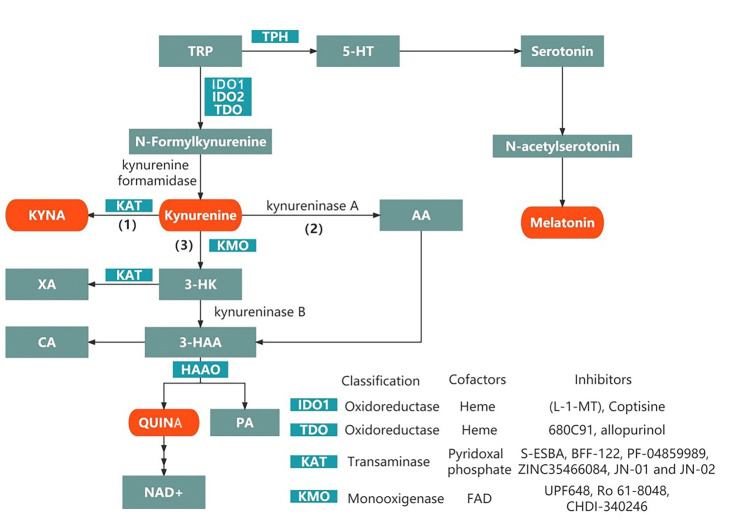
The metabolism of L-tryptophan (TRP) regulates homeostasis, immunity, and neuronal function. Altered TRP metabolism has been implicated in the pathophysiology of various diseases of the central nervous system. TRP is metabolized through two main pathways, the kynurenine pathway and the methoxyindole pathway. First, TRP is metabolized to kynurenine, then kynurenic acid, quinolinic acid, anthranilic acid, 3-hydroxykynurenine, and finally 3-hydroxyanthranilic acid along the kynurenine pathway. Second, TRP is metabolized to serotonin and melatonin along the methoxyindole pathway. In this review, we summarize the biological properties of key metabolites and their pathogenic functions in 12 disorders of the central nervous system: schizophrenia, bipolar disorder, major depressive disorder, spinal cord injury, traumatic brain injury, ischemic stroke, intracerebral hemorrhage, multiple sclerosis, Alzheimer's disease, Parkinson's disease, amyotrophic lateral sclerosis, and Huntington's disease. Furthermore, we summarize preclinical and clinical studies, mainly since 2015, that investigated the metabolic pathway of TRP, focusing on changes in biomarkers of these neurologic disorders, their pathogenic implications, and potential therapeutic strategies targeting this metabolic pathway. This critical, comprehensive, and up-to-date review helps identify promising directions for future preclinical, clinical, and translational research on neuropsychiatric disorders.
Overview
The claims and statistics of this paper haven’t been checked yet.
Run the check — free, no account needed. It reads the open-access text and checks the sources it cites.
Integrity signals
Registry
Cites
Statistics
Figures
Verification
Claims the paper makes
The claims and statistics of this paper haven’t been checked yet.
Run the check — free, no account needed. It reads the open-access text and checks the sources it cites.
Claims other papers make about this one
Each is checked against this paper’s own text: does it say what the citing paper says it does?
The cited source says what the claim attributes to it.
In the citing paper
“Moreover, inflammation induces the activation of indoleamine 2,3-dioxygenase (IDO) and diverts TRP metabolism from serotonin to KYN, reducing the availability of CNS-localized serotonin [23].”
The cited source says what the claim attributes to it.
In the citing paper
“This aligns with the notion that inflammatory conditions, despite their generation, stimulate TRP degradation and are related to increased levels of KP metabolites in the brain [23], including the neuroprotective KYNA and neurotoxic QUIN [44].”
Self-check
Percentages, sums and reported differences re-computed from the paper’s own numbers.
The self-check needs the paper’s full text.
Citations
Cites
Melatonin as an antioxidant: under promises but over delivers
Reiter, R. J., Mayo, J. C., Tan, D. X., Sainz, R. M., Alatorre-Jiménez, M. A., & Qin, L. (2016) · Journal of Pineal Research · doi:10.1111/jpi.12360 · Cited by 1,777 · cited 2×
“In the Fenton/Haber-Weiss reaction, melatonin chelates ferrous iron and copper, reducing toxic hydroxyl radicals and oxidative stress [61].”
BackgroundTryptophan metabolism as a common therapeutic target in cancer, neurodegeneration and beyond
Platten, M., Nollen, E. A. A., Röhrig, U. F., Fallarino, F., & Opitz, C. A. (2019) · Nature Reviews Drug Discovery · doi:10.1038/s41573-019-0016-5 · Cited by 1,586 · cited 7×
“The single nucleotide polymorphism of the KMO gene is related to SCZ, further supporting the notion that the decrease in the 3-HK branch in the KP pathway may cause L-KYN to convert to KYNA, which is one of the causes of SCZ [19].”
BackgroundResultInfluentialKynurenines in the mammalian brain: when physiology meets pathology
Schwarcz, R., Bruno, J. P., Muchowski, P. J., & Wu, H.-Q. (2012) · Nature Reviews Neuroscience · doi:10.1038/nrn3257 · Cited by 1,530 · cited 10×
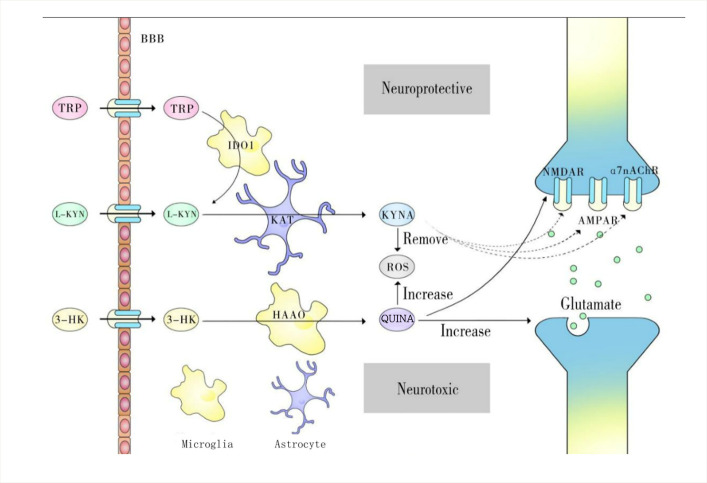
“KYNA inhibits endogenous broad-spectrum glutamate receptors, namely, N-methylD-aspartic acid receptors (NMDAR), kainite receptors, and α-amino-3-hydroxy-5-methyl-4-isoxazole-propionic acid receptors (AMPAR) [30].”
BackgroundInfluentialKynurenines: Tryptophan’s metabolites in exercise, inflammation, and mental health
Cervenka, I., Agudelo, L. Z., & Ruas, J. L. (2017) · Science · doi:10.1126/science.aaf9794 · Cited by 1,382 · cited 4×
“For example, the KYNAGPR35 interaction can reduce the inflammatory response of mononuclear macrophages to lipopolysaccharide [35] and release cytokines from human invariant natural killer cells [36].”
BackgroundInfluentialNAD + in aging, metabolism, and neurodegeneration
Verdin, E. (2015) · Science · doi:10.1126/science.aac4854 · Cited by 1,319
On the free radical scavenging activities of melatonin's metabolites, AFMK and AMK
Galano, A., Tan, D. X., & Reiter, R. J. (2012) · Journal of Pineal Research · doi:10.1111/jpi.12010 · Cited by 829 · cited 1×
“N(1)-acetyl-5-methoxykynuramine, for example, has an efficient antioxidant effect [60].”
BackgroundThe kynurenine pathway: a finger in every pie
Savitz, J. B. (2019) · Molecular Psychiatry · doi:10.1038/s41380-019-0414-4 · Cited by 805 · cited 8×
“As an antagonist of NMDARs, KYNA plays a vital role in this process [38].”
BackgroundInfluentialMaes, M., Leonard, B. E., Myint, A. M., Kubera, M., & Verkerk, R. (2011) · Progress in Neuro-Psychopharmacology and Biological Psychiatry · doi:10.1016/j.pnpbp.2010.12.017 · Cited by 700 · cited 1×
“Depression is related to decreased serotonin levels caused by TRP depletion [141] and sleep disturbances caused by decreased melatonin, both of which are symptoms in patients with ALS.”
BackgroundDiNatale, B. C., Murray, I. A., Schroeder, J. C., Flaveny, C. A., Lahoti, T. S., Laurenzana, E. M., Omiecinski, C. J., & Perdew, G. H. (2010) · Toxicological Sciences · doi:10.1093/toxsci/kfq024 · Cited by 651 · cited 2×
“Immunosuppressive effect by activating AhR [37] 5.”
BackgroundKynurenines in the CNS: recent advances and new questions
Vécsei, L., Szalárdy, L., Fülöp, F., & Toldi, J. (2013) · Nature Reviews Drug Discovery · doi:10.1038/nrd3793 · Cited by 641 · cited 8×
“*KYNA increases during acute relapse and decreases during chronic remission [22].”
BackgroundInfluential
Research works printed but not linked: 4
- Kapczinski F, Frey BN, Zannatto V (2004). [Physiopathology of bipolar disorders: what have changed in the last 10 years?]. Braz J Psychiatry, 26 Suppl 3:17-21. · DOI
- Jacobs KR, Lovejoy DB (2018). Inhibiting the kynurenine pathway in spinal cord injury: Multiple therapeutic potentials? Neural Regen Res, 13:2073-2076. · DOI
- Török N, Tanaka M, Vécsei L (2020). Searching for Peripheral Biomarkers in Neurodegenerative Diseases: The Tryptophan-Kynurenine Metabolic Pathway. Int J Mol Sci, 21: 9338 · DOI
- Oxenkrug G, van der Hart M, Roeser J, Summergrad P (2017). Peripheral Tryptophan - Kynurenine Metabolism Associated with Metabolic Syndrome is Different in Parkinson's and Alzheimer's Diseases. Endocrinol Diabetes Metab J, in press.
Cited by
Sorted by citations
Items 101–109 of 109
Wu, Q., Jiang, Y., Peng, L., Dang, Y., You, C., & Li, X. (2026) · Molecular Brain · doi:10.1186/s13041-026-01283-5
The Association Between Metabolomic and Usual Biochemical Data Helps to Detect Insulin Resistance
Pimenta, F. S., Conde, C., Júnior, R. R. R., Campagnaro, B. P., Pereira, T. M. C., Campos‐Toimil, M., Meyrelles, S. S., & Vasquez, E. C. (2026) · Biomedicines · doi:10.3390/biomedicines14020393
“However, although appropriate cutoff values for this purpose have been proposed [18,19], further validation and confirmation using additional analytical tools are still required.”
Douthitt, A. J., Bennett, A. H., Koustova, A., Abdelfattah, A., Horvat, D., & Geoffroy, C. G. (2025) · Brain Behavior & Immunity - Health · doi:10.1016/j.bbih.2025.101157
Desai, H., Iqbal, A., Kim, T., Panchal, S., Uppal, G., & Yoshimochi, T. (2025) · Health Science Inquiry · doi:10.29173/hsi500
“29 This integrated omics approach enables the development of biomarker-driven therapies, including anti-inflammatory agents, metabolic modulators, and exercise, thus offering alternatives for patients unresponsive to SSRIs.”
Shen, Y. C., Xiang, W., Xiong, Q., Luo, S., Chen, X., Song, Z., Qiu, Y., Pang, L., & Hong, D. (2025) · Neurological Research · doi:10.1080/01616412.2025.2534082
“…elevated levels of interferon-gamma can increase the activity of serotonin and dopamine neurons, enhancing the reuptake of monoamine neurotransmitters, reducing their concentration, and leading to dysfunction in monoaminergic neurotransmission, similar to the pathogenesis of depression [55].”
Theron, K., Gauthier, J., van Hulle, M., & Potter, M. (2025) · Clinical Biochemistry · doi:10.1016/j.clinbiochem.2025.110960
Altered Serotonin Metabolism in Functional Vitamin B12 Deficiency
Russell-Jones, G. (2025) · Journal of Medical - Clinical Research & Reviews · doi:10.33425/2639-944x.1414
Li, J.-X., Hao, G., Yan, Y., Li, M., Li, G.-F., Lu, Z., Sun, Z., Chen, Y., Liu, H., Zhao, Y.-K., et al. (2024) · Neurochemistry International · doi:10.1016/j.neuint.2024.105914
Ye, C. (2025) · Advances in Clinical Medicine · doi:10.12677/acm.2025.15123635
Metadata
- Authors
- Huang, Y., Zhao, M., Chen, X., Zhang, R., Le, A., Hong, M., Zhang, Y., Jia, L., Zang, W., Jiang, C., Wang, J., Fan, X., & Wang, J.
- Affiliations
- First Affiliated Hospital of Zhengzhou University (CN)
- Zhengzhou University (CN)
- Washington University in St. Louis (US)
- Sinai Hospital (US)
- University of Washington (US)
- Fifth Affiliated Hospital of Zhengzhou University (CN)
- Corresponding author
- Wang, Junmin
- Fan, Xiaochong
- Wang, Jian
- ORCID
- Venue
- Aging and disease
- Publisher
- Aging and Disease
- Published
- 2023
- Volume
- 14
- Issue
- 3
- Pages
- 858
- ISSN
- 2152-5250 (ISSN-L)
- PMC
- PMC10187711
- OpenAlex
- W4312580438
- Cited by
- 138
- References
- 198
- Citations by year
- 2026: 45 · 2025: 55 · 2024: 36 · 2023: 2
- FWCI
- 1.76
- Type
- journal article
- Language
- en
- Open access
- gold
- doi.org
- Licence
- cc-by
- Locations
- Aging and Disease (publishedVersion, cc-by)
- PubMed Central (publishedVersion, cc-by)
- PubMed (publishedVersion)
- Funders
- Zhengzhou University
- Topics
- Life Sciences › Neuroscience › Biological Psychiatry › Tryptophan and brain disorders
- Life Sciences › Biochemistry, Genetics and Molecular Biology › Biochemistry › Amino Acid Enzymes and Metabolism
- Health Sciences › Medicine › Pharmacology (medical) › Treatment of Major Depression
- Keywords
- tryptophan metabolism, kynurenine pathway, central nervous system disorders, schizophrenia, bipolar disorder, major depressive disorder, spinal cord injury, traumatic brain injury, ischemic stroke, intracerebral hemorrhage, multiple sclerosis, Alzheimer's disease, Parkinson's disease, amyotrophic lateral sclerosis, Huntington's disease, kynurenic acid, quinolinic acid, serotonin, melatonin, biomarkers, treatment options
About these checks
Registry, retraction, Cites and statistics results are computed, not judged, with one exception: a printed reference that no index lists is read once by a model before it counts as a citation error. Claims are extracted by a model and kept only when their quote appears verbatim in the text; each cited source is then checked, with a model’s help, for whether it says what the claim relies on. Those verdicts can be wrong — read the claim’s quote and the cited source before relying on one.
Statistics and arithmetic are recomputed, not judged.
Confidence bands are shown only for fields calibrated on our annotated test set. None is calibrated yet, so no band is shown.
What counts as a claim ›How we measure confidence ›How we check this ›
Are you an author, or do you see a problem with this page? Request a review
