

AI-based Academic Advising Framework: A Knowledge Management Perspective
Open accessThe DOI matches its Crossref record; 32 of the 32 references it cites were found in a registry or an index.
Abstract
Academic advising has become a critical factor of students’ success as universities offer a variety of programs and courses in their curriculum. It is a student-centered initiative that fosters a student’s involvement with the institution by supporting students in their academic progression and career goals. Managing the knowledge involved in the advising process is crucial to ensure that the knowledge is available to those who need it and that it is used effectively to make good advising decisions that impact student persistence and success. The use of AI-based tools strengthens the advising process by reducing the workload of advisors and providing better decision support tools to improve the advising practice. This study explores the challenges associated with the current advising system from a knowledge management perspective and proposes an integrated AI-based framework to tackle the main advising tasks.
Overview
The claims and statistics of this paper haven’t been checked yet.
Free: it reads the open-access text and checks the first 5 claims that cite a source we can check. Create a free account to check every claim.
Integrity signals
Registry
Cites
Statistics
Figures
Verification
Claims the paper makes
The claims and statistics of this paper haven’t been checked yet.
Free: it reads the open-access text and checks the first 5 claims that cite a source we can check. Create a free account to check every claim.
Claims other papers make about this one
Each is checked against this paper’s own text: does it say what the citing paper says it does?
The cited source says what the claim attributes to it.
In the citing paper
“AI tools can assist in automating routine advising tasks, identifying at-risk students, recommending courses, and providing timely responses to student inquiries.”
From Integrating Generative Artificial Intelligence Tools and Competencies in Biomedical Engineering Education (2025) · cites this paper as [37]
The cited source says what the claim attributes to it.
In the citing paper
“These functionalities alleviate the workload of human advisors, allowing them to focus on more personalized and complex mentorship [37,38].”
From Integrating Generative Artificial Intelligence Tools and Competencies in Biomedical Engineering Education (2025) · cites this paper as [37]
Self-check
Percentages, sums and reported differences re-computed from the paper’s own numbers.
The self-check needs the paper’s full text.
Citations
Cites
Dropout from Higher Education: A Theoretical Synthesis of Recent Research
Tinto, V. (1975) · Review of Educational Research · doi:10.2307/1170024 · Cited by 7,888 · cited 2×
“Tinto's prominent study [8] on the theoretical framework of retention states that students’ engagement within the institution has a direct impact on reduced attrition rates.”
BackgroundThe knowledge-creating company: How Japanese companies create the dynamics of innovation
Nonaka, I., & Takeuchi, H. (1996) · Long Range Planning · doi:10.1016/0024-6301(96)81509-3 · Cited by 5,774
Course signals at Purdue: using learning analytics to increase student success
Arnold, K. E., & Pistilli, M. D. (2012) · Proceedings of the 2nd International Conference on Learning Analytics and Knowledge · doi:10.1145/2330601.2330666 · Cited by 987 · cited 1×
“Furthermore, studies have also shown that timely interventions and support for lowperforming students are effective to help them manage their study patterns [25].”
BackgroundChatbots applications in education: A systematic review
Okonkwo, C. W., & Ade-Ibijola, A. (2021) · Computers and Education: Artificial Intelligence · doi:10.1016/j.caeai.2021.100033 · Cited by 879
Dropout Prediction in MOOCs: Using Deep Learning for Personalized Intervention
Xing, W., & Du, D. (2019) · Journal of Educational Computing Research · doi:10.1177/0735633118757015 · Cited by 321 · cited 2×
“Reference [27] used deep learning to identify students at risk of drop-out at an early stage in an online course.”
BackgroundResultA Holistic View of the Knowledge Life Cycle: The Knowledge Management Cycle (KMC) Model
Evans, M. M., Dalkir, K. L., & Bidian, C. (2014) · Electronic Journal of Knowledge Management · Cited by 308
The Role of Academic Advising in Student Retention and Persistence
Drake, J. K. (2011) · About Campus: Enriching the Student Learning Experience · doi:10.1002/abc.20062 · Cited by 273 · cited 1×
“Academic advising also offers extra support and guidance to students who need it the most [6], such as the students on probation or at risk of dropping out or failing a course.”
BackgroundAdnan, M., Habib, A., Ashraf, J., Mussadiq, S., Raza, A. A., Abid, M., Bashir, M., & Khan, S. U. (2021) · IEEE Access · doi:10.1109/access.2021.3049446 · Cited by 250 · cited 3×
“Study [26] used machine learning and deep learning algorithms for the early identification of students at risk using data collected from an online learning platform.”
MethodResultAcademic advising: does it really impact student success?
Young‐Jones, A. D., Burt, T. D., Dixon, S., & Hawthorne, M. J. (2013) · Quality Assurance in Education · doi:10.1108/09684881311293034 · Cited by 218
LADA: A learning analytics dashboard for academic advising
Gutiérrez, F., Seipp, K., Ochoa, X., Chiluiza, K., De Laet, T., & Verbert, K. (2020) · Computers in Human Behavior · doi:10.1016/j.chb.2018.12.004 · Cited by 148
Research works printed but not linked: 4
- M. Alavi and D. E. Leidner, -Knowledge management and knowledge management systems: Conceptual foundations and research issues,‖ MIS Q., pp. 107-136, 2001.
- N. J. Van Eck and L. Waltman, -VOSviewer manual,‖ Leiden: Univeristeit Leiden, vol. 1, no. 1, pp. 1-53, 2013.
- G. M. S. Alfarsi, K. A. M. Omar, and M. J. Alsinani, -A Rule-Based System for Advising,‖ J. Theor. Appl. Inf. Technol., vol. 95, no. 11, 2017.
- K. E. Arnold and M. D. Pistilli, -Learning Analytics to Increase Student Success,‖ 2nd Int. Conf. Learn. Anal. Knowl., no. May, pp. 267-270, 2012.
Cited by
A Primer on Generative Artificial Intelligence
Kalota, F. (2024) · Education Sciences · doi:10.3390/educsci14020172 · Cited by 177
“One study explored some of the challenges associated with traditional student advising systems and proposed a framework for an AI-based academic advising system [44].”
BackgroundInvestigating student acceptance of an academic advising chatbot in higher education institutions
Bilquise, G., Ibrahim, S., & Salhieh, S. M. (2024) · Education and Information Technologies · doi:10.1007/s10639-023-12076-x · Cited by 169
“An AI-based conversational agent is effective and efficient in advising interactions as it overcomes human limitations by being available 24/7 to respond to users’ queries (Bilquise & Shaalan, 2022).”
Self-citationArtificial Intelligence and Knowledge Management: Impacts, Benefits, and Implementation
Taherdoost, H., & Madanchian, M. (2023) · Computers · doi:10.3390/computers12040072 · Cited by 138
the Faculty of Hospitality and Tourism, P. O. S. U., Fuchs, K., & Aguilos, V. (2023) · International Journal of Information and Education Technology · doi:10.18178/ijiet.2023.13.9.1939 · Cited by 61
“Chatbots are being used to provide support to students around-the-clock, especially in administrative tasks such as scheduling appointments, answering questions about university policies and procedures, and providing guidance on academic programs and career options [19–21].”
MethodSaihi, A., Ben-Daya, M., Hariga, M., & As'ad, R. (2024) · Computers and Education: Artificial Intelligence · doi:10.1016/j.caeai.2024.100274 · Cited by 75
Ramandanis, D., & Xinogalos, S. (2023) · Multimodal Technologies and Interaction · doi:10.3390/mti7110103 · Cited by 74
“[15] Reduction of the workload of the administration staff.”
BackgroundMethodInfluentialRobo academic advisor: Can chatbots and artificial intelligence replace human interaction?
Thottoli, M. M., AL-RUQAISHI, B., & Soosaimanickam, A. (2023) · Contemporary Educational Technology · doi:10.30935/cedtech/13948 · Cited by 48
Esparza, D. M. C., Terven, J. R., Romero-González, J.-A., Córdova-Esparza, K.-E., Martínez, R. E. L., Ramírez, M. T. G., & Sánchez, R. C. (2025) · Information · doi:10.3390/info16040326 · Cited by 34
“Many studies propose frameworks for timely or even real-time interventions, focusing on academic counseling, customized feedback, or improved course design [24,63,80,132,142,153,163,217–219].”
Academic Advising Chatbot Powered with AI Agent
Tamascelli, M., Bunch, O., Fowler, B., Taeb, M., & Cohen, A. (2025) · ACM Southeast Regional Conference (ACMSE) · doi:10.1145/3696673.3723065 · Cited by 28
Artificial Intelligence in Education: Transforming Learning Landscapes
Kujundziski, A. P., & Bojadjiev, J. (2024) · Advances in educational technologies and instructional design book series · doi:10.4018/979-8-3693-4310-4.ch001 · Cited by 23
The AI-knowledge management nexus for sustainable learning: A PLS-SEM study
Ranjan, S., Joshith, V. P., Kavitha, K., & Chittakath, S. (2024) · Knowledge Management & E-Learning An International Journal · doi:10.34105/j.kmel.2024.16.037 · Cited by 22
Multifaceted Assessment of Responsible Use and Bias in Language Models for Education
Ahmed, I., Liu, W., Roscoe, R. D., Reilley, E., & McNamara, D. S. (2025) · Computers · doi:10.3390/computers14030100 · Cited by 20
Isaifan, R. J., & Hasna, M. O. (2025) · Quality in Higher Education · doi:10.1080/13538322.2025.2576326 · Cited by 12
Khojah, R., Werth, A., Broadhead, K. W., Dobrucki, L. W., Geiger, C., & Rubenstein, D. A. (2025) · Biomedical Engineering Education · doi:10.1007/s43683-025-00175-9 · Cited by 9
Albinali, K., Iahad, N. A., Yusof, A. F., & Abdulla, A. (2024) · International Journal of Academic Research in Business and Social Sciences · doi:10.6007/ijarbss/v14-i12/24100 · Cited by 9
“Integrating AI applications with existing educational systems, processes, and workflows can be challenging due to technological, organizational, and cultural barriers (Assiri et al., 2020; Bilquise et al., 2021).”
Matosas-López, L., García, M. G., & Boumadan, M. (2025) · Digital Education Review · doi:10.1344/der.2025.47.44-61 · Cited by 14
Lee, J.-H., & Rew, J. (2025) · Applied Sciences · doi:10.3390/app15179775 · Cited by 9
ChatGPT: Advancing Education with Virtual Assistants
Salem, M., & Shaalan, K. F. (2024) · Smart innovation, systems and technologies · doi:10.1007/978-981-97-3980-6_25 · Cited by 9
Self-citationKnowledge Transfer in The Digital Age: Investigating the Mechanisms and ChallengesPreprint
Kumar, A. A. (2024) · SSRN Electronic Journal · doi:10.2139/ssrn.4809874 · Cited by 8
Ibrahim, S., & Bilquise, G. (2024) · Education and Information Technologies · doi:10.1007/s10639-024-13252-3 · Cited by 9
“Existing literature also underscores key attributes of AI-based chatbots that appeal to language learners, such as their continuous availability (Bilquise & Shaalan, 2022), enabling learners to engage in skill development at any time and place.”
Self-citationMishra, A., & Brahmanapally, N. (2025) · AI · doi:10.3390/ai6060119 · Cited by 7
“With 20 teaching hours a week, research activities, and other administrative responsibilities, the advisor’s schedule leaves little time for one-on-one interactions with 25 to 30 advisees [3,7–9].”
Novalin, A., Gunawan, A., & Prihandoko, D. (2024) · IEEE International Conference on Interdisciplinary Approaches in Technology and Management for Social Innovation (IATMSI) · doi:10.1109/iatmsi60426.2024.10502986 · Cited by 10
The implications of artificial intelligence usage on management students’ academic productivity
Idrissi, I. E., & Alami, Y. (2025) · Artificial Intelligence in Education · doi:10.1108/aiie-05-2025-0103 · Cited by 7
Shifting the narrative: From technocentric to purpose-driven artificial intelligence in education
Hefnawi, A. (2025) · Management in Education · doi:10.1177/08920206251322644 · Cited by 8
A Systematic Literature Review on AI-Powered Chatbot for Universities
Ahmad, C. W. S. B. C. W., Ahmed, S. A., Rahman, K. B. A., Ahmad, S., & Basri, M. (2024) · Journal of Advanced Research in Applied Sciences and Engineering Technology · doi:10.37934/araset.62.4.111126 · Cited by 5
Satisfaction and intention to use AI tools among Indonesian university students in Sumatra
Habibi, A., Rahman, K. A., Hendra, R., Supian, S., Alharmali, T. M., Fauzee, M. S. O., Abdullah, H., Sumandya, I. W., & Negara, E. S. (2026) · Discover Sustainability · doi:10.1007/s43621-026-02745-5 · Cited by 4
Rodríguez, A. C., & Verdú, S. Á. A. (2025) · IGI Global eBooks · doi:10.4018/979-8-3373-3678-7.ch005 · Cited by 3
Enhancing academic advising with real-time classroom engagement using AI
Ghanem, S. I. (2025) · Interactive Learning Environments · doi:10.1080/10494820.2025.2511245 · Cited by 3
“By identifying at-risk students early on and offering customized interventions like instruction, more resources, or course adaptations, these systems improve student achievement and retention (Bilquise & Shaalan, 2022).”
Zhang, C., Hu, X., & Wei, W. (2025) · IEEE International Conference on Teaching, Assessment, and Learning for Engineering · doi:10.1109/tale66047.2025.11346728 · Cited by 3
“The application of AI in academic counseling, particularly in course recommendation, primarily focuses on creating personalized learning plans, early identification of students at academic risk, and offering individualized digital assistant services [4].”
Human-Technology Interaction: Enhancing Education Through AI-Powered Adaptive Learning
Thakur, S., Singh, H., Mishra, N., Tripathy, R., Nayak, R. K., & Thakur, A. (2025) · Advances in educational technologies and instructional design book series · doi:10.4018/979-8-3373-2262-9.ch013 · Cited by 2
The impact of AI-Based educational counseling on teaching effectiveness
Alenezi, A. R., & Alenezi, A. (2025) · EDUWEB · doi:10.46502/issn.1856-7576/2025.19.02.2 · Cited by 2
When AI becomes afterlife: psychological factors driving acceptance of thanabots services
Sousa, T. M. F. D., Bizarrias, F. S., Raposo, L. L., & da Cruz, D. L. (2025) · Journal of Services Marketing · doi:10.1108/jsm-01-2025-0052 · Cited by 4
What Are Students Saying About AI as an Academic Tool
Ng, L. L., & Ravana, V. (2024) · Advances in educational technologies and instructional design book series · doi:10.4018/979-8-3693-0872-1.ch008 · Cited by 3
KNOWLEDGE MANAGEMENT APPROACH IN COMPARATIVE STUDY OF AIR POLLUTION PREDICTION MODEL
Rohajawati, S., SETYODEWI, H., TRESNANTO, F. M. A., MARIANTHI, D., & Sihotang, M. T. B. (2024) · Applied Computer Science · doi:10.35784/acs-2024-11 · Cited by 2
“For instance, in a corporate setting, KM assists in fine-tuning prediction models by providing comprehensive insights and data analysis (Bilquise & Shaalan, 2022).”
BackgroundAnalisis Sistematis Program BK di Perguruan Tinggi dan Implikasinya terhadap Pengembangan Layanan
Daulay, M., Neviyani, N., & Firman, F. (2025) · Jurnal Al-Irsyad Jurnal Bimbingan Konseling Islam · doi:10.24952/bki.v7i1.16365 · Cited by 2
Widyananda, R., Maylinda, & Lie, Y. (2025) · International Conference on Cybernetics and Intelligent System (ICORIS) · doi:10.1109/icoris67789.2025.11296018 · Cited by 1
“AI-based chatbots are increasingly used in higher education to support academic tasks, enhance engagement, and provide 24/7 assistance [10], [11], [12].”
Exploring the Adoption of Virtual Advising Agents in Higher Education: A Multi-Campus Case Study
Ibrahim, S., & Bilquise, G. (2025) · International Conference on Information Technology Trends (ITT) · doi:10.1109/itt69610.2025.11352929 · Cited by 1
“They offer services like personalized learning, real-time support in academic planning, course registration, and enhance the overall student experience [2].”
Self-citationFrom Customary to Canny Academic Advising: The AI Panorama
Al-Azri, A. K., Ramachandran, N., Jetti, E. R., Hussini, W. A., & Gepulle, E. (2025) · International Journal of Computational and Experimental Science and Engineering · doi:10.22399/ijcesen.1893
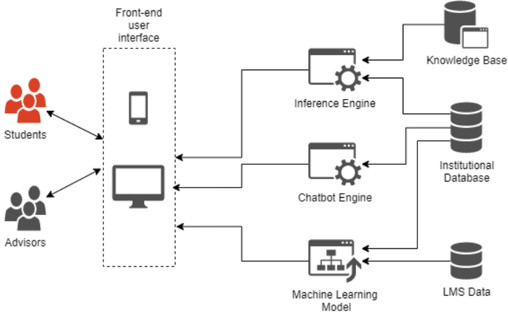
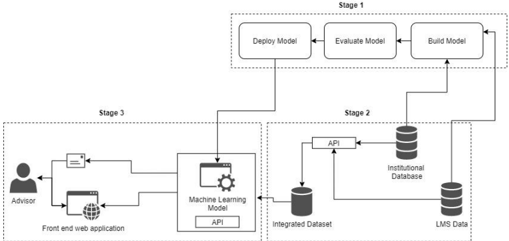
“The below is a representation of the adopted model that this study is aiming to use to overcome the challenges of academic advising [17].”
Lizarraga, C., Quiñonez, Y., Aguayo, R., Duran, J., & Reyes, V. (2025) · PeerJ Computer Science · doi:10.7717/peerj-cs.3236
السعدني, م. ع. ا., & صبحی, ل. ن. (2025) · تکنولوجيا التعليم سلسلة دراسات وبحوث · doi:10.21608/tesr.2025.462053
A Hybrid Decision Analysis Approach for Selecting Intelligent Language Tutors
Ibrahim, S., Bilquise, G., & Ibaisi, L. A. (2025) · International Conference on Business Analytics for Technology and Security (ICBATS) · doi:10.1109/icbats66542.2025.11258175
“These AI-powered agents are available anytime, allowing learners to practice at their own pace and convenience [6], [7].”
Self-citationSaraç, A. (2025) · Advances in computational intelligence and robotics book series · doi:10.4018/979-8-3373-4129-3.ch004 · Cited by 1
Integrating AI-Powered Chatbot Into the Academic Advising System
Shalash, A. M., Shouman, M. M., & ElSabry, E. A. (2025) · International Conference on Future Telecommunications and Artificial Intelligence (IC-FTAI) · doi:10.1109/ic-ftai67960.2025.11384193
“The success of these systems depends on factors like user interface design, data accuracy, and alignment with institutional policies [11].”
InfluentialWould students accept virtual agents for academic advising? A fit, viability, and risk perspective
Ibrahim, S., Bilquise, G., & Salhieh, S. M. I. (2026) · Interactive Technology and Smart Education · doi:10.1108/itse-10-2025-0293
Self-citationStorey, V. A. (2026) · Advances in computational intelligence and robotics book series · doi:10.4018/407554
A Locally Deployed RAG-Based Academic Advising System for Course Selection
(30515), F. L., & Iwata, Y. (2026) · Procedia Computer Science · doi:10.1016/j.procs.2026.10.089
Sarkar, R. (2026) · Advances in computational intelligence and robotics book series · doi:10.4018/979-8-3373-6571-8.ch002
Claour, J. P., Laciste, M. A. O., Lagman, A. C., Tano, I. M., Mababa, J., Cabrera, J. J. D., Pulumbarit, J. P., & Victoriano, J. M. (2026) · IEEE International Conference on Automatic Control and Intelligent Systems (I2CACIS) · doi:10.1109/i2cacis69435.2026.11600282
“In academic advising, forward chaining automates the creation of personalized study plans using student data and predefined academic rules [21].”
Irwan, D., Venesa, A., Rabiah, F. A., Geraldine, F. E., & Mirandea, A. S. (2023) · Jurnal Pendidikan Informatika dan Sains · doi:10.31571/saintek.v14i2.8716
SRILEKHA, K., Naik, J. R. K., & Vamsi, D. (2026) · International Journal of Technology & Emerging Research · doi:10.64823/ijter.2608003
“This continuous availability fosters greater student engagement, satisfaction, and overall academic success [8].”
Preparing Educators for the AI-Enhanced Classroom: Strategies and Training
Asrifan, A., Muhayyang, M., Sadaruddin, S., Syamsuardi, S., & Octaberlina, L. R. (2025) · Advances in computational intelligence and robotics book series · doi:10.4018/979-8-3693-8382-7.ch003
The Role of AI in Academic Advising: A Theoretical Framework for Supporting Student Decision-Making
Giam, N. M. (2026) · European Journal of Contemporary Education and E-Learning · doi:10.59324/ejceel.2026.4(5).01
Julianah, O. A. (2026) · WORLD JOURNAL OF INNOVATION AND MODERN TECHNOLOGY · doi:10.56201/wjimt.v10.no4.2026.pg163.173
Web-based Academic Advisor Information System with Automated Telegram Message Notification Features
Ridwansyah, Labusab, & Akil, M. (2026) · Jurnal Teknologi Informatika dan Komputer · doi:10.37012/jtik.v12i2.3743
نقش سیستمهای پشتیبانی تصمیمگیری در مشاوره مالی خودکار: بررسی مدلهای محاسباتی
Alavi, Z., Shafiei, M., علوی, ز., & شفیعی, م. (2024) · Accounting Finance and Computational Intelligence
AI in Education and Society: Teaching the machine, transforming the human
Balakrishnan, V. (2026) · International Journal of Emerging Perspectives in Education · doi:10.64306/zhvjhn26
Kumar, A. S. S., Doss, S., & Pólkowski, Z. (2025) · International Journal of Management and Data Intelligence · Cited by 3
Integrating Metacognitive Scaffolding with Generative AI for Course Selection: An Experimental Study
Zhang, C., Wei, W., & Hu, X. (2026) · IEEE International Conference on Advanced Learning Technologies (ICALT) · doi:10.1109/icalt68022.2026.00140
“Third, it establishes a bidirectional interaction model (user question → system recommendation → user feedback) that breaks the one-way flow of traditional systems [13], resolving the tension between efficiency and cognitive autonomy.”
Gnana Rajesh, D., AL-Hattali, M. A., Punnolli, M., Baskaran, A., & Raja, K. (2026) · International Journal of Artificial Intelligence and Machine Learning · doi:10.51483/ijaiml.2710
AI-Driven Career Guidance Platform: An Intelligent Web-Based Counselling System
Wankhade, S., Pandarkar, A., Lad, S., Nair, V., Patil, R. V., & Pawar, R. (2026) · doi:10.1109/worldsuas70880.2026.11767283
Metadata
- Authors
- Bilquise, G., & Shaalan, K.
- Affiliations
- Higher Colleges of Technology (AE)
- Venue
- International Journal of Advanced Computer Science and Applications
- Published
- 2022
- Volume
- 13
- Issue
- 8
- ISSN
- 2156-5570 (ISSN-L)
- 2158-107X
- OpenAlex
- W4294685895
- Cited by
- 48
- References
- 31
- Citations by year
- 2026: 9 · 2025: 23 · 2024: 10 · 2023: 6
- FWCI
- 21.04
- Type
- journal article
- Language
- en
- Open access
- diamond
- doi.org
- Licence
- cc-by
- Locations
- International Journal of Advanced Computer Science and Applications (publishedVersion, cc-by)
- International Journal of Advanced Computer Science and Applications (submittedVersion, cc-by)
- Topics
- Social Sciences › Education › Knowledge Management in Higher Education
- Social Sciences › Education › Artificial Intelligence in Education
- Physical Sciences › Computer Science › Artificial Intelligence › Edcuational Technology Systems
- Keywords
- academic advising, artificial intelligence, knowledge management, decision support system, student persistence, student success
About these checks
Registry, retraction, Cites and statistics results are computed, not judged, with one exception: a printed reference that no index lists is read once by a model before it counts as a citation error. Claims are extracted by a model and kept only when their quote appears verbatim in the text; each cited source is then checked, with a model’s help, for whether it says what the claim relies on. Those verdicts can be wrong — read the claim’s quote and the cited source before relying on one.
Statistics and arithmetic are recomputed, not judged.
Confidence bands are shown only for fields calibrated on our annotated test set. None is calibrated yet, so no band is shown.
What counts as a claim ›How we measure confidence ›How we check this ›
Are you an author, or do you see a problem with this page? Request a review
Data sources
Bibliographic data: Semantic Scholar, OpenAlex, Crossref.
Contains information from the Semantic Scholar Academic Graph Datasets, made available under the ODC Attribution License (ODC-BY 1.0).
Semantic Scholar’s data is described in: Kinney, R., et al. (2023). The Semantic Scholar Open Data Platform. arXiv:2301.10140.
