

Insulin-Like Growth Factor-1 Deficiency and Cirrhosis Establishment
Open accessThe DOI matches its Crossref record; 159 of the 159 references it cites were found in a registry or an index.
Abstract
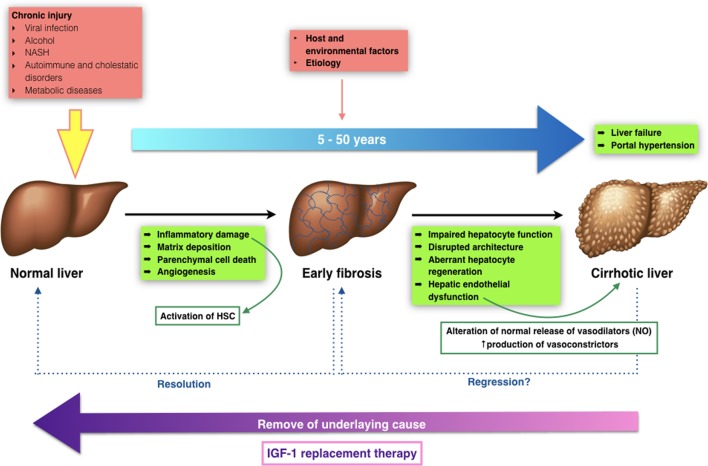
Cirrhosis represents the final stage of chronic liver damage, which can be due to different factors such as alcohol, metabolic syndrome with liver steatosis, autoimmune diseases, drugs, toxins, and viral infection, among others. Nowadays, cirrhosis is an important health problem and it is an increasing cause of morbidity and mortality, being the 14th most common cause of death worldwide. The physiopathological pathways that lead to fibrosis and finally cirrhosis partly depend on the etiology. Nevertheless, some common features are shared in this complex mechanism. Recently, it has been demonstrated that cirrhosis is a dynamic process that can be altered in order to delay or revert fibrosis. In addition, when cirrhosis has been established, insulin-like growth factor-1 (IGF-1) deficiency or reduced availability is a common condition, independently of the etiology of chronic liver damage that leads to cirrhosis. IGF-1 deprivation seriously contributes to the progressive malnutrition of cirrhotic patient, increasing the vulnerability of the liver to establish an inflammatory and oxidative microenvironment with mitochondrial dysfunction. In this context, IGF-1 deficiency in cirrhotic patients can justify some of the common characteristics of these individuals. Several studies in animals and humans have been done in order to test the replacement of IGF-1 as a possible therapeutic option, with promising results.
Overview
The claims and statistics of this paper haven’t been checked yet.
Free: it reads the open-access text and checks the first 5 claims that cite a source we can check. Create a free account to check every claim.
Integrity signals
Registry
Cites
Statistics
Figures
Verification
Claims the paper makes
The claims and statistics of this paper haven’t been checked yet.
Free: it reads the open-access text and checks the first 5 claims that cite a source we can check. Create a free account to check every claim.
Claims other papers make about this one
Each is checked against this paper’s own text: does it say what the citing paper says it does?
In the citing paper
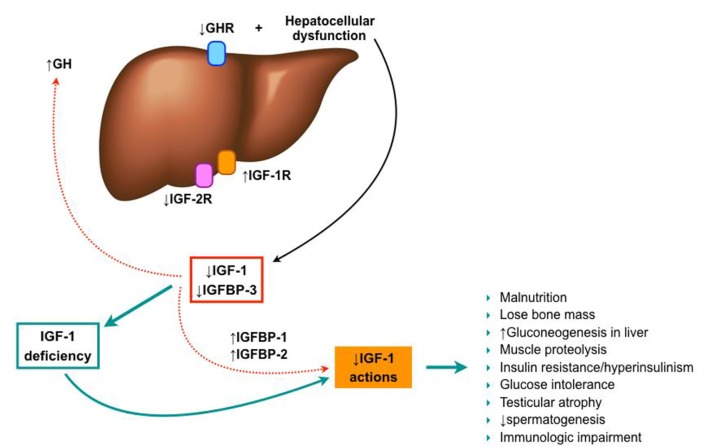
“In advanced liver cirrhosis, IGF-1 serum levels decrease as a result of diminished hepatocellular biosynthetic function and progressive loss of GH receptors on hepatocytes [65,72].”
From Bone diseases in patients with chronic liver disease (2019) · cites this paper as [72]
Self-check
Percentages, sums and reported differences re-computed from the paper’s own numbers.
The self-check needs the paper’s full text.
Citations
Cites
Bataller, R., & Brenner, D. A. (2005) · Journal of Clinical Investigation · doi:10.1172/jci24282 · Cited by 4,958
Insulin-Like Growth Factors and Their Binding Proteins: Biological Actions*
JONES, J. I., & CLEMMONS, D. R. (1995) · Endocrine Reviews · doi:10.1210/edrv-16-1-3 · Cited by 4,710 · cited 1×
“In summary, the common functions of IGFBPs are: 1) acting as carrier proteins for circulating IGF-1 and controller of its flow from the vascular space to tissues; 2) increasing IGF-1 half-life and regulating its metabolic clearance [34]; 3) modulating the interaction between IGF-1 and its receptor, and thus indirectly…”
BackgroundNonalcoholic Fatty Liver Disease: From Steatosis to Cirrhosis
Farrell, G. C., & Larter, C. Z. (2006) · Hepatology · doi:10.1002/hep.20973 · Cited by 2,414 · cited 1×
“Non-alcoholic liver disease is also increasing in developed countries [20, 21].”
BackgroundCornier, M.-A., Dabelea, D., Hernandez, T. L., Lindstrom, R. C., Steig, A. J., Stob, N. R., Van Pelt, R. E., Wang, H., & Eckel, R. H. (2008) · Endocrine Reviews · doi:10.1210/er.2008-0024 · Cited by 2,162
Schuppan, D., & Afdhal, N. H. (2008) · The Lancet · doi:10.1016/s0140-6736(08)60383-9 · Cited by 2,089
Insulin-like growth factors and their binding proteins: biological actions
Jones, J. I. (1995) · Endocrine Reviews · doi:10.1210/er.16.1.3 · Cited by 2,060
Diseases of the Liver and Biliary System
(2001) · Wiley eBooks · doi:10.1002/9780470986820 · Cited by 1,825
Cellular Actions of the Insulin-Like Growth Factor Binding Proteins
Firth, S. M., & Baxter, R. C. (2002) · Endocrine Reviews · doi:10.1210/er.2001-0033 · Cited by 1,750 · cited 1×
“In summary, the common functions of IGFBPs are: 1) acting as carrier proteins for circulating IGF-1 and controller of its flow from the vascular space to tissues; 2) increasing IGF-1 half-life and regulating its metabolic clearance [34]; 3) modulating the interaction between IGF-1 and its receptor, and thus indirectly…”
BackgroundTsochatzis, E. A., Bosch, J., & Burroughs, A. K. (2014) · The Lancet · doi:10.1016/s0140-6736(14)60121-5 · Cited by 1,740
Grundy, S. M. (2008) · Arteriosclerosis, Thrombosis, and Vascular Biology · doi:10.1161/atvbaha.107.151092 · Cited by 1,563 · cited 1×
“Moreover, it is well known that metabolic syndrome (MetS) is increasing worldwide [17], in part related to the occidentalization of lifestyle habits [18, 19].”
Background
Research works printed but not linked: 1
- [14]Quiroga J Beloqui O Castilla A Cirrhosis Prieto J Rodes J Schafritz DA Hepatobiliary Diseases Berlin Springer-Verlag 1992
Cited by
Li, B., Zhang, C., & Zhan, Y.-T. (2018) · Canadian Journal of Gastroenterology and Hepatology · doi:10.1155/2018/2784537 · Cited by 159
“Cirrhosis is the end stage of a wide number of chronic liver conditions that share common features of necroinflammation, fibrosis, and regenerative nodules, which modify the normal liver structure to reduce its functional mass and alter the vascular architecture [1].”
BackgroundLonardo, A., Mantovani, A., Lugari, S., & Targher, G. (2019) · International Journal of Molecular Sciences · doi:10.3390/ijms20112841 · Cited by 120
Frailty in advanced liver disease
Laube, R., Wang, H., Park, L., Heyman, J. K., Vidot, H., Majumdar, A., Strasser, S. I., McCaughan, G. W., & Liu, K. (2018) · Liver International · doi:10.1111/liv.13917 · Cited by 133
Bone diseases in patients with chronic liver disease
Jeong, H., & Kim, D. (2019) · International Journal of Molecular Sciences · doi:10.3390/ijms20174270 · Cited by 113
Yang, Y. J., & Kim, D. J. (2021) · International Journal of Molecular Sciences · doi:10.3390/ijms22052604 · Cited by 112
“In end-stage liver disease, hepatocellular dysfunction and reduced GH receptors lead to low serum IGF-1 levels, subsequently causing osteoporosis [87].”
Background
Metadata
- Authors
- de la Garza, R. G., Morales-Garza, L. A., Martin-Estal, I., & Castilla-Cortazar, I.
- Affiliations
- Tecnológico de Monterrey (MX)
- Venue
- Journal of Clinical Medicine Research
- Publisher
- Elmer Press, Inc.
- Published
- 2017
- Volume
- 9
- Issue
- 4
- Pages
- 233-247
- ISSN
- 1918-3003 (ISSN-L)
- 1918-3011
- PMC
- PMC5330765
- OpenAlex
- W2589573515
- Cited by
- 55
- References
- 157
- Citations by year
- 2026: 5 · 2025: 9 · 2024: 12 · 2023: 4 · 2022: 3 · 2021: 9 · 2020: 3 · 2019: 6 · 2018: 4
- FWCI
- 0.51
- Type
- journal article
- Language
- en
- Open access
- diamond
- doi.org
- Licence
- cc-by-nc
- Locations
- Journal of Clinical Medicine Research (publishedVersion, cc-by-nc)
- PubMed Central (publishedVersion, cc-by-nc)
- PubMed (publishedVersion)
- Topics
- Health Sciences › Medicine › Hepatology › Liver Disease and Transplantation
- Health Sciences › Medicine › Endocrinology, Diabetes and Metabolism › Growth Hormone and Insulin-like Growth Factors
- Health Sciences › Medicine › Hepatology › Liver physiology and pathology
- Keywords
- insulin-like growth factor I, IGF-1 deficiency, liver cirrhosis, liver fibrosis, malnutrition, mitochondrial dysfunction, oxidative stress, liver inflammation, chronic liver disease
About these checks
Registry, retraction, Cites and statistics results are computed, not judged, with one exception: a printed reference that no index lists is read once by a model before it counts as a citation error. Claims are extracted by a model and kept only when their quote appears verbatim in the text; each cited source is then checked, with a model’s help, for whether it says what the claim relies on. Those verdicts can be wrong — read the claim’s quote and the cited source before relying on one.
Statistics and arithmetic are recomputed, not judged.
Confidence bands are shown only for fields calibrated on our annotated test set. None is calibrated yet, so no band is shown.
What counts as a claim ›How we measure confidence ›How we check this ›
Are you an author, or do you see a problem with this page? Request a review
Data sources
Bibliographic data: Semantic Scholar, OpenAlex, Crossref.
Contains information from the Semantic Scholar Academic Graph Datasets, made available under the ODC Attribution License (ODC-BY 1.0).
Semantic Scholar’s data is described in: Kinney, R., et al. (2023). The Semantic Scholar Open Data Platform. arXiv:2301.10140.
