

Review of COVID-19 Variants and COVID-19 Vaccine Efficacy: What the Clinician Should Know?
Open accessThe DOI matches its Crossref record; 24 of the 24 references it cites were found in a registry or an index.
Abstract
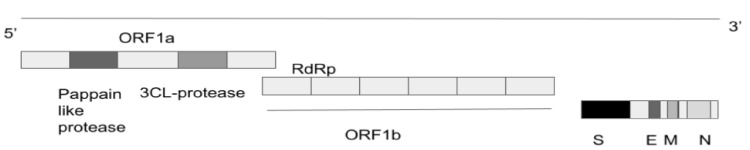
Severe acute respiratory syndrome coronavirus 2 (SARS-CoV-2) is a beta coronavirus that belongs to the Coronaviridae family. SARS-CoV-2 is an enveloped spherical-shaped virus. The ribonucleic acid (RNA) is oriented in a 5'-3'direction which makes it a positive sense RNA virus, and the RNA can be read directly as a messenger RNA. The nonstructural protein 14 (nsp14) has proofreading activity which allows the rate of mutations to stay low. A change in the genetic sequence is called a mutation. Genomes that differ from each other in genetic sequence are called variants. Variants are the result of mutations but differ from each other by one or more mutations. When a phenotypic difference is demonstrated among the variants, they are called strains. Viruses constantly change in two different ways, antigenic drift and antigenic shift. SARS-CoV-2 genome is also prone to various mutations that led to antigenic drift resulting in escape from immune recognition. The Center of Disease Control and Prevention (CDC) updates the variant strains in the different classes. The classes are variant of interest, variant of concern and variant of high consequence. The current variants included in the variant of interest by the USA are: B.1.526, B.1.525, and P.2; and those included in the variant of concern by the USA are B.1.1.7, P.1, B.1.351, B.1.427, and B.1.429. The double and triple mutant variants first reported in India have resulted in a massive increase in the number of cases. Emerging variants not only result in increased transmissibility, morbidity and mortality, but also have the ability to evade detection by existing or currently available diagnostic tests, which can potentially delay the diagnosis and treatment, exhibit decreased susceptibility to treatment including antivirals, monoclonal antibodies and convalescent plasma, possess the ability to cause reinfection in previously infected and recovered individuals, and vaccine breakthrough cases in fully vaccinated individuals. Hence, continuation of precautionary measures, genomic surveillance and vaccination plays an important role in the prevention of spread, early identification of variants, prevention of mutations and viral replication, respectively.
Overview
The claims and statistics of this paper haven’t been checked yet.
Free: it reads the open-access text and checks the first 5 claims that cite a source we can check. Create a free account to check every claim.
Integrity signals
Registry
Cites
Statistics
Figures
Verification
Claims the paper makes
The claims and statistics of this paper haven’t been checked yet.
Free: it reads the open-access text and checks the first 5 claims that cite a source we can check. Create a free account to check every claim.
Claims other papers make about this one
Each is checked against this paper’s own text: does it say what the citing paper says it does?
The source backs part of the claim, not all of it — or backs it for a different population, condition or comparison.
In the citing paper
“This Alpha variant increased its severity (40–80%) through the air pathway and the associated case fatality is expected to be 55% higher with a higher death rate [60, 61].”
From Waves and variants of SARS-CoV-2: understanding the causes and effect of the COVID-19 catastrophe (2022) · cites this paper as [61]
Experimental — accuracy not yet measured
Self-check
Percentages, sums and reported differences re-computed from the paper’s own numbers.
The self-check needs the paper’s full text.
Citations
Cites
A pneumonia outbreak associated with a new coronavirus of probable bat origin
Zhou, P., Yang, X.-L., Wang, X.-G., Hu, B., Zhang, L., Zhang, W., Si, H.-R., Zhu, Y., Li, B., Huang, C.-L., et al. (2020) · Nature · doi:10.1038/s41586-020-2012-7 · Cited by 21,969
The proximal origin of SARS-CoV-2
Andersen, K. G., Rambaut, A., Lipkin, W. I., Holmes, E. C., & Garry, R. F. (2020) · Nature Medicine · doi:10.1038/s41591-020-0820-9 · Cited by 5,081
Bats Are Natural Reservoirs of SARS-Like Coronaviruses
Li, W., Shi, Z., Yu, M., Ren, W., Smith, C., Epstein, J. H., Wang, H., Crameri, G., Hu, Z., Zhang, H., et al. (2005) · Science · doi:10.1126/science.1118391 · Cited by 2,560
Identifying SARS-CoV-2-related coronaviruses in Malayan pangolins
Lam, T. T.-Y., Jia, N., Zhang, Y.-W., Shum, M. H.-H., Jiang, J.-F., Zhu, H.-C., Tong, Y.-G., Shi, Y.-X., Ni, X.-B., Liao, Y.-S., et al. (2020) · Nature · doi:10.1038/s41586-020-2169-0 · Cited by 1,877
Gorbalenya, A. E., Baker, S. C., Baric, R. S., et al. (2020) · bioRxiv (Cold Spring Harbor Laboratory) · doi:10.1101/2020.02.07.937862 · Cited by 1,408
Increased mortality in community-tested cases of SARS-CoV-2 lineage B.1.1.7
CMMID COVID-19 Working Group, Davies, N. G., Jarvis, C. I., Edmunds, W. J., Jewell, N. P., Diaz-Ordaz, K., & Keogh, R. H. (2021) · Nature · doi:10.1038/s41586-021-03426-1 · Cited by 921 · cited 1×
“They also estimated that the mortality was approximately 55% higher when compared to other variants [20].”
ResultSARS-CoV-2 structure and replication characterized by in situ cryo-electron tomography
Klein, S., Cortese, M., Winter, S. L., Wachsmuth-Melm, M., Neufeldt, C. J., Cerikan, B., Stanifer, M. L., Boulant, S., Bartenschlager, R., & Chlanda, P. (2020) · Nature Communications · doi:10.1038/s41467-020-19619-7 · Cited by 731
New SARS-CoV-2 Variants — Clinical, Public Health, and Vaccine Implications
Abdool Karim, S. S., & de Oliveira, T. (2021) · New England Journal of Medicine · doi:10.1056/nejmc2100362 · Cited by 699
Sensitivity of infectious SARS-CoV-2 B.1.1.7 and B.1.351 variants to neutralizing antibodies
Planas, D., Bruel, T., Grzelak, L., Guivel-Benhassine, F., Staropoli, I., Porrot, F., Planchais, C., Buchrieser, J., Rajah, M. M., Bishop, E., et al. (2021) · Nature Medicine · doi:10.1038/s41591-021-01318-5 · Cited by 697 · cited 1×
“The mutation E484K in this variant mediates the antibody escape is the main reason for the reduced sensitivity to vaccines [25].”
BackgroundEmergence of SARS-CoV-2 B.1.1.7 Lineage — United States, December 29, 2020–January 12, 2021
Galloway, S. E., Paul, P., MacCannell, D. R., Johansson, M. A., Brooks, J. T., MacNeil, A., Slayton, R. B., Tong, S., Silk, B. J., Armstrong, G. L., et al. (2021) · MMWR. Morbidity and Mortality Weekly Report · doi:10.15585/mmwr.mm7003e2 · Cited by 613
Research works printed but not linked: 5
- [16]Europe PMC. https://europepmc.org/article/PMC/PMC7839510. Accessed April 22, 2021
- [27]Rita Rubin MA. Figuring Out Whether COVID-19 Vaccines Protect Against Variants. JAMA. https://jamanetwork.com/journals/jama/fullarticle/2777785. Published April 6, 2021. Accessed April 24, 2021
- [42]medRxiv. https://www.medrxiv.org/content/medrxiv/early/2020/09/03/2020.09.01.20186304.full.pdf. Accessed April 24, 2021. https://doi.org/10.1101/2020.09.01.20186304 · DOI
- [45]COVID-19 SARS-CoV-2 preprints from medRxiv and bioRxiv. bioRxiv COVID-19 SARS-CoV-2 preprints from medRxiv and bioRxiv. https://connect.biorxiv.org/relate/content/181.?page=1496. Accessed May 3, 2021
- [47]Rita Rubin MA. Figuring Out Whether COVID-19 Vaccines Protect Against Variants. JAMA. https://jamanetwork.com/journals/jama/fullarticle/2777785. Published April 6, 2021. Accessed May 3, 2021
Cited by
Waves and variants of SARS-CoV-2: understanding the causes and effect of the COVID-19 catastrophe
Thakur, V., Bhola, S., Thakur, P., Patel, S. K. S., Kulshrestha, S., Ratho, R. K., & Kumar, P. (2022) · Infection · doi:10.1007/s15010-021-01734-2 · Cited by 195
“This Alpha variant increased its severity (40–80%) through the air pathway and the associated case fatality is expected to be 55% higher with a higher death rate [60, 61].”
BackgroundCabore, J. W., Karamagi, H. C., Kipruto, H. K., Mungatu, J. K., Asamani, J. A., Droti, B., Titi-ofei, R., Seydi, A. B. W., Kidane, S. N., Balde, T., et al. (2022) · The Lancet Global Health · doi:10.1016/s2214-109x(22)00233-9 · Cited by 108
“31 This similitude suggests that capacity exists for making accurate predictions, and is particularly strong when local information is used to build the models—as compared with extrapolation of data from other locations.”
Review of COVID-19 viral vector-based vaccines and COVID-19 variants
Vanaparthy, R., Mohan, G., Vasireddy, D., & Atluri, P. (2021) · Infezioni in Medicina · doi:10.53854/liim-2903-3 · Cited by 102
Self-citationWillingness of the Jordanian Population to Receive a COVID-19 Booster Dose: A Cross-Sectional Study
Al-Qerem, W. A., Bawab, A. Q. A., Hammad, A. M., Ling, J., & Alasmari, F. F. (2022) · Vaccines · doi:10.3390/vaccines10030410 · Cited by 83
“2) variant, the efficacy of vaccines against infection with this variant and other so-called “variants of concern” was found to be reduced [7].”
BackgroundAn overview of the vaccine platforms to combat COVID-19 with a focus on the subunit vaccines
Bayani, F., Hashkavaei, N. S., Arjmand, S., Rezaei, S., Uskoković, V., Alijanianzadeh, M., Uversky, V. N., Siadat, S. O. R., Mozaffari‐Jovin, S., & Sefidbakht, Y. (2023) · Progress in Biophysics and Molecular Biology · doi:10.1016/j.pbiomolbio.2023.02.004 · Cited by 76
Metadata
- Authors
- Vasireddy, D., Vanaparthy, R., Mohan, G., Malayala, S. V., & Atluri, P.
- Affiliations
- Oregon Health & Science University (US)
- Temple University Hospital (US)
- Bay Area Hospital (US)
- Corresponding author
- Vasireddy, Deepa
- Venue
- Journal of Clinical Medicine Research
- Publisher
- Elmer Press, Inc.
- Published
- 2021-06
- Volume
- 13
- Issue
- 6
- Pages
- 317-325
- ISSN
- 1918-3003 (ISSN-L)
- 1918-3011
- PMC
- PMC8256910
- OpenAlex
- W3176797277
- Cited by
- 197
- References
- 21
- Citations by year
- 2026: 5 · 2025: 13 · 2024: 34 · 2023: 51 · 2022: 80 · 2021: 14
- FWCI
- 5.24
- Type
- journal article
- Language
- en
- Open access
- diamond
- doi.org
- Licence
- Locations
- Journal of Clinical Medicine Research (publishedVersion, cc-by-nc)
- PubMed Central (publishedVersion, cc-by-nc)
- PubMed (publishedVersion)
- Informationszentrum Lebenswissenschaften (ZB MED) (submittedVersion, cc-by-nc)
- Topics
- Health Sciences › Medicine › Infectious Diseases › SARS-CoV-2 and COVID-19 Research
- Health Sciences › Medicine › Infectious Diseases › COVID-19 Clinical Research Studies
- Physical Sciences › Mathematics › Modeling and Simulation › COVID-19 epidemiological studies
- Keywords
- SARS-CoV-2, SARS-CoV-2 variants, vaccine efficacy, antigenic drift, antigenic shift, variants of concern, variants of interest, Alpha variant, P.1 variant, Beta variant, immune evasion, reinfection, breakthrough infection, genomic surveillance, antiviral resistance, monoclonal antibodies, convalescent plasma
About these checks
Registry, retraction, Cites and statistics results are computed, not judged, with one exception: a printed reference that no index lists is read once by a model before it counts as a citation error. Claims are extracted by a model and kept only when their quote appears verbatim in the text; each cited source is then checked, with a model’s help, for whether it says what the claim relies on. Those verdicts can be wrong — read the claim’s quote and the cited source before relying on one.
Statistics and arithmetic are recomputed, not judged.
Confidence bands are shown only for fields calibrated on our annotated test set. None is calibrated yet, so no band is shown.
What counts as a claim ›How we measure confidence ›How we check this ›
Are you an author, or do you see a problem with this page? Request a review
Data sources
Bibliographic data: Semantic Scholar, OpenAlex, Crossref.
Contains information from the Semantic Scholar Academic Graph Datasets, made available under the ODC Attribution License (ODC-BY 1.0).
Semantic Scholar’s data is described in: Kinney, R., et al. (2023). The Semantic Scholar Open Data Platform. arXiv:2301.10140.
