

The DOI matches its Crossref record; 58 of the 58 references it cites were found in a registry or an index.
Wnt-7a Induces Presynaptic Colocalization of α7-Nicotinic Acetylcholine Receptors and Adenomatous Polyposis Coli in Hippocampal Neurons
Open accessAbstract
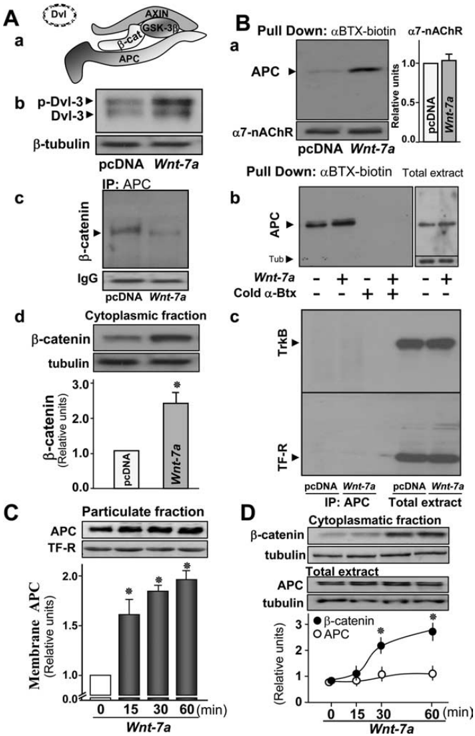
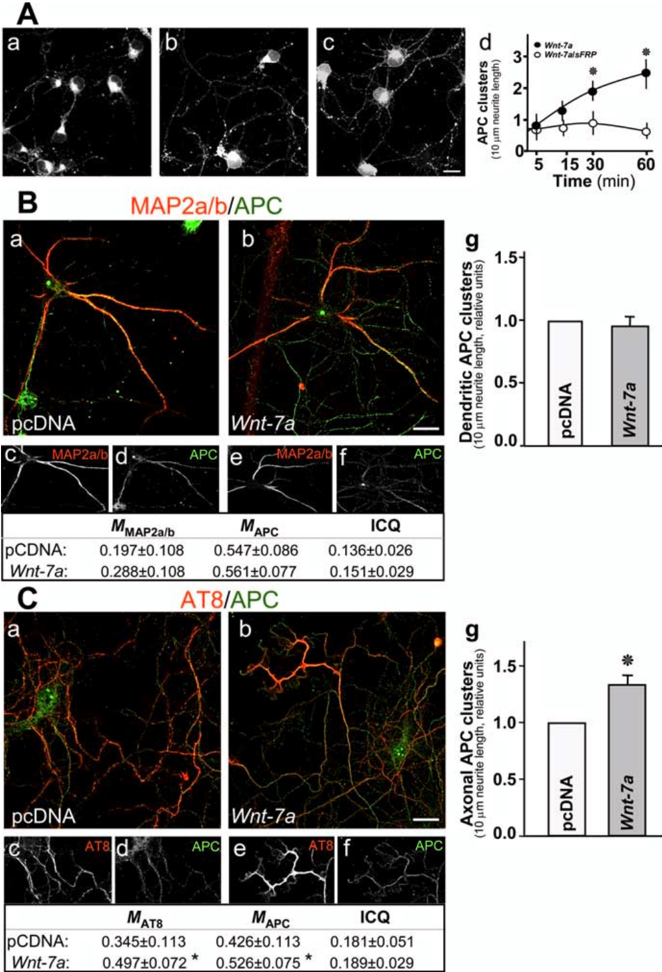
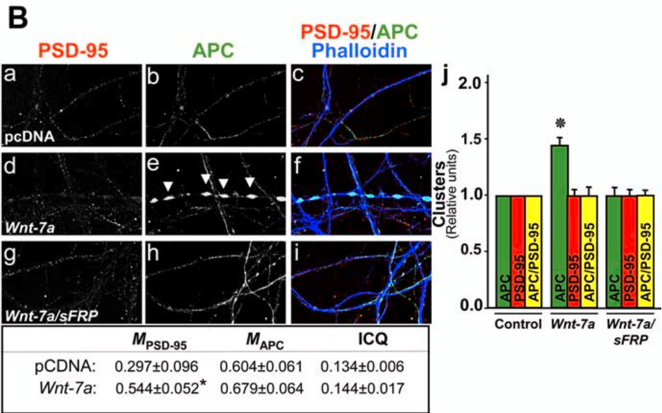
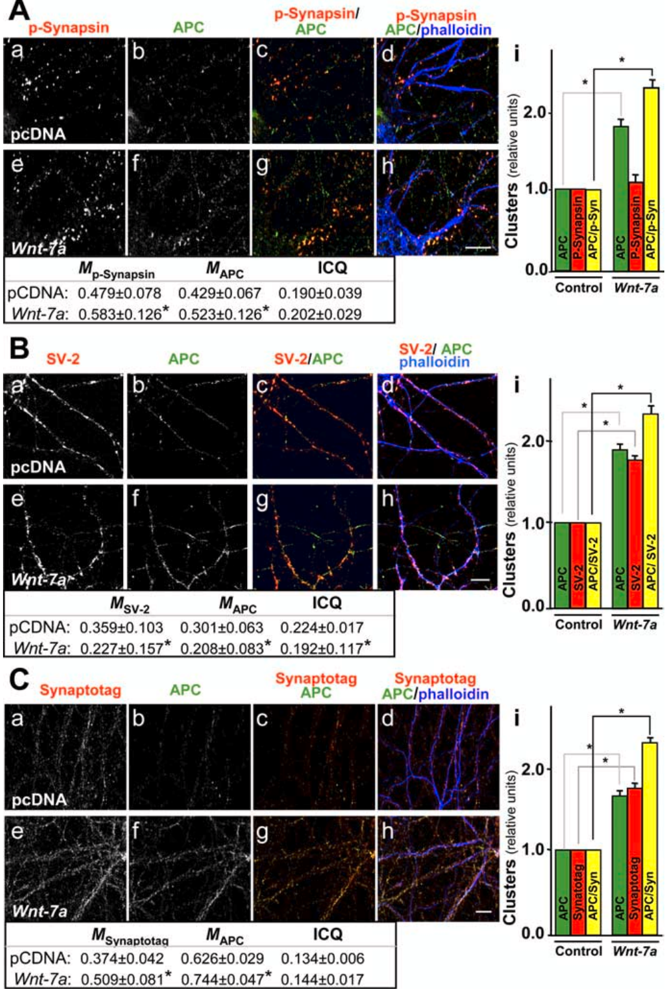
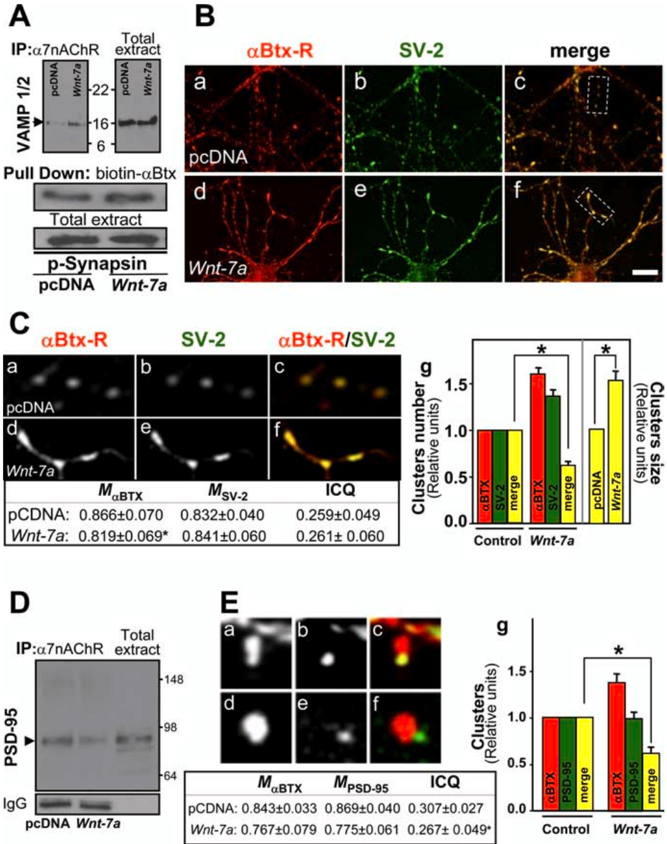
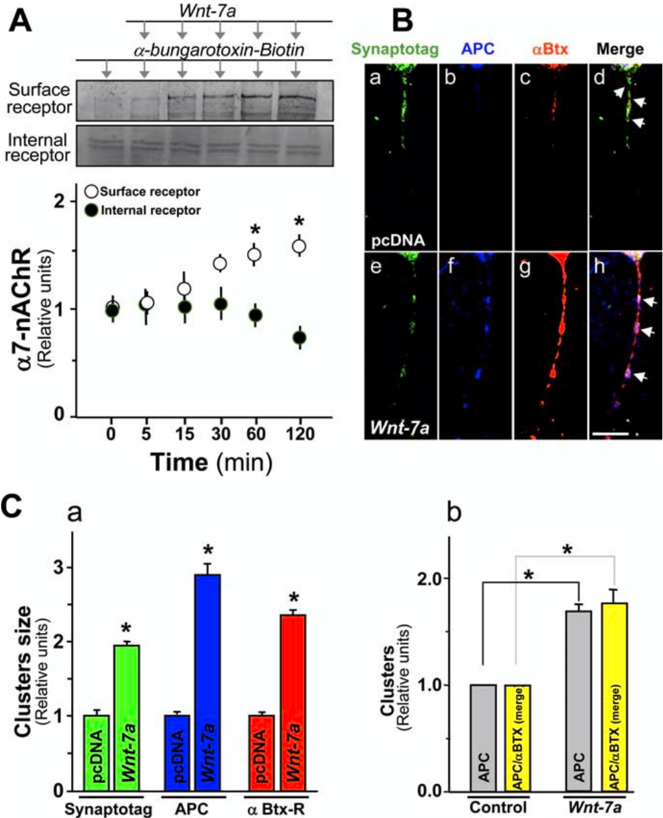
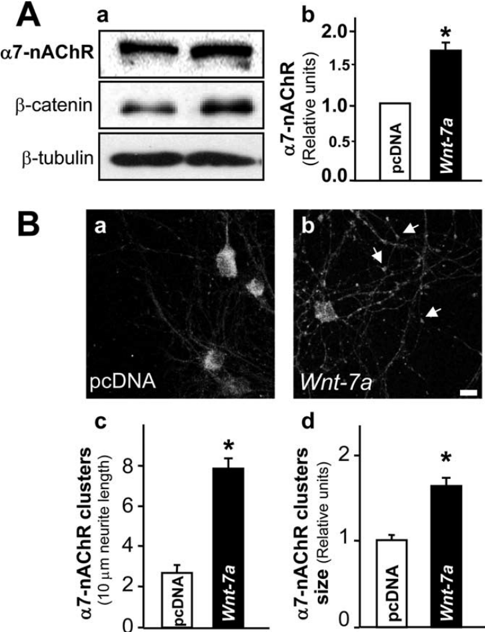
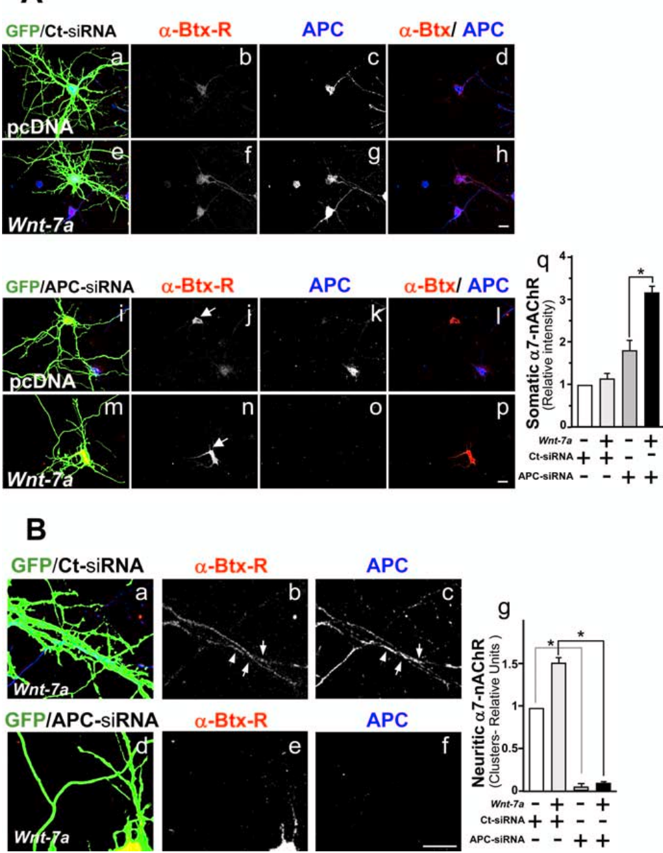
Nicotinic acetylcholine receptors (nAChRs) contribute significantly to hippocampal function. α7-nAChRs are present in presynaptic sites in hippocampal neurons and may influence transmitter release, but the factors that determine their presynaptic localization are unknown. We report here that Wnt-7a, a ligand active in the canonical Wnt signaling pathway, induces dissociation of the adenomatous polyposis coli (APC) protein from the β-catenin cytoplasmic complex and the interaction of APC with α7-nAChRs in hippocampal neurons. Interestingly,Wnt-7a induces the relocalization of APC to membranes, clustering of APC in neurites, and coclustering of APC with different, presynaptic protein markers.Wnt-7a also increases the number and size of coclusters of α7-nAChRs and APC in presynaptic terminals. These short-term changes in α7-nAChRs occur in the few minutes after ligand exposure and involve translocation to the plasma membrane without affecting total receptor levels. Longer-term exposure to Wnt-7a increases nAChR α7 subunit levels in an APC-independent manner and increases clusters of α7-nAChRs in neurites via an APC-dependent process. Together, these results demonstrate that stimulation through the canonical Wnt pathway regulates the presynaptic localization of APC and α7-nAChRs with APC serving as an intermediary in the α7-nAChR relocalization process. Modulation by Wnt signaling may be essential for α7-nAChR expression and function in synapses.
Overview
The claims and statistics of this paper haven’t been checked yet.
Run the check — free, no account needed. It reads the open-access text and checks the sources it cites.
Integrity signals
Registry
Cites
Statistics
Figures
Verification
Claims the paper makes
The claims and statistics of this paper haven’t been checked yet.
Run the check — free, no account needed. It reads the open-access text and checks the sources it cites.
Claims other papers make about this one
Each is checked against this paper’s own text: does it say what the citing paper says it does?
In the citing paper
“nonetheless, Wnt2 and other proteins traditionally associated with neural development may have important roles in post-critical period regulation of neuronal function (Farias et al., 2007; Moon et al., 2004; Wayman et al., 2006).”
From Unifying Views of Autism Spectrum Disorders: A Consideration of Autoregulatory Feedback Loops (2016) · cites this paper as Farias et al., 2007
Self-check
Percentages, sums and reported differences re-computed from the paper’s own numbers.
The self-check needs the paper’s full text.
Citations
Cites
Alzheimer's Disease: Genes, Proteins, and Therapy
Selkoe, D. J. (2001) · Physiological Reviews · doi:10.1152/physrev.2001.81.2.741 · Cited by 6,063
Alzheimer's Disease: A Disorder of Cortical Cholinergic Innervation
Coyle, J. T., Price, D. L., & DeLong, M. R. (1983) · Science · doi:10.1126/science.6338589 · Cited by 3,052
β‐catenin is a target for the ubiquitin–proteasome pathway
Aberle, H., Bauer, A., Stappert, J., Kispert, A., & Kemler, R. (1997) · The EMBO Journal · doi:10.1093/emboj/16.13.3797 · Cited by 2,586
Measurement of co‐localization of objects in dual‐colour confocal images
Manders, E. M. M., Verbeek, F. J., & Aten, J. A. (1993) · Journal of Microscopy · doi:10.1111/j.1365-2818.1993.tb03313.x · Cited by 2,132
WNT and β-catenin signalling: diseases and therapies
Moon, R. T., Kohn, A. D., Ferrari, G. V. D., & Kaykas, A. (2004) · Nature Reviews Genetics · doi:10.1038/nrg1427 · Cited by 1,763
Wnt signalling regulates adult hippocampal neurogenesis
Lie, D. C., Colamarino, S. A., Song, H., Désiré, L., Mira, H., Consiglio, A., Lein, E. S., Jessberger, S., Lansford, H., Dearie, A. R., et al. (2005) · Nature · doi:10.1038/nature04108 · Cited by 1,544
Lustig, B., Jerchow, B., Sachs, M., Weiler, S., Pietsch, T., Karsten, U., van de Wetering, M., Clevers, H., Schlag, P., Birchmeier, W., et al. (2002) · Molecular and Cellular Biology · doi:10.1128/mcb.22.4.1184-1193.2002 · Cited by 1,198
The Promise and Perils of Wnt Signaling Through β-Catenin
Moon, R. T., Bowerman, B. A., Boutros, M., & Perrimon, N. (2002) · Science · doi:10.1126/science.1071549 · Cited by 970
Synaptic Targeting by Alzheimer's-Related Amyloid β Oligomers
Lacor, P. N., Buniel, M. C., Chang, L., Fernandez, S. J., Gong, Y., Viola, K. L., Lambert, M. P., Velasco, P. T., Bigio, E. H., Finch, C. E., et al. (2004) · The Journal of Neuroscience · doi:10.1523/jneurosci.3432-04.2004 · Cited by 954
Hippocampal synaptic transmission enhanced by low concentrations of nicotine
Gray, R. G. F., Rajan, A. S., Radcliffe, K. A., Yakehiro, M., & Dani, J. A. (1996) · Nature · doi:10.1038/383713a0 · Cited by 947
Cited by
Sorted by citations
Items 101–108 of 108
Identification of transcriptional targets of the nerve injury-induced transcription factor Sox11
Salerno, K. M. (2011) · D-Scholarship@Pitt (University of Pittsburgh)
Potaros, T., Phornchirasilp, S., McKay, S. B., González-Cestari, T. F., Boyd, R. T., & McKay, D. B. (2010) · Neuroscience Letters · doi:10.1016/j.neulet.2010.11.075
Nicotinic Acetylcholine Receptors and the Roles of the Alpha7 Subunit
Paolini, M. A., Biasi, M. D., & Dani, J. A. (2014) · The Receptors · doi:10.1007/978-1-4939-1167-7_13
Dynamics and function of nicotinic acetylcholine receptors in the nervous system
Fernandes, C. D. C. (2011) · Portuguese National Funding Agency for Science, Research and Technology (RCAAP Project by FCT)
Nery, L. R. (2011) · Americanae (AECID Library)
Li, Z., Gou, C., Wang, W., Li, Y., Cui, Y., Duan, J., & Chen, Y. (2021) · Research Square · doi:10.21203/rs.3.rs-860148/v1
The therapeutic potential of cytisine and its derivatives in disorders of the central nervous system
Cheng, M., Zhu, D., Chen, S., Jia, J., Xu, J., & Zeng, X. (2026) · Biochemical Pharmacology · doi:10.1016/j.bcp.2026.117853
Etude du rôle du Syndécan à la jonction neuromusculaire de Caenorhabditis elegans
Vachon, C. (2020) · theses.fr (ABES) · doi:10.70675/4f34af1dzeed7z426dzbab2zb1e21a201491
Metadata
- Authors
- Farías, G. G., Vallés, A. S., Colombres, M., Godoy, J. A., Toledo, E. M., Lukas, R. J., Barrantes, F. J., & Inestrosa, N. C.
- Affiliations
- Pontificia Universidad Católica de Chile (CL)
- Barrow Neurological Institute (US)
- Instituto de Investigaciones Bioquímicas de Bahía Blanca, CONICET-UNS (AR)
- Venue
- The Journal of Neuroscience
- Publisher
- Society for Neuroscience
- Published
- 2007-05-16
- Volume
- 27
- Issue
- 20
- Pages
- 5313-5325
- ISSN
- 0270-6474 (ISSN-L)
- 1529-2401
- PMC
- PMC6672358
- OpenAlex
- W2081376704
- Cited by
- 108
- References
- 58
- Citations by year
- 2026: 1 · 2025: 1 · 2024: 2 · 2023: 1 · 2022: 4 · 2021: 7 · 2020: 6 · 2019: 4 · 2018: 4 · 2017: 3 · 2016: 4 · 2015: 5 · 2014: 8 · 2013: 17 · 2012: 8
- FWCI
- 3.31
- Type
- journal article
- Language
- en
- Open access
- hybrid
- doi.org
- Licence
- Locations
- Journal of Neuroscience (publishedVersion, cc-by-nc-sa)
- PubMed Central (publishedVersion)
- PubMed (publishedVersion)
- LA Referencia (Red Federada de Repositorios Institucionales de Publicaciones Científicas) (submittedVersion, cc-by-nc-sa)
- Americanae (AECID Library) (submittedVersion, cc-by-nc-sa)
- Funders
- Barrow Neurological Foundation
- Consejo Nacional de Investigaciones Científicas y Técnicas
- Universidad Nacional del Sur
- Arizona Biomedical Research Commission
- National Institutes of Health (DA015389)
- Comisión Nacional de Investigación Científica y Tecnológica
- National Institute on Drug Abuse (R01DA015389, DA015389)
- National Institute of Neurological Disorders and Stroke (NS040417, R01NS040417)
- Topics
- Life Sciences › Biochemistry, Genetics and Molecular Biology › Molecular Biology › Nicotinic Acetylcholine Receptors Study
- Life Sciences › Neuroscience › Cellular and Molecular Neuroscience › Neuroscience and Neuropharmacology Research
- Life Sciences › Biochemistry, Genetics and Molecular Biology › Molecular Biology › Wnt/β-catenin signaling in development and cancer
- Keywords
- Wnt7a, alpha7 nicotinic acetylcholine receptor, adenomatous polyposis coli, presynaptic localization, hippocampal neurons, Wnt/β-catenin signaling, β-catenin, synaptic transmission, plasma membrane translocation
- MeSH terms
- Animals, Cell Line, Cells, Cultured, Hippocampus, Humans, Mice, Inbred C57BL, Neurons, Proto-Oncogene Proteins, Receptors, Nicotinic, Signal Transduction, Rats, Sprague-Dawley, Presynaptic Terminals, Adenomatous Polyposis Coli Protein, Wnt Proteins, beta Catenin, Mice, Rats, alpha7 Nicotinic Acetylcholine Receptor
About these checks
Registry, retraction, Cites and statistics results are computed, not judged, with one exception: a printed reference that no index lists is read once by a model before it counts as a citation error. Claims are extracted by a model and kept only when their quote appears verbatim in the text; each cited source is then checked, with a model’s help, for whether it says what the claim relies on. Those verdicts can be wrong — read the claim’s quote and the cited source before relying on one.
Statistics and arithmetic are recomputed, not judged.
Confidence bands are shown only for fields calibrated on our annotated test set. None is calibrated yet, so no band is shown.
What counts as a claim ›How we measure confidence ›How we check this ›
Are you an author, or do you see a problem with this page? Request a review
