

The DOI matches its Crossref record; 82 of the 83 references it cites were found in a registry or an index, and 1 are not checked yet.
Probabilistic harmonization and annotation of single‐cell transcriptomics data with deep generative models
Open accessPublished version of a preprint
Abstract
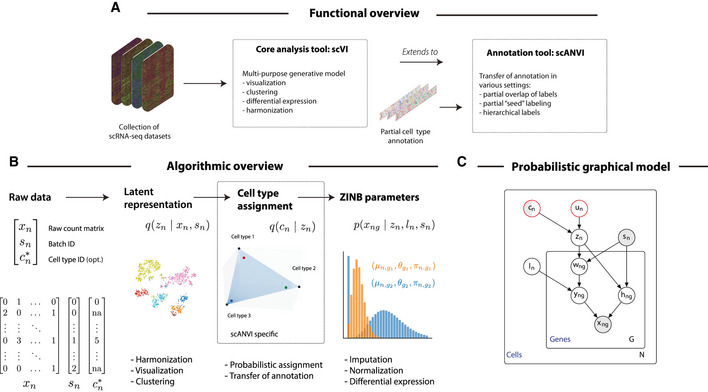
As the number of single‐cell transcriptomics datasets grows, the natural next step is to integrate the accumulating data to achieve a common ontology of cell types and states. However, it is not straightforward to compare gene expression levels across datasets and to automatically assign cell type labels in a new dataset based on existing annotations. In this manuscript, we demonstrate that our previously developed method, scVI, provides an effective and fully probabilistic approach for joint representation and analysis of scRNA‐seq data, while accounting for uncertainty caused by biological and measurement noise. We also introduce single‐cell ANnotation using Variational Inference (scANVI), a semi‐supervised variant of scVI designed to leverage existing cell state annotations. We demonstrate that scVI and scANVI compare favorably to state‐of‐the‐art methods for data integration and cell state annotation in terms of accuracy, scalability, and adaptability to challenging settings. In contrast to existing methods, scVI and scANVI integrate multiple datasets with a single generative model that can be directly used for downstream tasks, such as differential expression. Both methods are easily accessible through scvi‐tools.
Overview
The claims and statistics of this paper haven’t been checked yet.
Run the check — free, no account needed. It reads the open-access text and checks the sources it cites.
Integrity signals
Registry
Cites
Statistics
Figures
Verification
Claims the paper makes
The claims and statistics of this paper haven’t been checked yet.
Run the check — free, no account needed. It reads the open-access text and checks the sources it cites.
Claims other papers make about this one
Each is checked against this paper’s own text: does it say what the citing paper says it does?
The cited source says what the claim attributes to it.
In the citing paper
“To map SEA-AD data to cell types consistently across all 84 donors, we first defined robust transcriptional types, named supertypes, in the BICCN reference; 125 supertypes represented cell types that could be reliably reidentified in reference datasets (mean F1 score = 0.91) using hierarchical probabilistic Bayesian mapping47,48(Extended Data Fig. 5a,b).”
From Integrated multimodal cell atlas of Alzheimer’s disease (2024) · cites this paper as [48]
Self-check
Percentages, sums and reported differences re-computed from the paper’s own numbers.
The self-check needs the paper’s full text.
Citations
Cites
Adam: A Method for Stochastic Optimization
Kingma, D. P., & Ba, J. (2014) · arXiv · doi:10.48550/arxiv.1412.6980 · Cited by 98,946 · cited 4×
“We use Adam (Kingma & Ba, 2015) as a first-order stochastic optimizer to update the model parameters.”
InfluentialRobinson, M. D., McCarthy, D. J., & Smyth, G. K. (2010) · Bioinformatics · doi:10.1093/bioinformatics/btp616 · Cited by 41,364 · cited 2×
“Notably, CORAL achieves overall competitive performance except when transferring labels on the MarrowTM pairs, from 10x to Smart-Seq2.”
limma powers differential expression analyses for RNA-sequencing and microarray studies
Ritchie, M. E., Phipson, B., Wu, D., Hu, Y., Law, C. W., Shi, W., & Smyth, G. K. (2015) · Nucleic Acids Research · doi:10.1093/nar/gkv007 · Cited by 40,458 · cited 1×
“A wide range of methods have already been developed for this fundamental problem, initially for Microarrays and later on for bulk RNA sequencing, such as ComBat [15] and limma [16] which rely on generalized linear models with empirical Bayes shrinkage to avoid over-correction.”
MethodBatch Normalization: Accelerating Deep Network Training by Reducing Internal Covariate Shift
Ioffe, S., & Szegedy, C. (2015) · arXiv · doi:10.48550/arxiv.1502.03167 · Cited by 27,818 · cited 1×
“We use deterministic warmup [67] and batch normalization [68] in order to learn an expressive model.”
MethodUnpaired image-to-image translation using cycle-consistent adversarial networks
Zhu, J.-Y., Park, T., Isola, P., & Efros, A. A. (2017) · 2017 IEEE International Conference on Computer Vision (ICCV) · doi:10.1109/iccv.2017.244 · Cited by 23,602
Comprehensive Integration of Single-Cell Data
Stuart, T., Butler, A., Hoffman, P., Hafemeister, C., Papalexi, E., Mauck, W. M., Hao, Y., Stoeckius, M., Smibert, P., & Satija, R. (2019) · Cell · doi:10.1016/j.cell.2019.05.031 · Cited by 15,453
Batch Normalization: Accelerating Deep Network Training by Reducing Internal Covariate ShiftPreprint
Ioffe, S. (2024) · arXiv (Cornell University) · doi:10.57702/o9raffed · Cited by 15,273
Data Analysis Using Regression and Multilevel/Hierarchical Models
Gelman, A., & Hill, J. (2006) · doi:10.1017/cbo9780511790942 · Cited by 13,597
Integrating single-cell transcriptomic data across different conditions, technologies, and species
Butler, A., Hoffman, P., Smibert, P., Papalexi, E., & Satija, R. (2018) · Nature Biotechnology · doi:10.1038/nbt.4096 · Cited by 13,174 · cited 9×
“…or disease models in order to increase statistical robustness (Wen & Tang, 2018), achieve consistency and reproducibility among studies (Haghverdi et al , 2018; Butler et al , 2018), and ultimately converge to a common ontology of cell states and types (Wagner et al , 2016; Regev et al , 2017).”
InfluentialKass, R. E., & Raftery, A. E. (1995) · Journal of the American Statistical Association · doi:10.1080/01621459.1995.10476572 · Cited by 12,558
Research works printed but not linked: 4
- Goldberger J, Ben‐Reuven E (2017) Training deep neural‐networks using a noise adaptation layer. In Proceedings of the International Conference on Learning Representations, Toulon, France
- Kingma DP, Mohamed S, Jimenez Rezende D, Welling M (2014) Semisupervised learning with deep generative models. Adv Neural Inf Process Syst 27: 3581–3589
- Kingma DP, Welling M (2014) Auto‐encoding variational Bayes. In Proceedings of the International Conference on Learning Representations, Banff, Canada
- Louizos C, Swersky K, Li Y, Welling M, Zemel R (2016) The variational fair autoencoder. In Proceedings of the International Conference on Learning Representations, San Juan, Puerto Rico
Cited by
Sorted by citations
Items 501–600 of 702
Cluster-free annotation of single cells using Earth mover’s distance-based classificationPreprint
Forlin, R., Tajvar, P., Wang, N., Dimarogonas, D. V., & Brodin, P. (2024) · bioRxiv (Cold Spring Harbor Laboratory) · doi:10.1101/2024.03.18.585613
Mebane, R. H., Noel, T., Ing, N., Gouin, K. H., Shah, A. S., Zitser, D., Martinez, A., Gupta, G. P., Ho, A. Y., McArthur, H. L., et al. (2024) · bioRxiv (Cold Spring Harbor Laboratory) · doi:10.1101/2024.03.19.585798
Additional file 3 of scRNASequest: an ecosystem of scRNA-seq analysis, visualization, and publishing
Li, K., Sun, Y. H., Ouyang, Z., Negi, S., Gao, Z., Zhu, J. F., Wang, W., Chen, Y., Piya, S., Hu, W., et al. (2023) · Figshare · doi:10.6084/m9.figshare.22735494
Dong, J., Zhang, Y., & Wang, F. (2022) · Figshare · doi:10.6084/m9.figshare.19720079
Additional file 1 of scRNASequest: an ecosystem of scRNA-seq analysis, visualization, and publishing
Li, K., Sun, Y. H., Ouyang, Z., Negi, S., Gao, Z., Zhu, J. F., Wang, W., Chen, Y., Piya, S., Hu, W., et al. (2023) · Figshare · doi:10.6084/m9.figshare.22735488
Additional file 2 of scRNASequest: an ecosystem of scRNA-seq analysis, visualization, and publishing
Li, K., Sun, Y. H., Ouyang, Z., Negi, S., Gao, Z., Zhu, J., Wang, W., Chen, Y., Piya, S., Hu, W., et al. (2023) · Figshare · doi:10.6084/m9.figshare.22735491
Dong, J., Zhang, Y., & Wang, F. (2022) · Figshare · doi:10.6084/m9.figshare.19720082
Dong, J., Zhang, Y., & Wang, F. (2022) · Figshare · doi:10.6084/m9.figshare.19720085
Opportunities of complex analysis in single-cell RNA sequencing
Khozyainova, A. A., Valyaeva, A. A., Arbatsky, M. S., Isaev, S. V., Iamshchikov, P. S., Volchkov, E., Sabirov, M. S., Zainullina, V. R., & Chechekhin, V. I. (2023) · Biochemistry (Moscow) · doi:10.31857/s032097252302001x
In vitro spatiotemporal reconstruction of human skeletal muscle organogenesisPreprint
Mavrommatis, L., Daya, N., Volke, L., Lu, I., Zhuge, H., Stehling, M., Zeuschner, D., Jeong, H., Yang, J.-H., zu Hörste, G. M., et al. (2024) · bioRxiv (Cold Spring Harbor Laboratory) · doi:10.1101/2024.05.10.593520
Yuan, D. Y., McKeague, M. L., Raghu, V. K., Schoen, R. E., Finn, O. J., & Benos, P. V. (2024) · bioRxiv (Cold Spring Harbor Laboratory) · doi:10.1101/2024.06.14.598031
Advancing ScRNA-Seq Data Integration via a Novel Gene Selection Method
Lazaros, K., Exarchos, T., Maglogiannis, I. G., Vlamos, P., & Vrahatis, A. G. (2024) · IFIP advances in information and communication technology · doi:10.1007/978-3-031-63211-2_3
Ba, T., Hao, M., Zhang, L., Gao, C., & Wang, Y. (2024) · Bioinformatics · doi:10.1093/bioinformatics/btae480
“…principal component analysis (PCA), Seurat V3 (Stuart et al. 2019) utilizes canonical correlation analysis (CCA), LIGER (Welch et al. 2019) uses integrative nonnegative matrix factorization (iNMF), and DESC (Li et al. 2020), scVI (Lopez et al. 2018) and scANVI (Xu et al. 2021) use autoencoders.”
MethodA deep generative model for capturing cell to phenotype relationshipsPreprint
Weinberger, E., Yu, P. Z., & Lee, S. (2024) · bioRxiv (Cold Spring Harbor Laboratory) · doi:10.1101/2024.08.07.606396
“Similar to previous works in generative modeling of scRNA-seq data [7, 11, 2], we then transform z bi into the parameters of a negative binomial distribution to generate our observed data.”
BackgroundMethodInfluentialExploring group-specific technical variation patterns of single-cell dataPreprint
Zhou, Y., Sheng, Q., & Jin, S. (2024) · bioRxiv (Cold Spring Harbor Laboratory) · doi:10.1101/2024.09.20.614043
“These ranged from statistical methods based on similar cells or shared cell types (fastMNN (7), Seurat (8), Harmony, and LIGER (11)) to graph-based methods (BBKNN (16) and Conos (17)) and deep learning methods (scVI, scANVI (18), and scPoli (19)).”
MethodPrediction of context-specific regulatory programs and pathways using interpretable deep learningPreprint
Doncevic, D., Alvarez, C. R., Li, A., Zhang, Y., Bachmann, A., Noack, K., & Herrmann, C. (2024) · bioRxiv (Cold Spring Harbor Laboratory) · doi:10.1101/2024.11.06.622202 · Cited by 1
Andrade, A. X., Nguyen, S. N., Marckx, A., & Montillo, A. A. (2026) · Nature Communications · doi:10.1038/s41467-026-72666-4
“Finally, an additional comparable, we include the cell type-label supervised scANVI 17 and demonstrate that scMEDAL-RE ’ s bene fi ts extend beyond our default batch-invariant subnetworks to alternative supervised approaches.”
InfluentialAutomated Cell Type Annotation with Reference Cluster MappingPreprint
Galanti, V., Shi, L., Azizi, E., Liu, Y., & Blumberg, A. J. (2024) · bioRxiv (Cold Spring Harbor Laboratory) · doi:10.1101/2024.11.30.626130
“We provided each method with its expected input representation: log-normalized expression for CellTypist [29], Seurat [27], CIPR [41], SingleR [31], scmap [32], and clustifyr [42], and raw counts for scANVI [28] and SCALEX [30].”
InfluentialscKADE: Single-Cell Multi-Omics Integration with Kolmogorov-Arnold Deep Embedding
Pang, S., Wu, J., Wu, W., Li, H., Wang, R., Zhang, Y., & Wang, S. (2024) · IEEE International Conference on Bioinformatics and Biomedicine (BIBM) · doi:10.1109/bibm62325.2024.10822086
“To evaluate the method’s performance, we employed four evaluation metrics: Seurat Alignment Score (SAS) [17], omics layer Average Silhouette Width (ASW) [18], Neighbor Consistency (NC) [19], and Mean Average Precision (MAP) [18].”
Target-oriented Reference Construction for supervised cell type identification in scRNA-seq
Wei, X., Ma, W., Wu, Z. J., & Wu, H. (2024) · IEEE International Conference on Bioinformatics and Biomedicine (BIBM) · doi:10.1109/bibm62325.2024.10822047
Botas, J., Jia, J. D., Pasupuleti, S., Chen, H., Hu, X., Xu, Z., & Liu, Z. (2025) · bioRxiv (Cold Spring Harbor Laboratory) · doi:10.1101/2025.02.04.636468
P., G. F. P. D. M., Lins, M. P., da Fontoura, J. C., Osvaldt, A. B., Machado, S. M. D. S., Filippi‐Chiela, E. C., & Bonorino, C. (2025) · bioRxiv (Cold Spring Harbor Laboratory) · doi:10.1101/2025.02.08.637283
Mahmoud, A., Choi, P. H., Sukhwa, C., Pintar, J., Walch, H. S., Zhao, N., Bermeo, J., Chung, S. K., Raghavan, M. S., Bapat, S., et al. (2025) · bioRxiv (Cold Spring Harbor Laboratory) · doi:10.1101/2025.02.17.638725
“The overall best performer was scANVI 86 a semi-supervised variant of scVI 87 , a deep-learning method that uses a variational autoencoder network.”
Hu, H., Guo, Y., Ge, F., Yin, H. R., Zhang, H., Zhou, Z., Yan, F., Ye, Q., Wu, J., Cao, J., et al. (2025) · Advanced Science · doi:10.1002/advs.202410790
Reconstructing signaling histories of single cells via perturbation screens and transfer learning
Hutchins, N. T., Meziane, M., Lu, C., Mitalipova, M. M., Fischer, D. S., & Li, P. (2026) · Nature Methods · doi:10.1038/s41592-026-03213-8
“In particular, algorithms based on conditional variational autoencoders (CVAEs), such as scANVI and trVAE, can remove the highly nonlinear batch effects more comprehensively and embed cells with similar gene expression patterns together more robustly than comparatively simpler models 26–28 .”
InfluentialGerstner, N., Fröhlich, A. S., Matosin, N., Binder, E. B., & Arloth, J. (2025) · medRxiv · doi:10.1101/2025.03.17.25324098
Edited Filamin A in myeloid cells reduces intestinal inflammation and protects from colitisPreprint
Gawish, R., Varada, R., Deckert, F., Hladik, A., Steinbichl, L., Cimatti, L., Milanovic, K., Jain, M. K., Torgasheva, N., Andrea Tanzer, A., et al. (2025) · bioRxiv (Cold Spring Harbor Laboratory) · doi:10.1101/2025.03.25.643676
Primer on machine learning applications in brain immunology
Binder, N., Khavaran, A., & Sankowski, R. (2025) · Frontiers in Bioinformatics · doi:10.3389/fbinf.2025.1554010 · Cited by 1
Gao, Y., Duan, H., Meng, F., Zhang, C., Li, X., & Li, F. (2025) · IET Systems Biology · doi:10.1049/syb2.12107
“Unlike them, scANVI is a semi ‐ supervised learning method that uses variational inference for single ‐ cell annotation [23].”
Towards Spatial Transcriptomics-Guided Pathological Image Recognition with Batch-Agnostic Encoder
Nishimura, K., Bise, R., & Kojima, Y. (2025) · IEEE International Symposium on Biomedical Imaging (ISBI) · doi:10.1109/isbi60581.2025.10980754
Hu, L., Chen, Q., Qiu, P. S., Qin, H., Zhang, Y., Cao, L., Xia, T., Deng, Z., Zhang, Y., Fang, S., et al. (2025) · bioRxiv (Cold Spring Harbor Laboratory) · doi:10.1101/2025.05.06.652331
“To address this need, a range of automated annotation tools have been developed, such as CellTypist 17 , which employs label transfer strategies; SingleR 18 , which relies on reference-based marker gene expression; and scANVI 19 , which utilizes deep generative modeling for probabilistic annotation.”
HL-BscPF: Hybrid learning facilitates brain cell auto-identification in multiple pathologies
Suo, Z., Pan, B., Shi, H., Ma, L., Zheng, Y., Xu, W., Lin, L., Zhang, E., Wang, L., Zhang, M., et al. (2025) · Life Sciences · doi:10.1016/j.lfs.2025.123751
Subedi, S., & Park, Y. (2025) · medRxiv · doi:10.1101/2025.06.04.25328900
“A deep “fair” autodencoder model [24], such as ScANVI [18] and Biolord [25], also modify latent-to-cell variables to disentangle multiple sources of variation in latent space.”
Berkhout, J. B., Trender, S., Krabichler, Q., Podpecan, Y., Franke, F., Schubert, T., Burbach, J. P. H., Grinevich, V., Adan, R. A. H., Fröhlich, H., et al. (2025) · bioRxiv (Cold Spring Harbor Laboratory) · doi:10.1101/2025.06.10.658830
Dang, Q., Smart, N., Redpath, A. N., & Vieira, J. M. (2026) · Advanced Science · doi:10.1002/advs.202517640 · Cited by 1
Mu, Y., & Li, W. V. (2024) · Bioinformatics Advances · doi:10.1093/bioadv/vbaf189
A Benchmark of Semi-Supervised scRNA-seq Integration Methods in Real-World ScenariosPreprint
Shen, X., He, C., & Guan, L. (2025) · bioRxiv (Cold Spring Harbor Laboratory) · doi:10.1101/2025.08.23.671952
“For example, scANVI [11] and scDREAMER [12] encourage accurate classification of annotated cells to their labels during integration. scGEN [13] models gene expression changes associated with discrete covariates such as batch by learning latent shifts across conditions, which are estimated from…”
Streamlining Spatial Transcriptomics for Human Kidney TissuePreprint
Vo, S., Meadows, K., Do, H., Chapman, K., Andonegui, G., Muruve, D. A., Pham, T., & Chun, J. (2025) · bioRxiv (Cold Spring Harbor Laboratory) · doi:10.1101/2025.09.02.673834
Düz, T., Törőcsik, D., Momnougui, S. M. E., Oubounyt, M., Al, B., Gallinat, S., Baumbach, J., & Holzscheck, N. (2025) · bioRxiv (Cold Spring Harbor Laboratory) · doi:10.1101/2025.09.09.675235
Langohr, L., Kaaja, I., Douglas, S. P. M., Nebelung, H., Koski, J., Ikonen, I., Katainen, L., Maljanen, K., Hakkarainen, M., Räisänen, T., et al. (2026) · HemaSphere · doi:10.1002/hem3.70374 · Cited by 1
“…examined the blood transcriptome of 28 samples from 12 ED patients, 7 samples from 5 SDS patients, and 11 samples from 9 controls; and the skin fibroblast transcriptome of 74 samples from 8 ED patients, including 1 patient with a compound heterozygous mutation (the above ‐ mentioned founder…”
Cheng, Y., & Zhang, X. (2025) · bioRxiv (Cold Spring Harbor Laboratory) · doi:10.1101/2025.09.19.677191
Shen, Q., Zhang, S., & Zhang, S. (2025) · Genome Research · doi:10.1101/gr.280821.125
“For example, scANVI was employed to annotate MERFISH data derived from the kidney and liver (Xu et al. 2021; Liu et al. 2023a); RCTD was used on Slide-seq v2 datacollected fromthe cerebellum and hippocampus (Cable et al. 2022); Tangram was applied to STARmap and MERFISH data originating from the…”
Spatial Transcriptomics Characterisation of Radionecrotic Changes in Glioblastoma PatientsPreprint
Seferbekova, Z., Ritter, M., Ruckhovich, G., Schinkewitsch, S., Koeberer, N., Graßl, N., Keßler, T., Goidts, V., Ratliff, M., Herold‐Mende, C. C., et al. (2025) · medRxiv · doi:10.1101/2025.09.25.25336313
Correlated latent space learning for structural differentiation modeling in single cell RNA data
Fu, Z., & Chen, C. (2025) · Computers in Biology and Medicine · doi:10.1016/j.compbiomed.2025.111115
Camara-Peña, S., Rodríguez-Márquez, P., Planell, N., Calleja-Cervantes, M. E., Jordana-Urriza, L., Cinnirella, G., Reich-Zeliger, S., Rodríguez‐Otero, P., Tamariz‐Amador, L., Ochoa, I., et al. (2025) · bioRxiv (Cold Spring Harbor Laboratory) · doi:10.1101/2025.10.11.681788
“6.1) in combination with scANVI 36 , following the pipeline recommended by the authors.”
InfluentialSelf-citationA gene program dictionary of human cellsPreprint
Xu, Y., Wang, Y., Geng, Z., Qin, Y., & Ma, S. (2025) · bioRxiv (Cold Spring Harbor Laboratory) · doi:10.1101/2025.10.29.685322
Chen, J., Schmidt, F., & Henao, R. (2026) · PLoS Computational Biology · doi:10.1371/journal.pcbi.1013701
An Explainable AI Framework for Identifying Universal Aging Signatures in Cell EmbeddingsPreprint
Qiu, W., Arian, C., Weinberger, E., Yun, S. R., Mendenhall, A., Young, J. E., Brbić, M., & Lee, S. (2025) · bioRxiv (Cold Spring Harbor Laboratory) · doi:10.1101/2025.11.07.687286 · Cited by 1
Jia, Q., Goodrich, J. A., & Conti, D. V. (2025) · bioRxiv (Cold Spring Harbor Laboratory) · doi:10.1101/2025.11.13.688299
Wang, N., Turner, D., Feinberg, H., Caballero, V. E. N., Yuan, D., Scott, N., Cardenas, C., DeBerardine, M., Dan, S., Caceres, L., et al. (2025) · bioRxiv (Cold Spring Harbor Laboratory) · doi:10.1101/2025.11.16.686778
“Additionally, some integration methods attempt to use a semi-supervised approach, such as scANVI 36 .”
Age-dependent immune responses and resident cell dynamics in young mice following pneumonia
Michki, S. N., Perez, J. V., Varapula, D. A., Thomas, A. J., Vincent, T. L., Singer, B. D., Zepp, J. A., & McGrath‐Morrow, S. A. (2025) · iScience · doi:10.1016/j.isci.2025.114219
“74 Briefly, a small set of cells were used as ‘seeds’ for each of the expected cell type categories, identified by their maximal expression of established marker genes for each cell type.”
Functional and molecular insights into muscle proprioceptors
Lallemend, F., Prach, T., & Hadjab, S. (2025) · eLife · doi:10.7554/elife.106803 · Cited by 2
“Once scVI was trained, we initialized the scANVI model ( Xu et al., 2021 ) using the weights from the pretrained scVI model to perform semi-supervised integration and label transfer of Wu”
Streamlining single-cell spatial transcriptomics for human kidney tissue
Vo, S., Meadows, K., Do, H., Chapman, K., Andonegui, G., Muruve, D. A., Pham, T., & Chun, J. (2025) · BioTechniques · doi:10.1080/07366205.2025.2591484
Instrument-Aware Representation Learning for Robust Cross-Site Flow Cytometry Integration
Chen, H., Chien, W.-S., Wang, Y., Ko, B., & Lee, C.-C. (2025) · Annual International Conference of the IEEE Engineering in Medicine and Biology Society (EMBC) · doi:10.1109/embc58623.2025.11254223
“Feature-level approaches, often based on conditional variational autoencoders (CVAEs) [5] and exemplified by scANVI [6], aim to unify data in a latent space by encoding platform-specific attributes.”
Tang, X., Nelson, D. A., Hernáez, M., Kandimalla, K. K., & Kalari, K. R. (2025) · bioRxiv (Cold Spring Harbor Laboratory) · doi:10.64898/2025.12.03.692162
Li, W., Jihad, M., Lloyd, E. G., Mucciolo, G., Henríquez, J. A., Zaccaria, M., Cheng, P. S. W., Harish, S., Mills, S., Johnson, P. M., et al. (2025) · bioRxiv (Cold Spring Harbor Laboratory) · doi:10.64898/2025.12.05.692494
Uncovering Molecular Insights into Blood–Brain Barrier Dysfunction in Alzheimer's Disease
Lazaros, K., Krokidis, M. G., Grammenos, G., Adam, S., Exarchos, T. P., Vlamos, P., & Vrahatis, A. G. (2025) · IEEE International Conference on Bioinformatics and Bioengineering (BIBE) · doi:10.1109/bibe66822.2025.00013
“This deep learning model, built on a variational autoencoder framework, creates a shared latent representation of the data, enabling more accurate and biologically meaningful downstream analyses [12].”
Sparse, random sampling is sufficient for central tolerancePreprint
Meyer, H. V., Dasgupta, S., Banerjee, A., Lin, Y., Prabakar, R. K., Chapin, S. R., Kingsford, C., & Navlakha, S. (2025) · bioRxiv (Cold Spring Harbor Laboratory) · doi:10.64898/2025.12.09.693230
Benchmarking Self-Supervised Learning for Single-Cell DataPreprint
Toma, P., Ovcharenko, O., Daunhawer, I., Vogt, J. E., Barkmann, F., & Boeva, V. (2024) · bioRxiv (Cold Spring Harbor Laboratory) · doi:10.1101/2024.11.04.620867
Missarova, A., Dann, E., Rosen, L. U., Satija, R., & Marioni, J. (2024) · Figshare · doi:10.6084/m9.figshare.26750681
Additional file 4 of scRNASequest: an ecosystem of scRNA-seq analysis, visualization, and publishing
Li, K., Sun, Y. H., Ouyang, Z., Negi, S., Gao, Z., Zhu, J., Wang, W., Chen, Y., Piya, S., Hu, W., et al. (2023) · Figshare · doi:10.6084/m9.figshare.22735497
Curion, F., Rich‐Griffin, C., Agarwal, D., Ouologuem, S., Rue-Albrecht, K., May, L., Garcia, G. E. L., Heumos, L., Thomas, T. R., Lason, W., et al. (2024) · Figshare · doi:10.6084/m9.figshare.26211618
Hausmann, F., Ergen, C., Khatri, R., Marouf, M., Hänzelmann, S., Gagliani, N., Huber, S., Machart, P., & Bonn, S. (2023) · Figshare · doi:10.6084/m9.figshare.24172161
Missarova, A., Dann, E., Rosen, L. U., Satija, R., & Marioni, J. (2024) · Figshare · doi:10.6084/m9.figshare.26750675
Missarova, A., Dann, E., Rosen, L. U., Satija, R., & Marioni, J. (2024) · Figshare · doi:10.6084/m9.figshare.26750678
Curion, F., Rich‐Griffin, C., Agarwal, D., Ouologuem, S., Rue-Albrecht, K., May, L., Garcia, G. E. L., Heumos, L., Thomas, T. R., Lason, W., et al. (2024) · Figshare · doi:10.6084/m9.figshare.26211351
Hausmann, F., Ergen, C., Khatri, R., Marouf, M., Hänzelmann, S., Gagliani, N., Huber, S., Machart, P., & Bonn, S. (2023) · Figshare · doi:10.6084/m9.figshare.24172167
Missarova, A., Dann, E., Rosen, L. U., Satija, R., & Marioni, J. (2024) · Figshare · doi:10.6084/m9.figshare.26750687
Missarova, A., Dann, E., Rosen, L. U., Satija, R., & Marioni, J. (2024) · Figshare · doi:10.6084/m9.figshare.26750690
Hausmann, F., Ergen, C., Khatri, R., Marouf, M., Hänzelmann, S., Gagliani, N., Huber, S., Machart, P., & Bonn, S. (2023) · Figshare · doi:10.6084/m9.figshare.24172164
Missarova, A., Dann, E., Rosen, L. U., Satija, R., & Marioni, J. (2024) · Figshare · doi:10.6084/m9.figshare.26750684
Missarova, A., Dann, E., Rosen, L. U., Satija, R., & Marioni, J. (2024) · Figshare · doi:10.6084/m9.figshare.26750672
Batch Effects Remain a Fundamental Barrier to Universal Embeddings in Single-Cell Foundation ModelsPreprint
Wang, L., Zhang, C., & Zhang, S. (2025) · bioRxiv (Cold Spring Harbor Laboratory) · doi:10.64898/2025.12.19.695371 · Cited by 1
“(3) Supervision-level design: leverage biological priors such as cell type and regulatory networks as supervision signals [26, 27, 55, 56].”
Perez, G., Lai, Z., Edwards, G. A., Dundee, J. M., Leahy, S. N., Qi, C., Qi, Y., Park, Y.-J., Lu, T., Uddin, M. D., et al. (2026) · Molecular Neurodegeneration · doi:10.1186/s13024-025-00919-9
“1.2) [85].”
InfluentialQuantifying pathological progression from single-cell transcriptomic data with scPSSPreprint
Khan, S. R., Rahman, M. S., Rahman, M. S., & Samee, M. A. H. (2026) · Genome Research · doi:10.1101/gr.280411.125
“We have used the 30-dimensional scanVI (Xu et al. 2021) embeddings of the data set as input for scPSS.”
Drummer, F., Dorosti, N., Hurler, C.-A., Beltrán, E., Kuemmerle, L. B., Theis, F. J., & Jäkel, S. (2026) · bioRxiv (Cold Spring Harbor Laboratory) · doi:10.64898/2026.01.14.699226
Shade, L. M. P., Qiao, Q., Katsumata, Y., Mukherjee, S., Broome, J., Johnson, L. A., Ebbert, M., Nelson, P. T., & Fardo, D. W. (2026) · Nature Genetics · doi:10.1038/s41588-025-02473-y
“SEA-AD nuclei from snRNA-seq or snMultiome (≥500 genes) were mapped to this reference via the same iterative scANVI workflow 19 .”
InfluentialMOSAIC: A Structured Multi-level Framework for Probabilistic and Interpretable Cell-type AnnotationPreprint
Yang, M., Qi, J., Lan, M., Huang, J., & Jin, S. (2026) · bioRxiv (Cold Spring Harbor Laboratory) · doi:10.64898/2026.01.31.702798
Vaikunthan, M., Schoonen, A. C. M., Lia, I.-T., Guo, J., & McFaline‐Figueroa, J. L. (2026) · bioRxiv (Cold Spring Harbor Laboratory) · doi:10.64898/2026.02.06.703342
“These atlases, combined with evolving computational tools for reference mapping and annotation 37–39 , enable designs where users can achieve cell type identification and quantification of cell type proportions with targeted gene panels and cost-effective shallow sequencing.”
Artificial Intelligence in single-cell and spatial transcriptomics data analyses
Singh, S., Kumar, S., & Gupta, D. K. (2026) · Progress in molecular biology and translational science · doi:10.1016/bs.pmbts.2026.01.011
SuperCell2.0 enables semi-supervised construction of multimodal metacell atlasesPreprint
Hérault, L., Gabriel, A. A., Duc, B., Dolfi, B., Shah, A., Joyce, J. A., & Gfeller, D. (2026) · bioRxiv (Cold Spring Harbor Laboratory) · doi:10.64898/2026.02.19.706848
scDynOmics: An Optimized Transformer Model for Representation Learning from Single-Cell MultiomicsPreprint
Yu, G., Ramnarine, T. J. S., Klughammer, J., & Mages, S. (2026) · bioRxiv (Cold Spring Harbor Laboratory) · doi:10.64898/2026.02.28.708160
“Furthermore, it had comparable performance to the representative Variational Autoencoder[39] (VAE)-based benchmark, scANVI[40] after hyperparameter optimization (median accuracy (cid:103) Acc 10-CV = 0 .”
Chen, X., He, W., Yu, J., & Fang, Z. (2026) · Interdisciplinary Sciences Computational Life Sciences · doi:10.1007/s12539-026-00822-x
scDEcrypter: Uncertainty-aware differential expression analysis for viral infection in scRNA-seqPreprint
Zhong, L., Ensberg, K. J., Tibbets, S., et al. (2026) · bioRxiv (Cold Spring Harbor Laboratory) · doi:10.64898/2026.03.09.710583
“Several approaches have been developed to accommodate uncertainty in cell labeling, including scANVI [18], miloDE [19], and GEDI [20].”
Schmitz, M. T., Ding, J. W., Nolbrant, S., McMullen, R., Kim, C. N., Pavlovic, B. J., Nowakowski, T. J., Bakken, T. E., Ye, C., & Pollen, A. A. (2026) · eLife · doi:10.7554/elife.109659.1
Schmitz, M. T., Ding, J. W., Nolbrant, S., McMullen, R., Kim, C. N., Pavlovic, B. J., Nowakowski, T. J., Bakken, T. E., Ye, C., & Pollen, A. A. (2026) · eLife · doi:10.7554/elife.109659
Soria-Alcaide, G., García-Aguilera, G., Portasany-Rodríguez, M., Lalchandani, J., González‐Murillo, Á., Sánchez, E. G., Sáiz-Ladera, C., Ramírez-Orellana, M., & García-Martínez, J. A. (2026) · BMC Genomics · doi:10.1186/s12864-026-12767-y
“Specifically, scType employs a customizable reference to annotate cell populations; these initial labels are subsequently refined through integration with scANVI [30] to resolve previously unclassified cells.”
DyGFormer:Transformer With Resistance-Distance Bias for Semi-Supervised Cell-Type Identification
Dang, Y., Liu, W., Han, X., & Liu, B. Y. (2026) · IEEE Transactions on Computational Biology and Bioinformatics · doi:10.1109/tcbbio.2026.3676606
Planer, J. D., Morley, M. P., Cai, S., Peterson, A. R., Lu, M., Yang, Y., Hallquist, H., Schaefer, S. E., Carl, J., Zhou, S., et al. (2026) · bioRxiv (Cold Spring Harbor Laboratory) · doi:10.64898/2026.03.20.713166
Recent advances in machine learning-enhanced extracellular vesicle omics for oncology
Wang, Z., Lu, W. M., Guo, Z., Liu, H., Yin, Z., Ma, S., Wang, Z., Huang, Z., Sun, X. W., Xu, Y., et al. (2026) · Journal of Nanobiotechnology · doi:10.1186/s12951-026-04342-0 · Cited by 1
Wilson, C. G., Acharya, P., Karsch, L., Duck, L. W., Twumasi-Ankrah, N., Wang, Y., Shen, H., Xing, C., Frey, B. F., Oza, V. H., et al. (2026) · bioRxiv (Cold Spring Harbor Laboratory) · doi:10.64898/2026.03.27.714828
Berkhout, J. B., Trender, S., Krabichler, Q., Podpecan, Y., Franke, F., Schubert, T., Burbach, J. P. H., Grinevich, V., Adan, R. A. H., Fröhlich, H., et al. (2026) · iScience · doi:10.1016/j.isci.2026.115604
Dissecting human population variation in single-cell responses to SARS-CoV-2
Aquino, Y. (2023) · theses.fr (ABES) · doi:10.70675/061da45czf5e5z482dzb71dz92b95c997a05
ProtoCloud: A prototypical self-explaining model for single-cell analysis
Guo, K., & Ding, J. (2026) · Cell Genomics · doi:10.1016/j.xgen.2026.101217
Turep: Detecting cross-cancer tumor-reactive T cells in single-cell and spatial transcriptomics dataPreprint
Liu, W.-D., Tung, C.-H., Sevick-Muraca, E. M., & Zhao, Z.-M. (2026) · bioRxiv · doi:10.64898/2026.04.21.719961
Fu, Z., Chen, C., & Zhang, K. (2026) · Biomedical Signal Processing and Control · doi:10.1016/j.bspc.2026.110376
Mucosal-Associated Invariant T Cells Drive Bile Duct Inflammation
Nordhus, K. S., Zheng, F., Berntsen, N. L., Ramberg, O. H., Valestrand, L., Øgaard, J., Chung, B. K., Jiang, X., & Melum, E. (2026) · Cellular and Molecular Gastroenterology and Hepatology · doi:10.1016/j.jcmgh.2026.101794
Metadata
- Authors
- Xu, C., Lopez, R., Mehlman, E., Regier, J., Jordan, M. I., & Yosef, N.
- Affiliations
- University of California, Berkeley (US)
- École Polytechnique (FR)
- University of Michigan (US)
- Harvard University (US)
- Corresponding author
- Yosef, Nir
- Venue
- Molecular Systems Biology
- Published
- 2021-01-01
- Volume
- 17
- Issue
- 1
- Pages
- e9620-e9620
- ISSN
- 1744-4292 (ISSN-L)
- PMC
- PMC7829634
- OpenAlex
- W3121168830
- Semantic Scholar
- 58c22899af553a611bbd3acfd8d2b43f86d2b3fe
- Cited by
- 691
- References
- 83
- Citations by year
- 2026: 206 · 2025: 188 · 2024: 126 · 2023: 91 · 2022: 44 · 2021: 29
- FWCI
- 23.55
- Type
- journal article
- Language
- en
- Open access
- gold
- doi.org
- Licence
- Locations
- Molecular Systems Biology (publishedVersion, cc-by)
- PubMed Central (publishedVersion, cc-by)
- PubMed (publishedVersion)
- DOAJ (DOAJ: Directory of Open Access Journals) (submittedVersion, cc-by-sa)
- Funders
- HHS | NIH | National Institute of Allergy and Infectious Diseases (U19 AI090023)
- NIH | National Institute of Mental Health (U19 MH114821)
- Topics
- Life Sciences › Biochemistry, Genetics and Molecular Biology › Molecular Biology › Single-cell and spatial transcriptomics
- Life Sciences › Biochemistry, Genetics and Molecular Biology › Molecular Biology › Gene Regulatory Network Analysis
- Life Sciences › Biochemistry, Genetics and Molecular Biology › Molecular Biology › Gene expression and cancer classification
- Keywords
- single-cell transcriptomics, data integration, cell type annotation, scVI, scANVI, variational inference, deep generative models, stochastic modeling, uncertainty quantification, semi-supervised learning, differential gene expression
- MeSH terms
- Supervised Machine Learning, Humans, Sequence Analysis, RNA, Computational Biology, Gene Expression Profiling, Databases, Genetic, Molecular Sequence Annotation, Single-Cell Analysis
About these checks
Registry, retraction, Cites and statistics results are computed, not judged, with one exception: a printed reference that no index lists is read once by a model before it counts as a citation error. Claims are extracted by a model and kept only when their quote appears verbatim in the text; each cited source is then checked, with a model’s help, for whether it says what the claim relies on. Those verdicts can be wrong — read the claim’s quote and the cited source before relying on one.
Statistics and arithmetic are recomputed, not judged.
Confidence bands are shown only for fields calibrated on our annotated test set. None is calibrated yet, so no band is shown.
What counts as a claim ›How we measure confidence ›How we check this ›
Are you an author, or do you see a problem with this page? Request a review
