

Update on Vaccine-Derived Polioviruses-Worldwide, January 2017–June 2018
Open accessThe DOI matches its Crossref record; 25 of the 26 references it cites were found in a registry or an index.
Abstract
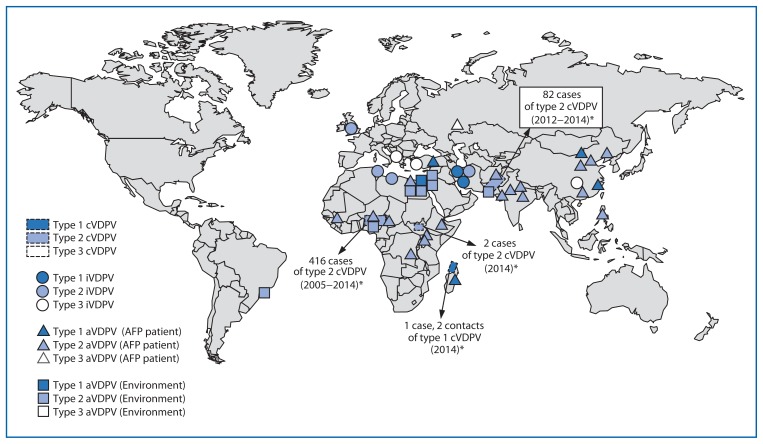
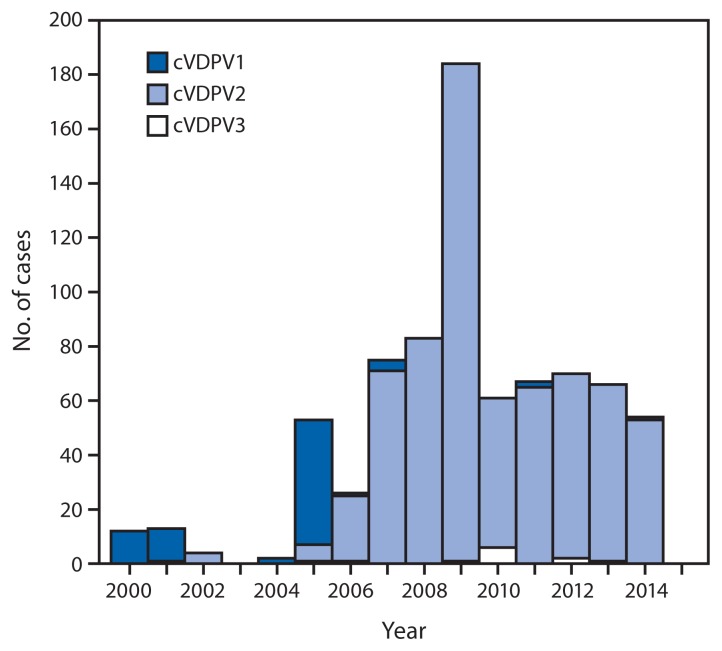
Since the Global Polio Eradication Initiative was launched in 1988 (1), the number of polio cases worldwide has declined by >99.99%. Among the three wild poliovirus (WPV) serotypes, only type 1 (WPV1) has been detected since 2012. This decline is attributable primarily to use of the live, attenuated oral poliovirus vaccine (OPV) in national routine immunization schedules and mass vaccination campaigns. The success and safety record of OPV use is offset by the rare emergence of genetically divergent vaccine-derived polioviruses (VDPVs), whose genetic drift from the parental OPV strains indicates prolonged replication or circulation (2). Circulating VDPVs (cVDPVs) can emerge in areas with low immunization coverage and can cause outbreaks of paralytic polio. In addition, immunodeficiency-associated VDPVs (iVDPVs) can emerge in persons with primary immunodeficiencies and can replicate and be excreted for years. This report presents data on VDPVs detected during January 2017-June 2018 and updates previous VDPV summaries (3). During this reporting period, new cVDPV outbreaks were detected in five countries. Fourteen newly identified persons in nine countries were found to excrete iVDPVs. Ambiguous VDPVs (aVDPVs), isolates that cannot be classified definitively, were found among immunocompetent persons and environmental samples in seven countries.
Overview
The claims and statistics of this paper haven’t been checked yet.
Free: it reads the open-access text and checks the first 5 claims that cite a source we can check. Create a free account to check every claim.
Integrity signals
Registry
Cites
Statistics
Figures
Verification
Claims the paper makes
The claims and statistics of this paper haven’t been checked yet.
Free: it reads the open-access text and checks the first 5 claims that cite a source we can check. Create a free account to check every claim.
Claims other papers make about this one
Each is checked against this paper’s own text: does it say what the citing paper says it does?
The source backs part of the claim, not all of it — or backs it for a different population, condition or comparison.
In the citing paper
“Between January 2017 and June 2018, there were 28 aVDPV cases in seven countries; 23 were aVDPV2, 4 were aVDPV3 and 1 was aVDPV1.”
From The Fight against Poliovirus Is Not Over (2023) · cites this paper as [110]
Experimental — accuracy not yet measured
Self-check
Percentages, sums and reported differences re-computed from the paper’s own numbers.
The self-check needs the paper’s full text.
Citations
Cites
Burns, C. C., Diop, O. M., Sutter, R. W., & Kew, O. M. (2014) · Journal of Infectious Diseases · doi:10.1093/infdis/jiu295 · Cited by 309 · cited 2×
“VDPVs are further classified as 1) cVDPVs, when evidence of person-to-person transmission in the community exists; 2) iVDPVs, when they are isolated from persons with primary immunodeficiencies; and 3) aVDPVs, when they are clinical isolates from persons with no known immunodeficiency and no evidence of transmission,…”
BackgroundSelf-citationPlatt, L. R., Estivariz, C. F., & Sutter, R. W. (2014) · Journal of Infectious Diseases · doi:10.1093/infdis/jiu184 · Cited by 267
Self-citationHampton, L. M., Farrell, M., Ramirez-Gonzalez, A., Menning, L., Shendale, S., Lewis, I., Rubin, J., Garon, J., Harris, J., Hyde, T., et al. (2016) · MMWR Morbidity and Mortality Weekly Report · doi:10.15585/mmwr.mm6535a3 · Cited by 193
Self-citationProgress Toward Polio Eradication — Worldwide, 2015–2016
Morales, M., Tangermann, R. H., & Wassilak, S. G. F. (2016) · MMWR. Morbidity and Mortality Weekly Report · doi:10.15585/mmwr.mm6518a4 · Cited by 182
Self-citationBurns, C. C., Shaw, J., Jorba, J., Bukbuk, D., Adu, F., Gumede, N., Pate, M. A., Abanida, E. A., Gasasira, A., Iber, J., et al. (2013) · Journal of Virology · doi:10.1128/jvi.02954-12 · Cited by 153
Self-citationSutter, R. W., Kew, O. M., Cochi, S. L., & Aylward, R. B. (2013) · Elsevier eBooks · doi:10.1016/b978-1-4557-0090-5.00035-5 · Cited by 85
Self-citationProgress Toward Polio Eradication-Worldwide, January 2016–March 2018
Khan, F., Datta, S. D., Quddus, A., Vertefeuille, J. F., Burns, C. C., Jorba, J., & Wassilak, S. G. F. (2018) · MMWR. Morbidity and Mortality Weekly Report · doi:10.15585/mmwr.mm6718a4 · Cited by 66
Self-citationLi, L., Ivanova, O., Driss, N., Tiongco-Recto, M., da Silva, R., Shahmahmoodi, S., Sazzad, H. M. S., Mach, O., Kahn, A.-L., & Sutter, R. W. (2014) · The Journal of Infectious Diseases · doi:10.1093/infdis/jiu065 · Cited by 63
Self-citationAghamohammadi, A., Abolhassani, H., Kutukculer, N., Wassilak, S. G., Pallansch, M. A., Kluglein, S., Quinn, J., Sutter, R. W., Wang, X., Sanal, O., et al. (2017) · Frontiers in Immunology · doi:10.3389/fimmu.2017.00685 · Cited by 54 · cited 1×
“Partially as a result of supplemental surveillance measures for VDPVs among patients with primary immunodeficiencies (9), the number of known iVDPV excretors has increased; the antiviral pocapavir has recently been used to treat iVDPV excretors under compassionate use protocols in three countries (Task Force for Globa…”
BackgroundSelf-citationCowger, T. L., Burns, C. C., Sharif, S., Gary, H. E., Iber, J. C., Henderson, E., Malik, F., Zaidi, S. S. Z., Shaukat, S., Rehman, L., et al. (2017) · PLoS ONE · doi:10.1371/journal.pone.0180608 · Cited by 51
Self-citationUpdate on vaccine-derived polioviruses - worldwide, July 2012-December 2013.
Diop, O. M., Burns, C. C., Wassilak, S. G. F., & Kew, O. M. (2014) · PubMed Central · Cited by 50
Self-citationIdentification of vaccine-derived polioviruses using dual-stage real-time RT-PCR
Kilpatrick, D. R., Ching, K., Iber, J., Chen, Q., Yang, S.-J., De, L., Williams, A. J., Mandelbaum, M., Sun, H., Oberste, M. S., et al. (2014) · Journal of Virological Methods · doi:10.1016/j.jviromet.2013.11.017 · Cited by 45
Self-citationProgress toward polio eradication - worldwide, 2014-2015.
Hagan, J. E., Wassilak, S. G. F., Craig, A. S., Tangermann, R. H., Diop, O. M., Burns, C. C., & Quddus, A. (2015) · PubMed Central · Cited by 45
Self-citationUpdate on Vaccine-Derived Polioviruses — Worldwide, January 2016–June 2017
Jorba, J. C., Diop, O. M., Iber, J. C., Henderson, E., Sutter, R. W., Wassilak, S. G. F., & Burns, C. C. (2017) · MMWR Morbidity and Mortality Weekly Report · doi:10.15585/mmwr.mm6643a6 · Cited by 44
Self-citationEtsano, A., Damisa, E., Shuaib, F., Nganda, G. W., Enemaku, O., Usman, S., Adeniji, A., Jorba, J., Iber, J., Ohuabunwo, C., et al. (2016) · MMWR. Morbidity and Mortality Weekly Report · doi:10.15585/mmwr.mm6530a4 · Cited by 39
Self-citationRhoden, E. E., Liu, H., Chern, S.-W. W., & Oberste, M. S. (2013) · Antiviral Research · doi:10.1016/j.antiviral.2013.03.003 · Cited by 36
Surveillance Systems to Track Progress Toward Polio Eradication — Worldwide, 2015–2016
Maes, E. F., Diop, O. M., Jorba, J. C., Chavan, S. S., Tangermann, R. H., & Wassilak, S. G. F. (2017) · MMWR Morbidity and Mortality Weekly Report · doi:10.15585/mmwr.mm6613a3 · Cited by 34
Self-citationAlleman, M. M., Chitale, R. A., Burns, C. C., Iber, J. C., Dybdahl-Sissoko, N., Chen, Q., Koko, D.-R. V., Ewetola, R., Riziki, Y., Kavunga‐Membo, H., et al. (2018) · MMWR Morbidity and Mortality Weekly Report · doi:10.15585/mmwr.mm6710a4 · Cited by 33 · cited 10×
“New outbreaks were reported in DRC (three cVDPV2 emergences); Somalia (one cVDPV2 emergence and one cVDPV3 emergence) with linked cVPDV2 isolation in sewage in Kenya (7); Nigeria (two cVDPV2 emergences); and Papua New Guinea (one cVDPV1 emergence) (Table).”
BackgroundInfluentialSelf-citationDiop, O. M., Asghar, H., Gavrilin, E., Gumede, N., Rey-Benito, G. J., Paladin, F. J., Pattamadilok, S., Zhang, Y., Goel, A., & Quddus, A. (2017) · MMWR Morbidity and Mortality Weekly Report · doi:10.15585/mmwr.mm6620a4 · Cited by 31
Self-citationSurveillance to Track Progress Toward Polio Eradication — Worldwide, 2016–2017
Gardner, T. J., Diop, O. M., Jorba, J., Chavan, S., Ahmed, J., & Anand, A. (2018) · MMWR. Morbidity and Mortality Weekly Report · doi:10.15585/mmwr.mm6714a3 · Cited by 29 · cited 1×
“The continued expansion of sewage sampling (244 sites in 41 countries) (8) has increased the frequency of detection of WPV, VDPV, and residual PV2 excretion after mOPV2 vaccination during outbreak responses.”
BackgroundSelf-citationBurns, C. C., Kilpatrick, D. R., Iber, J. C., Chen, Q., & Kew, O. M. (2016) · Methods in molecular biology · doi:10.1007/978-1-4939-3292-4_9 · Cited by 27
Self-citationMbaeyi, C., Wadood, M. Z., Moran, T. J., MJourn, Ather, F., Stehling-Ariza, T., Nikulin, J., Safadi, M. A., Iber, J. C., Zomahoun, L., et al. (2018) · MMWR Morbidity and Mortality Weekly Report · doi:10.15585/mmwr.mm6724a5 · Cited by 27 · cited 10×
“New outbreaks were reported in DRC (three cVDPV2 emergences); Somalia (one cVDPV2 emergence and one cVDPV3 emergence) with linked cVPDV2 isolation in sewage in Kenya (7); Nigeria (two cVDPV2 emergences); and Papua New Guinea (one cVDPV1 emergence) (Table).”
BackgroundInfluentialSelf-citationNotes from the Field: Circulating Vaccine-Derived Poliovirus Outbreaks — Five Countries, 2014–2015
Morales, M., Nnadi, C. D., Tangermann, R. H., & Wassilak, S. G. F. (2016) · MMWR Morbidity and Mortality Weekly Report · doi:10.15585/mmwr.mm6505a5 · Cited by 23
Self-citationEboh, V. A., Makam, J. K., Chitale, R. A., Mbaeyi, C., Jorba, J. C., Ehrhardt, D. T., Durry, E., Gardner, T. J., Mohamed, K., Kamugisha, C., et al. (2018) · MMWR Morbidity and Mortality Weekly Report · doi:10.15585/mmwr.mm6728a6 · Cited by 13 · cited 8×
“May 2018) and one mOPV2 round in Kenya (May 2018).”
BackgroundInfluentialSelf-citationProgress Toward Poliovirus Containment Implementation — Worldwide, 2017–2018
Fournier-Caruana, J., Previsani, N., Singh, H., Boualam, L., Swan, J., Llewellyn, A. C., Sutter, R. W., Zaffran, M., & MEng (2018) · MMWR Morbidity and Mortality Weekly Report · doi:10.15585/mmwr.mm6735a5 · Cited by 7 · cited 1×
“To control and prevent cVDPV2 outbreaks, approximately 100 million doses of monovalent type 2 OPV (mOPV2) have been distributed in 11 countries (4).”
BackgroundSelf-citation
Cited by
Engineering the Live-Attenuated Polio Vaccine to Prevent Reversion to Virulence
Yeh, M. T., Bujaki, E., Dolan, P. T., Smith, M., Wahid, R., Konz, J., Weiner, A. J., Bandyopadhyay, A. S., Van Damme, P., De Coster, I., et al. (2020) · Cell Host & Microbe · doi:10.1016/j.chom.2020.04.003 · Cited by 221
Hampton, L. M., Farrell, M., Ramirez-Gonzalez, A., Menning, L., Shendale, S., Lewis, I., Rubin, J., Garon, J., Harris, J., Hyde, T., et al. (2016) · MMWR Morbidity and Mortality Weekly Report · doi:10.15585/mmwr.mm6535a3 · Cited by 193
Self-citationImmune‐mediated adverse reactions to vaccines
Stone, C. A., Rukasin, C. R. F., Beachkofsky, T. M., & Phillips, E. J. (2019) · British Journal of Clinical Pharmacology · doi:10.1111/bcp.14112 · Cited by 180
“While these cases are exceedingly rare amongst the general population, they are more common amongst those with either primary or acquired immunodeficiencies.(98,104,106) Severe T‐cell immunodeficiency or a household memberwith a similar immunodeficiency is therefore a strict contraindication to immunization with any f…”
BackgroundBurns, C. C., Shaw, J., Jorba, J., Bukbuk, D., Adu, F., Gumede, N., Pate, M. A., Abanida, E. A., Gasasira, A., Iber, J., et al. (2013) · Journal of Virology · doi:10.1128/jvi.02954-12 · Cited by 153
Self-citationMucosal vaccines and technology
Miquel-Clopés, A., Bentley, E. G., Stewart, J. P., & Carding, S. R. (2019) · Clinical & Experimental Immunology · doi:10.1111/cei.13285 · Cited by 175
Metadata
- Authors
- Jorba, J., Diop, O. M., Iber, J., Henderson, E., Zhao, K., Sutter, R. W., Wassilak, S. G. F., & Burns, C. C.
- Affiliations
- National Center for Immunization and Respiratory Diseases (US)
- Corresponding author
- Jorba, Jaume
- ORCID
- Venue
- MMWR. Morbidity and Mortality Weekly Report
- Published
- 2018-10-26
- Volume
- 67
- Issue
- 42
- Pages
- 1189-1194
- ISSN
- 0149-2195 (ISSN-L)
- 1545-861X
- PMC
- PMC4584736
- OpenAlex
- W2290762240
- Cited by
- 197
- References
- 26
- Citations by year
- 2025: 4 · 2024: 8 · 2023: 10 · 2022: 8 · 2021: 16 · 2020: 27 · 2019: 24 · 2018: 22
- FWCI
- 16.84
- Type
- journal article
- Language
- en
- Open access
- bronze
- doi.org
- Locations
- MMWR Morbidity and Mortality Weekly Report (publishedVersion)
- Europe PMC (PubMed Central) (publishedVersion, cc-by)
- PubMed Central (publishedVersion, public-domain)
- PubMed Central (publishedVersion, cc-by)
- PubMed (publishedVersion)
- Funders
- World Health Organization
- Centers for Disease Control and Prevention
- National Center for Immunization and Respiratory Diseases
- Topics
- Health Sciences › Medicine › Infectious Diseases › Viral Infections and Immunology Research
- Health Sciences › Medicine › Epidemiology › Virology and Viral Diseases
- Social Sciences › Health › Vaccine Coverage and Hesitancy
- Keywords
- vaccine-derived poliovirus, circulating vaccine-derived poliovirus, oral polio vaccine, polio outbreak, paralytic poliomyelitis, primary immunodeficiency, genetic drift, Global Polio Eradication Initiative, vaccination coverage
- MeSH terms
- Adult, Child, Child, Preschool, Disease Outbreaks, Female, Humans, Infant, Infant, Newborn, Male, Poliomyelitis, Poliovirus Vaccine, Oral, Serotyping, Sewage, Vaccines, Attenuated, Global Health, Immunocompromised Host, Poliovirus
About these checks
Registry, retraction, Cites and statistics results are computed, not judged, with one exception: a printed reference that no index lists is read once by a model before it counts as a citation error. Claims are extracted by a model and kept only when their quote appears verbatim in the text; each cited source is then checked, with a model’s help, for whether it says what the claim relies on. Those verdicts can be wrong — read the claim’s quote and the cited source before relying on one.
Statistics and arithmetic are recomputed, not judged.
Confidence bands are shown only for fields calibrated on our annotated test set. None is calibrated yet, so no band is shown.
What counts as a claim ›How we measure confidence ›How we check this ›
Are you an author, or do you see a problem with this page? Request a review
Data sources
Bibliographic data: Semantic Scholar, OpenAlex, Crossref.
Contains information from the Semantic Scholar Academic Graph Datasets, made available under the ODC Attribution License (ODC-BY 1.0).
Semantic Scholar’s data is described in: Kinney, R., et al. (2023). The Semantic Scholar Open Data Platform. arXiv:2301.10140.
