

Impact of the COVID-19 Pandemic on Administration of Selected Routine Childhood and Adolescent Vaccinations — 10 U.S. Jurisdictions, March–September 2020
Open accessThe DOI matches its Crossref record; 8 of the 8 references it cites were found in a registry or an index; 8 of the 8 sources its claims cite were checked for support.
Abstract
After the March 2020 declaration of the COVID-19 pandemic in the United States, an analysis of provider ordering data from the federally funded Vaccines for Children program found a substantial decrease in routine pediatric vaccine ordering (1), and data from New York City and Michigan indicated sharp declines in routine childhood vaccine administration in these areas (2,3). In November 2020, CDC interim guidance stated that routine vaccination of children and adolescents should remain an essential preventive service during the COVID-19 pandemic (4,5). To further understand the impact of the pandemic on routine childhood and adolescent vaccination, vaccine administration data during March-September 2020 from 10 U.S. jurisdictions with high-performing* immunization information systems were assessed. Fewer administered doses of routine childhood and adolescent vaccines were recorded in all 10 jurisdictions during March-September 2020 compared with those recorded during the same period in 2018 and 2019. The number of vaccine doses administered substantially declined during March-May 2020, when many jurisdictions enacted stay-at-home orders. After many jurisdictions lifted these orders, the number of vaccine doses administered during June-September 2020 approached prepandemic baseline levels, but did not increase to the level that would have been necessary to catch up children who did not receive routine vaccinations on time. This lag in catch-up vaccination might pose a serious public health threat that would result in vaccine-preventable disease outbreaks, especially in schools that have reopened for in-person learning. During the past few decades, the United States has achieved a substantial reduction in the prevalence of vaccine-preventable diseases driven in large part to the ongoing administration of routinely recommended pediatric vaccines. These efforts need to continue even during the COVID-19 pandemic to reduce the morbidity and mortality from vaccine-preventable diseases. Health care providers should assess the vaccination status of all pediatric patients, including adolescents, and contact those who are behind schedule to ensure that all children are fully vaccinated.
Overview
CoChat Summary
TL;DR
Analysis of immunization information system data from 10 U.S. jurisdictions found routine childhood and adolescent vaccine doses dropped substantially during March–May 2020 compared with 2018–2019, then rebounded during June–September 2020 but not enough to catch up missed vaccinations. The authors warn this lag could threaten herd immunity and lead to vaccine-preventable disease outbreaks.
Key findings
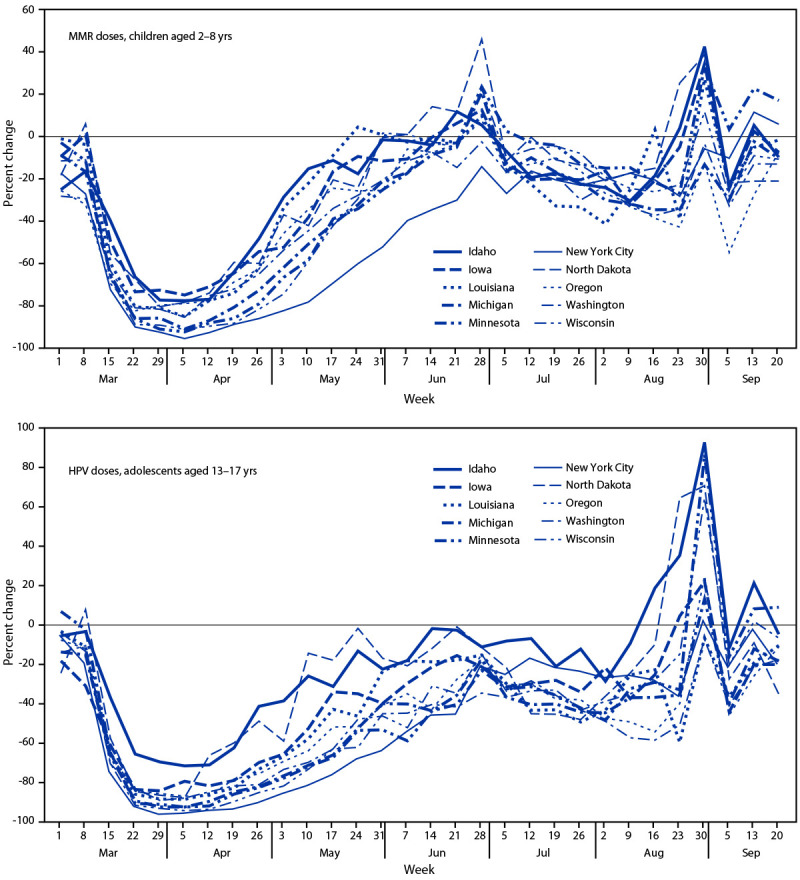
- During March–May 2020, median weekly administered doses declined across all examined vaccines and age groups: DTaP −15.7% for children aged <24 months and −60.3% for children aged 2–6 years; MMR −22.4% for children aged 12–23 months and −63.1% for children aged 2–8 years; HPV −63.6% for children aged 9–12 years and −71.3% for adolescents aged 13–17 years; Tdap −66.4% for children aged 9–12 years and −61.4% for adolescents aged 13–17 years.
- During June–September 2020, declines persisted but were smaller: DTaP −9.1% and −6.7%; MMR −8.8% and −11.3%; HPV −12.2% and −28.1%; Tdap −21.3% and −30.0% for the corresponding age groups.
- No jurisdiction demonstrated a sustained or prolonged increase in weekly doses above prepandemic levels, which the authors state would have been necessary to catch up children and adolescents who missed routine vaccinations.
- The authors suggest possible explanations including fear of contracting COVID-19 in health care or community settings, differences in stay-at-home order duration or enforcement, and reduced enforcement of school immunization requirements during virtual learning.
Methods
- Retrospective analysis of vaccine administration data from 10 U.S. jurisdictions with high-performing immunization information systems: Idaho, Iowa, Louisiana, Michigan, Minnesota, New York City, North Dakota, Oregon, Washington, and Wisconsin.
- Weekly vaccine doses administered during March–September 2020 were compared with the average number administered during the same periods in 2018 and 2019; periods examined were March–May 2020 and June–September 2020.
- For each jurisdiction, median and range of weekly percent change were calculated, then an overall median of the median weekly percentage was calculated across all 10 jurisdictions. Vaccines analyzed included DTaP, MMR, HPV, and Tdap across specified pediatric and adolescent age groups.
Limitations
- Stated: vaccination data from only 10 U.S. jurisdictions were analyzed, so findings might not be generalizable to the entire United States.
- Stated: immunization information systems were the only type of system analyzed, and vaccination information was not corroborated with other surveillance programs such as National Immunization Survey-Child or National Immunization Survey-Teen.
- Stated: the specific reasons for the decrease in March–May 2020 or the rebound in June–September 2020 could not be determined; the text also makes evident that this is an observational comparison of aggregate IIS data, so causal attribution is not possible.
Model-written summary. Check it against the paper before relying on it.
Integrity signals
Registry
Cites
Statistics
Figures
Verification
Claims the paper makes
6 Valid · 0 Not valid · 0 Not checked · 27 Own results and interpretations
Every source the paper cites for this claim was checked and supports it.
In the paper
“After the March 2020 declaration of the COVID-19 pandemic in the United States, an analysis of provider ordering data from the federally funded Vaccines for Children program found a substantial decrease in routine pediatric vaccine ordering (1), and data from New York City and Michigan indicated sharp declines in routine childhood vaccine administration in these areas (2,3).”
What the sources say
- Supportedcites [2] Langdon-Embry M, Papadouka V, Cheng I,. Notes from the field: rebound in routine childhood vaccine administration following decline during the COVID-19 Pandemic—New York City, March 1–June 27, 2020. MMWR Morb Mortal Wkly Rep 2020; 69: 999- 1001. 10.15585/mmwr.mm6930a3 32734936 PMC7392396 source
The New York City results report sharp declines in routine childhood vaccine administration, including decreases of 62% for children under 24 months and 96% for those aged 2–18 years during April 5–11, 2020. This source supports the New York City portion of the jointly cited claim; the Michigan portion is not attributed to this source alone. Page numbers are not supplied in our copy. (LLM, conf=0.94)
- Supportedcites [3] Bramer CA, Kimmins LM, Swanson R, Decline in child vaccination coverage during the COVID-19 pandemic—Michigan Care Improvement Registry, May 2016–May 2020. MMWR Morb Mortal Wkly Rep 2020; 69: 630– 1. 10.15585/mmwr.mm6920e1 32437340 source
The Michigan registry analysis reports declines in routine childhood vaccine administration: noninfluenza doses fell 21.5% among children aged ≤18 years and 15.5% among children aged ≤24 months. This source supports the Michigan portion of the jointly cited claim; the New York City portion is attributed to the other citation. The supplied passage has no page number. (LLM, conf=0.93)
hedgedstates an association- Asserted: passes — The authors put it forward as true.
- Checkable: passes — It can be checked against evidence.
- Load-bearing: unclear — It is unclear whether the paper’s conclusions depend on it.
- Based: passes — The paper gives a reason why it holds.
- Supported
Every source the paper cites for this claim was checked and supports it.
In the paper
“After the March 2020 declaration of the COVID-19 pandemic in the United States, an analysis of provider ordering data from the federally funded Vaccines for Children program found a substantial decrease in routine pediatric vaccine ordering (1), and data from New York City and Michigan indicated sharp declines in routine childhood vaccine administration in these areas (2,3).”
What the sources say
- Supportedcites [1] Santoli JM, Lindley MC, DeSilva MB, Effects of the COVID-19 pandemic on routine pediatric vaccine ordering and administration—United States, 2020. MMWR Morb Mortal Wkly Rep 2020; 69: 591– 3. 10.15585/mmwr.mm6919e2 32407298 source
The methods (p. 1) identify Vaccines for Children provider-order data as a source and describe the program as providing federally purchased vaccines. The findings (p. 1) report a notable decrease in orders for routine childhood vaccines after the national emergency declaration, and the discussion calls the reduction substantial. (LLM, conf=0.94)
plainstates a cause- Asserted: passes — The authors put it forward as true.
- Checkable: passes — It can be checked against evidence.
- Load-bearing: unclear — It is unclear whether the paper’s conclusions depend on it.
- Based: passes — The paper gives a reason why it holds.
- Supported
Every source the paper cites for this claim was checked and supports it.
In the paper
“During 2018–2019, a measles outbreak occurred in Rockland County, New York and nearby counties.”
§ Impact of the COVID-19 Pandemic on Administration of Selected Routine Childhood and Adolescent Vaccinations — 10 U.S. Jurisdictions, March–September 2020 > Discussion
What the sources say
- Supportedcites [9] McDonald R, Ruppert PS, Souto M, Notes from the field: measles outbreaks from imported cases in orthodox Jewish communities—New York and New Jersey, 2018–2019. MMWR Morb Mortal Wkly Rep 2019; 68: 444– 5. 10.15585/mmwr.mm6819a4 31095533 PMC6522080 source
The opening passage reports measles cases in New York from October 2018 through April 2019. The New York section specifies that 206 cases were in Rockland County and 36 were in nearby counties. (LLM, conf=0.94)
plain- Asserted: passes — The authors put it forward as true.
- Checkable: passes — It can be checked against evidence.
- Load-bearing: unclear — It is unclear whether the paper’s conclusions depend on it.
- Based: passes — The paper gives a reason why it holds.
- Supported
The cited sources support only part of this claim — read each source’s verdict below.
In the paper
“During March–May 2020, eight of the 10 jurisdictions implemented some form of stay-at-home order (no orders were issued in Iowa and North Dakota) (Supplementary Table, https://stacks.cdc.gov/view/cdc/106855) (7).”
What the sources say
- Partly supportedcites [7] Moreland A, Herlihy C, Tynan MA, Timing of state and territorial COVID-19 stay-at-home orders and changes in population movement—United States, March 1–May 31, 2020. MMWR Morb Mortal Wkly Rep 2020; 69: 1198– 203. 10.15585/mmwr.mm6935a2 32881851 PMC7470456 sourceExperimental — accuracy not yet measured
Split into 2 atoms — 0 confirmed, 2 partially supported, 0 disputed, 0 misattributed, 0 unverifiable. Expand the claim to see per-atom verdicts.
plain- Asserted: passes — The authors put it forward as true.
- Checkable: passes — It can be checked against evidence.
- Load-bearing: passes — The paper’s conclusions depend on it.
- Based: passes — The paper gives a reason why it holds.
- Partly supported
The cited sources support only part of this claim — read each source’s verdict below.
In the paper
“This decline, which is consistent with other data sources indicating a similar decrease in routine pediatric vaccine ordering, corresponded to the enactment of stay-at-home orders in many jurisdictions (1).”
§ Impact of the COVID-19 Pandemic on Administration of Selected Routine Childhood and Adolescent Vaccinations — 10 U.S. Jurisdictions, March–September 2020 > Discussion
What the sources say
- Partly supportedcites [1] Santoli JM, Lindley MC, DeSilva MB, Effects of the COVID-19 pandemic on routine pediatric vaccine ordering and administration—United States, 2020. MMWR Morb Mortal Wkly Rep 2020; 69: 591– 3. 10.15585/mmwr.mm6919e2 32407298 sourceExperimental — accuracy not yet measured
The report (p. 1) documents a decline in measles-containing vaccine administrations beginning the week of March 16, 2020, and notes that many states and localities issued stay-at-home orders. It does not specifically tie the decline to the enactment of those orders; it dates the decline in vaccine orders relative to the national emergency declaration. Its administration data end April 19, so they do not establish a decline through May. (LLM, conf=0.84)
plainstates an association- Asserted: passes — The authors put it forward as true.
- Checkable: passes — It can be checked against evidence.
- Load-bearing: unclear — It is unclear whether the paper’s conclusions depend on it.
- Based: passes — The paper gives a reason why it holds.
- Partly supported
23 more claims
Create a free account to see all 33 claims and every source verdict.
- It may state two separate claims as one. 4
- Probably not a substantial claim. 3
Self-check
Percentages, sums and reported differences re-computed from the paper’s own numbers.
Each contradiction between two passages listed here was confirmed by an independent check.
Rated minor: it would not touch a result — a value no result rests on, a p-value that stays on the same side of the significance level, or a conflict that is clerical, resolved elsewhere in the paper, or outside its own findings.
In the paper
§ Impact of the COVID-19 Pandemic on Administration of Selected Routine Childhood and Adolescent Vaccinations — 10 U.S. Jurisdictions, March–September 2020
“and tetanus, diphtheria and acellular pertussis (Tdap) for adolescents aged 13–17 years.”
§ Impact of the COVID-19 Pandemic on Administration of Selected Routine Childhood and Adolescent Vaccinations — 10 U.S. Jurisdictions, March–September 2020
“Doses of Tdap administered during this period in 2020 decreased a median of 66.4% among children aged 9–12 years and 61.4% among adolescents aged 13–17 years compared with 2018 and 2019.”
Citations
Cites
Delay or avoidance of medical care because of COVID-19–related concerns—United States, June 2020.
Czeisler, M. É., Marynak, K., Clarke, K. E. N., Salah, Z., Shakya, I., Thierry, J. M., Ali, N., McMillan, H., Wiley, J. F., Weaver, M. D., et al. (2020) · MMWR. Morbidity and Mortality Weekly Report · doi:10.15585/mmwr.mm6936a4 · Cited by 1,516
Santoli, J. M., Lindley, M. C., DeSilva, M. B., Kharbanda, E. O., Daley, M. F., Galloway, L., Gee, J., Glover, M., Herring, B., Kang, Y., et al. (2020) · MMWR. Morbidity and Mortality Weekly Report · doi:10.15585/mmwr.mm6919e2 · Cited by 701 · cited 2×
“This decline, which is consistent with other data sources indicating a similar decrease in routine pediatric vaccine ordering, corresponded to the enactment of stay-at-home orders in many jurisdictions (1).”
BackgroundResultMoreland, A., Herlihy, C., Tynan, M. A., Sunshine, G., McCord, R. F., Hilton, C., Poovey, J., Werner, A. K., Jones, C. D., Fulmer, E. B., et al. (2020) · MMWR. Morbidity and Mortality Weekly Report · doi:10.15585/mmwr.mm6935a2 · Cited by 614
Bramer, C. A., Kimmins, L. M., Swanson, R., Kuo, J., Vranesich, P., Jacques-Carroll, L. A., & Shen, A. K. (2020) · MMWR. Morbidity and Mortality Weekly Report · doi:10.15585/mmwr.mm6920e1 · Cited by 297
Self-citationEpidemiology of transmissible diseases after elimination.
De Serres, G., Gay, N. J., & Farrington, C. P. (2000) · American Journal of Epidemiology · doi:10.1093/oxfordjournals.aje.a010145 · Cited by 198 · cited 1×
“Measles vaccination coverage in schools in the affected area was only 77%, far below the 93%–95% coverage needed to sustain measles herd immunity (9,10).”
BackgroundMcDonald, R., Ruppert, P. S., Souto, M., Johns, D. E., McKay, K., Bessette, N., McNulty, L. X., Crawford, J. E., Bryant, P., Mosquera, M. C., et al. (2019) · MMWR Morbidity and Mortality Weekly Report · doi:10.15585/mmwr.mm6819a4 · Cited by 60
Langdon-Embry, M., Papadouka, V., Cheng, I., Almashhadani, M., Ternier, A., & Zucker, J. R. (2020) · MMWR Morbidity and Mortality Weekly Report · doi:10.15585/mmwr.mm6930a3 · Cited by 53
Progress in childhood vaccination data in immunization information systems—United States, 2013–2016.
Murthy, N., Rodgers, L., Pabst, L., Fiebelkorn, A. P., & Ng, T. (2017) · MMWR Morbidity and Mortality Weekly Report · doi:10.15585/mmwr.mm6643a4 · Cited by 48
Cited by
Pingali, C., Yankey, D., Elam-Evans, L. D., Markowitz, L. E., Williams, C. L., Fredua, B., McNamara, L. A., Stokley, S., & Singleton, J. A. (2021) · MMWR. Morbidity and Mortality Weekly Report · doi:10.15585/mmwr.mm7035a1 · Cited by 315
Kujawski, S. A., Yao, L., Wang, H. E., Carias, C., & Chen, Y.-T. (2022) · Vaccine · doi:10.1016/j.vaccine.2021.12.064 · Cited by 103
A systematic review of interventions to promote HPV vaccination globally
Escoffery, C., Petagna, C. N., Agnone, C., Perez, S. M., Saber, L. B., Ryan, G. W., Dhir, M., Sekar, S., Yeager, K. A., Biddell, C. B., et al. (2023) · BMC Public Health · doi:10.1186/s12889-023-15876-5 · Cited by 104
Strategies for Improving Vaccine Communication and Uptake
O’Leary, S. T., Opel, D. J., Cataldi, J. R., Hackell, J. M., O’Leary, S. T., Campbell, J. D., Ardura, M. I., Banerjee, R., Bryant, K. A., Caserta, M. T., et al. (2024) · PEDIATRICS · doi:10.1542/peds.2023-065483 · Cited by 130
Fleming-Dutra, K. E., Wallace, M. M., Moulia, D., Twentyman, E., Roper, L. E., Hall, E., Link‐Gelles, R., Godfrey, M., Woodworth, K. R., Anderson, T. C., et al. (2022) · MMWR Morbidity and Mortality Weekly Report · doi:10.15585/mmwr.mm7126e2 · Cited by 77
“The pandemic has also had additional indirect effects on children and families, including missed routine childhood immunizations and health care visits; worsening of children’s social, emotional, and mental well-being; and disruptions in early child care and education programs ( 17 – 19 ).”
BackgroundSeither, R., Laury, J., Mugerwa-Kasujja, A., Knighton, C. L., & Black, C. L. (2022) · MMWR Morbidity and Mortality Weekly Report · doi:10.15585/mmwr.mm7116a1 · Cited by 76
Hill, H. A., Yankey, D., Elam–Evans, L. D., Singleton, J. A., & Sterrett, N. (2021) · MMWR Morbidity and Mortality Weekly Report · doi:10.15585/mmwr.mm7041a1 · Cited by 79
“From other data sources, decreases in both vaccine ordering and administration have been documented, including substantial declines in doses of DTaP and MMR administered to children aged 0–23 months during March– September 2020 compared with the same period in 2019 (9).”
BackgroundUnderstanding medical mistrust and HPV vaccine hesitancy among multiethnic parents in Los Angeles
Tsui, J., Martínez, B., Shin, M., Allee-Munoz, A., Rodriguez, I., Navarro, J., Thomas-Barrios, K. R., Kast, W. M., & Baezconde-Garbanati, L. A. (2022) · Journal of Behavioral Medicine · doi:10.1007/s10865-022-00283-9 · Cited by 60
Cunniff, L., Alyanak, E., Fix, A., Novak, M., Peterson, M., Mevis, K., Eiden, A. L., & Bhatti, A. A. (2023) · Human Vaccines & Immunotherapeutics · doi:10.1080/21645515.2023.2246502 · Cited by 67
Odone, A., Gianfredi, V., Sorbello, S., Capraro, M., Frascella, B., Vigezzi, G. P., & Signorelli, C. (2021) · Vaccines · doi:10.3390/vaccines9101126 · Cited by 59
“These might help to counter the falling vaccination rates and dangerous under-immunisation pockets, that the COVID-19 pandemic contributed to aggravate [10,11] and whose determinants include low public trust in vaccines, constraints on affordability or access, and an emerging crisis in vaccine hesitancy [12,13].”
BackgroundRosenblum, H. G., Lewis, R. M., Gargano, J. W., Querec, T. D., Unger, E. R., & Markowitz, L. E. (2022) · Annals of Internal Medicine · doi:10.7326/m21-3798 · Cited by 62
Damgacioglu, H., Sonawane, K., Chhatwal, J., Lairson, D. R., Clifford, G. M., Giuliano, A. R., & Deshmukh, A. A. (2021) · The Lancet Regional Health - Americas · doi:10.1016/j.lana.2021.100143 · Cited by 59
Nguyen, K. H., Nguyen, K., Mansfield, K., Allen, J. D., & Corlin, L. (2022) · Public Health · doi:10.1016/j.puhe.2022.06.002 · Cited by 54
Gambrell, A., Sundaram, M. E., & Bednarczyk, R. A. (2022) · Vaccine · doi:10.1016/j.vaccine.2022.06.033 · Cited by 60
Murthy, B. P., Zell, E. R., Saelee, R., Murthy, N. C., Meng, L. M., Meador, S. A., Reed, K., Shaw, L., Gibbs‐Scharf, L., McNaghten, A. D., et al. (2021) · MMWR Morbidity and Mortality Weekly Report · doi:10.15585/mmwr.mm7035e1 · Cited by 50
Self-citationJi, C., Piché‐Renaud, P., Apajee, J., Stephenson, E., Forte, M., Friedman, J., Science, M. E., Zlotkin, S. H., Morris, S. K., & Tu, K. (2022) · Vaccine · doi:10.1016/j.vaccine.2022.02.008 · Cited by 66
Influenza Vaccinations During the COVID-19 Pandemic — 11 U.S. Jurisdictions, September–December 2020
Roman, P. C., Kirtland, K. A., Zell, E. R., et al. (2021) · MMWR Morbidity and Mortality Weekly Report · doi:10.15585/mmwr.mm7045a3 · Cited by 45
Self-citationPinto, A. C., Ranasinghe, L., Dodd, P. J., Budhathoki, S. S., Seddon, J. A., & Whittaker, E. (2022) · Frontiers in Pediatrics · doi:10.3389/fped.2022.979769 · Cited by 49
Yunusa, A., Cabral, C., & Anderson, E. (2022) · PLOS Global Public Health · doi:10.1371/journal.pgph.0000628 · Cited by 44
Oberg, C. N., Hodges, H. R., Gander, S., Nathawad, R., & Cutts, D. B. (2022) · Current problems in pediatric and adolescent health care · doi:10.1016/j.cppeds.2022.101181 · Cited by 57
Socioemotional Development of Infants and Toddlers During the COVID-19 Pandemic
Kuehn, L. M., Jones, A. M., Helmkamp, L. J., Knudtson, M. D., Domek, G. J., & Allison, M. A. (2023) · Archives of Pediatrics and Adolescent Medicine · doi:10.1001/jamapediatrics.2023.5684 · Cited by 43
Impact of COVID-19 on vaccine confidence and uptake: A systematic literature review
Vojtek, I., van Wouw, M., & Thomson, A. (2024) · Human Vaccines & Immunotherapeutics · doi:10.1080/21645515.2024.2384180 · Cited by 44
LaMori, J. C., Feng, X., Pericone, C. D., Mesa‐Frias, M., Sogbetun, O., & Kulczycki, A. (2022) · PLoS ONE · doi:10.1371/journal.pone.0264062 · Cited by 37
“Although motivation to receive the influenza vaccine may have increased during the COVID-19 pandemic [38], coverage of many other vaccines has been negatively impacted by the pandemic, among both adults and children [39, 40].”
BackgroundCOVID-19 pandemic impact on childhood vaccination coverage in Quebec, Canada
Kiely, M., Mansour, T., Brousseau, N., Rafferty, E., Paudel, Y. R., Sadarangani, M., Svenson, L. W., Robinson, J., Gagneur, A., Driedger, S. M., et al. (2021) · Human Vaccines & Immunotherapeutics · doi:10.1080/21645515.2021.2007707 · Cited by 32
Njoh, A. A., Saidu, Y., Bachir, H. B., et al. (2022) · Conflict and Health · doi:10.1186/s13031-022-00461-1 · Cited by 35
“This AFP surveillance improvement partly contributed to attaining the goals of the Global Polio Eradication Initiative, even in this area of insecurity in 2020 [24].”
BackgroundInfluenza Vaccine Uptake in the United States before and during the COVID-19 Pandemic
McGovern, I., Bogdanov, A., Cappell, K. A., et al. (2022) · Vaccines · doi:10.3390/vaccines10101610 · Cited by 34
Seneghini, M., Rüfenacht, S., Flury, B. B., Flury, D., Schlegel, M., Kuster, S. P., & Kohler, P. P. (2022) · Antimicrobial Stewardship & Healthcare Epidemiology · doi:10.1017/ash.2022.10 · Cited by 35
Ghaznavi, C., Eguchi, A., Lwin, K. S., Yoneoka, D., Tanoue, Y., Rauniyar, S. K., Horiuchi, S., Hashizume, M., & Nomura, S. (2022) · Vaccine · doi:10.1016/j.vaccine.2023.05.034 · Cited by 40
Mathis, A. D., Clemmons, N. S., Redd, S. B., Pham, H., Leung, J. W. T., Wharton, A. K., Anderson, R. D., McNall, R. J., Rausch-Phung, E., Rosen, J. B., et al. (2021) · Clinical Infectious Diseases · doi:10.1093/cid/ciab979 · Cited by 36
“These are critical issues of particular relevance in the midst of the COVID-19 pandemic, which is disrupting immunization systems here [38, 39] and elsewhere [40].”
Fish, L. J., Harrison, S. E., McDonald, J.-A., et al. (2022) · Human Vaccines & Immunotherapeutics · doi:10.1080/21645515.2022.2058264 · Cited by 29
Tabet, M., Kirby, R. S., & Xaverius, P. K. (2023) · JAMA Network Open · doi:10.1001/jamanetworkopen.2023.22588 · Cited by 28
Eiden, A. L., DiFranzo, A., Bhatti, A. A., Wang, H. E., Benčina, G., Yao, L., Saxena, K., Chen, Y.-T., & Kujawski, S. A. (2023) · Expert Review of Vaccines · doi:10.1080/14760584.2023.2217257 · Cited by 26
Pertussis Epidemiology in Children: The Role of Maternal Immunization
Principi, N., Bianchini, S., & Esposito, S. (2024) · Vaccines · doi:10.3390/vaccines12091030 · Cited by 42
Ellingson, M. K., Bednarczyk, R. A., O’Leary, S. T., Schwartz, J. L., Shapiro, E. D., & Niccolai, L. M. (2022) · Journal of Behavioral Medicine · doi:10.1007/s10865-022-00296-4 · Cited by 26
Vaccine hesitancy and cognitive biases: Evidence for tailored communication with parents
Casigliani, V., Menicagli, D., Fornili, M., Lippi, V., Chinelli, A., Stacchini, L., Arzilli, G., Scardina, G., Baglietto, L., Lopalco, P. L., et al. (2022) · Vaccine X · doi:10.1016/j.jvacx.2022.100191 · Cited by 33
Chido‐Amajuoyi, O. G., Pande, M., Agbajogu, C., et al. (2022) · JNCI Cancer Spectrum · doi:10.1093/jncics/pkac053 · Cited by 24
“Yet, the uptake of this vaccine is suboptimal in the United States (2), with this poor uptake further exacerbated during the COVID-19 pandemic (3).”
BackgroundVaccinators' Perception of HPV Vaccination in the Saa Health District of Cameroon
Haddison, E. C., Tambasho, A. C., Kouamen, G., & Ngwafor, R. (2022) · Frontiers in Public Health · doi:10.3389/fpubh.2021.748910 · Cited by 23
Alderman, K. B., Steffens, M., King, C. L., Abdi, I., Bullivant, B., & Beard, F. (2023) · Vaccine · doi:10.1016/j.vaccine.2023.05.037 · Cited by 24
“The COVID-19 pandemic has contributed to declines in childhood and adolescent vaccination rates globally [1,2].”
BackgroundCOVID-19 and Routine Childhood and Adolescent Immunizations: Evidence from Louisiana Medicaid
Walker, B., Anderson, A., Stoecker, C., Shao, Y., LaVeist, T. A., & Callison, K. (2021) · Vaccine · doi:10.1016/j.vaccine.2021.12.022 · Cited by 21
Public health impact of pneumococcal conjugate vaccination: a review of measurement challenges
Horn, E. K., Wasserman, M., Hall-Murray, C. K., Sings, H. L., Chapman, R., & Farkouh, R. (2021) · Expert Review of Vaccines · doi:10.1080/14760584.2021.1971521 · Cited by 20
“pneumoniae circulation and disease will return to preCOVID endemic levels once public health measures are lifted, in the context of decreased routine childhood vaccination and reduced person-to-person transmission during the pandemic [79].”
BackgroundTurner, K. L., Brownstein, N. C., Whiting, J., Arévalo, M., Vadaparampil, S. T., Giuliano, A. R., Islam, J. Y., Meade, C. D., Gwede, C. K., Kasting, M. L., et al. (2022) · Preventive Medicine Reports · doi:10.1016/j.pmedr.2022.102067 · Cited by 25
Berset, A. E., Burkhardt, M. C., Xu, Y. Y., Mescher, A., & Brinkman, W. B. (2022) · JAMA Network Open · doi:10.1001/jamanetworkopen.2022.42853 · Cited by 21
“13,14,32-34 Differences in rates of WCC completion compared with these studies may be due to (1) longer duration of follow-up in earlier studies, ranging from 6 to 18 months; (2) more than half the sample in previous studies had a WCC in the 12 months before intervention vs none in ours; or (3) earlier studies used hi…”
BackgroundMethodResultChanges in general and COVID-19 vaccine hesitancy among U.S. adults from 2021 to 2022
Nguyen, K. H., Chung, L., McChesney, C., Vasudevan, L., Allen, J. D., & Bednarczyk, R. A. (2024) · Annals of Medicine · doi:10.1080/07853890.2024.2357230 · Cited by 27
Chiu, N., Lo, K.-H., Chen, C.-C., Huang, S.-Y., Weng, S., Wang, C.-J., Kuo, H., Chi, H., Lien, C.-H., Tai, Y., et al. (2022) · Human Vaccines & Immunotherapeutics · doi:10.1080/21645515.2022.2071079 · Cited by 21
“A resurgence of vaccine preventable diseases may occur and trigger another wave of health threats after the COVID-19 pandemic.(25,26)”
BackgroundOlusanya, O. A., Masters, N. B., Zhang, F., Sugerman, D. E., Carter, R. J., Weiss, D., & Singleton, J. A. (2024) · Vaccines · doi:10.3390/vaccines12050495 · Cited by 24
“The pandemic has caused large-scale disruptions to the delivery and uptake of immunization services [6,11,12] and negatively impacted vaccine equity among susceptible populations and geographical areas [13,14].”
BackgroundPark, E. G. (2025) · International Journal of Strategic Communication · doi:10.1080/1553118x.2025.2462087 · Cited by 22
“For example, widespread misinformation about the COVID-19 vaccine has negatively impacted the acceptance of other vaccines, which previously had high immunization rates (Murthy et al., 2021).”
COVID-19 Impact on DTP Vaccination Trends in Africa: A Joinpoint Regression Analysis
Aguinaga-Ontoso, I., Guillén-Aguinaga, S., Guillén-Aguinaga, L., Alas-Brun, R., Onambele, L., Aguinaga-Ontoso, E., & Guillén‐Grima, F. (2023) · Vaccines · doi:10.3390/vaccines11061103 · Cited by 18
Leader, A. E., Miller-Day, M. A., Rey, R. T., Selvan, P., Pezalla, A. E., & Hecht, M. L. (2022) · Preventive Medicine Reports · doi:10.1016/j.pmedr.2022.101920 · Cited by 20
“(Findling et al., 2020; Patel Murthy et al., 2021) We wondered if perceptions of the COVID pandemic moderated the effects of video engagement on vaccine intention.”
BackgroundOsaghae, I., Chido‐Amajuoyi, O. G., & Shete, S. S. (2022) · Vaccines · doi:10.3390/vaccines10091515 · Cited by 18
Nguyen, K. H., Zhao, R., Mullins, C., Corlin, L., Beninger, P. R., & Bednarczyk, R. A. (2022) · Vaccine · doi:10.1016/j.vaccine.2022.11.023 · Cited by 17
Hanley, K., Chung, T. H., Nguyen, L. K., Amadi, T., Stansberry, S. A., Yetman, R. J., Foxhall, L. E., Bello, R. S., Diallo, T., & Le, Y. L. (2023) · Vaccines · doi:10.3390/vaccines11040872 · Cited by 19
Skolnik, A., Bhatti, A. A., Larson, A., et al. (2021) · The Annals of Family Medicine · doi:10.1370/afm.2730 · Cited by 16
Barros, L., Barros, L., do Carmo, R. F., Santos, M. B., Armstrong, A. D. C., Vasconcelos, R. D. A., & de Souza, C. D. F. (2023) · Viruses · doi:10.3390/v15020292 · Cited by 18
“On the other hand, developed countries such as the United States and Canada have reported that overall vaccination coverage, after the initial decline in the first few months of the pandemic, returned to pre-pandemic levels by May 2020.”
InfluentialNaavaal, S., Demopoulos, C. A., Kelly, A. L., Tranby, E. P., & Frantsve‐Hawley, J. (2023) · The Journal of the American Dental Association · doi:10.1016/j.adaj.2022.12.006 · Cited by 15
Has the COVID-19 pandemic affected general vaccination hesitancy? Findings from a national study
McRee, A., Gower, A. L., Kiss, D. E., et al. (2022) · Journal of Behavioral Medicine · doi:10.1007/s10865-022-00298-2 · Cited by 15
“Identifying such temporal changes in vaccination hesitancy is of great public health importance given the large decreases in vaccination rates that have been observed during the pandemic (National Foundation for Infectious Diseases, 2020; Patel Murthy et al., 2021).”
BackgroundJi, C., Senthinathan, A., Apajee, J., et al. (2025) · Vaccine · doi:10.1016/j.vaccine.2025.126811 · Cited by 14
The COVID-19 pandemic and vaccination abandonment in children: spatial heterogeneity maps
Rodrigues, R. N., do Nascimento, G. L. M., Arroyo, L. H., Arcêncio, R. A., de Oliveira, V. C., & Guimarães, E. A. D. A. (2022) · Revista Latino-Americana de Enfermagem · doi:10.1590/1518-8345.6132.3642 · Cited by 20
Abouelella, D. K., Canick, J. E., Barnes, J. M., Rohde, R. L., Watts, T. L., Boakye, E. A., & Osazuwa‐Peters, N. (2022) · Human Vaccines & Immunotherapeutics · doi:10.1080/21645515.2022.2148825 · Cited by 14
“This mandate directly contributed to the sharp decline reported in ordering and administering routine vaccines early in the pandemic, compared to 2018 and 2019.(20,21) There was a decrease in rate of vaccine doses administered for HPV (24%), Tdap (21.”
ResultSpotting a potential threat: Measles among pediatric solid organ transplantation recipients
Statler, V. A., Fox, T. G., & Ardura, M. I. (2023) · Pediatric Transplantation · doi:10.1111/petr.14502 · Cited by 14
Sell, H., Paudel, Y. R., Voaklander, D. C., et al. (2023) · Vaccine · doi:10.1016/j.vaccine.2023.01.011 · Cited by 14
Herrera-Restrepo, O., Kuang, Y., D’Angelo, J., et al. (2023) · Infectious Diseases and Therapy · doi:10.1007/s40121-023-00793-2 · Cited by 13
The Impact of the COVID-19 Pandemic on the Incidence of Herpes Zoster: A Narrative Literature Review
Parikh, R., Yousefi, M., Curran, D., & Widenmaier, R. (2024) · Infectious Diseases and Therapy · doi:10.1007/s40121-024-00924-3 · Cited by 15
Zheng, Y., Wang, D., Chen, Y.-T., Saxena, K., Benčina, G., & Eiden, A. L. (2024) · Expert Review of Vaccines · doi:10.1080/14760584.2024.2441255 · Cited by 15
Reasons for refusal of the human papillomavirus vaccine among young cancer survivors
Cherven, B. O., Klosky, J. L., Keith, K. E., et al. (2022) · Cancer · doi:10.1002/cncr.34521 · Cited by 12
Oka, E., Ueda, Y., Yagi, A., Ito, Y., Hosokawa, Y., Tabuchi, T., & Kimura, T. (2024) · Vaccine X · doi:10.1016/j.jvacx.2024.100441 · Cited by 13
“The Coronavirus disease of 2019 (COVID-19) pandemic that began in 2020 has detrimentally impacted HPV vaccination, as the rates are lower now than in the same period just before the pandemic [6].”
BackgroundResilience learning from the COVID-19 pandemic and its relevance for routine immunization programs
Falope, O. O., Nyaku, M. K., O’Rourke, C., Hermany, L. V., Plavchak, B., Mauskopf, J., Hartley, L., & Kruk, M. E. (2022) · Expert Review of Vaccines · doi:10.1080/14760584.2022.2116007 · Cited by 16
Larson, R. J., Jensen, J. L., Alvord, S. M., Sloan-Aagard, C. D., Skyles, T. J., Davis, S. C., Obray, A. M., Pogue, K., & Poole, B. D. (2024) · PLOS Global Public Health · doi:10.1371/journal.pgph.0003519 · Cited by 14
Hastings, T. J., Ha, D. R., Fox, B. I., Qian, J., Lakin, J. M., & Westrick, S. C. (2022) · Journal of the American Pharmacists Association · doi:10.1016/j.japh.2022.02.010 · Cited by 11
“Topics addressed within the CE article included (1) IIS introduction, (2) IIS policies, (3) Benefits of participation, (4) Enrollment, (5) Documentation of historical and administered vaccines, (6) Assessment and recommendation of additional vaccines, (7) Using IIS to provide patient records, (8) Vaccines for children…”
BackgroundHow Trust in Cancer Information Has Changed in the Era of COVID-19: Patterns by Race and Ethnicity
Bispo, J. B., Douyon, A., Ashad‐Bishop, K. C., Balise, R. R., & Kobetz, E. N. (2023) · Journal of Health Communication · doi:10.1080/10810730.2022.2117439 · Cited by 11
“…pandemic (e.g. due to stay-at-home orders and service suspensions), racial/ ethnic disparities have largely persisted and, in some cases, widened (DeGroff et al., 2021; Labaki et al., 2021; Marcondes, Cheng, Warner, Kamran, & Haas, 2021; Murthy et al., 2021; Santoli, 2020; Whaley et al., 2020).”
BackgroundCOVID-19 vaccination among different types of US Healthcare Personnel
Dudley, M. Z., Schuh, H. B., Shaw, J., Rimal, R. N., Harvey, S. A., Balgobin, K. R., Zapf, A. J., & Salmon, D. A. (2023) · Vaccine · doi:10.1016/j.vaccine.2023.01.030 · Cited by 13
Tsui, J., Shin, M., Sloan, K., Mackie, T. I., García, S., Fehrenbacher, A. E., Crabtree, B. F., & Palinkas, L. A. (2024) · Implementation Science Communications · doi:10.1186/s43058-024-00607-7 · Cited by 11
Lewis, R. M., & Markowitz, L. E. (2022) · Vaccine · doi:10.1016/j.vaccine.2022.03.028 · Cited by 13
Getting Human Papillomavirus Vaccination Back on Track: A National Survey
Kahn, B. Z., Huang, Q. E., Thompson, P., Gilkey, M. B., Dailey, S. A., & Brewer, N. T. (2023) · Journal of Adolescent Health · doi:10.1016/j.jadohealth.2023.01.004 · Cited by 10
“Since the introduction of HPV vaccines in the United States, coverage has slowly but steadily risen [7], though it remains well below the Healthy People 2030 target goal of 80% for adolescents aged 13 e 15 years [8].”
InfluentialPark, E. G., Kim, S., & Cameron, G. T. (2022) · Journal of Community Health · doi:10.1007/s10900-022-01100-9 · Cited by 12
García, S., Shin, M., Sloan, K., Dang, E., Garcia, C. O., Baezconde-Garbanati, L. A., Palinkas, L. A., Crabtree, B. F., & Tsui, J. (2023) · Healthcare · doi:10.3390/healthcare11172380 · Cited by 9
Fontenot, H. B., Quist, K. M., Glauberman, G., Michel, A., & Zimet, G. D. (2024) · Human Vaccines & Immunotherapeutics · doi:10.1080/21645515.2024.2311476 · Cited by 9
Maugeri, A., Barchitta, M., Cappuccio, G., Favara, G., Lio, R. M. S., & Agodi, A. (2024) · Vaccines · doi:10.3390/vaccines12101145 · Cited by 8
“Moreover, expanding age-based eligibility for vaccinations ensures that older children and adolescents who missed vaccinations earlier in life could catch up on their immunizations [11].”
BackgroundThakkar, P. V., Scott, Z., Hoffman, M. N., DeLaRosa, J. M., Hickerson, J., Boutzoukas, A. E., Benjamin, D. K., Brookhart, M. A., Zimmerman, K. O., & Moorthy, G. S. (2023) · Journal of the Pediatric Infectious Diseases Society · doi:10.1093/jpids/piad061 · Cited by 8
Perceived Effects of COVID-19 on Vaccine Hesitancy and Clinician Discussion: A Qualitative Study
Gurfinkel, D., Tietbohl, C. K., Clark, E., Saville, A. W., Albertin, C. S., O’Leary, S. T., Szilagyi, P. G., & Kempe, A. (2024) · PEDIATRICS · doi:10.1542/peds.2024-066819 · Cited by 11
Vu, M., Li, J., Hong, K., et al. (2025) · Cancer Medicine · doi:10.1002/cam4.70761 · Cited by 7
Vigezzi, G. P., Maggioni, E., Clavario, L., Mosina, L. C., Raso, E., Marjin, C., Parrini, A., Carbone, M., Fugazza, S., Marchisio, A., et al. (2025) · Expert Review of Vaccines · doi:10.1080/14760584.2025.2510338 · Cited by 12
Okobi, O. E., Akahara, P. F., Nwachukwu, O. B., Egbuchua, T. O., Ajayi, O. O., Oranu, K. P., & Ibanga, I. U. (2023) · Cureus · doi:10.7759/cureus.45194 · Cited by 9
“Also, these absences of regular and full body healthcare check-ups for children aged three to five years can lead to undetected health issues, delayed interventions, and potentially fatal consequences [2-6].”
BackgroundMethodInfluentialAssessing the impact of COVID-19 on routine immunization in Sierra Leone
Sesay, U., Serna‐Chavez, H. M., Gebru, G. N., Kangbai, J. B., Ogbonna, U., Squire, J. S., & Bakker, M. I. (2024) · BMC Public Health · doi:10.1186/s12889-024-19221-2 · Cited by 6
Immunogenicity and Safety of Extended-Interval 2-Dose Regimens of 9vHPV Vaccine
Klein, N. P., Wiesner, A., Bautista, O. M., et al. (2024) · PEDIATRICS · doi:10.1542/peds.2023-064693 · Cited by 7
Badeh, S. M., Elam–Evans, L. D., Hill, H. A., & Fredua, B. (2023) · AJPM Focus · doi:10.1016/j.focus.2023.100119 · Cited by 9
Aguinaga-Ontoso, I., Guillén-Aguinaga, S., Guillén-Aguinaga, L., et al. (2023) · Preprints.org · doi:10.20944/preprints202305.0010.v1 · Cited by 7
Mantina, N. M., Ngaybe, M. G. B., Zeiders, K. H., Osman, K. M., Wilkinson‐Lee, A. M., Landor, A. M., & Hoyt, L. T. (2024) · PLoS ONE · doi:10.1371/journal.pone.0307479 · Cited by 7
Diabetes Prevention and Measures to Ensuring a Healthy Lifestyle during COVID-19 Pandemic and after
Ayenigbara, I. O. (2023) · Korean Journal of Family Medicine · doi:10.4082/kjfm.21.0216 · Cited by 6
Grabert, B. K., McRee, A., Henrikson, N. B., et al. (2023) · Translational Behavioral Medicine · doi:10.1093/tbm/ibad002 · Cited by 6
Hepatitis B Vaccine Refusal Trends in Washington, DC, Newborns, 2017-2022
Yang, Y. T., Leslie, T. F., & Delamater, P. L. (2024) · JAMA Network Open · doi:10.1001/jamanetworkopen.2024.21202 · Cited by 6
Curran, D., La, E. M., Salem, A., Singer, D., Lecrenier, N., & Poston, S. A. (2022) · Human Vaccines & Immunotherapeutics · doi:10.1080/21645515.2022.2027196 · Cited by 7
Richards, T. B., Lindley, M. C., Byron, S. C., & Saraiya, M. (2022) · Preventive Medicine · doi:10.1016/j.ypmed.2022.107019 · Cited by 8
Ruckstuhl, L., Czock, A., Haile, S. R., et al. (2022) · Vaccine · doi:10.1016/j.vaccine.2022.09.038 · Cited by 6
Kang, Y., Meador, S. A., Black, C. L., et al. (2024) · Preventive Medicine · doi:10.1016/j.ypmed.2024.107936 · Cited by 6
Ji, C., Piché‐Renaud, P., Apajee, J., et al. (2021) · medRxiv · doi:10.1101/2021.10.28.21265578 · Cited by 6
Completion of multidose vaccine series in early childhood: current challenges and opportunities
Michels, S. Y., Daley, M. F., & Newcomer, S. R. (2024) · Current Opinion in Infectious Diseases · doi:10.1097/qco.0000000000001007 · Cited by 6
Pandemia por COVID-19 e o abandono da vacinação em crianças: mapas da heterogeneidade espacial
Rodrigues, R. N., do Nascimento, G. L. M., Arroyo, L. H., Arcêncio, R. A., de Oliveira, V. C., & Guimarães, E. A. D. A. (2022) · Revista Latino-Americana de Enfermagem · doi:10.1590/1518-8345.6132.3641 · Cited by 5
Kang, Y., Zhang, F., Chatham‐Stephens, K., et al. (2023) · Clinical Pediatrics · doi:10.1177/00099228231161335 · Cited by 5
Burkhardt, M. C., Berset, A. E., Xu, Y. Y., Mescher, A., & Brinkman, W. B. (2022) · The Journal of Pediatrics · doi:10.1016/j.jpeds.2022.09.035 · Cited by 6
Kindergarten Vaccination Status in California After Changes to Medical Exemption Policy
Delamater, P. L., Buttenheim, A. M., Salmon, D. A., et al. (2023) · JAMA · doi:10.1001/jama.2023.16995 · Cited by 5
Metadata
- Authors
- Patel Murthy, B., Zell, E., Kirtland, K., Jones-Jack, N., Harris, L., Sprague, C., Schultz, J., Le, Q., Bramer, C. A., Kuramoto, S., Cheng, I., Woinarowicz, M., Robison, S., McHugh, A., Schauer, S., & Gibbs-Scharf, L.
- Affiliations
- Michigan Department of Health and Human Services (US)
- Venue
- MMWR. Morbidity and Mortality Weekly Report
- Published
- 2021-06-11
- Volume
- 70
- Issue
- 23
- Pages
- 840-845
- ISSN
- 0149-2195 (ISSN-L)
- 1545-861X
- PMC
- PMC8191867
- OpenAlex
- W3165914407
- Cited by
- 192
- References
- 8
- Citations by year
- 2026: 7 · 2025: 28 · 2024: 38 · 2023: 40 · 2022: 64 · 2021: 14
- FWCI
- 21.50
- Type
- journal article
- Language
- en
- Open access
- diamond
- doi.org
- Locations
- MMWR Morbidity and Mortality Weekly Report (publishedVersion)
- PubMed Central (publishedVersion, public-domain)
- PubMed (publishedVersion)
- Topics
- Social Sciences › Health › Vaccine Coverage and Hesitancy
- Health Sciences › Medicine › Oncology › COVID-19 and healthcare impacts
- Physical Sciences › Mathematics › Modeling and Simulation › COVID-19 epidemiological studies
- Keywords
- COVID-19 pandemic, childhood immunization, adolescent vaccination, vaccine doses administered, catch-up vaccination, stay-at-home orders, vaccine-preventable diseases, immunization information systems, vaccine hesitancy
- MeSH terms
- COVID-19, Adolescent, Child, Child, Preschool, Humans, Infant, United States, Vaccination, Vaccines, Pandemics
About these checks
Registry, retraction, Cites and statistics results are computed, not judged, with one exception: a printed reference that no index lists is read once by a model before it counts as a citation error. Claims are extracted by a model and kept only when their quote appears verbatim in the text; each cited source is then checked, with a model’s help, for whether it says what the claim relies on. Those verdicts can be wrong — read the claim’s quote and the cited source before relying on one.
The claim verdicts this report counts are experimental: their accuracy is not yet measured.
A language model drew the claims from the paper on 2026-10-10, under version 3 of the claim definition (model deepseek-v4.1-flash, prompt extract-v3).
A second model labelled each claim on 2026-10-10 (model jev-1.13-20260917, definition revision gold-guideline-v0.2).
Cited sources are checked with a language model’s help (gpt-6-sol).
Statistics and arithmetic are recomputed, not judged.
Confidence bands are shown only for fields calibrated on our annotated test set. None is calibrated yet, so no band is shown.
What counts as a claim ›How we measure confidence ›How we check this ›
Are you an author, or do you see a problem with this page? Request a review
Data sources
Bibliographic data: Semantic Scholar, OpenAlex, Crossref.
Contains information from the Semantic Scholar Academic Graph Datasets, made available under the ODC Attribution License (ODC-BY 1.0).
Semantic Scholar’s data is described in: Kinney, R., et al. (2023). The Semantic Scholar Open Data Platform. arXiv:2301.10140.
