

Impact of the COVID-19 Pandemic on Administration of Selected Routine Childhood and Adolescent Vaccinations — 10 U.S. Jurisdictions, March–September 2020
Open accessThe DOI matches its Crossref record; 8 of the 8 references it cites were found in a registry or an index; 8 of the 8 sources its claims cite were checked for support.
Abstract
After the March 2020 declaration of the COVID-19 pandemic in the United States, an analysis of provider ordering data from the federally funded Vaccines for Children program found a substantial decrease in routine pediatric vaccine ordering (1), and data from New York City and Michigan indicated sharp declines in routine childhood vaccine administration in these areas (2,3). In November 2020, CDC interim guidance stated that routine vaccination of children and adolescents should remain an essential preventive service during the COVID-19 pandemic (4,5). To further understand the impact of the pandemic on routine childhood and adolescent vaccination, vaccine administration data during March-September 2020 from 10 U.S. jurisdictions with high-performing* immunization information systems were assessed. Fewer administered doses of routine childhood and adolescent vaccines were recorded in all 10 jurisdictions during March-September 2020 compared with those recorded during the same period in 2018 and 2019. The number of vaccine doses administered substantially declined during March-May 2020, when many jurisdictions enacted stay-at-home orders. After many jurisdictions lifted these orders, the number of vaccine doses administered during June-September 2020 approached prepandemic baseline levels, but did not increase to the level that would have been necessary to catch up children who did not receive routine vaccinations on time. This lag in catch-up vaccination might pose a serious public health threat that would result in vaccine-preventable disease outbreaks, especially in schools that have reopened for in-person learning. During the past few decades, the United States has achieved a substantial reduction in the prevalence of vaccine-preventable diseases driven in large part to the ongoing administration of routinely recommended pediatric vaccines. These efforts need to continue even during the COVID-19 pandemic to reduce the morbidity and mortality from vaccine-preventable diseases. Health care providers should assess the vaccination status of all pediatric patients, including adolescents, and contact those who are behind schedule to ensure that all children are fully vaccinated.
Overview
CoChat Summary
TL;DR
Analysis of immunization information system data from 10 U.S. jurisdictions found routine childhood and adolescent vaccine doses dropped substantially during March–May 2020 compared with 2018–2019, then rebounded during June–September 2020 but not enough to catch up missed vaccinations. The authors warn this lag could threaten herd immunity and lead to vaccine-preventable disease outbreaks.
Key findings
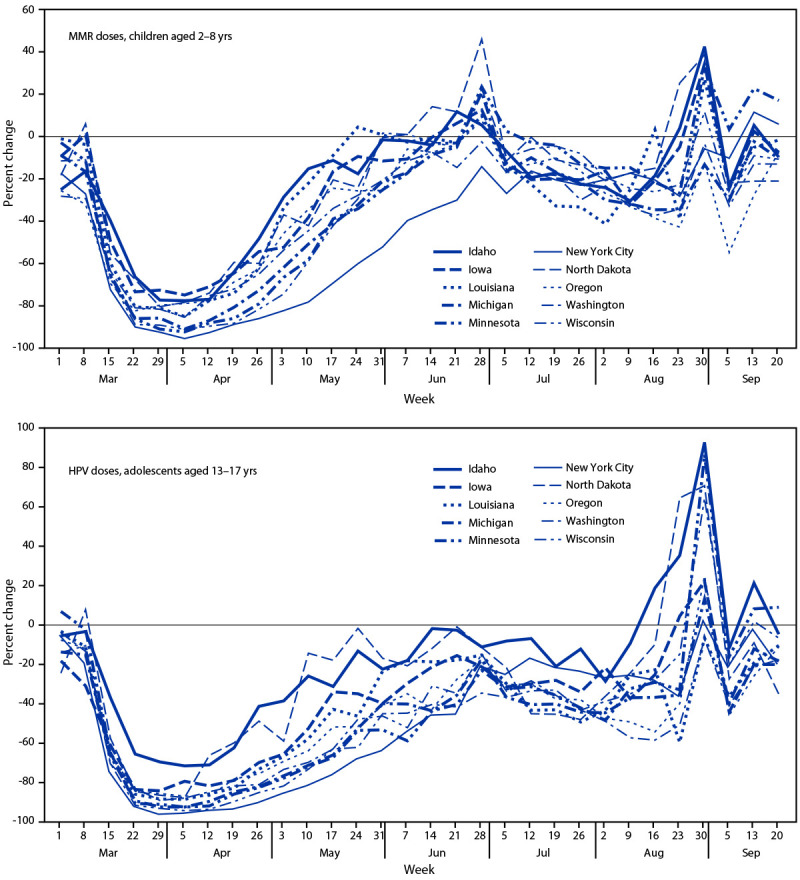
- During March–May 2020, median weekly administered doses declined across all examined vaccines and age groups: DTaP −15.7% for children aged <24 months and −60.3% for children aged 2–6 years; MMR −22.4% for children aged 12–23 months and −63.1% for children aged 2–8 years; HPV −63.6% for children aged 9–12 years and −71.3% for adolescents aged 13–17 years; Tdap −66.4% for children aged 9–12 years and −61.4% for adolescents aged 13–17 years.
- During June–September 2020, declines persisted but were smaller: DTaP −9.1% and −6.7%; MMR −8.8% and −11.3%; HPV −12.2% and −28.1%; Tdap −21.3% and −30.0% for the corresponding age groups.
- No jurisdiction demonstrated a sustained or prolonged increase in weekly doses above prepandemic levels, which the authors state would have been necessary to catch up children and adolescents who missed routine vaccinations.
- The authors suggest possible explanations including fear of contracting COVID-19 in health care or community settings, differences in stay-at-home order duration or enforcement, and reduced enforcement of school immunization requirements during virtual learning.
Methods
- Retrospective analysis of vaccine administration data from 10 U.S. jurisdictions with high-performing immunization information systems: Idaho, Iowa, Louisiana, Michigan, Minnesota, New York City, North Dakota, Oregon, Washington, and Wisconsin.
- Weekly vaccine doses administered during March–September 2020 were compared with the average number administered during the same periods in 2018 and 2019; periods examined were March–May 2020 and June–September 2020.
- For each jurisdiction, median and range of weekly percent change were calculated, then an overall median of the median weekly percentage was calculated across all 10 jurisdictions. Vaccines analyzed included DTaP, MMR, HPV, and Tdap across specified pediatric and adolescent age groups.
Limitations
- Stated: vaccination data from only 10 U.S. jurisdictions were analyzed, so findings might not be generalizable to the entire United States.
- Stated: immunization information systems were the only type of system analyzed, and vaccination information was not corroborated with other surveillance programs such as National Immunization Survey-Child or National Immunization Survey-Teen.
- Stated: the specific reasons for the decrease in March–May 2020 or the rebound in June–September 2020 could not be determined; the text also makes evident that this is an observational comparison of aggregate IIS data, so causal attribution is not possible.
Model-written summary. Check it against the paper before relying on it.
Integrity signals
Registry
Cites
Statistics
Figures
Verification
Claims the paper makes
6 Valid · 0 Not valid · 0 Not checked · 27 Own results and interpretations
Every source the paper cites for this claim was checked and supports it.
In the paper
“After the March 2020 declaration of the COVID-19 pandemic in the United States, an analysis of provider ordering data from the federally funded Vaccines for Children program found a substantial decrease in routine pediatric vaccine ordering (1), and data from New York City and Michigan indicated sharp declines in routine childhood vaccine administration in these areas (2,3).”
What the sources say
- Supportedcites [2] Langdon-Embry M, Papadouka V, Cheng I,. Notes from the field: rebound in routine childhood vaccine administration following decline during the COVID-19 Pandemic—New York City, March 1–June 27, 2020. MMWR Morb Mortal Wkly Rep 2020; 69: 999- 1001. 10.15585/mmwr.mm6930a3 32734936 PMC7392396 source
The New York City results report sharp declines in routine childhood vaccine administration, including decreases of 62% for children under 24 months and 96% for those aged 2–18 years during April 5–11, 2020. This source supports the New York City portion of the jointly cited claim; the Michigan portion is not attributed to this source alone. Page numbers are not supplied in our copy. (LLM, conf=0.94)
- Supportedcites [3] Bramer CA, Kimmins LM, Swanson R, Decline in child vaccination coverage during the COVID-19 pandemic—Michigan Care Improvement Registry, May 2016–May 2020. MMWR Morb Mortal Wkly Rep 2020; 69: 630– 1. 10.15585/mmwr.mm6920e1 32437340 source
The Michigan registry analysis reports declines in routine childhood vaccine administration: noninfluenza doses fell 21.5% among children aged ≤18 years and 15.5% among children aged ≤24 months. This source supports the Michigan portion of the jointly cited claim; the New York City portion is attributed to the other citation. The supplied passage has no page number. (LLM, conf=0.93)
hedgedstates an association- Asserted: passes — The authors put it forward as true.
- Checkable: passes — It can be checked against evidence.
- Load-bearing: unclear — It is unclear whether the paper’s conclusions depend on it.
- Based: passes — The paper gives a reason why it holds.
- Supported
Every source the paper cites for this claim was checked and supports it.
In the paper
“After the March 2020 declaration of the COVID-19 pandemic in the United States, an analysis of provider ordering data from the federally funded Vaccines for Children program found a substantial decrease in routine pediatric vaccine ordering (1), and data from New York City and Michigan indicated sharp declines in routine childhood vaccine administration in these areas (2,3).”
What the sources say
- Supportedcites [1] Santoli JM, Lindley MC, DeSilva MB, Effects of the COVID-19 pandemic on routine pediatric vaccine ordering and administration—United States, 2020. MMWR Morb Mortal Wkly Rep 2020; 69: 591– 3. 10.15585/mmwr.mm6919e2 32407298 source
The methods (p. 1) identify Vaccines for Children provider-order data as a source and describe the program as providing federally purchased vaccines. The findings (p. 1) report a notable decrease in orders for routine childhood vaccines after the national emergency declaration, and the discussion calls the reduction substantial. (LLM, conf=0.94)
plainstates a cause- Asserted: passes — The authors put it forward as true.
- Checkable: passes — It can be checked against evidence.
- Load-bearing: unclear — It is unclear whether the paper’s conclusions depend on it.
- Based: passes — The paper gives a reason why it holds.
- Supported
Every source the paper cites for this claim was checked and supports it.
In the paper
“During 2018–2019, a measles outbreak occurred in Rockland County, New York and nearby counties.”
§ Impact of the COVID-19 Pandemic on Administration of Selected Routine Childhood and Adolescent Vaccinations — 10 U.S. Jurisdictions, March–September 2020 > Discussion
What the sources say
- Supportedcites [9] McDonald R, Ruppert PS, Souto M, Notes from the field: measles outbreaks from imported cases in orthodox Jewish communities—New York and New Jersey, 2018–2019. MMWR Morb Mortal Wkly Rep 2019; 68: 444– 5. 10.15585/mmwr.mm6819a4 31095533 PMC6522080 source
The opening passage reports measles cases in New York from October 2018 through April 2019. The New York section specifies that 206 cases were in Rockland County and 36 were in nearby counties. (LLM, conf=0.94)
plain- Asserted: passes — The authors put it forward as true.
- Checkable: passes — It can be checked against evidence.
- Load-bearing: unclear — It is unclear whether the paper’s conclusions depend on it.
- Based: passes — The paper gives a reason why it holds.
- Supported
The cited sources support only part of this claim — read each source’s verdict below.
In the paper
“During March–May 2020, eight of the 10 jurisdictions implemented some form of stay-at-home order (no orders were issued in Iowa and North Dakota) (Supplementary Table, https://stacks.cdc.gov/view/cdc/106855) (7).”
What the sources say
- Partly supportedcites [7] Moreland A, Herlihy C, Tynan MA, Timing of state and territorial COVID-19 stay-at-home orders and changes in population movement—United States, March 1–May 31, 2020. MMWR Morb Mortal Wkly Rep 2020; 69: 1198– 203. 10.15585/mmwr.mm6935a2 32881851 PMC7470456 sourceExperimental — accuracy not yet measured
Split into 2 atoms — 0 confirmed, 2 partially supported, 0 disputed, 0 misattributed, 0 unverifiable. Expand the claim to see per-atom verdicts.
plain- Asserted: passes — The authors put it forward as true.
- Checkable: passes — It can be checked against evidence.
- Load-bearing: passes — The paper’s conclusions depend on it.
- Based: passes — The paper gives a reason why it holds.
- Partly supported
The cited sources support only part of this claim — read each source’s verdict below.
In the paper
“This decline, which is consistent with other data sources indicating a similar decrease in routine pediatric vaccine ordering, corresponded to the enactment of stay-at-home orders in many jurisdictions (1).”
§ Impact of the COVID-19 Pandemic on Administration of Selected Routine Childhood and Adolescent Vaccinations — 10 U.S. Jurisdictions, March–September 2020 > Discussion
What the sources say
- Partly supportedcites [1] Santoli JM, Lindley MC, DeSilva MB, Effects of the COVID-19 pandemic on routine pediatric vaccine ordering and administration—United States, 2020. MMWR Morb Mortal Wkly Rep 2020; 69: 591– 3. 10.15585/mmwr.mm6919e2 32407298 sourceExperimental — accuracy not yet measured
The report (p. 1) documents a decline in measles-containing vaccine administrations beginning the week of March 16, 2020, and notes that many states and localities issued stay-at-home orders. It does not specifically tie the decline to the enactment of those orders; it dates the decline in vaccine orders relative to the national emergency declaration. Its administration data end April 19, so they do not establish a decline through May. (LLM, conf=0.84)
plainstates an association- Asserted: passes — The authors put it forward as true.
- Checkable: passes — It can be checked against evidence.
- Load-bearing: unclear — It is unclear whether the paper’s conclusions depend on it.
- Based: passes — The paper gives a reason why it holds.
- Partly supported
23 more claims
Create a free account to see all 33 claims and every source verdict.
- It may state two separate claims as one. 4
- Probably not a substantial claim. 3
Self-check
Percentages, sums and reported differences re-computed from the paper’s own numbers.
Each contradiction between two passages listed here was confirmed by an independent check.
Rated minor: it would not touch a result — a value no result rests on, a p-value that stays on the same side of the significance level, or a conflict that is clerical, resolved elsewhere in the paper, or outside its own findings.
In the paper
§ Impact of the COVID-19 Pandemic on Administration of Selected Routine Childhood and Adolescent Vaccinations — 10 U.S. Jurisdictions, March–September 2020
“and tetanus, diphtheria and acellular pertussis (Tdap) for adolescents aged 13–17 years.”
§ Impact of the COVID-19 Pandemic on Administration of Selected Routine Childhood and Adolescent Vaccinations — 10 U.S. Jurisdictions, March–September 2020
“Doses of Tdap administered during this period in 2020 decreased a median of 66.4% among children aged 9–12 years and 61.4% among adolescents aged 13–17 years compared with 2018 and 2019.”
Citations
Cites
Delay or avoidance of medical care because of COVID-19–related concerns—United States, June 2020.
Czeisler, M. É., Marynak, K., Clarke, K. E. N., Salah, Z., Shakya, I., Thierry, J. M., Ali, N., McMillan, H., Wiley, J. F., Weaver, M. D., et al. (2020) · MMWR. Morbidity and Mortality Weekly Report · doi:10.15585/mmwr.mm6936a4 · Cited by 1,516
Santoli, J. M., Lindley, M. C., DeSilva, M. B., Kharbanda, E. O., Daley, M. F., Galloway, L., Gee, J., Glover, M., Herring, B., Kang, Y., et al. (2020) · MMWR. Morbidity and Mortality Weekly Report · doi:10.15585/mmwr.mm6919e2 · Cited by 701 · cited 2×
“This decline, which is consistent with other data sources indicating a similar decrease in routine pediatric vaccine ordering, corresponded to the enactment of stay-at-home orders in many jurisdictions (1).”
BackgroundResultMoreland, A., Herlihy, C., Tynan, M. A., Sunshine, G., McCord, R. F., Hilton, C., Poovey, J., Werner, A. K., Jones, C. D., Fulmer, E. B., et al. (2020) · MMWR. Morbidity and Mortality Weekly Report · doi:10.15585/mmwr.mm6935a2 · Cited by 614
Bramer, C. A., Kimmins, L. M., Swanson, R., Kuo, J., Vranesich, P., Jacques-Carroll, L. A., & Shen, A. K. (2020) · MMWR. Morbidity and Mortality Weekly Report · doi:10.15585/mmwr.mm6920e1 · Cited by 297
Self-citationEpidemiology of transmissible diseases after elimination.
De Serres, G., Gay, N. J., & Farrington, C. P. (2000) · American Journal of Epidemiology · doi:10.1093/oxfordjournals.aje.a010145 · Cited by 198 · cited 1×
“Measles vaccination coverage in schools in the affected area was only 77%, far below the 93%–95% coverage needed to sustain measles herd immunity (9,10).”
BackgroundMcDonald, R., Ruppert, P. S., Souto, M., Johns, D. E., McKay, K., Bessette, N., McNulty, L. X., Crawford, J. E., Bryant, P., Mosquera, M. C., et al. (2019) · MMWR Morbidity and Mortality Weekly Report · doi:10.15585/mmwr.mm6819a4 · Cited by 60
Langdon-Embry, M., Papadouka, V., Cheng, I., Almashhadani, M., Ternier, A., & Zucker, J. R. (2020) · MMWR Morbidity and Mortality Weekly Report · doi:10.15585/mmwr.mm6930a3 · Cited by 53
Progress in childhood vaccination data in immunization information systems—United States, 2013–2016.
Murthy, N., Rodgers, L., Pabst, L., Fiebelkorn, A. P., & Ng, T. (2017) · MMWR Morbidity and Mortality Weekly Report · doi:10.15585/mmwr.mm6643a4 · Cited by 48
Cited by
Items 101–200 of 200
Cataldi, J. R., Suresh, K., Brewer, S. E., et al. (2024) · Vaccine · doi:10.1016/j.vaccine.2024.01.042 · Cited by 5
Agopian, A., Sedrakyan, T., Muradyan, D., & Sahakyan, G. (2025) · BMC Public Health · doi:10.1186/s12889-025-24912-5 · Cited by 5
“This finding aligns with the literature, which indicates that older children experienced a more significant drop in vaccination recovery than younger children, a trend that has been observed globally [5, 6, 21, 28].”
Hayrumyan, V., Abrahamyan, A., Harutyunyan, A., Libaridian, L., & Sahakyan, S. (2024) · BMC Family Practice · doi:10.1186/s12875-024-02377-6 · Cited by 5
“For example, a study conducted in the United States showed that there was a lag in catching up with the delayed routine vaccinations that could result in an increased number of vaccine-preventable diseases, posing a serious public health concern [49].”
BackgroundLin, M. E., Ayo‐Ajibola, O., Castellanos, C. X., West, J. D., Luu, N. N., & Kokot, N. (2024) · OTO Open · doi:10.1002/oto2.70052 · Cited by 6
Parental Perceptions Related to Co-Administration of Adolescent COVID-19 and Routine Vaccines
Gidengil, C. A., Parker, A. M., Gedlinske, A. M., Askelson, N. M., Petersen, C. A., Lindley, M. C., Woodworth, K. R., & Scherer, A. M. (2022) · Journal of Adolescent Health · doi:10.1016/j.jadohealth.2022.11.242 · Cited by 5
“In the following months there was a rebound in vaccination rates but not to the extent required to compensate for the prior drop [10].”
BackgroundEjezie, C. L., Shegog, R., Durand, C. P., Cuccaro, P. M., & Savas, L. S. (2023) · Journal of Adolescent Health · doi:10.1016/j.jadohealth.2023.08.007 · Cited by 4
Mirieri, H., Nasimiyu, C., Dawa, J., Mburu, C. M., Jalango, R. E., Kamau, P., Igboh, L. S., Ebama, M., Wainaina, D., Gitonga, J., et al. (2023) · Vaccine · doi:10.1016/j.vaccine.2023.09.023 · Cited by 4
Practice Challenges for Federally Qualified Health Centers During the COVID-19 Pandemic
Walsh, J. A., & Gearhart, A. T. (2021) · Pediatric Annals · doi:10.3928/19382359-20211117-02 · Cited by 4
Huoi, C., Vargas-Zambrano, J. C., Macina, D., et al. (2022) · Expert Review of Vaccines · doi:10.1080/14760584.2022.2084076 · Cited by 4
Measuring the impact of COVID-19
Burns, K. F., & Horney, J. A. (2022) · Elsevier eBooks · doi:10.1016/b978-0-323-98810-0.00010-7 · Cited by 4
Examining Routine Pediatric Vaccination Availability in Community Pharmacies in Washington State
McKeirnan, K. C., Motzner, M. S., & Kherghehpoush, S. (2022) · Pharmacy · doi:10.3390/pharmacy10060156 · Cited by 4
Are all underimmunized measles clusters equally critical?
Moon, S. A., Marathe, A., & Vullikanti, A. K. S. (2023) · Royal Society Open Science · doi:10.1098/rsos.230873 · Cited by 4
A Systematic Review of Interventions to promote HPV Vaccination GloballyPreprint
Escoffery, C., Petagna, C. N., Agnone, C., et al. (2022) · Research Square · doi:10.21203/rs.3.rs-2094231/v1 · Cited by 4
Has COVID-19 Affected DTP3 Vaccination in the Americas?Preprint
Aguinaga-Ontoso, I., Guillén-Aguinaga, S., Guillén-Aguinaga, L., et al. (2023) · Preprints.org · doi:10.20944/preprints202312.0671.v2 · Cited by 4
Wu, Z., Zhang, J., Wei, J., Huang, C., Xu, W., Wu, J., & Jiang, M. (2025) · Frontiers in Public Health · doi:10.3389/fpubh.2025.1654535 · Cited by 10
Marshall, G. S., Petigara, T., Liu, Z., Wolfson, L. J., Johnson, D. R., Goveia, M. G., & Chen, Y.-T. (2022) · The Pediatric Infectious Disease Journal · doi:10.1097/inf.0000000000003609 · Cited by 3
“A hexavalent vaccine (Vaxelis, DTaPIPV-Hib-HepB; Sanofi, Toronto, Ontario Canada for MSP Vaccine Company, Swiftwater, PA) was approved in the United States with a recommended schedule of 2, 4 and 6 months.(22,23)”
BackgroundMohanty, N. (2022) · Telehealth and Medicine Today · doi:10.30953/thmt.v7.375 · Cited by 3
Family-Centered Care and Delayed or Missed Pediatric Preventive Care due to the COVID-19 Pandemic
Tabet, M., Kirby, R. S., Boyd, R. V., & Xaverius, P. K. (2024) · Academic Pediatrics · doi:10.1016/j.acap.2024.02.014 · Cited by 3
Trends in Vaccination Coverage among Children Aged 2–6 Years in Tennessee Counties, 2017–2023
Alali, W. Q., Huang, Q., Goodin, K., & Gonzalez-Lozano, A. (2024) · Vaccines · doi:10.3390/vaccines12091048 · Cited by 3
“Research by Patel Murthy et al. [29] highlighted that these communities faced higher rates of missed vaccination appointments due to fear of COVID-19 exposure, limited transportation options, and healthcare facility closures in their neighborhoods.”
BackgroundPreventable Disease, the Case of Colorado: School District Demographics and Childhood Immunizations
Nicolich, K., Gerken, J., Mallahan, B., Ross, D. W., & Zapata, I. (2022) · Vaccines · doi:10.3390/vaccines10101579 · Cited by 3
“Due to various socioeconomic and political factors, as well as the COVID-19 pandemic, childhood vaccination rates across the United States decreased throughout 2020–2021 [2,3].”
BackgroundKirtland, K. A., Raghunathan, T. E., Murthy, B. P., Li, J., White, K., Gibbs‐Scharf, L., Harris, L., & Zell, E. R. (2022) · Vaccine · doi:10.1016/j.vaccine.2022.10.070 · Cited by 4
Self-citationPfingstag, C. S. (2023) · Journal of Midwifery & Women s Health · doi:10.1111/jmwh.13568 · Cited by 3
A modelled analysis of the impact of COVID-19-related disruptions to HPV vaccination
Velentzis, L. S., Smith, M. A., Killen, J., Brotherton, J. M. L., Guy, R., & Canfell, K. (2023) · eLife · doi:10.7554/elife.85720 · Cited by 4
“study found recovery after a marked decline in HPV dose administration in March to May 2020 (median 64%162 71%) was not fully achieved during June-September 2020.(10) 163 164 In November 2020 WHO released a global strategy calling for all countries to take action to achieve the 165 elimination of cervical cancer as a…”
BackgroundParents’ News Consumption and COVID Sources in Their Decisions to Vaccinate
Perreault, M. F., & Foss, K. A. (2023) · Journal of Applied Research on Children Informing Policy for Children at Risk · doi:10.58464/2155-5834.1520 · Cited by 2
Has COVID-19 Affected DTP3 Vaccination in the Americas?
Aguinaga-Ontoso, I., Guillén-Aguinaga, S., Guillén-Aguinaga, L., Alas-Brun, R., Aguinaga-Ontoso, E., Rayón-Valpuesta, E., & Guillén‐Grima, F. (2024) · Vaccines · doi:10.3390/vaccines12030238 · Cited by 7
May, S. G., Roach, M., Maravić, M. C., Mitrovich, R., Wilson, R., Prood, N., & Eiden, A. L. (2024) · BMJ Public Health · doi:10.1136/bmjph-2023-000381 · Cited by 6
Rosen, K. L., Krelle, H., King, W. C., Klapheke, N., Pina, P., Anderman, J., Chung, A., Mendoza, F., Bagheri, A., Stadelman, J., et al. (2025) · BMJ Quality & Safety · doi:10.1136/bmjqs-2024-017893 · Cited by 6
“When sample text messages were shown (online supplemental appendix B), parents were split between preferring texts 2, 3 and 4.”
Yuliyanti, S., Rifqi, F. M., Prasetyo, R. L., et al. (2021) · Open Access Macedonian Journal of Medical Sciences · doi:10.3889/oamjms.2021.7336 · Cited by 3
“Although doses administered increased during June-September 2020, it can not catch up the vaccination coverage [17].”
BackgroundMaugeri, A., Barchitta, M., Zaffar, S. M., & Agodi, A. (2025) · International Journal of Environmental Research and Public Health · doi:10.3390/ijerph22060941 · Cited by 2
Epidemiology and Control: From Principles to Pandemics
Kaslow, R. A., & Bell, D. M. (2022) · Springer eBooks · doi:10.1007/978-1-4939-9544-8_1-1 · Cited by 4
Vázquez‐Otero, C., & Lockhart, E. A. (2022) · Preventive Medicine Reports · doi:10.1016/j.pmedr.2022.102025 · Cited by 2
Rames, J. D., Frisco, N. A., Jiang, R., Shah, K. P., Kahmke, R. R., Puscas, L., Osazuwa‐Peters, N., & Rocke, D. J. (2023) · Otolaryngology · doi:10.1002/ohn.242 · Cited by 2
Acute Otitis Media in Children
Bessen, S. Y., Rettig, E. M., & Tunkel, D. E. (2024) · Springer eBooks · doi:10.1007/978-3-031-68449-4_5 · Cited by 2
Mustafa, Z., Memeti, S., Karadzovski, Z., et al. (2022) · MEDIS – International Journal of Medical Sciences and Research · doi:10.35120/medisij010249m · Cited by 2
Evaluation of student-pharmacists’ experiences in COVID-19 vaccination clinics
Thandar, M., Prescott, G. M., Maerten‐Rivera, J., Prescott, W. A., Fiebelkorn, K. D., & Fusco, N. M. (2023) · Pharmacy Education · doi:10.46542/pe.2023.231.208215 · Cited by 2
School immunization coverage during the COVID-19 pandemic: A retrospective cohort studyPreprint
Sell, H., Paudel, Y. R., Voaklander, D. C., et al. (2022) · medRxiv · doi:10.1101/2022.05.04.22274665 · Cited by 2
“This decline in coverage seen during the pandemic is consistent with previous literature on other routine immunizations internationally, including infant,(3,15,16) preschool,(3,15) and adolescent.(2,3,17,18)”
ResultAre all underimmunized measles clusters equally critical?Preprint
Moon, S. A., Marathe, A., & Vullikanti, A. K. S. (2023) · medRxiv · doi:10.1101/2023.04.11.23288263 · Cited by 2
Has COVID-19 Affected DTP3 Vaccination in the Americas?Preprint
Aguinaga-Ontoso, I., Guillén-Aguinaga, S., Guillén-Aguinaga, L., et al. (2023) · Preprints.org · doi:10.20944/preprints202312.0671.v1 · Cited by 2
Children Lagging with COVID-19 Vaccination
Noor, A., Bäcker, M., & Krilov, L. R. (2022) · Pediatric Annals · doi:10.3928/19382359-20220314-06 · Cited by 1
Skoy, E. T., Dybsand, L. L., Hall, K. J., & Carson, P. J. (2022) · Education in the Health Professions · doi:10.4103/ehp.ehp_30_21 · Cited by 2
Berset, A. E., Burkhardt, M. C., Xu, Y. Y., Mescher, A., & Brinkman, W. B. (2023) · Academic Pediatrics · doi:10.1016/j.acap.2023.11.017 · Cited by 1
Diphtheritic Polyneuropathy: A Rare Complication that Needs to be Acknowledged
Jaya, F. O., Lee, P., & Ritarwan, K. (2024) · International Journal of Biomedical Science and Travel Medicine · doi:10.22225/ijbstm.1.1.2024.12-18 · Cited by 1
Hofstetter, A. M., Klein, E. J., Strelitz, B., Selvarangan, R., Schuster, J. E., Boom, J. A., Sahni, L. C., Halasa, N., Stewart, L. S., Staat, M. A., et al. (2024) · Vaccine · doi:10.1016/j.vaccine.2024.126455 · Cited by 1
Saxena, K., Wähner, C., Luzak, A., Reuter, T., Morais, E., & Chen, Y.-T. (2024) · European Journal of Pediatrics · doi:10.1007/s00431-024-05910-y · Cited by 1
Hesitancy towards routine childhood vaccinations before and after the COVID-19 pandemic in Arkansas
Cima, M. J., Joshua, C., Zohoori, N., Porter, A., Slagle, D. R., & Dillaha, J. A. (2025) · Vaccine · doi:10.1016/j.vaccine.2025.127834 · Cited by 2
A national survey on HPV vaccination status among 42,800 female physicians and nurses in China, 2021
Pei, C., Zeng, D., He, C., Sun, W., Ma, J., & Liu, Y. (2025) · Vaccine · doi:10.1016/j.vaccine.2025.128025 · Cited by 1
Naqvi, O. H., Wendelboe, A. M., Burnsed, L., et al. (2022) · The Journal of School Nursing · doi:10.1177/10598405221130701 · Cited by 1
“However, maintaining high vaccination coverage is critically important to maintain herd immunity against vaccine-preventable diseases (Bramer et al., 2020; Patel Murthy et al., 2021; Santoli et al., 2020, 2021; World Health Organization, 2012).”
Deerin, J. F., Gyekye-Kusi, A. A., Doss-Walker, J., Bablak, H., & Kim, D. S. (2022) · Journal of Public Health Policy · doi:10.1057/s41271-022-00373-7 · Cited by 1
Pandemia de COVID-19 y abandono de la vacunación en niños: mapas de heterogeneidad espacial
Rodrigues, R. N., do Nascimento, G. L. M., Arroyo, L. H., Arcêncio, R. A., de Oliveira, V. C., & Guimarães, E. A. D. A. (2022) · Revista Latino-Americana de Enfermagem · doi:10.1590/1518-8345.6132.3643 · Cited by 1
Stewart-Lynch, A. L., Lombardo, S., Ceriani, D., & Mastrangelo, S. (2023) · Journal of Interprofessional Education & Practice · doi:10.1016/j.xjep.2023.100606 · Cited by 2
García-Balaguera, C., Osorio, M., Echavarría, M., & Echavarría, M. P. (2023) · Medical Research Archives · doi:10.18103/mra.v11i4.3639 · Cited by 1
COVID-19 pandemic impact on primary immunization uptake
Alhusayn, K. O., Alsulaiman, T. A., Abdulkarim, A., Sultana, H., Jnaid, H., Alendijani, Y., & Alkhenizan, A. H. (2023) · Journal of Family Medicine and Primary Care · doi:10.4103/jfmpc.jfmpc_66_23 · Cited by 1
“[7] In the US, several states witnessed a sharp decline in vaccine ordering and administration.[11,12] In Karachi, Pakistan, the mean number of daily immunization visits decreased by 52.”
BackgroundAttitudes toward COVID-19 and Other Vaccines: Comparing Parents to Other Adults, September 2022
Dudley, M. Z., Schuh, H. B., Goryn, M., Shaw, J., & Salmon, D. A. (2023) · Vaccines · doi:10.3390/vaccines11121735 · Cited by 1
Jiter, N., Dykstra, A., Loper, O. R., Kuramoto, S., & Schultz, J. (2024) · Journal of Community Health · doi:10.1007/s10900-024-01355-4 · Cited by 1
Self-citationLong-term Implications and Barriers to Use of the Hepatitis B Vaccine at Birth
Hawkins, S. S. (2024) · Journal of Obstetric, Gynecologic & Neonatal Nursing · doi:10.1016/j.jogn.2024.09.008 · Cited by 1
Impact on COVID-19 pandemic on children immunization coverage in Bulgaria
Nikolova, V. (2025) · Biotechnology & Biotechnological Equipment · doi:10.1080/13102818.2025.2515108 · Cited by 1
“Numerous researchers have studied the impact of the COVID-19 pandemic on childhood immunization rates [15–22].”
Vaccines and Variants, Valiance and Variance.
Kemble, S. K., Edward, D., Irvin, L., & Pirkle, C. M. (2021) · Europe PMC (PubMed Central) · Cited by 2
Attitudes and Beliefs around the Value of Vaccination in the United States
Childers-Strawbridge, S., Eiden, A. L., Nyaku, M. K., & Bhatti, A. A. (2022) · Vaccines · doi:10.3390/vaccines10091470 · Cited by 3
Motivação e desempenho no contexto de uma organização militar: um estudo de caso
Júnior, C., & Carlos, L. G. D. C. (2013)
Is 2045 Optimistic?—Concerns Regarding Rising Vaccine Hesitancy—Reply
Zhang, Y., Fakhry, C., & DʼSouza, G. (2022) · JAMA Oncology · doi:10.1001/jamaoncol.2021.7166
R, S. H., Bant, D. D., & Subramanian, A. A. (2022) · Indian Journal of Public Health Research & Development · doi:10.37506/ijphrd.v13i2.17924
Vaccines Are Profoundly Effective, and We Can’t Stop There
Warren, M. D., & Hanna, M. F. (2022) · PEDIATRICS · doi:10.1542/peds.2022-057831
(2022) · The Journal for Nurse Practitioners · doi:10.1016/j.nurpra.2022.06.004
Ghaznavi, C., Eguchi, A., Lwin, K. S., et al. (2022) · SSRN Electronic Journal · doi:10.2139/ssrn.4198083
Scott, M. W., Metcalf, C. M., Bhadury, S., Feygin, Y. B., & Neal, A. E. (2022) · Cardiology in the Young · doi:10.1017/s1047951122003535
The impact of the COVID-19 pandemic on youth and families
Mazzeo, S. E., Corona, R., Everhart, R. S., & Jones, H. A. (2022) · Elsevier eBooks · doi:10.1016/b978-0-12-818872-9.00133-3
A modelled analysis of the impact of COVID-19-related disruptions to HPV vaccination analysisPreprint
Velentzis, L. S., Smith, M. A., Killen, J., et al. (2023) · medRxiv · doi:10.1101/2023.03.07.23286911
“study found recovery after a marked decline in HPV dose administration in March to May 2020 (median 64%162 71%) was not fully achieved during June-September 2020.(10) 163 164 In November 2020 WHO released a global strategy calling for all countries to take action to achieve the 165 elimination of cervical cancer as a…”
BackgroundEpidemiology and Control: From Principles to Pandemics
Kaslow, R. A., & Bell, D. M. (2023) · Springer eBooks · doi:10.1007/978-1-4939-9544-8_1-2
COVID-19: preparedness for this pandemic and beyond
Madad, S., Dhagat, P., & Popescu, S. V. (2023) · Elsevier eBooks · doi:10.1016/b978-0-323-91812-1.00001-9
Update in Pediatric Infectious Disease
Daniels, D., & Shaw, J. (2023) · Springer eBooks · doi:10.1007/978-3-031-41542-5_19
Savas, L. S., Shegog, R., Frost, E. L., Healy, C. M., Mantey, D. S., Coan, S. P., Shay, L. A., Teague, T. K., Ferreris, J. J., Preston, S. M., et al. (2024) · Vaccines · doi:10.3390/vaccines12050510 · Cited by 4
Boogaard, C. O., Harper, C., Weiner, E., Weissman, M., Lindquist, T., & Fox, E. R. (2024) · Archives of Community and Family Medicine · doi:10.22259/2638-4787.0701004
Nguyen, K. H., Vasudevan, L., & Bednarczyk, R. A. (2024) · Elsevier eBooks · doi:10.1016/b978-0-323-95648-2.00003-4
Hoffman, J. L., Lukomski, A., Lally, S., et al. (2024) · Pediatric Nursing · doi:10.62116/pnj.2024.50.4.185
Impact of a human papillomavirus vaccination clinical program in a commercially insured population
Pelaccio, K., Mo, M., Olmsted, A., & DeJager, K. (2024) · Journal of Managed Care & Specialty Pharmacy · doi:10.18553/jmcp.2024.30.12.1405
Post-COVID-19 pandemic immunization coverage in Algerian children: A cross-sectional study
Ghazy, R. M., Abadi, A. M., Salah, A., Ismail, E. A. A., Youssef, N. F. A., Saleeb, M., Abonazel, M. R., Gebreal, A., Elrewany, E. M. A., Moustafa, N. S., et al. (2025) · Medicine · doi:10.1097/md.0000000000041494 · Cited by 2
“[14] Moreover, approximately 22% of infants in the World Health Organization's European Region experienced interruptions in their vaccination schedules.”
Desai, M., Sharma, S. V., Domgue, J. F., et al. (2025) · doi:10.2196/preprints.77778
A National Survey on Hpv Vaccination Status Among 42,800 Female Physicians and Nurses in China, 2021Preprint
Pei, C., Zeng, D., Liu, Y., et al. (2025) · SSRN Electronic Journal · doi:10.2139/ssrn.5345765
Trends and disparities in HPV vaccination among U.S. adolescents, 2018–2023
Agboli, V. I., Usman, I. A., Alabi, A., & Amusa, T. (2025) · Open Health · doi:10.1515/ohe-2025-0073
Childhood Immunization Gaps in New York State After COVID-19: A Focus on Regional Disparities
Rustemi, K., & Soti, V. (2025) · Cureus · doi:10.7759/cureus.91850
“These findings suggest that urban areas with high population density and system strain may be particularly vulnerable to drops in routine immunization during public health crises [27].”
Regmi, N. P., Ulrich, A. K., Huang, Z., et al. (2025) · BMC Public Health · doi:10.1186/s12889-025-24434-0
“May 2020, due to disruptions caused by the COVID-19 pandemic, vaccine doses administered to children and adolescents substantially decreased across 10 US jurisdictions when compared with the same period in 2018 and 2019 [25] suggesting an urgent need to better understand current vaccination trends.”
Sun, W., Luo, Z., Li, S., Zhu, H., Ma, Y., & Wang, J. (2025) · Frontiers in Pediatrics · doi:10.3389/fped.2025.1648443
A ascensão letal da anticiência: advertência de um cientista
Hotez, P. J. (2025) · Editora FIOCRUZ eBooks · doi:10.7476/9786557083017
Hotez, P. J. (2025) · Editora FIOCRUZ eBooks · doi:10.7476/9786557083017.0001
Tempos Difíceis para Ser Cientista
Hotez, P. J. (2025) · Editora FIOCRUZ eBooks · doi:10.7476/9786557083017.0006
A Mais Árdua Comunicação Pública da Ciência de Todos os Tempos
Hotez, P. J. (2025) · Editora FIOCRUZ eBooks · doi:10.7476/9786557083017.0008
Um Ecossistema Político Anticiência
Hotez, P. J. (2025) · Editora FIOCRUZ eBooks · doi:10.7476/9786557083017.0005
A Propaganda sobre Liberdade de Escolha em Saúde nos Estados Unidos
Hotez, P. J. (2025) · Editora FIOCRUZ eBooks · doi:10.7476/9786557083017.0003
Um Exército de Patriotas se Volta contra os Cientistas
Hotez, P. J. (2025) · Editora FIOCRUZ eBooks · doi:10.7476/9786557083017.0002
O Manual de Estratégias Autoritárias
Hotez, P. J. (2025) · Editora FIOCRUZ eBooks · doi:10.7476/9786557083017.0007
Centro Meridional da Lei da Pobreza para Cientistas
Hotez, P. J. (2025) · Editora FIOCRUZ eBooks · doi:10.7476/9786557083017.0009
Hotez, P. J. (2025) · Editora FIOCRUZ eBooks · doi:10.7476/9786557083017.0004
Ishimori, S., Nishimura, A., Tamura, A., et al. (2025) · Journal of Infection and Chemotherapy · doi:10.1016/j.jiac.2025.102875
Changes in HPV Vaccine Uptake after the COVID Vaccine
Harlow, S., Anderson, E. C., & Cass, I. A. (2026) · Journal of Pediatric and Adolescent Gynecology · doi:10.1016/j.jpag.2026.01.045
Fighting the Infodemic: Global Policy Strategies for Digital Platform Governance and Health Trust
Tohit, N. F. M., & Haque, M. (2026) · Advances in Human Biology · doi:10.4103/aihb.aihb_270_25 · Cited by 1
Meadows, M. E., Wiltse, A., Carias, C., & Turman, J. E. (2026) · BMC Pediatrics · doi:10.1186/s12887-026-06696-8
Desai, M., Sharma, S. V., Domgue, J. F., Yu, R. K., Chan, W., Chido‐Amajuoyi, O. G., Darkoh, C., & Shete, S. S. (2026) · JMIR mhealth and uhealth · doi:10.2196/77778
Bednarczyk, R. A. (2026) · Expert Review of Vaccines · doi:10.1080/14760584.2026.2653756
COVID-19 and Influenza Vaccine Acceptance and Hesitancy Among Caregivers of Children With Cancer
Murray, A., Shibale, P., Wilkes, J. J., Englund, J. A., Bender, M. A., Harris, J. R., & Hofstetter, A. M. (2026) · Journal of Pediatric Hematology/Oncology · doi:10.1097/mph.0000000000003199 · Cited by 1
Global Immunization: Progress, Challenges, and Future Directions in Vaccine Access and Equity
Safi, N., & Ehiri, J. E. (2026) · Springer eBooks · doi:10.1007/978-1-0716-5436-1_3
Metadata
- Authors
- Patel Murthy, B., Zell, E., Kirtland, K., Jones-Jack, N., Harris, L., Sprague, C., Schultz, J., Le, Q., Bramer, C. A., Kuramoto, S., Cheng, I., Woinarowicz, M., Robison, S., McHugh, A., Schauer, S., & Gibbs-Scharf, L.
- Affiliations
- Michigan Department of Health and Human Services (US)
- Venue
- MMWR. Morbidity and Mortality Weekly Report
- Published
- 2021-06-11
- Volume
- 70
- Issue
- 23
- Pages
- 840-845
- ISSN
- 0149-2195 (ISSN-L)
- 1545-861X
- PMC
- PMC8191867
- OpenAlex
- W3165914407
- Cited by
- 192
- References
- 8
- Citations by year
- 2026: 7 · 2025: 28 · 2024: 38 · 2023: 40 · 2022: 64 · 2021: 14
- FWCI
- 21.50
- Type
- journal article
- Language
- en
- Open access
- diamond
- doi.org
- Locations
- MMWR Morbidity and Mortality Weekly Report (publishedVersion)
- PubMed Central (publishedVersion, public-domain)
- PubMed (publishedVersion)
- Topics
- Social Sciences › Health › Vaccine Coverage and Hesitancy
- Health Sciences › Medicine › Oncology › COVID-19 and healthcare impacts
- Physical Sciences › Mathematics › Modeling and Simulation › COVID-19 epidemiological studies
- Keywords
- COVID-19 pandemic, childhood immunization, adolescent vaccination, vaccine doses administered, catch-up vaccination, stay-at-home orders, vaccine-preventable diseases, immunization information systems, vaccine hesitancy
- MeSH terms
- COVID-19, Adolescent, Child, Child, Preschool, Humans, Infant, United States, Vaccination, Vaccines, Pandemics
About these checks
Registry, retraction, Cites and statistics results are computed, not judged, with one exception: a printed reference that no index lists is read once by a model before it counts as a citation error. Claims are extracted by a model and kept only when their quote appears verbatim in the text; each cited source is then checked, with a model’s help, for whether it says what the claim relies on. Those verdicts can be wrong — read the claim’s quote and the cited source before relying on one.
The claim verdicts this report counts are experimental: their accuracy is not yet measured.
A language model drew the claims from the paper on 2026-10-10, under version 3 of the claim definition (model deepseek-v4.1-flash, prompt extract-v3).
A second model labelled each claim on 2026-10-10 (model jev-1.13-20260917, definition revision gold-guideline-v0.2).
Cited sources are checked with a language model’s help (gpt-6-sol).
Statistics and arithmetic are recomputed, not judged.
Confidence bands are shown only for fields calibrated on our annotated test set. None is calibrated yet, so no band is shown.
What counts as a claim ›How we measure confidence ›How we check this ›
Are you an author, or do you see a problem with this page? Request a review
Data sources
Bibliographic data: Semantic Scholar, OpenAlex, Crossref.
Contains information from the Semantic Scholar Academic Graph Datasets, made available under the ODC Attribution License (ODC-BY 1.0).
Semantic Scholar’s data is described in: Kinney, R., et al. (2023). The Semantic Scholar Open Data Platform. arXiv:2301.10140.
