

Prevalence and characteristics of autism spectrum disorder among children aged 4 years - early autism and developmental disabilities monitoring network, seven sites, United States, 2010, 2012, and 2014
Open accessThe DOI matches its Crossref record; 45 of the 47 references it cites were found in a registry or an index.
Abstract
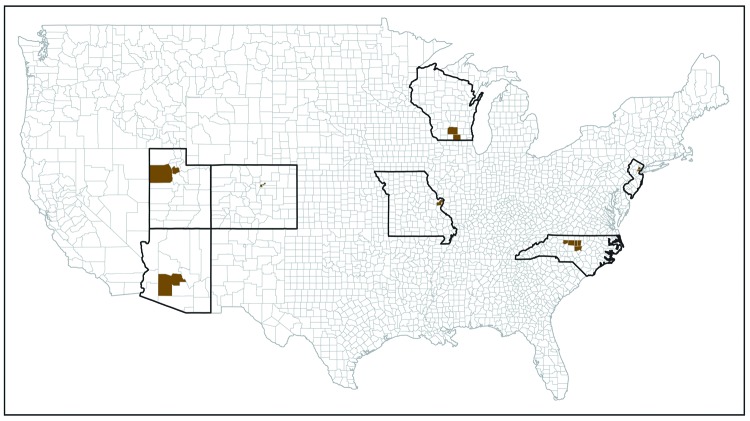
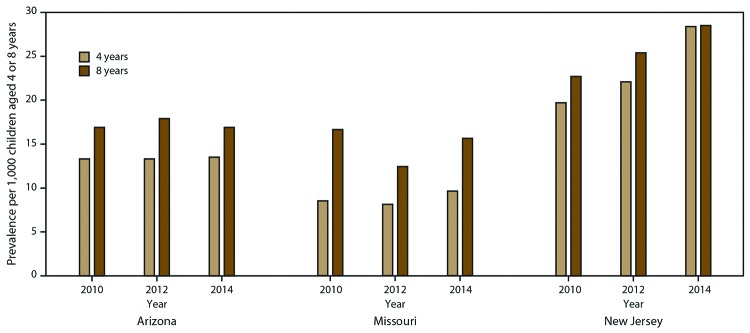
PROBLEM/CONDITION: Autism spectrum disorder (ASD) is estimated to affect up to 3% of children in the United States. Public health surveillance for ASD among children aged 4 years provides information about trends in prevalence, characteristics of children with ASD, and progress made toward decreasing the age of identification of ASD so that evidence-based interventions can begin as early as possible. PERIOD COVERED: 2010, 2012, and 2014. DESCRIPTION OF SYSTEM: The Early Autism and Developmental Disabilities Monitoring (Early ADDM) Network is an active surveillance system that provides biennial estimates of the prevalence and characteristics of ASD among children aged 4 years whose parents or guardians lived within designated sites. During surveillance years 2010, 2012, or 2014, data were collected in seven sites: Arizona, Colorado, Missouri, New Jersey, North Carolina, Utah, and Wisconsin. The Early ADDM Network is a subset of the broader ADDM Network (which included 13 total sites over the same period) that has been conducting ASD surveillance among children aged 8 years since 2000. Each Early ADDM site covers a smaller geographic area than the broader ADDM Network. Early ADDM ASD surveillance is conducted in two phases using the same methods and project staff members as the ADDM Network. The first phase consists of reviewing and abstracting data from children's records, including comprehensive evaluations performed by community professionals. Sources for these evaluations include general pediatric health clinics and specialized programs for children with developmental disabilities. In addition, special education records (for children aged ≥3 years) were reviewed for Arizona, Colorado, New Jersey, North Carolina, and Utah, and early intervention records (for children aged 0 to <3 years) were reviewed for New Jersey, North Carolina, Utah, and Wisconsin; in Wisconsin, early intervention records were reviewed for 2014 only. The second phase involves a review of the abstracted evaluations by trained clinicians using a standardized case definition and method. A child is considered to meet the surveillance case definition for ASD if one or more comprehensive evaluations of that child completed by a qualified professional describes behaviors consistent with the Diagnostic and Statistical Manual of Mental Disorders, 4th Edition, Text Revision (DSM-IV-TR) diagnostic criteria for any of the following conditions: autistic disorder, pervasive developmental disorder-not otherwise specified (PDD-NOS, including atypical autism), or Asperger disorder (2010, 2012, and 2014). For 2014 only, prevalence estimates based on surveillance case definitions according to DSM-IV-TR and the Diagnostic and Statistical Manual of Mental Disorders, Fifth Edition (DSM-5) were compared. This report provides estimates of overall ASD prevalence and prevalence by sex and race/ethnicity; characteristics of children aged 4 years with ASD, including age at first developmental evaluation, age at ASD diagnosis, and cognitive function; and trends in ASD prevalence and characteristics among Early ADDM sites with data for all 3 surveillance years (2010, 2012, and 2014), including comparisons with children aged 8 years living in the same geographic area. Analyses of time trends in ASD prevalence are restricted to the three sites that contributed data for all 3 surveillance years with consistent data sources (Arizona, Missouri, and New Jersey). RESULTS: The overall ASD prevalence was 13.4 per 1,000 children aged 4 years in 2010, 15.3 in 2012, and 17.0 in 2014 for Early ADDM sites with data for the specific years. ASD prevalence was determined using a surveillance case definition based on DSM-IV-TR. Within each surveillance year, ASD prevalence among children aged 4 years varied across surveillance sites and was lowest each year for Missouri (8.5, 8.1, and 9.6 per 1,000, for 2010, 2012, and 2014, respectively) and highest each year for New Jersey (19.7, 22.1, and 28.4 per 1,000, for the same years, respectively). Aggregated prevalence estimates were higher for sites that reviewed education and health care records than for sites that reviewed only health care records. Among all participating sites and years, ASD prevalence among children aged 4 years was consistently higher among boys than girls; prevalence ratios ranged from 2.6 (Arizona and Wisconsin in 2010) to 5.2 boys per one girl (Colorado in 2014). In 2010, ASD prevalence was higher among non-Hispanic white children than among Hispanic children in Arizona and non-Hispanic black children in Missouri; no other differences were observed by race/ethnicity. Among four sites with ≥60% data on cognitive test scores (Arizona, New Jersey, North Carolina, and Utah), the frequency of co-occurring intellectual disabilities was significantly higher among children aged 4 years than among those aged 8 years for each site in each surveillance year except Arizona in 2010. The percentage of children with ASD who had
Overview
The claims and statistics of this paper haven’t been checked yet.
Free: it reads the open-access text and checks the first 5 claims that cite a source we can check. Create a free account to check every claim.
Integrity signals
Registry
Cites
Statistics
Figures
Verification
Claims the paper makes
The claims and statistics of this paper haven’t been checked yet.
Free: it reads the open-access text and checks the first 5 claims that cite a source we can check. Create a free account to check every claim.
Claims other papers make about this one
Each is checked against this paper’s own text: does it say what the citing paper says it does?
The source backs part of the claim, not all of it — or backs it for a different population, condition or comparison.
In the citing paper
“Children with co-occurring intellectual disability are more likely to be identified earlier than children without intellectual disability, as indicated by an earlier median age at identification among this group (11) as well as the consistently higher proportion of children with intellectual disability at age 4 years (8,13) than at age 8 years (9,11,17).”
From Early Identification of Autism Spectrum Disorder Among Children Aged 4 Years — Autism and Developmental Disabilities Monitoring Network, 11 Sites, United States, 2018 (2021) · cites this paper as [13]
Experimental — accuracy not yet measuredThe source backs part of the claim, not all of it — or backs it for a different population, condition or comparison.
In the citing paper
“Racial disparities reflected in autism prevalence have been monitored in the United States over time and the pattern of change suggests a “catch up” in diagnosis in minorities who were initially underdiagnosed (Christensen et al., 2019; Maenner, 2020).”
From Global prevalence of autism: A systematic review update (2022) · cites this paper as Christensen et al., 2019
Experimental — accuracy not yet measuredThe source backs part of the claim, not all of it — or backs it for a different population, condition or comparison.
In the citing paper
“As approximately 45% of children with ASD experience co-occurring intellectual disability, it will be important that future studies adapt anxiety interventions for this population [7].”
From DINOSAUR: an integrated cognitive-behavioral treatment for anxiety in young children with ASD (2021) · cites this paper as [7]
Experimental — accuracy not yet measuredThe cited source says what the claim attributes to it.
In the citing paper
“The 2018 estimate for children aged 4 years was lower than the 23.0 per 1,000 ASD prevalence among children aged 8 years (11), a finding consistent with previous reports (8,13).”
The cited source says what the claim attributes to it.
In the citing paper
“The 2019 survey (Christensen et al., 2019) found a threefold variation of rate by site, where Missouri had the lowest rates (85, 81, and 96 per 10,000 for 2010, 2012, and 2014, respectively) and the highest were in New Jersey (197, 221, and 284 per 10,000, for the same years, respectively).”
From Global prevalence of autism: A systematic review update (2022) · cites this paper as Christensen et al., 2019
7 more claims about this paper
Create a free account to see every claim other papers make about this one.
Self-check
Percentages, sums and reported differences re-computed from the paper’s own numbers.
The self-check needs the paper’s full text.
Citations
Cites
2 retracted
Christensen, D. L., Baio, J., Braun, K. V. N., Bilder, D., Charles, J., Constantino, J. N., Daniels, J., Durkin, M. S., Fitzgerald, R. T., Kurzius-Spencer, M., et al. (2016) · MMWR. Surveillance Summaries · doi:10.15585/mmwr.ss6503a1 · Cited by 1,964
Self-citationRetractedChristensen, D. L., Braun, K. V. N., Baio, J., Bilder, D., Charles, J., Constantino, J. N., Daniels, J., Durkin, M. S., Fitzgerald, R. T., Kurzius-Spencer, M., et al. (2018) · MMWR. Surveillance Summaries · doi:10.15585/mmwr.ss6513a1 · Cited by 587
Self-citationRetractedDiagnostic and Statistical Manual of Mental Disorders
American Psychiatric Association (2013) · doi:10.1176/appi.books.9780890425596 · Cited by 116,369
Baio, J., Wiggins, L., Christensen, D. L., Maenner, M. J., Daniels, J., Warren, Z., Kurzius-Spencer, M., Zahorodny, W., Robinson, C., Rosenberg, et al. (2018) · MMWR. Surveillance Summaries · doi:10.15585/mmwr.ss6706a1 · Cited by 6,078 · cited 1×
“8 years in 2014 (13), compared with 14.”
Self-citationMaenner, M. J., Shaw, K. A., Baio, J., EdS1, Washington, A., Patrick, M., DiRienzo, M., Christensen, D. L., Wiggins, L. D., Pettygrove, S., et al. (2020) · MMWR. Surveillance Summaries · doi:10.15585/mmwr.ss6904a1 · Cited by 3,780
Self-citationDawson, G., Rogers, S., Munson, J., Smith, M., Winter, J., Greenson, J., Donaldson, A., & Varley, J. (2010) · Pediatrics · doi:10.1542/peds.2009-0958 · Cited by 2,835
Identification and Evaluation of Children With Autism Spectrum Disorders
Johnson, C. P., Myers, S. M., & and the Council on Children With Disabilities (2007) · Pediatrics · doi:10.1542/peds.2007-2361 · Cited by 2,011
Cited by
Items 301–362 of 362
Review on Nutrition and Dietetics
Sonkusare, R., Shaikh, R., Mulani, T., Shaikh, A., & Khan, T. (2023) · International Journal of Advanced Research in Science Communication and Technology · doi:10.48175/ijarsct-14085 · Cited by 1
Messaoud, K. B., Khachadourian, V., Arildskov, E. S., Hansen, S. N., Gardner, R. M., Ramlau‐Hansen, C. H., Kahn, L. G., & Janecka, M. (2024) · medRxiv · doi:10.1101/2024.09.17.24313638 · Cited by 1
Socioeconomic Factors and Comorbid Conditions in Children with Autism Spectrum Disorder
Paris, W. (2021) · ScholarWorks (Walden University) · Cited by 1
Inclusion, but not necessarily integration: Centring student perspectives and needs in education
Dwyer, P. S. R., Nosova, E., Kermond, C., & Leadbitter, K. (2026) · Autism · doi:10.1177/13623613261425303 · Cited by 1
“Currently, more and more children without co-occurring language or intellectual disabilities are being identified as autistic (Christensen et al., 2019; O’Nions et al., 2023).”
Treatment Related Stress in Parents of Children with Autism Spectrum Disorder
DeWit, C. (2019) · Deep Blue (University of Michigan) · Cited by 3
Kiani, A., Rasouli, J., & Kiani, S. (2020) · Journal of Molecular Biology Research · doi:10.5539/jmbr.v10n1p59
“The Autism Diseases Control Center announced that the incidence of ASD in 2000 was 1 per 150 children (Christensen et al., 2019), while National Health Center reported it I child per 36 children in 2006, which is considered high rate (Zablotsky et al., 2017).”
BackgroundThe Role of Demographics in the Age of Autism Diagnosis
Koller, J. (2020) · Springer eBooks · doi:10.1007/978-1-4614-6435-8_102442-1
Journey with Autism: Successful Educational and Social Interventions from a Single Case Study
JONGE-MOORE, K. D. (2019) · Digital Commons - Andrews University (Andrews University) · doi:10.32597/dissertations/1734 · Cited by 1
Autism Spectrum Disorder in Males: Considerations for Outcomes and Intervention
Testa, R., & Tonge, B. J. (2021) · Cambridge University Press eBooks · doi:10.1017/9781108646765.003
Anagnostou, E. A., Levy, S. E., Mazurek, M. O., & Veenstra-VanderWeele, J. M. (2020) · PEDIATRICS · doi:10.1542/peds.2019-1895b
Villavicencio, M. D. L. L. P. (2020) · Repositorio Institucional Zaloamati (Universidad Autónoma Metropolitana) · doi:10.24275/uama.5813.7498
Fuentes‐Afflick, E. (2021) · The Journal of Pediatrics · doi:10.1016/j.jpeds.2021.03.059
Tupou, J. (2020) · Open Access Victoria University of Wellington | Te Herenga Waka (Figshare) · doi:10.26686/wgtn.17148533
Demographics and the Age of Autism Diagnosis
Koller, J. (2021) · Springer eBooks · doi:10.1007/978-3-319-91280-6_102442
Researching African American Autistics
Bennett, M., & Goodall, E. (2022) · Emerald Group Publishing Limited eBooks · doi:10.1108/978-1-80382-463-520221008 · Cited by 1
Examining the Needs of Autistics With Intellectual Disabilities
Bennett, M., & Goodall, E. (2022) · Emerald Group Publishing Limited eBooks · doi:10.1108/978-1-80382-463-520221007
Cultural and Contextual Factors of Infancy Through Early Childhood
(2022) · Springer Publishing Company eBooks · doi:10.1891/9780826182791.0004
Reading and Writing Skills in Developmental Language Disorder: Parental Perception
Sepúlveda, E. M., Resa, P. L., & García, N. P. (2022) · doi:10.7176/jep/13-30-04
Xu, J., Zhou, D., & Xu, F. (2022) · doi:10.2196/preprints.45401
Intolerance of Uncertainty and Challenges in Decision-making in Adults with High-Functioning Autism
Kozunova, G. L., Novikov, A. Y., Stroganova, T. A., & Chernyshev, B. (2022) · Clinical Psychology and Special Education · doi:10.17759/cpse.2022110402
O contexto diagnóstico de indivíduos com autismo leve
da Rocha, S. S., Martins, A. L. B., Corrêa, V. F., Cardoso, A. C. C., Oliveira, M. C., & Fett‐Conte, A. C. (2023) · Arquivos de Ciências da Saúde · doi:10.17696/2318-3691.30.1.2023.177
Meenaakshisundhari, R. P., Murali, L., Rajesh Sharma, R., Nivethitha, A., & Abebe, M. (2023) · Research Square · doi:10.21203/rs.3.rs-3384417/v1
Martucci, M., Novelli, M., Scarselli, V., Palma, F. D., Fiorelli, F., Bernardini, L., Aceti, F., Giacchetti, N., Sogos, C., & Pizzuti, A. (2023) · PubMed · doi:10.7417/ct.2023.5018 · Cited by 3
Formation of cognitive processes in children with autism. Part I. Epigenetic mechanisms
Glotov, O. S., Chernov, A. N., Suchko, P. A., Eismont, Y. A., & Mayorova, L. A. (2024) · Rossiyskiy Vestnik Perinatologii i Pediatrii (Russian Bulletin of Perinatology and Pediatrics) · doi:10.21508/1027-4065-2024-69-1-34-44
Mostaghimi, M., Moeini, F., Honarvar, M. R., & Sharifi, A. (2024) · Pajouhan Scientific Journal · doi:10.61186/psj.22.1.22
Papatheodorou, T., & Prescott, A. (2024) · Elsevier eBooks · doi:10.1016/b978-0-443-27366-7.00016-x
Dola, F. N., & Kundu, G. K. (2025) · Journal of Bangladesh College of Physicians and Surgeons · doi:10.3329/jbcps.v43i1.78793
Quality of life of mothers of children with autistic disorder
Hamed, A. M. M., Aladawy, M. A.-A., Gaad, E., & Khodery, A. R. A. (2024) · Al-Azhar Assiut Medical Journal · doi:10.4103/azmj.azmj_45_24
Qing-hua, Y. (2025) · Methodology Insight · doi:10.71290/mi01010003
Cell Therapy for Autism Spectrum Disorders
Liem, N. T., & Nguyen, H.-P. (2025) · Springer eBooks · doi:10.1007/978-981-96-1261-1_8
Understanding Neurodiversity—Overview and Implications for the Criminal Justice System
Mogavero, M. C. (2025) · Springer eBooks · doi:10.1007/978-3-031-88816-8_2
Fradique, A. R., Carvalho, S., & Jorge, A. (2025) · Cureus · doi:10.7759/cureus.86986 · Cited by 1
“The global prevalence of ASD has been increasing steadily [2,3], currently affecting an estimated one in 36 children in the United States, with no significant differences across ethnicity or socioeconomic status and a fourfold higher prevalence among males [4].”
Screening for Autism in Preterm Children: A Systematic Review
Thomas, K. E., Raghuram, K., Banihani, R., Church, P., Mbuagbaw, L. C. E., & Penner, M. (2025) · PEDIATRICS · doi:10.1542/peds.2024-069837 · Cited by 1
Steed, R. R., Bakian, A. V., Smith, K. R., Wan, N., Brewer, S., Medina, R., & VanDerslice, J. (2022) · Figshare · doi:10.6084/m9.figshare.21268919
Rogič Ožek, S. (2024) · Repository of the University of Ljubljana (University of Ljubljana)
Ostrosky, K. (2023) · SHAREOK (University of Oklahoma; Oklahoma State University; Central Oklahoma University)
Фізична терапія дітей із розладами аутичного спектра з сенсомоторними порушеннями
Чеснокова, К. С. (2024) · Electronic Sumy State University Institutional Repository (Sumy State University) · Cited by 1
Mekayten, H., & Pearlman-Avnion, S. (2026) · Autism and child psychopathology series · doi:10.1007/978-3-032-07009-8_11
Bychkova, P. P., Filippova, N. V., & Barylnik, Y. B. (2026) · Vestnik nevrologii psihiatrii i nejrohirurgii (Bulletin of Neurology Psychiatry and Neurosurgery) · doi:10.33920/med-01-2601-02
Bermudez-Martin, P. (2020) · theses.fr (ABES) · doi:10.70675/d0d223ffzbc0ez44d9z8475z153f265e94f5
Autism Spectrum Disorder: Supporting Families Through Evaluation, Diagnosis, and Beyond
Hopkins, K. (2026) · American Academy of PediatricsItasca, IL eBooks · doi:10.1542/9781610028493-ch12
Sampaio, I. L. G., Junior, R. D. S. P., Adriano, M. P. F., de Castro, N. C. M. M. N., Paulo, A. C., Santos, J. A. F., & de Lima, A. K. M. M. N. (2026) · Research Society and Development · doi:10.33448/rsd-v15i4.50633
Ansari, A. M. S. A., Jahrami, H. A., Almohri, M. A., Suleiman, N. A., Hejair, R., Alfaqih, M. A., Almedfa, M. K., & Hamadeh, R. R. (2026) · Psychiatry International · doi:10.3390/psychiatryint7030089
Osredkar, J., Godnov, U., Vrhovšek, M. J., Osredkar, D., Avguštin, G., Štiglic, A. F., Fabjan, T., & Kumer, K. (2026) · Scientific Reports · doi:10.21203/rs.3.rs-9433871/v1
Suspect Screening of Urinary Neurotoxicants in Children with Autistic Spectrum Disorder
Song, G., Zhang, Q., Zhang, L., Ao, J., Zhang, J., Li, F., & Chen, D. (2026) · Environmental Science & Technology · doi:10.1021/acs.est.6c03172
Xu, L., Zhang, Z., & Shang, C. (2026) · BMJ Public Health · doi:10.1136/bmjph-2025-004801
Gut microbiota-derived 5-HTP penetrates the host blood–brain barrier and ameliorates autism symptoms
Li, B., Yang, Q., Li, M., He, J., Zhang, Z., Wan, X., Mo, Z., Li, R., Li, S., Xu, W., et al. (2026) · Acta Pharmaceutica Sinica B · doi:10.1016/j.apsb.2026.06.025
Musical short-term memory of autistic children and its cognitive correlates
Philibert-Lignières, G. (2026) · doi:10.82308/55646
Autism Spectrum Disorder from Pathophysiology to AI-Driven Precision Medicine A Review
Saini, S., Saxena, A., Vishwakarma, V. K., Sidhpuria, S., Gupta, H., & Kant, R. (2026) · PAIN JOINTS SPINE · doi:10.1922/pjs.16.3s.2026.542
Wang, S., Qi, Y., & Yao, D. (2026) · Translational Pediatrics · doi:10.21037/tp-2026-1-0168
“…Disabilities Monitoring (ADDM) Network report from the U.S. Centers for Disease Control and Prevention (CDC), the overall prevalence of ASD among 4-year-old children in 2020 reached 2.15%, representing a 60% increase compared to 2010 (Christensen et al. , 2019; Shaw et al. , 2023) (3,4).”
InfluentialShair, S. N., Zaki, N. R., Mohd, M. A., Amin, M. N. M., Abidin, A. W. Z., Ahmad, S., & Jamil, N. (2024) · Malaysian Journal of Public Health Medicine · doi:10.37268/mjphm/vol.24/no.3/art.2645 · Cited by 18
“A previous study on children aged 4 conducted in the United States between the years 2010, 2012, and 2014 revealed that ASD prevalence significantly increased over the years 6 .”
de Marchena, A. B., Wieckowski, A. T., Dickerson, A. F., Cheng, H. S., Liz, G. P., Dubin, A. H., Vivanti, G., Barton, M. L., FEIN, D. A., & Robins, D. L. (2026) · Autism · doi:10.1177/13623613261464200
“…in some children until they are in more structured settings (i.e., school) where demands sur-pass abilities, resulting in higher prevalence rates of autism among school-age children compared with preschool-age children (Baird et al., 2006; Baron-Cohen et al., 2009; Christensen et al., 2019).”
Proteome-Wide Antigen Discovery Reveals Compartment-Specific Humoral Responses in CoccidioidomycosisPreprint
Boutros, C. L., Caspar, C. M., McCutcheon, K. M., Dandekar, R., Zorn, K. C., Zamecnik, C. R., Gerungan, C., Sharathchandra, A., Sidhu, S., Homer, C. M., et al. (2026) · medRxiv · doi:10.64898/2026.08.24.26361245
Osorio, N. C., Quiñonez, T. I. S., Morales, N. I. R., & Verduzco, G. R. F. (2026) · ISEO Journal · doi:10.63344/pghrss26
Putative Cyclospora cayetanensis detection in wastewater metagenomic datasetsPreprint
Minor, N. R., Gardner, W. K., Johnson, M. C., O’Connor, S. L., & O’Connor, D. H. (2026) · bioRxiv (Cold Spring Harbor Laboratory) · doi:10.64898/2026.09.18.752766
Tatematsu, E., & 加部, 清. (2026) · IGI Global eBooks · doi:10.4018/979-8-2600-4508-4.ch011
Suganya Mahadeva, A. S. (2023) · Journal for ReAttach Therapy and Developmental Diversities
Couper, L., Camponuri, S. K., Sykes, J. E., Li, X., Hubbard, A. E., Bustamante, B. L. M., Williamson, T., Ruberto, I., Sondermeyer-Cooksey, G., Karmarkar, E. N., et al. (2026) · medRxiv · doi:10.64898/2026.10.14.26365564
... mezinárodní kongres zdraví ... Praha : sborník příspěvků ...
(n.d.) · Vědecká knihovna v Olomouci (Research Library in Olomouc)
Metadata
- Authors
- Christensen, D. L., Maenner, M. J., Bilder, D., Constantino, J. N., Daniels, J., Durkin, M. S., Fitzgerald, R. T., Kurzius-Spencer, M., Pettygrove, S. D., Robinson, C., Shenouda, J., White, T., Zahorodny, W., Pazol, K., & Dietz, P.
- Affiliations
- National Center on Birth Defects and Developmental Disabilities (US)
- University of Utah (US)
- Washington University in St. Louis (US)
- University of North Carolina at Chapel Hill (US)
- University of Wisconsin–Madison (US)
- University of Arizona, Tucson
- University of Arizona (US)
- University of Colorado Anschutz (US)
- Rutgers New Jersey Medical School (US)
- Colorado Department of Public Health and Environment (US)
- ORCID
- Venue
- MMWR. Surveillance Summaries
- Published
- 2019-04-12
- Volume
- 68
- Issue
- 2
- Pages
- 1-19
- ISSN
- 1545-8636 (ISSN-L)
- 1546-0738
- PMC
- PMC6476327
- OpenAlex
- W2938148958
- Cited by
- 344
- References
- 47
- Citations by year
- 2026: 19 · 2025: 25 · 2024: 42 · 2023: 41 · 2022: 55 · 2021: 81 · 2020: 64 · 2019: 15
- FWCI
- 31.25
- Type
- journal article
- Language
- en
- Open access
- diamond
- doi.org
- Licence
- public-domain
- Locations
- MMWR Surveillance Summaries (publishedVersion, public-domain)
- PubMed Central (publishedVersion, cc-by)
- PubMed (publishedVersion)
- UA Campus Repository (The University of Arizona) (acceptedVersion, public-domain)
- Funders
- National Institute of Environmental Health Sciences (P30ES010126)
- Topics
- Life Sciences › Neuroscience › Cognitive Neuroscience › Autism Spectrum Disorder Research
- Health Sciences › Medicine › Psychiatry and Mental health › Child Nutrition and Feeding Issues
- Social Sciences › Psychology › Clinical Psychology › Family and Disability Support Research
- Keywords
- autism spectrum disorder, prevalence, ASD subtypes, pervasive developmental disorders, DSM-IV-TR, developmental disabilities
- MeSH terms
- Autism Spectrum Disorder, Child, Preschool, Female, Humans, Male, United States, Prevalence, Public Health Surveillance
About these checks
Registry, retraction, Cites and statistics results are computed, not judged, with one exception: a printed reference that no index lists is read once by a model before it counts as a citation error. Claims are extracted by a model and kept only when their quote appears verbatim in the text; each cited source is then checked, with a model’s help, for whether it says what the claim relies on. Those verdicts can be wrong — read the claim’s quote and the cited source before relying on one.
Statistics and arithmetic are recomputed, not judged.
Confidence bands are shown only for fields calibrated on our annotated test set. None is calibrated yet, so no band is shown.
What counts as a claim ›How we measure confidence ›How we check this ›
Are you an author, or do you see a problem with this page? Request a review
Data sources
Bibliographic data: Semantic Scholar, OpenAlex, Crossref.
Contains information from the Semantic Scholar Academic Graph Datasets, made available under the ODC Attribution License (ODC-BY 1.0).
Semantic Scholar’s data is described in: Kinney, R., et al. (2023). The Semantic Scholar Open Data Platform. arXiv:2301.10140.
