

The DOI matches its Crossref record; 15 of the 15 references it cites were found in a registry or an index; 3 of the 20 sources its claims cite were checked for support.
Acceptance and commitment therapy-based behavioral intervention for insomnia: a pilot randomized controlled trial
Open accessAbstract
Objective: To evaluate a protocol for acceptance and commitment therapy-based behavioral intervention for insomnia (ACT-BBI-I) in adults compared to cognitive behavioral therapy for insomnia (CBT-I). Methods: Forty-five adults with chronic insomnia were randomized to ACT-BBI-I or CBT-I. Both interventions were performed in six weekly group sessions. The common treatment elements in both protocols included stimulus control and sleep restriction. CBT-I is focused on the cognitive restructuring of maladaptive beliefs about sleep and the daytime effects of insomnia. ACT-BBI-I focuses on therapeutic processes of acceptance, availability, values, defusion, and commitment. The results were evaluated through the following instruments: a sleep diary, the Insomnia Severity Index, the Epworth Sleepiness Scale, the Hospital Anxiety and Depression Scale, the Acceptance and Action Questionnaire-II, and the Dysfunctional Beliefs and Attitudes about Sleep scale. Results: Both interventions had a significant positive impact on sleep patterns, insomnia, anxiety, beliefs about sleep, and psychological flexibility. All improvement was maintained at the 6-month follow-up. Conclusion: The results suggest that integrating principles of ACT with behavioral techniques may be useful for treating insomnia. Further research should identify whether the principles of ACT result in added effectiveness compared to behavioral components alone. Clinical trial registration: RBR-7nc5wq. © 2021, Associacao Brasileira de Psiquiatria. All rights reserved.
Overview
CoChat Summary
## TL;DR
This pilot randomized controlled trial compared an ACT-based behavioral intervention for insomnia (ACT-BBI-I) with CBT-I in 45 adults with chronic insomnia. Both treatments improved sleep and related outcomes, with gains maintained at 6 months; the paper concludes ACT principles may be useful but cannot separate ACT’s added value from the shared behavioral components.
## Key findings
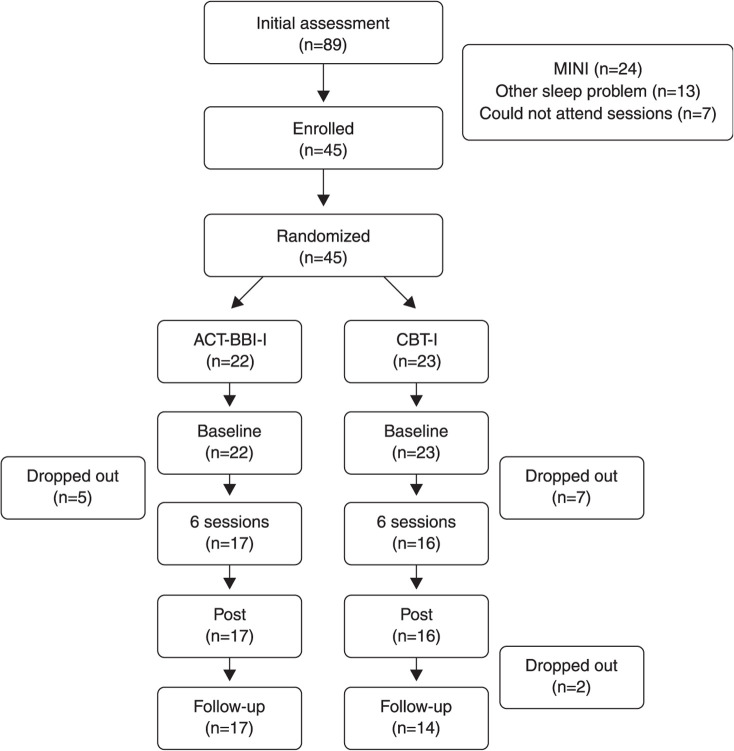
- 45 adults with chronic insomnia were randomized to ACT-BBI-I or CBT-I; 17 ACT-BBI-I participants completed post-treatment and 6-month follow-up, and 16 CBT-I participants completed treatment and post-treatment assessments.
- After both treatments, significant reductions were observed in SOL, NA, WASO, SE, insomnia, anxiety, beliefs about sleep, and psychological flexibility; improvements were maintained at the 6-month follow-up.
- After the intervention, approximately half of participants in both groups were in remission from insomnia, using ISI < 8 as the cutoff.
- The only significant between-group difference reported was for NA, with the ACT-BBI-I group showing significantly greater improvement.
## Methods
- Two-arm randomized design comparing ACT-BBI-I vs CBT-I in adults with chronic insomnia; outcomes were assessed at post-treatment and 6-month follow-up.
- Participants were recruited March 2018 to November 2018 through advertisements at a sleep outpatient unit in São Paulo, Brazil; inclusion criteria were 18–59 years old and chronic insomnia, and 45 eligible participants were randomized.
- Both interventions were delivered in six weekly group sessions with 4–6 participants per group, using shared behavioral components (psychoeducation, sleep hygiene, stimulus control, sleep restriction); outcomes were analyzed with two-way repeated-measures ANOVA.
## Limitations
- The paper states the limitations were small sample size, lack of a control group, and that sleep was assessed only with subjective measures; it also notes that no sleep diary was used at the 6-month follow-up.
- The paper says it cannot be inferred which specific therapeutic elements were responsible for improvement, because ACT and behavioral components were not separable.
- Evident from the design: as a pilot trial with no pure behavioral-only arm, it cannot isolate the added effect of ACT over the shared CBT-I behavioral techniques.
Model-written summary. Check it against the paper before relying on it.
Integrity signals
Registry
Cites
Statistics
Figures
Verification
Claims the paper makes
3 Valid · 0 Not valid · 7 Not checked · 30 Own results and interpretations
The sources with a verdict support this claim; the rest weren’t checked yet, have no full text we could read, or their verdicts aren’t rated yet.
In the paper
“considering that the efficacy of behavioral therapy components is well established.1-3”
§ Acceptance and commitment therapy-based behavioral intervention for insomnia: a pilot randomized controlled trial > Discussion
What the sources say
- Supportedcites [1] Morin CM, 2006, Psychological and behavioral treatment of insomnia: an update of recent evidence (1998–2004), Sleep source
The Conclusions state that stimulus control, relaxation, and paradoxical intention are well-validated therapies, and that sleep restriction has been upgraded to a well-established treatment. Section 4.6 also reports controlled trials showing efficacy for individual behavioral treatments. The review does not claim that every component’s separate contribution within CBT has been established. (LLM, conf=0.90)
- Not checked — no full text of the sourcecites [2] Okajima I, 2011, A meta-analysis on the treatment effectiveness of cognitive behavioral therapy for primary insomnia, Sleep Biol Rhythms source
- Not checked — no full text of the sourcecites [3] Zachariae R, 2016, Efficacy of internet-delivered cognitive-behavioral therapy for insomnia - a systematic review and meta-analysis of randomized controlled trials, Sleep Med Rev source
boosted- Asserted: passes — The authors put it forward as true.
- Checkable: passes — It can be checked against evidence.
- Load-bearing: passes — The paper’s conclusions depend on it.
- Based: passes — The paper gives a reason why it holds.
- Supported
The sources with a verdict support this claim; the rest weren’t checked yet, have no full text we could read, or their verdicts aren’t rated yet.
In the paper
“It is important to mention that behavioral components, such as stimulus control and sleep restriction, were used in both groups, which may have contributed to similar results in both groups, considering that the efficacy of behavioral therapy components is well established.1-3”
§ Acceptance and commitment therapy-based behavioral intervention for insomnia: a pilot randomized controlled trial > Discussion
What the sources say
- Supportedcites [1] Morin CM, 2006, Psychological and behavioral treatment of insomnia: an update of recent evidence (1998–2004), Sleep source
The citation supports the sentence’s background premise that stimulus control and sleep restriction are established insomnia treatments. Section 5.0 calls both well-established therapies, and Section 4.6 reports controlled evidence for each. The suggestion that their use in both groups contributed to similar results is the citing authors’ interpretation, not a result attributed to this review. (LLM, conf=0.92)
- Not checked — no full text of the sourcecites [2] Okajima I, 2011, A meta-analysis on the treatment effectiveness of cognitive behavioral therapy for primary insomnia, Sleep Biol Rhythms source
- Not checked — no full text of the sourcecites [3] Zachariae R, 2016, Efficacy of internet-delivered cognitive-behavioral therapy for insomnia - a systematic review and meta-analysis of randomized controlled trials, Sleep Med Rev source
hedgedstates a possible cause- Asserted: passes — The authors put it forward as true.
- Checkable: passes — It can be checked against evidence.
- Load-bearing: passes — The paper’s conclusions depend on it.
- Based: passes — The paper gives a reason why it holds.
- Supported
A result the paper reports from its own data — it cites no other source for it, so there is none to check. The quote shows it is in the paper.
In the paper
“The clinical improvements were maintained at the 6-month follow-up in both groups.”
- Also stated in: § Results: · plain
“All improvement was maintained at the 6-month follow-up.”
§ Acceptance and commitment therapy-based behavioral intervention for insomnia: a pilot randomized controlled trial > Results
plain- Asserted: passes — The authors put it forward as true.
- Checkable: passes — It can be checked against evidence.
- Load-bearing: passes — The paper’s conclusions depend on it.
- Based: passes — The paper gives a reason why it holds.
- Also stated in: § Results: · plain
A result the paper reports from its own data — it cites no other source for it, so there is none to check. The quote shows it is in the paper.
In the paper
“After both treatments (ACT-BBI-I and CBT-I), significant reductions were observed in SOL, NA, WASO, SE, insomnia, anxiety, beliefs about sleep, and psychological flexibility.”
§ Acceptance and commitment therapy-based behavioral intervention for insomnia: a pilot randomized controlled trial > Results
plainstates a cause- Asserted: passes — The authors put it forward as true.
- Checkable: passes — It can be checked against evidence.
- Load-bearing: passes — The paper’s conclusions depend on it.
- Based: passes — The paper gives a reason why it holds.
19 more claims
Create a free account to see all 40 claims and every source verdict.
- Probably not a substantial claim. 9
- It may state two separate claims as one. 9
Claims other papers make about this one
Each is checked against this paper’s own text: does it say what the citing paper says it does?
In the citing paper
“Moreover, replacing the cognitive therapy aspect of CBT-I with ACT did not enhance efficacy (El Rafihi-Ferreira et al., 2021).”
From The European Insomnia Guideline: An update on the diagnosis and treatment of insomnia 2023 (2023) · cites this paper as El Rafihi-Ferreira et al., 2021
Citations
Cites
The Hospital Anxiety and Depression Scale
Zigmond, A. S., & Snaith, R. P. (1983) · Acta Psychiatrica Scandinavica · doi:10.1111/j.1600-0447.1983.tb09716.x · Cited by 47,139
Validation of the Insomnia Severity Index as an outcome measure for insomnia research
Bastien, C. (2001) · Sleep Medicine · doi:10.1016/s1389-9457(00)00065-4 · Cited by 8,067
Bond, F. W., Hayes, S. C., Baer, R. A., Carpenter, K. M., Guenole, N., Orcutt, H. K., Waltz, T., & Zettle, R. D. (2011) · Behavior Therapy · doi:10.1016/j.beth.2011.03.007 · Cited by 3,950
Psychological and behavioral treatment of insomnia: update of the recent evidence (1998-2004)
Morin, C. M., Bootzin, R. R., Buysse, D. J., Edinger, J. D., Espie, C. A., & Lichstein, K. L. (2006) · Sleep · doi:10.1093/sleep/29.11.1398 · Cited by 1,345
Self-citationAmorim, P. (2000) · Revista Brasileira de Psiquiatria · doi:10.1590/s1516-44462000000300003 · Cited by 1,070
Edinger, J. D., Bonnet, M. H., Bootzin, R. R., Doghramji, K., Dorsey, C. M., Espie, C. A., Jamieson, A. O., McCall, W. V., Morin, C. M., & Stepanski, E. J. (2004) · Sleep · doi:10.1093/sleep/27.8.1567 · Cited by 1,039
Self-citationZachariae, R., Lyby, M. S., Ritterband, L. M., & O'Toole, M. S. (2016) · Sleep Medicine Reviews · doi:10.1016/j.smrv.2015.10.004 · Cited by 704
Portuguese-language version of the Epworth sleepiness scale: validation for use in Brazil
Bertolazi, A. N., Fagondes, S. C., Hoff, L. S., Pedro, V. D., Menna Barreto, S. S., & Johns, M. W. (2009) · Jornal Brasileiro de Pneumologia · doi:10.1590/s1806-37132009000900009 · Cited by 630
OKAJIMA, I., KOMADA, Y., & INOUE, Y. (2011) · Sleep and Biological Rhythms · doi:10.1111/j.1479-8425.2010.00481.x · Cited by 306
Gross, C. R., Kreitzer, M. J., Reilly-Spong, M., Wall, M., Winbush, N. Y., Patterson, R., Mahowald, M., & Cramer-Bornemann, M. (2011) · EXPLORE · doi:10.1016/j.explore.2010.12.003 · Cited by 249
Research works printed but not linked: 1
- Bertolazi AN, 2009, Validac¸a˜o da escala de sonolência de Epworth em português para uso no Brasil, J Bras Pneumol, 35, 877
Cited by
The European Insomnia Guideline: An update on the diagnosis and treatment of insomnia 2023
Riemann, D., Espie, C. A., Altena, E., Arnardottir, E. S., Baglioni, C., Bassetti, C. L. A., Bastien, C., Berzina, N., Bjorvatn, B., Dikeos, D., et al. (2023) · Journal of Sleep Research · doi:10.1111/jsr.14035 · Cited by 834
“Moreover, replacing the cognitive therapy aspect of CBT-I with ACT did not enhance efficacy (El Rafihi-Ferreira et al., 2021).”
MethodFerreira, M. G., Mariano, L. I., Rezende, J. V. D., Caramelli, P., & Kishita, N. (2022) · Journal of Affective Disorders · doi:10.1016/j.jad.2022.04.134 · Cited by 94
Zhang, Y., Liu, C., Chen, X., Zhang, Y., Li, Y., & Hu, X. (2024) · Psycho-Oncology · doi:10.1002/pon.70045 · Cited by 48
Paulos-Guarnieri, L., Linares, I. M. P., & El Rafihi-Ferreira, R. (2022) · Journal of Contextual Behavioral Science · doi:10.1016/j.jcbs.2021.11.001 · Cited by 48
Fang, S., & Ding, D. (2023) · Journal of Contextual Behavioral Science · doi:10.1016/j.jcbs.2023.03.015 · Cited by 33
Metadata
- Authors
- El Rafihi-Ferreira, R., Morin, C. M., Toscanini, A. C., Lotufo Neto, F., Brasil, I. S., Gallinaro, J. G., Borges, D. S., Conway, S. G., & Hasan, R.
- Affiliations
- Universidade de São Paulo (USP), Brazil
- Université Laval (CA)
- Universidade de São Paulo (BR)
- USP, Brazil
- ORCID
- Venue
- Brazilian Journal of Psychiatry
- Publisher
- EDITORA SCIENTIFIC
- Published
- 2021-10
- Volume
- 43
- Issue
- 5
- Pages
- 504-509
- ISSN
- 1516-4446 (ISSN-L)
- 1809-452X
- PMC
- PMC8555642
- OpenAlex
- W3113380354
- Cited by
- 46
- References
- 15
- Citations by year
- 2026: 9 · 2025: 10 · 2024: 15 · 2023: 4 · 2022: 5 · 2021: 3
- FWCI
- 2.22
- Type
- journal article
- Language
- en
- Open access
- diamond
- doi.org
- Licence
- cc-by-nc
- creativecommons.org/licenses/by-nc/4.0/ (vor)
- creativecommons.org/licenses/by-nc/4.0/ (am)
- creativecommons.org/licenses/by-nc/4.0/ (tdm)
- Locations
- Brazilian Journal of Psychiatry (publishedVersion, cc-by-nc)
- Europe PMC (PubMed Central) (publishedVersion, other-oa)
- PubMed Central (publishedVersion, cc-by-nc)
- PubMed (publishedVersion)
- DOAJ (DOAJ: Directory of Open Access Journals) (submittedVersion, cc-by-sa)
- Funders
- Fundação de Amparo à Pesquisa do Estado de São Paulo (2019/)
- Topics
- Social Sciences › Psychology › Experimental and Cognitive Psychology › Sleep and related disorders
- Social Sciences › Psychology › Clinical Psychology › Mindfulness and Compassion Interventions
- Social Sciences › Psychology › Experimental and Cognitive Psychology › Anxiety, Depression, Psychometrics, Treatment, Cognitive Processes
- Keywords
- acceptance and commitment therapy, insomnia, cognitive behavioral therapy for insomnia, behavioral interventions, chronic insomnia, psychological flexibility, dysfunctional beliefs about sleep, anxiety, sleep restriction, stimulus control, group therapy
- MeSH terms
- Adult, Humans, Sleep Initiation and Maintenance Disorders, Pilot Projects, Sleep, Cognitive Behavioral Therapy, Treatment Outcome, Acceptance and Commitment Therapy
About these checks
Registry, retraction, Cites and statistics results are computed, not judged, with one exception: a printed reference that no index lists is read once by a model before it counts as a citation error. Claims are extracted by a model and kept only when their quote appears verbatim in the text; each cited source is then checked, with a model’s help, for whether it says what the claim relies on. Those verdicts can be wrong — read the claim’s quote and the cited source before relying on one.
A language model drew the claims from the paper on 2026-10-11, under version 3 of the claim definition (model deepseek-v4.1-flash, prompt extract-v3).
A second model labelled each claim on 2026-10-11 (model jev-1.13-20260917, definition revision gold-guideline-v0.2).
Cited sources are checked with a language model’s help (gpt-6-sol).
Statistics and arithmetic are recomputed, not judged.
Confidence bands are shown only for fields calibrated on our annotated test set. None is calibrated yet, so no band is shown.
What counts as a claim ›How we measure confidence ›How we check this ›
Are you an author, or do you see a problem with this page? Request a review
How to cite
Cite CoChat for the checks on this page, and the paper for its own findings.
- This page
- CoChat. (2026). Citation check: Acceptance and commitment therapy-based behavioral intervention for insomnia: a pilot randomized controlled trial. https://app.cochat.ai/papers/10.1590/1516-4446-2020-0947
- The paper
- El Rafihi-Ferreira, R., Morin, C. M., Toscanini, A. C., Lotufo Neto, F., Brasil, I. S., Gallinaro, J. G., Borges, D. S., Conway, S. G., & Hasan, R. (2021). Acceptance and commitment therapy-based behavioral intervention for insomnia: a pilot randomized controlled trial. Brazilian Journal of Psychiatry. https://doi.org/10.1590/1516-4446-2020-0947
Data sources
Bibliographic data: Semantic Scholar, OpenAlex, Crossref.
Contains information from the Semantic Scholar Academic Graph Datasets, made available under the ODC Attribution License (ODC-BY 1.0).
Semantic Scholar’s data is described in: Kinney, R., et al. (2023). The Semantic Scholar Open Data Platform. arXiv:2301.10140.
