

Mindfulness in mood and anxiety disorders: A review of the literature
Open accessThe DOI matches its Crossref record; 25 of the 25 references it cites were found in a registry or an index; 49 of the 90 sources its claims cite were checked for support.
Abstract
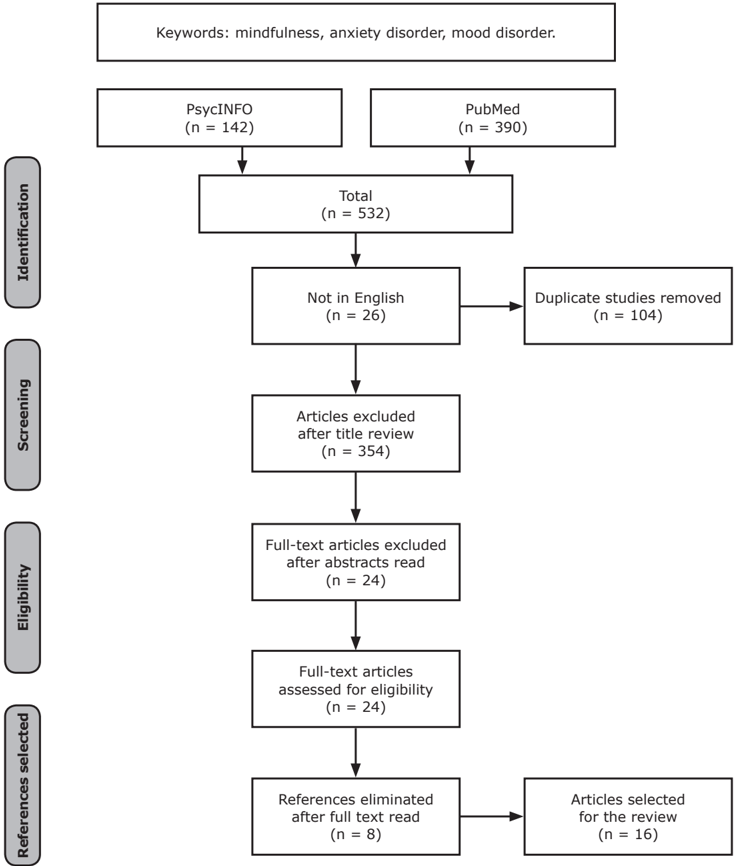
Introduction: The objective of this study was to conduct a review of the literature covering the use of different mindfulnessbased therapy approaches in treatment of mood and anxiety disorders, including mindfulness skills and mindfulness linked to emotional regulation and fear of negative appraisal. Methods: A review was conducted of literature identified by searching the scientific databases PubMed and PsycINFO with the following keywords: mindfulness, mood disorders, and anxiety disorders. The search covered the past 10 years. The search returned 532 articles, 24 were selected, their full texts were read, and 16 were included in this review. Results: Six articles about mindfulness-based stress reduction, four about mindfulness-based cognitive therapy, and three about fear of negative appraisal and emotional regulation were reviewed. All of the articles covered mindfulness in relation to mood and anxiety disorders. Conclusions: The literature in this field suggests that mindfulness is an effective strategy for the treatment of mood and anxiety disorders and is effective in therapy protocols with different structures including virtual modalities. Use of mindfulness in scientific models continues to expand. © 2017, Sociedade de Psiquiatria do Rio Grande do Sul. All rights reserved.
Overview
CoChat Summary
TL;DR
This literature review examined mindfulness-based approaches for mood and anxiety disorders and concluded that mindfulness is an effective treatment strategy across different therapy formats, including virtual delivery. It reviewed 16 selected studies covering MBSR, MBCT, emotional regulation, and fear of negative appraisal.
Key findings
- From 532 references, 16 studies were included; the review covered 6 articles on mindfulness-based stress reduction (MBSR), 4 on mindfulness-based cognitive therapy (MBCT), and 3 on fear of negative appraisal and emotional regulation.
- MBSR was reported as effective for reducing stress, anxiety, and depression, including in older adults and veterans, with reduced suicidal ideation; one trial found MBSR and stress management education produced substantial decreases in HAM-A scores at endpoint, though differences were not observed throughout treatment.
- MBCT was described as reducing relapse and recurrence of major depression and as an effective additional therapy for treatment-resistant depression; internet-based mindfulness treatments produced similar symptom changes to face-to-face delivery, and one mindfulness group therapy trial was non-inferior to treatment as usual.
- Mindfulness was linked to lower depression and anxiety and greater well-being; emotional regulation mechanisms included rumination, reappraisal, worry, and non-acceptance, and fear of negative appraisal decreased after treatment and was negatively associated with mindfulness throughout treatment and follow-up, although standard CBT alone did not affect mindfulness levels in social anxiety disorder.
Methods
- A literature review was conducted in PubMed and PsycINFO in July 2016, limited to articles published between January 2006 and July 2016, using the search terms mindfulness, mood disorders, and anxiety disorders.
- The search found 532 references; 26 were not in English and 104 were duplicates, leaving 402 references that underwent title and abstract analyses, after which 24 full texts were read and 16 were selected for the review.
- The paper presents a narrative synthesis with tables summarizing study characteristics, interventions, and main findings; no meta-analysis is reported.
Limitations
- The paper states limitations including small sample sizes, restricted statistical power, waitlist control designs with possible expectancy effects and attrition discrepancies, missing medical-record details on veterans’ characteristics, exclusion of non-Swedish-speaking immigrants in one randomized controlled trial, inclusion of patients with depressive and anxiety disorders, and reliance on self-report instruments whose accuracy may be affected by decreased emotional awareness.
- The paper also notes specific limitations in the Kraemer study: a fairly small and gender/age-homogeneous sample, sole reliance on self-report measures, cross-sectional data, and inclusion of young adults with rather well-controlled asthma.
- Limitations evident in the text include the small number of included studies (16), English-language restriction, use of only two databases, a 10-year search window, and heterogeneity across constructs and interventions, with several table entries marked “NI” or “NR.”
Model-written summary. Check it against the paper before relying on it.
Integrity signals
Registry
Cites
Statistics
Figures
Verification
Claims the paper makes
41 Valid · 5 Not valid · 30 Not checked · 17 Own results and interpretations
At least one cited source doesn’t support this claim or points to a different paper, and none confirmed it — see the verdicts below.
In the paper
“Likewise, treatment response and remission after MBCT could be predicted by enhanced anxiety sensitivity.19”
§ Mindfulness in mood and anxiety disorders: a review of the literature Mindfulness nos transtornos do humor e ansiedade: uma revisão da literatura > Mindfulness-based cognitive therapy (MBCT)
What the sources say
- Disputedcites [19] 19. Kim B, Cho SJ, Lee KS, Lee JY, Choe AY, Lee JE, et al. Factors associated with treatment outcomes in mindfulness-based cognitive therapy for panic disorder. Yonsei Med J. 2013;54:1454- 62. sourceExperimental — accuracy not yet measured
The Results (Treatment response and Remission) associate response and remission with greater improvement in anxiety sensitivity, not enhanced anxiety sensitivity. The Assessments section defines improvement as a reduction in ASI-R score from baseline, so the claim reverses the direction of the finding. (LLM, conf=0.88)
Checked by a reasoning model — may be wrong.
hedgedstates an association- Asserted: passes — The authors put it forward as true.
- Checkable: passes — It can be checked against evidence.
- Load-bearing: unclear — It is unclear whether the paper’s conclusions depend on it.
- Based: passes — The paper gives a reason why it holds.
- Disputed
At least one cited source doesn’t support this claim or points to a different paper, and none confirmed it — see the verdicts below.
In the paper
“In fact, negative affect and physiological arousal were found to be the stressors causing the development of emotional reactivity.”
§ Mindfulness in mood and anxiety disorders: a review of the literature Mindfulness nos transtornos do humor e ansiedade: uma revisão da literatura > Mindfulness-based cognitive therapy (MBCT)
What the sources say
- Disputedcites [18] 18. Britton WB, Shahar B, Szepsenwol O, Jacobs WJ. Mindfulness- based cognitive therapy improves emotional reactivity to social stress: results from a randomized controlled trial. Behav Ther. 2012;43:365-80. sourceExperimental — accuracy not yet measured
The Discussion describes negative affect and physiological arousal as emotional reactions to stress, not as stressors that cause emotional reactivity. It says these reactions can be adaptive, while prolonged arousal and negative affect after a stressor may increase depression risk. No page number is available in our copy. (LLM, conf=0.88)
Checked by a reasoning model — may be wrong.
plainstates a cause- Asserted: passes — The authors put it forward as true.
- Checkable: passes — It can be checked against evidence.
- Load-bearing: unclear — It is unclear whether the paper’s conclusions depend on it.
- Based: passes — The paper gives a reason why it holds.
- Disputed
At least one cited source doesn’t support this claim or points to a different paper, and none confirmed it — see the verdicts below.
In the paper
“Rumination may be a contributor to anxiety, particularly due to repetitive thoughts about future negative events.”
§ Mindfulness in mood and anxiety disorders: a review of the literature Mindfulness nos transtornos do humor e ansiedade: uma revisão da literatura > Emotional regulation and mindfulness
What the sources say
- Disputedcites [3] 3. Desrosiers A, Vine V, Klemanski DH, Nolen-Hoeksema S. Mindfulness and emotion regulation in depression and anxiety: common and distinct mechanisms of action. Depress Anxiety. 2013;30:654-61. sourceExperimental — accuracy not yet measured
The Discussion distinguishes the two forms of repetitive thinking: worry concerns future negative outcomes, whereas rumination concerns present and past negative events. Although the paper links rumination with anxiety in simple mediation analysis, it does not attribute that link to thoughts about future events; in multiple mediation analysis, worry rather than rumination was the significant mediator for anxiety. (LLM, conf=0.88)
Checked by a reasoning model — may be wrong.
hedgedstates a possible cause- Asserted: passes — The authors put it forward as true.
- Checkable: passes — It can be checked against evidence.
- Load-bearing: passes — The paper’s conclusions depend on it.
- Based: passes — The paper gives a reason why it holds.
- Disputed
Every source the paper cites for this claim was checked and supports it.
In the paper
“The remote delivery mode did not appear to decrease the effect of the mindfulness intervention.7”
§ Mindfulness in mood and anxiety disorders: a review of the literature Mindfulness nos transtornos do humor e ansiedade: uma revisão da literatura > Introduction
What the sources say
- Supportedcites [7] 7. Boettcher J, Astrom V, Pahlsson D, Schenstrom O, Andersson G, Carlbring P. Internet-based mindfulness treatment for anxiety disorders: a randomized controlled trial. Behav Ther. 2014;45:241-53. source
The Discussion explicitly concludes that remote Internet delivery does not seem to lessen the efficacy of mindfulness interventions. This matches the citing sentence’s qualified wording. (LLM, conf=0.95)
hedgedn = 91- Asserted: passes — The authors put it forward as true.
- Checkable: passes — It can be checked against evidence.
- Load-bearing: unclear — It is unclear whether the paper’s conclusions depend on it.
- Based: passes — The paper gives a reason why it holds.
- Supported
Every source the paper cites for this claim was checked and supports it.
In the paper
“The study concluded that mindfulness exercises carried out face-to-face or remotely via the internet both appear to result in similar changes in symptoms.”
§ Mindfulness in mood and anxiety disorders: a review of the literature Mindfulness nos transtornos do humor e ansiedade: uma revisão da literatura > Introduction
What the sources say
- Supportedcites [7] 7. Boettcher J, Astrom V, Pahlsson D, Schenstrom O, Andersson G, Carlbring P. Internet-based mindfulness treatment for anxiety disorders: a randomized controlled trial. Behav Ther. 2014;45:241-53. source
The Discussion explicitly concludes that mindfulness exercises delivered face-to-face or remotely via the Internet seem to yield similar changes in symptoms. This matches the citing sentence’s qualified wording; the paper bases the comparison on its Internet trial and previous face-to-face findings. (LLM, conf=0.95)
hedgedn = 91- Asserted: passes — The authors put it forward as true.
- Checkable: passes — It can be checked against evidence.
- Load-bearing: unclear — It is unclear whether the paper’s conclusions depend on it.
- Based: passes — The paper gives a reason why it holds.
- Supported
49 more claims · 25 with their cited sources checked
Create a free account to see all 93 claims and every source verdict.
- Borderline: one of the tests for a substantial claim is unclear. 1
- Probably not a substantial claim. 14
- It may state two separate claims as one. 28
- The quote only partly states this claim. 2
Self-check
Percentages, sums and reported differences re-computed from the paper’s own numbers.
Each contradiction between two passages listed here was confirmed by an independent check.
Rated minor: it would not touch a result — a value no result rests on, a p-value that stays on the same side of the significance level, or a conflict that is clerical, resolved elsewhere in the paper, or outside its own findings.
In the paper
“Sixty-five subjects enrolled on an MBCT program, and 48 of the subjects completed the program.The program was carried out in 13 separate groups, with 12 participants in each group.”
§ Mindfulness in mood and anxiety disorders: a review of the literature Mindfulness nos transtornos do humor e ansiedade: uma revisão da literatura > Mindfulness-based cognitive therapy (MBCT)
Reported 65 · recomputed 156
Rated minor: it would not touch a result — a value no result rests on, a p-value that stays on the same side of the significance level, or a conflict that is clerical, resolved elsewhere in the paper, or outside its own findings.
In the paper
§ Mindfulness in mood and anxiety disorders: a review of the literature Mindfulness nos transtornos do humor e ansiedade: uma revisão da literatura > Discussion
“All of the interventions involved 8-week sessions, and the duration of these sessions varied from two to three hours.”
§ Mindfulness in mood and anxiety disorders: a review of the literature Mindfulness nos transtornos do humor e ansiedade: uma revisão da literatura > Discussion
“Arch et al. 17 90 min 1x/week 10 weeks Group-based session plus a single 3 hour retreat and home based exercise”
Rated minor: it would not touch a result — a value no result rests on, a p-value that stays on the same side of the significance level, or a conflict that is clerical, resolved elsewhere in the paper, or outside its own findings.
In the paper
§ Mindfulness in mood and anxiety disorders: a review of the literature Mindfulness nos transtornos do humor e ansiedade: uma revisão da literatura > Discussion
“Arch et al. 17 90 min 1x/week 10 weeks”
§ Mindfulness in mood and anxiety disorders: a review of the literature Mindfulness nos transtornos do humor e ansiedade: uma revisão da literatura > References
“16. Arch JJ, Ayers CR, Baker A, Almklov E, Dean DJ, Craske MG. Randomized clinical trial of adapted mindfulness-based stress reduction versus group cognitive behavioral therapy for heterogeneous anxiety disorders.”
Citations
Cites
The benefits of being present: Mindfulness and its role in psychological well-being
Brown, K. W., & Ryan, R. M. (2003) · Journal of Personality and Social Psychology · doi:10.1037/0022-3514.84.4.822 · Cited by 13,448
Using Self-Report Assessment Methods to Explore Facets of Mindfulness
Baer, R. A., Smith, G. T., Hopkins, J., Krietemeyer, J., & Toney, L. (2006) · Assessment · doi:10.1177/1073191105283504 · Cited by 7,511
Nolen-Hoeksema, S., Wisco, B. E., & Lyubomirsky, S. (2008) · Perspectives on Psychological Science · doi:10.1111/j.1745-6924.2008.00088.x · Cited by 5,172
Responses to depression and their effects on the duration of depressive episodes
Nolen-Hoeksema, S. (1991) · Journal of Abnormal Psychology · doi:10.1037/0021-843x.100.4.569 · Cited by 4,529
Hoge, E. A., Bui, E., Marques, L., Metcalf, C. A., Morris, L. K., Robinaugh, D. J., Worthington, J. J., Pollack, M. H., & Simon, N. M. (2013) · The Journal of Clinical Psychiatry · doi:10.4088/jcp.12m08083 · Cited by 511 · cited 1×
“Hoge et al.13 120 min 1x/week 8 weeks Group-based session plus 4 hour retreat and home based exercise Immediately after the intervention HAM-A BAI In the majority of studies, the MBSR program consisted of 8 weekly group classes with a single weekend “retreat” day and daily home practice guided by…”
MethodDesrosiers, A., Vine, V., Klemanski, D. H., & Nolen-Hoeksema, S. (2013) · Depression and Anxiety · doi:10.1002/da.22124 · Cited by 392 · cited 6×
“2017;39(3) – 213 Mindfulness in mood and anxiety disorders - Rodrigues et al.”
BackgroundInfluentialRoemer, L., Lee, J. K., Salters-Pedneault, K., Erisman, S. M., Orsillo, S. M., & Mennin, D. S. (2009) · Behavior Therapy · doi:10.1016/j.beth.2008.04.001 · Cited by 392
Britton, W. B., Shahar, B., Szepsenwol, O., & Jacobs, W. J. (2012) · Behavior Therapy · doi:10.1016/j.beth.2011.08.006 · Cited by 268
Internet-based mindfulness treatment for anxiety disorders: a randomized controlled trial
Boettcher, J., Åström, V., Påhlsson, D., Schenström, O., Andersson, G., & Carlbring, P. (2014) · Behavior Therapy · doi:10.1016/j.beth.2013.11.003 · Cited by 245
Lenze, E. J., Hickman, S., Hershey, T., Wendleton, L., Ly, K., Dixon, D., Doré, P., & Wetherell, J. L. (2014) · International Journal of Geriatric Psychiatry · doi:10.1002/gps.4086 · Cited by 207 · cited 1×
“Lenze et al.14 150 min 1x/week 8 weeks 12 weeks Group-based session plus one day-long retreat or 2.5 hour retreat 3 months 6 moths MAAS CAMS-R The study showed that MBSR was effective in anxious older adults; the patients experienced positive developments such as decreased worry severity and…”
MethodInfluential
Cited by
The Role of BDNF in the Neuroimmune Axis Regulation of Mood Disorders
Jin, Y., Sun, L. H., Yang, W., Cui, R. J., & Xu, S. B. (2019) · Frontiers in Neurology · doi:10.3389/fneur.2019.00515 · Cited by 198
The Diagnosis and Treatment of Anxiety Disorders
Ströhle, A., Gensichen, J., & Domschke, K. (2018) · Deutsches Ärzteblatt international · doi:10.3238/arztebl.2018.0611 · Cited by 186
The Community Resiliency Model® to promote nurse well-being
Grabbe, L., Higgins, M. K., Baird, M., Craven, P. A., & San Fratello, S. (2020) · Nursing Outlook · doi:10.1016/j.outlook.2019.11.002 · Cited by 136
Mindfulness meditation increases default mode, salience, and central executive network connectivity
Bremer, B., Wu, Q., Álvarez, M. G. M., Hölzel, B. K., Wilhelm, M., Hell, E., Tavacioglu, E. E., Torske, A., & Koch, K. (2022) · Scientific Reports · doi:10.1038/s41598-022-17325-6 · Cited by 171
Unfolding the Role of BDNF as a Biomarker for Treatment of Depression
Rana, T., Behl, T., Sehgal, A., Srivastava, P., & BUNGAU, S. G. (2020) · Journal of Molecular Neuroscience · doi:10.1007/s12031-020-01754-x · Cited by 147
“As existing psychotherapy and drugs to treat mood disorders have shown limited efficacy and a number of side effects (Segal and Dinh-Williams 2016; Rodrigues et al. 2017), a more thorough understanding and investigation of the pathogenesis and underlying process of mood disorders is still needed for effective treatmen…”
BackgroundThe Trauma Resiliency Model: A “Bottom-Up” Intervention for Trauma Psychotherapy
Grabbe, L., & Miller-Karas, E. (2018) · Journal of the American Psychiatric Nurses Association · doi:10.1177/1078390317745133 · Cited by 107
Apolinário-Hagen, J., Drüge, M., & Fritsche, L. (2020) · Advances in Experimental Medicine and Biology · doi:10.1007/978-981-32-9705-0_17 · Cited by 100
The impact of a brief mindfulness training on interoception: A randomized controlled trial
Lima-Araujo, G. L. D., de Sousa Júnior, G. M., Mendes, T., Demarzo, M., Farb, N., Barros de Araujo, D., & Sousa, M. B. C. D. (2022) · PLOS ONE · doi:10.1371/journal.pone.0273864 · Cited by 68
“Several studies have shown the therapeutic potential of mindfulness practices in reducing anxiety after long and brief interventions [53].”
BackgroundRespiratory therapy for the treatment of anxiety: Meta-analytic review and regression
Leyro, T. M., Versella, M. V., Yang, M.-J., Brinkman, H. R., Hoyt, D. L., & Lehrer, P. (2021) · Clinical Psychology Review · doi:10.1016/j.cpr.2021.101980 · Cited by 53
Sports in time of COVID-19: Impact of the lockdown on team activity
Peña, J., Altarriba-Bartés, A., Vicens‐Bordas, J., Gil-Puga, B., Piniés-Penadés, G., Alba-Jiménez, C., Tantinyà, J. M., Baena-Riera, A., Loscos-Fàbregas, E., & Casals, M. (2020) · Apunts Sports Medicine · doi:10.1016/j.apunsm.2020.100340 · Cited by 62
“Although general recommendations in this period may have provided evidence-based insight to practitioners looking for information to tailor the practices to their athlete’s needs, generic advice may not be beneficial as, generally speaking, coaches and staff already apply these principles.”
Raugh, I. M., & Strauss, G. P. (2024) · Emotion · doi:10.1037/emo0001308 · Cited by 47
Yip, C. C. H., & Chan, K. K. S. (2022) · Research in Developmental Disabilities · doi:10.1016/j.ridd.2022.104243 · Cited by 50
Grabbe, L., Higgins, M. K., Jordan, D., Noxsel, L., Gibson, B., & Murphy, J. (2020) · International Journal of Mental Health and Addiction · doi:10.1007/s11469-019-00189-9 · Cited by 44
Simione, L., Frolli, A., Sciattella, F., & Chiarella, S. G. (2024) · Brain Sciences · doi:10.3390/brainsci14101001 · Cited by 46
“…of mindfulness-based interventions (MBIs), i.e., interventions that exploited principles and techniques of mindfulness meditation, and in ameliorating various psychopathological symptoms, including stress, depression, anxiety, and aggressivity, among others (for recent reviews see, [8–10].”
BackgroundKlietz, M., Drexel, S. C., Schnur, T., Lange, F., Groh, A., Paracka, L., Greten, S., Dressler, D. W., Höglinger, G. U., & Wegner, F. (2020) · Brain Sciences · doi:10.3390/brainsci10020111 · Cited by 31
Human Brain Disorders: A Review
Naz, F., & Siddique, Y. H. (2020) · The Open Biology Journal · doi:10.2174/1874196702008010006 · Cited by 37
Faedda, N., Natalucci, G., Baglioni, V., Giannotti, F., Cerutti, R., & Guidetti, V. (2019) · Expert Review of Neurotherapeutics · doi:10.1080/14737175.2019.1654859 · Cited by 28
Reangsing, C., Trakooltorwong, P., Maneekunwong, K., Thepsaw, J., & Oerther, S. E. (2023) · BMC Complementary Medicine and Therapies · doi:10.1186/s12906-023-04102-9 · Cited by 35
“With this practice, individuals become more aware and can self-regulate their thoughts, emotions, and behaviors related to anxiety [32].”
BackgroundInfluentialVictorson, D. E., Doninger, G. L., Victorson, S., Victorson, G., Hall, L., Maletich, C., Corr, B. R., Scortino, K., Burns, Z., Allen, L., et al. (2021) · International Journal of Environmental Research and Public Health · doi:10.3390/ijerph182312622 · Cited by 24
“Not unlike connection with nature and others, mindfulness has also been shown in a number of research trials to improve a host of emotional, cognitive, physical, and social domains, such as mood and negative affect [28,29], attention [30], and even regulation of biological processes associated with the body’s stress r…”
BackgroundWang, S., Chong, Z. Y., Zhang, C., & Xu, W. (2024) · Depression and Anxiety · doi:10.1155/da/6205475 · Cited by 27
Hawkins, R. D., Kuo, C.-H., & Robinson, C. (2024) · Frontiers in Psychiatry · doi:10.3389/fpsyt.2024.1355317 · Cited by 27
“Through such calming effects, pets also help to increase mindfulness and the ability to be “ present ” and “ in the moment ” , which is important for anxiety management (40).”
BackgroundEvaluating depression- and anxiety-like behaviors in non-human primates
Ausderau, K., Colman, R. J., Kabakov, S. A., SCHULTZ‐DARKEN, N. J., & Emborg, M. E. (2023) · Frontiers in Behavioral Neuroscience · doi:10.3389/fnbeh.2022.1006065 · Cited by 24
Wen, X., Rafaï, I., Duchêne, S., & Willinger, M. (2022) · International Journal of Environmental Research and Public Health · doi:10.3390/ijerph19095051 · Cited by 18
Murphy, J., Oliver, G., Ng, C. H., Wain, C., Magennis, J., Opie, R., Bannatyne, A. J., & Sarris, J. J. (2019) · Frontiers in Psychiatry · doi:10.3389/fpsyt.2019.00091 · Cited by 14
Lima, L. C., & Mendes, L. C. (2020) · Trends in Psychology · doi:10.1007/s43076-020-00020-8 · Cited by 17
Anxiety and theory of mind: A moderated mediation model of mindfulness and gender
Balaban, G., & Bilici, M. (2022) · PsyCh Journal · doi:10.1002/pchj.536 · Cited by 10
Riley, K. E., Park, C. L., Wong, C. C. Y., & Russell, B. S. (2022) · International Journal of Cognitive Therapy · doi:10.1007/s41811-022-00142-0 · Cited by 17
“In addition, mindfulness has been shown to decrease rumination (Perestelo-Perez et al., 2017) and produce positive cognitive (Chiesa et al., 2011), behavioral (Sancho et al., 2018), and emotional changes (Rodrigues et al., 2017).”
BackgroundDutta, T., Chhajer, R., Nag, S., & Dhir, S. (2023) · IIMB Management Review · doi:10.1016/j.iimb.2023.07.004 · Cited by 11
Zhao, F.-Y., Kennedy, G. A., Xu, P., Conduit, R., Wang, Y., Zhang, W., Wang, H., Yue, L.-P., Huang, Y., Wang, Y., et al. (2023) · Frontiers in Psychiatry · doi:10.3389/fpsyt.2023.1290580 · Cited by 11
Health Benefits of Mindful Meditation
Spadaro, K. C., & Provident, I. (2020) · Springer eBooks · doi:10.1007/978-3-030-30892-6_11 · Cited by 9
Os efeitos do mindfulness na percepção dos estudantes de medicina de uma universidade brasileira
Silveira, L. L., Fabrizzi, H. E., Hamilko, H. C. C., Stefanello, S., & dos Santos, D. V. D. (2021) · Revista Brasileira de Educação Médica · doi:10.1590/1981-5271v45.2-20200149 · Cited by 15
Effects of Gender of Artificial Intelligence Speaker on Mindfulness Meditation Users
Lee, S., & Nam, Y. (2020) · Journal of Digital Contents Society · doi:10.9728/dcs.2020.21.9.1645 · Cited by 6
Moskow, D. M., Curtiss, J. E., Carpenter, J. K., Ito, M., & Hofmann, S. G. (2025) · BMC Psychiatry · doi:10.1186/s12888-025-06488-x · Cited by 7
“As opposed to anxious thoughts about the future or rumination about the past, MBPs emphasize increasing awareness toward present moment sensations and experiences, while maintaining a non-judgmental attitude [2].”
Indirect Interventions: Lifestyle Options to Treat Mental Disorders
Kazdin, A. E. (2025) · Healthcare · doi:10.3390/healthcare13050505 · Cited by 6
“In terms of clinical problem domains, clearly depression and anxiety have dominated as the focus and now many reviews have attested to the benefits of mediation and mindfulness [76–78].”
Aldosary, A. H., Aljohani, M., Alghorayer, M., Albaqami, K. A., Alkhurayji, A., Alharbi, A., Almutairi, S., Alharbi, K., & Alhudaithi, H. (2023) · Middle East Current Psychiatry · doi:10.1186/s43045-023-00372-8 · Cited by 4
“A review article has shown mindfulness to be a helpful method for treating anxiety and mood disorders, and to be helpful in treatment protocols with different structures, such as virtual modalities [10].”
BackgroundOsborn, R., Dorstyn, D., Roberts, L., & Kneebone, I. (2024) · Research and Practice in Intellectual and Developmental Disabilities · doi:10.1080/23297018.2024.2371118 · Cited by 6
Hey Wait! I Just Thought of Something Else! Advaita and Clinical Hypnosis
Amundson, J. K., Ross, M. W., & Campbell, D. (2018) · American Journal of Clinical Hypnosis · doi:10.1080/00029157.2018.1428894 · Cited by 2
Williams, K., Hartley, S., & Taylor, P. J. (2021) · Mindfulness · doi:10.1007/s12671-021-01706-5 · Cited by 3
EFFECTS OF MEDITATION ON THE TREATMENT OF STRESS AND ANXIETY
Guimarães, S. S., Galli, L. M., & Nunes, J. R. P. (2021) · Psicologia Saúde & Doenças · doi:10.15309/21psd220223 · Cited by 7
Effects of an adapted mindfulness-based intervention on well-being in a Filipino college sample
Fernandez, K. T. G., Centeno, R. P. R., & Samaco-Zamora, M. C. F. (2022) · Asia Pacific Journal of Counselling and Psychotherapy · doi:10.1080/21507686.2022.2112246 · Cited by 4
“The practice of MBCT emphasizes acceptance and encourages viewing thoughts as simply thoughts instead of reflections of reality (Rodrigues et al., 2017).”
BackgroundMeral, Y., Yakın, İ., Çarboğa, G., & Bayram, Ö. E. (2024) · Klinik Psikoloji Dergisi · doi:10.57127/kpd.26024438m0000108 · Cited by 1
Anxiety and Stress in Young Adults
Nasir, L., & Lacroix, A. E. (2020) · Springer eBooks · doi:10.1007/978-1-4939-0779-3_136-1 · Cited by 1
مطاوع, م. م. ع. (2021) · مجلة البحث العلمى فى التربية · doi:10.21608/jsre.2021.100999.1382 · Cited by 1
MINDFULNESS PARA MANEJO DA ANSIEDADE EM CANDIDATOS À CARTEIRA NACIONAL DE HABILITAÇÃO
Beskow, C. F., & Boff, R. D. M. (2018) · Revista Destaques Acadêmicos · doi:10.22410/issn.2176-3070.v10i3a2018.1899 · Cited by 1
Anxiety and Stress in Young Adults
Nasir, L., & Lacroix, A. E. (2022) · Springer eBooks · doi:10.1007/978-3-030-54441-6_136 · Cited by 3
Znaczenie mindfulness w miejscu pracy – możliwości pobudzania uważności pracowników
Syper‐Jędrzejak, M., & Bednarska‐Wnuk, I. (2019) · e-mentor · doi:10.15219/em79.1413 · Cited by 3
Chronicle of an Indian psychiatrist's mindfulness journey retold
Sivasubramoney, K. (2021) · BJPsych International · doi:10.1192/bji.2021.33
نمذجة العلاقات السببية بين اليقظة العقلية والتنظيم الإنفعالي وقلق المستقبل لدى طلاب الجامعة
إبراهيم, ر. م. ا. (2021) · المجلة التربوية لکلية التربية بسوهاج · doi:10.21608/edusohag.2021.208300
(2021) · Elsevier eBooks · doi:10.1016/b978-2-294-77182-8.00028-3
Rosa, N. I., Sousa, A. L. R. S., de Souza, D. G., & Weel, I. C. (2022) · Editora Inovar eBooks · doi:10.36926/editorainovar-978-65-5388-026-9
Improving the body’s immunity against SARS-CoV-2 through exercise
Paraschiv, P., Cimpoeșu, R., & Paraschiv, C. (2022) · Elsevier eBooks · doi:10.1016/b978-0-323-85174-9.00011-x · Cited by 1
Do what matters, no matter what! Factorizing positive activities during COVID-19 lockdown
Herzberg, P. Y., Stender, T., Dechmann, J. C. G., Čolić, J., & Hoyer, J. (2022) · Journal of Health Psychology · doi:10.1177/13591053221120967
“, 2019; Reed and Ones, 2006) and mindfulness-oriented activities (e.g. Howarth et al., 2019; Rodrigues et al., 2017) have consistently been shown to improve mood, differential effects of the two are noticeable.”
BackgroundMechanism and Application of Mindfulness in Psychotherapy to Treat Depression
Xu, J. (2022) · BCP Social Sciences & Humanities · doi:10.54691/bcpssh.v20i.2178
Raugh, I. M., & Strauss, G. P. (2023) · doi:10.31234/osf.io/x2khq
COMPLICAÇÕES CLÍNICAS DA CIRURGIA METABÓLICA
Boranelli, A. P., Cardoso, A. C. S., Moscardini, M. C. D. P., Silva, M. G., Barroso, T. M., Diniz, C. M., Reis, A. L. D. F. R., Vieira, M. P. D., Andrade, A. C. L. D., & Corrêa, V. A. O. (2023) · Revista Foco · doi:10.54751/revistafoco.v16n8-035
Machado, B. M., Koury, L., da Silva, T. D., Marques, P. P., Saez, D. M., Soares, E. A., & Guerra, F. D. R. (2023) · Arquivos de Ciências da Saúde da UNIPAR · doi:10.25110/arqsaude.v27i9.2023-016 · Cited by 1
EMOTIONAL SELF-REGULATION OF PARENTS OF CHILDREN AND ADOLESCENTS WITH CHRONIC DISEASE
Burin, J., Weber, M. B., Reppold, C. T., & Calvetti, P. Ü. (2023) · Psicologia Saúde & Doenças · doi:10.15309/23psd240213
WITHDRAWNPreprint
Bose, J. (2024) · PsyArXiv (OSF Preprints) · doi:10.31234/osf.io/6mghw
Stress response, resilience, and brain
Tang, Y., & Tang, R. (2024) · Elsevier eBooks · doi:10.1016/b978-0-443-15602-1.00004-5 · Cited by 1
Saúde Integral: Perspectivas Multidisciplinares, Desafios e Estratégias para o Século XXI
da Silva, A. V., da Silva, C. M., Romão, A. A., & Silva, T. M. C. (2024) · doi:10.29327/5420479
Bose, J. (2024) · Thesis Commons (OSF Preprints) · doi:10.31237/osf.io/8qzyj
Khoramirad, A., Abedini, Z., Gaeeni, M., Dehghani, H., & Akhoundzadeh, K. (2024) · The Journal of Mental Health Training Education and Practice · doi:10.1108/jmhtep-05-2023-0046
Foroughi, P., Manshaee, G., & Pour, S. H. A. (2024) · Journal of Psychological Science · doi:10.61186/jps.23.142.279
Health Benefits of Mindful Meditation
Spadaro, K. C., & Provident, I. (2025) · Nutrition and health · doi:10.1007/978-3-031-87441-3_15
Shi, K., Calia, C., & Takács, Z. K. (2026) · BMC Psychology · doi:10.1186/s40359-026-05331-6
Cai, H., Leung, P.-Y., An, J.-A., Wang, S., Chan, S. H., & Tsang, H. W. H. (2025) · Research Square · doi:10.21203/rs.3.rs-6730548/v1
Characterizing eating behavioral phenotypes in mood disorders: A cross-sectional investigation
Koning, E., Jacobson, J. A., & Brietzke, E. M. (2026) · CNS Spectrums · doi:10.1017/s1092852926101230
“69 Mindfulness-based interventions focused on eating behavior involve reducing the rate of food consumption during a meal, reducing meal portions, and eliminating distractions while CNS Spectrums eating.”
Orozco-Vargas, A. E., Rojas-García, A., & Sanjuan-Acosta, A. C. (2025) · Revista Iberoamericana de Psicología · doi:10.33881/2027-1786.rip.18204
The Impact of Mindfulness on Cognitive Functioning and Mood in Pre-Service Elementary TeachersPreprint
Ganim, S., Haiadri, S., Cohen, C., & Mualem, R. (2026) · Research Square · doi:10.21203/rs.3.rs-8991328/v1
Metadata
- Authors
- Rodrigues, M. F., Nardi, A. E., & Levitan, M.
- Affiliations
- Universidade Federal do Rio de Janeiro (BR)
- Corresponding author
- Rodrigues, Michele F.
- Venue
- Trends in Psychiatry and Psychotherapy
- Publisher
- FapUNIFESP (SciELO)
- Published
- 2017-07-31
- Volume
- 39
- Issue
- 3
- Pages
- 207-215
- ISSN
- 2237-6089 (ISSN-L)
- 2238-0019
- OpenAlex
- W2740699672
- Cited by
- 69
- References
- 25
- Citations by year
- 2026: 3 · 2025: 5 · 2024: 10 · 2023: 11 · 2022: 12 · 2021: 9 · 2020: 10 · 2019: 5 · 2018: 3 · 2017: 1
- FWCI
- 6.43
- Type
- journal article
- Language
- en
- Open access
- diamond
- doi.org
- Licence
- cc-by-nc
- Locations
- Trends in Psychiatry and Psychotherapy (publishedVersion, cc-by-nc)
- PubMed (publishedVersion)
- LA Referencia (Red Federada de Repositorios Institucionales de Publicaciones Científicas) (publishedVersion, other-oa)
- Americanae (AECID Library) (submittedVersion, other-oa)
- DOAJ (DOAJ: Directory of Open Access Journals) (submittedVersion, cc-by-sa)
- Redalyc (Universidad Autónoma del Estado de México) (submittedVersion)
- Topics
- Social Sciences › Psychology › Clinical Psychology › Mindfulness and Compassion Interventions
- Social Sciences › Psychology › Experimental and Cognitive Psychology › Anxiety, Depression, Psychometrics, Treatment, Cognitive Processes
- Social Sciences › Psychology › Clinical Psychology › Psychotherapy Techniques and Applications
- Keywords
- mindfulness, mood disorders, anxiety disorders, mindfulness-based stress reduction, mindfulness-based cognitive therapy, emotion regulation, online therapy, psychotherapy treatment
- MeSH terms
- Anxiety Disorders, Humans, Cognitive Behavioral Therapy, Mood Disorders, Mindfulness
About these checks
Registry, retraction, Cites and statistics results are computed, not judged, with one exception: a printed reference that no index lists is read once by a model before it counts as a citation error. Claims are extracted by a model and kept only when their quote appears verbatim in the text; each cited source is then checked, with a model’s help, for whether it says what the claim relies on. Those verdicts can be wrong — read the claim’s quote and the cited source before relying on one.
The claim verdicts this report counts are experimental: their accuracy is not yet measured.
A language model drew the claims from the paper on 2026-10-11, under version 3 of the claim definition (model deepseek-v4.1-flash, prompt extract-v3).
A second model labelled each claim on 2026-10-11 (model jev-1.13-20260917, definition revision gold-guideline-v0.2).
Cited sources are checked with a language model’s help (gpt-6-sol).
Statistics and arithmetic are recomputed, not judged.
Confidence bands are shown only for fields calibrated on our annotated test set. None is calibrated yet, so no band is shown.
What counts as a claim ›How we measure confidence ›How we check this ›
Are you an author, or do you see a problem with this page? Request a review
Data sources
Bibliographic data: Semantic Scholar, OpenAlex, Crossref.
Contains information from the Semantic Scholar Academic Graph Datasets, made available under the ODC Attribution License (ODC-BY 1.0).
Semantic Scholar’s data is described in: Kinney, R., et al. (2023). The Semantic Scholar Open Data Platform. arXiv:2301.10140.
