

The effectiveness of acceptance and commitment therapy for social anxiety disorder: a randomized clinical trial
Open accessThe DOI matches its Crossref record; 53 of the 53 references it cites were found in a registry or an index; 8 of the 14 sources its claims cite were checked for support.
Abstract
Objective: Acceptance and commitment therapy has been used to treat anxiety disorders recently. The purpose of this study was to investigate the effectiveness of acceptance and commitment therapy for psychological symptoms in students with social anxiety disorder, including difficulty in emotion regulation, psychological flexibility based on experiential avoidance, self-compassion, and external shame. Methods: This study was a semi-experimental clinical trial. Twenty four students with social anxiety disorder were randomly divided into two groups after initial evaluations: an experimental group (12 subjects) and a control group (12 subjects). The experimental group received 12 treatment sessions based on a protocol of acceptance and commitment therapy for anxiety disorders, and the control group was put on a waiting list. Self-Compassion (SCS), Difficulty in Emotion Regulation (DERS), External Shame (ESS), Social Anxiety (SPIN), and Acceptance and Action (AAQ-II) questionnaires were used to assess participants. Data were analyzed using SPSS. Results: Acceptance and commitment therapy was shown to be effective at the post-test and follow up stages for reducing external shame, social anxiety, and difficulty in emotion regulation and its components, and for increasing psychological flexibility and self-compassion (p < 0.05). The largest effect size of treatment was for increase of psychological flexibility and the lowest efficacy was for the components “difficulty in impulse control” and “limited access to emotional strategies” at the post-test and follow-up stages, respectively. Conclusion: Acceptance and commitment therapy may be an appropriate psychological intervention for reducing the symptoms of students with social anxiety disorder and helping them to improve psychological flexibility. Emotion and related problems can be identified as one of the main targets of this treatment. Clinical trial registration: Iranian Registry of Clinical Trials, IRCT20180421039369N1. © 2020, Sociedade de Psiquiatria do Rio Grande do Sul. All rights reserved.
Overview
CoChat Summary
TL;DR
In a randomized clinical trial with 24 students with social anxiety disorder, acceptance and commitment therapy (ACT) was reported to improve external shame, social anxiety, emotion regulation difficulties, psychological flexibility, and self-compassion relative to a waiting-list control at post-test and two-month follow-up. The largest reported effect was for increased psychological flexibility.
Key findings
- ACT significantly reduced external shame, social anxiety, and difficulty in emotion regulation and its components, and increased psychological flexibility and self-compassion at post-test and follow-up (*p* < 0.05).
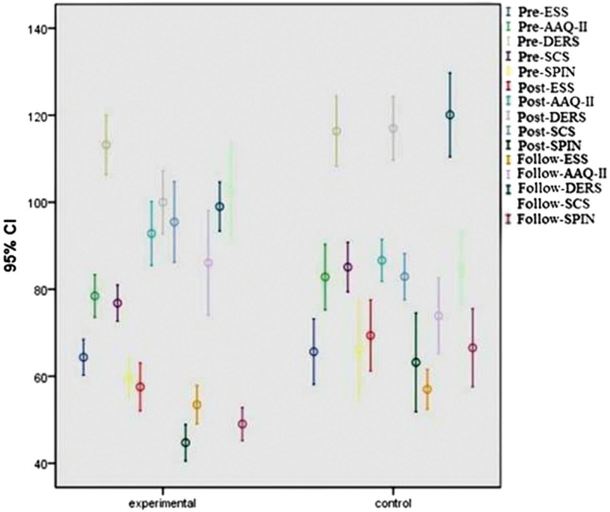
- The largest effect size was for psychological flexibility: reported as 43% at post-test and 67% at follow-up; Table 3 shows AAQ-II effect sizes of 0.43 and 0.627, respectively.
- The smallest effects were for “difficulty in impulse control” at post-test and “limited access to emotional strategies” at follow-up; Table 3 shows effect sizes of 0.013 and 0.014, respectively.
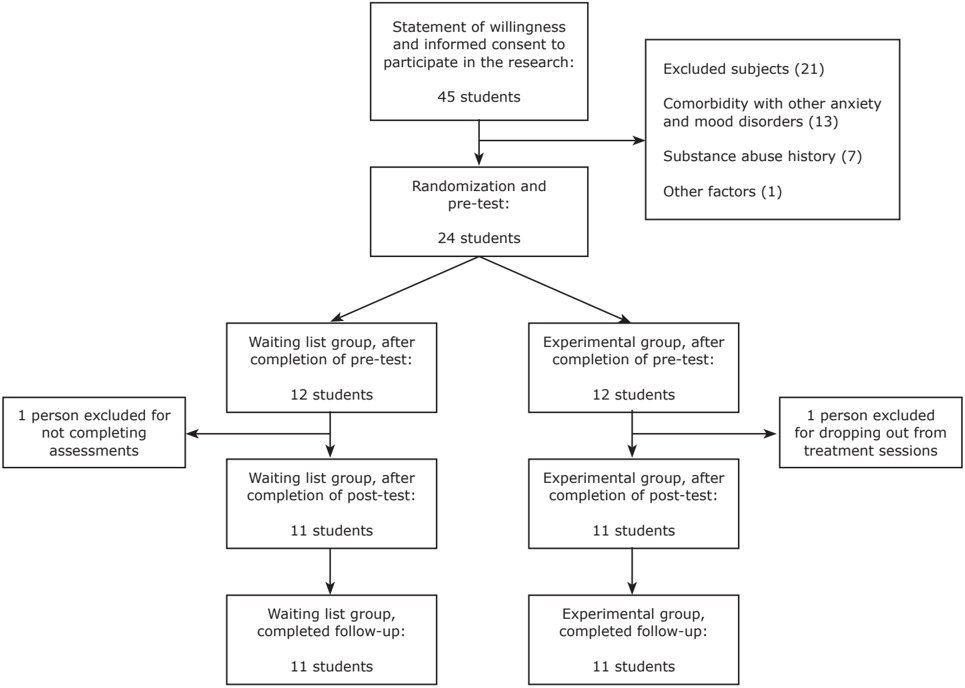
- Twenty-four students enrolled; 22 completed treatment sessions and pre-test/two-month follow-up evaluations, with one person excluded from each group. Mean age was reported as 22.12±1.08; 17 participants were women (70.8%) and 7 were men (29.2%).
Methods
- Semi-experimental clinical trial with control and experimental groups; 24 students with social anxiety disorder in Kermanshah were randomly assigned to ACT (12 subjects) or a waiting-list control (12 subjects).
- The experimental group received 12 ACT sessions of approximately 90 minutes based on an anxiety-disorder protocol by Eifert and Forsyth; the control group was placed on a waiting list and offered treatment after final evaluation.
- Measures included the ADIS-IV for diagnosis/clinical severity, plus SCS, DERS, ESS, AAQ-II, and SPIN. Data were analyzed in SPSS using multivariate analysis of covariance, chi-square for gender comparison, and independent *t* test for age comparison.
Limitations
- Stated: the sample size limits generalizability; the sample consisted entirely of students, who are not comparable with the general population in social, economic, or intellectual capabilities; use of a waiting-list control group is a limitation, and future studies should use more dynamic control groups.
- Evident from the text: reported sample and descriptive details are inconsistent in places (e.g., 24 enrolled vs. 22 completers; mean age 22.12±1.08 vs. Table 1 group means; some table values appear garbled), which complicates interpretation.
Model-written summary. Check it against the paper before relying on it.
Integrity signals
Registry
Cites
Statistics
Figures
Verification
Claims the paper makes
6 Valid · 0 Not valid · 2 Not checked · 20 Own results and interpretations
The sources with a verdict support this claim; the rest weren’t checked yet, have no full text we could read, or their verdicts aren’t rated yet.
In the paper
“One treatment that has been used recently to treat anxiety disorders and has demonstrated effectiveness for reducing anxiety symptoms is acceptance and commitment therapy (ACT).[23][24][25][26]”
§ The effectiveness of acceptance and commitment therapy for social anxiety disorder: a randomized clinical trial > Introduction
What the sources say
- Not checked — no full text of the sourcecites [23] 23. Twohig MP, Hayes SC, Masuda A. Increasing willingness to experience obsessions: acceptance and commitment therapy as a treatment for obsessive-compulsive disorder. Behav Therapy. 2006;37:3-13. source
- Not checked — no full text of the sourcecites [24] 24. Eifert GH, Forsyth JP, Arch J, Espejo E, Keller M, Langer D. Acceptance and commitment therapy for anxiety disorders: Three case studies exemplifying a unified treatment protocol. Cogn Behav Pract. 2009;16:368-85. source
- Supportedcites [25] 25. Dindo L. One-day acceptance and commitment training workshops in medical populations. Curr Opin Psychol. 2015;2:38-42. source
The Abstract says ACT has shown promise in treating anxiety. More directly, the “Distress in Vascular Disease” section reports significantly greater improvement in anxiety symptoms at six months among participants receiving ACT plus illness management than among those receiving usual care. The reported result is from a medical population and a combined intervention. (LLM, conf=0.90)
boostedstates a cause- Asserted: passes — The authors put it forward as true.
- Checkable: passes — It can be checked against evidence.
- Load-bearing: passes — The paper’s conclusions depend on it.
- Based: passes — The paper gives a reason why it holds.
The cited sources support only part of this claim — read each source’s verdict below.
In the paper
“Many studies have shown that people with social anxiety disorder have ineffective experiential avoidance.9,10”
§ The effectiveness of acceptance and commitment therapy for social anxiety disorder: a randomized clinical trial > Introduction
What the sources say
- Not checked — no full text of the sourcecites [9] 9. Kashdan TB, Farmer AS, Adams LM, Ferssizidis P, McKnight PE, Nezlek JB. Distinguishing healthy adults from people with social anxiety disorder: evidence for the value of experiential avoidance and positive emotions in everyday social interactions. J Abnorm Psychol. 2013;122:645. source
- Partly supportedcites [10] 10. Soltani E, Bahrainian SA, Arani AM, Farhoudian A, Gachkar L. Psychometric properties of the Persian version of the Social Anxiety-Acceptance and Action Questionnaire. Iran J Psychiatry Behav Sci. 2016;10:e3753. sourceExperimental — accuracy not yet measured
The Background (page not available) says social anxiety disorder is characterized by avoidance and that experiential avoidance plays a role in maintaining anxiety disorders. The Results (section 4.2; page not available) link greater acceptance of social-anxiety symptoms with less experiential avoidance and less social-interaction anxiety. These passages support a connection, but do not establish that people diagnosed with social anxiety disorder have ineffective experiential avoidance. (LLM, conf=0.82)
boosted- Asserted: passes — The authors put it forward as true.
- Checkable: passes — It can be checked against evidence.
- Load-bearing: passes — The paper’s conclusions depend on it.
- Based: passes — The paper gives a reason why it holds.
A result the paper reports from its own data — it cites no other source for it, so there is none to check. The quote shows it is in the paper.
In the paper
“Of the components of difficulty in emotion regulation, ACT had the greatest impact on”
§ The effectiveness of acceptance and commitment therapy for social anxiety disorder: a randomized clinical trial > Discussion
plainstates a cause- Asserted: passes — The authors put it forward as true.
- Checkable: passes — It can be checked against evidence.
- Load-bearing: passes — The paper’s conclusions depend on it.
- Based: passes — The paper gives a reason why it holds.
A result the paper reports from its own data — it cites no other source for it, so there is none to check. The quote shows it is in the paper.
In the paper
“The effect of this treatment in increasing the psychological flexibility of 43% and 67%, respectively, in post-test and follow-up, shows the highest degree of efficacy for ACT.”
§ The effectiveness of acceptance and commitment therapy for social anxiety disorder: a randomized clinical trial > Results
plainstates a cause- Asserted: passes — The authors put it forward as true.
- Checkable: passes — It can be checked against evidence.
- Load-bearing: passes — The paper’s conclusions depend on it.
- Based: passes — The paper gives a reason why it holds.
A result the paper reports from its own data — it cites no other source for it, so there is none to check. The quote shows it is in the paper.
In the paper
“Acceptance and commitment therapy was shown to be effective at the post-test and follow up stages for reducing external shame, social anxiety, and difficulty in emotion regulation and its components, and for increasing psychological flexibility and self-compassion (p < 0.05).”
- Also stated in: § Results · plain
“In other words, ACT had a significant effect, reducing external shame, social anxiety, and difficulty in emotion regulation and its components, while increasing psychological flexibility and self-compassion in the post-test and follow-up stages.”
§ The effectiveness of acceptance and commitment therapy for social anxiety disorder: a randomized clinical trial > Abstract
plainstates a causen = 12 ·- Asserted: passes — The authors put it forward as true.
- Checkable: passes — It can be checked against evidence.
- Load-bearing: passes — The paper’s conclusions depend on it.
- Based: passes — The paper gives a reason why it holds.
- Also stated in: § Results · plain
7 more claims
Create a free account to see all 28 claims and every source verdict.
- It may state two separate claims as one. 6
- Probably not a substantial claim. 11
- The quote only partly states this claim. 2
Claims other papers make about this one
Each is checked against this paper’s own text: does it say what the citing paper says it does?
The source backs part of the claim, not all of it — or backs it for a different population, condition or comparison.
In the citing paper
“This finding is consistent with the research results of Moradzadeh and Pirkhaefi [20], Khoramnia et al. [31], and Heydari et al. [32].”
From Effectiveness of Acceptance and Commitment Therapy on Anxiety, Cognitive Avoidance, and Empathy of Couples Visiting Counseling Centers in Ahvaz City, Iran (2021) · cites this paper as [31]
Experimental — accuracy not yet measuredThe source backs part of the claim, not all of it — or backs it for a different population, condition or comparison.
In the citing paper
“Also, the effectiveness of ACT was shown by the presence of an increase in self-compassion (effect size pre vs post test d = 1.66; effect size pre vs follow-up d = 1.24) and a 43% in crease in psychological flexibility”
From The role of the acceptance and commitment therapy in the treatment of social anxiety: An updated scoping review. (2022) · cites this paper as Khoramnia et al., 2020
Experimental — accuracy not yet measuredThe cited source says what the claim attributes to it.
In the citing paper
“and it is sensitive to changes following treatment [56-60].”
From A Virtual Reality-Assisted Cognitive Behavioral Therapy for and With Inuit in Québec: Protocol for a Proof-of-Concept Randomized Controlled Trial (2023) · cites this paper as [56]
The cited source says what the claim attributes to it.
In the citing paper
“In all these studies, a significant difference emerged in the scores of the scales administered, highlighting the effectiveness of the ACT in reducing the symptoms of social anxiety (Yadegari et al., 2014; Khoramnia et al., 2020)”
From The role of the acceptance and commitment therapy in the treatment of social anxiety: An updated scoping review. (2022) · cites this paper as Khoramnia et al., 2020
The cited source says what the claim attributes to it.
In the citing paper
“highlighting the effectiveness of the ACT in reducing the symptoms of social anxiety (Yadegari et al., 2014; Khoramnia et al., 2020), external shame (Khoramnia et al., 2020) and increasing psy chological flexibility (Azadeh et al., 2016; Khoramnia et al., 2020).”
From The role of the acceptance and commitment therapy in the treatment of social anxiety: An updated scoping review. (2022) · cites this paper as Khoramnia et al., 2020
1 more claim about this paper
Create a free account to see every claim other papers make about this one.
Self-check
Percentages, sums and reported differences re-computed from the paper’s own numbers.
Each contradiction between two passages listed here was confirmed by an independent check.
Rated major: it would touch a result — a value a result rests on, reported and recomputed p-values on opposite sides of the significance level, two passages that conflict with no sign which is right, or a cited work retracted before this paper was published.
In the paper
§ The effectiveness of acceptance and commitment therapy for social anxiety disorder: a randomized clinical trial > Results
“According to Table 3, the results of multivariate covariance analysis indicate that there were significant changes in all therapeutic variables among students with social anxiety in experimental and control groups (p < 0.05).”
§ The effectiveness of acceptance and commitment therapy for social anxiety disorder: a randomized clinical trial > Conclusion
“| Awareness | 1.23 | 0.65 | 0.066 | 0.89 |”
Citations
Cites
Gratz, K. L., & Roemer, L. (2004) · Journal of Psychopathology and Behavioral Assessment · doi:10.1023/b:joba.0000007455.08539.94 · Cited by 8,942
Bond, F. W., Hayes, S. C., Baer, R. A., Carpenter, K. M., Guenole, N., Orcutt, H. K., Waltz, T., & Zettle, R. D. (2011) · Behavior Therapy · doi:10.1016/j.beth.2011.03.007 · Cited by 3,950
Hayes, S. C., Wilson, K. G., Gifford, E. V., Follette, V. M., & Strosahl, K. (1996) · Journal of Consulting and Clinical Psychology · doi:10.1037//0022-006x.64.6.1152 · Cited by 3,595
Kessler, R. C., Petukhova, M., Sampson, N. A., Zaslavsky, A. M., & Wittchen, H. (2012) · International Journal of Methods in Psychiatric Research · doi:10.1002/mpr.1359 · Cited by 2,947
Hayes, S. C. (2004) · Behavior Therapy · doi:10.1016/s0005-7894(04)80013-3 · Cited by 2,493
Psychometric properties of the Social Phobia Inventory (SPIN): New self-rating scale
Connor, K. M., Davidson, J. R. T., Churchill, L. E., Sherwood, A., Weisler, R. H., & Foa, E. (2000) · British Journal of Psychiatry · doi:10.1192/bjp.176.4.379 · Cited by 1,624
Hayes, S. C., Villatte, M., Levin, M., & Hildebrandt, M. (2011) · Annual Review of Clinical Psychology · doi:10.1146/annurev-clinpsy-032210-104449 · Cited by 800
Forman, E. M., Herbert, J. D., Moitra, E., Yeomans, P. D., & Geller, P. A. (2007) · Behavior Modification · doi:10.1177/0145445507302202 · Cited by 687
Handbook of emotion regulation
Giombini, L. (2015) · Advances in Eating Disorders · doi:10.1080/21662630.2014.953321 · Cited by 676
Roemer, L., Orsillo, S. M., & Salters-Pedneault, K. (2008) · Journal of Consulting and Clinical Psychology · doi:10.1037/a0012720 · Cited by 554
Research works printed but not linked: 4
- 1. American Psychiatric Association. Diagnostic and Statistical Manual of Mental Disorders, Fifth Edition (DSM-5). Arlington: American Psychiatric Publishing; 2013.
- 6. Hofmann S, Otto M. Practical clinical guidebooks series. Cognitive- behavior therapy for social anxiety disorder: Evidence-based and disorder-specific treatment techniques. New York: Routledge/ Taylor & Francis; 2008.
- 38. Khanzadeh M, Saeediyan M, Hosseinchari M, Edrissi F. Factor structure and psychometric properties of Difficulties in Emotional Regulation Scale. Int J Psychol Behav Sci. 2012;6:87-96.
- 46. Etzel JC. A diagnostic exemplar of experiential avoidance: examining shame and self-harm in battered women with PTSD. Dissertation Abstracts International: Section B: The Sciences and Engineering. 2006;66:4480.
Cited by
Haller, H., Breilmann, P., Schröter, M., Dobos, G., & Cramer, H. (2021) · Scientific Reports · doi:10.1038/s41598-021-99882-w · Cited by 126
Examining the relationship between shame and social anxiety disorder: A systematic review
Swee, M. B., Hudson, C. C., & Heimberg, R. G. (2021) · Clinical Psychology Review · doi:10.1016/j.cpr.2021.102088 · Cited by 99
Iwakabe, S., Nakamura, K., & Thoma, N. C. (2023) · Psychotherapy Research · doi:10.1080/10503307.2023.2183155 · Cited by 74
“Khoramnia et al. (2020) RCT SAD ACT vs WL acceptance, mindfulness 12 × 90-min sessions 12 12 AAQ-II 79.72 (9.55) 82.27 (13.10) 94.45 (7.28) 83.00 (12.73) MANCOVA ES = 0.43 [Pre-Post g= 1.96] 2-month 83.02 (16.46) 2- month 75.18 (15.89) ES = 0.627 [Pre-2month g= 1.02] SCS 78.18 (12.70) 84.27 (14.93)…”
InfluentialCaletti, E., Massimo, C., Magliocca, S., Moltrasio, C., Brambilla, P., & Delvecchio, G. (2022) · Journal of Affective Disorders · doi:10.1016/j.jad.2022.05.008 · Cited by 54
Stynes, G., Leão, C. S., & McHugh, L. (2022) · Journal of Contextual Behavioral Science · doi:10.1016/j.jcbs.2022.01.006 · Cited by 39
Yuan, J., Zheng, M., Liu, D., & Wang, L. (2024) · ALPHA PSYCHIATRY · doi:10.5152/alphapsychiatry.2024.231324 · Cited by 30
“Acceptance and commitment therapy has recently been used to treat anxiety disorders 8 and has been shown to be an appropriate psychological management tool that may alleviate the symptoms of adolescents with social anxiety disorder, thereby improving their psychological flexibility.”
BackgroundThe efficacy of psychotherapy for social anxiety disorder, a systematic review and meta-analysis
de Ponti, N., Matbouriahi, M., Franco, P., Harrer, M., Miguel, C., Papola, D., Sicimoğlu, A., Cuijpers, P. J., & Karyotaki, E. (2024) · Journal of Anxiety Disorders · doi:10.1016/j.janxdis.2024.102881 · Cited by 37
The current status of acceptance and commitment therapy (ACT) in Iran: A systematic narrative review
Akbari, M., Seydavi, M., Davis, C. H., Levin, M. E., Twohig, M. P., & Zamani, E. (2022) · Journal of Contextual Behavioral Science · doi:10.1016/j.jcbs.2022.08.007 · Cited by 17
Figueiredo, D. V., Alves, F., & Vagos, P. (2024) · Current Psychology · doi:10.1007/s12144-023-04650-w · Cited by 13
“…evidence in adult population that targeting PI is beneficial for several disorders (for a review see Gloster et al., 2020), including SAD (e.g., Khoramnia et al., 2020; Yadegari et al., 2014; for reviews see Caletti et al., 2022 or García-Perez & Valdivia-Salas, 2018), though the results have…”
Spiritual Psychology and Counseling
(2020) · Spiritual Psychology and Counseling · doi:10.12738/spc · Cited by 13
Seon, Q., Mady, N., Yang, M., Karia, M., Lashley, M., Sescu, C., Lalonde, M., Puskas, S., Outerbridge, J., Parent-Racine, E., et al. (2023) · JMIR Research Protocols · doi:10.2196/40236 · Cited by 12
“Although there are no formal cutoff scores for the DERS, the English scale achieves moderate diagnostic accuracy (area under the curve [AUC]) among emotional disorders and nonsuicidal self-injury populations [53-55], and it is sensitive to changes following treatment [56-60].”
Yao, Y., Yan, Z., Xu, D., & Xuan, Y. (2024) · Current Psychology · doi:10.1007/s12144-024-06818-4 · Cited by 16
“Research has suggested that individuals with poor emotion regulation flexibility are more likely to experience social anxiety and generalized anxiety disorders (Brumariu & Kerns, 2013; Conroy et al., 2020; Khoramnia et al., 2020; Goodman et al., 2021).”
Self-Compassion in Psychotherapy: Clinical Integration, Evidence Base, and Mechanisms of Change
Germer, C. K. (2023) · Mindfulness in behavioral health · doi:10.1007/978-3-031-22348-8_22 · Cited by 20
Fattahi, A., Mazini, F., Jaberghaderi, N., Rajabi, F., Derakhshani, M., & Laki, M. (2025) · Trends in Psychiatry and Psychotherapy · doi:10.47626/2237-6089-2023-0685 · Cited by 21
“32-34 This study’s early findings showed that ACT is effective for reducing psychological problems such as depression, anxiety, and stress in cardiovascular patients.”
Self-citationDepartment of Psychology, F. O. H., Mohammadian, S., Asgari, P., Department of Psychology, F. O. H., Makvandi, B., Department of Psychology, F. O. H., Naderi, F., & Department of Psychology, F. O. H. (2021) · Journal of Research & Health · doi:10.32598/jrh.11.6.1889.1 · Cited by 8
Self-Compassion and Social Anxiety: A Scoping Review
Slivjak, E. T., Majid, F. A., Wrigley, J., Russell, S., Zielony, L., & Arch, J. J. (2024) · Mindfulness · doi:10.1007/s12671-024-02450-2 · Cited by 16
“Although contextual behavioral therapy modalities such as ACT have been shown to increase self-compassion (Khoramnia et al., 2020; Ong et al., 2019; Yadavaia et al., 2014), self-compassion is not typically the primary intervention target in these interventions; most content does not specifically…”
Hu, H., Kuang, L., Dai, H., & Sheng, Y. (2025) · Journal of Psychosocial Nursing and Mental Health Services · doi:10.3928/02793695-20241029-01 · Cited by 9
Kırca, B., & Eksı, H. (2020) · Spiritual Psychology and Counseling · doi:10.37898/spc.2020.5.3.127 · Cited by 12
“Several previous reports have also shown that ACT-based interventions are effective in dealing with anxiety (A-Tjak et al., 2015; Arch, Wolitzky-Taylor, Eifert & Craske, 2012; Khorammia et al., 2020; Swain, Hancock, Hainsworth & Bowmanb, 2013).”
BackgroundUysal, B., Gormez, V., Karatepe, H. T., Sönmez, D., Taştekne, F., Tepedelen, M. S., & Jordan, T. R. (2024) · Psychological Reports · doi:10.1177/00332941231174394 · Cited by 7
“…rumination (Kocovski et al., 2009; Norton et al., 2015; Swain et al., 2013), was associated with improvement in psychological fl exibility (Gr´egoire et al., 2018; Khoramnia et al., 2020), self-compassion (Khoramnia et al., 2020), mindfulness and acceptance increased (Kocovski et al., 2009, 2013).”
BackgroundEbrahimi, S., Moheb, N., & Alivani Vafa, M. (2024) · Practice in Clinical Psychology · doi:10.32598/jpcp.12.1.922.1 · Cited by 7
Zheng, Q., Feng, Y., Li, J., Xu, S., Ma, Z., & Wang, Y. (2024) · Child Abuse & Neglect · doi:10.1016/j.chiabu.2024.106967 · Cited by 10
Srichan, C., Yingsoong, A., & Pisitsungkagarn, K. (2023) · International Journal for the Advancement of Counselling · doi:10.1007/s10447-023-09524-1 · Cited by 8
“In their recent randomized clinical trial, Khoramnia et al. (2020) applied a 12-session group-based ACT to 12 undergraduates with social anxiety disorders.”
BackgroundWatanabe, T. (2021) · Case Reports in Psychiatry · doi:10.1155/2021/5511232 · Cited by 9
“The effectiveness of ACT has been reported for MDD [4, 5].”
BackgroundIwakabe, S., Nakamura, K., & Thoma, N. C. (2023) · Oxford University Press eBooks · doi:10.1093/oso/9780197611012.003.0017 · Cited by 6
Ahmad Othman, A., Wan Jaafar, W. M., Zainudin, Z. N., & Yusop, Y. M. (2024) · Current Psychology · doi:10.1007/s12144-023-05064-4 · Cited by 4
“ACT has shown to be effective in the treatment of many different illnesses (van Aubel et al., 2020; Khoramnia et al., 2020).”
Mattikoppa, N. V., Harshitha, G. S., Yahiya, G. K. M., & Paluru, M. S. (2024) · Journal of Psychiatry Spectrum · doi:10.4103/jopsys.jopsys_23_24 · Cited by 6
Latella, D., Marafioti, G., Formica, C., Calderone, A., Fauci, E. L., Foti, A., Calabrò, R. S., & Filippello, G. (2025) · Healthcare · doi:10.3390/healthcare13131587 · Cited by 6
“Some studies showed that ACT was used for reducing some psychiatric symptoms as well as delusions, hallucinations, suicidal ideation, and psychological inflexi-bility, while simultaneously enhancing psychological flexibility, emotional regulation, and mindfulness [54,64,65].”
The Efficacy of Acceptance and Commitment Therapy for Transitional-Age Youth: A Meta-analysis
Keulen, J., Deković, M., Oud, M., A-Tjak, J. G. L., & Bodden, D. H. M. (2025) · Clinical Child and Family Psychology Review · doi:10.1007/s10567-025-00543-5 · Cited by 14
Bolghan-Abadi, M., & Keyvani, E. (2021) · International Archives of Health Sciences · doi:10.4103/iahs.iahs_117_20 · Cited by 3
Zari Moin, Z., Abolmaali Alhosseini, K., & Sirafi, M. R. (2022) · Archives of Breast Cancer · doi:10.32768/abc.202294497-504 · Cited by 3
“A value-based action arouses a broad spectrum of desirable and undesirable thoughts and feelings.(31) Therefore, committed action means to do whatever is necessary to have a valuable life even if it is followed by pain and suffering.”
BackgroundKeulen, J., Deković, M., Matthijssen, D., Schraven, J., & Bodden, D. H. M. (2025) · Behavior Therapy · doi:10.1016/j.beth.2025.10.004 · Cited by 8
Alptekin, F. B., Burhan, H. Ş., & Kuru, T. (2023) · Cam and Sakura Medical Journal · doi:10.4274/csmedj.galenos.2023.2022-12-2 · Cited by 4
“SAD is related to experiential avoidance (3,4).”
Effect of Multivoice Chorus on Interpersonal Communication Disorder
Lei, H. (2022) · Occupational Therapy International · doi:10.1155/2022/6124778 · Cited by 4
“, it is necessary to use rich and flexible teaching methods and choose beautiful music that conform to the aesthetic tastes of today’s young people, and choreography methods such as singing and dancing, so that college students can establish a good relationship with each other [36].”
BackgroundRetractedChen, Y., & Lei, F. (2025) · Journal of Contextual Behavioral Science · doi:10.1016/j.jcbs.2025.100934 · Cited by 3
Li, X., Gao, Y., Xia, L., Tang, X., Wang, Y., Wang, Z., Zhang, J., Wang, L., Mu, L., Song, P., et al. (2026) · Journal of Behavioral Addictions · doi:10.1556/2006.2025.00199 · Cited by 4
“It can also be used to evaluate the effectiveness of ACT psychotherapy (Khoramnia et al., 2020).”
Social Anxiety Disorder among Teenagers
Zhang, Q. (2023) · Lecture Notes in Education Psychology and Public Media · doi:10.54254/2753-7048/7/2022910 · Cited by 2
The Effects of a Psychological Flexibility Intervention on Well-Being at Work
de Oliveira, A. S., Mourão, L., & Martins, L. F. (2024) · Psico-USF · doi:10.1590/1413-8271202429e269673 · Cited by 1
“…intervention studies comparing control and experimental groups and using ACT as a basis in the work context have shown a significant improvement in psychological flexibility and a reduction of anxiety in the work environment (Deval et al., 2017; Khoramnia et al., 2020; Pang et al., 2022).”
BackgroundKohli, M., Gupta, N., Kohli, G., Saini, P., & Guleria, K. (2025) · Investigación y Educación en Enfermería · doi:10.17533/udea.iee.v43n2e03 · Cited by 3
Bernabé, J. R. Y., Buz, J., Crego, A., Gregoris, L., & Alonso, M. (2026) · Scientific Reports · doi:10.1038/s41598-026-46387-z · Cited by 1
THERAPEUTIC INTERVENTIONS FOR ANXIETY DISORDERS: AN INTEGRATIVE REVIEW
Amaral, R. I., Flores, L. C. M., Kowalczuk, L., Paz, A. A., & Viana, A. C. W. (2022) · RECISATEC - REVISTA CIENTÍFICA SAÚDE E TECNOLOGIA · doi:10.53612/recisatec.v2i10.200 · Cited by 1
“17 (ACT), effectiveness for improving psychological symptoms in students with SAD was evaluated, showing significant results for decreasing symptoms and promoting psychological flexibility.(29) Stangier et al.”
BackgroundBektaş-Aydın, C., & Yüksel-Şahin, F. (2024) · Women s Studies International Forum · doi:10.1016/j.wsif.2024.103042 · Cited by 2
فاعلیة العلاج بالقبول والالتزام فی خفض أعراض اضطراب الشخصیة التجنبیة لدى عینة من طالبات الجامعة
الحميد, ه. ج. ع., & أبوزید, أ. م. ج. (2020) · مجلة جامعة الفيوم للعلوم التربوية والنفسية · doi:10.21608/jfust.2020.49016.1163
CONTRIBUIÇÃO DA CINOTERAPIA PARA PSICOTERAPIA EM IDOSOS INSTITUCIONALIZADOS
Corrêa, G. T., Araujo, M. N., Lourenço, C. H. L., Costa, D. B., Pereira, J. D. A., Serra, R. D. C. E. S., Fonteles, T. F., & Santana, L. N. (2021) · doi:10.22533/at.ed.63721070712
A IMPORTÂNCIA DA PSICOLOGIA JURÍDICA NOS PROCESSOS JUDICIAIS DE ALIENAÇÃO PARENTAL
da Silveira, F. M., Castro, A. B. S., Barbosa, E. D. L., da Silva, V. A., & Santos, V. L. S. (2021) · doi:10.22533/at.ed.63721070715
PSICOSES, FAMÍLIA E ARTE: MEIOS PARA PSICOEDUCAÇÃO DE FAMILIARES PELA ARTE
dos Santos, B. L., Nogueira, A. A., & de Meis, C. (2021) · doi:10.22533/at.ed.63721070716
LUTO PERINATAL: OS DANOS PSICOLÓGICOS CAUSADOS PELAS PERDAS GESTACIONAL E NEONATAL
Santos, L. D. S., Damasceno, R. A., de Farias, R. R. S., & Souza, S. C. (2021) · doi:10.22533/at.ed.63721070713
Docasar, D., Silva, A. D. S., Silva, D. C. D. S., Lima, G. V. D. S., & Barboza, R. M. (2021) · doi:10.22533/at.ed.63721070719
رزق, ع. ح. م. (2022) · مجلة التربية الخاصة · doi:10.21608/mtkh.2022.283506
Aziz, S., Ibrahim, R., & Abubaker, B. Q. (2023) · Evaluation Study of Three Diagnostic Methods for Helicobacter pylori Infection · doi:10.24271/garmian.2023.10285 · Cited by 2
الوزان, ب. أ. ع. (2023) · مجلة العلوم التربوية و الدراسات الإنسانية · doi:10.55074/hesj.vi35.898
Moradi, S. H., Demehri, F., Aghazadeh, R., & Saeidmanesh, M. (2024) · مجله علمی دانشگاه علوم پزشکی رفسنجان · doi:10.61186/jrums.23.1.17
Henning, A., & Muschalla, B. (2024) · Acta Neurologica Scandinavica · doi:10.1155/2024/6674418
Zhong, H., Shen, J., Liao, X.-Y., Sheng, X.-T., Huang, X., Tan, D.-Y., Fu, L., & Fan, Y. (2024) · Psychiatry and Clinical Psychopharmacology · doi:10.5152/pcp.2024.24947
da Silva, T. M. P., de Moura, A. E., de Melo, C. B., & Galdino, M. K. C. (2025) · Psico-USF · doi:10.1590/1413-8271202530e280804
Postpartum Depression from the Perspective of Third-Wave Psychotherapies
Hamarat, H., Fidantek, H., Özdem, M., & Ertürk, İ. Ş. (2026) · Psikiyatride Guncel Yaklasimlar - Current Approaches in Psychiatry · doi:10.18863/pgy.1636688
“…2020), anxiety (Mohabbat - Bahar et al. 2015, Heydari et al. 2018), generalized anxiety disorder (Wetherell et al. 2011), social anxiety disorder (Khoramnia et al. 2020), panic disorder (Meuret et al. 2012), obsessive - compulsive spectrum disorders (Bluett et al. 2014), and post - traumatic…”
Ahmadi, S., Khalatbari, A., & Arab, S. (2025) · Middle East Journal of Rehabilitation and Health Studies · doi:10.5812/mejrh-166808
“In ACT, individuals primarily learn to put their negative experiences in a compassionate framework, which enables them to have a kind of appreciative and empathetic attitude toward themselves even in stressful situations and, consequently, experience fewer emotional problems (46, 48).”
Nzeadibe, A. C., Egara, F. O., Eseadi, C., Madu, B. C., Mosia, M. S., & Chukwuorji, J. C. (2025) · Social Sciences & Humanities Open · doi:10.1016/j.ssaho.2025.102190 · Cited by 2
Magdala, I., Sánchez-Fernández, M., & Mestre, J. M. (2026) · Archives of Women s Mental Health · doi:10.1007/s00737-025-01662-2 · Cited by 2
“Acceptance and Commitment Therapy has been shown to be effective in transforming negative shame and enhancing emotion regulation (Khoramnia et al. 2020; Lear and Luoma 2025; Yuan et al. 2024).”
Xiong, Y., Xiao, N., Ding, X., Zhang, J., & Luo, H.-S. (2026) · Frontiers in Psychology · doi:10.3389/fpsyg.2026.1787151 · Cited by 1
Triguero‐Sánchez, R., & Triguero-López, M. J. (2026) · Journal of Eating Disorders · doi:10.1186/s40337-026-01614-w · Cited by 1
“Importantly, targeting experiential avoidance through process-focused, acceptance-based interventions, such as Acceptance and Commitment Therapy (ACT), has shown efficacy in reducing both eating disorder and anxiety symptoms, highlighting its clinical relevance [24, 34, 39, 43].”
An Acceptance-Based Behavioral Exposure Therapy for Social Anxiety: A Case Paper
Hayes‐Skelton, S. A., Wu, J. L., Amado, S., Lopez, A. K., & González-Garzón, A. M. (2026) · Cognitive and Behavioral Practice · doi:10.1016/j.cbpra.2026.05.007
Sistiaga, S., Yan, X., Dousset, C., & Campanella, S. (2026) · Progress in Neuro-Psychopharmacology and Biological Psychiatry · doi:10.1016/j.pnpbp.2026.111794
Silva, H. S. (2026) · Revista de Geopolítica · doi:10.56238/revgeov17n9-019
Metadata
- Authors
- Khoramnia, S., Bavafa, A., Jaberghaderi, N., Parvizifard, A., Foroughi, A., Ahmadi, M., & Amiri, S.
- Affiliations
- Kermanshah University of Medical Sciences (IR)
- Venue
- Trends in Psychiatry and Psychotherapy
- Publisher
- FapUNIFESP (SciELO)
- Published
- 2020-03
- Volume
- 42
- Issue
- 1
- Pages
- 30-38
- ISSN
- 2237-6089 (ISSN-L)
- 2238-0019
- OpenAlex
- W3016536041
- Semantic Scholar
- ff9f3f865e7f5f16d50e6bacdb44aebcd8ac2c48
- Cited by
- 65
- References
- 51
- Citations by year
- 2026: 9 · 2025: 9 · 2024: 14 · 2023: 13 · 2022: 7 · 2021: 10 · 2020: 3
- FWCI
- 3.29
- Type
- journal article
- Language
- en
- Open access
- diamond
- doi.org
- Licence
- cc-by
- creativecommons.org/licenses/by/4.0/ (vor)
- creativecommons.org/licenses/by/4.0/ (am)
- creativecommons.org/licenses/by/4.0/ (tdm)
- Locations
- Trends in Psychiatry and Psychotherapy (publishedVersion, cc-by)
- PubMed (publishedVersion)
- LA Referencia (Red Federada de Repositorios Institucionales de Publicaciones Científicas) (publishedVersion, other-oa)
- Americanae (AECID Library) (submittedVersion, other-oa)
- DOAJ (DOAJ: Directory of Open Access Journals) (submittedVersion, cc-by-sa)
- Topics
- Social Sciences › Psychology › Clinical Psychology › Mindfulness and Compassion Interventions
- Social Sciences › Psychology › Experimental and Cognitive Psychology › Anxiety, Depression, Psychometrics, Treatment, Cognitive Processes
- Social Sciences › Psychology › Clinical Psychology › Psychotherapy Techniques and Applications
- Keywords
- acceptance and commitment therapy, social anxiety disorder, psychological flexibility, experiential avoidance, self-compassion, external shame, emotion regulation, students, anxiety disorder treatment
- MeSH terms
- Phobia, Social, Emotional Regulation, Adaptation, Psychological, Adult, Female, Humans, Iran, Male, Students, Universities, Outcome Assessment, Health Care, Young Adult, Acceptance and Commitment Therapy
About these checks
Registry, retraction, Cites and statistics results are computed, not judged, with one exception: a printed reference that no index lists is read once by a model before it counts as a citation error. Claims are extracted by a model and kept only when their quote appears verbatim in the text; each cited source is then checked, with a model’s help, for whether it says what the claim relies on. Those verdicts can be wrong — read the claim’s quote and the cited source before relying on one.
The claim verdicts this report counts are experimental: their accuracy is not yet measured.
A language model drew the claims from the paper on 2026-10-11, under version 3 of the claim definition (model deepseek-v4.1-flash, prompt extract-v3).
A second model labelled each claim on 2026-10-11 (model jev-1.13-20260917, definition revision gold-guideline-v0.2).
Cited sources are checked with a language model’s help (gpt-6-sol).
Statistics and arithmetic are recomputed, not judged.
Confidence bands are shown only for fields calibrated on our annotated test set. None is calibrated yet, so no band is shown.
What counts as a claim ›How we measure confidence ›How we check this ›
Are you an author, or do you see a problem with this page? Request a review
Data sources
Bibliographic data: Semantic Scholar, OpenAlex, Crossref.
Contains information from the Semantic Scholar Academic Graph Datasets, made available under the ODC Attribution License (ODC-BY 1.0).
Semantic Scholar’s data is described in: Kinney, R., et al. (2023). The Semantic Scholar Open Data Platform. arXiv:2301.10140.
