

Adsorption of chromium ion (VI) by acid activated carbon
Open accessThe DOI matches its Crossref record; 32 of the 32 references it cites were found in a registry or an index.
Abstract
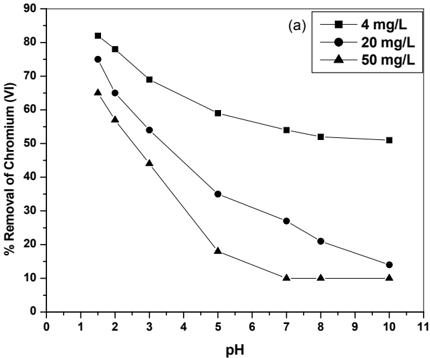
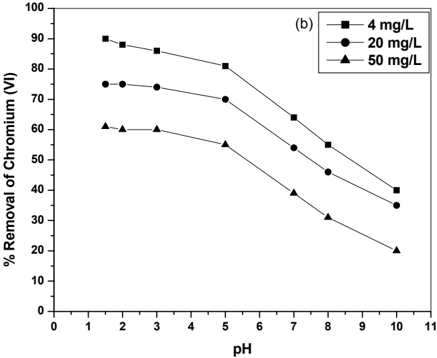
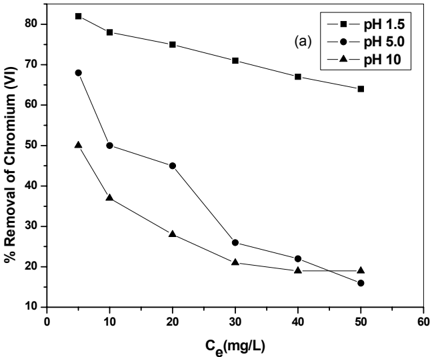
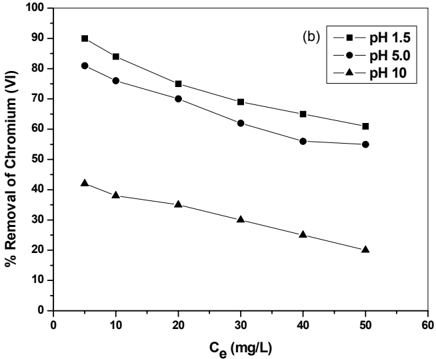
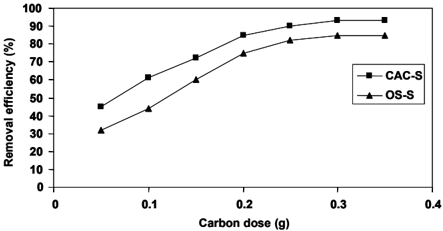
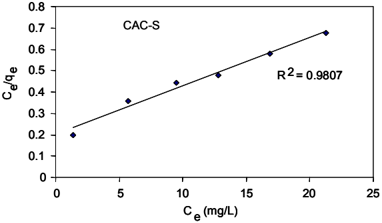
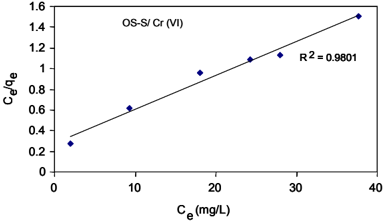
The activated carbon produced from olive stones was chemically activated using sulfuric acid, (OS-S), and utilized as an adsorbent for the removal of Cr(VI) from aqueous solution in the concentration range 4-50 mg/L. Adsorption experiments were carried out in a batch process and various experimental parameters such as effect of contact time, initial chromium ion concentration, carbon dosage, and pH on percentage removal have been studied. Adsorption results obtained for activated carbon (OS-S) were compared with the acid-treated commercial activated carbon (CAC-S). The optimum efficiency shows that the Cr(VI) uptake being attained at pH 1.5. The equilibrium adsorption data was better fitted to the Langmuir adsorption model. The results of kinetic models showed that the pseudo-first-order kinetic model was found to correlate the experimental data well. It was concluded that activated carbon produced from olive stones (OS-S) has an efficient adsorption capacity compared to (CAC-S) sample.
Overview
The claims and statistics of this paper haven’t been checked yet.
Free: it reads the open-access text and checks the first 5 claims that cite a source we can check. Create a free account to check every claim.
Integrity signals
Registry
Cites
Statistics
Figures
Verification
Claims the paper makes
The claims and statistics of this paper haven’t been checked yet.
Free: it reads the open-access text and checks the first 5 claims that cite a source we can check. Create a free account to check every claim.
Claims other papers make about this one
Each is checked against this paper’s own text: does it say what the citing paper says it does?
The source backs part of the claim, not all of it — or backs it for a different population, condition or comparison.
In the citing paper
“This may be due to the unavailability of adsorption sites for Cr(VI) adsorption at lower t-TW dosages, as discussed earlier39.”
From Optimized removal of hexavalent chromium from water using spent tea leaves treated with ascorbic acid (2022) · cites this paper as [39]
Experimental — accuracy not yet measuredThe cited source says what the claim attributes to it.
In the citing paper
“The decrease in Cr(VI) adsorption with an increase in pH has been reported in activated carbons39, nanocomposites40, and organic adsorbents41 such as ours.”
From Optimized removal of hexavalent chromium from water using spent tea leaves treated with ascorbic acid (2022) · cites this paper as [39]
The cited source says what the claim attributes to it.
In the citing paper
“The pH-dominated effects, such as the one-factor effect of pH (Fig. 4a), can be explained by the prevalence of fewer affinitive chromate ions (at high pH), leading to less-frequent electrostatic interactions with the adsorbent surface, resulting in reduced adsorptive removal of Cr(VI)39,40.”
From Optimized removal of hexavalent chromium from water using spent tea leaves treated with ascorbic acid (2022) · cites this paper as [39]
Self-check
Percentages, sums and reported differences re-computed from the paper’s own numbers.
The self-check needs the paper’s full text.
Citations
Cites
Babel, S., & Kurniawan, T. A. (2004) · Chemosphere · doi:10.1016/j.chemosphere.2003.10.001 · Cited by 925
Removal of heavy metals using the fungus Aspergillus niger
Kapoor, A., Viraraghavan, T., & Cullimore, D. R. (1999) · Bioresource Technology · doi:10.1016/s0960-8524(98)00192-8 · Cited by 756
Industrial Wastewater Treatment Technology
Patterson, J. W. (1985) · Cited by 711
Chromium(VI) adsorption from aqueous solution by sawdust activated carbon
KARTHIKEYAN, T., RAJGOPAL, S., & MIRANDA, L. (2005) · Journal of Hazardous Materials · doi:10.1016/j.jhazmat.2005.05.003 · Cited by 679
Removal of chromium(VI) from aqueous solution by activated carbons: Kinetic and equilibrium studies
Khezami, L., & Capart, R. (2005) · Journal of Hazardous Materials · doi:10.1016/j.jhazmat.2005.04.012 · Cited by 647
Aksu, Z. (2001) · Separation and Purification Technology · doi:10.1016/s1383-5866(00)00212-4 · Cited by 642
Hamadi, N. (2001) · Chemical Engineering Journal · doi:10.1016/s1385-8947(01)00194-2 · Cited by 620
Batch Cr(VI) removal by polyacrylamide-grafted sawdust: Kinetics and thermodynamics
Raji, C., & Anirudhan, T. S. (1998) · Water Research · doi:10.1016/s0043-1354(98)00150-x · Cited by 458
Heavy metal removal in a biosorption column by immobilized M. rouxii biomass
Yan, G., & Viraraghavan, T. (2001) · Bioresource Technology · doi:10.1016/s0960-8524(01)00020-7 · Cited by 448
Removal of Hexavalent Chromium with a Lignocellulosic Substrate Extracted from Wheat Bran
Dupont, L., & Guillon, E. (2003) · Environmental Science & Technology · doi:10.1021/es0342345 · Cited by 384
Metal removal from aqueous solutions using chitosan-enhanced membrane filtration
Juang, R.-S., & Shiau, R.-C. (2000) · Journal of Membrane Science · doi:10.1016/s0376-7388(99)00235-5 · Cited by 361
Biosorption of aqueous chromium(VI) by Tamarindus indica seeds
Agarwal, G. S., Bhuptawat, H. K., & Chaudhari, S. (2006) · Bioresource Technology · doi:10.1016/j.biortech.2005.04.030 · Cited by 312
Adsorption of Cr(VI) using activated neem leaves: kinetic studies
Babu, B. V., & Gupta, S. (2008) · Adsorption · doi:10.1007/s10450-007-9057-x · Cited by 270
Adsorption of chromium from aqueous solution on treated sawdust
Garg, V. K., Gupta, R., Kumar, R., & Gupta, R. K. (2004) · Bioresource Technology · doi:10.1016/j.biortech.2003.07.004 · Cited by 270
Oliveira, E. A., Montanher, S. F., Andrade, A. D., Nóbrega, J. A., & Rollemberg, M. C. (2005) · Process Biochemistry · doi:10.1016/j.procbio.2005.02.026 · Cited by 254
Biosorption of Cr(VI) from aqueous solutions by Eichhornia crassipes
Mohanty, K., Jha, M., Meikap, B. C., & Biswas, M. N. (2006) · Chemical Engineering Journal · doi:10.1016/j.cej.2005.11.018 · Cited by 252
Kinetics and thermodynamics of the Cr(III) adsorption on the activated carbon from co-mingled wastes
Lyubchik, S. I., Lyubchik, A. I., Galushko, O. L., Tikhonova, L. P., Vital, J., Fonseca, I. M., & Lyubchik, S. B. (2004) · Colloids and Surfaces A: Physicochemical and Engineering Aspects · doi:10.1016/j.colsurfa.2004.04.066 · Cited by 236
Chromium adsorption on high-performance activated carbons from aqueous solution
Hu, Z., Lei, L., Li, Y., & Ni, Y. (2003) · Separation and Purification Technology · doi:10.1016/s1383-5866(02)00149-1 · Cited by 197
Use of low-cost biological wastes and vermiculite for removal of chromium from tannery effluent
SUMATHI, K. (2005) · Bioresource Technology · doi:10.1016/j.biortech.2004.04.015 · Cited by 183
Adsorption, Kinetic and Equilibrium Studies of Cr(VI) by Hazelnut Shell Activated Carbon
Kobya, M. (2004) · Adsorption Science & Technology · doi:10.1260/026361704323150999 · Cited by 181
The treatment of chromium wastewaters using the sorptive potential of leaf mould
Sharma, D. C., & Forster, C. F. (1994) · Bioresource Technology · doi:10.1016/0960-8524(94)90170-8 · Cited by 162
Cr(VI) removal from aqueous solution by iron (III) hydroxide-loaded sugar beet pulp
Altundogan, H. S. (2005) · Process Biochemistry · doi:10.1016/j.procbio.2004.06.027 · Cited by 156
Removal of Cr(VI) from Aqueous Solution Using Activated Cow Dung Carbon
Das, D. D., Mahapatra, R., Pradhan, J., Das, S. N., & Thakur, R. S. (2000) · Journal of Colloid and Interface Science · doi:10.1006/jcis.2000.7141 · Cited by 144
Tsai, W., Chang, C., Wang, S. Y., Chang, C. F., Chien, S. F., & Sun, H. F. (2001) · Bioresource Technology · doi:10.1016/s0960-8524(00)00111-5 · Cited by 130
Removal of chromium (VI) from aqueous solution using treated oil palm fibre
Isa, M. H., Ibrahim, N., Aziz, H. B. A., Adlan, M. N., Sabiani, N. H. M., Zinatizadeh, A. A., & Kutty, S. R. M. (2007) · Journal of Hazardous Materials · doi:10.1016/j.jhazmat.2007.07.033 · Cited by 82
Optimization of Parameters for Cr(VI) Adsorption on Used Black Tea Leaves
Hossain, M. A., Kumita, M., Michigami, Y., & Mori, S. (2005) · Adsorption · doi:10.1007/s10450-005-5613-4 · Cited by 68
Removal of hexavalent chromium by Kendu fruit gum dust
Samantaroy, S., Mohanty, A. K., & Misra, M. (1997) · Journal of Applied Polymer Science · doi:10.1002/(sici)1097-4628(19971121)66:8<1485::aid-app9>3.0.co;2-a · Cited by 42
Reduction of chromium (VI) by the indirect action of Thiobacillus thioparus
Donati, E., Oliver, C., & Curutchet, G. A. (2003) · Brazilian Journal of Chemical Engineering · doi:10.1590/s0104-66322003000100013 · Cited by 41
Wang, X. S., Tang, Y. P., & Tao, S. R. (2008) · Adsorption · doi:10.1007/s10450-008-9145-6 · Cited by 36
The process of biosorption of heavy metals in bioreactors loaded with sanitary sewage sludge
Barros, A. J. M., Prasad, S., Leite, V. D., & Souza, A. G. D. (2006) · Brazilian Journal of Chemical Engineering · doi:10.1590/s0104-66322006000200001 · Cited by 36
Chromium (VI) adsorption onto activated kraft lignin produced from alfa grass (Stipa tenacissima)
Tazrouti, N., & Amrani, M. (2009) · BioResources · doi:10.15376/biores.4.2.740-755 · Cited by 25
Chromium adsorption in olive stone activated carbon
Pereira, M. R., Arroyo, P. A., de Barros, M. A. S. D., Sanches, V. M., da Silva, E. A., Fonseca, I., & Lovera, R. A. G. (2006) · Adsorption · doi:10.1007/s10450-006-0377-z · Cited by 20
Research works printed but not linked: 4
- Cieslak, G. M., Toxis and magnetic effects of chromium (VI) Polyhedron Aug, 21, 3665 (1996).
- Devaparasath, P. M., Soloman, J. S. and Thomas, B. V., Removal of Cr(VI) from aqueous solution using natural material J. Appl. Environ. Sanit., 2 (3), 77 (2007).
- Grag, V. K., Gupta, P., Kumar, R. and Gupta, R. K., Adsorption of chromium from aqueous solution treated saw dust. Bioresor. Technol. 92, 79 (2004).
- Yang, G. Y. and Viraraghavan T., Heavy metal removal in biosorption column by immobilized Mrouxii biomass. Bioresource Tech. 78(3), 243 (2001).
Cited by
Prasad, S., Yadav, K. K., Kumar, S., Gupta, N., Cabral-Pinto, M. M. S., Rezania, S., Radwan, N., & Alam, J. (2021) · Journal of Environmental Management · doi:10.1016/j.jenvman.2021.112174 · Cited by 744
Effect of hexavalent chromium on the environment and removal techniques: A review
Ukhurebor, K. E., Aigbe, U. O., Onyancha, R. B., Nwankwo, W., Osibote, O. A., Paumo, H. K., Ama, O. M., Adetunji, C. O., & Siloko, I. U. (2021) · Journal of Environmental Management · doi:10.1016/j.jenvman.2020.111809 · Cited by 377
Aigbe, U. O., & Osibote, O. A. (2020) · Journal of Environmental Chemical Engineering · doi:10.1016/j.jece.2020.104503 · Cited by 165
ALOthman, Z. A., Naushad, M., & Ali, R. (2013) · Environmental Science and Pollution Research · doi:10.1007/s11356-012-1259-4 · Cited by 159
Recent innovative research on chromium (VI) adsorption mechanism
Islam, M. A., Angove, M. J., & Morton, D. W. (2019) · Environmental Nanotechnology, Monitoring & Management · doi:10.1016/j.enmm.2019.100267 · Cited by 158
Metadata
- Authors
- Attia, A. A., Khedr, S. A., & Elkholy, S. A.
- Affiliations
- National Research Center
- Corresponding author
- Attia, A. A.
- ORCID
- Attia, A. A.
- Venue
- Brazilian Journal of Chemical Engineering
- Publisher
- FapUNIFESP (SciELO)
- Published
- 2010-03
- Volume
- 27
- Issue
- 1
- Pages
- 183-193
- ISSN
- 0104-6632 (ISSN-L)
- OpenAlex
- W2043783689
- Cited by
- 172
- References
- 32
- Citations by year
- 2026: 2 · 2025: 2 · 2024: 14 · 2023: 11 · 2022: 15 · 2021: 12 · 2020: 22 · 2019: 20 · 2018: 13 · 2017: 19 · 2016: 7 · 2015: 13 · 2014: 8 · 2013: 5 · 2012: 5
- FWCI
- 4.22
- Type
- journal article
- Language
- en
- Open access
- hybrid
- doi.org
- Licence
- cc-by-nc
- Locations
- Brazilian Journal of Chemical Engineering (publishedVersion, cc-by-nc)
- LA Referencia (Red Federada de Repositorios Institucionales de Publicaciones Científicas) (publishedVersion, other-oa)
- Americanae (AECID Library) (submittedVersion, other-oa)
- Topics
- Physical Sciences › Environmental Science › Water Science and Technology › Adsorption and biosorption for pollutant removal
- Physical Sciences › Environmental Science › Health, Toxicology and Mutagenesis › Chromium effects and bioremediation
- Physical Sciences › Environmental Science › Environmental Engineering › Environmental remediation with nanomaterials
- Keywords
- hexavalent chromium, Cr(VI) adsorption, activated carbon, olive stones, sulfuric acid activation, low-cost adsorbent, heavy metal removal from water, Langmuir isotherm, pseudo-first-order kinetics, pH effect on adsorption, commercial activated carbon comparison
About these checks
Registry, retraction, Cites and statistics results are computed, not judged, with one exception: a printed reference that no index lists is read once by a model before it counts as a citation error. Claims are extracted by a model and kept only when their quote appears verbatim in the text; each cited source is then checked, with a model’s help, for whether it says what the claim relies on. Those verdicts can be wrong — read the claim’s quote and the cited source before relying on one.
Statistics and arithmetic are recomputed, not judged.
Confidence bands are shown only for fields calibrated on our annotated test set. None is calibrated yet, so no band is shown.
What counts as a claim ›How we measure confidence ›How we check this ›
Are you an author, or do you see a problem with this page? Request a review
Data sources
Bibliographic data: Semantic Scholar, OpenAlex, Crossref.
Contains information from the Semantic Scholar Academic Graph Datasets, made available under the ODC Attribution License (ODC-BY 1.0).
Semantic Scholar’s data is described in: Kinney, R., et al. (2023). The Semantic Scholar Open Data Platform. arXiv:2301.10140.
