

Growth and content of Spirulina platensis biomass chlorophyll cultivated at different values of light intensity and temperature using different nitrogen sources
Open accessThe DOI matches its Crossref record; 40 of the 40 references it cites were found in a registry or an index.
Abstract
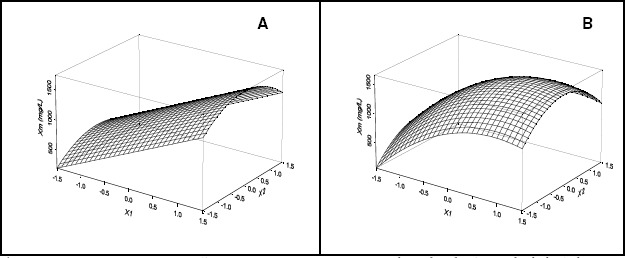
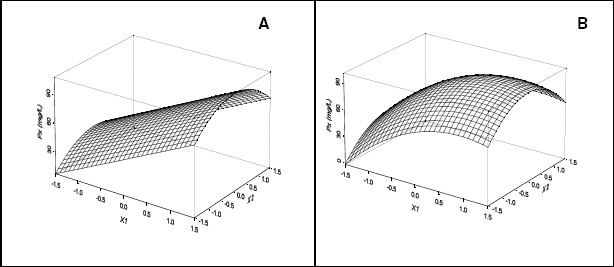
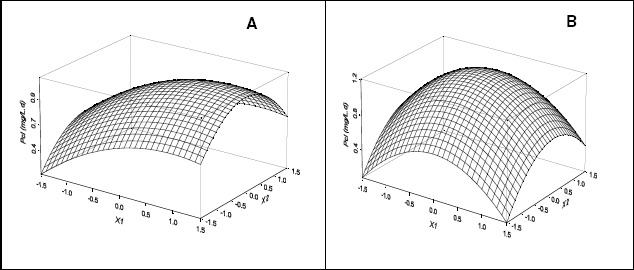
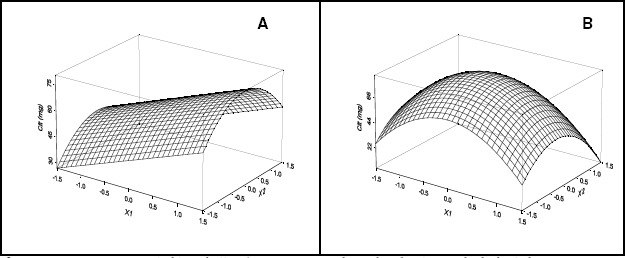
The effects of light intensity and temperature in S. platensis cultivation with potassium nitrate or urea as nitrogen source were investigated, as well as the biomass chlorophyll contents of this cyanobacteria, through the Response Surface Methodology. Experiments were performed at temperatures from 25 to 34.5ºC and light intensities from 15 to 69 µmol photons m(-2) s(-1), in mineral medium. In cultivations with both sources of nitrogen, KNO3 and urea, statistic evaluation through multiple regression, no interactions of such independent variables were detected in the results of the dependent variables maximum cell concentration, chlorophyll biomass contents, cell and chlorophyll productivities, as well as in the nitrogen-cell conversion factor. In cultivation performed with both sources of nitrogen, it was possible to obtain satisfactory adjustments to relate the dependent variables to the independent variables. The best results were achieved at temperature of 30ºC, at light intensity of 60 µmol photons m(-2)s(-1), for cell growth, with cell productivity of approximately 95 mg L(-1) d(-1) in cultivations with urea. For the chlorophyll biomass content, the most adequate light intensity was 24 µmol photons m(-2) s(-1).
Overview
The claims and statistics of this paper haven’t been checked yet.
Free: it reads the open-access text and checks the first 5 claims that cite a source we can check. Create a free account to check every claim.
Integrity signals
Registry
Cites
Statistics
Figures
Verification
Claims the paper makes
The claims and statistics of this paper haven’t been checked yet.
Free: it reads the open-access text and checks the first 5 claims that cite a source we can check. Create a free account to check every claim.
Claims other papers make about this one
Each is checked against this paper’s own text: does it say what the citing paper says it does?
The source backs part of the claim, not all of it — or backs it for a different population, condition or comparison.
In the citing paper
“Light saturation was not reached; an increase in biomass productivity could certainly be achievable with PPFD higher than 60 µ mol/m 2 /s.”
From Optimization of Arthrospira platensis (Spirulina) Growth: From Laboratory Scale to Pilot Scale (2017) · cites this paper as [21]
Experimental — accuracy not yet measuredThe source backs part of the claim, not all of it — or backs it for a different population, condition or comparison.
In the citing paper
“Two independent studies found that Spirulina final biomass concentration productivity was the highest at the highest photosynthetically photon flux density (PPFD) they used (around 60 µ mol/m 2 /s) [10,21].”
From Optimization of Arthrospira platensis (Spirulina) Growth: From Laboratory Scale to Pilot Scale (2017) · cites this paper as [21]
Experimental — accuracy not yet measured
Self-check
Percentages, sums and reported differences re-computed from the paper’s own numbers.
The self-check needs the paper’s full text.
Citations
Cites
Larcher, W. (1980) · Springer eBooks · doi:10.1007/978-3-642-96545-6 · Cited by 3,038
Spirulina Platensis Arthrospira
(1997) · doi:10.1201/9781482272970 · Cited by 704
Piorreck, M., Baasch, K.-H., & Pohl, P. (1984) · Phytochemistry · doi:10.1016/s0031-9422(00)80304-0 · Cited by 538
RELATIONS BETWEEN PIGMENT CONTENT AND PHOTOSYNTHETIC CHARACTERISTICS IN A BLUE-GREEN ALGA
Myers, J., & Kratz, W. A. (1955) · The Journal of General Physiology · doi:10.1085/jgp.39.1.11 · Cited by 333 · cited 5×
“The material was submitted to extraction with acetone and chlorophyll a was measured spectrophotometrically at 661.7 nm through a calibration curve using as standard chlorophyll a SIGMA® C6144 (13, 16, 24, 25, 29, 41).”
BackgroundMethodInfluentialSpirulina in Human Nutrition and Health
(2007) · doi:10.1201/9781420052572 · Cited by 322
Toxicity of ammonia to algae in sewage oxidation ponds
Abeliovich, A., & Azov, Y. (1976) · Applied and Environmental Microbiology · doi:10.1128/aem.31.6.801-806.1976 · Cited by 286 · cited 3×
“Y = bo + b1X1 + b2X2 + b11X1 2 + b22X2 2 + b12X1X2 (1)”
BackgroundInfluentialPhotosynthetically Active Radiation
McCree, K. J. (1981) · Physiological Plant Ecology I · doi:10.1007/978-3-642-68090-8_3 · Cited by 248 · cited 2×
“The light intensities, measured with SEKONIC 246 illuminance meter, were initially expressed in klux, and then converted to photosynthetic photon flux density (PPFD), expressed in μmol photons m s, using the conversion factor (12 μmol photons m s klux) proposed by McCree (23) for white fluorescent light.”
MethodTHE BIOCHEMISTRY AND INDUSTRIAL POTENTIAL OF SPIRULINA
Ciferri, O., & Tiboni, O. (1985) · Annual Review of Microbiology · doi:10.1146/annurev.mi.39.100185.002443 · Cited by 241 · cited 1×
“carotene and chlorophyll pigments that have been used as food and drink, cosmetic and pharmaceutical colorants are emphasized (4, 10, 31).”
BackgroundProduction of spirulina biomass: Effects of environmental factors and population density
Vonshak, A., Abeliovich, A., Boussiba, S., Arad, S., & Richmond, A. (1982) · Biomass · doi:10.1016/0144-4565(82)90028-2 · Cited by 237
Chen, F., & Zhang, Y. (1997) · Enzyme and Microbial Technology · doi:10.1016/s0141-0229(96)00116-0 · Cited by 201
Chlorophyll production from Spirulina platensis: cultivation with urea addition by fed-batch process
Rangel-Yagui, C. D. O., Danesi, E. D. G., de Carvalho, J. C. M., & Sato, S. (2004) · Bioresource Technology · doi:10.1016/j.biortech.2003.09.002 · Cited by 187
Self-citationThe Biochemistry and Industrial Potential of Spirulina
Ciferri, O. (1985) · Annual Review of Microbiology · doi:10.1146/annurev.micro.39.1.503 · Cited by 178
Danesi, E. D. G., de O. Rangel-Yagui, C., de Carvalho, J. C. M., & Sato, S. (2002) · Biomass and Bioenergy · doi:10.1016/s0961-9534(02)00054-5 · Cited by 174 · cited 4×
“7 nm through a calibration curve using as standard chlorophyll a SIGMA C6144 (13, 16, 24, 25, 29, 41).”
BackgroundMethodSelf-citationMass production of Spirulina, an edible microalga
Shimamatsu, H. (2004) · Hydrobiologia · doi:10.1023/b:hydr.0000020364.23796.04 · Cited by 169 · cited 1×
“This occurred likely because, in fed-batch process, where the cells were fed with the nitrogen source during the period of cultivation, the urea was hydrolyzed due both alkaline conditions (13) and urease (34) leading to release of ammonia, which is the preferred nitrogen source for S.”
BackgroundMoore, A. L. (1978) · FEBS Letters · doi:10.1016/0014-5793(78)80282-8 · Cited by 168
Mass culture of Spirulina outdoors--the earthrise farms experience
Belay, A. (1997) · Cited by 153
Photoinhibition and Reactivation of Photosynthesis in the Cyanobacterium Anacystis nidulans
Samuelsson, G., Lönneborg, A., Rosenqvist, E., Gustafsson, P., & Öquist, G. (1985) · Plant Physiology · doi:10.1104/pp.79.4.992 · Cited by 141 · cited 1×
“quantity of light energy higher than the minimum required for the photosynthesis (32).”
BackgroundTorzillo, G., Bernardini, P., & Masojídek, J. (1998) · Journal of Phycology · doi:10.1046/j.1529-8817.1998.340504.x · Cited by 136
Influence of inoculum age and concentration in Spirulina platensis cultivation
Pelizer, L. H., Danesi, E. D. G., Rangel, C. D. O., Sassano, C. E. N., Carvalho, J. C. M., Sato, S., & Moraes, I. O. (2003) · Journal of Food Engineering · doi:10.1016/s0260-8774(02)00209-1 · Cited by 135 · cited 1×
“collected in logarithmic growth phase (27), filtered and used in preparation of the inoculum.”
MethodSelf-citationInfluence of light and temperature on photoinhibition of photosynthesis inSpirulina platensis
Jensen, S., & Knutsen, G. (1993) · Journal of Applied Phycology · doi:10.1007/bf02182508 · Cited by 128
Spirulina: Growth, Physiology and Biochemistry
(1997) · Spirulina Platensis Arthrospira · doi:10.1201/9781482272970-11 · Cited by 115
Kebede, E., & Ahlgren, G. (1996) · Hydrobiologia · doi:10.1007/bf00016689 · Cited by 114
Mass production of Spirulina, an edible microalga
Shimamatsu, H. (2004) · Springer eBooks · doi:10.1007/978-94-007-0944-7_6 · Cited by 112
Volkmann, H., Imianovsky, U., Oliveira, J. L. B., & Sant'Anna, E. S. (2008) · Brazilian Journal of Microbiology · doi:10.1590/s1517-83822008000100022 · Cited by 109
LeDuy, A., & Zajic, J. E. (1973) · Biotechnology and Bioengineering · doi:10.1002/bit.260150412 · Cited by 102
Kinetics and bioenergetics of light‐limited photoautotrophic growth of Spirulina platensis
Lee, H. Y., Erickson, L. E., & Yang, S. S. (1987) · Biotechnology and Bioengineering · doi:10.1002/bit.260290705 · Cited by 101
Different nitrogen sources and growth responses of Spirulina platensis in microenvironments
Costa, J. A. V., Cozza, K. L., Oliveira, L., & Magagnin, G. (2001) · World Journal of Microbiology and Biotechnology · doi:10.1023/a:1011925022941 · Cited by 98 · cited 1×
“platensis growth in the batch process (11, 15).”
BackgroundOlaizola, M., & Duerr, E. O. (1990) · Journal of Applied Phycology · doi:10.1007/bf00023370 · Cited by 88 · cited 4×
“7 nm through a calibration curve using as standard chlorophyll a SIGMA C6144 (13, 16, 24, 25, 29, 41).”
BackgroundMethodInfluentialCarvalho, J. C. M., Francisco, F. R., Almeida, K. A., Sato, S., & Converti, A. (2004) · Journal of Phycology · doi:10.1111/j.1529-8817.2004.03167.x · Cited by 83 · cited 1×
“20 were considered for quadratic (b11 and b22) and interaction (b12) coefficients (7).”
BackgroundSelf-citationAmmonia Uptake in the Alkalophilic Cyanobacterium Spirulina platensis1
Boussiba, S. (1989) · Plant and Cell Physiology · doi:10.1093/oxfordjournals.pcp.a077743 · Cited by 74
Vonshak, A., Torzillo, G., & Tomaseli, L. (1994) · Journal of Applied Phycology · doi:10.1007/bf02185901 · Cited by 74
Volkmann, H., Imianovsky, U., Oliveira, J. L. B., et al. (2008) · PubMed · doi:10.1590/s1517-838220080001000022 · Cited by 73
LeDuy, A., & Samson, R. (1982) · Biotechnology Letters · doi:10.1007/bf00132830 · Cited by 70 · cited 1×
“5 M, by a potentiometer, model 710-A (Orion, Beverly, MA, USA), using a selective ammonia ion electrode, model 95-12 (Orion) (20).”
MethodHattori, A., & Myers, J. (1966) · Plant Physiology · doi:10.1104/pp.41.6.1031 · Cited by 60
Sánchez‐Luna, L. D., Bezerra, R. P., Matsudo, M. C., Sato, S., Converti, A., & de Carvalho, J. C. M. (2007) · Biotechnology and Bioengineering · doi:10.1002/bit.21097 · Cited by 48
Self-citationGitelson, A. A., Laorawat, S., Keydan, G. P., & Vonshak, A. (1995) · Journal of Phycology · doi:10.1111/j.0022-3646.1995.00828.x · Cited by 46
Principles for efficient utilization of light for mass production of photoautotrophic microorganisms
RICHMOND, A. E., & Qiang, H. (1997) · Applied Biochemistry and Biotechnology · doi:10.1007/bf02920463 · Cited by 44 · cited 1×
“They are more flexible and easily controlled, they can be operated continuously, they can be carried out in small area and periods of time, and they are not subject to climatic variations and do not drastically affect the environment (3, 30).”
BackgroundCulture Conditions stimulating high γ-Linolenic Acid accumulation by Spirulina platensis
Ronda, S. R., & Lele, S. S. (2008) · Brazilian Journal of Microbiology · doi:10.1590/s1517-83822008000400018 · Cited by 43
Culture Conditions stimulating high γ-Linolenic Acid accumulation by Spirulina platensis.
Ronda, S. R., & Lele, S. S. (2008) · PubMed · doi:10.1590/s1517-838220080004000018 · Cited by 21
Principles for Efficient Utilization of Light for Mass Production of Photoautotrophic Microorganisms
RICHMOND, A. E., & Qiang, H. (1997) · Humana Press eBooks · doi:10.1007/978-1-4612-2312-2_57 · Cited by 10
Research works printed but not linked: 3
- [12]Danesi, E.D.G. (2001). Cultivo de Spirulina platensis por processo descontínuo alimentado para obtenção de clorofila. Ph.D. thesis, University of São Paulo, Brazil, 211p.
- [15]Faintuch, B.L. (1989). Análise comparativa da produção de biomassa a partir de três cianobactérias empregando distintas fontes nitrogenadas São Paulo. Master Thesis, Faculty of Pharmaceutical Sciences, University of São Paulo, Brazil.
- [22]Lee, H.Y.; Erickson, L.E.; Yang, S.S. (1987). Kinetics and bioenergetics of light-limited photoautotrophic growth of Spirulina platensis Biotechnol. Bioeng. 29, 832–843. 18576528
Cited by
Ho, S.-H., Chan, M.-C., Liu, C.-C., Chen, C.-Y., Lee, W.-L., Lee, D.-J., & Chang, J.-S. (2014) · Bioresource Technology · doi:10.1016/j.biortech.2013.11.031 · Cited by 214
Nitrogen and phosphorus stress as a tool to induce lipid production in microalgae
Maltsev, Y., Kulikovskiy, M., & Maltseva, S. (2023) · Microbial Cell Factories · doi:10.1186/s12934-023-02244-6 · Cited by 174
“For example, urea was the predominant nitrogen source for Arthrospira platensis and Arthrospira sp. compared to nitrates [49, 53], for Chlamydomonas [54] and ammonium for Chlorella vulgaris [50], nitrate for Botryococcus braunii and Dunaliella tertiolecta [47].”
BackgroundOptimization of Arthrospira platensis (Spirulina) Growth: From Laboratory Scale to Pilot Scale
Delrue, F., Alaux, E., Moudjaoui, L., Gaignard, C., Fleury, G., Perilhou, A., Richaud, P., Petitjean, M., & Sassi, J.-F. (2017) · Fermentation · doi:10.3390/fermentation3040059 · Cited by 105
“Two independent studies found that Spirulina final biomass concentration productivity was the highest at the highest photosynthetically photon flux density (PPFD) they used (around 60 μmol/m2/s) [10,21].”
MethodNiangoran, N. U. F., Buso, D., Zissis, G., & Prudhomme, T. (2021) · OCL · doi:10.1051/ocl/2021025 · Cited by 47
Biomass production by Arthrospira platensis under different culture conditions
de Castro, G. F. P. D. S., Rizzo, R. F., Passos, T. S., Santos, B., Dias, D. D. S., Domingues, J. R., & Araújo, K. G. D. L. (2015) · Food Science and Technology · doi:10.1590/1678-457x.6421 · Cited by 47
Metadata
- Authors
- Danesi, E. D. G., Rangel-Yagui, C. O., Sato, S., & Carvalho, J. C. M. D.
- Affiliations
- Universidade Estadual de Maringá (BR)
- Universidade de São Paulo (BR)
- Corresponding author
- Danesi, Eliane Dalva Godoy
- Venue
- Brazilian Journal of Microbiology
- Publisher
- FapUNIFESP (SciELO)
- Published
- 2011-03
- Volume
- 42
- Issue
- 1
- Pages
- 362-373
- ISSN
- 1517-8382 (ISSN-L)
- PMC
- PMC3768952
- OpenAlex
- W2030606214
- Semantic Scholar
- 0a872bcb96f3e6902bcb9f5b99f1f6a9cd2f55b9
- Cited by
- 67
- References
- 37
- Citations by year
- 2026: 4 · 2025: 4 · 2024: 5 · 2023: 10 · 2022: 8 · 2021: 8 · 2020: 4 · 2019: 2 · 2018: 2 · 2017: 7 · 2016: 2 · 2015: 3 · 2014: 3 · 2013: 4 · 2012: 1
- FWCI
- 1.06
- Type
- journal article
- Language
- en
- Open access
- hybrid
- doi.org
- Licence
- cc-by-nc
- Locations
- Brazilian Journal of Microbiology (publishedVersion, cc-by-nc)
- Europe PMC (PubMed Central) (publishedVersion, cc-by-nc)
- PubMed Central (publishedVersion, cc-by-nc)
- PubMed (publishedVersion)
- Americanae (AECID Library) (publishedVersion, other-oa)
- LA Referencia (Red Federada de Repositorios Institucionales de Publicaciones Científicas) (publishedVersion, other-oa)
- Portuguese National Funding Agency for Science, Research and Technology (RCAAP Project by FCT) (publishedVersion)
- DOAJ (DOAJ: Directory of Open Access Journals) (submittedVersion, cc-by-sa)
- Funders
- Fundação de Amparo à Pesquisa do Estado de São Paulo
- Topics
- Physical Sciences › Energy › Renewable Energy, Sustainability and the Environment › Algal biology and biofuel production
- Physical Sciences › Environmental Science › Environmental Chemistry › Aquatic Ecosystems and Phytoplankton Dynamics
- Physical Sciences › Earth and Planetary Sciences › Oceanography › Marine and coastal plant biology
- Keywords
- Spirulina platensis, cyanobacteria cultivation, light intensity, temperature, nitrogen source, potassium nitrate, urea, chlorophyll content, biomass growth, cell productivity, response surface methodology
About these checks
Registry, retraction, Cites and statistics results are computed, not judged, with one exception: a printed reference that no index lists is read once by a model before it counts as a citation error. Claims are extracted by a model and kept only when their quote appears verbatim in the text; each cited source is then checked, with a model’s help, for whether it says what the claim relies on. Those verdicts can be wrong — read the claim’s quote and the cited source before relying on one.
Statistics and arithmetic are recomputed, not judged.
Confidence bands are shown only for fields calibrated on our annotated test set. None is calibrated yet, so no band is shown.
What counts as a claim ›How we measure confidence ›How we check this ›
Are you an author, or do you see a problem with this page? Request a review
Data sources
Bibliographic data: Semantic Scholar, OpenAlex, Crossref.
Contains information from the Semantic Scholar Academic Graph Datasets, made available under the ODC Attribution License (ODC-BY 1.0).
Semantic Scholar’s data is described in: Kinney, R., et al. (2023). The Semantic Scholar Open Data Platform. arXiv:2301.10140.
