

Growth and content of Spirulina platensis biomass chlorophyll cultivated at different values of light intensity and temperature using different nitrogen sources
Open accessThe DOI matches its Crossref record; 40 of the 40 references it cites were found in a registry or an index.
Abstract
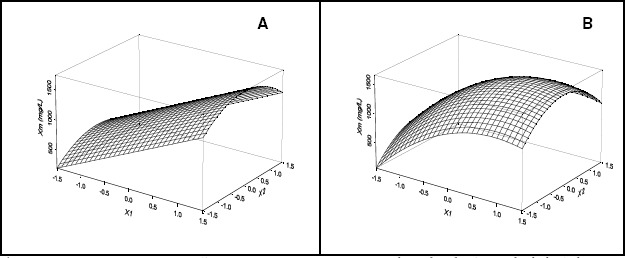
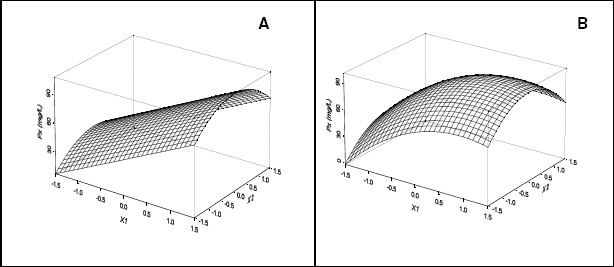
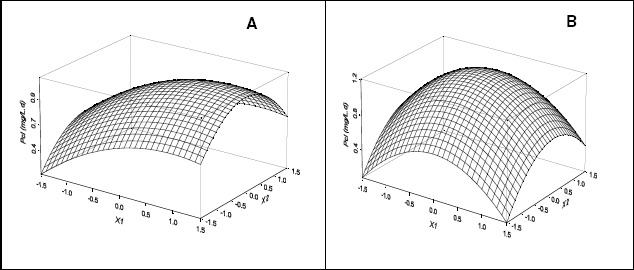
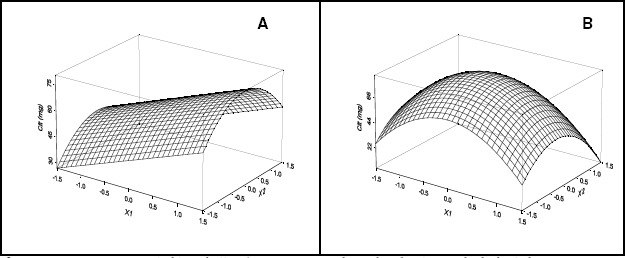
The effects of light intensity and temperature in S. platensis cultivation with potassium nitrate or urea as nitrogen source were investigated, as well as the biomass chlorophyll contents of this cyanobacteria, through the Response Surface Methodology. Experiments were performed at temperatures from 25 to 34.5ºC and light intensities from 15 to 69 µmol photons m(-2) s(-1), in mineral medium. In cultivations with both sources of nitrogen, KNO3 and urea, statistic evaluation through multiple regression, no interactions of such independent variables were detected in the results of the dependent variables maximum cell concentration, chlorophyll biomass contents, cell and chlorophyll productivities, as well as in the nitrogen-cell conversion factor. In cultivation performed with both sources of nitrogen, it was possible to obtain satisfactory adjustments to relate the dependent variables to the independent variables. The best results were achieved at temperature of 30ºC, at light intensity of 60 µmol photons m(-2)s(-1), for cell growth, with cell productivity of approximately 95 mg L(-1) d(-1) in cultivations with urea. For the chlorophyll biomass content, the most adequate light intensity was 24 µmol photons m(-2) s(-1).
Overview
The claims and statistics of this paper haven’t been checked yet.
Free: it reads the open-access text and checks the first 5 claims that cite a source we can check. Create a free account to check every claim.
Integrity signals
Registry
Cites
Statistics
Figures
Verification
Claims the paper makes
The claims and statistics of this paper haven’t been checked yet.
Free: it reads the open-access text and checks the first 5 claims that cite a source we can check. Create a free account to check every claim.
Claims other papers make about this one
Each is checked against this paper’s own text: does it say what the citing paper says it does?
The source backs part of the claim, not all of it — or backs it for a different population, condition or comparison.
In the citing paper
“Light saturation was not reached; an increase in biomass productivity could certainly be achievable with PPFD higher than 60 µ mol/m 2 /s.”
From Optimization of Arthrospira platensis (Spirulina) Growth: From Laboratory Scale to Pilot Scale (2017) · cites this paper as [21]
Experimental — accuracy not yet measuredThe source backs part of the claim, not all of it — or backs it for a different population, condition or comparison.
In the citing paper
“Two independent studies found that Spirulina final biomass concentration productivity was the highest at the highest photosynthetically photon flux density (PPFD) they used (around 60 µ mol/m 2 /s) [10,21].”
From Optimization of Arthrospira platensis (Spirulina) Growth: From Laboratory Scale to Pilot Scale (2017) · cites this paper as [21]
Experimental — accuracy not yet measured
Self-check
Percentages, sums and reported differences re-computed from the paper’s own numbers.
The self-check needs the paper’s full text.
Citations
Cites
Larcher, W. (1980) · Springer eBooks · doi:10.1007/978-3-642-96545-6 · Cited by 3,038
Spirulina Platensis Arthrospira
(1997) · doi:10.1201/9781482272970 · Cited by 704
Piorreck, M., Baasch, K.-H., & Pohl, P. (1984) · Phytochemistry · doi:10.1016/s0031-9422(00)80304-0 · Cited by 538
RELATIONS BETWEEN PIGMENT CONTENT AND PHOTOSYNTHETIC CHARACTERISTICS IN A BLUE-GREEN ALGA
Myers, J., & Kratz, W. A. (1955) · The Journal of General Physiology · doi:10.1085/jgp.39.1.11 · Cited by 333 · cited 5×
“The material was submitted to extraction with acetone and chlorophyll a was measured spectrophotometrically at 661.7 nm through a calibration curve using as standard chlorophyll a SIGMA® C6144 (13, 16, 24, 25, 29, 41).”
BackgroundMethodInfluentialSpirulina in Human Nutrition and Health
(2007) · doi:10.1201/9781420052572 · Cited by 322
Toxicity of ammonia to algae in sewage oxidation ponds
Abeliovich, A., & Azov, Y. (1976) · Applied and Environmental Microbiology · doi:10.1128/aem.31.6.801-806.1976 · Cited by 286 · cited 3×
“Y = bo + b1X1 + b2X2 + b11X1 2 + b22X2 2 + b12X1X2 (1)”
BackgroundInfluentialPhotosynthetically Active Radiation
McCree, K. J. (1981) · Physiological Plant Ecology I · doi:10.1007/978-3-642-68090-8_3 · Cited by 248 · cited 2×
“The light intensities, measured with SEKONIC 246 illuminance meter, were initially expressed in klux, and then converted to photosynthetic photon flux density (PPFD), expressed in μmol photons m s, using the conversion factor (12 μmol photons m s klux) proposed by McCree (23) for white fluorescent light.”
MethodTHE BIOCHEMISTRY AND INDUSTRIAL POTENTIAL OF SPIRULINA
Ciferri, O., & Tiboni, O. (1985) · Annual Review of Microbiology · doi:10.1146/annurev.mi.39.100185.002443 · Cited by 241 · cited 1×
“carotene and chlorophyll pigments that have been used as food and drink, cosmetic and pharmaceutical colorants are emphasized (4, 10, 31).”
BackgroundProduction of spirulina biomass: Effects of environmental factors and population density
Vonshak, A., Abeliovich, A., Boussiba, S., Arad, S., & Richmond, A. (1982) · Biomass · doi:10.1016/0144-4565(82)90028-2 · Cited by 237
Chen, F., & Zhang, Y. (1997) · Enzyme and Microbial Technology · doi:10.1016/s0141-0229(96)00116-0 · Cited by 201
Research works printed but not linked: 3
- [12]Danesi, E.D.G. (2001). Cultivo de Spirulina platensis por processo descontínuo alimentado para obtenção de clorofila. Ph.D. thesis, University of São Paulo, Brazil, 211p.
- [15]Faintuch, B.L. (1989). Análise comparativa da produção de biomassa a partir de três cianobactérias empregando distintas fontes nitrogenadas São Paulo. Master Thesis, Faculty of Pharmaceutical Sciences, University of São Paulo, Brazil.
- [22]Lee, H.Y.; Erickson, L.E.; Yang, S.S. (1987). Kinetics and bioenergetics of light-limited photoautotrophic growth of Spirulina platensis Biotechnol. Bioeng. 29, 832–843. 18576528
Cited by
Ho, S.-H., Chan, M.-C., Liu, C.-C., Chen, C.-Y., Lee, W.-L., Lee, D.-J., & Chang, J.-S. (2014) · Bioresource Technology · doi:10.1016/j.biortech.2013.11.031 · Cited by 214
Nitrogen and phosphorus stress as a tool to induce lipid production in microalgae
Maltsev, Y., Kulikovskiy, M., & Maltseva, S. (2023) · Microbial Cell Factories · doi:10.1186/s12934-023-02244-6 · Cited by 174
“For example, urea was the predominant nitrogen source for Arthrospira platensis and Arthrospira sp. compared to nitrates [49, 53], for Chlamydomonas [54] and ammonium for Chlorella vulgaris [50], nitrate for Botryococcus braunii and Dunaliella tertiolecta [47].”
BackgroundOptimization of Arthrospira platensis (Spirulina) Growth: From Laboratory Scale to Pilot Scale
Delrue, F., Alaux, E., Moudjaoui, L., Gaignard, C., Fleury, G., Perilhou, A., Richaud, P., Petitjean, M., & Sassi, J.-F. (2017) · Fermentation · doi:10.3390/fermentation3040059 · Cited by 105
“Two independent studies found that Spirulina final biomass concentration productivity was the highest at the highest photosynthetically photon flux density (PPFD) they used (around 60 μmol/m2/s) [10,21].”
MethodNiangoran, N. U. F., Buso, D., Zissis, G., & Prudhomme, T. (2021) · OCL · doi:10.1051/ocl/2021025 · Cited by 47
Biomass production by Arthrospira platensis under different culture conditions
de Castro, G. F. P. D. S., Rizzo, R. F., Passos, T. S., Santos, B., Dias, D. D. S., Domingues, J. R., & Araújo, K. G. D. L. (2015) · Food Science and Technology · doi:10.1590/1678-457x.6421 · Cited by 47
Development of Cassava Doughnuts Enriched with Spirulina platensis Biomass
Rabelo, S. F., Lemes, A. C., Takeuchi, K. P., Frata, M. T., Carvalho, J. C. M. D., & Danesi, E. D. G. (2013) · Brazilian Journal of Food Technology · doi:10.1590/s1981-67232013005000001 · Cited by 39
“3 Results and discussion The S. platensis was cultivated under conditions defined in previous works (DANESI et al., 2002, 2004, 2011; RANGEL-YAGUI et al., 2004) in order to avoid ammonia toxicity, and showed typical cellular growth.”
MethodSelf-citationMassoud, R., Khosravi-Darani, K., Nakhsaz, F., & Varga, L. (2016) · Czech Journal of Food Sciences · doi:10.17221/289/2015-cjfs · Cited by 36
Tourang, M., Baghdadi, M., Torang, A., & Sarkhosh, S. (2017) · International Journal of Environmental Science and Technology · doi:10.1007/s13762-017-1592-8 · Cited by 40
Cheirsilp, B., Mandik, Y. I., & Prasertsan, P. (2015) · Aquaculture International · doi:10.1007/s10499-015-9927-2 · Cited by 37
Sankarapandian, V., Nitharsan, K., Parangusadoss, K., Gangadaran, P., Ramani, P., Maran, B. A. V., & Jogalekar, M. P. (2022) · BioTech · doi:10.3390/biotech11020013 · Cited by 30
(2014) · Universiti Putra Malaysia Institutional Repository (Universiti Putra Malaysia) · Cited by 23
Lim, H. R., Khoo, K. S., Chew, K. W., Teo, M. Y. M., Ling, T. C., Alharthi, S., Alsanie, W. F., & Show, P. L. (2024) · IEEE Internet of Things Journal · doi:10.1109/jiot.2023.3296525 · Cited by 22
“Although some microalgae strains can tolerate slightly higher or lower temperatures, the optimal temperatures for Spirulina cultivation typically range from 28 ◦ C–30 ◦ C [20], [21].”
BackgroundDianursanti, D., Siregar, A. F., Maeda, Y., Yoshino, T., & Tanaka, T. (2020) · International Journal of Technology · doi:10.14716/ijtech.v11i5.4331 · Cited by 19
“Thus, the photosynthesis rate was higher than the respiration rate, and it led to an increase in cell concentration (Danesi et al., 2011; Dianursanti et al., 2016).”
BackgroundYahia, M. A. F., Aisha, S., & Saifeldin, A. F. E. N. (2013) · AFRICAN JOURNAL OF BIOTECHNOLOGY · doi:10.5897/ajb2013.12234 · Cited by 18
“…growth In literature, the interaction between illumination and temperature on the growth of S. platensis was extensively studied showing that at low temperature, the photo inhibition effect is more accentuated and results in low cells concentrations and productivities (Danesi et al., 2011).”
InfluentialSoreanu, G., Crețescu, I., Diaconu, M., Cojocaru, C., Ignat, M., Samoilă, P., & Harabagiu, V. (2020) · Chemosphere · doi:10.1016/j.chemosphere.2020.128465 · Cited by 17
Producción de pigmentos procedentes de Arthrospira maxima cultivada en fotobiorreactores
Maza, L. R., Guevara, M., Gómez, B., Arredondo-Vega, B. O., Cortez, R., & Licet, B. (2017) · Revista Colombiana de Biotecnología · doi:10.15446/rev.colomb.biote.v19n1.59671 · Cited by 17
“Los resultados del contenido de clorofila a en esta investigación coinciden con lo reportado por Godoy et al. (2011), y Parages et al. (2012), quienes encontraron en Arthrospira contenidos de este pigmento entre 0,6–1,6%.”
Backgroundda Silva, S. P. D. S., Perrone, D., & do Valle, A. F. (2021) · Journal of Applied Phycology · doi:10.1007/s10811-021-02601-1 · Cited by 16
Wastewater from the demineralization of cheese whey for cost-efficient cultivation of spirulina
Lucáková, S., Brányiková, I., Brányik, T., Matoulková, D., & Krausová, G. (2021) · Journal of Applied Phycology · doi:10.1007/s10811-021-02644-4 · Cited by 15
“1) and reduced medium costs achieved by replacement of nitrate with urea are consistent with other studies that investigated the use of urea as a better nitrogen source for large-scale cultivation of spirulina (Fox 1996; Danesi et al. 2011; Rizal et al. 2017).”
ResultJunique, L., Watier, L., Lejeune, H., Viudes, F., Deblieck, M., & Watier, D. (2021) · Bioresource Technology Reports · doi:10.1016/j.biteb.2021.100763 · Cited by 21
Dianursanti, Indraputri, C. M., & Taurina, Z. (2018) · AIP conference proceedings · doi:10.1063/1.5023960 · Cited by 15
Liu, J. (2013) · Journal of Applied Phycology · doi:10.1007/s10811-013-0099-z · Cited by 14
The Bioeconomy of Production of Microalgal Pigments
Jeevanandam, J., Choudhary, V., Selvam, J. D., & Danquah, M. K. (2020) · Springer eBooks · doi:10.1007/978-3-030-50971-2_14 · Cited by 15
Mahrouqi, H. A., Naqqiuddin, M. A., Achankunju, J., Omar, H., & Ismail, A. S. (2015) · Cited by 17
Effect of commercial NPK fertilizer on growth and biomass of Navicula sp. and Nannochloropsis sp
Lathifah, W., Fikri, R. A., Hidayati, N. A., Anggraini, I. D., Putri, N. K., Prabowo, B., & Marno, S. (2021) · IOP Conference Series Earth and Environmental Science · doi:10.1088/1755-1315/762/1/012060 · Cited by 12
Streit, N. M., Mérida, L. G. R., Zepka, L. Q., Lopes, E. J., & QUEIROZ, M. I. (2017) · Ingeniare. Revista chilena de ingeniería · doi:10.4067/s0718-33052017000200350 · Cited by 12
“Los autores informaron un aumento del 29% en la producción de este pigmento en condiciones de 2 klux de intensidad luminosa y 30 oC, en comparación con los cultivos que crecieron a 5 klux a la misma temperatura [27].”
BackgroundRajput, S. D., & Keshavkant, S. (2025) · Chemical Engineering Journal · doi:10.1016/j.cej.2025.163585 · Cited by 11
Nghinaunye, T., Waldeck, P., Jung, C. G. H., Küpper, J. ‐., Jung, F., & Braune, S. (2023) · Clinical Hemorheology and Microcirculation · doi:10.3233/ch-238104 · Cited by 11
Assaye, H., Belay, A., Haki, G. D., & Gray, D. A. (2017) · Journal of Applied Phycology · doi:10.1007/s10811-017-1359-0 · Cited by 10
“concentration of chlorophyll a in wet season biomass might be associated with light limitation due to clouds during this season (Zinabu 2002) as cyanobacteria produce higher amounts of chlorophyll a to optimize the light harvesting process in lower light intensities (Ravelonandro et al. 2008; Danesi et al. 2012).”
Cultivation Conditions and Operating Modes in Large-Scale Microalgae Processes
Ahamefule, C. S., Osilo, C. B., Idenyi, J. N., Ogbonna, I. O., & Ogbonna, J. C. (2025) · Grand challenges in biology and biotechnology · doi:10.1007/978-3-031-84282-5_3 · Cited by 11
Biogas Production from Arthrospira platensis Biomass
Hawrot-Paw, M., Koniuszy, A., Ratomski, P., Sąsiadek, M., & Gawlik, A. (2023) · Energies · doi:10.3390/en16103971 · Cited by 8
Pelagatti, M., Mori, G., Falsini, S., Ballini, R., Lazzara, L., & Papini, A. (2023) · Microorganisms · doi:10.3390/microorganisms11051236 · Cited by 9
Naqqiuddin, M. A., Nor, N. M., Omar, H., & Ismail, A. S. (2014) · Cited by 14
Hussin, A. A., To, S. W., Sani, M. H., Amin, M. F. M., & Kamaroddin, M. F. (2021) · IOP Conference Series: Earth and Environmental Science · doi:10.1088/1755-1315/842/1/012036 · Cited by 7
“[23], at the beginning of cultivation, there are few cells per unit of volume in the vessel and the quantity of light energy received by each cell is higher than the minimum required for the photosynthesis, increasing the cell concentration of the microalgae.”
BackgroundMirhosseini, N. Z., Davarnejad, R., Hallajisani, A., Cano-Europa, E., & Tavakoli, O. (2022) · International Journal of Engineering · doi:10.5829/ije.2022.35.03c.03 · Cited by 7
Sathinathan, P., Parab, H. M., Yusoff, R. B., & Ngoh, G. C. (2025) · Biomass and Bioenergy · doi:10.1016/j.biombioe.2025.108088 · Cited by 10
Production of Photosynthetic Pigments from Spirulina platensis Under Different Light Intensities
Kusumaningtyas, P., Gultom, S. D., & Usman, U. Z. (2023) · BERKALA SAINSTEK · doi:10.19184/bst.v11i3.38474 · Cited by 7
“Some previous studies have reported the effect of light intensity on the growth and pigment production of S. platensis [6], [7].”
BackgroundEvaluation on microalgae for the production of bio-chemicals and electricity
Khairuddin, F., Fuzi, S. F. Z. M., Ahmad, A., Oon, L. K., Bokhari, A., Dailin, D. J., Habila, M. A., Nawaz, A., & Chuah, L. F. (2023) · Chemosphere · doi:10.1016/j.chemosphere.2023.141007 · Cited by 6
Vásquez-Villalobos, V., Vergaray, D., Méndez, J., Barrios, I., Baquedano, R., Caldas, C. S., da Cruz, J. B. F., Gamboa, J., & Rivera, I. (2017) · Scientia Agropecuaria · doi:10.17268/sci.agropecu.2017.01.04 · Cited by 8
Yuan, R., Yu, C.-L., Xu, R., Liu, J., Zhou, L., Shao, S., Qian, J., Li, J., Xu, P., & Zhou, W. (2025) · Chemical Engineering Journal · doi:10.1016/j.cej.2025.171405 · Cited by 4
Ainas, M., Tir, M., Mameri, N., & Bouarab, R. (2022) · PLANT ARCHIVES · doi:10.51470/plantarchives.2022.v22.no2.089 · Cited by 4
“In open and closed cultures, various parameters greatly influence the growth of Spirulina platensis including pH, light intensity, inoculum level and culture contamination (Xie et al., 2015; Vonshak et al., 1982; Richmond, 2004; Danesi et al., 2011).”
Paramanya, A., Abiodun, A. O., Ola, M. S., & Ali, A. (2024) · Chemistry & Biodiversity · doi:10.1002/cbdv.202400281 · Cited by 4
Maldonado-Ortiz, A. J., Arízaga, G. G. C. C., Camacho-Ruiz, R. M., la Rosa, J. D. P.-D., Panikar, S. S., & Khandual, S. (2026) · Biofuels Bioproducts and Biorefining · doi:10.1002/bbb.70173 · Cited by 3
“31,32 As there have been very few reports on S. subsalsa to date, this strain is highlighted due to its ease of cultivation and harvesting compared with Chlorella .”
Hidayati, N. A., Anggraini, I. D., Marno, S., Fikri, R. A., Lathifah, W., Putri, N. K., FITRIANI, I. N., Prabowo, B., & FITRIANI, R. (2022) · IOP Conference Series Earth and Environmental Science · doi:10.1088/1755-1315/1034/1/012021 · Cited by 5
“Since urea delivers two N atoms per molecule, cells received more N than cells grown under medium without urea [21].”
BackgroundIslam, Z., Khatoon, H., Rahman, M. R., Hasan, J., & Hasan, S. J. (2022) · doi:10.60015/bjvas/v09i2a9 · Cited by 3
Arboleda, A. M. (2023) · Journal of International Food & Agribusiness Marketing · doi:10.1080/08974438.2023.2270612 · Cited by 3
“Its composition is at least 55% protein and can reach up to 70% (Danesi, Rangel-Yagui, Sato, & de Carvalho, 2011; Lafarga et al., 2020).”
Fakhri, M., Astryanti, S., Arifin, N. B., Putriani, O., Zalni, A., Riyani, E., Adi, B., Yuniastutik, T., Yuniarti, A., & Hariati, A. M. (2024) · Journal of Microbiology Biotechnology and Food Sciences · doi:10.55251/jmbfs.10127 · Cited by 3
Nutrient Balance and Nitrogen Cycling In a Multistage, Multispecies Space Farm
Meyer, B. L., & Shepherd, N. S. (2016) · AIAA SPACE 2016 · doi:10.2514/6.2016-5586 · Cited by 3
Mulokozi, D. P., Mtolera, M. S. P., & Mmochi, A. J. (2019) · International Journal of Biological and Chemical Sciences · doi:10.4314/ijbcs.v13i2.23 · Cited by 6
Wu, Y., Wang, X., & Li, H. (2020) · Wiley eBooks · doi:10.1002/9781119143802.ch63 · Cited by 3
Influence of Bio-AgNP on Growth and Biochemical Composition of Spirulina platensis
Nartop, P., & Kuşku, E. (2023) · Biology Bulletin · doi:10.1134/s1062359023601015 · Cited by 2
“This result showed that chlorophyll-a content decreased distinctly as the concentration of bio-AgNPs became higher than 15 mg/L. Chen et al. (2010) and Danesi et al. (2011) reported that chlorophyll-a content of S. platensis at higher illumination rates at 1.8 and 1.51%, respectively.”
InfluentialEconomically Potential Pigments from Marine Blue-Green Algae for the Application in Food and Health
Salim, K. P., Chandra, R. D., Heriyanto, H., Susilaningsih, D., Limantara, L., & Brotosudarmo, T. H. P. (2019) · Indonesian Journal of Natural Pigments · doi:10.33479/ijnp.2019.01.2.37 · Cited by 2
Mirhosseini, N. Z., Davarnejad, R., Hallajisani, A., Tavakoli, O., & Cano-Europa, E. (2021) · International Journal of Engineering · doi:10.5829/ije.2021.34.07a.01 · Cited by 2
(2022) · Asian Journal of Agriculture and Biology · doi:10.35495/ajab.2021.05.220 · Cited by 3
“The chlorophyll of S. platensis is determined by the nutrient, light and temperature (Danesi et al., 2011).”
BackgroundProduction of Spirulina platensis Using Inexpensive Local Resources in Palestine
Al-Jabali, I., Qutob, A., Alkhatib, M., & Qutob, M. (2024) · Journal of Environmental Protection · doi:10.4236/jep.2024.153021 · Cited by 2
Zidane, S., Bouleghlem, H., & Seghir, A. M. (2022) · Emirates Journal of Food and Agriculture · doi:10.9755/ejfa.2022.v34.i9.2879 · Cited by 1
Kiefer, M., Bottenbruch, B., Sprißler, A.-K., Knörle, S., Witt, A., & Frühwirth, H. (2024) · CyTA - Journal of Food · doi:10.1080/19476337.2024.2331067 · Cited by 1
“Furthermore, an oversupply of magnesium seems to increase the growth rate of A. platensis and could be related to a higher production of chlorophyll-a (Danesi et al., 2011).”
Changes in cyanobacterial growth and photosynthetic pigment under different conditions
Seyedabadi, M., Zaker, A., Akhar, F. K., & Ameri, M. (2026) · Microbiology Spectrum · doi:10.1128/spectrum.03782-25 · Cited by 1
“In Anabaena sp., on the 15th day, chlorophyll a , total carotenoids, and PC content reached their peaks under low-light conditions, with significantly higher concentrations than those observed under high-light exposure (37 studies (38, 39).”
Spirulina Optimization Using Cane Molasses as the Cost-Effective Alternative of Sodium Bicarbonate
Mahrouqi, H. A., Dobretsov, S., Avilés, A., & Abdala‐Díaz, R. (2022) · Biology Bulletin · doi:10.1134/s106235902213012x · Cited by 1
Design and development of an automated spirulina (Arthrospira platensis) algae cultivator
Mariñas II, M. Q., B. Enojas, M. J., Balolong, D. C., B. Correa, C. Z., C. Roldan, L. K., Teves, M. L., & Dela Cruz, C. M. (2025) · Indonesian Journal of Electrical Engineering and Computer Science · doi:10.11591/ijeecs.v39.i1.pp139-147
“It was found out that there are different factors that affect the growth of spirulina algae such as ph, light intensity, and temperature [5].”
Rodrigues, M. S. (2012) · Digital Library of Theses and Dissertations (Universidade de São Paulo) · doi:10.11606/t.9.2012.tde-12092012-143000
Mass Flows, Flow Control, and Tradeoffs for a Spectrum of Multistage Evolving Space Farms
Meyer, B. L. (2017) · AIAA SPACE and Astronautics Forum and Exposition · doi:10.2514/6.2017-5363
Mahrouqi, H. A., Kader, M. A. N. A., Achankunju, J., Omar, H., & Ismail, A. S. (2014) · Universiti Putra Malaysia Institutional Repository (Universiti Putra Malaysia)
Osman, N. (2018) · Universiti Putra Malaysia Institutional Repository (Universiti Putra Malaysia)
Maroubo, L. A. (2021) · Digital Library of Theses and Dissertations (Universidade de São Paulo) · doi:10.11606/t.18.2021.tde-29042022-174400
Kiatmontri, J., & Ruangsomboon, S. (2023) · King Mongkut s Agricultural Journal · doi:10.55003/kmaj.2023.04.30.011
Evaluation of the effects of immobilization on Spirulina platensis cultures
Nartop, P., & Kuşku, E. (2024) · Bulletin of Biotechnology · doi:10.51539/biotech.1560848
Sukumaran, P. (2017) · Universiti Putra Malaysia Institutional Repository (Universiti Putra Malaysia)
Improved technologies for production of biomass and bioactive compounds by marine microalgae
Assunção, J. (2023) · Portuguese National Funding Agency for Science, Research and Technology (RCAAP Project by FCT) · doi:10.34626/bxe6-dr46
Combe, C. (2016) · theses.fr (ABES) · doi:10.70675/907047e7z2f22z4fdez87bfz9feb8acfe8d7 · Cited by 2
Azarmi, R., Teymurluyi, A. N., Esmaielpour, B., Giglou, R. H., & Nasrabadi, S. A. (2026) · Iranian Journal of Science · doi:10.1007/s40995-026-02008-y
“The results of this study were consistent with those of studies conducted by Danesi et al. (2011) and Soni et al. (2019), which reported that the chlorophyll a content increased with increasing nitrogen concentration.”
Two-stage cultivation strategy for enhanced bioactive productivity in Spirulina platensis
Sun, J., Gawali, S., & Juneja, A. (2026) · Algal Research · doi:10.1016/j.algal.2026.105001
Metadata
- Authors
- Danesi, E. D. G., Rangel-Yagui, C. O., Sato, S., & Carvalho, J. C. M. D.
- Affiliations
- Universidade Estadual de Maringá (BR)
- Universidade de São Paulo (BR)
- Corresponding author
- Danesi, Eliane Dalva Godoy
- Venue
- Brazilian Journal of Microbiology
- Publisher
- FapUNIFESP (SciELO)
- Published
- 2011-03
- Volume
- 42
- Issue
- 1
- Pages
- 362-373
- ISSN
- 1517-8382 (ISSN-L)
- PMC
- PMC3768952
- OpenAlex
- W2030606214
- Semantic Scholar
- 0a872bcb96f3e6902bcb9f5b99f1f6a9cd2f55b9
- Cited by
- 67
- References
- 37
- Citations by year
- 2026: 4 · 2025: 4 · 2024: 5 · 2023: 10 · 2022: 8 · 2021: 8 · 2020: 4 · 2019: 2 · 2018: 2 · 2017: 7 · 2016: 2 · 2015: 3 · 2014: 3 · 2013: 4 · 2012: 1
- FWCI
- 1.06
- Type
- journal article
- Language
- en
- Open access
- hybrid
- doi.org
- Licence
- cc-by-nc
- Locations
- Brazilian Journal of Microbiology (publishedVersion, cc-by-nc)
- Europe PMC (PubMed Central) (publishedVersion, cc-by-nc)
- PubMed Central (publishedVersion, cc-by-nc)
- PubMed (publishedVersion)
- Americanae (AECID Library) (publishedVersion, other-oa)
- LA Referencia (Red Federada de Repositorios Institucionales de Publicaciones Científicas) (publishedVersion, other-oa)
- Portuguese National Funding Agency for Science, Research and Technology (RCAAP Project by FCT) (publishedVersion)
- DOAJ (DOAJ: Directory of Open Access Journals) (submittedVersion, cc-by-sa)
- Funders
- Fundação de Amparo à Pesquisa do Estado de São Paulo
- Topics
- Physical Sciences › Energy › Renewable Energy, Sustainability and the Environment › Algal biology and biofuel production
- Physical Sciences › Environmental Science › Environmental Chemistry › Aquatic Ecosystems and Phytoplankton Dynamics
- Physical Sciences › Earth and Planetary Sciences › Oceanography › Marine and coastal plant biology
- Keywords
- Spirulina platensis, cyanobacteria cultivation, light intensity, temperature, nitrogen source, potassium nitrate, urea, chlorophyll content, biomass growth, cell productivity, response surface methodology
About these checks
Registry, retraction, Cites and statistics results are computed, not judged, with one exception: a printed reference that no index lists is read once by a model before it counts as a citation error. Claims are extracted by a model and kept only when their quote appears verbatim in the text; each cited source is then checked, with a model’s help, for whether it says what the claim relies on. Those verdicts can be wrong — read the claim’s quote and the cited source before relying on one.
Statistics and arithmetic are recomputed, not judged.
Confidence bands are shown only for fields calibrated on our annotated test set. None is calibrated yet, so no band is shown.
What counts as a claim ›How we measure confidence ›How we check this ›
Are you an author, or do you see a problem with this page? Request a review
Data sources
Bibliographic data: Semantic Scholar, OpenAlex, Crossref.
Contains information from the Semantic Scholar Academic Graph Datasets, made available under the ODC Attribution License (ODC-BY 1.0).
Semantic Scholar’s data is described in: Kinney, R., et al. (2023). The Semantic Scholar Open Data Platform. arXiv:2301.10140.
