

Clomiphene citrate treatment for late onset hypogonadism: rise and fall
Open accessThe DOI matches its Crossref record; 23 of the 23 references it cites were found in a registry or an index; 1 of the 22 sources its claims cite were checked for support.
Abstract
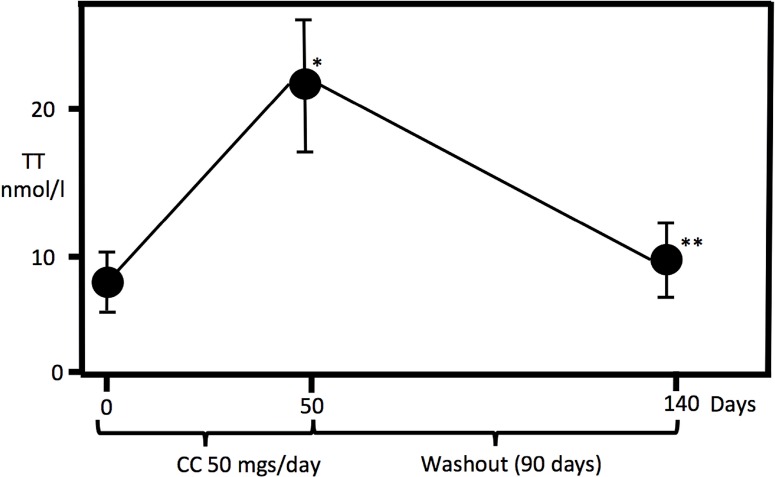
OBJECTIVE: Previous series have demonstrated that Clomiphene Citrate (CC) is an effective treatment to increase Total Testosterone (TT) in Late Onset Hypogonadism (LOH) patients. However, what happens to TT levels after ending CC treatment is still debatable. The objective of this study is to evaluate TT levels 3 months after the discontinuation of CC in patients with LOH who were previously successfully treated with the same drug. MATERIALS AND METHODS: Twenty-seven patients with LOH that were successfully treated (achieved TT levels >11nmol/l) with CC 50mgs daily for 50 days were prospectively recruited in our Andrological outpatient clinic. CC was then stopped for 3 months and TT levels were measured at the end of this period. RESULTS: Mean TT level before discontinuation of CC was 22.7±8.1nmol/L (mean±SD). Three months after discontinuation, mean TT level significantly decreased in all pa¬tients, 10.2±3.9nmol/l (p < 0.01). Twenty-one patients (78%) decreased TT levels under 11nmol/L. Six patients (22%) had TT levels that remained within the normal recommended range (≥11nmol/l). No statistical significant differences were observed between both groups. CONCLUSION: In the short term LOH does not seem to be a reversible condition in most patients after CC treatment. More studies with longer follow-up are needed to evaluate the kinetics of TT in LOH.
Overview
CoChat Summary
TL;DR
In men with late onset hypogonadism who achieved normal total testosterone after 50 days of clomiphene citrate, total testosterone fell significantly 3 months after discontinuation, with 78% dropping below 11 nmol/L. The authors conclude LOH does not appear reversible in most patients after short-term CC, though longer follow-up is needed.
Key findings
- Mean total testosterone before discontinuation was 22.7±8.1 nmol/L; 3 months after stopping CC it was 10.2±3.9 nmol/L (p<0.01), and all 27 patients decreased.
- Twenty-one of 27 patients (78%) fell below 11 nmol/L; 6/27 (22%) remained ≥11 nmol/L at 3 months, but in those 6, testosterone later decreased to pre-treatment levels (<11 nmol/L) at 6 months.
- No statistically significant differences were observed between patients who maintained normal testosterone at 3 months and those who did not (e.g., age, previous testosterone levels).
- After testosterone increased, 5/13 (38.5%) with decreased sexual desire improved; 3/11 (27.3%) with erectile dysfunction improved, with IIEF-5 median rising from 18 (range 17–21) to 22 (range 21–24); 2/3 (66.7%) with both symptoms improved.
Methods
- Prospective study in an andrological outpatient clinic: 30 men with LOH (mean age 50.1 years, range 32–70) defined by symptoms and total testosterone <11 nmol/L on at least two measurements; 27 achieved total testosterone >11 nmol/L after CC 50 mg daily for 50 days.
- CC was then stopped for 3 months, and total testosterone was measured at the end of this period; testosterone was analyzed by electrochemiluminescence immunoassay, and LH/FSH by direct chemiluminimetric immunoassay.
- Statistical analysis used GraphPad software, paired t-test, significance at p<0.05, and results shown as mean±SD.
Limitations
- Stated by the authors: short follow-up; no evaluation of estradiol or free testosterone; no specific LOH symptom questionnaire was applied, though the authors note such questionnaires are not recommended by guidelines because of low specificity.
- Evident from the text: small sample size (27 completers; only 3 non-responders in the initial group), no control or comparator arm, and short follow-up limits conclusions about long-term safety and testosterone kinetics.
Model-written summary. Check it against the paper before relying on it.
Integrity signals
Registry
Cites
Statistics
Figures
Verification
Claims the paper makes
0 Valid · 5 Not valid · 13 Not checked · 25 Own results and interpretations
At least one cited source doesn’t support this claim or points to a different paper, and none confirmed it — see the verdicts below.
In the paper
“On the other hand, Kaminetsky and cols, and Wiehle and cols. reported that in patients with secondary hypogonadism who responded to EC therapy, once the treatment was stopped TT levels decreased and returned to the pre-treatment values (23, 25).”
§ Clomiphene citrate treatment for late onset hypogonadism: rise and fall > DISCUSSION
What the sources say
- Not checked yetcites [23] Kaminetsky J, 2013, Oral enclomiphene citrate stimulates the endogenous production of testosterone and sperm counts in men with low testosterone: comparison with testosterone gel, J Sex Med. source
A check is scheduled.
- Disputedcites [25] Wiehle R, 2013, Testosterone Restoration by Enclomiphene Citrate in Men with Secondary Hypogonadism: Pharmacodynamics and Pharmacokinetics, BJU Int. sourceExperimental — accuracy not yet measured
Our copy of Wiehle et al. 2013 says the opposite of the claim: the Abstract (Conclusions) states 'The effects on LH and total testosterone persisted for at least 1 week after stopping treatment,' and the Results report that 'Seven days after cessation of treatment... The greatest preservation of serum total testosterone was found in the enclomiphene citrate 25 mg group, in which it was found to be slightly increased.' The Discussion further describes a 'persistence or legacy effect' and 'persistence of serum total testosterone after discontinuation of enclomiphene citrate 25 mg... in sharp contrast to those men who had taken transdermal testosterone,' noting missing one or two dosing days 'would not mean that their total testosterone would drop precipitously.' The study's follow-up was only a 1-week washout (Patients and Methods, Protocol: final blood draw at 7 weeks after a 1-week washout), so it neither reports a decline nor a return to pre-treatment values in enclomiphene responders. (LLM, conf=0.85)
Checked by a reasoning model — may be wrong.
plainstates a cause- Asserted: passes — The authors put it forward as true.
- Checkable: passes — It can be checked against evidence.
- Load-bearing: passes — The paper’s conclusions depend on it.
- Based: passes — The paper gives a reason why it holds.
- Not checked yet
A result the paper reports from its own data — it cites no other source for it, so there is none to check. The quote shows it is in the paper.
In the paper
“Three months after discontinuation, mean TT level significantly decreased in all patients, 10.2±3.9nmol/l (p<0.01).”
- Also stated in: § RESULTS · plain
“All patients (n=27) significantly decreased (p<0.01) TT after discontinuation of CC (Figure-1).”
§ Clomiphene citrate treatment for late onset hypogonadism: rise and fall > Abstract > Results:
plainstates a causen = 27- Asserted: passes — The authors put it forward as true.
- Checkable: passes — It can be checked against evidence.
- Load-bearing: passes — The paper’s conclusions depend on it.
- Based: passes — The paper gives a reason why it holds.
- Also stated in: § RESULTS · plain
A result the paper reports from its own data — it cites no other source for it, so there is none to check. The quote shows it is in the paper.
In the paper
“Three months after discontinuation, mean TT level significantly decreased in all patients, 10.2±3.9nmol/l (p<0.01).”
- Also stated in: § RESULTS · plain
“Three months after discontinuation of treatment, mean TT level (n=27) was 10.2±3.9nmol/L.”
§ Clomiphene citrate treatment for late onset hypogonadism: rise and fall > Abstract > Results:
plainn = 27- Asserted: passes — The authors put it forward as true.
- Checkable: passes — It can be checked against evidence.
- Load-bearing: passes — The paper’s conclusions depend on it.
- Based: passes — The paper gives a reason why it holds.
- Also stated in: § RESULTS · plain
A result the paper reports from its own data — it cites no other source for it, so there is none to check. The quote shows it is in the paper.
In the paper
“Mean TT level before discontinuation of CC was 22.7±8.1nmol/L (mean±SD).”
§ Clomiphene citrate treatment for late onset hypogonadism: rise and fall > Abstract > Results:
plain- Asserted: passes — The authors put it forward as true.
- Checkable: passes — It can be checked against evidence.
- Load-bearing: passes — The paper’s conclusions depend on it.
- Based: passes — The paper gives a reason why it holds.
A result the paper reports from its own data — it cites no other source for it, so there is none to check. The quote shows it is in the paper.
In the paper
“No statistical significant differences were observed between both groups.”
- Also stated in: § RESULTS · plain
“No statistical significant differences were observed between the group of patients who maintained TT levels within the normal range (three months after discontinuation) and those who decreased it (i.e. age, previous TT levels).”
§ Clomiphene citrate treatment for late onset hypogonadism: rise and fall > Abstract > Results:
plainn = 27- Asserted: passes — The authors put it forward as true.
- Checkable: passes — It can be checked against evidence.
- Load-bearing: unclear — It is unclear whether the paper’s conclusions depend on it.
- Based: passes — The paper gives a reason why it holds.
- Also stated in: § RESULTS · plain
16 more claims
Create a free account to see all 43 claims and to verify the 19 references still open.
- It may state two separate claims as one. 14
- Probably not a substantial claim. 12
Claims other papers make about this one
Each is checked against this paper’s own text: does it say what the citing paper says it does?
In the citing paper
“This effect was also seen by Marconi et al. (2016) (n = 27) demonstrating during trial without CC therapy that 78% of the patients had decreased TT levels of <10 nmol/ after 3 months, and all patients had decreased TT levels of <10 nmol/L after 6 months.”
From Clomiphene citrate: A potential alternative for testosterone therapy in hypogonadal males (2023) · cites this paper as Marconi et al. (2016)
Citations
Cites
Identification of late-onset hypogonadism in middle-aged and elderly men
Wu, F. C. W., Tajar, A., Beynon, J. M., Pye, S. R., Silman, A. J., Finn, J. D., O'Neill, T. W., Bartfai, G., Casanueva, F. F., Forti, G., et al. (2010) · New England Journal of Medicine · doi:10.1056/nejmoa0911101 · Cited by 1,544 · cited 1×
“Late Onset Hypogonadism was defined according to previous consensus definition (15): -Symptoms: decreased sexual interest, decreased morning erections, erectile dysfunction.”
Prevalence of Symptomatic Androgen Deficiency in Men
Araujo, A. B., Esche, G. R., Kupelian, V., O’Donnell, A. B., Travison, T. G., Williams, R. E., Clark, R. V., & McKinlay, J. B. (2007) · The Journal of Clinical Endocrinology & Metabolism · doi:10.1210/jc.2007-1245 · Cited by 720 · cited 1×
“The exact prevalence of Late Onset Hypogonadism (LOH) is a matter of debate (1-3); however, there is consensus that it constitutes an emerging problem (4).”
BackgroundAssociation of Specific Symptoms and Metabolic Risks with Serum Testosterone in Older Men
Zitzmann, M., Faber, S., & Nieschlag, E. (2006) · The Journal of Clinical Endocrinology & Metabolism · doi:10.1210/jc.2006-0401 · Cited by 552 · cited 2×
“We know that the first is very sensitive to TT levels (18), however, extremely subjective.”
BackgroundTrends in androgen prescribing in the United States, 2001 to 2011
Baillargeon, J., Urban, R. J., Ottenbacher, K. J., Pierson, K. S., & Goodwin, J. S. (2013) · JAMA Internal Medicine · doi:10.1001/jamainternmed.2013.6895 · Cited by 336
Tajar, A., Huhtaniemi, I. T., O'Neill, T. W., Finn, J. D., Pye, S. R., Lee, D. M., Bartfai, G., Boonen, S., Casanueva, F. F. F., Forti, G., et al. (2012) · The Journal of Clinical Endocrinology & Metabolism · doi:10.1210/jc.2011-2513 · Cited by 318 · cited 1×
“The exact prevalence of Late Onset Hypogonadism (LOH) is a matter of debate (1-3); however, there is consensus that it constitutes an emerging problem (4).”
BackgroundCorrelates of low testosterone and symptomatic androgen deficiency in a population-based sample
Hall, S. A., Esche, G. R., Araujo, A. B., Travison, T. G., Clark, R. V., Williams, R. E., & McKinlay, J. B. (2008) · The Journal of Clinical Endocrinology & Metabolism · doi:10.1210/jc.2008-0021 · Cited by 167 · cited 1×
“The exact prevalence of Late Onset Hypogonadism (LOH) is a matter of debate (1-3); however, there is consensus that it constitutes an emerging problem (4).”
BackgroundGuay, A. T. (1995) · Journal of Clinical Endocrinology & Metabolism · doi:10.1210/jc.80.12.3546 · Cited by 150
Clomiphene citrate is safe and effective for long‐term management of hypogonadism
Moskovic, D. J., Katz, D. J., Akhavan, A., Park, K., & Mulhall, J. P. (2012) · BJU International · doi:10.1111/j.1464-410x.2012.10968.x · Cited by 136
Guay, A. T., Jacobson, J., Perez, J. B., Hodge, M. B., & Velasquez, E. (2003) · International Journal of Impotence Research · doi:10.1038/sj.ijir.3900981 · Cited by 128 · cited 4×
“in 2003 mentioned that in some patients with LOH, CC can be stopped and normal TT levels can be maintained (8).”
BackgroundInfluentialAndrogenic hormones during prolonged physical stress, sleep, and energy deficiency
Opstad, P. K. (1992) · Journal of Clinical Endocrinology & Metabolism · doi:10.1210/jc.74.5.1176 · Cited by 127
Research works printed but not linked: 2
- Devoto E, 2008, Postpubertal idiopathic hypothalamic functional hypogonadotrophic hypogonadism in the male, Rev Int Androl, 6, 89
- Wiehle R, 2013, Testosterone Restoration by Enclomiphene Citrate in Men with Secondary Hypogonadism: Pharmacodynamics and Pharmacokinetics, BJU Int.
Cited by
Clomiphene citrate for men with hypogonadism: a systematic review and meta‐analysis
Huijben, M., Lock, M. T. W. T., de Kemp, V. F., de Kort, L. M. O., & van Breda, H. M. K. (2022) · Andrology · doi:10.1111/andr.13146 · Cited by 65
Clomiphene citrate: A potential alternative for testosterone therapy in hypogonadal males
Huijben, M., Lock, M. T. W. T., de Kemp, V. F., Beck, J. J. H., De Kort, L. M. O., & van Breda, H. M. K. (2023) · Endocrinology, Diabetes & Metabolism · doi:10.1002/edm2.416 · Cited by 23
Pharmacological management of testosterone deficiency in men current advances and future directions
Corona, G., Rastrelli, G., Sparano, C., Vignozzi, L., Sforza, A., & Maggi, M. (2024) · Expert Review of Clinical Pharmacology · doi:10.1080/17512433.2024.2366505 · Cited by 19
The role of clomiphene citrate in late onset male hypogonadism
Ros, C. T. D., Ros, L. U. D., & da Ros, J. P. U. (2022) · International braz j urol · doi:10.1590/s1677-5538.ibju.2021.0724 · Cited by 16
Helo, S., Wynia, B., & McCullough, A. (2017) · Sexual Medicine Reviews · doi:10.1016/j.sxmr.2017.03.003 · Cited by 11
O diagnóstico genético pré-implantacional e as técnicas de reprodução humana assistida
Cantanhede, A. J. (2020) · CEUB (University Center of Brasília) · Cited by 2
Testosterone kinetics on hypogonadal men under clomiphene
Silva, É. D., da Silva, M. M., Moretti, T. B. C., Andrade, D. L., Avilez, N. D., & Reis, L. O. (2022) · International Urology and Nephrology · doi:10.1007/s11255-022-03230-4 · Cited by 1
Bandura, A., Furka, S., Hromníková, D., Kalafutová, I., Furka, D., & Böhmer, D. (2026) · Andrology · doi:10.1111/andr.70306 · Cited by 1
Kamińska, M., Strzoda, A. J., & Polak, A. (2023) · Journal of Health Study and Medicine · doi:10.2478/jhsm-2023-0018
Clomifeencitraat voor hypogonadale klachten: bijna 10 jaar ervaring
Huijben, M., & Lock, M. T. W. T. (2022) · Tijdschrift voor Urologie · doi:10.1007/s13629-022-00352-3
Câmara, L. C. (2025) · Asian Journal of Research in Medical and Pharmaceutical Sciences · doi:10.9734/ajrimps/2025/v14i1289
Metadata
- Authors
- Marconi, M., Souper, R., Hartmann, J., Alvarez, M., Fuentes, I., & Guarda, F. J.
- Affiliations
- Pontificia Universidad Católica de Chile (CL)
- Corresponding author
- Marconi, Marcelo
- Venue
- International braz j urol
- Publisher
- FapUNIFESP (SciELO)
- Published
- 2016-12
- Volume
- 42
- Issue
- 6
- Pages
- 1190-1194
- ISSN
- 1677-5538 (ISSN-L)
- PMC
- PMC5117976
- OpenAlex
- W2527855948
- Semantic Scholar
- 3887c7f2e272c097014097f31c8e76366632f606
- Cited by
- 11
- References
- 23
- Citations by year
- 2026: 1 · 2025: 1 · 2024: 1 · 2023: 2 · 2022: 4 · 2020: 1 · 2017: 1
- FWCI
- 0.20
- Type
- journal article
- Language
- en
- Open access
- diamond
- doi.org
- Licence
- cc-by
- Locations
- International braz j urol (publishedVersion, cc-by)
- PubMed Central (publishedVersion, cc-by)
- PubMed (publishedVersion)
- LA Referencia (Red Federada de Repositorios Institucionales de Publicaciones Científicas) (publishedVersion, other-oa)
- Americanae (AECID Library) (submittedVersion, other-oa)
- DOAJ (DOAJ: Directory of Open Access Journals) (submittedVersion)
- Topics
- Health Sciences › Medicine › Endocrinology, Diabetes and Metabolism › Hormonal and reproductive studies
- Health Sciences › Medicine › Reproductive Medicine › Hypothalamic control of reproductive hormones
- Health Sciences › Medicine › Endocrinology, Diabetes and Metabolism › Adrenal Hormones and Disorders
- Keywords
- clomiphene citrate, andropause, total testosterone, testosterone replacement therapy, androgen therapy
- MeSH terms
- Adult, Aged, Clomiphene, Estrogen Antagonists, Follow-Up Studies, Follicle Stimulating Hormone, Humans, Hypogonadism, Luteinizing Hormone, Middle Aged, Prospective Studies, Testosterone, Treatment Outcome
About these checks
Registry, retraction, Cites and statistics results are computed, not judged, with one exception: a printed reference that no index lists is read once by a model before it counts as a citation error. Claims are extracted by a model and kept only when their quote appears verbatim in the text; each cited source is then checked, with a model’s help, for whether it says what the claim relies on. Those verdicts can be wrong — read the claim’s quote and the cited source before relying on one.
The claim verdicts this report counts are experimental: their accuracy is not yet measured.
A language model drew the claims from the paper on 2026-11-25, under version 3 of the claim definition (model deepseek-v4.1-flash, prompt extract-v3).
A second model labelled each claim on 2026-11-25 (model jev-1.13-20260917, definition revision gold-guideline-v0.2).
Cited sources are checked with a language model’s help (qwen3.8-omni-flash).
Statistics and arithmetic are recomputed, not judged.
Confidence bands are shown only for fields calibrated on our annotated test set. None is calibrated yet, so no band is shown.
What counts as a claim ›How we measure confidence ›How we check this ›
Are you an author, or do you see a problem with this page? Request a review
Data sources
Bibliographic data: Semantic Scholar, OpenAlex, Crossref.
Contains information from the Semantic Scholar Academic Graph Datasets, made available under the ODC Attribution License (ODC-BY 1.0).
Semantic Scholar’s data is described in: Kinney, R., et al. (2023). The Semantic Scholar Open Data Platform. arXiv:2301.10140.
