

Clomiphene citrate treatment for late onset hypogonadism: rise and fall
Open accessThe DOI matches its Crossref record; 23 of the 23 references it cites were found in a registry or an index; none of the 22 sources its claims cite is checked for support yet.
Abstract
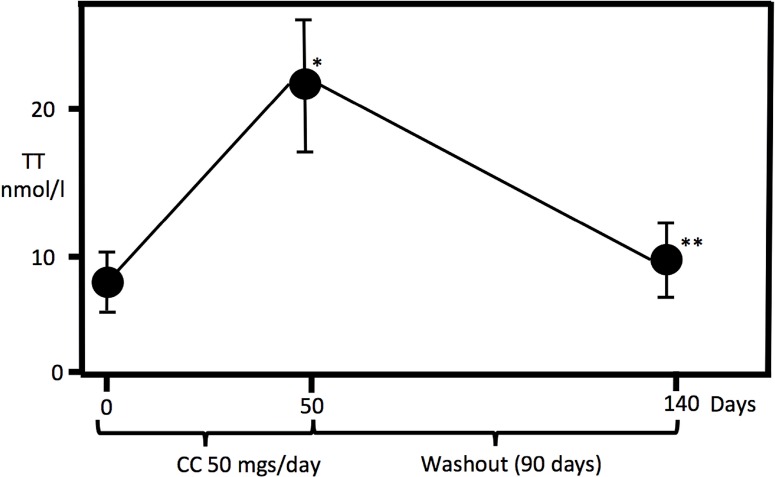
OBJECTIVE: Previous series have demonstrated that Clomiphene Citrate (CC) is an effective treatment to increase Total Testosterone (TT) in Late Onset Hypogonadism (LOH) patients. However, what happens to TT levels after ending CC treatment is still debatable. The objective of this study is to evaluate TT levels 3 months after the discontinuation of CC in patients with LOH who were previously successfully treated with the same drug. MATERIALS AND METHODS: Twenty-seven patients with LOH that were successfully treated (achieved TT levels >11nmol/l) with CC 50mgs daily for 50 days were prospectively recruited in our Andrological outpatient clinic. CC was then stopped for 3 months and TT levels were measured at the end of this period. RESULTS: Mean TT level before discontinuation of CC was 22.7±8.1nmol/L (mean±SD). Three months after discontinuation, mean TT level significantly decreased in all pa¬tients, 10.2±3.9nmol/l (p < 0.01). Twenty-one patients (78%) decreased TT levels under 11nmol/L. Six patients (22%) had TT levels that remained within the normal recommended range (≥11nmol/l). No statistical significant differences were observed between both groups. CONCLUSION: In the short term LOH does not seem to be a reversible condition in most patients after CC treatment. More studies with longer follow-up are needed to evaluate the kinetics of TT in LOH.
Overview
CoChat Summary
TL;DR
In men with late onset hypogonadism who achieved normal total testosterone after 50 days of clomiphene citrate, total testosterone fell significantly 3 months after discontinuation, with 78% dropping below 11 nmol/L. The authors conclude LOH does not appear reversible in most patients after short-term CC, though longer follow-up is needed.
Key findings
- Mean total testosterone before discontinuation was 22.7±8.1 nmol/L; 3 months after stopping CC it was 10.2±3.9 nmol/L (p<0.01), and all 27 patients decreased.
- Twenty-one of 27 patients (78%) fell below 11 nmol/L; 6/27 (22%) remained ≥11 nmol/L at 3 months, but in those 6, testosterone later decreased to pre-treatment levels (<11 nmol/L) at 6 months.
- No statistically significant differences were observed between patients who maintained normal testosterone at 3 months and those who did not (e.g., age, previous testosterone levels).
- After testosterone increased, 5/13 (38.5%) with decreased sexual desire improved; 3/11 (27.3%) with erectile dysfunction improved, with IIEF-5 median rising from 18 (range 17–21) to 22 (range 21–24); 2/3 (66.7%) with both symptoms improved.
Methods
- Prospective study in an andrological outpatient clinic: 30 men with LOH (mean age 50.1 years, range 32–70) defined by symptoms and total testosterone <11 nmol/L on at least two measurements; 27 achieved total testosterone >11 nmol/L after CC 50 mg daily for 50 days.
- CC was then stopped for 3 months, and total testosterone was measured at the end of this period; testosterone was analyzed by electrochemiluminescence immunoassay, and LH/FSH by direct chemiluminimetric immunoassay.
- Statistical analysis used GraphPad software, paired t-test, significance at p<0.05, and results shown as mean±SD.
Limitations
- Stated by the authors: short follow-up; no evaluation of estradiol or free testosterone; no specific LOH symptom questionnaire was applied, though the authors note such questionnaires are not recommended by guidelines because of low specificity.
- Evident from the text: small sample size (27 completers; only 3 non-responders in the initial group), no control or comparator arm, and short follow-up limits conclusions about long-term safety and testosterone kinetics.
Model-written summary. Check it against the paper before relying on it.
Integrity signals
Registry
Cites
Statistics
Figures
Verification
Claims the paper makes
0 Valid · 4 Not valid · 14 Not checked · 25 Own results and interpretations
A result the paper reports from its own data — it cites no other source for it, so there is none to check. The quote shows it is in the paper.
In the paper
“Three months after discontinuation, mean TT level significantly decreased in all patients, 10.2±3.9nmol/l (p<0.01).”
- Also stated in: § RESULTS · plain
“All patients (n=27) significantly decreased (p<0.01) TT after discontinuation of CC (Figure-1).”
§ Clomiphene citrate treatment for late onset hypogonadism: rise and fall > Abstract > Results:
plainstates a causen = 27- Asserted: passes — The authors put it forward as true.
- Checkable: passes — It can be checked against evidence.
- Load-bearing: passes — The paper’s conclusions depend on it.
- Based: passes — The paper gives a reason why it holds.
- Also stated in: § RESULTS · plain
A result the paper reports from its own data — it cites no other source for it, so there is none to check. The quote shows it is in the paper.
In the paper
“Three months after discontinuation, mean TT level significantly decreased in all patients, 10.2±3.9nmol/l (p<0.01).”
- Also stated in: § RESULTS · plain
“Three months after discontinuation of treatment, mean TT level (n=27) was 10.2±3.9nmol/L.”
§ Clomiphene citrate treatment for late onset hypogonadism: rise and fall > Abstract > Results:
plainn = 27- Asserted: passes — The authors put it forward as true.
- Checkable: passes — It can be checked against evidence.
- Load-bearing: passes — The paper’s conclusions depend on it.
- Based: passes — The paper gives a reason why it holds.
- Also stated in: § RESULTS · plain
A result the paper reports from its own data — it cites no other source for it, so there is none to check. The quote shows it is in the paper.
In the paper
“Mean TT level before discontinuation of CC was 22.7±8.1nmol/L (mean±SD).”
§ Clomiphene citrate treatment for late onset hypogonadism: rise and fall > Abstract > Results:
plain- Asserted: passes — The authors put it forward as true.
- Checkable: passes — It can be checked against evidence.
- Load-bearing: passes — The paper’s conclusions depend on it.
- Based: passes — The paper gives a reason why it holds.
A result the paper reports from its own data — it cites no other source for it, so there is none to check. The quote shows it is in the paper.
In the paper
“No statistical significant differences were observed between both groups.”
- Also stated in: § RESULTS · plain
“No statistical significant differences were observed between the group of patients who maintained TT levels within the normal range (three months after discontinuation) and those who decreased it (i.e. age, previous TT levels).”
§ Clomiphene citrate treatment for late onset hypogonadism: rise and fall > Abstract > Results:
plainn = 27- Asserted: passes — The authors put it forward as true.
- Checkable: passes — It can be checked against evidence.
- Load-bearing: unclear — It is unclear whether the paper’s conclusions depend on it.
- Based: passes — The paper gives a reason why it holds.
- Also stated in: § RESULTS · plain
A result the paper reports from its own data — it cites no other source for it, so there is none to check. The quote shows it is in the paper.
In the paper
“Twenty-one patients (78%) decreased TT levels under 11nmol/L.”
- Also stated in: § RESULTS · plain
“Twenty-one (78%) patients decreased TT levels under 11nmol/L.”
§ Clomiphene citrate treatment for late onset hypogonadism: rise and fall > Abstract > Results:
plainstates a causen = 27- Asserted: passes — The authors put it forward as true.
- Checkable: passes — It can be checked against evidence.
- Load-bearing: passes — The paper’s conclusions depend on it.
- Based: passes — The paper gives a reason why it holds.
- Also stated in: § RESULTS · plain
16 more claims
Create a free account to see all 43 claims and to verify the 20 references still open.
- It may state two separate claims as one. 14
- Probably not a substantial claim. 12
Claims other papers make about this one
Each is checked against this paper’s own text: does it say what the citing paper says it does?
In the citing paper
“This effect was also seen by Marconi et al. (2016) (n = 27) demonstrating during trial without CC therapy that 78% of the patients had decreased TT levels of <10 nmol/ after 3 months, and all patients had decreased TT levels of <10 nmol/L after 6 months.”
From Clomiphene citrate: A potential alternative for testosterone therapy in hypogonadal males (2023) · cites this paper as Marconi et al. (2016)
Citations
Cites
Identification of late-onset hypogonadism in middle-aged and elderly men
Wu, F. C. W., Tajar, A., Beynon, J. M., Pye, S. R., Silman, A. J., Finn, J. D., O'Neill, T. W., Bartfai, G., Casanueva, F. F., Forti, G., et al. (2010) · New England Journal of Medicine · doi:10.1056/nejmoa0911101 · Cited by 1,544 · cited 1×
“Late Onset Hypogonadism was defined according to previous consensus definition (15): -Symptoms: decreased sexual interest, decreased morning erections, erectile dysfunction.”
Prevalence of Symptomatic Androgen Deficiency in Men
Araujo, A. B., Esche, G. R., Kupelian, V., O’Donnell, A. B., Travison, T. G., Williams, R. E., Clark, R. V., & McKinlay, J. B. (2007) · The Journal of Clinical Endocrinology & Metabolism · doi:10.1210/jc.2007-1245 · Cited by 720 · cited 1×
“The exact prevalence of Late Onset Hypogonadism (LOH) is a matter of debate (1-3); however, there is consensus that it constitutes an emerging problem (4).”
BackgroundAssociation of Specific Symptoms and Metabolic Risks with Serum Testosterone in Older Men
Zitzmann, M., Faber, S., & Nieschlag, E. (2006) · The Journal of Clinical Endocrinology & Metabolism · doi:10.1210/jc.2006-0401 · Cited by 552 · cited 2×
“We know that the first is very sensitive to TT levels (18), however, extremely subjective.”
BackgroundTrends in androgen prescribing in the United States, 2001 to 2011
Baillargeon, J., Urban, R. J., Ottenbacher, K. J., Pierson, K. S., & Goodwin, J. S. (2013) · JAMA Internal Medicine · doi:10.1001/jamainternmed.2013.6895 · Cited by 336
Tajar, A., Huhtaniemi, I. T., O'Neill, T. W., Finn, J. D., Pye, S. R., Lee, D. M., Bartfai, G., Boonen, S., Casanueva, F. F. F., Forti, G., et al. (2012) · The Journal of Clinical Endocrinology & Metabolism · doi:10.1210/jc.2011-2513 · Cited by 318 · cited 1×
“The exact prevalence of Late Onset Hypogonadism (LOH) is a matter of debate (1-3); however, there is consensus that it constitutes an emerging problem (4).”
BackgroundCorrelates of low testosterone and symptomatic androgen deficiency in a population-based sample
Hall, S. A., Esche, G. R., Araujo, A. B., Travison, T. G., Clark, R. V., Williams, R. E., & McKinlay, J. B. (2008) · The Journal of Clinical Endocrinology & Metabolism · doi:10.1210/jc.2008-0021 · Cited by 167 · cited 1×
“The exact prevalence of Late Onset Hypogonadism (LOH) is a matter of debate (1-3); however, there is consensus that it constitutes an emerging problem (4).”
BackgroundGuay, A. T. (1995) · Journal of Clinical Endocrinology & Metabolism · doi:10.1210/jc.80.12.3546 · Cited by 150
Clomiphene citrate is safe and effective for long‐term management of hypogonadism
Moskovic, D. J., Katz, D. J., Akhavan, A., Park, K., & Mulhall, J. P. (2012) · BJU International · doi:10.1111/j.1464-410x.2012.10968.x · Cited by 136
Guay, A. T., Jacobson, J., Perez, J. B., Hodge, M. B., & Velasquez, E. (2003) · International Journal of Impotence Research · doi:10.1038/sj.ijir.3900981 · Cited by 128 · cited 4×
“in 2003 mentioned that in some patients with LOH, CC can be stopped and normal TT levels can be maintained (8).”
BackgroundInfluentialAndrogenic hormones during prolonged physical stress, sleep, and energy deficiency
Opstad, P. K. (1992) · Journal of Clinical Endocrinology & Metabolism · doi:10.1210/jc.74.5.1176 · Cited by 127
Taylor, F., & Levine, L. (2010) · The Journal of Sexual Medicine · doi:10.1111/j.1743-6109.2009.01454.x · Cited by 108 · cited 2×
“Evidence suggests that long term CC treatment has no adverse effects and that efficacy is maintained, however, in the longer studies the follow-up does not exceed 46 months (14).”
BackgroundRelationship Between Sleep‐Related Erections and Testosterone Levels in Men
GRANATA, A. R. M., ROCHIRA, V., LERCHL, A., MARRAMA, P., & CARANI, C. (1997) · Journal of Andrology · doi:10.1002/j.1939-4640.1997.tb01967.x · Cited by 105
Clomiphene citrate effects on testosterone/estrogen ratio in male hypogonadism
Shabsigh, A., Kang, Y., Shabsign, R., Gonzalez, M., Liberson, G., Fisch, H., & Goluboff, E. (2005) · The Journal of Sexual Medicine · doi:10.1111/j.1743-6109.2005.00075.x · Cited by 98 · cited 1×
“Even though, Clomiphene Citrate treatment is not approved for men in many countries, it has been used over-the-counter for decades, first to improve sperm count and in the last 15 years it has proved to be an effective and safe strategy to increase testosterone levels in patients with LOH (13, 14).”
BackgroundThe treatment of hypogonadism in men of reproductive age
Kim, E. D., Crosnoe, L., Bar-Chama, N., Khera, M., & Lipshultz, L. I. (2013) · Fertility and Sterility · doi:10.1016/j.fertnstert.2012.10.052 · Cited by 89 · cited 1×
“Clomiphene Citrate blocks the estrogen receptor in the hypothalamus and pituitary gland, increasing FSH and LH levels and secondarily increasing spermatogenesis and testosterone levels (11, 12).”
BackgroundRamasamy, R., Scovell, J. M., Kovac, J. R., & Lipshultz, L. I. (2014) · Journal of Urology · doi:10.1016/j.juro.2014.03.089 · Cited by 84
Restoration of Plasma Testosterone Levels in Uremic Men With Clomiphene Citrate
LIM, V. S., & FANG, V. S. (1976) · The Journal of Clinical Endocrinology & Metabolism · doi:10.1210/jcem-43-6-1370 · Cited by 81
Kaminetsky, J., Werner, M., Fontenot, G., & Wiehle, R. D. (2013) · The Journal of Sexual Medicine · doi:10.1111/jsm.12116 · Cited by 78
Critical Update of the 2010 Endocrine Society Clinical Practice Guidelines for Male Hypogonadism
Seftel, A. D., Kathrins, M. N., & Niederberger, C. (2015) · Mayo Clinic Proceedings · doi:10.1016/j.mayocp.2015.06.002 · Cited by 68
EMAS position statement: Testosterone replacement therapy in the aging male
Dimopoulou, C., Ceauşu, I., Depypere, H. T., Lambrinoudaki, I. V., Mueck, A. O., Pérez-López, F. R., Rees, M., van der Schouw, Y. T., Senturk, L. M., Simonsini, T., et al. (2015) · Maturitas · doi:10.1016/j.maturitas.2015.11.003 · Cited by 57
Wiehle, R., Cunningham, G. R., Pitteloud, N., Wike, J., Hsu, K., Fontenot, G. K., Rosner, M., Dwyer, A., & Podolski, J. (2013) · BJU International · doi:10.1111/bju.12363 · Cited by 46
Alternatives to testosterone replacement: testosterone restoration
McCullough, A. (2015) · Asian Journal of Andrology · doi:10.4103/1008-682x.143736 · Cited by 17
Controversies in testosterone supplementation therapy
Khera, M. (2015) · Asian Journal of Andrology · doi:10.4103/1008-682x.148728 · Cited by 16
Enclomiphene, an estrogen receptor antagonist for the treatment of testosterone deficiency in men
Hill, S., Arutchelvan, V, & Quinton, R. (2009) · Newcastle University · doi:10.25405/ncl.34119717
Research works printed but not linked: 2
- Devoto E Aravena ML Postpubertal idiopathic hypothalamic functional hypogonadotrophic hypogonadism in the male Rev Int Androl 2008 6 2 89 96
- Wiehle R Cunningham GR Pitteloud N Wike J Hsu K Fontenot GK Testosterone Restoration by Enclomiphene Citrate in Men with Secondary Hypogonadism: Pharmacodynamics and Pharmacokinetics BJU Int. 2013 [Epub ahead of print] PMC4155868 23875626
Cited by
Clomiphene citrate for men with hypogonadism: a systematic review and meta‐analysis
Huijben, M., Lock, M. T. W. T., de Kemp, V. F., de Kort, L. M. O., & van Breda, H. M. K. (2022) · Andrology · doi:10.1111/andr.13146 · Cited by 65
Clomiphene citrate: A potential alternative for testosterone therapy in hypogonadal males
Huijben, M., Lock, M. T. W. T., de Kemp, V. F., Beck, J. J. H., De Kort, L. M. O., & van Breda, H. M. K. (2023) · Endocrinology, Diabetes & Metabolism · doi:10.1002/edm2.416 · Cited by 23
Testosterone kinetics on hypogonadal men under clomiphene
Silva, É. D., da Silva, M. M., Moretti, T. B. C., Andrade, D. L., Avilez, N. D., & Reis, L. O. (2022) · International Urology and Nephrology · doi:10.1007/s11255-022-03230-4 · Cited by 1
Metadata
- Authors
- Marconi, M., Souper, R., Hartmann, J., Alvarez, M., Fuentes, I., & Guarda, F. J.
- Affiliations
- Pontificia Universidad Católica de Chile (CL)
- Corresponding author
- Marconi, Marcelo
- Venue
- International braz j urol
- Publisher
- FapUNIFESP (SciELO)
- Published
- 2016-12
- Volume
- 42
- Issue
- 6
- Pages
- 1190-1194
- ISSN
- 1677-5538 (ISSN-L)
- PMC
- PMC5117976
- OpenAlex
- W2527855948
- Semantic Scholar
- 3887c7f2e272c097014097f31c8e76366632f606
- Cited by
- 11
- References
- 23
- Citations by year
- 2026: 1 · 2025: 1 · 2024: 1 · 2023: 2 · 2022: 4 · 2020: 1 · 2017: 1
- FWCI
- 0.20
- Type
- journal article
- Language
- en
- Open access
- diamond
- doi.org
- Licence
- cc-by
- Locations
- International braz j urol (publishedVersion, cc-by)
- PubMed Central (publishedVersion, cc-by)
- PubMed (publishedVersion)
- LA Referencia (Red Federada de Repositorios Institucionales de Publicaciones Científicas) (publishedVersion, other-oa)
- Americanae (AECID Library) (submittedVersion, other-oa)
- DOAJ (DOAJ: Directory of Open Access Journals) (submittedVersion)
- Topics
- Health Sciences › Medicine › Endocrinology, Diabetes and Metabolism › Hormonal and reproductive studies
- Health Sciences › Medicine › Reproductive Medicine › Hypothalamic control of reproductive hormones
- Health Sciences › Medicine › Endocrinology, Diabetes and Metabolism › Adrenal Hormones and Disorders
- Keywords
- clomiphene citrate, andropause, total testosterone, testosterone replacement therapy, androgen therapy
- MeSH terms
- Adult, Aged, Clomiphene, Estrogen Antagonists, Follow-Up Studies, Follicle Stimulating Hormone, Humans, Hypogonadism, Luteinizing Hormone, Middle Aged, Prospective Studies, Testosterone, Treatment Outcome
About these checks
Registry, retraction, Cites and statistics results are computed, not judged, with one exception: a printed reference that no index lists is read once by a model before it counts as a citation error. Claims are extracted by a model and kept only when their quote appears verbatim in the text; each cited source is then checked, with a model’s help, for whether it says what the claim relies on. Those verdicts can be wrong — read the claim’s quote and the cited source before relying on one.
A language model drew the claims from the paper on 2026-11-25, under version 3 of the claim definition (model deepseek-v4.1-flash, prompt extract-v3).
A second model labelled each claim on 2026-11-25 (model jev-1.13-20260917, definition revision gold-guideline-v0.2).
Statistics and arithmetic are recomputed, not judged.
Confidence bands are shown only for fields calibrated on our annotated test set. None is calibrated yet, so no band is shown.
What counts as a claim ›How we measure confidence ›How we check this ›
Are you an author, or do you see a problem with this page? Request a review
Data sources
Bibliographic data: Semantic Scholar, OpenAlex, Crossref.
Contains information from the Semantic Scholar Academic Graph Datasets, made available under the ODC Attribution License (ODC-BY 1.0).
Semantic Scholar’s data is described in: Kinney, R., et al. (2023). The Semantic Scholar Open Data Platform. arXiv:2301.10140.
