

Testosterone restoration using enclomiphene citrate in men with secondary hypogonadism: a pharmacodynamic and pharmacokinetic study
Open accessThe DOI matches its Crossref record; 24 of the 24 references it cites were found in a registry or an index; none of the 27 sources its claims cite is checked for support yet.
Abstract
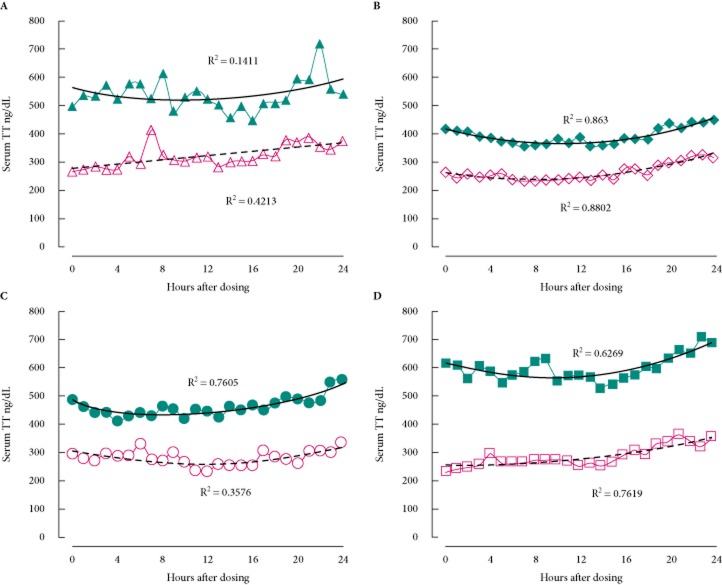
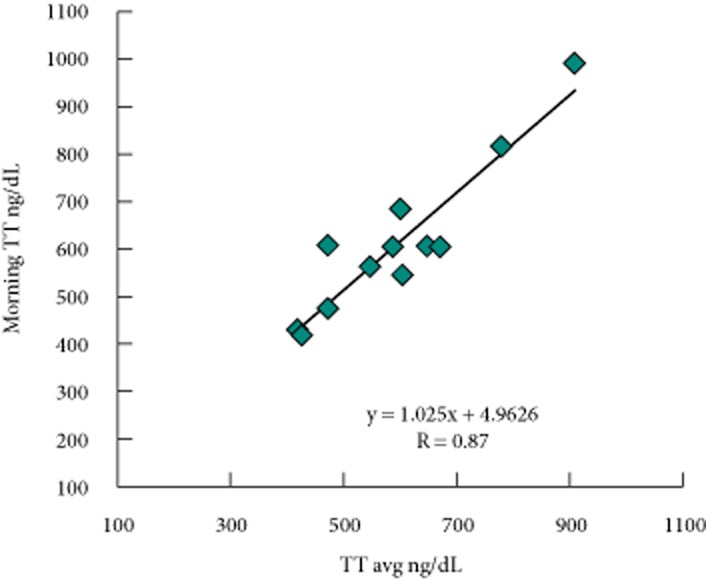
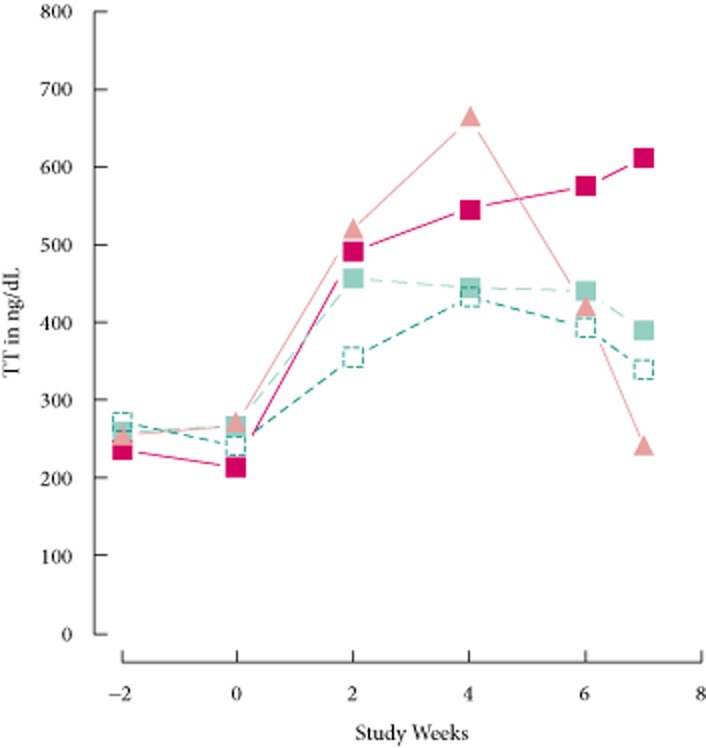
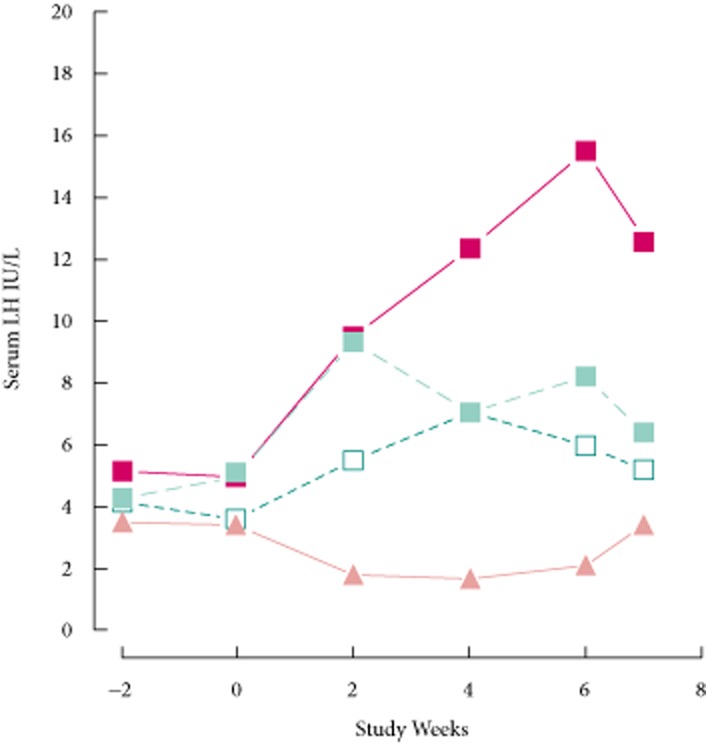
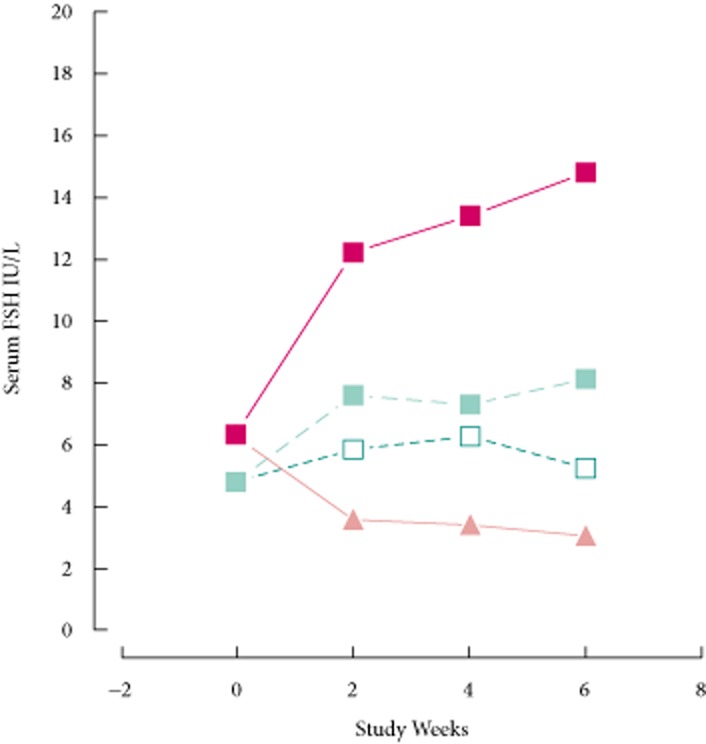
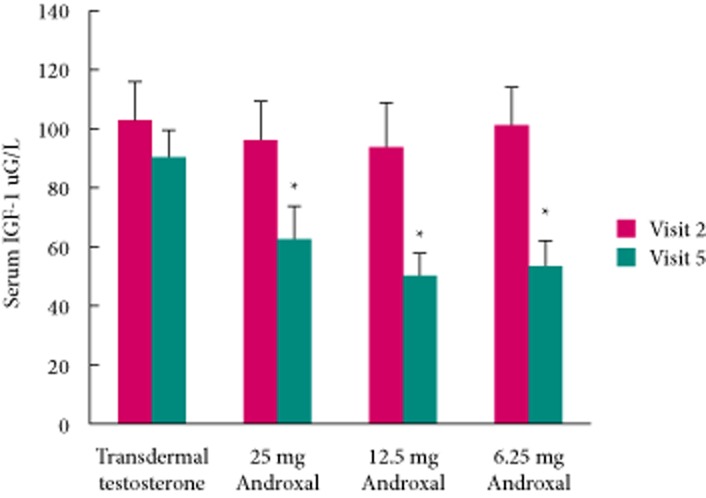
Objectives: To determine the pharmacodynamic profile of serum total testosterone and luteinizing hormone ( LH ) levels in men with secondary hypogonadism after initial and chronic daily oral doses of enclomiphene citrate vs transdermal testosterone. To determine the effects of daily oral doses of enclomiphene citrate in comparison with transdermal testosterone on other hormones and markers in men with secondary hypogonadism. Patients and Methods: This was a randomized, single‐blind, two‐centre, phase II study to evaluate the effects of three different doses of enclomiphene citrate (6.25, 12.5 and 25 mg) vs transdermal testosterone on 24‐h LH and total testosterone in otherwise normal healthy men with secondary hypogonadism. Forty‐eight men were enrolled in the trial (the intent‐to‐treat population), but four men had testosterone levels >350 ng/dL at baseline. Forty‐four men completed the study per protocol. All subjects enrolled in this trial had serum total testosterone in the low range (<350 ng/dL) and had low to normal LH (<12 IU /L) on at least two occasions. Total testosterone and LH levels were assessed each hour for 24 h to examine the effects at each of three treatment doses of enclomiphene citrate vs a standard dose (5 g) of transdermal testosterone. In the initial profile, total testosterone and LH were determined in a naïve population after a single initial oral or transdermal treatment (day 1). This was contrasted to that seen after 6 weeks of continuous daily oral or transdermal treatment (day 42). The pharmacokinetics of enclomiphene citrate were assessed in a select subpopulation. Serum samples were obtained over the course of the study to determine the levels of various hormones and lipids. Results: After 6 weeks of continuous use, the mean ( sd) concentration of total testosterone at day 42 was 604 (160) ng/dL for men taking the highest dose of enclomiphene citrate (enclomiphene citrate, 25 mg daily) and 500 (278) ng in those men treated with transdermal testosterone. These values were higher than day 1 values but not different from each other ( P = 0.23, t ‐test). All three doses of enclomiphene citrate increased the testosterone concentration at time 0 of each 24‐h sampling period, and the mean, maximum, minimum and range of testosterone concentrations over the 24‐h sampling period. Transdermal testosterone also raised total testosterone, albeit with more variability, and with suppressed LH levels. The patterns of total testosterone over the 24‐h period after 6 weeks of dosing could be fit to a nonlinear function with morning elevations, mid‐day troughs, and rising night‐time levels. Enclomiphene citrate and transdermal testosterone increased levels of total testosterone within 2 weeks, but they had opposite effects on FSH and LH . Treatment with enclomiphene citrate did not significantly affect levels of thyroid‐stimulating hormone, adenocorticotropic hormone, cortisol, lipids or bone markers. Both transdermal testosterone and enclomiphene citrate decreased insulin‐like growth factor‐1 levels ( P < 0.05) but suppression was greater in the enclomiphene citrate groups. Conclusions: Enclomiphene citrate increased serum LH and total testosterone; however, there was not a temporal association between the peak drug levels and the maximum concentration levels of LH or total testosterone. Enclomiphene citrate consistently increased serum total testosterone into the normal range and increased LH and FSH above the normal range. The effects on LH and total testosterone persisted for at least 1 week after stopping treatment.
Overview
CoChat Summary
TL;DR
In men with secondary hypogonadism, 6 weeks of oral enclomiphene citrate increased total testosterone and LH, whereas transdermal testosterone raised total testosterone but suppressed LH and FSH. Enclomiphene citrate’s testosterone effects persisted for at least 1 week after stopping, and its pharmacokinetic profile did not temporally match LH or testosterone peaks.
Key findings
- After 6 weeks, mean (SD) total testosterone at day 42 was 604 (160) ng/dL with enclomiphene citrate 25 mg and 500 (278) ng/dL with transdermal testosterone; both were higher than day 1 but not different from each other (P = 0.23, t-test).
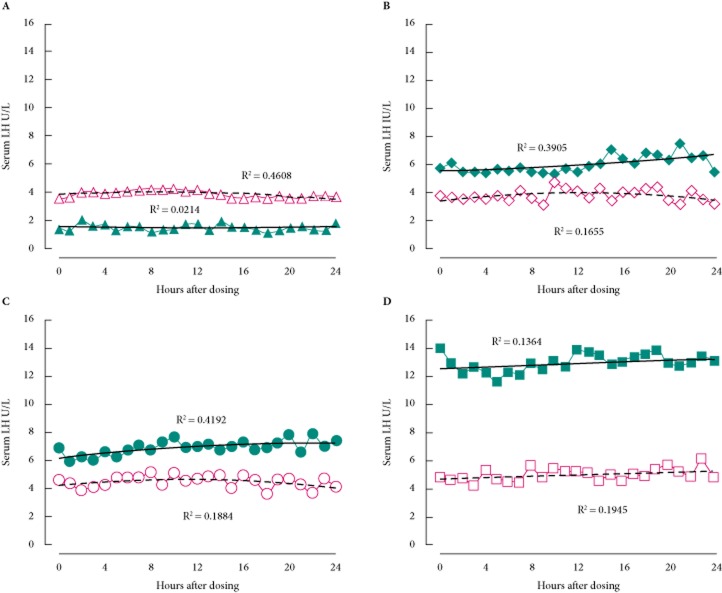
- Enclomiphene citrate increased LH, while transdermal testosterone suppressed it: day-42 mean (SD) LH was 13.1 (7.0) IU/L for enclomiphene citrate 25 mg, 6.9 (2.4) for 12.5 mg, 6.0 (2.7) for 6.25 mg, and 1.5 (1.8) for transdermal testosterone (difference among groups P = 3 × 10⁻⁶).
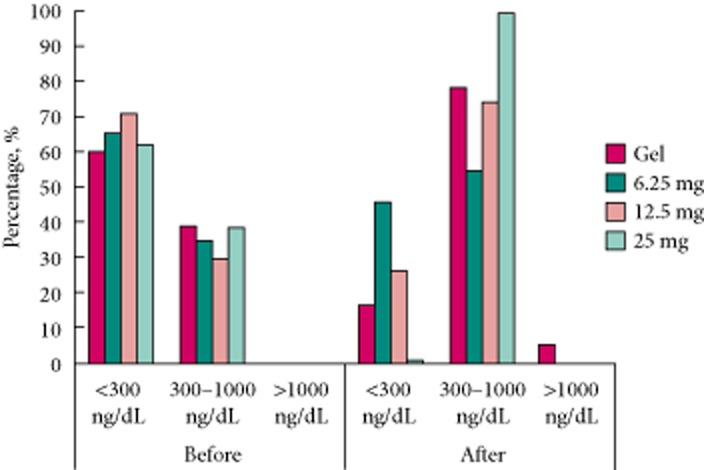
- Enclomiphene citrate 25 mg produced fewer out-of-range testosterone values than transdermal testosterone: 0/272 samples <300 ng/dL and 2/272 >1000 ng/dL, vs 50/305 (16.4%) <300 ng/dL and 17/305 (6%) >1000 ng/dL; CTTrange was 314 ± 65 vs 590 ± 465 ng/dL (P < 0.001).
- Both treatments decreased IGF-1 (P < 0.05), with greater suppression in enclomiphene citrate groups; at 6 weeks IGF-1 was 54 ± 30, 50 ± 24, and 62 ± 42 µg/L for enclomiphene citrate 6.25, 12.5, and 25 mg vs 90 ± 34 µg/L for transdermal testosterone (P = 0.03 among groups).
Methods
- Randomized, single-blind, two-centre phase II four-arm study with 6-week active dosing; 48 men were enrolled (ITT) and 44 completed per protocol. Participants were healthy men 18–65 years with morning total testosterone ≤350 ng/dL and low/inappropriately normal LH (<12 IU/L).
- Randomized to enclomiphene citrate 6.25 mg (n = 16), 12.5 mg (n = 14), or 25 mg (n = 16) daily, or transdermal testosterone 5 g/day (n = 14).
- Total testosterone and LH were measured hourly over 24 h after initial dose (day 1) and after 6 weeks (day 42); pharmacokinetics of enclomiphene citrate were assessed in a subpopulation at week 6; hormones/lipids were measured. Analyses used ANOVA/Kruskal–Wallis, t-tests/paired t-tests/Mann–Whitney–Wilcoxon, and regression.
Limitations
- Stated: hGH could not be measured for technical reasons; significance of the IGF-1 decrease is uncertain; a much larger study would be needed to assess whether enclomiphene citrate restores the daily testosterone rhythm; pulsatility could not be discerned without sampling every 10 min for 4–6 h.
- Evident: small phase II sample (44 per protocol; the 12.5 mg per-protocol group had n = 7), short 6-week treatment duration, single-blind design with open-label transdermal testosterone, and no placebo arm.
Model-written summary. Check it against the paper before relying on it.
Integrity signals
Registry
Cites
Statistics
Figures
Verification
Claims the paper makes
0 Valid · 1 Not valid · 18 Not checked · 122 Own results and interpretations
A result the paper reports from its own data — it cites no other source for it, so there is none to check. The quote shows it is in the paper.
In the paper
“After 6 weeks of continuous use, the mean (sd) concentration of total testosterone at day 42 was 604 (160) ng/dL for men taking the highest dose of enclomiphene citrate (enclomiphene citrate, 25 mg daily) and 500 (278) ng in those men treated with transdermal testosterone.”
- Also stated in: § Results · plain
“CTT0h | 265 ± 93 | 295 ± 81 | 253 ± 80 | 268 ± 58 | 0.38 | 420 ± 212 | 404 ± 165 | 604 ± 160 | 500 ± 278 | 0.07”
§ Testosterone restoration using enclomiphene citrate in men with secondary hypogonadism: a pharmacodynamic and pharmacokinetic study > Abstract > Results
plainn = 12- Asserted: passes — The authors put it forward as true.
- Checkable: passes — It can be checked against evidence.
- Load-bearing: unclear — It is unclear whether the paper’s conclusions depend on it.
- Based: passes — The paper gives a reason why it holds.
- Rests on an assumption not shown here.
- Also stated in: § Results · plain
A result the paper reports from its own data — it cites no other source for it, so there is none to check. The quote shows it is in the paper.
In the paper
“Enclomiphene citrate and transdermal testosterone increased levels of total testosterone within 2 weeks, but they had opposite effects on FSH and LH.”
§ Testosterone restoration using enclomiphene citrate in men with secondary hypogonadism: a pharmacodynamic and pharmacokinetic study > Abstract > Results
plainstates a cause- Asserted: passes — The authors put it forward as true.
- Checkable: passes — It can be checked against evidence.
- Load-bearing: passes — The paper’s conclusions depend on it.
- Based: passes — The paper gives a reason why it holds.
- Rests on an assumption not shown here.
A result the paper reports from its own data — it cites no other source for it, so there is none to check. The quote shows it is in the paper.
In the paper
“The greatest preservation of serum total testosterone was found in the enclomiphene citrate 25 mg group, in which it was found to be slightly increased.”
§ Testosterone restoration using enclomiphene citrate in men with secondary hypogonadism: a pharmacodynamic and pharmacokinetic study > Results
plainstates a cause- Asserted: passes — The authors put it forward as true.
- Checkable: passes — It can be checked against evidence.
- Load-bearing: unclear — It is unclear whether the paper’s conclusions depend on it.
- Based: passes — The paper gives a reason why it holds.
A result the paper reports from its own data — it cites no other source for it, so there is none to check. The quote shows it is in the paper.
In the paper
“After 6 weeks of continuous use, the mean (sd) concentration of total testosterone at day 42 was 604 (160) ng/dL for men taking the highest dose of enclomiphene citrate (enclomiphene citrate, 25 mg daily) and 500 (278) ng in those men treated with transdermal testosterone.”
§ Testosterone restoration using enclomiphene citrate in men with secondary hypogonadism: a pharmacodynamic and pharmacokinetic study > Abstract > Results
plain- Asserted: passes — The authors put it forward as true.
- Checkable: passes — It can be checked against evidence.
- Load-bearing: unclear — It is unclear whether the paper’s conclusions depend on it.
- Based: passes — The paper gives a reason why it holds.
- Rests on an assumption not shown here.
A result the paper reports from its own data — it cites no other source for it, so there is none to check. The quote shows it is in the paper.
In the paper
“When we looked at the effects of each of the treatments before and after the 6-week treatment regimen, it was determined that there were many fewer values below 300 ng/dL before treatment, as expected, but after treatment there was a higher percentage of morning total testosterone values in the 300–1000 ng/dL range.”
§ Testosterone restoration using enclomiphene citrate in men with secondary hypogonadism: a pharmacodynamic and pharmacokinetic study > Results
plainstates a cause- Asserted: passes — The authors put it forward as true.
- Checkable: passes — It can be checked against evidence.
- Load-bearing: passes — The paper’s conclusions depend on it.
- Based: passes — The paper gives a reason why it holds.
- Rests on 2 assumptions not shown here.
63 more claims
Create a free account to see all 141 claims and to verify the 27 references still open.
- It may state two separate claims as one. 62
- Probably not a substantial claim. 20
Claims other papers make about this one
Each is checked against this paper’s own text: does it say what the citing paper says it does?
In the citing paper
“For males, the United States Food and Drug Administration (FDA) did not approve the medicine with reason of unclear clinical effect because of the lack of well‐controlled and well‐powered controlled trials. 14 , 15 , 16 , 17”
From Clomiphene citrate: A potential alternative for testosterone therapy in hypogonadal males (2023) · cites this paper as [14]
In the citing paper
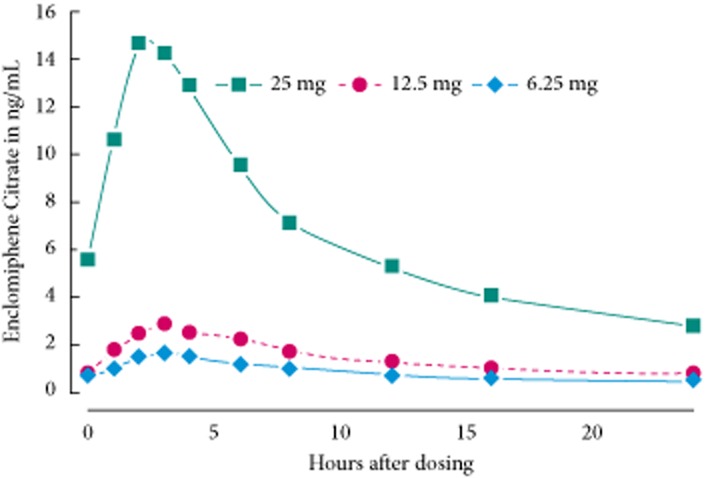
“There was also evidence of drug accumulation in the tissues, as serum levels did not return to baseline within 24 hours of dosing.”
From Enclomiphene citrate for the treatment of secondary male hypogonadism (2016) · cites this paper as [31]
In the citing paper
“In pharmacokinetic studies, it was found that maximum serum drug concentration after a single dose of enclomiphene was achieved 2–3 hours after drug ingestion, followed by first order elimination.”
From Enclomiphene citrate for the treatment of secondary male hypogonadism (2016) · cites this paper as [31]
In the citing paper
“Initial results support the conclusion that enclomiphene citrate increases serum testosterone levels by raising luteinizing hormone (LH) and follicle stimulating hormone (FSH) levels, without negatively impacting semen parameters.”
From Enclomiphene citrate for the treatment of secondary male hypogonadism (2016) · cites this paper as [31]
In the citing paper
“Of the phase II/III trials of enclomiphene citrate, the reported side effects have included elevated estradiol levels, headache and abdominal discomfort.[31, 32, 37, 43, 44, 47]”
From Enclomiphene citrate for the treatment of secondary male hypogonadism (2016) · cites this paper as [31]
9 more claims about this paper
Create a free account to see every claim other papers make about this one.
Self-check
Percentages, sums and reported differences re-computed from the paper’s own numbers.
Each contradiction between two passages listed here was confirmed by an independent check.
Rated major: it would touch a result — a value a result rests on, reported and recomputed p-values on opposite sides of the significance level, two passages that conflict with no sign which is right, or a cited work retracted before this paper was published.
In the paper
§ Testosterone restoration using enclomiphene citrate in men with secondary hypogonadism: a pharmacodynamic and pharmacokinetic study > Discussion
“A higher percentage of samples had total testosterone values <300 ng/dL with transdermal testosterone (50/305 [16.4%])”
§ Testosterone restoration using enclomiphene citrate in men with secondary hypogonadism: a pharmacodynamic and pharmacokinetic study > Discussion
“vs (131/287 [46%]) in the enclomiphene citrate 6.25 mg group, (42/162 [26%]) in the enclomiphene citrate 12.5 mg group”
Rated major: it would touch a result — a value a result rests on, reported and recomputed p-values on opposite sides of the significance level, two passages that conflict with no sign which is right, or a cited work retracted before this paper was published.
In the paper
“Forty-eight men were randomized to receive either: 6.25 mg enclomiphene citrate (Androxal®, Repros Therapeutics Inc., Houston, TX, USA) daily (n = 16), 12.5 mg enclomiphene citrate daily (n = 14), 25 mg enclomiphene citrate daily (n = 16) or transdermal testosterone daily (AndroGel®, AbbVie Inc., Chicago, IL, USA; n = 14).”
§ Testosterone restoration using enclomiphene citrate in men with secondary hypogonadism: a pharmacodynamic and pharmacokinetic study > Patients and Methods > Patients
Reported 48 · recomputed 60
Rated minor: it would not touch a result — a value no result rests on, a p-value that stays on the same side of the significance level, or a conflict that is clerical, resolved elsewhere in the paper, or outside its own findings.
In the paper
§ Testosterone restoration using enclomiphene citrate in men with secondary hypogonadism: a pharmacodynamic and pharmacokinetic study > Results
“<350 ng/dL (<10.4 nmol/L)”
§ Testosterone restoration using enclomiphene citrate in men with secondary hypogonadism: a pharmacodynamic and pharmacokinetic study > Results
“below the 300 ng/dL (10.4 nmol/L)”
Rated minor: it would not touch a result — a value no result rests on, a p-value that stays on the same side of the significance level, or a conflict that is clerical, resolved elsewhere in the paper, or outside its own findings.
In the paper
“| CLHrange | 4.1 ± 1.8 | 2.5 ± 2.0 | 5.4 ± 3.1 | 4.1 ± 1.5 | 0.15 | 6.1 ± 2.8 | 5.9 ± 2.3 | 9.0 ± 2.3 | 2.6 ± 2.8 | 9 × 10⁻⁴ |”
§ Testosterone restoration using enclomiphene citrate in men with secondary hypogonadism: a pharmacodynamic and pharmacokinetic study > Results
Reported 5.4 · recomputed 5.9
Rated minor: it would not touch a result — a value no result rests on, a p-value that stays on the same side of the significance level, or a conflict that is clerical, resolved elsewhere in the paper, or outside its own findings.
In the paper
“| CLHrange | 4.1 ± 1.8 | 2.5 ± 2.0 | 5.4 ± 3.1 | 4.1 ± 1.5 | 0.15 | 6.1 ± 2.8 | 5.9 ± 2.3 | 9.0 ± 2.3 | 2.6 ± 2.8 | 9 × 10⁻⁴ |”
§ Testosterone restoration using enclomiphene citrate in men with secondary hypogonadism: a pharmacodynamic and pharmacokinetic study > Results
Reported 4.1 · recomputed 4.4
4 more findings
Create a free account to see every finding of this check.
Citations
Cites
Low Serum Testosterone and Mortality in Older Men
Laughlin, G. A., Barrett-Connor, E., & Bergstrom, J. (2008) · The Journal of Clinical Endocrinology & Metabolism · doi:10.1210/jc.2007-1792 · Cited by 798
Loss of Circadian Rhythmicity in Blood Testosterone Levels with Aging in Normal Men*
Bremner, W. J., Vitiello, M. V., & Prinz, P. N. (1983) · The Journal of Clinical Endocrinology & Metabolism · doi:10.1210/jcem-56-6-1278 · Cited by 785
Tajar, A., Forti, G., O'Neill, T. W., Lee, D. M., Silman, A. J., Finn, J. D., Bartfai, G., Boonen, S., Casanueva, F. F., Giwercman, A., et al. (2010) · The Journal of Clinical Endocrinology & Metabolism · doi:10.1210/jc.2009-1796 · Cited by 604
Pitteloud, N., Hardin, M., Dwyer, A. A., Valassi, E., Yialamas, M., Elahi, D., & Hayes, F. J. (2005) · The Journal of Clinical Endocrinology & Metabolism · doi:10.1210/jc.2004-2190 · Cited by 525
Self-citationRelationship Between Testosterone Levels, Insulin Sensitivity, and Mitochondrial Function in Men
Pitteloud, N., Mootha, V. K., Dwyer, A. A., Hardin, M., Lee, H., Eriksson, K.-F., Tripathy, D., Yialamas, M., Groop, L., Elahi, D., et al. (2005) · Diabetes Care · doi:10.2337/diacare.28.7.1636 · Cited by 472
Self-citationHoffman, A. R., & Crowley, W. F. (1982) · New England Journal of Medicine · doi:10.1056/nejm198211113072003 · Cited by 353
Insulin Resistance, Body Fat Distribution, and Sex Hormones in Men
Haffner, S. M., Karhapää, P., Mykkänen, L., & Laakso, M. (1994) · Diabetes · doi:10.2337/diab.43.2.212 · Cited by 307
Aromatase Inhibition in the Human Male Reveals a Hypothalamic Site of Estrogen Feedback
Hayes, F. J. (2000) · Journal of Clinical Endocrinology & Metabolism · doi:10.1210/jc.85.9.3027 · Cited by 265
Androgen deficiency, diabetes, and the metabolic syndrome in men
Kalyani, R. R., & Dobs, A. S. (2007) · Current Opinion in Endocrinology, Diabetes & Obesity · doi:10.1097/med.0b013e32814db856 · Cited by 177
Single-dose pharmacokinetics of clomiphene citrate in normal volunteers
Mikkelson, T. J., Kroboth, P. D., Cameron, W. J., Dittert, L. W., Chungi, V., & Manberg, P. J. (1986) · Fertility and Sterility · doi:10.1016/s0015-0282(16)49574-9 · Cited by 170
Cited by
Dean, J. D., McMahon, C. G., Guay, A. T., Morgentaler, A., Althof, S. E., Becher, E. F., Bivalacqua, T. J., Burnett, A. L., Buvat, J., El Meliegy, A., et al. (2015) · The Journal of Sexual Medicine · doi:10.1111/jsm.12952 · Cited by 159
Kim, E. D., McCullough, A., & Kaminetsky, J. (2016) · BJU International · doi:10.1111/bju.13337 · Cited by 81
Wiehle, R. D., Fontenot, G. K., Wike, J., Hsu, K., Nydell, J., & Lipshultz, L. (2014) · Fertility and Sterility · doi:10.1016/j.fertnstert.2014.06.004 · Cited by 80
Self-citationClomiphene citrate for men with hypogonadism: a systematic review and meta‐analysis
Huijben, M., Lock, M. T. W. T., de Kemp, V. F., de Kort, L. M. O., & van Breda, H. M. K. (2022) · Andrology · doi:10.1111/andr.13146 · Cited by 65
Awouters, M., Vanderschueren, D., & Antonio, L. (2020) · Andrology · doi:10.1111/andr.12725 · Cited by 39
Metadata
- Authors
- Wiehle, R., Cunningham, G. R., Pitteloud, N., Wike, J., Hsu, K., Fontenot, G. K., Rosner, M., Dwyer, A., & Podolski, J.
- Affiliations
- Repros Therapeutics Inc Houston TX USA
- Centre Hospitalier Universitaire Vaudois (CH)
- Corresponding author
- Wiehle, Ronald
- Venue
- BJU International
- Publisher
- Wiley
- Published
- 2013-11-04
- Volume
- 112
- Issue
- 8
- Pages
- 1188-1200
- ISSN
- 1464-4096 (ISSN-L)
- 1464-410X
- PMC
- PMC4155868
- OpenAlex
- W2052157618
- Cited by
- 46
- References
- 24
- Citations by year
- 2026: 4 · 2025: 1 · 2024: 1 · 2023: 2 · 2022: 8 · 2021: 2 · 2020: 1 · 2019: 4 · 2018: 1 · 2017: 3 · 2016: 8 · 2015: 5 · 2014: 6
- FWCI
- 3.31
- Type
- journal article
- Language
- en
- Open access
- hybrid
- doi.org
- Licence
- Locations
- British Journal of Urology (publishedVersion, cc-by-nc-nd)
- PubMed Central (publishedVersion, cc-by-nc-nd)
- PubMed (publishedVersion)
- IRIS (submittedVersion)
- SERVAL (Université de Lausanne) (submittedVersion, other-oa)
- Topics
- Health Sciences › Medicine › Endocrinology, Diabetes and Metabolism › Hormonal and reproductive studies
- Health Sciences › Medicine › Reproductive Medicine › Hypothalamic control of reproductive hormones
- Health Sciences › Medicine › Endocrinology, Diabetes and Metabolism › Adrenal Hormones and Disorders
- Keywords
- secondary hypogonadism, transdermal testosterone, luteinizing hormone, pharmacodynamics, pharmacokinetics, dose-response relationship, androgen deprivation therapy, testosterone replacement therapy, lipids, sex hormone-binding globulin, estradiol, GnRH agonist, men's health
About these checks
Registry, retraction, Cites and statistics results are computed, not judged, with one exception: a printed reference that no index lists is read once by a model before it counts as a citation error. Claims are extracted by a model and kept only when their quote appears verbatim in the text; each cited source is then checked, with a model’s help, for whether it says what the claim relies on. Those verdicts can be wrong — read the claim’s quote and the cited source before relying on one.
A language model drew the claims from the paper on 2026-11-25, under version 3 of the claim definition (model deepseek-v4.1-flash, prompt extract-v3).
A second model labelled each claim on 2026-11-25 (model jev-1.13-20260917, definition revision gold-guideline-v0.2).
Statistics and arithmetic are recomputed, not judged.
Confidence bands are shown only for fields calibrated on our annotated test set. None is calibrated yet, so no band is shown.
What counts as a claim ›How we measure confidence ›How we check this ›
Are you an author, or do you see a problem with this page? Request a review
How to cite
Cite CoChat for the checks on this page, and the paper for its own findings.
- This page
- CoChat. (2026). Citation check: Testosterone restoration using enclomiphene citrate in men with secondary hypogonadism: a pharmacodynamic and pharmacokinetic study. https://app.cochat.ai/papers/10.1111/bju.12363
- The paper
- Wiehle, R., Cunningham, G. R., Pitteloud, N., Wike, J., Hsu, K., Fontenot, G. K., Rosner, M., Dwyer, A., & Podolski, J. (2013). Testosterone restoration using enclomiphene citrate in men with secondary hypogonadism: a pharmacodynamic and pharmacokinetic study. BJU International. https://doi.org/10.1111/bju.12363
Data sources
Bibliographic data: Semantic Scholar, OpenAlex, Crossref.
Contains information from the Semantic Scholar Academic Graph Datasets, made available under the ODC Attribution License (ODC-BY 1.0).
Semantic Scholar’s data is described in: Kinney, R., et al. (2023). The Semantic Scholar Open Data Platform. arXiv:2301.10140.
